Showing posts with label AUTHOR Gerry Conway. Show all posts

13 August 2012

Batman Goes Goth (Again)

I’ve written before about how the Batman: From the ’30s to the ’70s collection was my first sustained exposure to superhero comics. And a selective exposure it was, I’ve since realized.

E. Nelson Bridwell’s introduction described the “New Look” and television-show period of Batman comics (1964-68), but the anthology omitted nearly all stories from those years. Its 1960s section showcased the Caped Crusader’s science-fiction adventures at the start of that decade. That section included three of the seven tales that ever featured Betty Kane as Bat-Girl, leaving me with an outsized impression of her place in the overall saga.

Bridwell presented the 1970s as “the reappeance of the dark, avening figure of mystery called The Batman!!” That section started with “One Bullet Too Many” from December 1969, which showed Dick Grayson heading off to college and Bruce Wayne using forensic science to solve a murder mystery with no costumed criminals. Bruce and Alfred also moved into the headquarters of the Wayne Foundation, beginning a period of overt social activism that would culminate in a brief appointment to the US Senate. The 1970s Batman comics thus promised to become more deeply rooted in the real world.

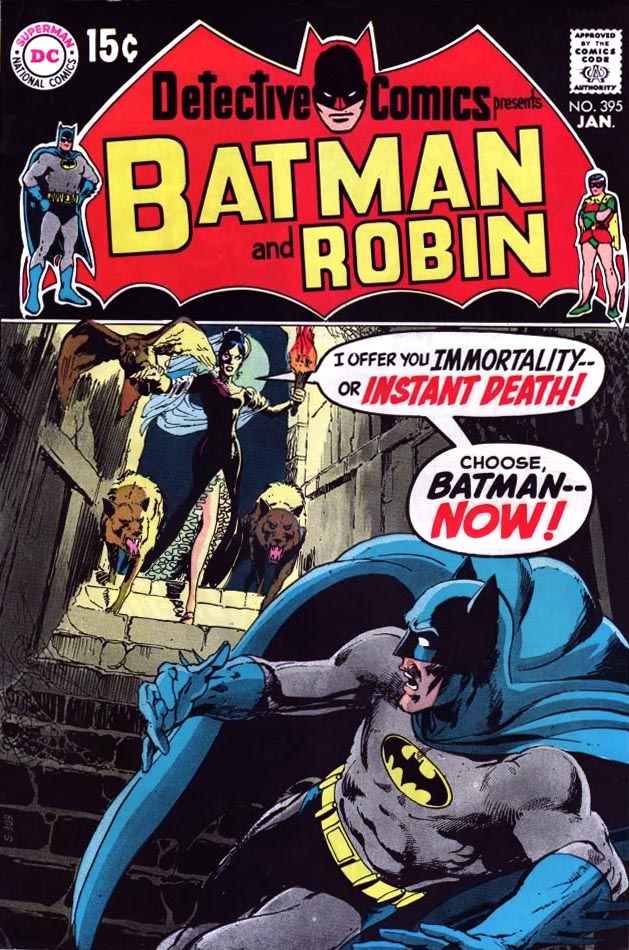
Yet that section of the book also included the highly regarded “Secret of the Waiting Graves,” by Dennis O’Neil and Neal Adams; “Man or Bat?” introducing Man-Bat, by Frank Robbins and Adams; and “The Demon of Gothos Mansion,” by O’Neil and Irv Novick. Those are all Gothic tales of monsters, ghosts, and other spooky things. Though Man-Bat is a creation of science gone wrong, the other two tales clearly rest on the supernatural.

Which left little me confused. If the Batman comics had redeemed themselves from camp by returning him to his roots as a crime-solving detective, why was this volume showing me ghost stories? Mysteries are all about ratiocination, but the “Waiting Graves” and “Gothos Mansion” stories end with Batman realizing the limits of his deductive powers to make sense of the world.

I’ve since learned that Batman’s roots lie just as deep in Gothic horror as in detective stories. Bruce Wayne is dressed as a giant bat, after all. Among the character’s earliest adventures were fights against vampires, monsters, and other supernatural creatures. Those villains flourished again in the 1970s, and in 1982 Gerry Conway even brought the vampirical Monk and Dala from 1939 back to life. But I still prefer the detective stories.

27 June 2010

The Short, Happy Life of the First Jason Todd

When I posited that Reason for Robin #10 is that “Robin Isn’t Evil,” I promised to discuss the two major counterexamples. Actually, back when I conceived of that series, I had only one counterexample in mind: the second Jason Todd. And to lay the groundwork, I have to address the first Jason.

Back in 1940, Dick Grayson went from meeting Batman to becoming his costumed companion in the course of a few panels on one page. His decision to leave the partnership in the early 1980s took considerably longer, aided by the huge success of the New Teen Titans magazine. Leading DC’s hottest team (in every sense of the word), Dick became an independent young adult.

The pivotal moment arrived when a meeting of writers Gerry Conway and Marv Wolfman, artist George Pérez, and their editors concluded that Dick Grayson should break free from the Batman books and adopt a new identity—eventually Nightwing. Meanwhile, Conway could develop a new character to take his place at Wayne Manor.

This was the first Jason Todd. Conway had a traditional understanding of how Robin functioned in Batman stories, and his Jason was very much like Dick Grayson. To the extent of being a young trapeze artist whose parents are murdered by criminals and goes to live with billionaire Bruce Wayne.

Jason fought crime in a costume and mask in Detective Comics, #526—the 500th appearance of Batman in that magazine, and Conway’s last issue. But it took the rest of 1983, and some black hair dye, before he officially became Robin. One milestone in that period was when Dick Grayson graciously passed on the red, green, and yellow outfit. For merchandising reasons (all those pajamas with Robin’s picture on them), Jason had to look exactly like Dick.

Just like the Robin of the 1940s through 1960s, the first Jason Todd was occasionally impetuous and immature. He made mistakes, and showed more emotional reactions than Batman. He was, after all, still a kid.

In that period, each superhero comic usually had a complete adventure in one issue, but subplots extending over many months. The first Jason Todd became the object of a custody battle between Bruce Wayne and Natalia Knight, the criminal Nocturna; basically, he went undercover as her adoptee. Again, that plot emphasizes how Robin is still a child.

Robin scholar Mary Borsellino quotes a letter from a reader in Detective Comics, #530, calling this Jason a “quiche eater,” an allusion to the 1982 bestseller Real Men Don’t Eat Quiche. But of course a Boy Wonder isn’t supposed to be a Real Man—yet.

In Alan Moore and Dave Gibbons’s terrific Superman story, “For the Man Who Has Everything” (1985), an extraterrestrial conqueror dismisses Jason as “the little yellow one.” Yet who saves the world in the end? That tale is the first Jason Todd’s finest hour.

(In that story, Jason had also grown up enough for Batman to famously remind him, “Think clean thoughts, chum.” But different artists depicted him at different stages of adolescence.)

Then two major events jolted the DC Universe. The first was Wolfman and Pérez’s Crisis on Infinite Earths (1985-86), which opened the door for DC to relaunch and redefine all its major franchises.

The second was Frank Miller’s The Dark Knight Returns (1986), the story of a potential future Batman. Among its innovations was a female Robin. Among its allusions to the standard comics was a brief line about Jason Todd being dead; clearly, this was a rougher Batman in a rougher world. This series was highly stylized, highly violent, and highly successful.

Post-Crisis, DC commissioned Pérez to retell the origin of Wonder Woman, John Byrne to relaunch Superman, and Miller to set a new tone for the regular Batman series. Editors thought that the character’s origin myth still worked, but that readers would appreciate more grit. The audience for superhero comics now consisted of young adults in specialty shops, not kids browsing in drugstores.

In Batman, #404-7 (1987), Miller and David Mazzucchelli showed the start of Bruce Wayne’s career as Batman. Like Miller’s earlier series, Batman: Year One was stylized, stark, and very successful.

The first Jason Todd, cheerful former circus acrobat, had come out of the Crisis of 1986 intact, and appeared in a few more months of stories. But DC’s editors felt that his character didn’t fit the new, grittier Batman’s world. Therefore, in Batman, #408, the Caped Crusader met a new Jason Todd.

COMING UP: Battling for the soul of a new Robin.

10 May 2010

“Now to Tickle the Cerebellum”

After the first two stories in The Strange Deaths of Batman, discussed yesterday, the volume’s Robin content falls off precipitously. There’s a tale by Gerry Conway from World’s Finest, #269, which shows his fondness for suspension bridges but not his usual ability to build logical plots. Dick Grayson is injured by a mad bomber because Superman apparently forgets which one of them is superfast and invulnerable.

Near the end of the book is an image of Tim Drake consumed with glee because Batman is marrying Catwoman. This turns out to be Catwoman’s dream—it surely isn’t Tim’s.

In between comes a legendary example of comic-book storytelling, originally published in The Brave and the Bold, #115. After the Caped Crusader is fatally wounded, the Atom shrinks to cellular size, enters Batman’s brain, and steers his body by kicking the appropriate neurons. Only Bob Haney could have come up with this approach to crime-fighting.

The heart of the collection is titled “Where Were You on the Night Batman Was Killed?”—a four-issue series from 1977 written by David V. Reed and illustrated by John Calnan and Tex Blaisdell. The premise of this tale is that the Gotham underworld is buzzing with rumors that Batman is dead. A coterie of villains gathers to conduct an inquest and determine who can claim the honor of killing him.

In successive issues Catwoman, the Riddler, Lex Luthor, and the Joker each explains how she or he killed Batman. Former prosecutor Harvey Dent as Two-Face dissects their stories through a combination of Encyclopedia Brown-style trivia (wood from the Brazilian pepper tree doesn’t float!) and outlandish plot revelations (that was actually Superman pretending to be Batman!).

I don’t think it will spoil anything if I reveal that at the end of these four installments it turns out Batman isn’t dead after all.

I found Calnan’s art distracting. His drawings show extreme foreshortening, especially hands and faces thrust out at the readers, and the pointy ears on Batman’s cowl are unusually thick. (Rather like bats’ ears, to be fair.) Calnan was primarily a commercial artist, and he also worked on the Catholic comic book Treasure Chest. According to a Comic Book Artist interview with letterer John Workman, DC’s editors worried that Calnan “just didn’t have that spark” for superhero stories, and he left the genre.

“Where Were You on the Night Batman Was Killed?” kept readers uncertain if Batman was really dead for a whole four issues. Stories in earlier decades had to wrap up everything within a couple of dozen pages. Nowadays, the pace of superhero comic-book storytelling is quite different:

  • Four issues is a short time for a comic-book company to explore a major change to its universe. Major arcs seem to be taking six to twelve issues.
  • Within each of those issues a lot less happens because of “decompressed storytelling.”
  • Nonetheless, the stories have the same rhythm of early defeats, reversals, and mysteries solved only at the last minute, just at a slower tempo. This means that the frustrations and stumbles that the Dynamic Duo suffered in pages 3-10 of their early stories are now stretched out over two or three issues in the middle of an arc, leaving some readers frustrated as well.
  • At the same time, marketing and the internet mean that fans can see the covers of upcoming stories months in advance, taking back some of that suspense.
In fact, it looks like DC went only about four months between the apparent death of Bruce Wayne in Batman and Final Crisis and the announcement of the upcoming miniseries The Return of Bruce Wayne.

11 April 2010

Gerry Conway on Robin in 1981

In December 1981, The Comics Journal published an interview with comics scripter Gerry Conway. This conversation took place during the period when, as recent weekly Robins have traced, Conway was helping to move Dick Grayson out of the shadow of Batman’s cape.

In the interview Conway stated, “I’m tentatively scheduled to write the Robin backup feature in Batman.” Depending on when the interview took place, this might be an early reference to the mid-1981 three-part story about Dick returning to a traveling circus that I described last week. Or it might refer to plans for an ongoing feature that never came about.

Conway expressed a traditional view of Robin, as well as Captain America’s boy sidekick:

Bucky ideally should be about 15 years old, just as Robin ideally should be about 15 years old. They should be on the verge of manhood, they should be on the verge of taking on the responsibility for their own lives, and they should be looking toward Captain America or Batman or whoever as the model on which they want to build their own lives. . . .

Robin now is almost a college graduate in his early 20s, I would guess, or late teens; at the very earliest he’d be 19. So you’ve lost that essential connection.
Conway thus helped to bring Dick Grayson to independence without having a clear sense of what the character would represent after that. No wonder the conclusion to his three-part story—“I am myself!”—is tautological. The question remained: Who is Dick Grayson to be?

Of course, most young people face that question as they enter adulthood. Finding his priorities and confirming his values helped to define Robin’s symbolic value for the next couple of years—but within the pages of the New Teen Titans magazine by Marv Wolfman and George Pérez.

Conway was already scripting most issues of Detective Comics, and he took over Batman with issue #348, in mid-1982. That story brought the Caped Crusader back to Wayne Manor and the bat-cave, returning the saga to its pre-1969 settings. Robin helped moved Batman home, but did Conway have more in mind for him?

As it turned out, he didn’t. Titans artist Pérez described the situation in a 1984 interview archived at the Titans Tower website:
Gerry Conway, who was handling the Batman series at the time, had priority over Robin. Since he was the leader of the Teen Titans, it put us in a compromising position. Marv was being complimented on his characterization, I was being complimented on making Robin look like an adult at last. Yet we couldn't do anything more than just maintain a certain facade; we'd just make a very virile Robin. but couldn't do anything with his personality or his basic character. That was all the responsibility of whoever was writing Batman.

It wasn't until Gerry Conway said that he had no intentions of using Robin that we were given carte blanche. Then, there was talk that they wanted to give Batman a new kid sidekick, in order to bring back the father image of the character.
Conway’s vision that Robin “should be on the verge of manhood” thus opened the door for an older Dick Grayson to become Nightwing, affirming his step into adulthood. Conway went on to introduce the first Jason Todd who, in Detective Comics, #526, first went into a fight as the new Boy Wonder.

04 April 2010

Thought Balloons and Systems of Narration

Thought balloons (discussed at length yesterday) were part of a system of narration that dominated American adventure comics for decades. This system also involved an omniscient narrator, often bombastic and occasionally redundant.

Using thought balloons, this narrative approach could reveal any character’s thoughts, including hero or villain, as long as it served the story. Conversely, since adventure comics depended on sudden plot turns, this style also involved concealing characters’ thoughts if they would give away the next twist too early. (See “Reason for Robin, #2.”)

Other comics genres took different approaches to narration. Romance comics were often told in the first-person voice of the central character, like magazine “confessions”; both captions and thought balloons let us into that character’s head, and hers alone. Horror comics were introduced and narrated by recurring figures like the Crypt Keeper, who had supernatural insight into characters’ thoughts and fates. And of course there were experiments and exceptions within every genre.

To find examples of the typical adventure-comics approach in full flower, I looked at Batman issues from the early 1980s, since they were handy. Batman, #336, has a script by Roy Thomas, based on a Bob Rozakis plot. The captions are in the voice of an omniscient narrator. There are thought balloons from Batman/Bruce Wayne, Alfred Pennyworth, Commissioner Jim Gordon, and two villains, the Spellbinder and the Cluemaster. That narrator knows everything!

This style offers leeway for a character to take over the narration for a while. Gerry Conway’s main story in Batman, #338, has an omniscient narrator, also displays the hero’s voice in both thought balloons and captions, and quotes the villain’s voice in captions for a flashback. The captions in characters’ voices include quotation marks around the words. (This tale also has one passing thought balloon for a saleswoman we never see again.)

Yet that same stretch of Batman magazine offers an alternative way of narrating adventure comics, a way that would come to dominate the form. That style appears in the back-up feature in Batman, #337-9, featuring none other than Robin.

Written by Conway, this three-part story shows Dick Grayson looking back on his life, exploring his roots in a traveling circus, and solidifying his identity beyond being Batman’s sidekick.

That story is narrated by Dick himself. The captions are all in his voice; there are no quotation marks to set them off from an omniscient narrator‘s captions.

Likewise, Dick is the only character trailing thought balloons. As narrator, he’s not privy to other characters’ thoughts, only to their actions and words. And as the following panel shows, the captions and thought balloons run into each other. (One theme of this installment is that Dick’s fretting about his past can distract him from the present.) This first-person narrative approach makes perfect sense for this story. The external plot—a murder mystery at the circus—is minor. So minor that Dick appears in his Robin costume in only three panels of the third installment, all flashbacks.

What matters in this tale is Dick’s internal journey to figuring out who he is, separate from Batman, with a different drive. That continues a process which began in preceding issues of Batman and which we also saw in concurrent issues of The New Teen Titans. And it was a forerunner of recent decades of superhero stories that are, at least nominally, as much about the heroes’ individual emotional lives as about their ability to catch bad guys and hit them.TOMORROW: Along the thought balloon trail.

NEXT WEEK: Gerry Conway on Robin.

13 September 2009

The Legend of Batman and Raven

Robin: Tragedy and Triumph was DC Comics’s second volume of stories about Tim Drake, the fourth (or, by some counts, third) Robin. Editor Dennis O’Neil’s preface on the history of Batman sidekicks begins, somewhat self-congratulatorily, “The third time we got it right.”

O’Neil writes with authority about the role of Robin in the early Batman comics, which I’ll analyze someday alongside my own “Reasons for Robin” series. Today the weekly Robin explores a path that O’Neil says DC didn’t take after the success of the New Teen Titans magazine of 1980 made Robin into the tail wagging the Batman dog.

As O’Neil told the story in 1993, the company decided Dick Grayson should become Nightwing. And as for a sidekick for Batman:

Gerry Conway began seeking a replacement.

Gerry was writing the Batman titles and he felt Robin was a necessary part of the saga. Or, if not Robin, maybe a new sidekick? Gerry suggested that Robin be retired and replaced by Raven, whom Gerry conceived as a black ghetto kid. It was a nifty idea, one that today might very well be adopted, but at the time Gerry’s superiors opted for tradition. They wanted nothing more or less than another Robin—fast.
The result was the first Jason Todd, basically a younger Dick Grayson with red hair—which was quickly dyed black. Other analyses suggest that DC didn’t dare make a big change because it had deals with too many licensees selling the traditional image of Robin as a white teenager with black hair and no pants.

However, there are some inaccuracies in O’Neil’s history. He describes Jason Todd being invented after Dick Grayson became Nightwing, but in fact the new boy appeared in the comics a year before, as Conway’s run on the Batman and Detective magazines culminated with the May 1983 issues.

It’s easy to spot why O’Neil was confused. In the early 1980s he was writing for Marvel (particularly Daredevil and Iron Man), so his knowledge of Robin-replacement conversations was secondhand at best. O’Neil returned to the Batman comics as editor in mid-1986, just in time to deal with the second Jason Todd.

Furthermore, there’s no way DC would have seriously considered giving Batman a sidekick named Raven in the 1980s. The company already had a major character using that name. That Raven was a linchpin of the same popular Titans team that was taking up Dick Grayson’s time. (Read more about her at Titans Tower.)

So did Gerry Conway really propose the new team of “Batman and Raven”? It would be nice to resolve this mystery Annie Hall-style by saying, “I happen to have Gerry Conway right here,” and pulling him out from behind a movie poster to resolve the questions.

Alas, when I raised the question through the weekly Robin Twitter feed, @gerryconway’s quick and gracious reply was: “Hmm. Sounds like something I might have thought of, but I’m not 100% sure.” Which isn’t surprising. Conway’s been coming up with ideas for comics and other formats full-time since 1969. If a quarter-century ago one short-lived idea was “Batman and Raven,” he never had time to dwell on it.

My suspicion is that Conway did propose making Batman’s new sidekick a poor black kid as a way to do something different, possibly even progressive, with the opening created by Dick Grayson‘s impending departure. The phrase “Batman and Raven” might have been a shorthand label for that idea—sounds like “Batman and Robin,” but new.

I suspect O’Neil later heard of that idea during discussions of what to do with Jason Todd, who quickly lost popularity with readers in the late 1980s. Starting in the late 1970s, O’Neil had been part of the cohort that pushed DC into contemporary themes, along with Neal Adams, Marv Wolfman, Len Wein, and other young creators.

I suspect the “Batman and Raven” meme stuck in O’Neil’s mind as a slightly revolutionary road not taken. (Revolutionary for superhero comics of that time, that is.) And, knowing that that Raven could never fly, he shared the idea with readers in 1993 to encourage them to consider forgone possibilities.

NEXT WEEK: Another time Robin was black—almost.