Showing posts with label AUTHOR David Hutchison. Show all posts

22 November 2011

The Tin Woodman’s Head on My Mind
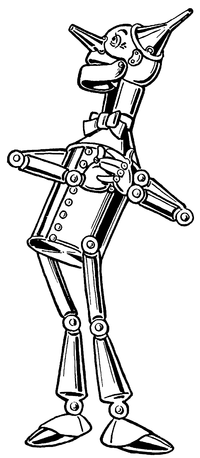
In The Wonderful Wizard of Oz, W. W. Denslow gave the Tin Woodman a skull-shaped head.

Of course, the long nose and ears riveted on that dome, as well as the lively eyes, make it possible to overlook the resemblance most of the time. But the rounded cranium and hinged jaw are quite reminiscent of fleshless human anatomy.

John R. Neill followed Denslow’s model in his illustrations for Ozma of Oz and Dorothy and the Wizard in Oz. As in the series’s first book, the tin man’s head bulges out at the back.

However, in The Marvelous Land of Oz, published before those two titles, and in all the Oz books that followed them, Neill used a different character design, with a cylindrical head. The neck varied at first, but eventually settled on the vague sort of attachment Denslow has used.

In most of those books, when the Tin Woodman takes off his funnel cap, we see that the top of his head is a rounded dome. Neill used the same design for Captain Fyter, the tin emperor’s doppelgänger in The Tin Woodman of Oz (1918).

Toward the end of his career, starting with Ozoplaning with the Wizard of Oz (1939), Neill made yet another variation: he drew the tin man’s head as flat on top, like a tin can. I suspect Neill was out of practice drawing his Tin Woodman; Ruth Plumly Thompson made little use of Baum’s more mature male characters.

I review this history to acknowledge that even within the Oz books there’s a significant variation in the Tin Woodman’s character design. On top of that, we have the costumes created for David Montgomery and Jack Haley, which have to allow a man to fit inside. Thus, people can imagine many things when they think of Nick Chopper.

Lots of comics artists like to depict the Tin Woodman as a robot. That’s doesn’t really fit his origin, in which he’s a living man whose body is gradually replaced with tin parts, and it leaves less room in the saga for Tik-Tok, an actual robot. But some artists just love drawing robots.

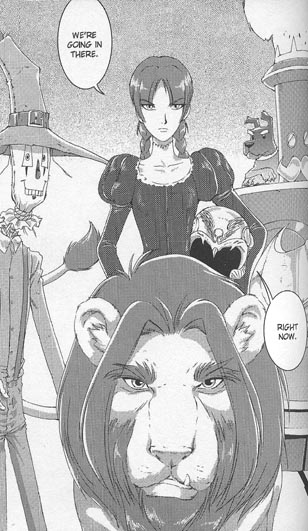
One example of that trend is David Hutchison in his Oz: The Manga series, as shown at right. His Tin Woodman’s head is a smokestack, and the robotic characterization extends to gear-shaped speech balloons.

Skottie Young avoided that temptation in helping to adapt the series for Marvel Comics. Indeed, his character design plays up the characters’ old-fashioned, rural beginning. (The man harvested wood, after all.) The tin mustache is reminiscent of L. Frank Baum himself.

And I have a hard time warming to the result. I think the problem for me is that as colored in a pale, tinny way, the mustache looks white. The character’s smooth round head and old-fashioned style reinforce that impression. As a result, this Tin Woodman always looks to me like an old man.

Based on Neill and Denslow’s art, and Baum’s writing, I think of Nick Chopper as a man in his twenties, preserved agelessly by being made into tin (and by living in Oz). Though the Tin Woodman has excellent and kind instincts, and matures somewhat over the series, he’s not old enough to have become wise. He makes mistakes and still regards his appearance with more than a little vanity.

I have trouble imagining the Tin Woodman as a Richard Farnsworth type, much as I admire that actor and some of the characters he’s played. Of course, it’s better than a robot.

09 May 2008

More Oz Manga on the Way

I might as well conclude this spasm of postings about David Hutchison's comics adaptation of L. Frank Baum's Oz stories with his cover art for the Land of Oz volume, to be published next month by Antarctic Press.

In other Oz/manga news, Anna at Tangognat alerted me that Del Rey is about to publish three volumes of Yuko Osada's Toto!: The Wonderful Adventure in the US. Prospero's Manga provides a plot summary of the first volume that mentions a little dog, a balloon, and a farmgirl named Dorothy. Baum Bugle editor Sean Duffley tells me that the hero's name, Kakashi, means "scarecrow."

Toto! looks like it contains an original story that alludes freely to Oz, but doesn't follow the plot of any Oz book. However, you can tell from the number of links in the paragraph above that I have absolutely no knowledge of my own to impart about this book.

08 May 2008

Speech Balloon Variety in Oz: The Manga

In its use of the comics form, David Hutchison's Oz: The Manga didn't impress me quite as much as Michael Cavallaro's adaptation of the same novel, which is also manga-influenced. But I found one element of Hutchison's graphic storytelling very interesting: the speech balloons.

(Bear with me here.)

For this comic, Hutchison developed a complex system of using different balloon shapes and different type treatments for his various characters' speeches. The full system doesn't kick in until halfway through chapter/issue 4. (That's also the first point where I saw him cutting and pasting art electronically to save time; perhaps that coincided with a shift to all-digital production.)

Ordinary human and animal speech appears in tall oval balloons. At first those balloons appear hand-drawn, but after chapter 4 they're exactly elliptical. There are some standard balloon variations that we see in many other comics, such as a jagged shape for a yell, a dashed outline for a whisper, and a cloud shape for the rare expressed thoughts.
This panel shows the balloon variation among Dorothy's three companions. The Cowardly Lion has an ordinary, smooth oval balloon. The Scarecrow's balloons are more rectilinear, especially after chapter 4. The Tin Woodman's balloons are shaped like elliptical gears, reflecting his mechanical makeup. (The Lion's balloons turn a bit wavery as he feels the effects of the poppy field and the Wizard's courage in a bottle.)

When the Wizard appears in a different incarnation to each traveler, each guise has its own balloon style:

  • The giant head's balloons have dark borders and Sand type.
  • The pretty lady has ordinary human balloons--with drop shadows behind them.
  • The beast has craggy balloons and boldface italic lettering.
  • The fireball has a wavery balloon and rounded lettering with long serifs.
When the humbug Wizard speaks from a hiding-place, his balloons have wavery outlines, with bubbles attached. But as soon as Dorothy lays eyes on the little man, he starts to speak in the same simple balloons as she.

Among the books' antagonists, the wildcat in the poppy field has a fanged or hairy balloon. The wolves' balloons have ragged black borders and a special typeface while the bees speak inside a different type of jagged border. The Winged Monkeys' speeches appear in white lettering on irregular black fields; these balloons don't have tapering tails like all the others, just spattery trails of black leading to the speakers.

The Wicked Witch of the West is set off from other human characters by her speech balloons. After the book's chapter 4, she's the only human character whose oval balloons are hand-drawn, and her words appear in a different font, with more variations in stroke thickness and a hint of serifs. Oz: The Manga is a veritable tutorial in creating different speech balloon formats.

07 May 2008

Dorothy and the Wicked Witch

The most interesting narrative innovation in David Hutchison's Oz: The Manga is how it portrays and uses L. Frank Baum's character the Wicked Witch of the West.

This is not the dried-up, eyepatched crone that W. W. Denslow drew, or the hook-nosed green hag played by Margaret Hamilton in the MGM movie. Hutchison draws a youthful-looking Witch, with her hair over one eye like Veronica Lake.

In the original Wizard of Oz, the Wicked Witch is basically rattling around in her castle on her own. Baum narrated her thoughts, but the comics form prefers drama and dialog, so Hutchison beefs up those scenes by giving the Witch an evil counselor named Nestred. And once she has people, she seems less alone and even more formidable.

But the most interesting touch in this adaptation is Hutchison's strong signals that in killing the Wicked Witch, however inadvertently, Dorothy has become more like her. She puts on a darker dress. The magic cap that calls the Winged Monkeys isn't a cloth cap, as in Denslow's illustrations, but a martial helmet.

When this Dorothy returns to the Emerald City, the Wizard orders his Soldier to send her away. The Soldier answers: "Well, I would, but the girl scares me... (I dare say she looks like the Wicked Wi--)"

And indeed, this Dorothy Gale should scare any humbug.

06 May 2008

Retracing the Path with Oz: The Manga

Oz: The Manga was written and illustrated by David Hutchison, so it has the same relationship to actual Japanese comics as food in American Chinese restaurants has to actual Chinese food. But I like food in American Chinese restaurants, and I liked this adaptation of L. Frank Baum's The Wonderful Wizard of Oz.

Although it's easy to see the influence of Japanese comics on the book's human characters, format, and pacing, it's also easy to read the book. Panels and pages go from left to right, like regular English books, and the storytelling eschews the more esoteric aspects of manga.

Hutchison's adaptation includes almost all the episodes from that original. Even the China Country is included; that was probably a last-minute insertion by Baum, and many versions leave it out. Moments I missed were Dorothy rescuing Toto after he falls through the storm door during the cyclone, the Scarecrow's meeting with a stork in the middle of a river, Dorothy's first two calls to the Winged Monkeys (leaving it unclear why she can't use the magic cap more often), and the Fighting Trees.

Some readers see the last leg of Dorothy's journey, from the Emerald City to Glinda's palace, as anticlimactic. This version makes those episodes much faster by narrating them with captions rather than dramatizing each through speech balloons.

Apparently for the sake of pacing, Hutchison also moved the Scarecrow and Tin Woodman's backstories to the chapter (or, in the comic's original serial form, the issue) after the Cowardly Lion joins the party. He may also have borrowed a couple of moments from the MGM movie:

  • The Lion flees far away from his first meeting with the Great and Terrible Oz.
  • Our first glimpse of the Wicked Witch of the West comes early on, shortly after Dorothy has taken the Silver Shoes (though she doesn't show herself to Dorothy yet).
Hutchison seems to have imagined a post-industrial Oz. The Tin Woodman has an internal boiler, gauges for eyes, and steam coming from his head. A (broken) pipeline parallels the Yellow Brick Road.

Each part of Oz favors a different form of architecture. Munchkin buildings tend toward the round (as shown here) while the Wicked Witch of the West's castle is a dark, asymmetrical, spiny tower with cranes alongside it. (Think Saruman's castle in The Lord of the Rings.) The Emerald City has all the charm of nuclear plant cooling towers, and Glinda's palace looks like an old sci-fi rocket ship on the launch pad.

Among the interesting touches in characterization, Hutchison's Wizard looks like Mark Twain. The Soldier in the Emerald City isn't tall with a long beard, as Baum described him, but a young, clean-shaven man of ordinary height wearing the number 2. For some reason, the Wicked Witch's crows talk like refugees from P. G. Wodehouse's Drones Club.

TOMORROW: Dorothy and the Wicked Witch of the West, manga style.