Showing posts with label ARTIST E. J. Barnes. Show all posts

17 April 2024

“Outside the Box” Opening Reception in Jamaica Plain, 21 April


With friends from the Boston Comics Roundtable, I’m helping to organize an exhibit of comics art in the gallery of the Footlight Club, America’s oldest continuously running community theater. It’s on Eliot Street in the Jamaica Plain neighborhood of Boston.

A few weeks back, a volunteer at that theater contacted our group about assembling a show. Its current production is Tuck Everlasting, a family musical based on Natalie Babbitt’s novel, so he wanted to showcase art that would appeal to kids.

Many B.C.R. members have created comics for kids, and co-founder Dan Mazur published Boston Powers, a comic book with short, local superhero stories. So there was a good talent pool to choose from.

The exhibit has ended up featuring thirteen artists, including Boston Powers contributors, folks publishing on their own on paper or the web, a couple of graphic novelists (Jonathan Todd, Jerel Dye), and even a picture-book artist who works in comics form (Lindsay Leigh).

I’m represented through the work of Brendan Tobin, with pages from our “Stupendo and Secret Girl” collaboration.

This Sunday, 21 April, at 1:00 PM we’ll have a reception to celebrate the exhibit before a matinee performance of the musical. The art will remain up before, during, and after every show for families to enjoy. 

17 October 2020

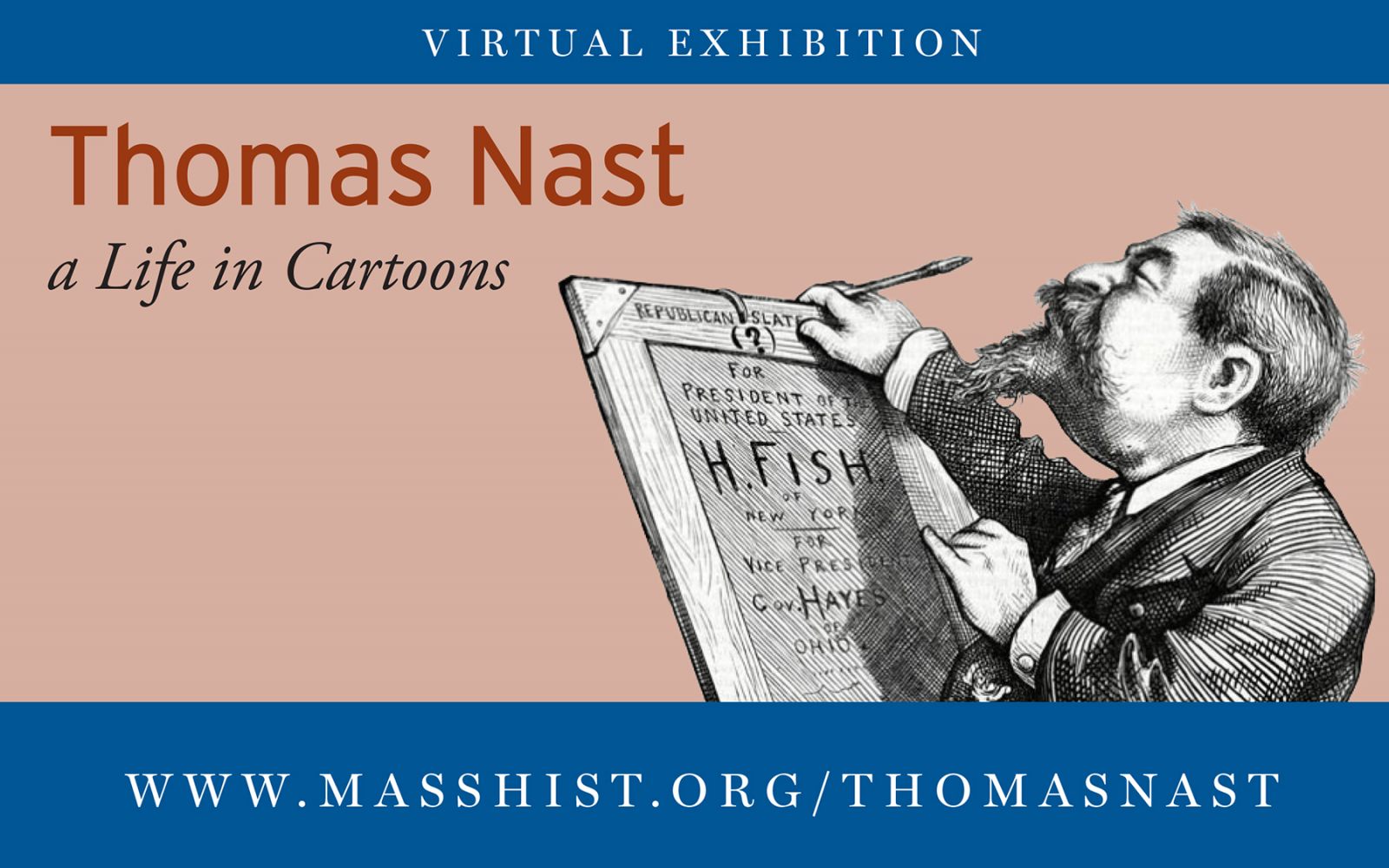
The “Thomas Nast” Art Team, Part 2

With the next set of pictures for “Thomas Nast: A Life in Cartoons,” we got into the political part of his career. And the three cartoonists drawing those moments all have experience in political art.

Nast joined the staff of Harper’s Weekly in 1859, just in time for the US Civil War. Some of the magazine’s artists, such as Winslow Homer, drew battle scenes from life. Nast, though he took some trips to camp, preferred symbolic scenes with unmistakable pro-Union messages. His images could be so powerful that the Republican Party adopted them as campaign material.

We illustrated that connection with a symbolic meeting between Nast and President Abraham Lincoln, drawn by Shea Justice. Lincoln voices oft-quoted praise for Nast’s work in front of three of his most famous works from the war years. I suggested adopting elements from two cartoon traditions: making Lincoln and Nast into a “Mutt and Jeff” pair, and borrowing Tom Toles’s technique of adding commentary on the main scene from a couple of characters in the corner.

As for that commentary, that grew from my inability even in the age of Google to find any source for Lincoln’s praise before A. B. Paine‘s 1904 authorized biography of Nast. Fiona Deans Halloran wrote the same in her modern biography, expressed in the polite language of a footnote.

Stated more bluntly, this “Lincoln quotation” seems to have come from, or at least through, Nast himself. After consulting with Halloran, we made her the voice of doubt (or reason) while Nast speaks up for printing the legend.

Shea Justice, MFA, is a teacher at Lincoln-Sudbury Regional High School and a member of the African-American Master Artists in Residence Program. His portraits of figures from African-American history have been collected in this volume.

To hear from Dr. Fiona Deans Halloran herself, check out this video of her far-ranging conversation with longtime political cartoonist Pat Bagley for the Massachusetts Historical Society.

The next cartoon looks at Nast’s campaign during Reconstruction for basic equality for all Americans, built around his iconic cartoon “Uncle Sam’s Thanksgiving Dinner.” Nast’s vision of equality was limited, though. His take on, and caricatures of, non-white Americans could be quite disparaging. And he particularly disliked Irish Catholics, as this cartoon highlights.

Originally I had Nast saying, “Except for the Irish Catholics!” But then my artistic colleagues noticed that one of the figures at Uncle Sam’s table—on the right, near where his finger rests—had the profile that Nast typically gave to his Irishmen. So I tweaked the wording to acknowledge that Nast even gave an Irish couple a seat at Thanksgiving.

E. J. Barnes drew this panel, as well as serving the whole project as art director. She did admirable work assembling all the images, a job that turned out to include not only cajoling the cartoonists but also securing workable reproductions of Nast’s drawings and inserting them into our modern drawings in the midst of the pandemic shutdown. E. J. sells her artwork and comics stories through Drowned Town Press.

The next panel dramatizes one of the most famous episodes in Nast’s career, the second time he helped to bring down William “Boss” Tweed of Tammany Hall. Nast drew a lot of cartoons about Tweed, rousing public opinion enough for other legal authorities to move in. When Tweed fled US custody to Spain, police there recognized him as a wanted man from a cover of Harper’s Weekly—though they weren’t clear about what he was wanted for. Information from across the Atlantic is easier to come by these days, as I found when I sought period images of Spanish police uniforms.

The artist for this panel is Heide Solbrig, another colleague from the Boston Comics Roundtable. With a doctorate in communication from UCSD, Heide has taught arts and media studies at various colleges in New England. She’s working a graphic memoir called The Dandelion King and a series of comics journalism reports about the US-Mexico border. I see a reflection of her interest in immigration at the center of her panel as people line up in front of that transatlantic ship.

COMING UP: Part 3.

09 October 2020

Taking Thomas Nast’s Life Online

It was disappointing to learn, as I described recently, that the cartoon biography of Thomas Nast I’d worked on since this spring would not be displayed in the Massachusetts Historical Society as originally planned. But frankly, in this needlessly calamitous year, that change in plans felt like a minor glitch.

At the time, I was researching visual references for the artists: What did Nast’s editors look like? What about their workspaces? How did Spanish police officers dress in the 1870s? As I did, I tried to imagine our new pictures in an online environment. How would they come across on people’s computer screens instead of up on the wood-paneled walls? Most important, what could a digital exhibit do that a material one could not?

Online, the cartoons would be smaller than they would be when displayed on a wall. But the webpages could give viewers links to the Nast images they played off of—and to many more images than the physical room had space for. I began to reimagine the exhibit as a series of webpages with supplemental webpages offering additional information.

There were still some challenges caused by the pandemic. The M.H.S. is looking after its employees by making sure only a few are in the building at a time, which meant that it took longer to digitize some of the Nast images we needed. There was no chance for all the people involved in the exhibit to sit down in a room, lay out the material, and discuss how it fit together. But again, compared to what else was happening in America, those weren’t big problems.

My colleague E. J. Barnes did a terrific job rounding up all the cartoonists’ drawings, keeping track of the necessary Nast artwork, assembling the hybrid images, and then going back to the artists to ensure they supplied all the info they needed to be credited and paid. And she drew one of the new cartoons as well!

“Thomas Nast: A Life in Cartoons” made its online debut a few days ago. It’s an adjunct of a larger digital exhibit on political cartoons in American history, “Who Counts: A Look at Voting Rights through Political Cartoons.” With the country in the middle of a crucial election, and access to the ballot at issue more than anytime for decades, this is a very timely exhibit. I’m proud that I was able to be part of it, and to help provide a forum for so many talented cartoonists. (More about them coming up.)

On Thursday, 15 October, Nast’s modern biographer, Fiona Deans Halloran, and political cartoonist Pat Bagley will give a virtual talk about the man through the M.H.S. Sign up here.


23 September 2013

Me and the Massachusetts Independent Comics Expo, 28-29 Sept.

This weekend brings the Massachusetts Independent Comics Expo in Cambridge’s Porter Square, a free show featuring independent and small-press comics from the region’s top creators.

See new mini-comics, original art, and fine graphic novels. Special events for the kids! Hands-on workshops!

And if that’s not enough to get you interested, I’ll be moderator for two panels.

Saturday, 11am to 12 noon
Educating with Comics
A conversation with artists who create comics that entertain and inform, on topics including anthropology, primatology, astronomy and zoology. What are the approaches and techniques that cartoonists use to translate fact into fun? Featuring:
Sunday, 2:30pm to 3:30pm
Reinterpretations of Classics
Comics provides infinite opportunities to adapt, re-vamp and update classic texts, for readers of all ages, from the reverent to the ridiculous. A panel of writer-artists and editors talk about their work in this area, including adapations of Shakespeare, fairy tales, myths and the great works of literature. Featuring:
In addition, I’ll be the volunteer designated to help out at this panel, to be moderated by Brigid Alverson (which is my way of making sure I won’t miss it).

Sunday, 11:30am to 12:30pm
Why YA Comics?
The challenge of creating graphic novels for teens and tweens is finding an authentic voice—one that comes from within rather than above. How have independent creators managed to connect with teens at their own level? What sorts of stories resonate with then? And can anyone over 20 really be trusted? Featuring:
How could you plan to be anywhere else?

19 April 2012

(Not) At the Boston Comic-Con This Weekend

Because I’ll speak at the SCBWI New England conference this weekend, and don’t have the option of an alternate life, I won’t be at the Boston Comic-Con. Physically, that is.

In spirit, I’ll be represented by two publications. First, the Boston Comics Roundtable has issued Hellbound II, its anthology of horror comics, as a handy paperback. Heretofore the collection was available only in an “art edition,” with handmade paper covers and box. The new paperback has all the chills of the first state at a fraction of the price.

Among the stories in Hellbound II is “RobMeBlind.com,” by me and Andy Wong. Formally I’m the scripter and Andy’s the artist, but this was a true collaboration. The inspiration was an anecdote that Andy told at a roundtable meeting. I went home and wrote a script spinning off that. Andy drew my script, turning four pages into five. I suggested ways to clarify the word balloons and darken the art, and Andy inserted what worked for him. (And finally I used my leverage as the book’s proofreader to push for the last page to be hidden by a page turn.)

Jen Vaughn at the Center for Cartoon Studies’ Schulz Library just reviewed the collection, and I’ll quote my favorite passage:
Often the failing of a horror anthology is that you you read WITH the intention of being scared and thus, thumb through the pages bravely. A well-written comic is not necessarily terrifying until at night, it twists itself in the dark of your room, and you can suddenly recall images.

A particular story that follows that logic is RobMeBlind.com, which is about thieves who utilize location-based smart phone apps to figure out when people are gone from their homes. The clever crafting by J.L. Bell and Andy Wong left me awake blinking at my ceiling (possibly at the easy ability people have of giving away information for temporary celebrity). And the dark woodcut panels of E.J. Barnes in Patrick Flaherty’s story The Plague exemplify a great use of comics to set the mood for the story. Hellbound 2 is perfect for the horror fan or lover of hand-made objects, especially if those objects are a skin suit made from their victims.
Also at Boston Comic-Con, Jesse Lonergan will be offering a samizdat collection of images of robots from Boston Comics Roundtable members and other friends. I sent him a sketch of a robot singing, “R. U. R. or R. U. Ain’t My Baby?” Cartooning is outside my comfort zone, but how often will I have the chance to honor Karel Capek and Louis Jordan in one image?