Showing posts with label AUTHOR Alan Moore. Show all posts

19 August 2013

Is Analyzing The Killing Joke Like Dissecting a Frog?

Retiring Batman scribe Grant Morrison went back on Kevin Smith’s Fat Man on Batman podcast this month and proclaimed his interpretation of The Killing Joke, a landmark graphic novel from 1989. As Robot 6 and Comics Beat reported, Morrison declared:
No one gets the end, because Batman kills the Joker. . . . That’s why it’s called The Killing Joke. The Joker tells the “Killing Joke” at the end, Batman reaches out and breaks his neck, and that’s why the laughter stops and the light goes out, ’cause that was the last chance at crossing that bridge. And Alan Moore wrote the ultimate Batman/Joker story—he finished it. . . . the laughter stops, it abruptly stops, it’s quite obvious. . . .

But he did it in such a way that it’s ambiguous, so people will never have to be sure, which means it doesn’t have to be the last Batman/Joker story. It’s brilliant!
This wasn’t a new theory. One can find traces of such speculation or interpretation on the internet for years. Artist Brian Bolland joked about the perceived ambiguity in his afterword to a recolored edition without resolving the questions. But letterer Richard Starkings recalls Bolland saying that he didn’t try to show Batman killing the Joker.

Prof. Scott Eric Kaufman rejected Morrison’s interpretation wholly, in part in a skilled interpretation of art and words and in part because it came from Morrison.

In fact, fans who think Batman kills the Joker don’t even agree on the method. Does he, as Morrison said, wring or snap the man’s neck (and, if so, where is the sound effect)? Or does Batman jab the Joker with one of his own poisoned needles (and does Joker venom even work on the Joker)?

The folks at Bleeding Cool did the important journalistic work of digging up Alan Moore’s script for that final page—which it say the site lifted material from the feed of transcriber Mr. Phil Jackson.

Moore didn’t write that Batman kills the Joker. He didn’t ask Bolland to depict the scene with any ambiguity, and he was quite explicit about motivation, symbolism, and multiple meanings elsewhere. (As I noted before, Moore opened this script by writing paragraphs about the endpapers of the book—that’s detailed.) Bolland’s drawings for the final page closely follow Moore’s very detailed descriptions.

But the sound-effects lettering is significantly different from what’s in the script. As Moore wrote the scene, the laughter ended in panel 5, the center of the nine-panel grid. Police sirens appeared in panels 5 through 7, in 8 “we can no longer hear the sirens” [I can’t bring myself to capitalize like Moore], and in 9 the sirens resume—presumably as the police take the Joker away.
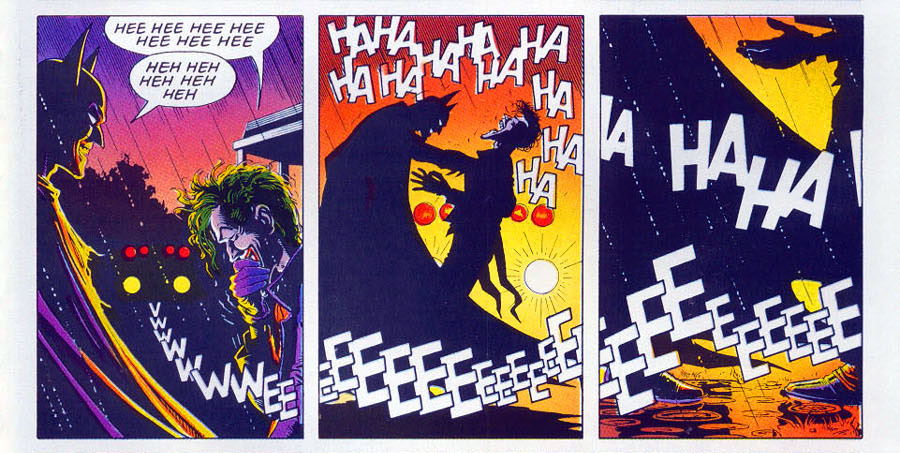
Ultimately the book followed a different timing. The laughter continues for through panel 6 and off the right side of the grid. The sirens don’t recur for the last panel—which is a major improvement over having a bunch of EEEs breaking into what Moore sought for that image: “more an abstract design than anything else.”

Who made those changes and when? The evidence currently available doesn’t say. They probably occurred in the editing process as Moore, Bolland, and their editors discussed the book. So whatever Moore might have meant originally could have changed by the final product. But Bolland would still have needed to know what to draw.

Furthermore, Morrison’s interpretation puts a lot of weight on how “the laughter stops,” a phrase he repeated. But in the final book, the laughter doesn’t stop in panel 5 when Batman touches the Joker. Nor does it stop in panel 6—it continues off the right side.

So what have we learned or relearned from this worldwide discussion?
  • Grant Morrison likes people to think he has secret knowledge. (And to be fair, sometimes he really does.)
  • Superhero comics are a collaborative art form. The storytelling is the product of the writers, artists, letterer, and editors, with only the final product containing all their contributions.
  • A lot of fans really wish Batman could kill the Joker.

01 September 2012

Moore’s “concepts that I wanted to reflect in V”

As long as I’m cogitating about comics writer Alan Moore’s inspirations, I’ll quote something striking he wrote about V for Vendetta, his breakthrough series with David Lloyd. In an article published in England in 1983 as that comic was being published, reprinted as an afterword in the 1990 DC Comics collection, Moore wrote:
One night, in desperation, I made a long list of concepts that I wanted to reflect in V, moving from one to another with a rapid free-association that would make any good psychiatrist reach for the emergency cord. The list was something as follows:

Orwell. Huxley. Thomas Disch. Judge Dredd. Harlan Ellison’s “‘Repent, Harlequin!‘ Said the Ticktockman.” “Catman” and “Prowler in the City at the Edge of the World” by the same author. Vincent Price’s Dr. Phibes and Theatre of Blood. David Bowie. The Shadow. Nightraven. Batman. Fahrenheit 451. The writings of the New Worlds school of science fiction. Max Ernst’s painting “Europe After the Rains.” Thomas Pynchon. The atmosphere of British Second World War films. The Prisoner. Robin Hood. Dick Turpin...
For many writers, “concepts” might be themes or emotions. For others, they might be imagined scenes, or memories. For others, they might be questions about real people and their decisions. And so on.

But for Moore, the “concepts that I wanted to reflect” were the work of previous storytellers and performers. Even in a work of protest about the direction of British politics, he was thinking about science fiction, comics, and old movies.

No wonder Douglas Wolk writes in Reading Comics that “Virtually every comic Moore has written is inspired by some kind of pop-culture source of the past that he can elaborate and improve on.” In fact, Wolk listed V for Vendetta among the few “totally original major creations in [Moore’s] bibliography” (along with “A Small Killing, the never-finished Ballad of Halo Jones, the never-finished Big Numbers”). But that might be because Moore cast a wider net for “concepts that I wanted to reflect.”

29 August 2012

Mogo Doesn’t Plagiarize

A colleague in the Boston Comics Roundtable told a story of someone seeing his Green Lantern T-shirt and asking, “Hal, John, or Kyle?” To which he was pleased to answer, “Guy.”

Evidently that’s how Green Lantern fans talk. A few years ago, I wouldn’t have been able to make head or tails of the conversation. But now I could answer: “Mogo.”

Mogo is the planet-sized Green Lantern who debuted in the six-page story “Mogo Doesn’t Socialize,” published in Green Lantern, #188 (1985). That back-up feature, written by Alan Moore and drawn by Dave Gibbons, is collected in DC Universe: The Stories of Alan Moore.

As an Alan Moore character, however, Mogo almost perforce has a longer literary pedigree. Duy Tano just noted this panel from “The Bounty Hunters,” a story by Moore and artist John Higgins published in the British comics magazine 2000 AD in 1982.

One character says, “I read this story once where these guys are looking for an alien, not realising that the alien is really the planet they’re standing on…” That panel appears in The Complete Alan Moore Future Shocks. It shows Moore was already mulling over the idea that became Mogo.

By having his character allude to a “story,” I think Moore was hinting that he himself had read such a tale. Or two or more. Back in 1963, as Bob from Cartoonacy pointed out on Duy Tano’s site, a Green Lantern story featured a sentient planet: “The Strange World Named Green Lantern,” written by John Broome and drawn by Gil Kane. Marvel Comics had its own living planet, Ego, created by Jack Kirby and Stan Lee in 1966.

But Moore’s clearest comics antecedent is “Dead Planet,” published in Tales to Astonish, #27, with a cover date of Jan 1962. Scripted by Lee and drawn by Steve Ditko, this story is only five pages long. Nathan Mahney synopsizes it like so:
The Komok race travels from planet to planet, as each one of its warriors conquers a planet single-handedly. But if any one Komok fails, all of them will be forced to return home in disgrace. Mopox is dispatched to conquer his planet, but he can find no sign of life on its barren surface, despite what his instruments tell him. He dies of loneliness, not knowing that the life on this planet takes the form of sentient rocks.
See more panels on Bully’s Tumblr.

“Mogo Doesn’t Socialize” has the same plot as “Dead Planet”: a character bent on conquest comes to a planet and searches in vain for a foe to fight because he can’t recognize what he’s looking for. Like the Green Lantern in 1963, he eventually discovers he’s up against an entire planet.
Of course, Moore does the story better than his predecessors. He ties the episode into the larger DC mythos. He uses the Green Lantern symbol as part of the big reveal. His prose is lively.

Still, this is one of many examples of how Moore builds many of his best stories on preceding writers’ creations—combining them, building on them, twisting them in new ways. Without, however, rendering the sources unidentifiable.

01 July 2012

The Economics of Oracle and Batgirl

Two weeks ago I wrote about how we can interpret certain heroes of the 1986-2011 DC Universe—Wally West, Cassandra Cain, and Stephanie Brown—as having successfully come of age.

In rebooting its universe, DC made most of its characters younger. If the company had returned those three to their original status as young heroes struggling under their elders’ shadows and other burdens, that would erase their hard-won achievements and disappoint their biggest fans.

But then I asked, “Why doesn’t the same logic apply to Dick Grayson, Tim Drake, and Barbara Gordon?” Comics readers have seen all of them grow up along their intersecting paths:
  • Dick as Robin, Nightwing, Batman briefly, Nightwing again, and finally Batman, evidently to stay.
  • Tim as Robin and then Red Robin.
  • Barbara as Batgirl and then Oracle.
Yet with the 2011 reboot of the DC Universe, Dick is once again Nightwing and Barbara once again Batgirl. Both those heroes are apparently in their early twenties. All three characters are once again dealing with the shadow of Bruce Wayne as Batman.

The first factor in this restoration of the status quo ante is simply economics. Versions of all three characters were featured in the Batman television series, live and animated. Many more people saw those stories than were reading the last two decades of comic books.

That factor seems to be most influential in the case of Barbara Gordon. Originally created at the instigation of the Batman television producers, her initial conflict was trying to keep up with the Dynamic Duo while hiding her masked crime-fighting from her father, Police Commissioner Gordon. For a while she was a US Congresswoman (with Dick Grayson as a young aide and eager romantic interest). That suggested she had indeed come of age.

Not knowing where to take Barbara after that (and with Dick romancing Koriand’r in New Teen Titans), DC Comics benched her in the 1980s. Then the company approved Alan Moore’s proposal to have the Joker shoot and paralyze her in Batman: The Killing Joke (1988).

Subsequently Kim Yale and John Ostrander, an editor-writer team and couple, developed a new role for Barbara Gordon: as Oracle, mysterious computer mastermind, online investigator, and super-police dispatcher. In comics like Suicide Squad, Batman: Gotham Knights, Birds of Prey, Justice League, and two Batgirl series starring younger teen protégées, Oracle pulled strings throughout the DC Universe. Her physical disability coupled with online mobility both reflected her past and personality and produced an unresolvable foundational conflict that generated stories.

But Oracle’s networking was tied into the complexity of that DC Universe, and the company feared that complexity was scaring off new readers. And, as I wrote above, millions of TV viewers knew Barbara Gordon as Batgirl. So back she came.

For the new universe, DC didn’t erase Barbara’s past as Oracle, paraplegic computer jock. But it did shorten that period to about three years, delete the Birds of Prey team she created, and completely restore her athleticism. Those changes rendered her work as Oracle far less important. Writer Gail Simone is exploring the psychological trauma of the Joker’s attack, and that may become part of the character’s new foundational conflict. But for many readers Barbara had already overcome that trauma by remaking herself as Oracle.

As well reviewed as Simone’s stories are, the removal of the 1986-2011 continuity’s Oracle does seem like an unreplaced loss and a disappointment. There was still a lot of story potential in the character’s previous situation.

However, the most recent sales figures (for May 2012) show DC selling nearly 59,000 copies of Batgirl through the Diamond wholesaler while the sales of the last issue starring Stephanie Brown (from August 2011) were below 23,000. It would be hard to convince the publisher that it had made a mistake when sales are up over 250%.

COMING UP: And Tim and Dick? This is the weekly Robin, after all.

26 April 2012

Alan Moore and the Pitfalls of Unforeseen Success

Folks who blog about superhero comics are apparently supposed to have a moral stand on DC Comics’s decision to commission prequels to Alan Moore and Dave Gibbons’s Watchmen, despite the former’s vociferous opposition.

I don’t view that as a major ethical issue, but rather a business venture that will find its judgment in the marketplace. The American superhero comics industry has grown over the decades from writers and artists taking inspiration from and contributing to collective narratives. Moore knew that when he signed his contracts with DC in the 1980s, and in fact much of his work has grown from other writers’ creations.

Moore’s main beef with DC now is not that the company isn’t abiding by the contracts he signed, but that it is. He just didn’t expect those contracts would still apply to him.

That’s not because Moore thought his work was special. It’s because he didn’t think it would be as successful as it’s been. Moore assumed that Watchmen would go out of print after just a few years. He’s said as much in many interviews, but here’s a recent one from Kurt Amacker:
KA:  I thought we could discuss the initial ownership dispute you had with DC back in the 1980s, wherein you and Dave Gibbons expected to get the rights to Watchmen and its characters back a year after the trade paperback went out of print. But, it never went out of print--and one suspects DC probably knew it wouldn't.

AM:  We were told that. That was the understanding upon which we did Watchmen--that they understood that we wanted to actually own the work that we'd done, and that they were a "new DC Comics," who were going to be more responsive to creators. And, they'd got this new contract worked out which meant that when the work went out of print, then the rights to it would revert to us--which sounded like a really good deal. I'd got no reason not to trust these people.  They'd all been very, very friendly. They seemed to be delighted with the amount of extra comics they were selling. . . .

Now, I've since seen the Watchmen contract, which obviously we didn't read very closely at the time. It was the first contract that I'd ever seen--and I believe that it was a relatively rare event for a contract to actually exist in the comics business. Most of the time, people just signed away all their rights on the back of their invoice voucher. But, I was so pleased with the deal with Watchmen, that I suggested to David Lloyd that we do the same thing on V for Vendetta--which was, again, something that we owned and that we wanted to carry on owning.  The contracts actually are some of the most anti-creator contracts imaginable.  They've got clauses such as, if I refuse to sign for any reason any agreements in the future, DC can appoint an attorney to sign them instead of me. 
Actually, that last is a rather common clause, but not one that publishers try invoking often, if at all. No company wants to work with someone who can’t stand to work with it. I also don’t know if there are any strong precedents for that clause standing up in court.

As for the provision that most arouses Moore’s resentment—that a publisher keeps the copyright holders’ license to issue a literary work as long as it remains in print—that’s completely standard for the book industry.

I’m sure that Ernest Hemingway signed contracts with that clause, and Stephen King, and J. K. Rowling—even after they became bestselling authors. Most authors are happy when a publisher keeps selling a book. That’s a lot easier and more lucrative and less ego-deflating than when a publisher puts a book out of print and reverts the rights. Moore has never denied DC’s statements that the company’s paid him all the Watchmen royalties he’s due—a considerable sum, given the book’s sales in the millions.

It’s probably true that Moore, Gibbons, and DC didn’t expect Watchmen to still be selling strongly nearly thirty years later. No one had the superpower of being able to foresee that future. As Moore admits, he recognized that mid-1980s contract as far better than anything he’d seen before and didn’t consider its terms carefully. But a good contract is negotiated to anticipate all possible outcomes. The Watchmen contract spelled out what would happen if the book stayed in print, and that arrangement is simply industry standard.

By his own account, Moore took the same approach to his movie rights, including not only Watchmen but League of Extraordinary Gentlemen. This spring he spoke about that in a BBC interview, quoted here on semi-coherence:
Originally, I was under the illusion that the way that films worked was that you got a lot of option money, and then after a couple of years they decided that they weren't going to make the film. Which was the perfect result, the film didn’t get made, you got the money. Then they actually made a couple of my films, and at that point I decided, well, I'll just distance myself from them as much as is possible.
Again, Moore signed contracts anticipating the most common outcome but didn’t think through the possibility of success.

Perhaps that reflects Moore’s upbringing in the working class of northern England, where folks might not expect anything to work out well, much less phenomenally well. The American publishers and movie producers, in contrast, were ready for things to work out better than they expected. Maybe that’s characteristic of American businesspeople, or maybe it’s just why they were willing to put up the money.

18 November 2011

“The utter eradication of thought balloons”

Once established (as discussed yesterday), thought balloons became a valuable way that comics creators could “show the invisible,” which I posit is a dimension that sets that form apart from other types of illustrations. That was especially useful when there was a contrast between a character’s thoughts and his actions or speech, as with Cerebus or Peter Parker.

Too often, however, comics creators used thought balloons to tell rather than show, especially for the benefit of young readers and those who had never, ever seen a comic before: “Oh, no! Once again my ring won’t work against anything yellow! I must think of something else before...” (I exaggerate, but only a little.)

In the early 1980s, artist David Lloyd and writer Alan Moore were discussing a new feature for the magazine Warrior in their native Britain. This was meant to be a more sophisticated adventure for adult readers, and its main character’s plans and motives were opaque. Moore wrote of that planning:
Dave was giving me his ideas as to how he actually wanted to approach the strip in terms of layout and execution. These included the absolute banning of sound effects, and, as an afterthought, the utter eradication of thought balloons into the bargain.

As a writer, this terrified me. I wasn’t so much bothered about the sound effects, but without thought balloons, how was I going to get over all the nuances of character that I needed to make the book satisfying on a literary level? All the same, there was something about the discipline of the idea that fascinated me, and while dropping off to sleep at night I’d find it nagging away somewhere in the recesses of my cerebral swamp.

A couple of days later I wrote back to Dave telling him...that not only would we do without thought balloons and sound effects but I was prepared to get rid of most of the caption boxes as well and just rely entirely on pictures and dialogue.
The result was V for Vendetta, and a more cinematic approach to comics storytelling. There may well be earlier examples of mainstream comics creators deliberately doing without so many of their standard narrative tools, but this approach was most influential. That’s because Moore, getting over his initial reluctance, embraced the approach and carried it with him to Watchmen.

Meanwhile, a bunch of American comics creators, including Marv Wolfman, John Byrne, and Frank Miller, were experimenting with first-person narration in captions instead of third-person narration. Those captions offered a space for internal monologue separate from thought balloons. The popularity of the results, particularly Miller’s Ronin and Dark Knight Returns, worked with Watchmen and V for Vendetta to make thought balloons seem unsophisticated. And soon they were utterly eradicated.

11 November 2011

Billion for the Guy?


Over at Boston 1775, I’ve been tracing how a particular stylized depiction of Guy Fawkes has become an international symbol of political protest.

It’s a path that leads from a terrorist plot against the entire British government to festivals of patriotic misrule in the 1700s through boys’ sports in the 1800s and Alan Moore and David Lloyd’s V for Vendetta comic to an internet meme and back into the political world. The journey started here.

24 July 2010

“We’re rubbish, even though we are as gods.”

Super scripter Alan Moore had stuff to say about superheroes in a recent Quietus interview published in The Stool Pigeon:

In the past I’ve tried to say, ‘Look, we are all crappy superheroes,’ because personal computers and mobile phone devices are things that only Batman and Mr Fantastic would have owned back in the sixties. We've all got this immense power and we’re still sat at home watching pornography and buying scratch cards. We’re rubbish, even though we are as gods. . . .

I’ve come to the conclusion that what superheroes might be — in their current incarnation, at least — is a symbol of American reluctance to involve themselves in any kind of conflict without massive tactical superiority. I think this is the same whether you have the advantage of carpet bombing from altitude or if you come from the planet Krypton as a baby and have increased powers in Earth’s lower gravity.

That’s not what superheroes meant to me when I was a kid. To me, they represented a wellspring of the imagination. Superman had a dog in a cape! He had a city in a bottle! It was wonderful stuff for a seven-year-old boy to think about. But I suspect that a lot of superheroes now are basically about the unfair fight. You know: people wouldn’t bully me if I could turn into the Hulk. . . .

Initially Watchmen gained a lot of its readership because it was taking an unusual look at superheroes, but actually it was more about redefining comics than it was about redefining one particular genre. I think both me and Dave Gibbons had a lot of knowledge about that scene and we were able to take it and change it around to our advantage.

And, as you say, there hasn’t been a more sophisticated comic released in the 25 years since, which I find profoundly depressing, because it was intended to be something that expanded the possibilities of comics rather than what it has apparently become — a massive psychological stumbling block that the rest of the industry has yet to find a way round.
Of course, many nations have superheroes. But perhaps they’re all simply imitations of a fundamentally American innovation.

And perhaps Moore’s disenchantment with the genre has more to do with his stage of life than with the roots of the genre, geopolitics, or the state of the industry.

27 June 2010

The Short, Happy Life of the First Jason Todd

When I posited that Reason for Robin #10 is that “Robin Isn’t Evil,” I promised to discuss the two major counterexamples. Actually, back when I conceived of that series, I had only one counterexample in mind: the second Jason Todd. And to lay the groundwork, I have to address the first Jason.

Back in 1940, Dick Grayson went from meeting Batman to becoming his costumed companion in the course of a few panels on one page. His decision to leave the partnership in the early 1980s took considerably longer, aided by the huge success of the New Teen Titans magazine. Leading DC’s hottest team (in every sense of the word), Dick became an independent young adult.

The pivotal moment arrived when a meeting of writers Gerry Conway and Marv Wolfman, artist George Pérez, and their editors concluded that Dick Grayson should break free from the Batman books and adopt a new identity—eventually Nightwing. Meanwhile, Conway could develop a new character to take his place at Wayne Manor.

This was the first Jason Todd. Conway had a traditional understanding of how Robin functioned in Batman stories, and his Jason was very much like Dick Grayson. To the extent of being a young trapeze artist whose parents are murdered by criminals and goes to live with billionaire Bruce Wayne.

Jason fought crime in a costume and mask in Detective Comics, #526—the 500th appearance of Batman in that magazine, and Conway’s last issue. But it took the rest of 1983, and some black hair dye, before he officially became Robin. One milestone in that period was when Dick Grayson graciously passed on the red, green, and yellow outfit. For merchandising reasons (all those pajamas with Robin’s picture on them), Jason had to look exactly like Dick.

Just like the Robin of the 1940s through 1960s, the first Jason Todd was occasionally impetuous and immature. He made mistakes, and showed more emotional reactions than Batman. He was, after all, still a kid.

In that period, each superhero comic usually had a complete adventure in one issue, but subplots extending over many months. The first Jason Todd became the object of a custody battle between Bruce Wayne and Natalia Knight, the criminal Nocturna; basically, he went undercover as her adoptee. Again, that plot emphasizes how Robin is still a child.

Robin scholar Mary Borsellino quotes a letter from a reader in Detective Comics, #530, calling this Jason a “quiche eater,” an allusion to the 1982 bestseller Real Men Don’t Eat Quiche. But of course a Boy Wonder isn’t supposed to be a Real Man—yet.

In Alan Moore and Dave Gibbons’s terrific Superman story, “For the Man Who Has Everything” (1985), an extraterrestrial conqueror dismisses Jason as “the little yellow one.” Yet who saves the world in the end? That tale is the first Jason Todd’s finest hour.

(In that story, Jason had also grown up enough for Batman to famously remind him, “Think clean thoughts, chum.” But different artists depicted him at different stages of adolescence.)

Then two major events jolted the DC Universe. The first was Wolfman and Pérez’s Crisis on Infinite Earths (1985-86), which opened the door for DC to relaunch and redefine all its major franchises.

The second was Frank Miller’s The Dark Knight Returns (1986), the story of a potential future Batman. Among its innovations was a female Robin. Among its allusions to the standard comics was a brief line about Jason Todd being dead; clearly, this was a rougher Batman in a rougher world. This series was highly stylized, highly violent, and highly successful.

Post-Crisis, DC commissioned Pérez to retell the origin of Wonder Woman, John Byrne to relaunch Superman, and Miller to set a new tone for the regular Batman series. Editors thought that the character’s origin myth still worked, but that readers would appreciate more grit. The audience for superhero comics now consisted of young adults in specialty shops, not kids browsing in drugstores.

In Batman, #404-7 (1987), Miller and David Mazzucchelli showed the start of Bruce Wayne’s career as Batman. Like Miller’s earlier series, Batman: Year One was stylized, stark, and very successful.

The first Jason Todd, cheerful former circus acrobat, had come out of the Crisis of 1986 intact, and appeared in a few more months of stories. But DC’s editors felt that his character didn’t fit the new, grittier Batman’s world. Therefore, in Batman, #408, the Caped Crusader met a new Jason Todd.

COMING UP: Battling for the soul of a new Robin.

02 May 2010

Robin Isn’t Evil, But Batman…?

At last the weekly Robin returns to exploring how the tenet that Robin isn’t evil became an important part of what the character symbolized in the DC Comics mythos. Before the 1980s, all superheroes weren’t evil. Robin’s solo stories had depicted him as struggling to follow Batman’s model. But a new characterization showed him trying to help people with Batman as one inspiration among several.

Concurrently, DC writers were edging toward the possibility that Batman might be evil. In the early ’80s The Comics Journal quoted comics artist and writer John Byrne calling the character a “brooding psychopath.” Not everyone in the business agreed with him, of course, but that possibility became more and more central to Batman stories.

Does Batman operate so close to the edge of human endurance that he might go over at any time? Is he so driven by his mission that he’s willing to sacrifice ordinary human relationships? Is his life as Bruce Wayne such a sham that it’s made him as hollow as he acts? As his ward, Dick Grayson was Bruce Wayne’s natural foil in such stories.

In Detective, #500 (1981), scripted by Alan Brennert, Batman got a chance to enter an alternative universe where Bruce Wayne is still a boy and his parents haven’t been murdered—yet. He jumps at the chance at saving some version of his parents. Robin (already a star of New Teen Titans) races to accompany Batman because he doesn’t trust what Bruce might do when he sees his parents under attack. While Batman gets tunnel vision, Robin worries about disrupting this alternate universe before deciding what his values require. This story ends with a curious twist. Batman does save his parents, but his young alter ego nevertheless starts to dedicate himself to being a crime-fighter. That implies that Bruce wasn’t necessarily motivated by his parents’ murder; rather, their murder may have simply been his rationale for doing what he’d have been naturally driven to do anyway.

DC started to separate Batman from its other heroes with Batman and the Outsiders, #1 (1983). Scripter Mike W. Barr showed him storming out of the Justice League of America to start his own, more aggressive superhero team. A crossover with New Teen Titans a few issues later underscored the new rift and differences between Batman and Robin—the younger man is the better team leader.

Which brings us to Batman’s working methods. Back in 1939, Gardner Fox’s origin story explained that after his parents’ murder he chooses to dress as a bat to scare criminals. He became more cuddly under the Comics Code of the 1950s and early ’60s, then returned to the dark side. And any persona based on vengeance and fear naturally lends itself to questions of evil. In the early 1980s writers began to explore how close Batman came to that evil. Could Bruce Wayne be driven to kill? Does the Batman persona actually attract supervillains like the Joker? Might Batman’s methods end up producing the injustice that he wants to eradicate?

Frank Miller brought those themes to the fore in The Dark Knight Returns (1986). This volume also explored how Superman might become evil, so ready to serve “the American way” that he’s the tool of a repressive US government. Where in that book does the ideal of heroism shine purest? In its new Robin, of course: Carrie Kelley.

Miller’s vision of Batman fed into Alan Moore’s characterization of Batman in A Killing Joke and Grant Morrison’s in Arkham Asylum: A Serious House on Serious Earth, both depicting the Dark Knight as a mirror of his villains. These stories aren’t outliers in the modern Batman mythos; they’re fundamental. Most of the examples I’ve discussed are among the ten greatest Batman stories ever told as recently announced at Comics Should Be Good!

In the last two decades, Batman’s storytellers have maintained his potential for evil—never fully realized, of course—as part of his basic characterization, even in the DC Animated Universe. Meanwhile, the most successful young Robins provide solid examples of sanity and virtue. Some notable storylines:

  • Knightfall: After being injured, Bruce Wayne chooses a replacement Batman who can’t stand the pressure, goes crazy, and starts killing criminals. Meanwhile, Robin isn’t evil.
  • JLA: Tower of Babel: After suffering hideously effective attacks, members of the Justice League discover that Batman has assembled information on how to beat each of them, and a villain has obtained those files. The League members wonder if they can trust Batman, and their young counterparts in Young Justice wonder the same. But Robin isn’t evil.
  • In one of DC’s many lead-ups to its Infinite Crisis event, Batman has created a satellite called Brother Eye to keep watch over everyone on Earth with superpowers or criminal tendencies. Naturally, this gets out of his control and threatens everyone on Earth. Meanwhile, Robin and Nightwing aren’t evil.
We can see those themes in today’s magazines and movies: Batman being driven to kill in Final Crisis, the Joker’s soliloquies in The Dark Knight, Tim Drake putting on a dark cowl in Red Robin and then having to pull himself out of a dark place, and of course the “goddamn Batman” of Miller’s All-Star Batman and Robin.

COMING UP: But what about the second Jason Todd—wasn’t that Robin evil?

26 August 2009

No Smoking in the Watchmen Movie

One of the distinctive visual details in the graphic novel Watchmen, written by Alan Moore and drawn by Dave Gibbons, is the lollipop-shaped glass pipes that several characters smoke instead of cigarettes. In particular, the female lead, Laurie, used such a pipe.

I missed that detail in the movie. Some of the bad guys smoked: the Comedian and Big Figure had cigars, and Moloch was down to his last cigarette. But none of the heroes did, and the movie lost one of the book's vaguely-out-of-this-world details. (Are these pipes somehow a result of Dr. Manhattan’s molecular manipulation?)

It turns out the pipes vanished because of Warner Bros. executive Alan Horn. Director Zack Snyder told the i09 site:

Alan hates smoking. Alan Horn - the head of the studio - that's his biggest, biggest thing. The Comedian can smoke, because he might be a bad guy, he's the bad guy, but that's it. That was the line that he drew.
Almost everything in the Watchmen novel connects with something else, however, so the loss of those pipes had costs.

In one scene, Laurie and her old heroing comrade Dan fight off some muggers, then engage in what's clearly a parody of post-coital behavior, with her having a smoke. That prefigures their deeper relationship to come, and keeps up a theme of crime-fighting as physical fulfillment. In the movie, the same scene has no such resonances (and a lot more blood).

Later Laurie is in Dan's flying owlship, looking for the lighter so she can have a smoke, and she accidentally turns on the flamethrower. (Don't you hate when that happens?) In the movie, there's no reason for Laurie to hit the red button with a flame on it. The scene just makes her look stupid.

Finally, damienoujia at this Comicvine forum noted another moment where Lori's smoking habit illuminated her character:
Her first meeting with the Comedian and it seems he's hitting on her...he lights what we presume is her first cigarette. Her mom comes in and she [Laurie]'s all embarrassed about being caught smoking. It just changes the dynamic of the scene.
I don’t like tobacco anymore than Alan Horn does, but there's no doubt this no-smoking policy came at an artistic cost.

10 April 2009

“America Was Like This Fabled Foreign Land”

I've quoted Neil Gaiman on trying to decipher American culture through American comic books. Here's Watchmen artist Dave Gibbons on the same topic, from an interview with Time:

When you and Alan [Moore] were making Watchmen, how important was it that you guys were English, and working in the UK, far away from the watchful eye of the mother ship in New York?

Actually it was a big deal. I think the whole thing of Brits working for American comics was a big deal. Because America was like this fabled foreign land. When I first came to New York City, what I was thrilled about was not the Empire State Building, or the Statue of Liberty, it was the fireplugs in the street. These things that Jack Kirby had drawn. Or these cylindrical water towers on top of buildings that Steve Ditko's Spider-Man fights used to happen in and around.

So it's always been this kind of exotic babylon. And that's so for Alan as well. We used to get the American comics imported, and it wasn't just the stories, it was the whole thing of Tootsie Rolls and Schwinn bicycles. This is the kind of thing we'd talk about for hours on the phone. All this stuff that to you Americans is everyday stuff, as boring to you as our everyday stuff is to us.

So I think that we were able to stand back from American culture, stand back from comic books, although we'd read them all our lives. I can't imagine that we could have done Watchmen if we hadn't had that detachment. You know? Love for the subject matter, love for the culture, but a detachment. And perhaps a slight British cynicism? Impressed, but not impressed.
Gaiman also mentioned the mystery of fire hydrants. Why did the New York water supply hold such fascination for London youngsters? Perhaps because they grew up in a climate where they didn't need to worry about water--it was more often than not falling on their heads.

TOMORROW: What inspired that previous generation of American comic artists the same way?

19 December 2008

Blades

Two highly compelling book-length comics that I found in the Young Adult Graphic Novels section of my local library, though I'm still not convinced they belong anywhere near there—

Clyde Fans, by Seth, because there's nothing teenagers like to read more than delicately paced studies of two brothers who tried to sell electric fans to Canadian retailers midway through the last century.

From Hell, by Alan Moore and Eddie Campbell, because there's nothing parents like their teenagers to read more than a depiction of the Jack the Ripper murders in all their bloody, full-frontal, sex-and-gore detail.

Yes, this is part of my ongoing meditation/grouse about how in America the comics form makes people think that books are more appropriate for younger readers than their subjects, stories, and styles should really indicate.

Though I wonder if the real explanation for that shelving is that the YA librarian was more aggressive about buying well-reviewed graphic novels, just to make sure they got into the collection.

01 November 2008

Strangest Comic of the Month

Blotchmen, by Kevin Cannon, is a parodic mash-up of Alan Moore and Dave Gibbons's Watchmen, William Carlos Williams's "This Is Just to Say," Crockett Johnson's Harold and the Purple Crayon, and Maurice Sendak's Where the Wild Things Are.

Seriously.


As a bonus, this page throws in unnecessary action labels from Japanese comics.

Thanks to Matthew Holm for the pointer. I think.

18 April 2008

“The Theme Is Your Spine”

Yesterday I quoted a remark by comics novelist Alan Moore on how a powerful plot works. In the same essay that passage came from, Writing for Comics, Moore also insisted: "A plot isn't the main point of the story or the story's main reason for existing. It is something that is there more to enhance the central idea of the story and the characters who will be involved in it."

And earlier, "A good starting point would perhaps be the aspect that lies at the very heart of any creative process: the idea. The idea is what the story is about; not the plot of the story, or the unfolding of events within that story, but what the story is essentially about."

That reminder is echoed in another book called Writing for Comics, by Peter David--another scripter who's achieved a great deal of respect in adventure comics, if not the outright adulation that Moore can inspire. Using different terminology, David offered similar advice:

Furthermore, you need to have a solid grasp of your theme. If ideas and conflict are the skeleton of your story, the theme is your spine. I define theme as that aspect of the human condition upon which your story offers commentary. Ideally everything that transpires in your story should somehow connect to your theme. It sounds simplistic, I know, but you must have a clear idea of your theme, and whence the conflict stems, before you embark upon telling your story. Without that, your story will be unfocused and vague.
While books about writing fiction in prose forms also discuss "the theme" or "the central idea," I rarely see such emphasis on that quality as a necessary early step in storytelling. Rather, many novelists argue that their themes develop as they write, and are in any event far more interesting to English teachers than to working writers. Novel-writing advice books often stress characters as the starting-point.

I think there are several reasons why these two writers put so much emphasis on theme in their advice to people wanting to enter the comics field.
  • First, in the superhero comics where David and Moore did their most visible work, characters have often been defined by other writers decades before, and are owned by corporations rather than individual creators. David, for instance, is admired for writing a long, successful run of The Incredible Hulk, about a character created by Stan Lee and Jack Kirby in 1962. While it's important in writing such comics to understand the central characters, what drives them, and what they represent, the writer isn't called on so often to invent them. (I'll say more on Moore's use of established characters at some future point.)
  • Moore and David also work in a field that requires stories to have action that can be illustrated. Commercial comics have long thrived on plot-driven stories with twist endings. In sum, anyone trying to write mainstream comics probably already knows that plots are required; that's where they'd start. They'd need help with remembering to think about why a plot matters. I also wonder if such plotting has always come easily to Moore and David--hence their success. Writers who are excellent at scene-setting, or character-building, or style, might need more of a push on plots and less on those aspects of storytelling.
  • Perhaps most important, Moore and David have probably seen a lot of stories, both unpublished and published, that are all plot and action with no central idea or theme. ("What if Wolverine fought Superman? Wouldn't that be neat!" "Why would they fight? What would be that story's central idea? What would it say about the human condition?" "Um, I dunno. But wouldn't it be neat!") Moore and David might have emphasized this step for beginning writers not because it's the first thing they do when they write, but because it's what they see others not doing enough.

17 April 2008

The Back Alleys of Your Narrative

In my presentation on plotting last Saturday, I quoted from the writer Alan Moore's essay Writing for Comics, available as an unnecessarily illustrated booklet from Avatar.

Mainstream comics publishing puts a premium on plot, sometimes at the expense of other elements of storytelling. For decades adventure comics have promised conflict and confrontation, twists and trick endings, a roller coaster of emotions and expectations that leaves readers wanting to take another ride. To succeed in that business, therefore, Moore had to figure out that element of a good story early on. And here's what he learned.

As I see it, a successful story of any kind should be almost like hypnosis: You fascinate the reader with your first sentence, draw them in further with your second sentence and have them in a mild trance by the third.

Then, being careful not to wake them, you carry them away up the back alleys of your narrative and when they are hopelessly lost within the story, having surrendered themselves to it, you do them terrible violence with a softball bat and then lead them whimpering to the exit on the last page.
Believe me, they'll thank you for it. TOMORROW: More Moore.

05 November 2007

Comics and Non-Comics, Manuscript and Script

In June I featured COMICS WEEK, with every posting about comic books or comics in other forms. In September I launched NON-COMICS WEEK, about books that have something to do with comics, but aren't comics. But today Oz and Ends starts something totally new: COMICS AND NON-COMICS WEEK!

Which is to say, I'm going to post thoughts on what makes comics different from other illustrated books. Some of these differences have to do with form, and thus may be inherent to the different storytelling media. Some involve the way that the different types of books are created, and thus may be more related to organizational cultures and traditions than the artistic forms. I base these comments on analysis rather than much experience with creating either of those types of books, so I welcome comments and rebuttals from people in the fields.

My first observation began several years ago when I drafted a comics script about Button-Bright and submitted it to the world's leading Oz comics creator. (What the heck?) I hadn't found any books about writing comics scripts, so I followed the only rules for to-be-illustrated manuscripts that I knew: the rules for picture books.

Those rules are:

  • The author writes the text on the page and nothing else.
  • Not even page breaks. The artist (working with the editor) decides where those fall.
  • No, you may not describe the action or the setting.
  • All right, if a visual detail is absolutely crucial to the editor and artist understanding a story, you can include it as a note in your manuscript.
  • You as author do not give ideas directly to the artist. In fact, you should not even be in contact with the artist until the book is done.
In one of my writing groups, an author had sold a picture-book manuscript about canoeing on the Charles River with her son. When it was published, the artist had decided to portray the mother and child as Native American. That's how that picture-book publishing works. Editors explain that this is necessary to give the artist enough creative input.

I've heard some experienced authors speak of exceptions to the rules. Stephen Krensky has noted in his manuscript what image should go on the wordless last page of a picture book. Joanna Cole and Robie Harris both insisted that they had to work closely with their illustrators--Bruce Degen and Michael Emberley, respectively--given the nature of the Magic School Bus and It's [Sensible Information about the Human Body] series. But those authors know that they're exceptional. They were all established, and two even had in-house editorial experience, before they broke the rules above. Newcomers don't have the same freedom.

So back to my Button-Bright comic. I carefully wrote out a manuscript that included only the words that would appear on the page, with the barest possible description of the action. No breakdown by pages or panels, no descriptions of characters, no commentary on mood. I had ideas on all those things, but was scrupulous about keeping them to myself.

The artist sent back a polite note gently telling me that's not how comics scripts work. Over the past year I've gotten around to looking at Dennis O'Neil's DC Comics Guide to Writing Comics and several other books that include scripts, either in full or as part of the DVD-like extras that DC and Marvel include in their "graphic novel" editions.

And sure enough, though there are many styles to creating a comics script, the writer has the freedom and responsibility to break the action down into pages and panels, to describe characters' actions and emotions, often even to suggest the shapes of panels and viewpoints from which they should be drawn. Paradoxically, even though a comics artist creates many more drawings per story than a picture-book artist, he or she is expected to have less control over the interaction of art and text.

Sometimes this can cause anxiety. In the extras added to Identity Crisis, penciller Rags Morales recalls complaining to his wife that Brad Meltzer's script was too detailed and controlling, that he couldn't do the job. But gradually Morales realized what Meltzer had in mind, and how all those details would add up. To be sure, the same material and interviews highlight places where Morales suggested changes from Meltzer's instructions which both agree were better. But clearly the scripter was deeply involved in creating the visuals of this book.

Among other award-winning comics scripters, Neil Gaiman's texts are casually conversational:
Well, hi Kelley, Malcolm, Todd, Steve, Tom, Karen...

Here we are at the third part of Season of Mists. We last saw the Sandman watching Lucifer walking away into the mists, having been given the key to Hell. This episode begins a few hours later.

Now, the last issue was pretty low on characters - it was basically just Lucifer and the Sandman, with a couple of cameos. This issue has a cast of thousands. Well, hundreds. Well, lots.
Alan Moore's seem erudite and freakishly detailed:
FIRSTLY, SINCE I’M NOT ENTIRELY SURE HOW THESE GRAPHIC NOVELS ARE SET OUT, MIGHT I SUGGEST THAT IF THERE ARE END-PAPERS OF ANY KIND THEY MIGHT BE DESIGNED SO AS TO FLOW INTO AND OUT OF THE FIRST AND LAST PANELS OF THE STORY. SINCE BOTH THE FIRST AND LAST PANELS CONTAIN A SIMPLE CLOSE-UP IMAGE OF THE SURFACE OF A PUDDLE RIPPLED BY RAIN, THEN MAYBE A SIMPLE ENLARGEMENT OF A BLACK AND WHITE RIPPLE EFFECT TO THE POINT WHERE IT BECOMES HUGE AND ABSTRACT WOULD BE IN ORDER?
All I can say to picture-book authors is: Do not try this! If your manuscript includes chatty commentary for your editorial and illustration team or detailed suggestions about the endpapers, for goodness' sake, you will brand yourself as the worst type of control freak: the type who doesn't know what the heck she's doing.