Showing posts with label self-publishing and other ways to spend all your money. Show all posts

03 July 2026

Credit Where It’s Due

I view the public discussion over fair credit for Rachel Hope Cleves’s Charity and Sylvia in Tillie Walden’s Charity and Sylvia from a particular perspective.

I’ve scripted indie comics, the field where Walden has made her name. I’ve written scholarly books and articles like Cleves. I’ve also worked in book publishing, so I know the considerations involved in adding more pages to a printed book or writing promotional copy about how ground-breaking a new title is.
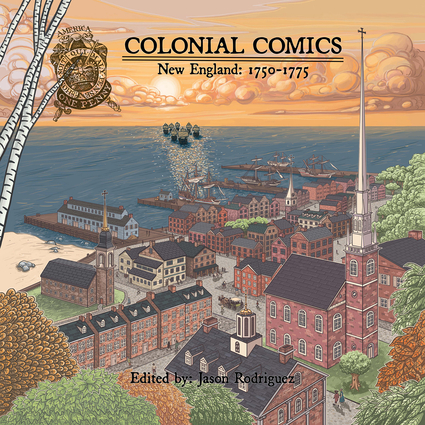
I’ve worked on both sides of the nonfiction-into-comic process. For Colonial Comics: New England, I adapted historical sources into stories about Samuel Maverick, Benjamin Franklin, and Crispus Attucks. I also supplied my nonfiction writing and research for other scripters to adapt into their own stories. I’ve seen artists add immeasurably to a tale in ways that go beyond what historical research could provide.

I also know what it’s like to have the work of historical research be rendered close to invisible. Years back, I worked with producers of the History Detectives television show to figure out the mysteries behind a couple of artifacts. I was never going to be paid, but for one of those two shows there were plans to interview me on camera. In the end, my name appeared as one short line in small type as the closing credits scroll by.

On my history blog I’ve published a series of posts about James McHenry and Elizabeth Willing Powell, drawing on new archival research and analysis. In 2019, the Washington Post published Zara Anishanslin’s article about Powell. She acknowledged relying on my work for one point, apologizing that the newspaper wouldn’t allow credit by name, only by a link. And then when a Post staffer wrote another article citing Anishanslin’s, that link didn’t survive. That’s a common problem in the major news media.

A few months back, I discovered my book The Road to Concord: How Four Stolen Cannon Ignited the Revolutionary War had been turned into a novel. A novel! The author never contacted me about obtaining derivative rights. The book contains one line of acknowledgement, grateful in tone but small in type. Since this novel was self-published, I decided simply to keep quiet about it.

At the same time, I think The Road to Concord could be adapted into a nifty movie. I’ve even taken a meeting with an aspiring producer about that prospect. If that ever happens, I darn well want credit and compensation, even though the whole point of the book and its many citations was to lay out the historical facts and sources for anyone to follow.

16 March 2024

“Historic Children’s Voices” Coming from American Antiquarian Society

The American Antiquarian Society in Worcester will launch a website on “Historic Children’s Voices, 1799-1899.”

Its introductory page explains: “The holdings to be digitized are not children’s literature, i.e., works created BY adults FOR children, but rather are direct testimony as well as imaginative works created BY children. As such, they constitute an archive of historical evidence not previously accessible.”

The materials to be digitized include diaries, letters, stories, poems, and the AAS’s “large amateur newspaper collection—most printed on home parlor presses.” There will be 15,000 pages of content in all.

Those presses were very popular in the late 1800s. When L. Frank Baum issued the Rose Lawn Home Journal and later self-published works on stamp collecting and chicken farming, he was among thousands of young people working their own small presses.

Accompanying the website, the AAS will host an in-person and online symposium on 2–3 May featuring panel discussions on “Authentic Children’s Voices,” “Archival Silences,” “Visual Culture of Children’s Production,” and “Hearing the Child’s Voice.”

On 5–9 August, the AAS will host an institute for K-12 teachers on the subject, with hands-on workshops using the collection and a field trip to Lowell National Historical Park.

12 March 2020

Stupendo Takes Off!

I’m pleased to report that the Kickstarter crowdfunding campaign for Boston Powers, the Boston Comics Roundtable’s collection of all-ages superhero comics, was successful.

And Brendan Tobin has done wonders with the art for our story. Here’s a slightly blurred preview as Stupendo and Secret Girl discuss the challenge of being a hero from another planet.

13 August 2014

Wrapping Up the Winkie Convention, part 2

The final, actual Winkie Con 2014 schedule continues with the official events of Saturday, 9 August. This was the biggest day of the convention with the highest attendance and the most events going on at once.

Saturday, 7:30 am
Army of Oogaboo Bootcamp led by the well-traveled Colin Ayres

Saturday, 9:00 am
Costume Contest hosted by Kurt Raymond and Lee Speth

Saturday, 10:00 am
The Winkie Con Quizzes administered by last year’s winners Jared Davis, Miriam Esther Goldman, and Susan Hall
Conversation with Movie Historian Aljean Harmetz with interviewer Anthony Tringali
Oz Collectibles with collectors Freddy Fogarty, Bill Campbell, and Kurt Raymond
Auction Preview
Dealers’ Room Reopens
Oz Research Table, Art Show, and Swap Table Reopen
Display of Judy Garland Movie Costumes Reopens with Michael Siewert

Saturday, 11:00 am
Friends of Dorothy: The LGBT Side of Oz with authors and artists Michael Cart, Dee Michel, Joe Phillips, Rachael Anderson, and Anthony Trujillo
The Oz Books for Beginners: Reading and Collecting with experts Eric Gjovaag and Paul Bienvenue
Mechanical Men and Dinosaurs in Oz with science-fiction fans William R. Lund, Susan Hall, Lee Speth, and Tim Tucker
Walking Tour of Coronado with the Coronado Historical Association (reprise)
Auction Session 1 with auctioneer Bill Thompson

Saturday, 12:00 noon
A. Arnold Gillespie: The Wizard of Special Effects with biographer Robert A. Welch (reprise)
Fictional Worlds and Fandoms: From Oz to Star Trek and Beyond with fandom veterans Bjo and John Trimble, Margaret Koontz, Michael Cart, and Tim Tucker
Soon As I Get Home: An Oz Lunch Concert with singer-songwriter Anthony Whitaker

Saturday, 1:00 pm
Oz and Tarot with publishers Anna Warren Cebrian and Mark Anthony Masterson and reader Gita Morena
Oz and the American Musical with musicologist Ryan Bunch
From Humbug to Hero: Getting to Know the Wizard of Oz with fans Stan Sieler, Atticus Gannaway, Carrie Hedges, John W. Kennedy, and J. L. Bell
Storytelling Workshop: From Character to Comic led by Anthony Nuñez
Auction Session 2 with auctioneer Bill Thompson

Saturday, 2:00 pm
Oz Tabletop Roleplaying Game led by Stephen Koontz
Toto of Oz, a Great and Powerful Film Career with Patricia Watson
Today’s Publishing Options with authors Henry Herz, Paul Dana, Edward Einhorn, and Kevin Gerard
Tarot Readings by Gita Morena

Saturday, 3:00 pm
Conversation with Bjo and John Trimble with interviewer Jack Plummer
Storytelling in Someone Else’s Sandbox with authors Melissa Wiley, Caroline Spector, Edward Einhorn, and Gina Wickwar

Saturday, 4:00 pm
Conversation with Priscilla Montgomery, an MGM Munchkin, with interviewer Anthony Tringali
Crafting Oz with artists Dave Kelleher, Karyl Carlson, and Bill Campbell
The Baum Bugle: Meet the Editors! with Craig Noble and Jared Davis

Saturday, 6:00 pm
The Grand Winkie Banquet and awards ceremony

Saturday, 8:00 pm
The Tik-Tok Man of Oz Musical Play directed by Chrissy Burns

Saturday, 11:00 pm
Tik-Tok’s Robotic Ragtime Revelry after-party with the Heliotrope Ragtime Ensemble

The image above is sheet music from The Tik-Tok Man of Oz, produced in 1913. That musical extravaganza was L. Frank Baum’s attempt to recreate the huge success he’d enjoyed with the 1902 stage version of The Wizard of Oz. What we saw on Saturday night was a game attempt to produce a coherent drama from the fragmentary surviving scripts and songs. Always lively, full of delights, and produced for just the right audience.

24 October 2013

Before “New Media Day” Gets Old

SCBWI New England’s “New Media Day” at the Eric Carle Museum of Picture Book Art made clear that publishing has entered a period of hybridization, combining both print and digital books published both by companies and by authors.

Despite all the stories and insights, though, my biggest takeaway was that the website Scribd.com likes to be pronounced with a short I.

Here I am with Mary Jane Begin, Gail Gauthier, and Emilie Boon, who were on a panel I moderated, and (second from left) artist Ruth Sanderson.

I can’t see why people keep asking me to moderate panels; I’m really quite shy and retiring.

13 October 2013

A Festschrift for Dick Grayson?

Soon after I started the weekly Robin, I realized that the 75th anniversary of the introduction of Dick Grayson/Robin was going to arrive in 2015. Of course, sometime when I was a lad I realized that I’d be around for the 500th anniversary of Columbus’s arrival in America, and that turned out to be a bust.

DC Comics and its fans like anniversaries of all sorts: notable years (60th!), notable issues (#500!), and even some milestones notable only to insiders (the upcoming Detective Comics, vol. 2, #27, will be special because Detective Comics, vol. 1, #27, introduced Batman, don’t you know?).

So the company probably has something planned, but will it reflect all that the character represents? I doubt it, especially since two years ago the company decided to erase from its current continuity most of the history that made Dick Grayson notable.

This weekend the medievalist behind Thoughts About Dick Grayson proposed a collective celebration in some form, perhaps including scholarly essays. There’s a tradition of that with Batman, including semi-authorized collections Batman Unauthorized, edited by Dennis O’Neil; Batman and Psychology; and Batman and Philosophy. Surely those Caped Crusader anthologies need a brightly colored companion volume!

Mary Borsellino’s Boy and Girl Wonders: Robin in Cultural Context, published in digital form through Lulu, is the only book-length study of the Robin mythos that I know of. And its focus is rather narrow, growing out of Project Girl Wonder.

Self-publishing technology makes it possible for such a volume to reach fans. Indeed, such a volume might have to be created non-commercially. In 2010 Keith Dallas, author of The Flash Companion, wrote: “DC has significantly raised its licensing fee to the point where it's now cost prohibitive to produce material like this.” But would a scholarly book require the same official authorization as that TwoMorrows volume, full of pictures of DC’s trademark characters? On the other hand, would a scholarly publisher see enough green in Robin?

22 April 2013

The Twisted Dark Journey Across the Atlantic

Among the comics creators planning to display at this past weekend’s Boston Comic Con was Neil Gibson. Unfortunately, the convention was indefinitely postponed because the metro area, as you probably heard, indefinitely shut down the day before.

Very unfortunately, Gibson and his publishing partner had come all the way from the UK with hundreds of copies of his collection Twisted Dark. And they really didn’t want to schlep those books back across the Atlantic. So instead of tabling at the convention, they spent the weekend visiting various comics shops around Boston and giving away copies of the book for free.

I was at stuffed-to-the-ceiling Comicopia in Kenmore Square when the Twisted Dark crew came through, struggling politely to convince store managers that they should take a dozen copies to give away. So out of solidarity I came away with a copy.

Though I’ve scripted a couple of horror stories lately, I’m not really a fan of that mode of fiction. But twist-ending stories are a fine way to develop and demonstrate one’s comics-writing skills. All the tales in Twisted Dark are scripted by Gibson, but the art comes from several artists: Caspar Wijngaard, Atula Siriwardane, Heru Prasetyo Djalal, Jan Wijngaard, Ant Mercer, and Dan West.

I found the first couple of stories to be competent, with a leisurely pace that emphasized mood over plot twists. Since, as I said, I’m not really fond of the horror mode, I wasn’t sure I’d finish the volume soon until I read Erik Sugay’s review for Spandexless and the Comics Alliance, which suggests that it offers more than meets a first glance.

I also checked out Gibson’s comics website and enjoyed ”Hidden Scribbles,” from a series of autobiographical tales of growing up called “The World of Chub Chub.” That’s more what I like.

06 February 2013

Aw Yeah Comics: Darling and Adorable?

Art Baltazar and Franco, the team behind Tiny Titans and other comics for young fans from DC, are launching their own original comic out of a store they co-own in Illinois, both called Aw Yeah Comics!

I enjoyed many pages in Tiny Titans, though I was never sure whether its natural audience was really young readers or the older nostalgic type. I also critiqued a pattern of that magazine showing the girl heroes babysitting a lot more than the boys. In fact, I couldn’t find a boy ever volunteering to babysit.

The image above shows part of the cast of Aw Yeah Comics. The main characters are said to be Action Cat and Adventure Bug. On the left of this image is Daring Dog. And the other three animals shown fully are, I’ve read enough comics to be pretty sure, female versions of those first three.

Let’s look at the subtle cartoon signals. Shelly and Adorable Cat are very, very pink. Darling Dog and Adorable Cat stand in identical poses, feet turned apart and right hand extended for no reason with left hand high on the hip. Darling Dog is smaller than Daring Dog and has big round eyes. Darling Dog, Adorable Cat, and I believe even Shelly have full pink lips instead of black lines for mouths. And Adorable Cat wears a dress with a frilly collar. Absent long eyelashes and hairbows, I’m not sure how the gender iconography could be clearer.

The three male characters are associated with “Daring,” “Action,” and “Adventure.” What’s important about the three female characters? Being “Darling” and “Adorable.” And being a bug with a shell, but that doesn’t seem very individual.

Maybe my interpretation is wrong. Maybe Action Cat is also female, so this comic isn’t just another one built around superpowered male characters. Maybe Darling Dog is male, and just as darling. Maybe as the comic develops Baltazar and Franco and their big-name collaborators will have their characters model a wider range of qualities for young female readers.

28 January 2013

The Evolution of Grease Monkey

Tim Eldred has published his comic Grease Monkey in a variety of ways: as a series of indy comics starting in the mid-1990s, with presses Kitchen Sink and Image, in this 2006 volume from Tor Books, and on the web.

Evidently inspired by the opening scenes of 2001: A Space Odyssey, Eldred imagined a gorilla in space alongside humans. He also wanted to explore slice-of-life stories instead of the usual battle-for-life sagas of superhero comics and space operas.

The result is a series of episodes set on a large military spaceship guarding Earth after one extraterrestrial race has nearly destroyed the planet and another has provided reparative technology and sped up evolution for gorillas to make them as intelligent as Homo sapiens. That spaceship isn’t at war; its personnel are training for war. But the tensions and rivalries of military life provide plenty of twists in the mild, character-driven plots.

Though Eldred started with his gorilla mechanic Mac Gimbensky, the main character really is Mac’s teen-aged assistant. That character—young, idealistic, and upright—is named Robin. (I’m just saying.) Most of the stories are coming-of-age episodes for Robin as he works through his role in the Barbarians fighter squadron, his crush on an assistant librarian, and his loyalty to dubious friends.

Indeed, Mac and an older gorilla in the custodial service provide so much help and wisdom to Robin that they might have become futuristic substitutes for the “Magical Negro” of single-species stories. But both those characters have their own plotlines, Mac especially, and Eldred provides a wide range of archetypal roles for both people and gorillas. Indeed, one of the few weaknesses of the saga is that most supporting characters fall quickly into familiar roles as antagonists or helpers.

Eldred draws in a classic American “realistic” comics style with some “cartoony” bulging eyes or floating hearts where called for. There’s a clear visual difference between the mid-1990s installments and when he picked up the series again a few years later, but the shift is interesting rather than jarring.

The only reading problem Grease Monkey posed for me was a tendency for panels to be stacked on the left without clear visual cues to guide the eyes. The online installments from the yet-to-be-printed sequel use word balloons as a visual bridge from one panel to the next in such layouts.

That sequel also provides a dangerous enemy for the spaceship’s crew—a shift back toward traditional adventure now that most of the characters have been established. I worry that the number of years since the end of that saga and now without a printed volume means Grease Monkey isn’t getting the readership it deserves.

24 January 2013

“Strong inky lines” and “swift composition”

The Poopsheet Foundation, which reviews indy and small-press comics, has nice things to say about The Greatest of All Times Comics Anthology, and in specific about my contribution:
J.L. Bell & Braden Lamb deliver the greatest spy of all time, and I’d love to see something feature length from these strong inky lines and the swift composition of the storytelling on display.
There are also fine words for many other contributors, especially Line Olsson (“I’d kill for a piece of her original art”).

Braden also featured a page from our story on his Tumblr site. Doesn’t that make you want to obtain a copy from Ninth Art Press?

14 April 2012

“Publishing Is Going Away”?

At Findings, a site devoted to a social-reading service, technologist Clay Shirky talked about the future of book publishing:

Publishing is not evolving. Publishing is going away. Because the word “publishing” means a cadre of professionals who are taking on the incredible difficulty and complexity and expense of making something public. That’s not a job anymore. That’s a button. There’s a button that says “publish,” and when you press it, it’s done.

In ye olden times of 1997, it was difficult and expensive to make things public, and it was easy and cheap to keep things private. Privacy was the default setting. We had a class of people called publishers because it took special professional skill to make words and images visible to the public. Now it doesn’t take professional skills. It doesn’t take any skills. It takes a Wordpress install.

The question isn’t what happens to publishing — the entire category has been evacuated. The question is, what are the parent professions needed around writing? Publishing isn’t one of them. Editing, we need, desperately. Fact-checking, we need. For some kinds of long-form texts, we need designers. Will we have a movie-studio kind of setup, where you have one class of cinematographers over here and another class of art directors over there, and you hire them and put them together for different projects, or is all of that stuff going to be bundled under one roof? We don’t know yet. But the publishing apparatus is gone.
Publishing isn’t just making something public, as in making it available. It’s bringing the work to the attention of the public. The same forces that have made it easier to make work available are also making it easier to attract attention in some ways, but harder in others: there are many more competitors for readers’ eyes and time.

For that reason, the combination of good vetting and good presentation remain valuable. Furthermore, the “brand” of a publisher (or author consortium, or interest group, or however the business grows) may become more valuable than ever. The little name at the bottom of a book’s spine carried little weight with readers, but knowing an ebook comes from a recognized company could make readers more willing to risk a purchase.

It’s quite possible that publishing organizations will focus on marketing, including publicity, negotiating with popular vendors, and so on. But simply because anyone can make his story about a tree falling in a forest instantly available for readers around the world doesn’t mean any significant part of the public’s going to notice.

09 February 2012

Amelia's Path to Publishing Success

Publishers Weekly featured Brigid Alverson’s profile of Jimmy Gownley, writer, artist, and for a time publisher of the Amelia Rules comics series.

Gownley started out self-publishing in magazine form, improvised a paperback collection (his printing partner “shaved the staples of the single issues and bound them together”), worked with packager Byron Preiss, and went back to self-publishing after Preiss’s sudden death. Some efforts were surprisingly successful, some failures. And that was just the first five years.

Then came the biggest challenge yet—the fruits of unusual success. Alverson reports:
Getting Amelia into the Scholastic book fairs, which was nearly unheard of for a self-published book, was another important step; the best-of anthology that Gownley produced for Scholastic sold 83,000 copies. But with bigger sales came bigger headaches. Big book orders can completely paralyze small publishers who may not have the man power to deliver the order on time. "Six months or so after the Scholastic deal, when we could sell that book ourselves, we got an order for 4,000 copies," Gownley said. "My father helped [get the order fulfilled], and he was really sweating, and I said, 'Can you imagine how strong J. K. Rowling must be?'"
Finally in 2008 Gownley signed an eight-book deal with Simon & Schuster. That arrangement meant Gownley could focus on content rather than production and distribution. Another benefit, as I noted back here, was more support with proofreading, which I can’t help but think meant that the books got into more school libraries.

With the end of his S&S contract, the article reveals, Gownley is moving on to new projects. It’s too bad that there won’t be more Amelia, but she has been growing up, little by little.

22 July 2011

The Xeric Foundation’s Change of Focus

This month the Xeric Foundation announced that after one more grants season it will stop giving money to independent comics creators seeking to self-publish.

Founded with the overflowing Teenage Mutant Ninja Turtles money in 1992, Xeric has been supplying selected comics work with funds and attention for two decades. Among this year’s grant recipients was Seamus Heffernan for Freedom (sample pages here).

But technology and market conditions have changed, and it’s no longer necessary (and, to some respect, feasible) to seek a readership by offering a paper product through comics retailers. Storytellers are turning to the web, where the reproduction cost is small and the potential reach is broad.

But where’s the money? The web offers some possibilities. This same month, Publishers Weekly posited that Kickstarter had become the third-largest independent (non-DC, non-Marvel) publisher of graphic novels. The source of funds has spread out among readers. In a way, we’re all the Xeric Foundation now.

08 October 2010

Hey, Kids, Here’s a Way to Add Color to the Tea Party!

The Tea Party Coloring Book for Kids got a lot of publicity last week, with some folks wondering if it was a parody, or simply self-parody. It’s self-published through a site called coloringbook.com, showing the ease with which we can now disseminate digital information. Self-publishing is the way to go when creators can easily identify and reach a niche market, and want to move fast.

The book’s picture of American history is bunk, of course. Talking Points Memo quotes the text this way:

In 1773 we had a Tea Party and this led to freedom from high taxes. Today we are having another Tea Party and this will lead to freedom from high taxes again! Ask grandma and grandpa what this means. Ask your friends what this means. Are you going to have your own tea party?
The issue of 1773 wasn’t “high taxes”; it was “taxation without representation.” You’d think people who so revere American history could remember that phrase—it rhymes and everything! (In fact, the British government wrote the Tea Act of 1773 to lower the consumer price of tea in North America.)

I find it telling how that passage mentions “grandma and grandpa.” Passing by the implication that those folks were around in 1773, that mention reflects how surveys find strong Tea Party adherents to be older than the average American adult. Similarly, most of the testimonials on the manufacturer’s website come from grandparents.

Another observation about this product came from Jezebel:
Things gleaned from the cover of The Tea Party Coloring Book For Kids: Tea Party includes many minorities, kids are angry about slow U.S. job growth, and money grows on trees.
And I don’t think any market-savvy publisher would have let the book’s cover suggest that boys in the movement outnumber girls 5:1.

26 June 2010

The Future of Publishing: Free Books at a High Cost?

Scott Adams, himself a bestselling author and even artist, recently wrote on his blog:

I predict that the profession known as “author” will be retired to history in my lifetime, like blacksmith and cowboy. In the future, everyone will be a writer, and some will be better and more prolific than others. But no one will pay to read what anyone else creates. . . .

The iPad [and its coming clones] has a browsing capability that allows you to see any content on the Internet, legal or not, and consume it from just about anywhere. . . . At some point, I assume, a Google search for any popular book title will return an illegal source at the top of the page.
Back in December, I quoted publishing consultant Mike Shatzkin saying much the same thing. He then proceeded to discuss other ways that authors will be able to make money, primarily by using their ability to attract eyeballs, just as storytellers in the free but advertising-supported media do now.

Other analyses of the future of publishing focus on bottlenecks. Currently the narrow spot is getting published. In future, the distribution part of publishing will be easy. The finding-a-significant-audience will be hard. The bottleneck will therefore move further down the pipeline toward readers.

Agent Nathan Bransford predicts:
bookstores are still going to work according to the current system, i.e. they’re going to be selling books published by publishers. What will expand further is online bookselling, where there are already millions of titles anyway and where you are already successfully navigating a giant jumble. I don’t really see this impacting how you find books, except that you'll have more options if you want them. . . .

Nor do I think everyone is going to have to self-publish first. Publishers are still going to exist and will still probably be the place where the biggest books are generated, including debuts! . . . What will change is that books that may not have been taken on by publishers because they weren't seen as a safe bet will have an opportunity to catch on with readers and spread through word of mouth via blogs, Forums, and other social media, and I see this is as a really awesome thing.
However, Laura Miller at Slate imagines the future of literature as the equivalent of publishers’ slush piles:
Everybody acknowledges that there have to be a few gems out in the slush pile -- one manuscript in 10,000, say -- buried under all the dreck. The problem lies in finding it. A diamond encased in a mountain of solid granite may be truly valuable, but at a certain point the cost of extracting it exceeds the value of the jewel. With slush, the cost is not only financial (many publishers can no longer afford to assign junior editors to read unsolicited manuscripts) but also -- as is less often admitted -- emotional and even moral.

It seriously messes with your head to read slush. Being bombarded with inept prose, shoddy ideas, incoherent grammar, boring plots and insubstantial characters -- not to mention ton after metric ton of clichés -- for hours on end induces a state of existential despair that's almost impossible to communicate to anyone who hasn't been there themselves: Call it slush fatigue.
But of course that’s why Editorial Assistants get paid the big bucks. Hahahahaha!

Miller concludes: “it's a dirty job, but someone’s got to do it, and if the prophecies of a post-publishing world come true, it looks, gentle readers, as if that dirty job will soon be yours. Also, no one will pay you for it.” On the bright side, according to Scott Adams, you won’t have to pay anyone for the privilege.

08 June 2010

Reasons to Smile

Today Roger Sutton announced that Raina Telgemeier’s memoir Smile is an Honor Book in the Nonfiction category of the 2010 Boston Globe/Horn Book Awards.

Even before that news, the book’s first printing sold out—despite the fact that it’s still possible to read Smile on the web. Like Jeff Kinney’s Diary of a Wimpy Kid (discussed here), Telgemeier’s book took a path to publication that seems paradoxical yet worked.

Both Kinney and Telgemeier shared their stories on the web before finding publishers. That exposure helped them to build a following as they developed their vision. Lots of people liked the result. Some of those people probably still see no need to buy the books, but many more did buy, and told their friends as well.

Since I ended my SCBWI New England conference workshop on comics scripting by suggesting that this model looked like the best route to publication, I’m delighted to have a new example of success to point to.

Jason Green interviewed Telgemeier for Playback:stl about her choice to display finished pages on the web as she created them, starting in 2004. Telgemeier explained:

I really love the print medium, and so [that] was always what I wanted to do, was to make books. And the webcomics thing happened because people kept saying, “Put your stuff on the web! Put your stuff on the web!” I didn’t know how to do that! I didn’t know what an FTP program was, I didn’t know how to get comics from my page to a screen. I had to have it all explained to me, over and over again, in detail, before I sort of figured it out.

And once I did, it was like, “Oh, I get it, you can get a much bigger audience this way, and you can really do a lot of interesting things with page layouts,” and stuff like that. But, because I came from print, I was still not stretching my wings too far as far as the format of the story, and I knew that I wanted to print it someday. So, I think it was like I was making a print graphic novel, but I was serializing it on the web on a weekly basis.
Before then, Telgemeier had self-published her mini-comic Takeout, another way of developing an audience. That route was easier years ago, given the economics of comics distribution, but today the web is clearly more affordable and powerful. Of course, you’ve gotta have appealing content and the energy to promote it.

In the same year that Telgemeier started to share Smile, Scholastic’s David Saylor announced that the firm had commissioned her to adapt Ann S. Martin’s Baby-Sitters Club into comics form. The success of those books helped put her name on booksellers’ computers.

Telgemeier could probably have published Smile herself, based on that success, but the effort would have taken a lot of her time. Instead, she signed with Scholastic. That firm has a powerful distribution arm, including those school book fairs. It has the capital to invest in color printing, as with Jeff Smith’s Bone, which sets the print edition of Smile off from the web pages. And there’s still cachet in coming out through a major publisher—but that’s not as valuable as an already established readership.

05 February 2010

Links to Look at

There are responses to Wednesday’s posting on whether we can assume kids choose books without regard to race in the comments, from Roger Sutton at Read Roger, and from Colleen Mondor at Chasing Ray responding. (See also her remarks additional to the article that got me thinking about that aspect of the topic.) Zetta Elliott has contributed to the discussion even as she gears up for the reissue of her novel for teens combining history and science fiction, A Wish After Midnight.

Elsewhere, I enjoyed Catherynne M. Valente’s remarks about the realities of self-publishing as a model for publishing in the future. They’re especially meaningful because she’s the author of an award-winning web-published novel, The Girl Who Circumnavigated Fairyland (which was picked up by a print publisher).

At the Spectacle, I admired Jo Whittemore’s analysis of the advantages and disadvantages of using a protagonist who’s an insider or an outsider in a fantasy world. Do you want a hero who has to learn about everything, so readers can follow along, or someone who’s already familiar with that world, so readers can plunge right in?

Finally, Dave Elzey at Fomagrams has started his series on what boys like in books:

But let’s be brutally honest for a moment: boys are a pain in the ass.

They’ll say they hate books and reading, and the next thing you know they’re driving books like Jeff Kinney’s Diary of a Wimpy Kid or Rick Riordan’s Percy Jackson series onto the bestsellers list.

They’ll ask for something exactly like what they just finished reading, a beginning reader series like the Time Warp Trio or Geronimo Stilton, and then quickly lose interest because they’ve discovered and become bored with the formula.

They’ll read a page of grade-level text aloud in a halting stammer, then read the sports section of the newspaper as smoothly as professional television announcers.
Do I recognize anyone in those descriptions? Well, I can still describe the exact architecture of any Encyclopedia Brown or Three Investigators title. And my brother taught himself to read in order to keep up with the Bruins scores.

01 February 2010

Looking Back at the Book Futurists

Last Friday night I attended the first meeting of the Boston Book Futurists, a group interested in exploring the evolving forms, meanings, and business of books in a digital age.

The meeting was held at Microsoft’s New England Research & Development (NERD) Center, in a meeting room with two screens set up to show digital slide shows and mouse-clicking. And we soon confirmed a rule I also noticed during my OAH panel in Seattle last March: the more a session depends on technology, the worse the technology behaves.

We appeared to start a half-hour late (unless that was supposed to be networking time, in which case most of us book futurists used it to fiddle with digital projectors or sit in chairs watching other people do so). By the end of the evening, one of the screens was showing only about 2/3 of the images, and we all had the chance to say whether we wanted to update the Norton Antivirus software.

Joanne McNeil of the Tomorrow Museum moderated the program, introducing three narratives in unusual form:

The first speaker was Joshua Glenn, coeditor of Hilobrow and author of Taking Things Seriously. He talked about his Significant Objects project, conceived with Rob Walker. They bought 100 cheap secondhand objects and auctioned them at big markups after having fiction writers invest each with some “meaning” through a story. The profit went to those writers, who thus had the incentive to maximize their objects’ appeal. Even though the stories were identified as fictional, they gave the objects enough perceived significance to inrease their value (in most cases) several hundred percent.

Sean Fitzroy, a local filmmaker, then presented his idea for how marketing these days corresponds the three-act structure of classic myths and popular entertainment. I didn’t think the periods lined up exactly. Or, to put it another way, we can divide any endeavor into three or four stages. But I agree with Fitzroy that the “making of“ story has become a crucial part of attracting and rewarding an audience for many types of stories. The most obvious examples are the on-set interviews used to promote movies, but writers’ websites and social networking posts, interviews, and public presentations are also increasingly about how they produced their tales.

Putting Fitzroy’s ideas together with Glenn’s, I foresee a market for people able to massage “making of” stories into more entertaining, compelling forms with fictional material. (“The road to a Newbery Medal began in a deep cavern underneath Corvallis, Oregon—and it almost ended there. . . .”)

Novelist Stona Fitch discussed the Concord Free Press, which published books in a familiar form—the paperback novel—but a new manner. The non-profit endeavor gives away 2-3,000 copies through its website and independent bookstores, “demonetizing” distribution to lessen the risk and anxiety for all involved. The press asks readers to give a donation to charity in lieu of the purchase price, and to pass on the copy to another person. So far the enterprise has issued three books and raised $127,000. I haven’t read any of the books, but I did go home and buy the snazzy T-shirt.

Peggy Nelson introduced her Twitter narrative In Search of Adele H., tweets in the voice of Victor Hugo’s daughter, who became obsessed with a suitor who didn’t deserve her, but also didn’t deserve to be pursued across two continents. This series started last June, and will run through March.

Finally, Matthew Battles, author of Library: An Unquiet History, offered a “Terms of service agreement for the book.” His presentation involved such remarks as “Book futurism is about that type of negative capability,” so I could tell that it was time for me to go home.

One question that occurred to me about all these innovative ventures and forms is whether they would get attention and support if they weren’t innovative. To reach their potential, most artistic forms have to be revisited and refined by other minds. Will the second attempt in each of these areas be seen as, well, meaningful? To take a small example, will the second meeting of the Boston Book Futurists attract as many people as the first?

20 November 2009

“Just Wait Until Self-Pubbing Becomes the Norm.”

Yet more quoting of what the brave new world of publishing might look like, this time from literary agent Rachelle Gardner:

If you think the published books are bad now, just wait until self-pubbing becomes the norm. Holy cow. Folks, you don’t see an agent’s daily slush pile. Sure, some of it is good. But let me tell you. At least half of it is seriously not good. As I look at all the books I say “no” to, and then realize these books could be for sale [through self-publishing] within a matter of months, I get depressed.

If you think the overall quality of literature has already declined substantially in the last, oh, forty years or so? I shudder to think how it will be ten years into a new world of self-publishing. “Literature” as we know it could be a thing of the past.
Gardner sees what quality exists in standard book publishing now as the product of an evolutionary struggle: each manuscript has to convince a lot of people in the industry who’ve read a lot of other books that it will make money before it gets printed.

Publication of “literature” is somewhat skewed because our capitalist publishing economy uses “making money” as the criterion rather than “literary quality.” But of course the latter does have some connection to the former, and the former actually pays the bills.

I think there will still be an evolutionary struggle even if every manuscript in the world becomes a book through self-publishing. That struggle will simply occur at a later stage—the stage of attracting readers instead of industry partners. Wealthy authors will be able to buy more promotion. (Of course, they can do that now; we don’t see the phenomenon often because “wealthy authors” is usually an oxymoron.) But in the end the books that please the most people will have the highest visibility.

I suspect the danger to “literature” will come if potential readers feel overwhelmed with available choices, and decide to get their story fix from another medium instead. We know that too much choice can make the human brain shut down, rather than open up.

The much higher cost of making a movie or television show could bring two unintended benefits to the cinematic medium: it will always have fewer choices, and professional quality will be more immediately apparent. In other words, those forms of entertainment will always have a tougher evolutionary struggle, and the winners may thus have an advantage over prose stories in holding onto an audience.

Thanks to Nathan Bransford for the link. For old times’ sake, here’s another look at part of Tor's slush pile in 2006, recorded by SF Revu.

06 November 2009

Proof: The Power and Pitfalls of Self-Marketing

I was looking back at posts I never finished writing, and found one inspired by a December 2007 story on fantasy author Troy (Tompkins) CLE in a local section of the New York Times. The article’s opening hook was how CLE had created a fictional publicist for a press release for his self-published fantasy novel.

A similar press release dated May 2007 and preserved on the Hip Hop Cosign explains how CLE wasn’t just his own publicist, he was also the book’s original publisher:

When Troy couldn’t find an agent or major publisher for his novel, he published it himself with the help of David Finn, co-founder of the worldwide corporate PR firm, Ruder & Finn, and then created a fictitious publicist to get the word out.
Though that raises a question: If the co-founder of a “worldwide corporate PR firm” (which actually prefers to be called “Ruder Finn”) is helping to publish your book, why do you have to create a publicist? Isn’t that the one type of expert you already have behind you?

That same May 2007 release says of the book:
Combining the best and hottest elements of fantasy, science fiction, hip-hop, video gaming, Nascar and Anime, “The Marvelous Effect” has been likened to a “Black Harry Potter,” for the outrageous adventures, over the top sci fi gadgets and memorable characters Troy has created, as well as the passion it elicits from the hundreds of high schools [sic] students in some of the toughest neighborhoods who’ve attended Troy’s readings.
So CLE’s fictional publicist didn’t lack audacity.

After the Times story, some publishing pros criticized CLE’s tactic. MediaBistro’s Galleycat countered by asking, “Is Having An Imaginary Publicist So Wrong?”

Even asking that question seems quaint now that publishing staffs have been decimated and publicity efforts outsourced. Worldwide media conglomerates are asking first-time authors what they can do on their own to push book sales.

Furthermore, CLE’s method worked. His press release about a reading caught the attention of someone at Simon & Schuster. The company saw enough potential in the Marvelous World series to republish the first book, The Marvelous Effect, and this month is bringing out the second, Olivion’s Favorites. (So this posting isn’t two years late, after all.)

I see two downsides to marketing one’s book through a fake publicist or the story of one, however. The first is that it makes natural cynics like me even more suspicious of any claims. Just who was likening The Marvelous Effect to a “Black Harry Potter”? Did Simon & Schuster really offer “a six-figure advance” for CLE’s book rights? Beyond cross-cultural name-dropping, what exactly is a hybrid of hip-hop, anime, and NASCAR?

And the second pitfall is that publicity can draw attention to a book for the wrong reasons. There are two ways to promote a novel: the story in it, and the story of it. The second can bring attention (CLE was on Tavis Smiley’s talk show and PBS’s Now) and initial sales, but only the latter can please readers and lead to lasting sales.

As I’ve written before, the story of Harry Potter (impoverished single mother finds magical riches!) produced the book’s first spate of publicity in Britain, and dovetailed surprisingly well with the story in Harry Potter (impoverished orphaned boy finds magic and riches!). If the book hadn’t delivered, however, J. K. Rowling’s life story would have been a flash in the British tabloid pan.

I’m not seeing the same overlap between how CLE steered himself to publication and what I read of his hero, Louis Proof, who sets out to win a radio-car race in a junkyard and ends up in a coma. (The fact that the opening chapter is all circumstance and no character doesn’t help.)

And as for the series’s potential as a “Black Harry Potter,” the first book’s jacket showed African-American characters. Its paperback and the second book have abstract science-fiction images on the front.