Showing posts with label fantasy literature of the past. Show all posts

14 March 2020

The Magic Wand of Tudor Jenks

I’ve been enjoying the Magic Wand book set by Tudor Jenks, published in 1905.

This collection of modern fairy tales first came to my attention because the volumes were illustrated by John R. Neill in between his work on L. Frank Baum’s Marvelous Land of Oz and John Dough and the Cherub. His style is immediately and delightfully recognizable.

Tudor Jenks was Baum’s near contemporary, born in 1857 and dying in 1922. He was a child of New York City rather than Syracuse, however, and he enjoyed the benefits of Yale College and Columbia Law School.

Jenks started a career in the law, interrupted that to spend fifteen years as an associate editor of St. Nicholas Magazine, and then went back to the law. But he continued to churn out books for young people, mostly nonfiction.

It was shortly after stepping away from the editorial desk that Jenks wrote the Magic Wand series for the Henry Altemus Company. The series consists of six short books about magic:
Each volume is a little over 100 pages long, printed in black and red, with many simple line drawings by Neill. None appears to have been in print for a very long time, but I’ve linked to scans of them all.

The stories are all independent. Some are set in what seems like modern America with a touch of magic. Others take place in countries with kings, queens, dragons, fairies, witches, and similar elements of European fairy tales—but also party line telephones, bicycles, and corporations that offer princess-rescuing services.

The tales show lots of fondness for traditional fairy stories but not too much reverence. They remind me of E. Nesbit’s “The Deliverers of Their Country,” George MacDonald’s The Light Princess, and some of Baum’s American Fairy Tales from the same years.

The plots can be perfunctory, possibly cut off once word or page counts had been achieved. Jenks had what feels to me like a lazy habit of naming his characters after roles from Shakespeare or everyday objects, as in Duchess Darningneedle or the pony Gallopoff. But his narrative voice is charming.

It’s also striking how often Jenks tells stories from an adult’s point of view, even though the protagonists are almost always children or teens. The result is a series of magical tales that kids of 1905 might well have enjoyed but that really reflect the sensibility of adults who would rather not be working office jobs.

27 December 2019

The Oxford and Cambridge Schools of British Fantasy

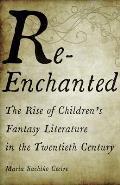
From Slate’s interview with Maria Sachiko Cecire, professor at Bard and author of Re-Enchanted: The Rise of Children’s Fantasy Literature in the Twentieth Century:
J.R.R. Tolkien and C.S. Lewis, of course, as many people know, were friends and colleagues, but they were actually working to reform the English curriculum at Oxford, in addition to writing their own fantasy.

They were the architects of this curriculum, which went into effect in 1931. And they really had an enormous role to play in the kinds of questions that were set in examinations, the texts that were required for undergrads to read; then this had this kind of huge knock-on effect in terms of what people were studying for the next nearly 40 years at Oxford. There’s still some vestiges of that curriculum in the Oxford education today. Then the younger authors I was looking at were Susan Cooper, Kevin Crossley-Holland, Diana Wynne Jones, and Philip Pullman. They all studied this curriculum and got their degrees between 1956 and 1968.

This curriculum at Oxford was really heavy on medieval literature, just at the moment when most other universities were going in the direction of modernism and the kinds of writing that we now associate with literary fiction in the 20th and 21st centuries. At Oxford they were doubling down on medieval literature and also looking at it not just as examples for linguistic analysis—which was how it had been primarily studied in the 19th century under philology—but really looking at it as literature. Really seriously asking students to meditate on both the English medieval past and also this idea of magic and enchantment. . . .

And for comparison’s sake, I also went to the archive at a few other universities, including Cambridge, which went in a really different direction from Oxford in the ’20s and ’30s—much more intentionally towards modernism, towards more contemporary texts, and cutting out medieval requirements for their undergraduate English degree.

And interestingly, Cambridge didn’t really have the same legacy of children’s fantasy writers. T.H. White was at Cambridge at a really interesting time, when there was still a medieval requirement, but right as they were ending it. If you compare his The Once and Future King to, say, The Lord of the Rings, they’re so different in the way they talk about the Middle Ages, with a different level of reverence. There’s anachronism in White’s writing, and pretty profound critiques of the warlike nature of the Middle Ages and of a lot of the nostalgia for that period. Whereas Tolkien and his students tend to be a lot more reverent of that material.
See previous discussions of Tolkien as a teacher of future fantasy writers in 2010 and 2011.

29 October 2014

“Wonderlands” Conference and Call for Papers

The University of Chichester’s Sussex Centre for Folklore, Fairy Tales and Fantasy is hosting a symposium on “Wonderlands: Reading/ Writing/ Telling Fairy Tales and Fantasy” on 23 May 2015.

The event is “Timed to coincide with the 150th anniversary of Alice’s Adventures in Wonderland, this event is primarily aimed at postgraduate students and early career researchers, although other scholars and the general public will be welcome.”

The call for papers says:
We are seeking papers which explore all aspects of reading, writing, and telling fairy tales and fantasy. In particular, we invite discussion of wonder lands in fantastical literature, classic and modern fairy tales, and contemporary oral storytelling.

Possible topics of focus include, but are not limited to:
  • Other worlds, otherworldliness, Wonderland, and wonder lands
  • Relationships between reading, writing, and/or telling fantasy
  • Contemporary scholarship in children’s and adult’s fantasy literature
  • Storytelling as a vehicle for the fantastic
  • Practice and performance of fairy tales
  • Fantastical non-fiction
  • Relationships between real and imagined wonder lands
  • Meta-textual conversations with classic fantasy literature
  • Imagining the fantastical world through illustrations and picture books
We also welcome paper submissions or panel presentations which include a creative or performative element.

Please submit abstracts of no more than 300 words (or panel proposals of 1,000 words) and a short personal bio to the organisers, Joanna Coleman, Joanne Blake Cave, and Rose Williamson at wonderlands.symposium@gmail.com. The deadline for submission will be 31st January 2015.
The keynote lecturer will be Oxford professor Diane Purkiss, who has also co-written as Tobias Druitt. As a promise or threat, the announcement ends, “The day will close with a series of performances from professional storytellers which engage with the theme of wonder lands.”

(h/t to Karen Graham at Telling Tales)

25 November 2013

“This gentle, kindly naturalist”

From the New York Times Book Review’s “By the Book” interview with Richard Dawkins:
Did you identify with any fictional characters as a child? Who was your literary hero?

I didn’t know children were expected to have literary heroes, but I certainly had one, and I even identified with him at one time: Doctor Dolittle, whom I now half identify with the Charles Darwin of Beagle days. This gentle, kindly naturalist, who could talk to nonhuman animals and commanded godlike powers through their devotion to him, is nowadays unfashionable — and even banned from libraries — because of suspected racism. Well, what do you expect? Hugh Lofting was writing in the 1920s, and the ubiquitous racism of England at that time can be seen in so much fiction, including Agatha Christie, Sapper (“Bulldog Drummond”) and many other popular writers for all ages. This is not to excuse it, but Lofting’s racism was paternalistic rather than malign and, in my opinion, sufficiently outweighed by the admirable anti-speciesism of all his books.
Dawkins grew up to be an evolutionary biologist, ethologist, and proponent of secular rationalism.

24 September 2013

Looking in on St. Nicholas

If I were in Manhattan Friday afternoon, instead of getting ready for MICE, I’d try to attend this lecture at the New York Public Library: “St. Nicholas Magazine: a Portable Art Museum”:
In November 1873, American publisher Scribner and Company published the first issue of a new illustrated monthly magazine for children, St. Nicholas Magazine: Scribner’s Illustrated Magazine for Girls and Boys. Contributing to its success was the editorial vision of its first and most influential editor, Mary Mapes Dodge, who was to create a new kind of magazine for children, one in which illustration and art education were important foci.

The greatest expression of St. Nicholas’ art education program is seen in its many reproductions of fine art and architecture from Antiquity, the Old Masters, and contemporary academic artists. These reproductions accompanied art historical information, illustrated fictional stories, or stood alone for the reader to contemplate.

St. Nicholas also contained the work of trade illustrators who would become famous through the distribution of illustrated magazines, including Howard Pyle, Jessie McDermott and Reginald Birch. Contained between the two heavy, matte paper covers were innovative and artistic layouts, typography, and decorative designs that consciously paralleled the styles of the predominate artistic movements, such as those associated with the American Renaissance and English Aestheticism, that were popular among elite, genteel Victorian Americas.
The speaker is Mary F. Zawadzi, an art historian and writer in residence in the Library’s Wertheim Study.

The picture above, courtesy of The Oz Enthusiast, is a poster advertising the publication of L. Frank Baum’s fantasy originally called “The Magic Cloak,” a titled that gradually changed into Queen Zixi of Ix. It probably underwent more rigorous editing at St. Nicholas than any other Baum fantasy; he usually worked with small publishers where he was a big fish and got a fair amount of deference. As a result, it’s one of his best.

01 May 2013

Editors Seeking Studies of Early African-American Children’s Lit

Anna Mae Duane and Kate Capshaw Smith are seeking papers on a little-studied subject: early African-American children’s literature. Their call for chapters in an anthology says:
African American childhood in the eighteenth and nineteenth centuries was a fraught proposition. On one hand, African Americans of all ages were infantilized by those in power. On the other hand, evolving constructions of childhood explicitly excluded African Americans: they were not cherubs dependent on motherly love, and they weren’t part of a private domestic sphere, and, the argument ran, they were never going to grow into self-sufficient adulthood. Perhaps it’s no surprise that we have not really thought about African American children’s literature in the years before 1900.

Yet as scholars such as Caroline Lavender, Karen Sanchez-Eppler, Courtney Wiekle-Mills, Robin Bernstein and others have shown, literature about childhood and aimed at children were rich sites for conveying—and rejecting—vital concepts of personal and national development that would translate into ideologies of race, class, gender, sexuality and citizenship.

This collection of essays seeks to recover and reframe the largely untheorized body of literature *aimed* at one of the nineteenth century’s most thought-provoking, anxiety producing, and boundary-testing subjects: the black child. What were black children reading? How did that material represent race, ideology, and selfhood to a young audience? How did black children imagine themselves as creative agents?

We welcome abstracts for essays to be considered for inclusion in the collection. Although we welcome a wide range of perspectives and methodologies, the main focus of each essay should be on African American children as readers, students, or authors. We do not seek essays that address the figure of the child in work aimed at an adult audience or in work that did not have a black child readership.

Possible sources and topics include, but are not limited to:
  • Children’s novels, short stories, picture books.
  • Schooling materials.
  • Religious publications (Sunday school, newspapers).
  • Poetry, pageantry, school plays.
  • Newspaper texts featuring African American’s children’s work or voices.
  • Conduct literature written for, or read by, African American children.
  • Antislavery literature written for, or read by, African American children.
  • Canonical African American writers’ engagement with children’s
    literature.
  • Recovery of understudied black writers who addressed young people.
Strategies of cross-reading and cross-writing:
  • What happens when African American children read literature not intended for them?
  • How do we theorize the relationship between women’s literature and children’s literature in the nineteenth century?
  • How does an awareness of early black children’s literature change our vision of the field or of particular authors?
The prospective book’s editors ask authors to send a detailed abstract of a paper (750-1000 words) by 1 July to Anna Mae Duane and Kate Capshaw Smith. Final drafts of 5,000-8,000 words will be due in November.

18 April 2012

A Taxonomy of Fantasy

This weekend I’ll be at the Society of Children’s Book Writers and Illustrators’ annual New England conference, this year in Springfield (Seuss Country), Massachusetts. I’ll be part of a panel on independent editors and the future of publishing, will teach a workshop on “Defining the Borders of Reality,” and may give away some door prizes.

“Defining the Borders of Reality” is really about fantasy literature, and I’m doing my usual thing of categorizing and defining types. In this I’m guided by such scholars as Farah Mendelsohn in Rhetorics of Fantasy, but I’ve ended up with my own system and labels.

To begin with, I call fantasy literature a “mode,” not a “genre.” My definition of “genres” involves reader expectations for plot while “modes” are defined mainly by setting, including the level of coincidence, action, and emotional reaction that characters of that world accept. Thus, in the phrase “paranormal romance,” the first word indicates the fantasy mode while the second defines a genre demanding certain plot points. Stories from many genres can be told in the fantasy mode. Conversely, a genre like mystery or romance can be told in the realistic, fantastic, historical, melodramatic, or farcical mode.

And then there are my labels for types of fantasy.

Immersion Fantasy. These stories take place entirely in a fantastic world where the laws of physics, mortality, biology, and other aspects of the universe we know don’t apply. Within immersion fantasy, there are many approaches: from “high fantasy” to “magical realism,” from traditionally rooted fairy tales to entirely new cosmologies.

Portal Fantasy. Protagonists travel from an ordinary, recognizable, and unmagical world into a magical one. The plot usually involves getting back home, often after setting things right in the other place. As Mendelsohn points out, portal fantasies are usually quest stories.

Intrusion Fantasy. Something magical enters the ordinary world, and usually has to be forced back, helped back, or experienced and declined. The world typically ends much as it was when the story begins, but the protagonists have learned a valuable lesson about life.

Shadow Fantasy. A world very much like the readers’ own turns out to have magical people or creatures hiding within it. These stories often revolve around protecting those creatures, or protecting oneself from them.

Dimension Fantasy. A world very much like the readers’ own turns out to have pervasive magical layers and forces that most people never perceive. The typical protagonist turns out to have some special aptitude or role in the magical dimension. The universe turns out to be a much bigger, scarier place.

Alternate-Life Fantasy. Through time travel, body-switching, or some other means, protagonists get a chance to view how their lives might be different. These books are usually about, well, learning how life can be different.

Have I left anything out?

01 December 2011

Rediscovering The Lost Farm

The Lost Farm by Jane Louise Curry is a really strange book. Especially by today’s standards, but also by the prevailing standards when it was published in 1974.

The cover painting is an accurate depiction of an important scene near the end of the story. You might think that young readers are supposed to identify with the blond boy. But no, the book’s central character is the little old bearded farmer, yelling at the boy to get off his lawn.

The Lost Farm begins with that character as a boy named Pete living in rural Pennsylvania in the 1920s. His ne’er-do-well junk-dealer father is about to yank him out of school so he can do more work around the farm. Curry thus sets up a clear conflict. She also describes the rural setting in poetic language at a length possible in the early 1970s but no longer.

The book takes a turn into fantasy as Pete discovers a village that’s been miniaturized, with a few mini-people trapped in it—including a spunky girl about his age. Pete promises to help her escape the man who’s done this to her town and restore her to her proper size. Another clear conflict, and the promise of some adventure.

Then the villain miniaturizes Pete’s farm, leaving him six inches tall. He’s stuck on that isolated landscape with his useless father, spunky grandmother, and livestock. The physics of all this are unclear, but Curry’s descriptions of the family’s new setting are once again vivid. And we have yet another conflict: never mind school, put aside the girl—how will Pete rescue himself?

Well, he doesn’t. His mule dies. His father dies. He builds a horseless carriage, but it doesn’t achieve anything. His grandmother dies. Pete grows old on the little lost farm, somehow surviving predatory wildlife, lack of supplies, winters, disease, and every other threat. Eventually he’s a lonely sexagenarian. Because that’s what kids want to read about.

In the end other people rescue Pete, including the boy on the cover, whom we’ve never seen before. It turns out that the spunky girl was restored to her natural size decades before. There’s a thin connection between her and Pete’s rescuers, but this plot resolution basically arrives as a deus ex machina. In sum, The Lost Farm breaks nearly every “rule” of creating a satisfying story for modern children. Or for this adult.

07 November 2011

Trying to Claim Fantasy Literature for Christianity

Reviewing two fantasy novels in the Jewish Review of Books back in 2010, Michael Weingrad asked “Why There Is No Jewish Narnia.” However, he starts with C. S. Lewis and J. R. R. Tolkien, which naturally points the discussion in a particular way. (We could do worse than ask whether there have been many Jewish dons at Oxford who felt secure enough to publish fantasy novels.)

Then Weingrad dismisses respected counterexamples by writing:
Haven’t modern Jewish writers, from Kafka and Bruno Schulz to Isaac Bashevis Singer and Cynthia Ozick, written about ghosts, demons, magic, and metamorphoses? But the supernatural does not itself define fantasy literature, which is a more specific genre. It emerged in Victorian England, and its origins are best understood as one of a number of cultural salvage projects that occurred in an era when modern materialism and Darwinism seemed to drive religious faith from the field.
No, that’s not what defines fantasy literature. It may be part of the definition of “high fantasy,” with its emphasis on magic-infused lands and epic battles between good and evil, but that’s only one part of the corpus. Weingrad tries to define fantasy as wholly separate from science fiction, where there are, he acknowledges, many Jewish authors. He also disregards all fantasy storytelling outside the prose form: no comics, no movies.

Weingrad’s critique immediately prompted replied from more knowledgeable critics like Farah Mendelsohn, Abigail Nussbaum, and Spencer Ackerman.

D. G. Myers just followed up with a Commentary essay titled “Fantasy Is a Genre of Christianity.” This is an even less tenable thesis, explored in less depth at less length. Myers can manage even that much only because he gets to define his terms: “The bedrock premise of fantasy, which cannot be waived without voiding the genre, is the existence of a spirit realm.”

There’s no “spirit realm” in, for example, Mary Norton’s The Borrowers, Walter R. Brooks’s Freddy the Pig, or E. B. White’s Stuart Little—only unseen corners of everyday life. Myers’s definition also excludes all fiction that provides a non-mystical explanation, however scientifically stretchy, for the unfamiliar.

Furthermore, the “spirit realm” is neither the creation nor the exclusive property of Christianity. It’s Platonist. The philosophical movement later labeled “Middle Platonism” infused early Christian theological writings, but its ideas are independent of that faith.

22 October 2011

Ruth Berman’s Quest for Bradamant

I’m pleased to post this interview with Ruth Berman, author of Bradamant’s Quest. This is a new novel about an old character, originally created in the late Middle Ages. Yet Bradamant is also the forerunner of the many female knights in fiction today, so this tale can speak to modern readers.
Bradamant’s Quest is set in a fantasy world that was immensely popular for centuries, but which we don’t visit much anymore: the “Matter of France,” or romances of Charlemagne. How did you decide to add to that saga? What does it offer that we don’t find in other great myths of the western world?

When I read the stories in the Incompleat Enchanter series by L. Sprague de Camp and Fletcher Pratt, many years back, their treatments of the worlds that Harold the I.E. visits made me interested in looking up and reading the books involved. That eventually led me to reading a translation of Ariosto’s Orlando Furioso, and I thought Ariosto’s Bradamant was a fascinating character, sure of herself and resourceful in going after her true love (a warrior in the enemy army’s forces? — no reason to give up, is her feeling).

Bradamant gets treated rather poorly in modern stories, being presented as a too-big, beefy, well-meaning-but-clumsy type in deCamp/Pratt, and as a rigidly military fighting machine in Italo Calvino’s The Non-Existent Knight. I thought there ought to be more adventures for Bradamant as strong without being therefore laughable or unpleasant, and eventually decided to do something about that.

Oberon also makes an appearance in Bradamant’s Quest. I know he’s got roots in the Middle Ages, but has he played a role in Carolingian romances before? Would we recognize him from A Midsummer Night’s Dream (or would he recognize himself)?

Oberon the Fairy King is a major character in the 12th century Huon of Bordeaux, Huon being one of Charlemagne’s knights. The 1534 translation of it into English is where Shakespeare got his Oberon. The name is equivalent to Auberon, which is equivalent to the German Alberich, meaning elf-lord, although Oberon would not recognize himself in the Alberich of the stories of the Volsung Saga/Ring of the Nibelungs. Huon’s Oberon is enough like Shakespeare’s to make them recognizable, for instance, in their power and in their inclination to befriend mortals, although Shakespare made important changes, such as introducing Titania and Robin Goodfellow into Oberon’s court.

The romance authors of medieval Europe freely added to each other’s work, as when Ariosto wrote Orlando Furioso to finish Boiardo’s Orlando Innamorato. These days, many people would call that plagiarism, or fanfiction (and which is more respectable?). What are your thoughts on this sort of collective fiction-making? Should we revise our ideas of originality and look at it differently today?

No one seems to object to modern Arthurian adventures. Jane Yolen likes to say that King-Arthur-and-his-knights make up one of the earliest shared-world settings, although by no means the earliest. Tennyson, when he was doing his retellings of stories from Greek mythology (and the same applies to his Arthurian adventures in his Idylls of the King) remarked in a letter to a friend that he did not like to re-tell a story if he thought it was simply a rechaufée, re-heated leftovers, but if he felt he had something to say that was more than could be found in the original, then he felt that his version was worth doing. And, as T.S. Eliot said: only bad poets borrow — good poets steal.

You’re a charter member of the Int’l Wizard of Oz Club, and you’ve been writing articles about fantasy literature and resurrecting lost stories for many years, as well as writing short stories. How does it feel to be publishing your first novel?

I’m delighted to have it in print. I remember some years back I was on a panel at a science-fiction convention about writing stories based on legends/myths. I tried to say something about Bradamant, and the moderator kept shutting me up, I think because she thought an unpublished novel could not be worth talking about. I take a good deal of satisfaction in thinking that now I can tell people about it, and if they think it sounds interesting, it’s possible for them to get it.
Bradamant’s Quest comes to us from FTL Publications of Minnesota, which offers a free peek at the first chapter.

19 October 2011

Ormondroyd Lost and Found

On Saturday morning, I finished reading Edward Ormondroyd’s Time at the Top, which features as its narrator a Bay Area–author named Ormondroyd. However, that character doesn’t quite match the author described on the back jacket flap: no kids, no day job. That led me to wonder about the real man.

On Saturday afternoon, I opened an email from author Marc Tyler Nobleman reporting that he was about to post Ormondroyd’s first interview about his writing career, in two parts.

Now that’s service.

Actually, the interview didn’t answer my questions, and in fact raised others. But it was very interesting, including this exchange:
Did you ever consider a sequel to David and the Phoenix?

I not only considered it, I was fool enough to write it. Disaster! I threw away the whole book.

What was the sequel about? When did you write it? Did you save no copy?

Well, the Phoenix was irrevocably gone, so I substituted a gnome-like figure, and he and David set out on a quest, carried by a flying suitcase...but of course without the old Phoenix it was as useless as Gone with the Wind without Scarlett O'Hara. I can't remember when I committed this literary crime. No copy. My wastebasket is a receptacle of no return.
I think that reflects how the character of the Phoenix so dominated that book, and David was fairly blank. Any sequel would also have risked undercutting the first book’s theme of accepting the cycle of life and death. Ormondroyd did write a sequel to Time at the Top, once again featuring an author named Ormondroyd, and I may have to look that up now.

20 March 2011

Dick Gray and Richard Grayson

Marc Tyler Nobleman, author of Boys of Steel: The Creators of Superman and an upcoming biography of Bill Finger, co-creator of Batman and Robin, recently alerted me to the sensational character find of 1903: The Boy Wonder, Dick Gray!

Appearing in one story in the pulp magazine Brave and Bold, Dick Gray was “athletic in figure and singularly agile in his movements”—but then so were most other dime-novel heroes.

In the Comic Buyer’s Guide, David Frank reported that “The Boy Wonder, or Dick Gray’s Marvellous Pump” is “about the adventures Gray gets into with his anti-gravity device.” It thus seems to be of a piece with the Stratemeyer syndicate’s Tom Swift series, L. Frank Baum’s Master Key, and similar young men’s tales from that age of technological wonder.

I doubt this 1903 magazine had any influence on the creation of Dick Grayson in 1940. Finger, Jerry Robinson, and Bob Kane weren’t even born when Dick Gray was pumped out. But the similarity of the characters’ names highlights one ubiquitous aspect of American pop fiction until recently: the WASPiness of its heroes and heroines.

Both Baum and Edward Stratemeyer had German surnames, but practically all their main characters had surnames from the British Isles. Two generations later, many of the first generation of superhero creators were Jewish: Finger, Bob Kane (originally Robert Kahn), Jerry Siegel, Joe Shuster, Will Eisner, Joe Simon, Jack Kirby (originally Jacob Kurtzberg), Stan Lee (originally Stanley Leiber), and so on. But they created heroes with names like Bruce Wayne, Clark Kent, Lois Lane, Denny Colt, Steve Rogers, Reed Richards, and Peter Parker.

That trend in popular culture both reflected and amplified the trend in real life for some Americans to shed their “ethnic” names. Which brings me to a real Richard Grayson.

Back during the national crisis over the edition of Tom Sawyer and Huckleberry Finn published without ethnic slurs, one small electronic press announced the publication of The Hipster Huckleberry Finn. It replaced the “n word” with “hipster.” The editor and publisher of that edition is a writer, teacher, and activist named Richard Grayson.

In this autobiographical essay he explains:

I was born Richard Arnold Ginsberg in Brooklyn on June 4, 1951, two years after my parents, Marilyn and Daniel, had married. When I was six months old, Mom and Dad changed our Jewish last name to the ethnically neutral Grayson.
At that time, superhero comics were in a doldrum. Robin was one of the handful of costumed heroes who continued to appear often in comic books—Batman, Detective, and World’s Finest—but even he had lost his cover slot on Star Spangled Comics.

The Batman newspaper comic strip had stopped years before. The low-budget movie serial Batman and Robin had appeared in theaters in 1949 and then disappeared, and there was no TV show in daily reruns.

As a result, most Americans might not have seen any particular meaning in the name “Richard Grayson,” aside from the “ethnically neutral” quality this man’s parents were seeking.

But as the former Richard Ginsburg grew up, superhero comics came back. He even read them:
I also was a big fan of superhero comic books. I proudly possessed the early issues of Justice League of America, Green Lantern, Spider-Man, and Daredevil. At 11, I would pretend to be The Flash – Fastest Man Alive – as I bicycled around the neighborhood, playing hooky from Hebrew school.
Alas, Grayson doesn’t discuss whether he identified with Batman’s Boy Wonder, or was teased for sharing that character’s name. Perhaps one day he’ll make a story about it.

01 December 2010

Finding a Lost Illustrator of Andersen

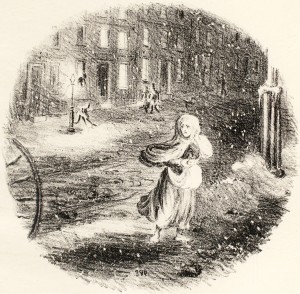
At the American Antiquarian Society’s Past Is Present blog, Laura Wasowicz describes how she identified the artist who produced this lithograph to illustrate an 1873 Boston edition of Hans Christian Andersen’s “Little Match-Girl.”

The trail led from the initials “S.G.P.” through two libraries, one misspelling, and the personal correspondence of the publisher. At the end was an upper-class woman, twenty-two years old, who undertook this illustration “to contribute something in aid of the Children’s Hospital.”

Or at least that’s how the publisher presented the situation to Andersen. Clearly, however, Sarah Gooll Putnam had serious artistic ambitions, and she painted portraits throughout her life. But because she was (a) female, and (b) too rich to have to work, she was seen as a talented amateur.

13 November 2010

Correction: When Edward Met Edith

Months back, I wrote an analysis of how Edward Eager’s 1954 fantasy Half Magic addressed history—in its setting in the past, in its depiction of change over time, and in its explicit allusions to E. Nesbit’s novels from decades earlier. I wrote that Eager set Half Magic around the period when he had first read Nesbit.

Fellow Oz fan and scholar Dee Michel recommended that I read Eager’s thoughts on the Oz series in his 1948 Horn Book essay “A Minority Report,” and in doing so I came across evidence that my supposition about Eager’s childhood reading was wrong.

Eager didn’t read Nesbit’s books as a child. He discovered them as a young father in the 1940s, and in this essay he thanked the “learned ladies” of the American children’s book establishment for cluing him in. Those ladies included Anne Eaton, Anne Carroll Moore, “Mrs. Becker, Miss [Bertha E.] Mahony and the rest.”

Their praise for Nesbit’s books sent Eager “vainly chasing through New York’s thrift shops and secondhand bookstores.” The books had gone out of print in America, and their owners apparently still treasured their old copies. By great pre-Amazonian effort Eager found enough to declare Nesbit’s “magnificent works” to be “the best children’s books, I am quite sure, in the world!”

An editorial note with Eager’s essay in the 1959 Horn Book Sampler says that Coward-McCann had reprinted Nesbit’s novels in the US only the year before. By then, Eager had made his own name in children’s books.

So my original argument stands: that Eager set Half Magic in the period of his own childhood, and that the book comments in part on that period and historic change. But Eager didn’t choose that setting because it reminded him of first reading Nesbit.

19 October 2010

Homer Price: “a universal and delightful brat”?!

Eric Gugler began a short essay in the November 1943 Horn Book like this:

When I thumb through this decidedly provocative bunch of illustrations made by Bob McCloskey for his new book, Homer Price (Viking), hundreds of tangent thoughts pop up.
Evidently not among them was “I should read this book.” Because it quickly becomes apparent that Gugler hadn’t read Homer Price.

“What a universal and delightful brat, this Homer Price,” Gugler proclaimed two sentences later, leading into a rhapsodic ode to mischievous boys:
They rings bells at front doors; when maids answer they snitch ice cream and cakes from the kitchen door and run away with bubbling glee; and they know they are never going to amount to much in the future unless they sell newspapers.
At no point in Homer Price or its 1951 sequel, Centerburg Tales, does Homer play any pranks like that. Instead, most of the time we see him working: in his mother’s hotel, in his uncle’s lunch room, at the greenhouse, at the library, in the town pageant.

For fun, Homer builds a crystal radio and goes to a movie, but he passes up fishing because of a job. Neither he nor his young friends makes trouble. Instead, it’s the adults of Centerburg who avoid work, put things over on each other, and tell outlandish tales. Level-headed, hard-working Homer helps to keep the town together.

Gugler was obviously less interested in reading McCloskey’s stories than in sharing “reminiscences of other boys I knew very well indeed.” Maybe he was busy, on deadline, and anxious to say nice things about “Bob’s” new book. He provided a lively disquisition on the “lovable bad boy” type established by Twain, Aldrich, Tarkington, Shute, and Peck. But Gugler didn’t know young Homer Price at all.

What was Gugler’s connection to children’s literature? How did he come to The Horn Book? He was an architect who helped design the West Wing of the White House. Among Gugler’s other work was the office of his good friend May Massee at Viking Press—editor of Homer Price. So this little essay looks like those excited but empty five-star Amazon reviews you can’t help suspecting were written by the author’s friends and relations.

The same issue of The Horn Book contained a better appraisal of Homer Price by James Daugherty, Newbery winner in 1940. He focused on its gentle satire of “the daily life of the Mid-Western small town” and McCloskey’s “solemn and devastating humor.” Daugherty noted how “Homer and his friends cope with, and master, such surprising emergencies as radio robbers, Superman, musical mousetraps, ferocious doughnut machines, housing problems, and mass production.” He didn’t neglect the delight and craft of McCloskey’s pictures, but it’s clear that Daugherty had read the text as well.

28 January 2010

A Heavy Contract for Baum and Denslow

David Loiterstein of Readex kindly called my attention to this item from the Helena Independent, dated 25 June 1900. It appears to be based on a press release from the Geo. M. Hill Company, a small Chicago publisher:

A Heavy Contract

Chicago, June 24.—What is said to be the most important contract of the kind ever made west of the Mississippi river was executed here last night. By its terms a local publishing company secures for five years the exclusive publication of the joint productions of L. Frank Baum and W. W. Denslow, respectively author and illustrator of “Father Goose, His Book” and “The Wonderful Wizard of Oz.” Messrs. Baum and Denslow are to produce at least one book a year and it is said that they are guaranteed royalties of $10,000 each annually.
The same item ran in other Midwest papers around the same time, reflecting regional pride.

I thumbed through Michael Patrick Hearn’s Annotated Wizard of Oz and Katharine M. Rogers’s L. Frank Baum: Creator of Oz, and didn’t see a mention of this contract. This sort of newspaper report was easily overlooked before Readex’s searchable database. And it sheds some doubt on a story both those books retell, based on many accounts from the Baum family going back to 1908.

According to that tale, Baum, after prodding from his wife Maud, went to Geo. M. Hill toward the end of 1900 and asked for an early payment of royalties in order to buy Christmas presents. He brought home the check without looking at it, and the couple was amazed to find that it was for thousands of dollars. Over $13,000, according to some versions, more like $3,000 if it was the same amount Denslow received about that time.

But this newspaper item indicates that Baum, Denslow, and Hill were already talking about $10,000 in annual royalties before the middle of that year. Even if that’s just a projection with some puffery for publicity’s sake, that suggests the Baums’ surprise was misplaced.

The item is also remarkable since The Wonderful Wizard of Oz had been printed only about a month before, as The Annotated Wizard of Oz describes. The Bookseller magazine reported in June that Hill had ordered a second printing of 5,000 copies as the company prepared for the Chicago Book Fair in July. (Again, publishers’ announced print runs are often inflated for publicity.)

Thus, Hill made the multi-book offer to Baum and Denslow when they had produced one huge hit (Father Goose) and appeared to be on the verge of enjoying another—indeed a smart time for a publisher to sew up a successful author team.

Baum and Denslow produced only one more major project together, Dot and Tot in Merryland, published by Hill in 1901. They soon had a falling-out, and the company went bankrupt in 1902. So this “heavy contract” didn’t last. And evidently it didn’t survive in the Baum family lore.

11 January 2010

Half Magic and History

On Friday, in an ongoing discussion of how the fantastic elements of The Storm in the Barn affect its status as historical fiction, I compared the book to another fantasy set in a historic period, Edward Eager’s Half Magic.

Monica Edinger responded:

while Edgar Eager does indeed set his tale in the early years of the 20th century, I don’t see that as particularly significant as far as the story goes.
The story of children finding a token that grants wishes, getting in some mild troubles, making their lives a little better, and then giving up that magic could indeed occur in any era. Eager unabashedly borrowed from E. Nesbit’s fantasy novels, just as Laurel Snyder borrowed a lot from Eager’s for her recent contemporary fantasy Any Which Wall.

However, it was clearly important for Eager’s storytelling enterprise that he chose a historical setting. The very first line of the book tells us that its events happened “about thirty years ago,” or in the mid-1920s. (Half Magic was published in 1954.) The narrator highlights period details for us, such as a steam-puffing fire engine (“the way it used to do in those days”) and silent films (“for in those days movies did not talk”).

Though the technology in Half Magic might seem quaint to the readers of 1954, it is nonetheless on the march. Eager even intertwines a new-fangled machine and magic when one of the family’s first wishes brings on Mr. Smith in his automobile. Later the narrator reminds us: “everyone did not own a motor car in those days.”

At another point (page 98, to be exact), Eager’s narrator draws a line in the kids’ lives between the period before they found the magic coin and the period afterward:
Meanwhile today they would have a good old-fashioned day out, the kind of day that had seemed the height of excitement to them, back in the time before the charm had crossed their path. They would put all their allowances together, go downtown on the street car and spend the day, have lunch and see a movie.
This passage makes sure we see change happening in the characters’ lives.

Thus, though the plot of Half Magic has nothing to do with the historical events for which we remember the mid-1920s (which are…? Anyone? Anyone?), it nonetheless keeps reminding its readers that:
  • This story takes place decades before their time.
  • Time is always passing, and life is always changing.
In fact, Half Magic takes place late in Eager’s own childhood—he was born in 1911. The pleasures he describes are undoubtedly the pleasures he remembered as he wrote the novel, his first for children. And foremost among those remembered pleasures are the books he’d read as a boy, particularly Nesbit’s fantasies. [CORRECTION: Although Eager set Half Magic in the period of his childhood, he didn’t discover Nesbit’s books until he was a young father.]

Nesbit published those tales starting in 1902, so they were up to two decades old when Eager read them. He obviously enjoyed those books despite their somewhat unfamiliar setting, and his own antiquated setting assures readers that they can enjoy adventures occurring decades before their own time as well. Indeed, we might even suspect that Eager designed Half Magic to take readers about halfway back to Nesbit.

Does its historical setting and historical themes make Half Magic historical fiction? Not in the sense that reading it immerses us in the lives of Americans in the past. It couldn’t because those people never had wish-granting coins, just speculative stocks. The supernatural elements that steer Half Magic’s plot make it a fantasy set in the 1920s.

TOMORROW: Back to The Storm in the Barn.

24 November 2009

Three Degrees of Maginel Wright Enright

I knew before reading it on Jacket Knack that illustrator Maginel Wright Enright was the sister of architect Frank Lloyd Wright. But I didn’t recall that she was the mother of author Elizabeth Enright.

Maginel Wright Enright illustrated Twinkle and Chubbins, L. Frank Baum’s pseudonymous fantasy for younger and brain-damaged children. (Can you tell I don’t think much of the book?)

Jacket Knack shows more of Enright’s work, as well as that of some contemporaries. Among them is Maxfield Parrish, whose first book-illustration job was Baum’s first children’s book, Mother Goose in Prose.

23 October 2009

Mary Sues of the 19th Century

Months back, I noted this passage from “Too Good to Be True: 100 Years of Mary Sue”, by Pat Pflieger. For those who have had the pleasure not to encounter a “Mary Sue,” the term was invented to classify some fanfiction writers’ tendency to insert original characters into established worlds—too-perfect characters who, it becomes clear, are stand-ins for the writers and all that they wish to accomplish or say in that world.

But the phenomenon well predates the moment adolescents had the bright idea of writing their own Twilight, Harry Potter, or even Star Trek stories.

Nineteenth-century versions appear in the pages of Robert Merry’s Museum. Founded in 1841 by Samuel Goodrich, by the time the magazine was absorbed by the Youth’s Companion in 1872, it had featured works by every major nineteenth-century American writer for children, from Goodrich to [Louisa May] Alcott, Jacob Abbott, Mary Mapes Dodge, and Sophie May.

It also published works by lesser literary lights, most notably the subscribers themselves, who made the magazine their own from 1857 to 1868. While boys tended to write non-fiction articles, girls most often wrote stories and poems—some about wonderful girls whose accomplishments and charms are tangibly appreciated by those around them.

Emily Martin, who in 1862 saves a sleeping Indian chief from certain death by bear; Maia, whose gentleness and kindness are extolled by animals and elves in 1858; Unella, a white child raised by Native Americans in 1865, so lovable that she holds the entire village in a gentle thralldom; even little Ellen, who dies beautifully of her mother's thoughtlessness in 1849—all have elements we associate with Mary Sue.
Most of Pflieger’s essay is about examples and traits of the modern Mary Sue. But it’s refreshing to realize that she’s always been with us.

Check out Pflieger’s website on “Nineteenth-Century American Children and What They Read” for more images and stories from Robert Merry’s Museum and other popular magazines of the era.

20 August 2009

“Two Kinds of Fantastic Fiction”?

In a foreword for the second collection of Neil Gaiman’s Sandman comics, Clive Barker wrote:

May we open this celebration of the work in your hand by defining two kinds of fantastic fiction? One, the kind most often seen in horror novels and movies, offers up a reality that resembles our own, then postulates a second invading reality, which has to be accommodated or exiled by the status quo it is attempting to overtake.

Sometimes, as in any exorcism movie--and most horror movies are that, by other names--the alien thorn is successfully removed from the suppurating flank of the real. On other occasions the visitor becomes part of the fabric of “everyday” life. Superman is, after all, an alien lifeform. He’s simply the acceptable face of invading realities.

The second kind of fantastique is far more delirious. In these narratives, the whole world is haunted and mysterious. There is no solid status quo, only a series of relative realities, personal to each of the characters, any or all of whom are frail, and subject to eruptions from other states and conditions.

One of the finest writers in this second mode is Edgar Allen Poe, in whose fevered stories landscape, character--even architecture--become a function of the tormented, sexual anxious psyche of the author; in which anything is possible because the tales occur within the teller’s skull.

Is it perhaps freedom from critical and academic scrutiny that has made the medium of the comic book so rich an earth in which to nurture this second kind of fiction?
Barker goes on to praise Gaiman’s comics for achieving the latter effect, which is also what his own stories are known for.

I took a moment to consider Barker’s dichotomy and realized that I could think of at least three other types of fantastic fiction:
  • Our reality coexists with another, where fantastic or supernatural rules apply, but the two realms are largely separate. Often these stories are narratives of journey and return, as in Alice in Wonderland, The Wonderful Wizard of Oz, or The Phantom Tollbooth.
  • Much of the setting seems like our reality, but there are magical elements. Unlike the situation in Barker’s first group, however, those supernatural elements are not part of “a second invading reality” to be rooted out, but a recognized part of life, as in the world of Diana Wynne Jones’s Chrestomanci or James and the Giant Peach.
  • The entire story takes place in another reality quite unlike our own, where magic or other forces apply, but that reality is as firmly grounded and consistent for the characters as this reality is to us. Examples include high fantasy of The Lord of the Rings.
And perhaps more as well.

I suspect Barker’s vision was narrowed by his experience writing horror, seeking to create “fantastic fiction” at its most frightening rather than exploring other emotional goals. But this was back in 1990, and since then he's stretched in many other approaches to fantastic fiction.