Showing posts with label YA or not YA. Show all posts

30 September 2017

Pocketing the Bad Machinery Series

I heartily enjoy John Allison’s Bad Machinery graphic novels, following a team of teen detectives in the fictional mid-sized city of Tackleford, England.

Allison created these stories first as webcomics, and they retain that form’s rhythm. Each page has a payoff of its own. The narrative can jerk ahead in time from one to the next. That serves the sprawling stories well since they’re as much about upper-school personalities and the British class system as that term’s mystery.

Allison drew his pages to the dimensions of a computer screen, about half again as wide as they are tall. As a result, the first print editions were more than a foot wide, floppy and hard to shelve. I loved the stories, but I didn’t have space for them all.

Oni Press has started to reissue the Bad Machinery books in “Pocket Editions,” a shade less than nine inches wide. That makes them the same size as the seventh and latest volume, The Case of the Forked Road, which Allison created in a more traditional vertical format for print.

I was worried, however, that my aging eyes wouldn’t be able to read the balloons on the smaller pages. But I took a chance on the first two volumes, The Case of the Team Spirit and The Case of the Good Boy, and my eyes worked fine. While I still don’t see as many commas of direct address as I’d like, Allison’s verbal wit comes through just as well as his visuals.

(In addition to the seven Bad Machinery novels, one of the Tackleford teens, Charlotte, crosses over into another of Allison’s series in Murder, She Writes, set in the cutthroat world of children’s publishing. It’s a fine introduction to Allison’s work.)

17 July 2017

Airlocked-Room Mystery

In 2002, M. T. Anderson began his novel Feed with the line, “We went to the moon to have fun, but the moon turned out to completely suck.”

The first narrative page of Stuart Gibbs’s Space Case from 2015 includes the line, “Life in outer space sucks. Believe me, I know.”

I note that parallel not to underscore the similarity of the two books in the science fiction mode, but to introduce how they zoom off in different directions from that point.

Anderson wrote a young adult novel that took place mostly in its enervated narrator’s head and conversations. The big dramatic turns are shopping expeditions and a fatal disease. It turns out the moon isn’t the only place that completely sucks.

Space Case, in contrast, is for “Ages 8-12.” It’s plot-driven, not character-driven. The hero’s sucky life on the Moon gets a jolt of excitement from a mysterious death that only a twelve-year-old can solve. With a limited cast of characters, the lunar base a fine set-up for a murder mystery.

In the end, however, the science fiction wins out over the mystery in Space Case. The explanation for the death turns out to involve a scientific discovery that the narrator and readers weren’t privy to earlier in the story. Though that resolution’s beyond the bounds of current science, it’s not beyond the bounds of a science-fiction fan’s imagination.

13 July 2017

What the New Spider-Man Comes Home to

Back in 2014, it was widely reported that Captain America: The Winter Soldier was a superhero movie crossed with a 1970s political thriller. That’s why the sight of Robert Redford, star of Three Days of the Condor, All the President’s Men, and Brubaker, in the film was so resonant.

In the same way, I think Spider-Man: Homecoming as a superhero movie crossed with a 1980s high-school romantic comedy. The sort of movie on which John Hughes made his name. The genre that such other talents as Cameron Crowe, Martha Coolidge, Amy Heckerling, and Savage Steve Holland contributed to.

In the midst of the usual superpowered action and angst, there are a lot of laughs about the culture of high school, as seen from the student perspective. Adults are either petty tyrants or ineffectual scolds (even Captain America). High-school rituals like the morning news bulletin, homecoming dance, and academic decathlon are both laughable and life-or-death important. Everyone else seems to be having more fun.

In many ways, the high school in Spider-Man: Homecoming is a welcome update to the schools in those earlier movies and in the original Spider-Man comics. Peter Parker attends a high school devoted to science and technology, so by older standards everyone’s already a nerd. His rival Flash Thompson isn’t the football captain; he just has a big mouth and sharp tongue. And the student body is very ethnically diverse.

Spider-Man: Homecoming doesn’t seem shy about its cinematic pedigree. The movie even includes a clip from Hughes’s Ferris Bueller’s Day Off, an iconic example of the genre. The soundtrack features the Ramones, the English Beat, and A Flock of Seagulls. The homecoming dance has an ’80s theme, which would be exotic for characters born in this century but is nostalgic for some of this movie’s target audience.

My friend Dan Mazur has said that he used to enjoy Spider-Man comics and their common theme of “With great power there must also come—great responsibility!” But eventually he noticed that almost every story came back to “With great power there must also come—great responsibility!” And he began to think that comics should find more to say. [More on that here.]

That’s not the theme of this Spider-Man movie, however. It’s not an origin story, as in Amazing Fantasy, #15. We don’t see Peter Parker bit by the spider, we don’t see him try pro wrestling, we don’t see him ignore the burglar who kills his uncle. At no point does he really think about tossing everything away or just showing off, as Peter has occasionally done in the comics and previous movies.

Instead, when Spider-Man: Homecoming starts, Peter is already determined to take on great responsibilities as a costumed crimefighter. Indeed, he’s too eager. The major moment of character growth is actually stepping away from big, flashy responsibilities in favor of staying home. The Homecoming subtitle refers to how the story immediately follows from Captain America: Civil War, the high school dance, and Peter’s decision to focus on his own neighborhood.

The main theme of this Spider-Man is thus the same as those earlier high-school movies: stay true to yourself and your real friends, and you’ll get through this.

12 December 2015

Underestimating an Audience

Earlier this week I attended an unusual book event at the Public Library of Brookline.

Author M. T. Anderson read the introduction of his new nonfiction book, Symphony for the City of the Dead: Dmitri Shostakovich and the Siege of Leningrad. He spoke about Shostakovich’s String Quartet No. 8, composed well after the war but perhaps looking back on it. Then the Arneis Quartet performed that work. nd finally Anderson took questions.

The audience was big enough that the librarians had to bring in more chairs, which is always gratifying for event organizers. Always better to underestimate turnout by a little than to overestimate. As at most cultural offerings, the audience leaned toward the senior side rather than Anderson’s usual readership of teens and middle-graders.

There were some kids there with their parents. I assumed they were fans of Anderson’s Pals in Peril! series. I wondered what they were thinking about this much more serious presentation, with historical/musical analysis of a composition that even some classical music fans find puzzling.

During the question session, one of those kids eagerly raised his hand. He was sitting with a friend the same age and one of their fathers. He had a bowl haircut and a big hole in one of the knees of his trousers. I wondered, how far off the topic of this event was his question going to be?

“I read your book,” he told Anderson. “How long did it take to you find out all this stuff?”

Five years of research, Anderson explained. And we all learned something.

25 November 2015

An Update to Parrotfish for This Historical Moment

Ellen Wittlinger’s article in The Horn Book about updating her novel Parrotfish (published in 2007) is testimony to changes in society and in language.

Wittlinger’s novel is considered the first modern young adult novel with a transgender protagonist. In writing it, she consulted with Toby, a twentysomething friend of one of her children who was female-to-male transgender. That was only ten years ago, but the first edition’s language was already out of date.

Wittlinger writes:
In the ALAN Review interview, and often in the original edition of the book, I used the word transgendered. This usage is no longer correct. If you say, for example, that paper has “yellowed,” something has happened to the paper to make it yellow. But “yellow paper” has always been yellow, just as transgender people have always been who they are — nothing has acted upon them to make them transgender. As the GLAAD Reference Guide points out, “You would not say that Elton John is ‘gayed’ or Ellen DeGeneres is ‘lesbianed,’ therefore you would not say Chaz Bono is ‘transgendered.’” Scratch the “-ed” ending.

But the word that bothered me — and critics — most was tranny. A decade ago, Toby felt it was a word that transgender people would use amongst themselves or to refer to themselves, and that’s how I used it in the book. But the word has evolved to be defamatory. GLAAD’s entry says, “Please note that while some transgender people may use ‘tranny’ to describe themselves, others find it profoundly offensive.”
In this age of digital publishing, it’s relatively easy to make such changes in electronic books and new printings. The existing paper copies of Parrotfish will, of course, remain the same. Wittlinger also states that 2007 remains the novel’s “historical moment” even with the terminology changes.

She also expects further change in this area of language. When GLAAD issued the ninth edition of its Media Reference Guide in 2014, it stated it had been publishing that reference for “over 15 years.” At 66 pages, with a lot of white space in the design, it’s not a hefty text. Nonetheless, at the pace it’s been revised so far, that ninth edition will need replacement in 2016.

Given how sensitive we are these days about language and other signifiers, I wonder how soon there may be complaints about print copies of Parrotfish being not just of its historical moment, but insensitive. It took only three days after Wittlinger’s essay appeared for a pseudonymous commenter to take issue with its spelling of “cis-gender”—a very new word that’s appeared in three different forms (“cisgender,” “cis-gender,” and “cis gender”) in news stories this month.

29 December 2013

Young Justice Time

Last month the Nerdy Show podcast interviewed the creators of the Young Justice TV show, Greg Weisman and Brandon Vietti, on the release of a videogame tied to the show.

That game is set between the TV show’s two seasons, which take place five years apart—one of the striking ways this cartoon used narrative time. In addition, each episode and each sequence have precise stamps of time and place (which Weisman and Vietti said proved to be a real headache), and the companion comic book had to fit into the same timeline.

In the interview Weisman explained how showing the passage of time was integral to the show’s main themes and narrative:
We felt that we were doing a show about growing up, gaining responsibility, gaining powers, gaining experience. . . . The first season takes place over six cohesive months, from July 4 to January 1, and our second season, and this was always the plan, takes places from Jan 1 to July 4, so it’s six months cohesive as well. . . . So in one sense we were always doing “a year in the life,” it’s just that half the year took place five years ago.

In order to tell a story about growing up…and the life of a teenager in particular, you just can't show that in six months or even in one year. And so if you’re going to show how Robin has evolved, or rather what I should say is Dick Grayson has evolved, then we want to see him as Robin in season one and Nightwing in season two. [We want to see him] advance from being an incredibly competent but still relatively immature thirteen-year-old kid to being a leader. You’re not to going to see that over the period of six months. . . . You needed to see him become Nightwing, you needed to see him become a true sort of heir to Batman, whether he wanted to or not, and that meant jumping. So it made the time jump somewhat inevitable. And I don’t just mean Dick Grayson, it was true of Wally West and Artemis and everyone who was a lead in season one—we really wanted to see…how they grew.

And so the time jump, I’m not saying it was planned from moment one, but it was something that we talked about from really early on in the development of the show, and certainly by the time we were in…preproduction of season one we knew we were going to do the time jump for season two—assuming we got a season two.
The show never got a season three, so we don’t know what Weisman and Vietti might have had planned for that season’s timeframe.

Both Weisman and Vietti are working on new projects. For Weisman, one is a new series of novels about a teen-aged girl in the Caribbean, starting with Rain of the Ghosts.

16 November 2013

Print on Demand Has Gone Too Far

On Thursday I noted a website that allows customers to insert their names into The Wonderful Wizard of Oz and other classic (i.e., public-domain) works of literature. As disturbing as that prospect might be, it wasn’t the aspect of the site that worried me most.

Even more alarming, the business offers generic romances, mysteries, and “teen books” ready for customization and delivery. What are the “teen book” choices now?

  • Black Lace - Paranormal Romance
  • First Bite - Vampire Romance
  • Night Wolf - Werewolf Suspense
  • Prom & Prejudice - High School Fun
  • Sea Spell - Fantasy Romance
So one reason publishers are telling us that paranormal romance is over-published might be that the offerings have become so generic that final texts can be produced by machine.

As with the classics, the site asks customers to enter certain traits for each character—up to nineteen characteristics. To generate a preview requires only a handful of traits, such as name, gender, and hair color. Of course, this can be the result:
After a pause, Abelone said, "Whats with the third clue?"

Preservia re-read the clue and looked at the numbers.

"It just looks weird to me," Abelone told Preservia. "The number of words doesn't seem to fit."

The two pondered the list silently, playing absently with her light brown hair.
(Is that last line an editing error or a hint of something more erotic?)

Even the generic novels aren’t what really bugs me about this site. No, that irksome detail is the site’s name: BooksbyYou.com. It says, “You co-author our personalized novels…” Those titles appear under categories like “Romance By You” and even “Classic Book By You.”

That suggests that the only thing involved in co-authoring a novel is to choose the name and superficial characteristics of the major characters. The characters’ personalities and desires, the plot, the voice, the setting, even the copyediting—those are someone else’s responsibilities.

18 November 2012

A Sidekick in the Pants

Sidekicks has a mighty “tween”-looking cover for a book that starts out with a boner.

In fact, teen-sidekick-getting-an-erection was the starting-point for novelist Jack D. Ferraiolo, as he explained on his blog:
I was a full-fledged Batman freak... and being that this was the early eighties (and the Batman comics from the 70s were still pretty available), the DC writers/artists were continuing the process of aging Robin up. I remember…looking at a comic of a late teen/early 20’s Robin and thinking, “Man, he should really cover up.” Here he is fighting hardened criminals – thugs, thieves, murderers – and he's wearing the tiniest pair of green jockey shorts imaginable. And no one mentions it?  I mean, not one street tough has something to say about Robin’s itty-bitty bikini bottoms? Especially with all those high kicks he was throwing around?
Actually, Robin’s friends had been calling him “Shortpants” for years by then. Marv Wolfman and George Pérez acknowledged the oddity of an eighteen-year-old in trunks as they discussed the early New Teen Titans. Mention of Dick Grayson’s bare legs was forbidden only for villains and, of course, Bruce Wayne.

Then came Frank Miller’s The Dark Knight Returns and more emphasis on realism/grittiness in superhero comics. In 2007, even DC addressed the erection question in Nightwing Annual, #2, which shows a late-teens Robin wishing for a longer cape and a minute to compose himself after getting too close to Batgirl.

Ferraiolo’s prose novel examines the plight of the adolescent sidekick through the voice of Bright Boy, ward of Phantom Justice. Their relationship is obviously modeled on that of Batman and Robin. As a dark-caped crimefighter, Phantom Justice says, “Good soldier”; he talks about “embracing the night” but can’t connect with anyone emotionally. There’s even an Alfred figure, a butler and voice of common sense.

However, in this world some people have been born with extra strength, speed, and/or intelligence. Phantom Justice and Bright Boy aren’t “badass normal” like Bruce Wayne and Dick Grayson. They’re “plus-plus.” And while their world has mad scientists with amazing inventions, there’s no Wonder Woman, Green Lantern, or Spectre to keep them from the top of the pecking order.

Reviewers obviously new to the superhero genre seem struck by the drastic reversals built into the plot, but those are common in adventure comics. What seems fresh to me is the realistic dialogue between the two adolescents feeling their way into a complicated love affair. On the downside, there are pages and pages of exposition.

I thought the biggest flaw in Sidekicks is that it ends with no “price of fantasy,” as Ellen Howard has termed it. At the start of the book, protagonist Scott feels like a nobody in high school and an embarrassment in the media—those are the costs of being a superpowered hero. (In addition, Scott’s parents died in an accident when he was little, but—unlike the ache that drives the Harry Potter books, even though Harry never knew his parents—we don’t feel that loss.)

At the end of Sidekicks [and that means SPOILERS AHEAD], Scott has solved the problems that bothered him at the start. He’s got a girlfriend, and pals, and cooler clothes, and public adultation, and freakin’ superpowers. For a while it looks like he has to pay a big price—he thinks two of the people he loves have died. But everyone turns out okay in various futuristic ways. The only person he really loses is someone whom he could never warm up to. Scott even manages to come out on top of the Oedipal conflict. It’s total wish-fulfillment with very little cost. [End of SPOILERS] But, as with the plot reversals, that probably won’t look like a flaw to teen readers not yet jaded about this genre.

Which brings me back to that cover. Amulet designer Chad Beckerman has shown how it went through a lot of changes, starting with a more realistic close-up of the main character (wearing braces, though I don’t think they’re mentioned in the book) before ultimately ending up with the art above. One intermediate version appears to the left. Twice, Beckerman writes, the design sketches had “too much crotch.” Yet “too much crotch” is exactly where the story starts.

Ferraiolo writes that he’s heard some criticism (from adults) and lost some library speaking gigs because people thought the novel was inappropriate for younger readers. I think the story’s quite appropriate for young adolescents. But the final cover’s cartoony art, and our culture’s assumption that all superhero stories are appropriate for kids, may suggest to some adults that this is a book for the middle grades.

05 November 2012

With YA Power Comes YA Responsibility?

At the CBC Diversity blog, author and digi-editor Daniel Nayeri shared an essay on an apparent double standard in discussions of Young Adult books:

These days every book festival has a YA panel, and every panel has a moment when a well-meaning attendee will stand up and ask: Are YA novels becoming more perverse? . . .

several times I’ve heard authors say, “Well, we can’t take responsibility for what a reader will take from a book. It could be anything.”

Dylan Klebold and Eric Harris could have been reading Judy Moody just as easily as The Catcher in the Rye.

It’s a tempting idea for anyone who has ever written anything. You write what you write. Readers take whatever they want from it. . . .

ten minutes later—still at this hypothetical YA panel—a different panelist will mention all the good that their book might have done. A young fan wrote in with news of recovery, and the author glows with pride. . . .

We believe in the power of writing, and we accept the good it can cause in the lives of young readers, but we reject even the notion that it can also do harm.
In fact, the CBC Diversity blog itself is based in part on the idea that books can harm young readers by not portraying a diverse set of people or by portraying certain people in insulting or stereotypical ways. That acknowledges the power of writing. 

17 September 2012

Upcoming Events in Boston Teen Lit

On Tuesday, 18 September, Boston GLOW is sponsoring two panel discussions on the theme of “Fight Like a Girl” at Hosteling International, 19 Stuart Street in Boston.

The middle-grade panel (ages 8-12) starting at 5:00 P.M. will feature authors Linda Mullaly Hunt, Padma Venkatraman, Erin Dionne, Jennifer Carson, and Ellen Booraem. The YA panel (ages 12+) follows at 7:00, and will include Terry Farish, Gina Damico, A.J. Paquette, Diana Renn, and Susan Carlton.

Boston GLOW is “a nonprofit aimed at fostering leadership skills among girls and women.” Its poster for the event is here.

The Boston Teen Author Festival is being organized by Emerson College’s publishing-program undergraduates with support from the Boston Book Festival. It is scheduled to take place on Sunday, 28 October, from 1:00 to 6:00 P.M., at the Bill Bordy Theatre of Emerson College, 216 Tremont Street in Boston.

Authors scheduled to attend are A.C. Gaughen, Amelia Atwater-Rhodes, Caitlin Kittredge, Daniel Waters, Diana Renn, Erin Dionne, Huntley Fitzpatrick, Jack Ferraiolo, Karsten Knight, Laurie Stolarz, Leigh Fallon, Marissa Doyle, Steven Goldman, Susan Carlton, and Wendy Wunder.

22 July 2012

Dick Grayson’s First Kiss

Batman, #107 (Apr 1957) contained a story from Bill Finger and Sheldon Moldoff titled “Robin Falls in Love.” According to the Batman volume of the Encyclopedia of Comic Book Heroes, this was the first time Robin the Boy Wonder developed a crush on a girl.

Robin rescues Vera Lovely, a fourteen-year-old figure skater. She kisses him; I haven’t seen the panel in question, but I assume it was an unreciprocated kiss on the cheek. [ADDENDUM: The Robin Appreciation Group on Facebook have kindly posted that panel, confirming my hunch.] Nonetheless, for a while he’s gaga, with little red hearts orbiting around his head.

But at the end of the story, Robin and Vera agree to be just good friends, and the situation returns to the status quo ante.

In seven stories of the early 1960s, Betty Kane comes to Gotham and takes up the mantle of Bat-Girl, mostly because she has a crush on the dreamy Boy Wonder. For a long time he doesn’t return her feelings.
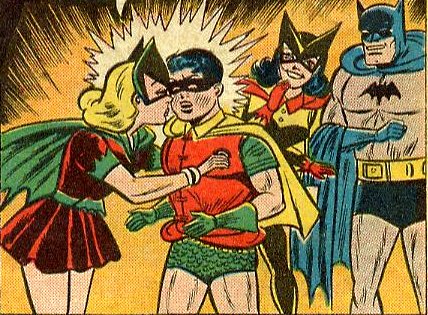
In “Prisoners of Three Worlds” (Batman, #153, Feb 1963), Finger and Moldoff showed Bat-Girl finally getting her wish. The teen crime-fighters share a full-on, lip-to-lip kiss. At the end of the story the young masked couple even goes off together, presumably to do some more necking.

But that’s the pre-“New Look” Dick Grayson. It’s not the Dick Grayson of the 1986-2011 DC Universe. His first kiss appears in the story “Grimm” in Batman: Legends of the Dark Knight, #149-53. (Since that magazine told stories outside the concurrent Batman continuity, it’s possible that this was yet another version of Dick Grayson, but I’m assuming not.)

In this story, Dick is eleven years old. It’s about a month after he started to patrol Gotham City as Robin the Boy Wonder, about two months after he became Bruce Wayne’s ward. (So much for years of careful training.) Batman and Robin are still struggling to trust themselves as a team and a family.

One night Robin chases down a young teen thief called Wily Wendi. She nearly kisses him, as shown in the panel at top, and slips away. After that, Dick can’t get Wendi out of his mind.
He sits in his oddly cluttered room “thinking about The Girl” and puzzling over “such a strange feeling rippling through me.”

In the adventure that follows, Robin leaves Wayne Manor to go into the underground world of Mother Grimm, where Wendi and other orphaned children live. There are various completely unbelievable twists, spectacularly illustrated by Trevor Von Eeden and José Luis Garcia-López. Von Eeden’s website discusses the background of the story and displays some of the line art.

Mother Grimm’s haven catches on fire. Batman and Robin manage to rescue all the children, with Robin carrying Wendi from a burning hospital. And at last they really kiss.
How do we know that’s this Dick Grayson’s first kiss? Because he tells us (even if he doesn’t admit as much to Wendi).
The story ends with Mother Grimm and her twin sister, both murderous loons, disappearing down a raging river, and Batman having to find new homes for all of the orphans. The whole experience cements Dick’s relationship to Bruce, and his confidence as Robin.

And what about Wendi? Dick, narrating the story in his third Nightwing costume and thus in his mid-twenties, tells us she’s “getting a master’s in journalism.” The art shows us that he keeps tabs on her through the bat-computer. The caption says she’s “just as…memorable” for him as before.

But are they still in touch in any way? Might he run into her in Gotham City, as either Dick Grayson or Nightwing? J. M. DeMatteis’s script leaves a loose thread just perfect for fanfiction, but I couldn’t Google up a single story about Wily Wendi.

How long will it take now before such a story appears?

18 July 2012

The Influence of Middle-Grade Fiction on Wes Anderson

Movie director Wes Anderson, born in 1969, grew up reading the children’s books that librarians praised in the 1970s. Not that there’s anything wrong with that.

That influence was clear the moment that the narrator of The Royal Tenenbaums tells us that two of the siblings had lived surreptitiously in the Metropolitan Museum of Art, just as in E. L. Konigsburg’s From the Mixed-Up Files of Mrs. Basil E. Frankweiler, Newbery winner for 1968. That scene took less than a minute, as I recall; any longer, and it would have moved from homage to outright theft.

Anderson of course adapted Roald Dahl’s The Fantastic Mr. Fox, published in 1970.

According to Hollywood.com, Anderson had some more fantastic middle-grade models in mind for his latest movie, Moonrise Kingdom:
…Anderson returned to many of books and movies he loved as a kid. Anderson recalls Madeleine L’Engle’s A Wrinkle in Time [Newbery Medal, 1963], Mark Twain’s Huckleberry Finn (which the director suggests shaped the characterization of his young hero Sam Shakusky) and Susan Cooper’s ’60s [actually 1965 and 1973-77] fantasy series, The Dark Is Rising [Newbery Honor in 1974, Newbery Medal in 1977].

Anderson calls the first book in the saga, Under Sea Under Stone, “a tease,” in that at the core of the epic tale was a touching family story. But that didn’t stop him from immersing himself in the more fantastic elements as a kid.
Anderson was right in detecting something different about that first volume: Cooper didn’t envision the more fantastic sequels when she wrote it. In the US it even came from a different publisher. The epic qualities arrive in the second volume:
“There’s a poem that includes all these different symbols and talisman, and there’s this whole sort of mythology associated with it,” Anderson fondly remembers. “But it does not have the complexity of Tolkien. It’s young adult novel feeling, from the ’50s, ’60s, so there’s a sort of simplicity at the same time that there’s a very fleshed-out fantasy world. I remember carrying and wearing objects that I was imbuing with the powers of these talismans that were in the series.”
I don’t think the term “young adult” applies to any of those books, however. (Even Huckleberry Finn is either middle-grade or adult.) They’re all middle-grade novels, most about finding capability instead of finding identity. But of course “young adult” is a hot term today.

TOMORROW: The greatest influences on Moonrise Kingdom.

14 July 2012

How Teen Boat! Was Launched

Adolescence is a period of change, but in our culture we paradoxically view it as a period of change into what you really are the whole time. Almost all popular-media stories about teens consciously trying to change themselves end with some level of failure for not being honest about their true selves. Instead, our modern stories emphasize self-acceptance, recognizing the value of what you are all along. Whether that’s a purely Good Thing is another matter.

Which, by a roundabout course, brings me to Teen Boat!, a new collection of comics adventures by writer Dave Roman and artist John Green. Little Willow’s interview with Roman at Bildungsroman dredges up the start of this tale:
…the inspiration came to us while we were on a bus. Long trips can often lead to loopy thoughts, especially for comic creators. One minute John Green and I are discussing ’80s cartoons and the spectrum of cool vs. less-cool transformation powers, then we’re talking about imaginary boardroom meetings gone wrong, and before long we were pitching tag lines like “The ANGST of being a teen, the THRILL of being a boat.”

It easily could have stayed a joke amongst ourselves, but we felt compelled to share our idea of a teenager who transforms into a yacht with all our cartoonists friends. The more they laughed, the more John and I were motivated to turn the silly premise into something real. And one of the many beautiful things about comics is there's very little stopping you from making that happen.

Our first Teen Boat! books were printed on a black and white photocopier, hand stapled, and hand sold for 50 cents each at indie comic shows. Ten years later, it’s a full-color hardcover book sold in bookstores everywhere and endorsed by the Junior Library Guild!
Specifically, Teen Boat! appears to have been inspired by Turbo Teen, a 1984 animated cartoon about a boy who makes temperature-sensitive shifts to and from being a car. Hard to imagine why that show lasted only twelve episodes.

Teen Boat! began as a series of black-and-white minicomics parodying such adventures through a adolescent hero who can change into a small yacht. It grew into a substantial (though unfinished) collection of stories from Clarion, now fully colored (by a team that included Braden Lamb).

Mercifully, the collection doesn’t include an origin story. We have no idea how Teen Boat came to be both a boy and a boat. (In one flashback panel he has a mom.) Nor does he have a secret identity—his name is Teen Boat. But we don’t need those elements of the classic superhero narrative. All that matters for these stories is that our hero is stuck/blessed with being both a boat and a teenager.

Beyond that premise, Teen Boat! floats on an ocean of North American teen-comedy-adventure stories from cartoons, sitcoms, and comics. We see the rich and jockish bully, the pretty exchange student, the inveterate rule-breaker, and other familiar high-school types. Teen Boat’s best friend climbs in through his bedroom window as on Clarissa Explains It All or Doogie Howser, M.D. Stories revolve around the class trip, the big dance, the school election, the driving test, the mystery that only a teen-aged amateur sleuth can solve, and other common rites of passage.

Yet Teen Boat! goes deeper than parody. As other have noted, including the AV Club and Hal Johnson at Paste Magazine, these stories has real heart. Just because the situations that teenagers find themselves in can easily be parodied doesn’t mean the underlying emotions aren’t real.

Teen Boat’s everyboat quality makes him an appealing hero. While young readers may laugh at the parodic touches, they may also recognize their own concerns in him. And when they see that even Teen Boat worries about skin blemishes or how to buy “nautical accessories,” might that offer a little more perspective on their own angst?

09 July 2012

James Treadwell: “Teenagers are basically fantastical beings”

My conversation with James Treadwell about his new novel, Advent, wraps up with a question about the book’s young protagonists.

Advent’s main character is Gavin, a teen-aged boy. Horace and Marina, two other important characters, are younger adolescents. Did you conceive of the book as for readers of that age or a little younger, or is adolescence just a good period of life for a transformative fantasy?

This is another great question, and I don’t think there’s much hope of responding briefly, but I’ll do my best.

To take the second part of the question first: yes. Yes it is.

Which is brief, but not very helpful …

I think it’s because teenagers are basically fantastical beings. They don’t quite live in the real world. They’re intensely aware of the inadequacy of things as they are, they’re intensely resistant to the idea that the world has to be the way adults say it is. They also have a strange and wonderful mix of freedom and unfreedom. They can’t choose their own course in the world, they don’t have their own houses and incomes and they can’t decide what to do with their time; but at the same time they’re not caught up in the web of obligations and necessities which makes adults unfree. Someone else deals with bank accounts and dentists and bills and wills and the possibility of being fired or going hungry or having to move to Peoria.

(Of course there are all sorts of social and economic and ideological determinants that affect children massively; but their relationship with those forces is much more oblique than it is for adults. Anyway, if we’re going to have even slightly brief answers I’m going to have to generalise …) I suppose what I mean is that teenagers are unplaced, as it were. Their lives haven’t dried hard yet. They’re closer to being seven-year-olds than we (or they) think. So where an adult might just dismiss fantasy as a distraction or a delusion or a nice-idea-but-we-all-know-things-don’t-work-like-that, a teenager might hear it speaking to them directly, honestly, intriguingly.

As for the first part of the question: I have a distant memory of wanting to write specifically for YA readers, just because my own reading experiences between about twelve and eighteen don’t seem to be going away no matter how much older I get or how much other (and, sometimes, better) stuff I read.

The difficulty, for me, is that “writing for an age group” actually means “writing the way books for a certain age group are supposed to be written, according to current commercial requirements.” Publishers’ ideas of what a book for (say) fourteen year-olds ought to look like were very different in the 1970s from the way they are now, and very different again in the 1920s, and the 1870s, and so on. It’s a marketing issue, essentially. For all their differences, if you think about what Harry Potter and Percy Jackson and the Hunger Games have in common — imagine a sort of stylistic Venn diagram — then I’d say you’d have a good idea of the minimum current requirements for something to count as YA fiction.

Alas, whether I’d like it to or not, my pen just won’t write that way.

The simple answer is that I didn’t write Advent for any age group. Of course, I didn’t write it against any age group either; I very much hope readers of Gavin’s age (fifteen) will enjoy it. But all I could do was tell the story the way I felt it wanted to be told.


Thanks, James! This photo by Arthur Ka Wai Jenkins shows me with Godson, Godson’s Brother, and their dad (James) during a hike a few years ago. In just two more years, we’ll see exactly how fantastical teenagers are!

22 March 2012

Making Sense of Manga Man

Manga Man, written by Barry Lyga and illustrated by Colleen Doran, explores the premise of a typical manga hero coming to earth in an American high school.

Of course, there is no “typical manga hero.” Ryoko Kiyama is a typical “bishonen” or “beautiful boy” type from one genre of Japanese comics. He’s an adolescent with big eyes and extraordinary hair. He has a tendency to express emotions by turning into a cute, small chibi version of himself. Given his background, Ryoko is comfortable with barely explained gender-shifting, robot attacks, and sitting still to watch nature for several panels.

For Marissa Montaigne, the prettiest girl in her high school, Ryoko is a delightful change from her ex-boyfriend the football captain, but their attraction doesn’t go any deeper than that.

Artist Colleen Doran does a fine job of fitting characters in both styles into the same panels. Scripter Barry Lyga also seems to focus on that contrast rather than on the characters’ relationship, and I didn’t think all his ideas panned out.

For example, because Japanese comics are read right to left, a couple of times Ryoko finds himself moving opposite to his American classmates. He can even foresee the future in a limited, one-panel way. I kept waiting for that to become a major part of the plot, but it didn’t.

At another point, Ryoko reveals his ability to move into the gutters between panels, and thus to move supernaturally between scenes, again emphasizing his identity as a comics character. But then he shows his love interest, Marissa Montaigne, how to do this as well, meaning that she’s also living in a comics universe.

For me that shifts Manga Man from being about a comics character visiting the real world to a Japanese comics character visiting some form of American comics—but not one matching the conventions of any genre I know. And the American characters just weren’t developed enough to stand on their own without a genre background.

Then the reality shifts back again as Ryoko gets in trouble for fighting too rough with his romantic rival. He expects to cause no more damage than in his typical stories, but Marissa’s old boyfriend ends up on a ventilator. Which left me further confused since a long-standing complaint about American comics is that they show unrealistic violence without consequences.

22 December 2011

“The lessons they want to hand down”

The Horn Book just sent me editor Roger Sutton’s interview with Daniel Handler on the textual side of Why We Broke Up. I don’t think it’s yet on the web, so this might be a reminder to sign up for the Horn Book’s electronic newsletter.

In any event, at one point Handler (né for book-buying audiences Lemony Snicket) says:
I don’t quite understand what YA literature is. To me it’s the genre where the authors publicly talk the most about the lessons they want to hand down to the reader, even more so than in picture books, I’d say. It seems like everybody who's writing a book for a fifteen-year-old is trying to save a particular kind of fifteen-year-old from a particular kind of thing.
That’s just not true. There’s a whole ’nother kind of YA lit whose valuable lesson about life is reassuring a fifteen-year-old that others are going through a particular kind of thing just like them, so they don’t need saving.

(Unless, of course, the “particular kind of thing” is the adolescent belief that nobody is suffering just like them, that everyone else in high school is having more fun than they are.)

But does Why We Broke Up at the end offer a sense of hope?

12 December 2011

Wisest Thing I’ve Read Today

I much enjoyed editor Andrew Karre’s essay “#yamatters” at Hunger Mountain:

I’ve made the joke several times that there are two sure-fire ways to drive traffic to a blog or newspaper website. Barely informed speculation about a new Apple product is the first. Second is a half-baked analysis of the state of YA literature (“Think of the children!”). Sometimes this joke gets laughs. . . .

More than any other tech company, Apple thrives on disruptive technology. Remember the music industry before the iPod and iTunes? Remember what your cell phone looked like and what you expected it to do in 2006? Remember netbooks? And the list goes on. In short, a disruptive technology is some device or system that, when it enters an established market, changes everything. . . .

I believe modern novels for young readers—particularly YA novels—are a disruption in children’s books and maybe in books in general.
And just imagine what sort of disruption there will be when those crazy kids can read their books on their iPhones!

What? . . . Really?! . . . Oh, my god, the disruption!
Novels for teens and younger readers are substantially less intermediated and substantially more anticipated in real time. For affluent audiences of avid young adult readers, teachers and librarians no longer act as gatekeepers. They are still there, but now they’re just one of dozens of avenues for discovery. Fifteen years ago, authors were abstractions; today, they’re friends on Facebook, and we stay up until midnight to buy their new books at the moment of release.

Additional evidence of this disruption is abundant: Look at children’s and teen sections in stores and libraries now and fifteen years ago. Look at the sizes of book advances and print runs. Bestselling adult authors are writing YA novels (or feeling the need to deny that they’d ever do so—it’s the same thing really). Etc, etc. YA has disrupted children’s books.
Of course, this disruption follows the disruption of the Harry Potter series, with each volume rewriting the rules of publishing. Remember when it took months for books to be published on both sides of the Atlantic, when there was no New York Times best-seller list for children’s books, when everyone knew that eight-year-olds couldn’t possibly read more than 160 pages? And the scary part is that it’s the same readers!

14 November 2011

“Mine is full of slightly antiquated, pre-contemporary language”

The British publishing magazine The Bookseller has run an interview with debut fantasy novelist James Treadwell (also Godson’s Dad). Although his book Advent features teens as central characters, Treadwell agrees that it’s not typical YA:
The central theme of magic in the real world is reminiscent of the classic fantasy series The Dark is Rising (a sequence of seven [sic] books first published in the late 1960s and 1970s), and it’s no surprise to hear Treadwell describe those books as “a huge part of my mental geography growing up—I loved them”.

Advent is for a slightly more sophisticated readership though, and Hodder is pitching at both the adult and older YA market. With the rise in the appeal of fantasy for a mainstream audience, Hodder is hoping for a Jonathan Strange & Mr Norrell-style crossover. . . .

Treadwell doesn’t think his former academic career—he was a Romanticist specialising in 18th and 19th-century writers—has had a direct influence on Advent, but he does acknowledge that spending so much of his adult life reading will have an effect on his own writing: “Any writer has an internal echo chamber, full of bits of phrases and words and language. Mine is full of slightly antiquated, pre-contemporary language, because that’s what I read for a long time.”

Treadwell says while he loved the idea of writing for teenagers when he started the novel, “I realised that these are not young adult sentences. My hand wouldn’t do it. I’m quite prolix. I write long sentences, I don’t write straightforward fast-moving plots . . . but I would love teenagers to read it, and I hope that they will.”
The great thing about the teen years, of course, is that book-lovers can read both well above and below their stated age range.

14 October 2011

What Made Maus YA?

More remarks on our cultural assumption that comics must be appropriate for kids from Dwight Garner’s review of Art Spiegelman’s MetaMaus in the New York Times:
When the book won a young-adult award from librarians, he was peeved. “I’d made something as mature as I was capable of making, and it seemed unfair that I was a victim of a prejudice against my medium,” he says. Ultimately, he says, “I reconciled to the fact that if ‘Gulliver’s Travels’ and ‘Huckleberry Finn’ can be considered children’s books, I can settle for ‘Maus’ being on those shelves.”
Gulliver’s Travels is considered appropriate for young readers because of its fantastic element, and because many retellings have been bowdlerized of such scenes as Gulliver putting out a fire for the Lilliputians. Huckleberry Finn gets on that shelf because it has a child as protagonist and narrator. Maus is there because it’s in comics form, with talking animals.

03 September 2011

Campbell: “Comics were supposed to have grown up”

In a 2008 interview with Tom Spurgeon, comics creator Eddie Campbell responded to a question about his “take on the New York publishing world, and how they may be slowly revamping the comics industry into an adjunct of the children's book publishing business”:
This is something that has been bugging me for some time. The latest news to come down is that First Second Books, the publisher of my last three books, are now under the umbrella of Macmillan's Children's Group. I'm not surprised, because the book world, by which I mean the mainstream book publishers as well as the libraries and the Library Association, has been viewing "the graphic novel" as a young reader's genre for quite some time.

In part I think it's because the part of a publishing house that is likely to be interested in bright illustrated narratives is the children's books department, and in part also because those publishers, and America's libraries, see the "graphic novel" as a way of grabbing a part of the literate populace that has hitherto proved elusive.

Now, I have no objection to young folks having their own literature specially designed for them, though when I was a young 'un myself I would have been highly suspicious of anything that the adult world thought I should read because it was supposed to be good for me. Let's not forget that this is one of the things that drew us to comics in the first place, the very fact that they were not approved by our adults; they were our visual rock'n'roll, the things we knew that they didn't. However, let's not get bogged down on that point.

The problem with this development is that comics were supposed to have grown up and become the "graphic novel," but now we are apt to find articles telling us that the "graphic novel has grown up." In other words we're back where we started.
Campbell then added a quote from “a relevant blog post” by, um, me.

That was rather exciting to stumble across. It’s also rather circular, since my thoughts on how our culture perceives the comics form had been pushed along by earlier comments from Campbell. So maybe it’s just the two of us muttering about this on opposite sides of the world.

But if you Google the phrase "graphic novels aren't just for kids", over 1,500 hits come up. With almost 500 more for "graphic novels not just for kids". And a lot of those hits are library sites.

In any case, let me reiterate how I enjoyed Campbell’s autobiographical Alec: The Years Have Pants, especially the pages that deal with the British comics scene of the 1980s and with parenthood. It’s fine work, and adult.