Showing posts with label libraries and why they matter. Show all posts

25 July 2025

Marking the Many Media of Oz
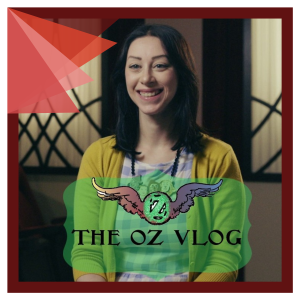
Tori Calamito, host of the Oz Vlog, is doing a live online event called “Defying Gravity: The Evolution of Oz from Page to Stage to Screen” for local libraries.

The event description says:
This exclusive Zoom program offers a rare glimpse into over a century of Oz storytelling, from L. Frank Baum’s original book series to the latest Broadway productions and upcoming film. The Oz Vlog will share treasures from her extensive memorabilia collection while exploring how the Land of Oz has evolved across different media. Whether you’re a longtime fan of the 1939 MGM classic, a Broadway enthusiast who’s seen Wicked multiple times, or curious about the upcoming Wicked: For Good, this program has something magical for everyone.

Come prepared to be amazed by the depth and breadth of Oz’s influence on entertainment, and leave with a deeper appreciation for the wonderful world that has inspired some of the most popular characters of all time. This program is sponsored by The Oz Vlog who is donating her time to this event!
This event will take place on Wednesday, 30 July, starting at 7:00 Massachusetts time. Folks can register for this event through the Burlington Public Library.

In a similar vein, on Saturday, 16 August, Worldcon in Seattle will feature a panel discussion on “Oz: America’s First Multimedia Franchise,” organized and moderated by Eric Gjovaag.

That description is:
Known around the world for the famous film adaptation, The Wizard of Oz is back in everyone’s minds thanks to the current two-part Wicked movie. But Oz started life as a popular novel, which then spawned a Broadway musical, a series of other books, early silent movies, and more. Oz is a franchise that always grows and changes with the times. Learn more about the origins of The Wizard of Oz and how it has been reinterpreted on stage, television, and computers and in movies, comics, toys, games, and more from 1900 to the present day.
Panelists are A. J. Hackwith, J.R. Dawson, and Terri Ash. Eric will also moderate a panel the next day on “How The Wizard of Oz Has Shaped Science Fiction.”

16 March 2024

“Historic Children’s Voices” Coming from American Antiquarian Society

The American Antiquarian Society in Worcester will launch a website on “Historic Children’s Voices, 1799-1899.”

Its introductory page explains: “The holdings to be digitized are not children’s literature, i.e., works created BY adults FOR children, but rather are direct testimony as well as imaginative works created BY children. As such, they constitute an archive of historical evidence not previously accessible.”

The materials to be digitized include diaries, letters, stories, poems, and the AAS’s “large amateur newspaper collection—most printed on home parlor presses.” There will be 15,000 pages of content in all.

Those presses were very popular in the late 1800s. When L. Frank Baum issued the Rose Lawn Home Journal and later self-published works on stamp collecting and chicken farming, he was among thousands of young people working their own small presses.

Accompanying the website, the AAS will host an in-person and online symposium on 2–3 May featuring panel discussions on “Authentic Children’s Voices,” “Archival Silences,” “Visual Culture of Children’s Production,” and “Hearing the Child’s Voice.”

On 5–9 August, the AAS will host an institute for K-12 teachers on the subject, with hands-on workshops using the collection and a field trip to Lowell National Historical Park.

09 October 2020

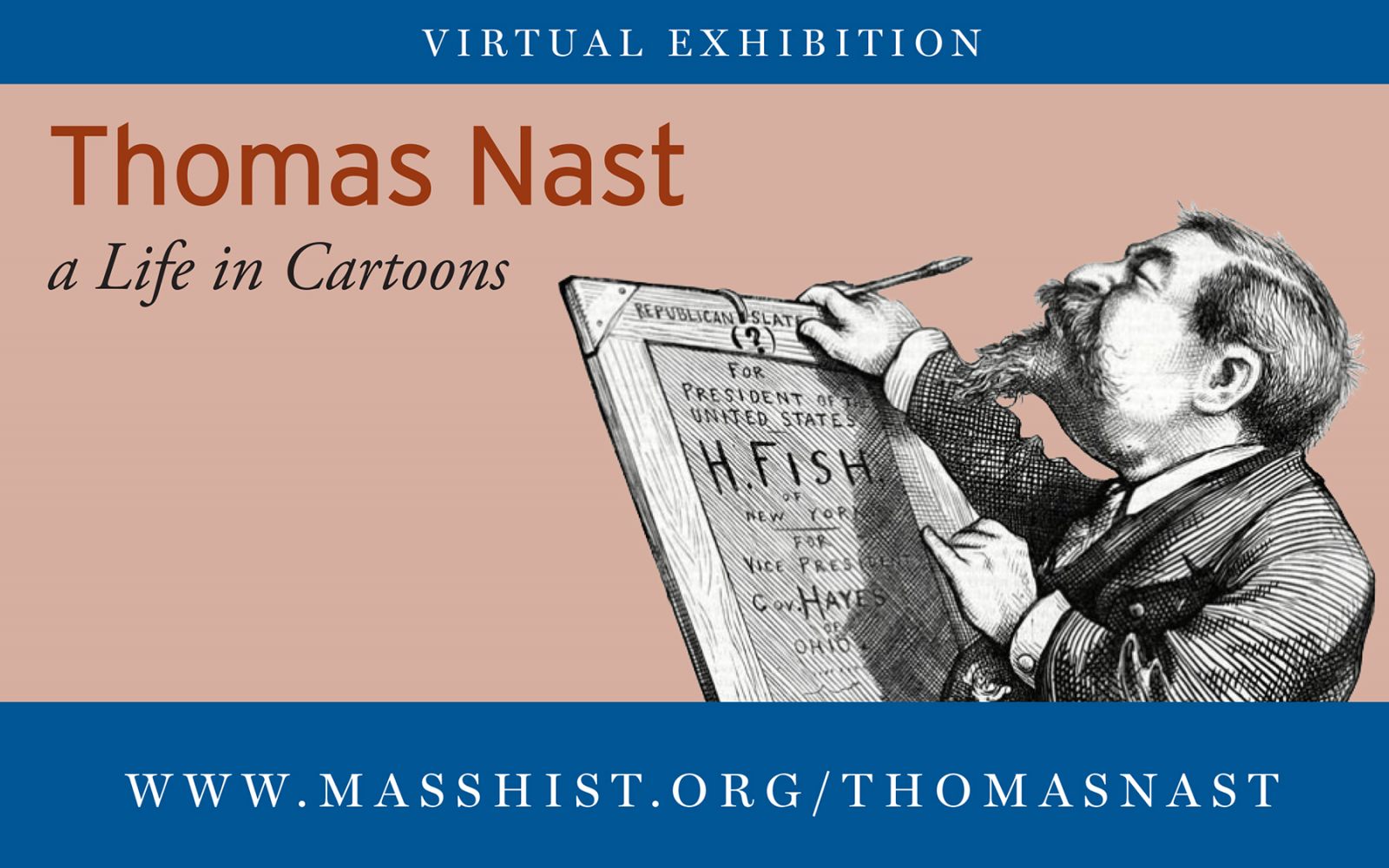
Taking Thomas Nast’s Life Online

It was disappointing to learn, as I described recently, that the cartoon biography of Thomas Nast I’d worked on since this spring would not be displayed in the Massachusetts Historical Society as originally planned. But frankly, in this needlessly calamitous year, that change in plans felt like a minor glitch.

At the time, I was researching visual references for the artists: What did Nast’s editors look like? What about their workspaces? How did Spanish police officers dress in the 1870s? As I did, I tried to imagine our new pictures in an online environment. How would they come across on people’s computer screens instead of up on the wood-paneled walls? Most important, what could a digital exhibit do that a material one could not?

Online, the cartoons would be smaller than they would be when displayed on a wall. But the webpages could give viewers links to the Nast images they played off of—and to many more images than the physical room had space for. I began to reimagine the exhibit as a series of webpages with supplemental webpages offering additional information.

There were still some challenges caused by the pandemic. The M.H.S. is looking after its employees by making sure only a few are in the building at a time, which meant that it took longer to digitize some of the Nast images we needed. There was no chance for all the people involved in the exhibit to sit down in a room, lay out the material, and discuss how it fit together. But again, compared to what else was happening in America, those weren’t big problems.

My colleague E. J. Barnes did a terrific job rounding up all the cartoonists’ drawings, keeping track of the necessary Nast artwork, assembling the hybrid images, and then going back to the artists to ensure they supplied all the info they needed to be credited and paid. And she drew one of the new cartoons as well!

“Thomas Nast: A Life in Cartoons” made its online debut a few days ago. It’s an adjunct of a larger digital exhibit on political cartoons in American history, “Who Counts: A Look at Voting Rights through Political Cartoons.” With the country in the middle of a crucial election, and access to the ballot at issue more than anytime for decades, this is a very timely exhibit. I’m proud that I was able to be part of it, and to help provide a forum for so many talented cartoonists. (More about them coming up.)

On Thursday, 15 October, Nast’s modern biographer, Fiona Deans Halloran, and political cartoonist Pat Bagley will give a virtual talk about the man through the M.H.S. Sign up here.


25 July 2020

The Mystery of Baum’s Final Book

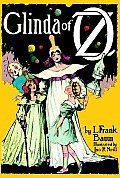
This year I reread L. Frank Baum’s final Oz book: Glinda of Oz, published one hundred years ago.

Unlike the preceding book, The Magic of Oz, it has a single, focused plot. Ozma and Dorothy venture to the northern edge of Gillikin Country to intervene in a war between two small communities. They get trapped there. Glinda leads an expedition to save them. With the help of local magic-workers, the rescuers succeed. Glinda repairs the war damage, and Ozma installs new rulers in the two communities.

And there the book ends. There’s no detailed return journey to the Emerald City, no celebration in Ozma’s palace, no concluding discussion among Ozma, Dorothy, and Glinda. Ozma says to no one in particular, “it is always wise to do one’s duty, however unpleasant that duty may seem to be.” Done. Baum had filled his requisite number of pages, composing 40,000 words.

The manuscript for Glinda of Oz survives at the Library of Congress. The only parts that have been digitized appear in this online exhibit, and they say contradictory things about who Baum wrote it.

The title page has a note in Baum’s own handwriting that says: “MS. Completed Feb 17th / 1917 by L. Frank Baum.” But the first manuscript page also has a note in his handwriting: “L. Frank Baum / Feb. 1918.” A note added to the manuscript by Baum’s family says, “Written January & February 1917. finished the night before L F entered hospital,” but we know Baum went in for surgery on his gall bladder on 18 Feb 1918. He had alerted his publisher, Reilly and Lee, to the new book just four days before.

Those contradictory clues convinced Baum’s biographer Katharine M. Rogers to theorize that he finished a first draft of Glinda in February 1917 and a second version a year later. Exactly a year later, which seems like a mighty coincidence.

I think Baum simply wrote down the wrong year on his title page. February was still early in the new calendar year, and he had a lot weighing on his mind as he prepared for surgery. That title page in turn confused the relative who knew he finished just before the operation. All the other clues about how Baum wrote his last three Oz books fall into place. He drafted them in the order they were later published over the eighteen months between August 1916 and February 1918, finishing just before he went into the hospital.

Mostly bedridden after that surgery, Baum spent his last year working with his family to polish those texts and prepare typescripts to send to his publisher. Baum died on 6 May 1919. The Magic of Oz was published a month later, and Glinda of Oz eleven months after that.

Someday, after this pandemic is over, I hope to visit the Library of Congress and examine the full manuscript of Glinda of Oz in the same way that I looked at The Magic of Oz. Does it match the book’s final text as closely? Rogers reported one scene revised to be less scary and a few other small changes. I’m curious about a passage describing the famous residents of the Emerald City that strikes me as stylistically distinct from the surrounding prose. Does that appear in Baum’s handwriting?

Still, even if someone else—a relative or an editor—filled out Glinda of Oz for Baum, they didn’t tack on a more detailed ending.

02 April 2020

A Picture Book for Patriots Day

A couple of years ago, I did a specialized editorial job for Disney’s publishing wing.

The company contacted me because of my research into the start of the Revolutionary War and asked me to fact-check a picture book on the topic.

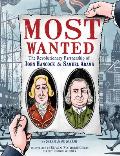
Most Wanted: The Revolutionary Partnership of John Hancock and Samuel Adams is written by Sarah Jane Marsh and illustrated by Edward Fotheringham. Earlier, they collaborated on Thomas Paine and the Dangerous Word, also from Disney.

On the day after OzCon 2018, a bunch of attendees made plans to go to Disneyland. I expected to go with them until I suddenly realized I’d had my fill of company and wanted to decompress in a library with a manuscript and my history sources. So instead of giving money to the Disney Corporation, I spent the day earning money from it with this job.

Most Wanted was published this week, just in time for the pandemic cancellation of the reenactment of the Battle of Lexington and Concord, which provides the book’s climax. That was bad luck for Marsh and Fotheringham, I thought. But as I was preparing this blog post, I realized the book had gone through another big change recently.

Powell’s was now listing Most Wanted as a Little, Brown title. Same with the Paine book. I had to reassure myself that my little story about Disney was accurate.

Then I remembered that in February the Disney Corporation sold a thousand children’s titles to Hachette, parent company of Little, Brown. Hachette was already distributing for Disney, so the supply chain is intact (except for the retail end, of course). There’s a lot of editorial and marketing shuffling going on, though.

I hope Most Wanted comes through the turmoil unscathed, the way Samuel Adams and John Hancock made it out of Lexington and to the Second Continental Congress.

03 October 2019

Hard to Read

One reason the Waukegan Public Library may have chosen not to portray native son Ray Bradbury as a little boy (as I discussed yesterday) is that the site is already chock full of metal kids with books.

The library’s Stimson Sculpture Garden contains no fewer than seven bronze sculptures depicting ten little kids reading, along with a few fairy-tale animals.

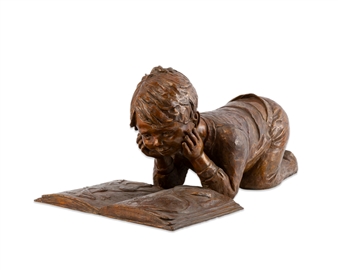
There used to be two more children reading, but in 2012 they were stolen and melted down as scrap. Since those statues were bronze, other castings survive, such as Jane Rankin’s “Little Scholar” shown here.

Last time I checked, my public library has two such bronze statues of little kids with books. It looks like this is a genre with solid demand, and artists like Gary Lee Price, Randolph Rose, and Rankin are happy to supply the market.

Someday art historians will write monographs on this form and the studios and patrons behind it, like the studies of Civil War statuary.

02 October 2019

Ray Bradbury’s Rocket

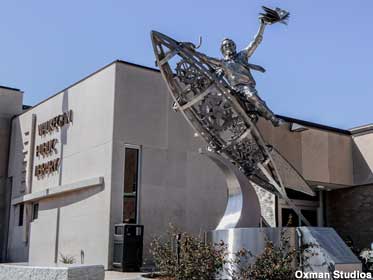
I am not taken with the Ray Bradbury sculpture erected in his native town of Waukegan, Illinois, and unveiled this summer.

Zachary Oxman sculpted the figure of a young Bradbury riding the outline of a rocket, steampunk gears inside. The steel figure waves a copy of Fahrenheit 451.

The design is deliberately “retro” to fit with the mid-20th-century library building nearby, where Bradbury bequeathed his book collection. But the result strikes me as cheesy, diminishing the themes he wrote about instead of celebrating them. “I send my rockets forth between my ears,” Bradbury wrote in a poem, and this turns that metaphor into something solid and heavy again.

I also wouldn’t recognize Bradbury from this statue. I picture him from photos and TV appearances in my youth as a somewhat rounded bespectacled middle-aged man, a chatty dean of American science fiction.

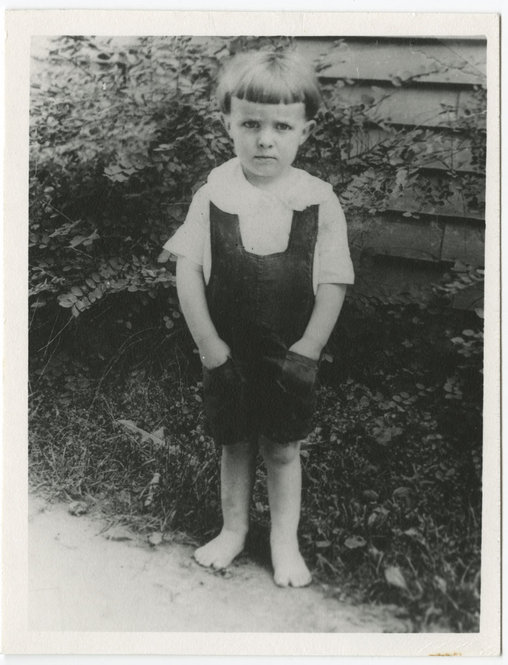
It would make sense for a Bradbury statue in Waukegan to depict him as he looked when he was living in Waukegan. That would be a little kid since the family moved to Arizona when he was six. A young boy dreaming of the future could be iconic but not recognizable. Here’s Bradbury at age three, from the Knopf collection of the Harry Ransom Center. Here he is again, said to be in 1923 but probably a couple of years later.

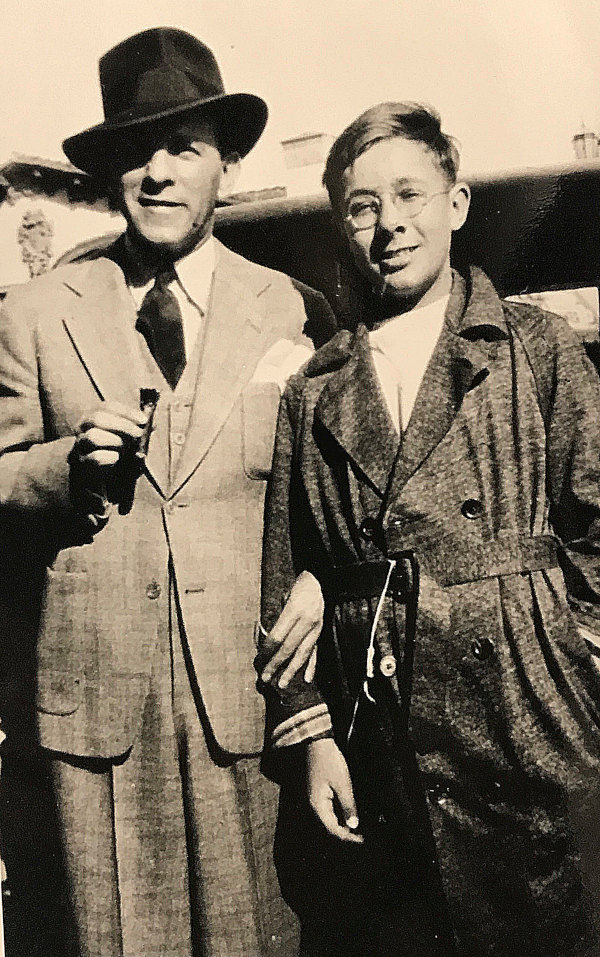
By age 14, Bradbury was a working writer in LA with hints of how he’d appear as an adult. But I haven’t found any photo of Bradbury looking like the young man in that sculpture. He didn’t wear his glasses for photos in the 1940s, and he had a crew cut through the 1950s. The statue’s combination of spectacles, floppy hair, and svelteness seems like a composite. (Or perhaps Oxman worked from family photos I haven’t seen.)

Lastly, I have to admit, when I see someone clinging to a rocket like that, I can’t help but think of Bucky Barnes about to be blown up by Baron Zemo.

03 August 2019

Catching Bob le flambeur at Last

In my mid-teens I saw a bunch of movies at the now-closed Nickelodeon cinema, the type of theater that flourished in college towns before the art films they showed became available on VHS.

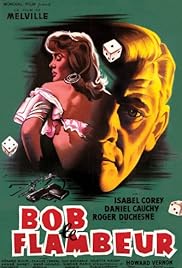
In front of every damn one of those movies, the cinema showed a preview of Bob le flambeur, a 1956 film by Jean-Pierre Melville that’s often pegged as the start of the French new wave. I saw that preview so many times that I could recite its voiceover: “…the story of a man who moves like a prince through the dark streets of Paris, gambling in back rooms until dawn. Then one day, down on his luck, he masterminds the biggest gamble of his life: the robbery of the Deauville casino…”

Almost forty years later, through my local library’s Kanopy subscription, I finally watched Bob le flambeur. I was expecting a heist film, but it’s really a character portrait with a heist attached. Bob doesn’t even come up with the robbery scheme until halfway through the movie, after we explore his relationships with a protégé, a young demimondaine, and a police inspector.

There are scenes of Bob walking his confederates through his robbery plan on a floor outline painted on a field, and of a safecracker at work. But to anyone who knows the rules of good storytelling, those scenes are a tip-off that we’ll never see the plan come off that way, and we don’t.

Instead, the movie is an homage to American gangster movies and what Melville’s colleagues dubbed film noir. Roger Duchesne has a ducal George Raft vibe at the center. Women, and the men who love them too much, prove to be the weak spots in the conspiracy. But in the end, it’s Bob’s character that matters.

25 November 2018

“I think he should have a kid buddy”

The Library of Congress has a new exhibit featuring a recent donation, Steve Geppi’s vast collection of American comics and pop culture.

George Gene Gustines reported on the display for the New York Times. Many of the items reflect the interplay of comics and other media. For example, there’s the sheet music of a song inspired by the Yellow Kid. There’s the first mockup of the G.I. Joe action figure alongside one of the G.I. Joe comic books. There’s the storyboard for a Mickey Mouse cartoon.

But for the theme of the weekly Robin, the most important item is Joe Simon’s first drawing of Captain America, even before the hero started using a circular shield ( reportedly under pressure from the publisher of an earlier patriotic crime- and Nazi-fighter, the Shield). Created for Timely Comics publisher Martin Goodman, it labels some traits of his costume and logo.

At the bottom of the paper is this note:
Simon created this art in 1940. It shows how the popularity and practicality of the “kid buddy” was already evident to the superhero comics industry, only months after the debut of Robin the Boy Wonder.  And Simon recognized the principal benefit of a sidekick: giving the hero someone to talk to.

07 August 2018

Heading Out to Oz

“In May I began describing, photographing, and re-housing a discrete collection of posters within the Ludlow-Santo Domingo (LSD) Library collection,” Rachel Parker writes on the blog of the Houghton Library at Harvard. “Tackling the Ludlow-Santo Domingo Library poster collection has been exciting, in part because of the descriptive challenges in title creation.”

Elsewhere the library explains, “The Ludlow-Santo Domingo Library is the world’s largest private collection of material on altered states of mind.” Which is to say, “The 50,000-plus-item collection documents psychoactive drugs and their physical and social effects.”

One suspects the initials LSD don’t just stand for Ludlow–Santo Domingo, even if the collection was produced by “Julio Mario Santo Domingo Jr.’s acquisition and integration of the Fitz Hugh Ludlow Library of San Francisco in 2001.”

The Houghton library blog credits the poster above to “James McMullen” at an unknown time. That artist spells his name James McMullan. Another website credits it to “The Push Pin Graphic, Issue 52 (1966).” (Seymour Chwast authored a 2004 book looking back on The Push Pin Graphic, and some poster-reprinting websites carelessly credit the image to him.)

In other news, I’m heading out to OzCon this week.

12 December 2015

Underestimating an Audience

Earlier this week I attended an unusual book event at the Public Library of Brookline.

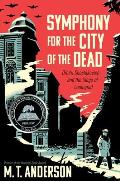
Author M. T. Anderson read the introduction of his new nonfiction book, Symphony for the City of the Dead: Dmitri Shostakovich and the Siege of Leningrad. He spoke about Shostakovich’s String Quartet No. 8, composed well after the war but perhaps looking back on it. Then the Arneis Quartet performed that work. nd finally Anderson took questions.

The audience was big enough that the librarians had to bring in more chairs, which is always gratifying for event organizers. Always better to underestimate turnout by a little than to overestimate. As at most cultural offerings, the audience leaned toward the senior side rather than Anderson’s usual readership of teens and middle-graders.

There were some kids there with their parents. I assumed they were fans of Anderson’s Pals in Peril! series. I wondered what they were thinking about this much more serious presentation, with historical/musical analysis of a composition that even some classical music fans find puzzling.

During the question session, one of those kids eagerly raised his hand. He was sitting with a friend the same age and one of their fathers. He had a bowl haircut and a big hole in one of the knees of his trousers. I wondered, how far off the topic of this event was his question going to be?

“I read your book,” he told Anderson. “How long did it take to you find out all this stuff?”

Five years of research, Anderson explained. And we all learned something.

08 November 2015

“Some outstanding work” in Dick Grayson, Boy Wonder

Here are nice quotes from reviews of Dick Grayson, Boy Wonder, edited by Kristen L. Geaman and published this year by McFarland.

John DeNardo, Kirkus Reviews:

“Dick Grayson, aka. Robin, Batman’s young sidekick, [has] been around nearly as long as the caped crusader but rarely sees any media attention. That is, until now, with this collection of scholarly essays. Dick Grayson, Boy Wonder: Scholars and Creators on 75 Years of Robin, Nightwing and Batman is an interesting collection that features critical analyses and essays about the most overshadowed sidekick in comics. Also included are interviews with the Boy Wonder’s past and current creators Chuck Dixon, Devin Grayson and Marv Wolfman. Collectively, these essays examine Robin’s place in comics and his evolution across the decades—all within various contexts like trauma, friendship, feminism and masculinity.”
Nick Smith, ICv2 (4 Stars out of 5):
“Some outstanding work . . . for anyone who wants insights into the detailed history of Dick Grayson, as Robin and as Nightwing, and into the creative processes that have guided the character over such a long time, this is a valuable work, well worth reading. It should also be of interest to anyone interested in writing any company-owned character, because the history and interviews may prevent career-threatening pitfalls. Its price may keep it out of the hands of some fans, but it belongs in most libraries, at the least.”
As I wrote last week, the preview function on Barnes and Noble and Amazon websites offers an overview of the book and a good chunk of the first essay, by me.

18 November 2014

“The Wizard of Oz teapot tempest”

In 1957 Ralph Ulveling, director of the Detroit Public Library, received nationwide criticism for remarks he was reported as having made about the Oz books.

I’ve been looking into that story, and this is part of one of the documents from it: Ulveling’s counterattack in the October 1957 American Library Association Bulletin.

Ulveling insisted that his library system hadn’t gotten rid of The Wizard of Oz—it simply wasn’t in the children’s rooms. To be fair to him, that decision had been made “More than thirty years ago,” or shortly after L. Frank Baum’s death. On the other hand, his endorsement of that policy acknowledged rather than refuted the anti-Oz-book sentiments attributed to him.

Ulveling went on to accuse the Michigan State University Press, of all people, of ginning up the controversy to sell books.

And you know, he might have been right.

30 September 2014

A Myth about Oz’s “Women in Strong Leadership Roles”

A new myth about banning The Wonderful Wizard of Oz has cropped up and spread on the web.

Back in March 2013, R. Wolf Baldassarro posted a blog essay about objections to the book. Baldassarro isn’t a librarian, educator, or scholar. He’s a “seasoned paranormal investigator” who happens to feel strongly about book banning.

I found several faults with that essay, including falling for a 2004 Deadbrain hoax about Jerry Falwell and misquoting sources.

Baldassarro’s essay also said about the book:
Nevertheless, it has come under attack several times. Ministers and educators challenged it for its “ungodly” influence and for depicting women in strong leadership roles. They opposed not only children reading it, but adults as well, lest it undermine longstanding gender roles.

In 1928, the city of Chicago banned it from all public libraries.
Note that the words “depicting women in strong leadership roles” were Baldassarro’s own. While ascribing that thought to “Ministers and educators,” he didn’t cite any source, person, place, or date for that complaint.

Despite (or because of) how it overstated the evidence, Baldassarro’s essay got quoted on Buzzfeed and other sites.

Then this February Kristina Rosenthal at the University of Tulsa’s McFarlane Library posted her own essay on the book’s troubles with librarians and censors, which said:
In 1928 all public libraries banned the book arguing that the story was ungodly for “depicting women in strong leadership roles”. This argument remained the common defense against the novels from ministers and educators through the 1950s and 60s.
Baldassarro’s statement about a supposed policy in Chicago thus became a statement about “all public libraries,” and his phrase “depicting women in strong leadership roles” appeared as if it were a direct quotation from those 1928 book banners. That’s shoddy scholarship.

Furthermore, that statement doesn’t stand up to the briefest historical scrutiny. In 1928, Reilly & Lee was publishing one book every year in the Oz series, and would continue to do so for over a decade. How would that have remained economic if “all public libraries banned the book”? Hollywood adapted The Wonderful Wizard of Oz as a feature film in 1925, a cartoon in 1933, and a major feature in 1939. If the book had so many opponents, why was it so broadly popular?

Was there really widespread opposition to “women in strong leadership roles,” even in a fairy tale, in 1928 America? Women had just finished serving as governors of Wyoming and Texas. In 1929 nine women took seats in Congress, including one elected from Illinois.

Finally, people who actually read The Wonderful Wizard of Oz know that its “women in strong leadership roles” consist of Glinda and possibly the Good Witch of the North; two others, the Wicked Witches, are actually eliminated. Meanwhile, the story shows the Scarecrow, Tin Woodman, and Lion all becoming males in strong leadership roles.

I don’t think there’s any evidence of widespread, powerful objections to The Wonderful Wizard of Oz or its sequels based on their depiction of Glinda, Ozma, or Dorothy as strong females. There’s certainly no evidence that was cited in 1928 as a reason for “all public libraries” or any to ban the book. That’s a myth based on our wish to see ourselves as greatly superior to the people of past decades.

16 August 2014

What Do Those Challenges to The Giver Mean?

Slate just ran Ben Blatt’s article with the incendiary headline “The Giver Banned” and the more temperate subtitle “Why Do So Many Parents Try to Remove Lois Lowry’s Book?”

Blatt wrote:
Since its release in 1993, The Giver has been one of the most controversial books in American schools. Between 1990 and 1999, The Giver ranked 11th on the list of the books most frequently requested for removal. In the 2000s it was 23rd, just two spots below To Kill a Mockingbird. This Friday marks the release of the first film adaptation of The Giver, which is likely to renew fandom, as well as opposition, to the dystopian young adult novel.
That analysis is lacking several crucial variables:
  • just how many schools and school libraries have The Giver as a standard title. The more schools use a book, especially as assigned reading for a whole class, the more likely it is to prompt challenges, but the rate of those challenges could still be much lower than for other titles.
  • how much difference there is between the top of the list and 23rd.
The article states that, in contrast to most other controversial titles, and especially the most challenged, “The most frequently cited reasons to challenge The Giver have been ‘Violence’ and claims that the book is ‘Unsuited to [the] Age Group’—or in other words that it’s too dark for children.” That point is accompanied by a chart showing how types of challenges to The Giver compared to the ALA’s total database. But the chart offers no “n value”—no statement of how many challenges were counted.

And that complaint brings up another missing variable: what grades the complaints were coming from. To a parent “Unsuited to Age Group” doesn’t mean too dark for all children but too dark for the particular children assigned to read it.

And let’s face it, The Giver is a dark book, regardless of what age its readers are. That’s kind of the point.

19 May 2014

Thunderstruck Strikes

My science-activity book Soap Science is out of print, but it’s received a dollop of literary immortality in Elizabeth McCracken’s new collection of short stories, Thunderstruck.

In the story “Juliet,” originally published in Esquire, some town librarians look up the record of a kid who’s suddenly in the news for all the wrong reasons. All they find is that two years before he’d borrowed Bell, Soap Science (1993), and never returned it.

I’m pleased to report that the story doesn’t suggest I was a bad influence. Instead, the appearance of Soap Science as what the kid probably borrowed for a school assignment reads as one of many innocuous details—so dutiful, so clean—that don’t add up to an explanation of what’s gone wrong. As in her best-known work, The Giant’s House, Elizabeth McCracken focuses on details of ordinary living in an extraordinary circumstance.

At the time she wrote that story, Elizabeth was working as a librarian outside Boston. We knew each other in high school and crossed paths in local book circles once or twice. Now she’s teaching at the University of Texas and tweeting up a storm.

Elizabeth McCracken is swinging through New England on her book tour this week, including appearances at Porter Square Books in Cambridge on Wednesday and Newtonville Books in Newton Centre on Thursday. Unfortunately, I can’t go to either event since I’m heading across the Atlantic this week. So I’m spreading the word about them instead. Check out Thunderstruck. Especially page 70.

27 February 2014

Will Eisner Week in Metro Boston

The Million Year Picnic comics shop, Stephen Weiner of the Maynard Public Library, the Cambridge Public Library, and folks from the Boston Comics Roundtable are collaborating on a local celebration of Will Eisner Week.

On Thursday, 6 March, the Cambridge library will host a conversation between two comics creators about Eisner’s art and legacy:
  • Paul Hornschemeier, creator of Mother, Come Home; The Three Paradoxes; and the New York Times best seller Life with Mr. Dangerous, among other titles.
  • Denis Kitchen, “underground comix” cartoonist, founder of Kitchen Sink Press and the Comic Book Legal Defense Fund, and Eisner’s literary executor.
That event is said to be scheduled from 6:00 to 8:00 PM at the library. This will be followed by a signing at the Million Year Picnic in Harvard Square, which has a weeklong sale of Eisner books. (I just bought one using another discount.)

On Saturday, 8 March, several local comics creators will lead comics workshops for kids (and interested adults who bring kids along) at the Cambridge library. Those creators are Jef Czekaj, Josh Dahl, Bob Flynn, Dan Mazur, Dan Moynihan, Braden Lamb, and Shelli Paroline. Those workshops start at 12:30 PM and run for two hours. Afterwards, there will be another signing at the Million Year Picnic from 3:00 to 5:00 PM.

06 February 2014

Set-Up for a Heartwarming Story

Matthew is a nine-year-old kid. He was born with very short fingers on his right hand—a condition known as “limb difference.” Usually this doesn’t bother Matthew, but after his family moved into a small town in Kansas other kids kept asking him about his hand.

Jennifer is Matthew's mother. She adopted him and two other kids. Her late father also had only a partial hand, and she remembered that bothered him. Jennifer came across plans on the internet for making an artificial hand, but she knew that was beyond her technical skills.

Mason is a sixteen-year-old high-school student. He’s always been a tinkerer; he built his own computer, for instance. He was on the football team, but after his third concussion from sports Mason’s parents told him he couldn’t play anymore, so suddenly he had a lot of free time.

The Johnson County Library has a 3-D printer.

I couldn’t make this up.

28 January 2014

Oz Comes to Kansas

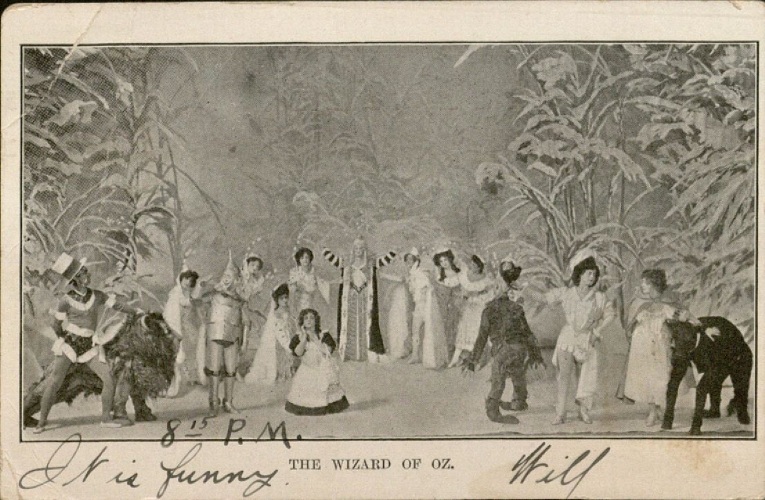
This 1906 postcard shows a scene from the popular stage extravaganza based on L. Frank Baum’s The Wizard of Oz. The producers made such cards available at the end of each performance in the hopes that people would recommend the show to their friends—as “Will” did with this one.

The Cowardly Lion is at the left, Imogene the Cow (the show’s more-easily-performed substitute for Toto) at the far right. The Tin Woodman stands above the word “funny” and the Scarecrow above the W in “Will.” Dorothy kneels near the center. The figure upstage in the center with striped sleeves is the Good Witch, bringing on a snowstorm to counteract the effect of the Poppy Field—a plot point invented for this show and then reused in the 1939 MGM movie.

This postcard is from the University of Kansas library’s new “Magic of Oz” exhibit, featuring documents and artifacts from the collection of alumna Jane Albright. Jane’s been very active in the International Wizard of Oz Club for many years, especially in organizing events.

Unfortunately, the opening of this exhibit has coincided with a health crisis in Jane’s family, so she’s been unable to visit it herself. Everyone in the Oz fan community wishes Jane’s husband a swift and full recovery so they can enjoy sharing her impressive collection with folks in Kansas.

15 January 2014

Writing for “the Saddest Little Girl in the World”

Here’s Jimmy Gownley, author of the Amelia Rules! series, on the Comic Book Diner podcast a couple of years back, talking about his response to criticism that his comic for kids shouldn’t tackle tough emotional topics:
The trick, and this is the hokiest thing in the world and is completely corny and you guys will be like rolling your eyes, but I always picture like writing Amelia for one person: the saddest little girl in the world. Okay? . . .

You don’t know if she has any friends, you don’t know if she has any family or any money, but she’s, like, in a library, right? And she’s just miserable. And she has this book.

And so what am I going to say to her? Well, I want to say something that’s funny, hopefully. I want to say something that’s uplifting, ultimately. But I also want to say something that’s true, because false hope isn’t hope. It’s just a lie.

So that’s what I try to do. And the truth of the matter is that sometimes childhood is not “suitable for children.”
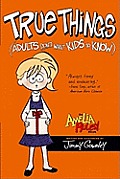
These remarks appear at about 42 minutes into podcast episode 50. I can’t find a link to that episode on the Comic Book Diner website, but cohost John Gallagher has a link here.