Showing posts with label AUTHOR Dennis O'Neil. Show all posts

24 November 2019

Tom Lyle and the Robin Miniseries

In 1986 Tom Lyle, an aspiring comic-book artist in his thirties, went to a comics convention in Philadelphia. There he met Chuck Dixon, a young writer who was scripting Air Boy for Eclipse. Based on Lyle’s samples, Dixon got him the job of penciler on a related title, Sky Wolf. In a chat with Comics Interview magazine, Lyle credited that as “the event that triggered my career” in comics.

Lyle was recruited by DC Comics to draw Starman in 1988. After a couple of years, as he was wrapping up that assignment, Lyle asked Batman group editor Dennis O’Neil if he had any openings. O’Neil was planning a miniseries focusing the newly created Robin, Tim Drake.

“I’ve never been real thrilled with the Robins,” Lyle told his interviewer. “Dick Grayson, the original Robin, I couldn’t have given a flip about when I was a kid; it was like, ‘Get out of the way, kid, I want to see Batman.” But a job was a job.

O’Neil’s team wanted to make Robin into a martial-arts expert, so they needed a writer who understood the martial arts. Lyle suggested Dixon. He got the assignment and went on to be DC’s most productive writer of the decade. (On the occasion of his 40,000th comics page in 2017, Bleeding Cool noted Dixon wrote 106 issues of Robin, 89 issues of Detective Comics, 77 issues of Nightwing, 46 issues of Birds Of Prey, and 22 issues of Catwoman, to name a few.)

Dixon and Lyle’s first issue of the first Robin series carried a cover date of January 1991. The character of Tim Drake had been created by Marv Wolfman in issues drawn by George Pérez, Jim Aparo, and Norm Breyfogle, and his costume was designed by Neal Adams. But Dixon and Lyle’s portrayal fleshed him out by showing him on his own. Lyle was especially good at portraying Tim as a thirteen-year-old, lithe but not a powerhouse, the littlest guy in the fight who needed to think harder than anyone else to stay alive.

In the gritty, pouched, and overpumped 1990s, Robin was the equivalent of counterprogramming on broadcast television—standing out by doing something different. And it worked. According to Lyle, DC expected to sell about 200,000 copies of the first issue of the Robin miniseries. Instead, it sold three times that number.

DC asked the Dixon-Lyle team for a second miniseries about Tim Drake going up against the Joker, issued at the end of 1991. Then came a third, featuring the character the Huntress for an interesting contrast. That was the height of the speculative boom, and those magazines are festooned with holograms and other gimmicks.

Dixon and Lyle also collaborated on issues of Batman and Detective Comics showing Batman and Robin together. One of those magazines introduced Stephanie Brown as the Spoiler, who went on to become Tim Drake’s love interest, a fan favorite, and eventually Robin and Batgirl herself for limited periods. Lyle was also the artist for the first Robin Annual and the 1992 public service ad in which Tim decides to learn the facts about AIDS.

During that time, Lyle also plotted and penciled the early issues of The Comet for DC’s Impact imprint. In 1993 he started working for Marvel Comics on Spider-Man stories. That same year, DC launched the Robin monthly series with Dixon as regular scripter.

After another ten years or so, Lyle left monthly comics to become an art teacher at the Savannah College of Art and Design. Earlier this year he suffered an aneurysm, and last week he died, aged 66. Friends and fans have set up a Go Fund Me page for his family.

24 August 2014

Roy Harper, the Anti-Dick Grayson

Just as DC Comics had to separate Green Arrow from Batman, its storytellers had to figure out a way to make Green Arrow’s young sidekick Speedy different from Robin, the Boy Wonder.

For decades the two characters existed in parallel—helping their mentors in fighting crime, providing useful sounding boards, and expressing the emotions of young readers. Dick Grayson was a teen orphan living with Bruce Wayne. Roy Harper was a teen orphan living with Oliver Queen. And their paths never crossed.

In 1964 Robin began working with Aqualad, Kid Flash, and Wonder Girl as the Teen Titans. But Speedy was notably absent. Fans wrote in, asking why the line’s other long-time kid sidekick was being left out.

So Teen Titans, #4 and #11, featured guest appearances by Speedy. And in issue #19 he became an official member of the team—and also managed to score a date with Wonder Girl, thus distinguishing him from all the other teammates who had crushes on her. But not by much.

The real differentiation began in 1971 when Neal Adams and Dennis O’Neil used the character of Roy Harper to explore the issue of drug use—a breakthrough for DC. Green Arrow discovered that his sidekick had become addicted to heroin. Not so badly that he couldn’t kick the habit within two issues, but enough to suggest a new direction for Speedy.

The Teen Titans series, aimed at a younger audience, never mentioned Speedy’s heroin troubles through the 1970s. Its writers tried sought other ways to set him apart from Robin: he and Wonder Girl remained a casual couple, and he was a bit more hot-headed. There was enough space between the characters for the series’ last issue to retroactively establish Speedy as a founding member of the team.

In the early 1980s Marv Wolfman and George Pérez brought Roy Harper back for occasional appearances in the New Teen Titans magazine, this time referencing his troubled past. Now working for a government agency, he joined the Titans in attacks on drug dealers. Those issues also portrayed him as an incorrigible ladies’ man just as Dick Grayson was entering a serious (and sexual) relationship with Koriand’r.

Finally, after Crisis on Infinite Earths Wolfman and Pérez added another layer to Roy Harper’s character. New Teen Titans, vol. 2, #21, revealed that he’d gone undercover [!] and had an affair with an international assassin named Cheshire. They’d even had a child together. Dick (now Nightwing) and Kory were having sex, but Roy was having unprotected sex with a villain!

That provided such a distinction between Dick Grayson and Roy Harper that Wolfman could write a story in Action Comics Weekly of their adventures together looking for Roy’s daughter. Where once Robin and Speedy couldn’t be on the same team, now Nightwing and Speedy could play off each other for several issues on end.

Roy Harper had become DC Comics’s anti-Dick Grayson. Dick was charming, respectful, and monogamous. Roy hit on almost any woman he met, especially when he was on duty. Dick became the one member of the original Titans who never married or had kids. Roy did the kids part first and muddled through as a single dad.

Nightwing was the young hero who did everything more beautifully than anyone else, whom everyone trusted. Roy was the character who managed to screw up most of the time. He bounced among among crime-fighting identities: Speedy to Agent Harper to Arsenal to Red Arrow and back to Arsenal. He owed his co-workers money. He took over the Titans, and the team fell apart. He formed the Outsiders for Dick to lead, and made a stupid fundamental error from the start. Nonetheless, he kept going. The result was a far more compelling character, a favorite for some readers.

While not all of Roy Harper’s background gets transferred into other versions of the DC Universe, his definition as the anti-Dick Grayson does. When the Teen Titans television cartoon introduced Speedy in a later season, producer David Slack explained, “we were looking for someone to mirror Robin.” In the sillier Teen Titans Go, the producers even have actor Scott Menville provide both rival characters’ voices (and of course make in-jokes about that).

DC’s “New 52” universe wiped out the Titans’ past and left little time for Roy Harper to have worked with the new Oliver Queen. Nonetheless, it reintroduced Roy as “the worst former sidekick ever” in Red Hood and the Outlaws. That may not be the best treatment for him, but at least it’s better than the Cry for Justice/Rise of Arsenal miniseries of 2010, which were so poorly received they were quickly written out of continuity. And it does preserve Roy Harper’s distinct role in the DC Universe.

23 August 2014

Putting Distance between Green Arrow and Batman

As I described on Thursday, DC Comics’s syncretism meant the company sometimes ended up owning two quite similar characters/trademarks. That pushed its staffers to come up with creative ways to distinguish them, expanding the bounds of its superhero stories.

Thus, in 1986 the company put Superman and his most successful equivalent from another publisher, Captain Marvel, in the same universe. And the editors and writers started emphasizing what made them different.

The fact that Captain Marvel is really a kid named Billy Batson—i.e., even more of a naïf than Kansas farmboy Clark Kent—became the defining aspect of his character. Storytellers also found more significance in how Captain Marvel’s powers arose from some form of magic (rather than, like Superman’s, through science).

Wonder Woman didn’t present such problems because no other company had such a powerful female hero. Instead, DC had to struggle with America’s changing picture of the ideal woman—and that’s another story.

As for Batman’s equivalents, it’s important to note what defined that character for most of his 75-year history. It wasn’t being dark and brooding and driven by vengeance. In fact, from the early 1940s through the mid-1980s, Batman was a cheery special independent agent of the Gotham police who just happened to dress as a bat. What defined him was:
  • He had no special powers beyond being a very smart, very athletic man.
  • He wore a mask to preserve his real identity.
  • He was an immensely rich socialite.
  • He had a lot of cool bat-themed gadgets and vehicles to deploy in a fight.
  • He worked with a teen-aged assistant.
That formula proved so popular that in 1941 DC’s sibling company, All-American Publications, created its own version: Green Arrow. He, too, wore a mask to disguise his life as Oliver Queen, an immensely rich bachelor. He used trick arrows, an Arrow Car, an Arrow Plane, an Arrow Signal, and even an Arrow Cave. And of course Green Arrow had his own kid sidekick, Speedy.

For a long time, DC kept Batman and Green Arrow apart. While Batman was an occasional member of the Justice Society of America, Green Arrow was relegated to a lesser hero team, the Seven Soldiers of Victory. Stories about him and Speedy appeared in World’s Finest after Batman and Robin’s, but the heroes never met. Green Arrow survived in backup stories through the early-1950s crash of superhero comics, probably because DC editor Mort Weisinger had co-created him, but he never had his own magazine.

When DC launched the Justice League of America, first in The Brave and the Bold and then in its own title, Batman made brief appearances. But Green Arrow didn’t show up at all, prompting fans to ask why he was left out. The problem, I suspect, was that he seemed too similar to Batman—why would the team need them both?

After popular demand, Green Arrow finally joined that group in Justice League of America, #4. Batman then stopped appearing so often, and it wasn’t until issue #10 that both characters showed up on the same cover.

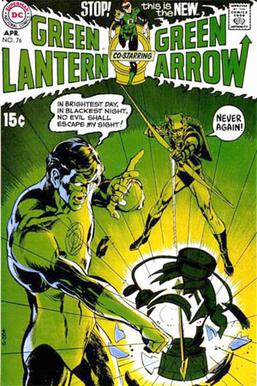
Eventually the proximity of two similar characters prompted a new generation of creative minds to come up with ways to distinguish them—and to take superhero comics in a new direction. In 1969 artist Neal Adams gave Green Arrow a new look with a Van Dyke beard (at a time when facial hair had a politic meaning). Writer Dennis O’Neil made radical changes in the character of Oliver Queen. He lost all his money—no longer a millionaire with an unending supply of gadgets. He started a romance with an independent crime-fighting colleague, Black Canary.

While Bruce Wayne was then showing a new sort of social conscience with the Wayne Foundation, O’Neil had Oliver Queen start speaking loudly for political justice and change. Now the character stood out in Justice League meetings—in fact, he came to alienate some members of the group. It wasn’t just his politics but his temper and attitude. Green Arrow thus became one of DC’s first examples of a superhero who wasn’t a paragon in every way.
As a result, Green Arrow became an interesting character, perhaps for the first time. O’Neil and Adams partnered him with Green Lantern in a series of stories exploring social issues in America. Those highly regarded tales didn’t sell well enough to keep the Green Lantern magazine from cancellation in 1972, but they did cement the new character of Oliver Queen for readers. As a result, it became possible for him to be a foil for Bruce Wayne/Batman in subsequent decades rather than a pale green copy.

A similar process occurred in the late 1980s after DC introduced the Charlton character of Ted Kord, the Blue Beetle, into its main line. He, too, was a masked man without powers but with a lot of gadgets and smarts. He ended up on the Justice League with Batman. But that was the start of the grim, antisocial Batman we know today, and the magazine’s creators moved that Blue Beetle in the opposite direction, toward comedy.

With the “New 52,” DC brought Wildstorm Comics’s Batman equivalent, Midnighter, into its standard universe. Already Midnighter had been established as gay and happily partnered with the Wildstorm equivalent of Superman, providing more distance from the Caped Crusader. Now Midnighter is showing up in Grayson, actually offering storytelling value in how the character is a version of Batman.

20 March 2014

Crisis on Multiple Podcasts

This week comic-book writer and editor Dennis O’Neil showed up on two of my podcasts.

I’d expected to hear his voice on Fat Man on Batman because Kevin Smith had promised a multi-part interview about O’Neil’s career in comics, particularly as writer and editor of the Batman magazines.

But I was surprised to also hear O’Neil pop up on Back Story, the best radio show/podcast about American history. The St. Patrick’s Day theme was “green,” and producer Andrew Parsons interviewed O’Neil about the Green Lantern/Green Arrow series starting in 1970.

That series was also a big part of Smith’s interview, which is longer and more detailed. It’s a milestone in “relevant” superhero comics, marred only by the fact that it didn’t win over enough readers at the time to keep the Green Lantern magazine from being canceled within two years.

22 September 2013

The Good Old Days with Mike W. Barr

Comics Alliance has run a wide-ranging conversation between columnist Chris Sims and Mike W. Barr, who scripted many Batman and Robin stories in the 1980s and recently returned to those characters with a story for DC’s digital-first, out-of-continuity Legends of the Dark Knight series.

As I discussed back here, that story reads like a throwback to the pre-Crisis Batman, perhaps even to the 1960s television Batman. Indeed, Barr says he was aiming for a retro feel, even inventing a new villain who seems to be a very old one. As for Robin:

I’d written the first episode with basically the Jason Todd Robin, and [artist] Tom [Lyle] obviously feels more comfortable with the Tim Drake Robin, which is fine, because he co-created the character. I said “Sure, I have no problem with that whatsoever, whatever Tom is comfortable with,” so we used Tim Drake for the rest of the story. And it worked out fine. As [editor] Hank [Kanalz] pointed out, there are some differences between the personalities of the characters, which we were able to use in the second chapter. Tim is a different character than Jason, and that’s reflected in the story.
But that’s also why the Robin in the first of the three installment reads like smart-mouthed Jason, and why the verbal clues indicating he’s Tim don’t show up until the later installments.

Another striking aspect of the interview is how much freedom Dennis O’Neil allowed his writers and artists when he was editing DC’s Batman line from 1986 to 2000. Early in that period Max Allan Collins and Jim Starlin were making Jason Todd an angrier character with a grittier background, but Barr continued to write Jason as a happy young sidekick facing off against old Batman villains. “Denny O’Neil was always open to those kinds of stories, as long as you set up what was going on,” says Barr.

Furthermore, when it came to Son of the Demon, Barr’s graphic novel with Jerry Bingham:
MWB: The graphic novel took a fair amount of time to come about, because it was such a long story. Denny O’Neil was actually not involved in that as the editor. Dick Giordano was the editor, and it was in the pipe by the time Denny and I were doing Detective, I believe. I always told Denny, “You should look into this because I guarantee you’re going to want to know what’s happening in this story,” but I don’t think he ever did until someone pretty much handed him a Xeroxed copy of the finished book and what was in there.

CA: What was his reaction?

MWB: I don’t know, because he never told me. I have heard stories, and this is hearsay, I’ll admit, but I’ve heard it from a number of sources, that Denny very much disapproved of what I’d done with Batman and Talia. Not only getting them married, which was done as a sequel to one of his stories, but also having a child, which he had absolutely forbidden.
Evidently O’Neil kept himself from criticizing Barr’s story (and his mentor Giordano’s work as editor) even when he “very much disapproved” of how it had used Talia, a character he had co-created. O’Neil would have had the company on his side; according to Barr, “Warner executives” disliked Batman having a child with one of his villains so much that:
[DC publisher] Jenette Kahn herself called me and told me that if that child ever appeared again in a story, she would be fired. I don’t know how much of that I believe, even to this day, but basically we were told to never use that child ever again, he does not exist in continuity anymore.
(Almost two decades later, Barr’s story was the inspiration for Grant Morrison’s saga of Damian Wayne.)

Even today, it appears, Denny O’Neil still hasn’t told Barr that he shouldn’t have told the story he wanted to tell. As an editor, his philosophy was to give his creators room to create, and the results include some of the most popular modern Batman sagas, such as Knightfall and No Man’s Land. Given all the stories coming out of DC Comics today about the in-house staff vetoing storylines in the works, O’Neil’s editorial example seems even more striking.

11 November 2012

The Exaggerations of Dick Grayson’s Love Life

A couple of weeks ago, the weekly Robin discussed how in 1984 Dick Grayson was the first hero DC Comics clearly showed having a sex life—and outside of marriage yet! However, his relationship with fellow Titan Koriand’r was always presented as a long-term commitment.

Indeed, for the rest of the 1980s that relationship was one of the tent poles of the Titans franchise—which meant Marv Wolfman and his artists were constantly shaking it to make readers worry. Kory contracted a political marriage for the sake of her home planet, and Dick couldn’t handle it. Teammate Raven had sexual fantasies about Dick, and Kory could handle it. A freedom fighter from an alternate future disguised herself as Kory to have sex with Dick.

The relationship endured until New Titans, #100, when Dick and Kory tried to get married and everything went horribly, horribly wrong. Dick and Kory broke up, and that Titans team itself went separate ways—which just shows how much of a tent pole it was.

That left Dick Grayson unattached for the first time in years. He kept busy being Batman for a while, but then DC’s writers happily seized the chance to use “Dick has a new girlfriend” as the starting-point for stories.

Meanwhile, the internet enabled fanfiction to spread, and that area of writing has never been bound by what official continuities say about heroes’ love lives. As a result, Dick Grayson became a “fandom bicycle” on which everyone got a ride. TV Tropes lists him as DC’s top “Launcher of a Thousand ’Ships,” saying: “It's a running gag in the DC Universe that virtually every female that comes in contact with Nightwing falls in love with him.” In fanfiction, that group expands to include every male.

Despite Dick being a symbol of sexual appeal, however, his romantic/sexual activity within the comics was exaggerated. Here’s a conversation on the topic between Dick and Tim Drake, his successor as Robin, in Nightwing, #25 (dated October 1998, script by Chuck Dixon, art by Scott McDaniel). The boys are, naturally, standing on the back of a freight train while blindfolded—Dick’s told Tim this is good training. Tim manages to say the only thing that can throw Dick off balance.
Dick asks Tim if perhaps he could choose a girlfriend who’s not an “Afterschool Special,” knowing that won’t happen. Tim responds by showing off how much of a Dick Grayson fan he is.
Tim lists six women whom Dick has had a relationship with since Crisis on Infinite Earths. But in fact that list is exaggerated, even more than Dick’s response in the following panel lets on.

His relationship with Koriand’r was more than “a need…for affection”—it was a multi-year, live-in relationship that came close to marriage. It was precisely the opposite of casual.

As Dick reminds Tim, he and Donna Troy never “really dated.” They never dated at all. Wolfman did propose to “have very slowly had Dick and Donna get together,” “if only for them to see that they were too similar to be together.” But that never happened.

Miggie Webster appeared in the Nightwing miniseries by Dennis O’Neil and Greg Land. Dick was apparently depressed at the time—or maybe just weighed down by his hair. In any event, he became briefly infatuated with Miggie because he thought she represented a normal, happy family life—only to see her kill her abusive father. And as far as I can tell, they never even went on a date.

Emily Washburn married Dick in Nightwing Annual, #1 (cover shown above). That was part of a 1997 DC tribute to pulp fiction, and the story was a James M. Cain-style take on a murderous marriage. Dick married Emily as part of his investigation. After he identified the killer, he offered to remain her husband and help raise her son—again with the monogamous values!—but she declined. It’s unclear whether the marriage was consummated, but given scripter Devin Grayson’s take on Dick as a very physical and open person, it probably was.

Meanwhile, in 1996 DC launched the Nightwing series written by Dixon. Among its subplots was Dick’s friendship—or would it be something more?—with the superintendent of his apartment building in Blüdhaven, Bridget Clancy. Dixon was a master at playing out conflicts over many issues, but this relationship never reached the level of dating.

Instead, at the time of this train-top conversation, Dixon was gradually moving Dick toward a second serious, multi-year relationship: with Barbara Gordon, daughter of the Gotham police commissioner, former Batgirl, and at that time Oracle. Dick had shown interest in her in the 1970s, but fans then pointed out that she was several years older than he. At the time of this issue, Nightwing, #25, it was still unclear whether they would become an item.

Thus, of the six women Tim reeled off, Dick had actually had serious and/or sexual relationships with only two, and in one of those (Emily Washburn) he was working on a case. That exchange thus leaves a misleading impression.
Of course, I have to acknowledge a seventh relationship that Tim, despite his snooping, doesn’t know about until Dick reveals it. Dick is just coming off the 1998 Nightwing/Huntress miniseries, once again scripted by Devin Grayson and drawn by Land. That shows his brief affair with Helena Bertinelli, the Huntress. It’s clearly sexual. (“Tunnel”!)

But in that miniseries Dick is looking for something long-lasting. (He’s evidently drawn to strong women who need rescuing.) The story ends with Helena seeing the chemistry between him and Barbara and chuckling that they don’t notice it themselves. In other words, even this example of Dick having a sexual fling points to him as a man seeking a committed love.

From the No Man’s Land crossover (1999) through Infinite Crisis (2006), Dick and Barbara were usually a couple. Since then, each new regular Nightwing scripter came up with a new love interest: a fashion designer, a criminal who lured a teen-aged Dick away from Wayne Manor, a librarian. Judd Winick has put him back in bed with Kory a couple of times. But only the unfortunate Nightwing Annual, #2, portrayed him as anything other than a one-woman man.

13 August 2012

Batman Goes Goth (Again)

I’ve written before about how the Batman: From the ’30s to the ’70s collection was my first sustained exposure to superhero comics. And a selective exposure it was, I’ve since realized.

E. Nelson Bridwell’s introduction described the “New Look” and television-show period of Batman comics (1964-68), but the anthology omitted nearly all stories from those years. Its 1960s section showcased the Caped Crusader’s science-fiction adventures at the start of that decade. That section included three of the seven tales that ever featured Betty Kane as Bat-Girl, leaving me with an outsized impression of her place in the overall saga.

Bridwell presented the 1970s as “the reappeance of the dark, avening figure of mystery called The Batman!!” That section started with “One Bullet Too Many” from December 1969, which showed Dick Grayson heading off to college and Bruce Wayne using forensic science to solve a murder mystery with no costumed criminals. Bruce and Alfred also moved into the headquarters of the Wayne Foundation, beginning a period of overt social activism that would culminate in a brief appointment to the US Senate. The 1970s Batman comics thus promised to become more deeply rooted in the real world.

Yet that section of the book also included the highly regarded “Secret of the Waiting Graves,” by Dennis O’Neil and Neal Adams; “Man or Bat?” introducing Man-Bat, by Frank Robbins and Adams; and “The Demon of Gothos Mansion,” by O’Neil and Irv Novick. Those are all Gothic tales of monsters, ghosts, and other spooky things. Though Man-Bat is a creation of science gone wrong, the other two tales clearly rest on the supernatural.

Which left little me confused. If the Batman comics had redeemed themselves from camp by returning him to his roots as a crime-solving detective, why was this volume showing me ghost stories? Mysteries are all about ratiocination, but the “Waiting Graves” and “Gothos Mansion” stories end with Batman realizing the limits of his deductive powers to make sense of the world.

I’ve since learned that Batman’s roots lie just as deep in Gothic horror as in detective stories. Bruce Wayne is dressed as a giant bat, after all. Among the character’s earliest adventures were fights against vampires, monsters, and other supernatural creatures. Those villains flourished again in the 1970s, and in 1982 Gerry Conway even brought the vampirical Monk and Dala from 1939 back to life. But I still prefer the detective stories.

20 July 2012

OIP Derangement Syndrome: The Dark Knight Rises Edition

In 1993, Dennis O’Neil and the Batman team at DC Comics envisioned a long story of the Dark Knight meeting his match and having to retire from crime-fighting for a while. This story got the overall title of Knightfall.

What villain would be worthy of breaking Batman’s back? As with the concurrent “Death of Superman” storyline, the company thought that job called for a completely new character. Writer Chuck Dixon and artist Graham Nolan came up with Bane. He wore the full-face mask of a Mexican luchador wrestler and pumped himself up with a steroid-like drug called “venom” (thus making his victory over Batman a cheat). The name Bane reflects the character’s function within Knightfall: he was the bane of Batman’s existence and his name an abridgement of “Bruce Wayne.”

Knightfall led to a character named Azrael taking over as Batman and going crazy with great power and responsibility, to the Robin solo series, and eventually to Dick Grayson wearing the cape and cowl for a while in Batman: Prodigal. It remains one of the most popular Batman sagas, recently reprinted.

Bane has also remained a formidable villain. He’s smart as well as muscular, and knows Bruce Wayne’s secret. His upbringing, as a poor boy in a horrible prison, is the mirror image of Wayne’s privilege and creates natural sympathy. In subsequent stories, Bane teamed up with the Batman family. After Batman appeared to die, he even toyed with the possibility of taking the Caped Crusader’s place.

The character of Bane has also appeared in other media, including nearly all the DC television cartoons, several videogames, and the 1997 Batman and Robin movie. A few years ago, writer-director Christopher Nolan decided to make Bane, as played by Tom Hardy, one of the main villains of his highly-anticipated The Dark Knight Rises, opening today.

Earlier this week right-wing commentators began to speculate about what that character’s visibility might mean to the presidential candidacy of Mitt Romney, until 2002 the chief executive and sole stockholder of Bain Capital.

Dixon, a vocal political conservative, wrote on his website that any connection was “Ridiculous…Tho’ I got a cold feeling in the pit of my stomach that Rush may pick up on this.” (Dixon gave similar comments to Comicbook.com.)

And indeed Rush Limbaugh felt the need to comment on Bane. One might think that he’d feel some affinity for a drug-dependent character, or notice that the story of a heroic multimillionaire might make moviegoers more willing to admire Romney.

Instead, Limbaugh let his paranoia flow. “Do you think that it is accidental that the name of the really vicious fire breathing four eyed whatever it is villain in this movie is named Bane?” he asked, according to his own transcript. He declared that “a lot of brain-dead people, entertainment, the pop culture crowd” would indeed connect Bane and Bain when they voted. “You may think it's ridiculous, I’m just telling you this is the kind of stuff the Obama team is lining up.”

Of course, this conspiracy theory has no historical or logical basis. Limbaugh could have easily dismissed it. But he couldn’t resist any chance to say bad things about President Barack Obama. As has been clear for years now, the racist blowhard suffers from OIP Derangement Syndrome.

29 April 2012

The Psychoanalysis of Superheroes and Their Fans

This image, by Norm Breyfogle, adorns Spencer Ackerman’s article in the new Pacific Standard on “Comic Con on the Couch: Analyzing Superheroes.”

It’s a profile of Robin [yes] Rosenberg, a clinical psychologist who edited the essay collection The Psychology of Superheroes. She’s also written about psychological issues in the Harry Potter, Twilight, and Girl with the Dragon Tattoo books, and has a blog at Psychology Today titled “The Superheroes” as well as her own.

Rosenberg’s website promises some more books this year, including What Is a Superhero? coedited with Peter Coogan, Superhero Origins: What Makes Superheroes Tick and Why We Care, and What's the Matter with Batman? She’s already written “What’s Wrong with Bruce Wayne?” for Dennis O’Neil’s Batman Unauthorized.

As part of her research, Rosenberg visits comics conventions interviewing cosplayers about their costume choices and what those heroes mean to them. Ackerman reports:
Usually therapy takes weeks or months to cultivate the trust in a doctor necessary for patients to open up. But when Rosenberg asks even the least invasive of questions — Why are you dressed like this hero? — the cosplayers can respond with a surprising amount of intimacy. One cosplayer in a black cloak and orange wig, acting out a part from an obscure Japanese anime show, explains that, just like his character, “I never really knew my father.”

Rosenberg, who loves cosplay and cosplayers, gets reactions like that more often than you might expect. At conventions, “people are so open, so nice and so friendly,” she says. When the orange-haired fellow shuffles on, she adds, “This guy was very psychologically insightful. He understood how he felt. Those people can get quite personal.”

Rosenberg is banking on that. Her unconventional career choice is based on two related hunches. First, superhero fans, used to viewing their idols as allegories for the good (or bad) life, are actually hungry for psychological insight. Second, those allegories provide a prism to introduce and popularize psychology.
I’m sure Rosenberg has considered the irony of hearing honest and open remarks from people in disguise—often masked. Does the costume or the persona provide an extra layer of visual or physical protection that empowers more emotional vulnerability? Or does the melodramatic style of superhero comics and similar cosplay-attracting genres encourage fans to bring emotions to the surface?

08 May 2011

“We need a new Robin right away.”

Yesterday I enjoyed Free Comic Book Day at Outer Limits, where the crowd seemed to be one-third regulars, one-third parents with kids, and one-third visitors from the International Steampunk City festival.

On the store’s freebies shelf I picked up a first issue with an embossed cover, indicating that DC Comics has high hopes for its title character. I suspect this young man will have staying power.

Last year I raised the question of whether in 1989 DC Comics might have decided to leave Robin behind. The comic-book business had moved its focus off the youth market, which the character had originally been designed for. That year’s Batman movie and the period’s bestselling Batman graphic novels didn’t include a current Robin. (The Dark Knight Returns introduced future sidekick Carrie Kelley.)

In fact, the Batman comics team apparently did want to let the Boy Wonder rest in peace as the editors and fans recovered from the brouhaha over Jason Todd’s death. But Warner Communications (which in March 1989 merged with Time, Inc.) saw no value in letting a nearly-50-year-old trademark wither. As Vaneta Rogers reported for Newsarama earlier this year:

Denny O’Neil, the Batman editor at the time, initially wanted to wait a while before introducing a new Robin. “After we bumped off Jason, I thought eventually, we’d need a new Robin, but I thought we’d give it a year,” he said. “But word came down from on high—I mean, higher than Jenette [Kahn, then DC president]—no, we need a new Robin right away.”
Marv Wolfman, co-creator and longtime writer of the New Teen Titans, had been instrumental in establishing Dick Grayson as an independent character, giving him the identity of Nightwing, and spurring the creation of the first Jason Todd. As for the search for a new Robin, he told The Titans Companion:
Actually, I was trying to stay as far away from it as possible, but I got a phone call from Barbara Randall—now Barbara Kesel—who was my editor, and she said, “Would you be interested in creating a new Robin?”

I wasn’t too sure, but then I thought about it and the idea came to me, and it felt like the old days where it was a real solid idea.
At the time Wolfman, having torn down and rebuilt the DC Multiverse in Crisis on Infinite Earths, was suffering from a debilitating writer’s block. He hadn’t created a successful new character for years. But this time he thought he had a winner.

COMING UP: O’Neil’s team prepares the ground for Wolfman’s “real solid idea.”

12 September 2010

Looking Back on Jason Todd

Today’s comic-book marketing depends heavily on creator interviews put out on the web for retailers and fans. Amazingly, every writer, artist, and editor feels excited about the stories that are just going on sale. Of course, they can’t say why they’re excited without giving away plot twists, but excited they are. I find these interviews to be nearly indistinguishable and almost useless for seeing how superhero comics get put together.

But give the same creators a couple of years, a new assignment, a managerial change or two, and then the interesting behind-the-scenes stories come out: the arguments, the unexplored paths, the mistakes. Many of those stories are probably even true.

Batman editor Dennis O’Neil offers an interesting example. In 1987, soon after taking that job, he gave an interview to the first issue of Comics Scene (a printed fanzine in those pre-web days, quoted on Titans Tower) about the new Jason Todd:

Jason steals the tires off the Batmobile. And Batman decides, “This kid is going to end up dead or in prison by the time he’s 20 anyhow, I might as well see what I can do with him.” He also likes the kid, he feels a kind of chemistry. . . . And thank God for people like Jason Todd, because without him and Alfred, Bruce Wayne would be sort of a monster. They’re a very humanizing influence.
That’s how things looked—or at least how O’Neil and his employer wanted fans to see things—in 1987. Within two years, Jason Todd was dead, killed off by his unpopularity.

Less than two years after that, in an interview for The Many Lives of the Batman, edited by Roberta E. Pearson and William Uricchio (1991), O’Neil ruminated about how the wheels had come off:
Q: Why did everyone hate him so much? Why did he get killed?

A: Boy, that’s a good question. They did hate him. I don’t know if it was fan craziness—maybe they saw him as usurping Dick Grayson’s position. Some of the mail response indicated that this was at least on some people’s minds. I think this is taking the whole thing entirely too seriously.

It may be that something was working in the writers’ minds, probably on a subconscious level. They made the little brat a little bit more disagreeable than his predecessor had been. He did become unlikeable, and that was not any doing of mine. Once we became aware of that, of course, we began playing with it.

Q: And this decision was influenced by the fan letters you were getting?

A: Yeah. The general response. The fan letters and then being a comic book editor, artist and writer in the eighties mean you go out and meet the fans a lot. What we get in the way of verbal response and mail is certainly not definitive, but it is probably as informative as the television ratings. It’s sort of an informal sampling.

I think that once writers became aware the fans didn’t like Jason Todd, they began to make him bratty. I toned some of it down. If I had to do it again, I would tone it down more. But you make these decisions from hour to hour and sometimes not under the best conditions.

So we did a story, for example, in which it was left vague as to whether or not Jason pushed someone off a balcony. The writer, Jim Starlin, thought he did—I thought he didn’t, but we let the reader decide. There was certainly no doubt that throughout much of the story he wanted to push this guy off of the balcony.

And then when we were building up to the death of Robin we made him rebellious—he ran away, and in a way he got what he was asking for. He disobeyed Batman twice, and that’s what led his demise.
Starlin himself sees things differently, according to interviews he gave in the past decade (i.e., many years after the events) to Universo HQ and Adelaide Comics:
I always thought that the whole idea of a kid side-kick was sheer insanity. So when I started writing Batman, I immediately started lobbying to kill off Robin. . . .

And Denny O’Neill [sic] said “We can’t kill Robin off”. Then Denny one night got this flash that “Hey, if we get this number where people call in and they can vote on it, they can decide whether Robin lives or dies.” . . .

So we did this and the book came out, Denny was on all these talk shows across the country that day saying, it’s kind of funny because he was taking credit for the whole project. But as soon as the book came out and Robin died, the executives up at DC started going “Whoof!” because they had all these lunch pails with Robin’s picture on it—suddenly it was all my idea again.
I don’t find Starlin’s recollection as convincing as O‘Neil’s. Despite his contempt for the idea of a kid sidekick, Starlin wrote Jason Todd as a very traditional Robin in a 1988 miniseries called Batman: The Cult. He’s a pro; he would have continued to write stories about both Batman and Robin if the fans had continued to demand them.

It’s true that the last chapter of A Death in the Family was Starlin’s penultimate issue of Batman. But if there was pressure from DC executives about “all these lunch pails with Robin’s picture,” why did the company embark on a big redesign of the Robin character in 1990?

I think the recollections from both O’Neil and Starlin reveal the human tendency to massage our pasts into stories with coherence and meaning. For Starlin, Jason Todd died because his character made no sense, and Starlin saw that before others at DC. For O’Neil, the lesson of the Jason Todd debacle was not to let fans perceive a new Robin as usurping the place of the first one. O’Neil might also posit that Starlin’s hostility toward Jason was unconscious resentment about such usurpation, which I presume Starlin would deny.

Which man is right? Usually in a disagreement like this, the boss wins. O’Neil was the editor, Starlin a freelancer. O’Neil wanted to get Robin right, and Starlin wasn’t the writer to do that. So in early 1989 Starlin was off the Batman book, and O’Neil was seeking a way to introduce a new Robin that showed proper respect for Dick Grayson.

29 August 2010

1989: Year Without a Robin?

As 1989 began, it was the first year since 1940 that DC Comics had no character named Robin appearing (at least occasionally) as Batman’s young assistant. Toward the end of the previous year, fans had voted to let the Joker kill Jason Todd, the latest Robin.

The Batman editorial team was reeling from fans’ criticism of the character of Jason and from wider criticism of the decision to show his death. Interviews and introductions to Batman collections published around that time show how editor Dennis O’Neil was feeling more than a little shell-shocked.

To be sure, the company was still publishing stories about Dick Grayson, the original Robin, in his new guise as Nightwing. Those stories, in The New Titans, were among the company’s top sellers. And DC still owned the Robin trademark, which had been a source of licensing revenue for decades. But there was no Robin in the Batman comic books, and at least a possibility that there would be no replacement.

That year looked like it would be huge for Batman. It was the fiftieth anniversary of when the character debuted (without Robin). Warner Bros. would bring out a major Batman movie by director Tim Burton in the summer (without Robin).

Furthermore, some graphic novels had pushed Batman into more adult territory, including Mike W. Barr and Jerry Bingham’s Son of the Demon (1987), and Alan Moore and Brian Bolland’s The Killing Joke (1988). Neither of those volumes included Robin.

Frank Miller’s future-set The Dark Knight Returns (1986) debuted a new Robin in Carrie Kelley, but also presciently portrayed Jason Todd as dead and Dick Grayson as estranged from his mentor—hinting that there had been no Robin for years.

In fact, some comics readers and creators were insisting that Robin no longer made sense in the Batman mythos. Grant Morrison couldn’t convince Dave McKean to include Jason in their Arkham Asylum: A Serious House on Serious Earth graphic novel, due to be published in 1989. Morrison later wrote:

The original first draft of the script included the character of Robin as Batman’s sidekick. Robin appeared in a few scenes at the beginning then remained at Police Headquarters for the bulk of the book, where he spent his time studying plans and histories of the house, in order to find a way in to help his mentor.

Dave McKean, however, felt that he had already compromised his artistic integrity sufficiently by drawing Batman and refused point blank to bend over for the Boy Wonder—so after one brave but ridiculous attempt to put him in a trench coat, I wisely removed him from the script.
Not entirely, though. The Joker tries to unnerve Batman by alluding to his unseen partner: “How is the Boy Wonder? Started shaving yet? . . . a cute little long-legged boy in swimming trunks?” Those remarks underscored how poorly the character seemed to fit in a more realistic, more dangerous crime-fighting world.

The Batman movie became a huge hit, spawning three sequels. (I didn’t care for it myself.) Arkham Asylum, benefiting from coming out alongside the movie, sold half a million copies. Batman comic-book sales soared. Those developments helped touch off a speculative boom in the comics industry over the next few years. In sum, it didn’t look like Batman needed Robin to be a hit anymore.

But O’Neil and his writers were already planning a replacement for Jason Todd.

COMING UP: Her name was the Huntress.

25 July 2010

Buy This Magazine or We’ll Kill This Robin

In early 1988, Batman magazines editor Dennis O’Neil faced two novel challenges. First, he’d proposed that DC Comics set up and publicize 900 numbers to let readers vote on some question in the DC Universe. This would strengthen the link to readers and get some publicity, O’Neil argued. But what question would be appropriate?

Publisher Jenette Kahn didn’t want to use the effort for a minor issue, such as a new costume or a year’s free membership in the Justice League. At the same time, the vote’s effect had to be limited enough that one magazine could be ready to reflect the readers’ choice. Readers couldn’t be invited to vote on something that would affect the entire line, such as reversing the recent Crisis on Infinite Earths.

O’Neil’s second challenge was the “Robin problem” that arose after writers Max Allan Collins and Jim Starlin had given Batman’s young sidekick Jason Todd a new background and more challenging personality. To O’Neil’s surprise, readers disliked the result. For example, in Batman, #424, reader George Gustines wrote of recent issues:

The best part of all these stories is that there have been few appearances of Robin, who I think is an insult to the real hero who once wore that costume.
Even Starlin was reportedly lobbying to get rid of the new Robin. The character had stopped appearing in Detective Comics as Alan Grant and John Wagner became its writers. (Here’s Greg Burgas’s appreciation of those issues.) O’Neil and his Batman team had already decided to remove Jason from the Robin role, but not how to do that or what to do with him next.

O’Neil saw the “Robin problem” as the answer to his 900-number challenge, and the 900-number vote as the answer to his Robin problem. Jason was on his way out, but readers would be invited to decided whether he would die or would survive but no longer be able or eager to serve as Robin. Turning the result over to readers would also spare O’Neil the need to impose a choice himself.

Starlin scripted a series of Batman issues under the title “A Death in the Family.” The family was Jason’s: he discovers that the mother he remembered wasn’t his birth mother and runs away from Gotham City to track down three candidates. As for the death, that would be his mother’s—and it could be his as well. Ads in all the DC magazines told readers:
Robin will die because the Joker wants revenge but you can prevent it with a telephone call.
The options under the two phone numbers were, “The Joker fails, and Robin lives,” and “The Joker succeeds and Robin will not survive.” (The copywriters appear to have shied away from using the word “die” or “kill.”)

The issues went out. The calls came in. Readers voted for Jason to survive the Joker’s bomb. Batman found him badly injured in the wreckage, and the character was shipped off for rehabilitation, thus removing him from the comics for an indefinite time. But before he disappeared, Jason promised Bruce Wayne that he would adopt a new attitu—

Oh, wait, that’s what happened in an alternate universe. In our universe, fans voted 5,343 to 5,271 for Jason to die. Artist Jim Aparo had prepared two versions of the final panel in Batman, #428. One showed Batman anguishing over Jason’s corpse, the other Batman celebrating that Jason had survived. The panel to the left is the one that never got colored.

The difference was only 72 votes out of more than 10,000, or .68% of the total. O’Neil, who had been reading the fan mail, expected the vote to be much higher in favor of death. Editorial Director Dick Giordano bet that the fans would go the other way.

In an interview O’Neil later said, “I heard it was one guy, who programmed his computer to dial the thumbs down number every ninety seconds for eight hours.” But it’s not clear whether the source of that statement was the company that recorded the calls or an untraceable comics-convention rumor.

Either way, Jason Todd was dead.

COMING UP: Reactions from a couple of Robin fans, and why death was the best thing that ever happened to the character of Jason Todd.

18 July 2010

Jason Todd: Capable of Killing?

The last two weekly Robins have discussed how the personality and narrative function of the second Jason Todd varied greatly depending on who wrote the stories. Those differences arose from the approach of the new editor on DC’s Batman books, Dennis O’Neil. He had helped to usher in the modern Batman after 1969, then worked as an editor at Marvel, and finally returned to DC.

O’Neil recently described his ideal approach to editing:

During my first stint as a card-carrying, full-time comic book editor entitled to health benefits, personal days and my own invitation to the office Christmas party, I screwed up. I thought that the bossfolk had hired me because they thought I could write and therefore all I had to do was make the work of the writers I hired indistinguishable from my own. Which was dunderheaded. . . .

the editorial task was simply to get the best possible stuff from the creative people, given whatever limitations and restrictions were established. To cram another’s prose into the procrustean bed of my own productions was to get, at best, third rate O’Neil when what we should have wanted was first rate (fill in the name of some poor freelancer whose labor was massacred by the younger and dumber me).
Artist Norm Breyfogle confirmed what it was like to work for O’Neil at DC in an interview with Graphic Novel Reporter: “He allowed his creative teams great freedom while providing basic visionary parameters.”

What did that mean for Jason Todd? It meant O’Neil okayed the ideas that his writers thought would produce the best stories. As quoted at Titans Tower, O’Neil described this genesis for Jason’s reinvention:
In 1986, Max Allan Collins inherited the Batman writing assignment and told his editor he had an idea for an improved Jason Todd. Make him a street kid, Collins said. Make his parents criminals. Have him and Batman on opposite sides at first.

Sounded fine to the editor and, since DC was in the middle of a vast, company-wide overhaul of storylines anyway, Collins was told to go ahead. I was the editor; I did the telling. And I’d do it again, today. Collins’s Robin was dramatic, did have story potential.

But readers didn’t take to him. I don’t know now, and will probably never know why. Jason was accepted as long as he was a Dick Grayson clone, but when he acquired a distinct and, Collins and I still believe, more interesting back story, their affection cooled.
O’Neil’s hands-off approach allowed Collins’s Jason to differ from Mike W. Barr’s, which in turn differed drastically from Jim Starlin’s. O’Neil let each writer play to his strength rather than dictate a single approach. With troubling consequences.One of Starlin’s storylines in 1988 involved Batman and Robin tracking down a serial rapist, only to learn that he has diplomatic immunity because of his father. Jason, hot-headed and angry, wants to go after the guy. Bruce, eyes on the law, tells Jason to hold back.

It’s easy to see why O’Neil approved this plotline: it has good storytelling potential (as well as being gritty, the way the new DC wanted). Starlin laid out an interesting conflict between Batman and Robin, letting them act out important debates:
  • What do you do when justice appears to be in conflict with the law?
  • How do you balance the good of an individual against the good of a principle?
  • Can a crimefighter lose his sense of justice by becoming too emotionally involved, or sacrifice it by not being emotional enough?
  • What are the downsides of Batman’s principle not to kill?
In Batman, #424, Jason finds one of the rapist’s victims has hung herself, fearing he’ll come after her again. He swings over to confront the man on his balcony. In the next panel we see the man plunging to the street. Batman arrives.
Jason says the man slipped and refuses to answer any questions. What happened on that balcony remains ambiguous twenty years later. In some stories, that sort of ambiguity can be powerful. But for Jason Todd it was fatal.

Because Robin isn’t evil.

COMING UP: The decision point.

04 July 2010

Jason Todd Remade: ”Promises to Be a Real Thriller”

In late 1986, two new writers took over the Batman stories from Doug Moench: Mike W. Barr on Detective Comics and Max Allan Collins on Batman. Around the same time, Dennis O’Neil returned to DC Comics as editor of the Batman magazines.

Early in 1987, four issues of Batman were turned over to Frank Miller and David Mazzucchelli’s telling of Bruce Wayne’s first year fighting crime in Gotham City, which set a new, grittier tone for the series. Then Collins returned and tackled the challenge of Jason Todd, the current Robin.

At the time Collins was also scripting the daily Dick Tracy comic strip and the Ms. Tree comics with Terry Beatty, featuring a hard-boiled female detective. He would go on to write Road to Perdition, a bloody crime drama. He proposed a way to make Jason Todd part of Batman’s new, rougher milieu.

In Batman, #408, subtitled “The New Adventures,” Collins zipped readers into a new “continuity” for the Dynamic Duo. Dick Grayson’s departure to become Nightwing was no longer a drawn-out but peaceful story of a young man discovering his adult role. Jason Todd was no longer a second boy trapeze artist with murdered parents who found a new home in Wayne Manor.

Instead, the Joker shoots Dick, Bruce Wayne “fires” Dick as Robin out of poorly expressed concern for his safety, and Dick leaves to become Nightwing with the Titans. (New Teen Titans was still one of DC’s bestselling titles, so that last part was a given.) This sort of retroactive rewriting of characters’ history is known among fans as a “retcon.”

As for Jason, he now enters the scene by stealing the tires off the Batmobile in Crime Alley, the same place where Bruce’s parents were killed. When the Caped Crusader tracks down the young thief, he turns out to be living on his own in an abandoned tenement. This scene raises a number of logical questions. How can a young teen boost four tires from a supercar with a state-of-the-art security system? What abandoned tenement still has electricity, and how does Jason keep that stereo from being stolen? Where did he get those red jeans, and why does he wear a vest (aside from his clothes offering visual links to the Robin costume)?

But hey—it’s a superhero comic. Logic matters less than what the new character symbolized. Criminal activity, black vest, hard rock, even (gasp!) smoking—those markers showed us that this Jason Todd was bad!

In the following Batman issues, as Jason takes over the Robin role, Collins revealed that his father was a criminal. Jason learns that his father was murdered by the villain Two-Face, and for a time is devoured by rage, only to learn a valuable lesson about life.

From a storytelling perspective, Collins’s idea was very good. The new Jason was distinct. As reader Anne Guerra said in a letter four issues later:

[Jason’s] first origin was much too similar to Dick Grayson’s and, let’s face it guys, it wasn’t very original. This latest explanation shows imagination and promises to be a real thriller. . . . A gifted writer like Max Allen [sic] Collins could have a field day with a potential storyline like this.
Readers noted how Jason’s new past and personality reshaped the dynamic of the Dynamic Duo, opening the door for never-before-told stories. In that same letters column Adam Schultz wrote:
I hope Jason will remain belligerent for awhile, even after he becomes Batman’s partner. It will be an interesting change from the idol-worshipping that we can usually expect from Robin.
Dick sometimes took impulsive gambles because he was too eager to help. Jason could take the same aggressive risks, even knowingly disobeying Batman’s orders, out of anger at the criminal world. This Robin’s coming-of-age story could thus explore choosing values as well as learning skills.

But there was a problem with a Robin who has a criminal past, who’s driven by questionable motives, who habitually disobeys. DC’s creative team didn’t realize the importance of one thing the character represents:

COMING UP: The two paths of the second Jason Todd.

30 May 2010

When Robin Might Have Had AIDS

Mary Borsellino, co-founder of the Girl-Wonder.org website and author of Girl and Boy Robins, interviewed Judd Winick for Sequential Tart this week. The occasion was the release of the Batman: Under the Hood animated feature that Winick scripted, based on his comics storyline depicting the second Jason Todd’s return from the dead.

Borsellino wrote:

Deciding to put my disturbingly encyclopedic knowledge of all things Jason Todd to good use, I ask Winick if he’s ever heard about a storyline that was planned but never done, wherein Jason’s death would have been from AIDS.

“I think it was a stunning, unbelievable thing. In the time of fears and epidemic, to have had a superhero have it, I was stunned and proud to hear about that. But they were not able to do it. I always forget to ask Denny [O’Neil] about that, about what happened.”
Winick speaks from his present perspective, having become friends with AIDS educator Pedro Zamora on The Real World and writing Pedro and Me (2000), the most influential treatment of AIDS in the comics format (and also, I’ve argued, a milestone in the acceptance of graphic novels in American libraries).

However, the idea that Borsellino spoke of appears to have had a less noble beginning. Back in 2003, former Batman scripter Jim Starlin had this to say to Adelaide Comics:
I always thought that the whole idea of a kid side-kick was sheer insanity. So when I started writing Batman [in 1987], I immediately started lobbying to kill off Robin. At one point DC had this AIDS book they wanted to do. They sent around memos to everybody saying “What character do you think we should, you know, have him get AIDS and do this dramatic thing” and they never ended up doing this project. I kept sending them things saying “Oh, do Robin! Do Robin!” [laughs] And Denny O’Neil said “We can’t kill Robin off”.
Starlin eventually got to depict Jason Todd’s death in a different way. Such a slapdash way, in fact, that I’m pleased DC didn’t take up his idea for a storyline about Robin contracting HIV, which was clearly not motivated by a wish to educate the public or to explore the character. In fact, I doubt the company seriously considered his suggestion.

In 1987, American popular culture was just waking up to the reality of AIDS. That year brought ACT UP, the AIDS Memorial Quilt, and Randy Shilts’s And the Band Played On. Children like Ryan White and the Ray brothers were being kept from school even though experts said ordinary contact with HIV-positive people posed no unusual health risks.

In that environment, progressive executives at DC Comics might well have discussed how to use the company’s conduit to readers in their teens and twenties to spread useful information, as it had tried a few years before with the very special issues of New Teen Titans. But the corporation would surely have balked at linking one of its oldest and most valuable trademarks to the still-dreaded disease.

In 1988 DC Comics published stories about gay and HIV-positive characters in New Guardians, Swamp Thing, and Hellraiser, a title from its more mature Vertigo imprint. But those characters were new creations, and they weren’t teenagers.

In the early 1990s the company addressed AIDS in all its magazines by featuring its heroes in a series of one-page public-service advertisements. Some of those ads were nearly explicit about the fallacies behind gay-bashing mobs or assuming “nice women” couldn’t be infected.

But the popular new Robin, Tim Drake, was seen as a character for younger teens. The ad that featured him was therefore especially circumspect about AIDS. It offered reassurance that “casual contact” was safe, advice to learn more, and complete silence on how HIV is transmitted. Ironically, Tim complains, “Nobody tells us. It’s like adults think we can’t handle it or something.”(Remember when getting some facts meant leaving the supercomputer?)