Showing posts with label AUTHOR Jerry Siegel. Show all posts

23 February 2014

Neal Adams on Robinson’s Robin

In the third part of Kevin Smith’s podcast interview with artist Neal Adams, Smith asks whom Adams sees as the creator of Batman. Earlier in the conversation Adams mentioned both Bob Kane and Bill Finger, and he didn’t evince a lot of respect for either man. Rather, he says, he sees Batman as a collective creation, not any one person’s character.

But Adams goes on to say:
I think of Robin as Jerry Robinson’s, for sure. That bouncy…Robin that I put in Batman: Odyssey. Like, I have Man-Bat right at the beginning of the story. . . . Man-Bat comes into the cave and just grabs Robin and starts flipping him up into the rafters. And so they fight up in the rafters, but while they’re fighting Robin is talking to Batman, and Batman is talking to Robin.

And for Robin, that’s great. First of all, he’s hearing from his mentor,…and yet he’s flying around in the top of the cave…with Man-Bat, and they’re spinning on stuff and doing all this shit. That’s Jerry Robinson’s Robin to me. He doesn’t stand there and have a conversation, boy, if he can be up in the rafters and spinning around. That’s Robin. And I love that Robin.
That said, Adams dressed the Dick Grayson in Batman: Odyssey in the costume he’d designed for Tim Drake back in 1989 or so, rather than in Robinson’s costume. There are limits, after all. Or maybe royalties.

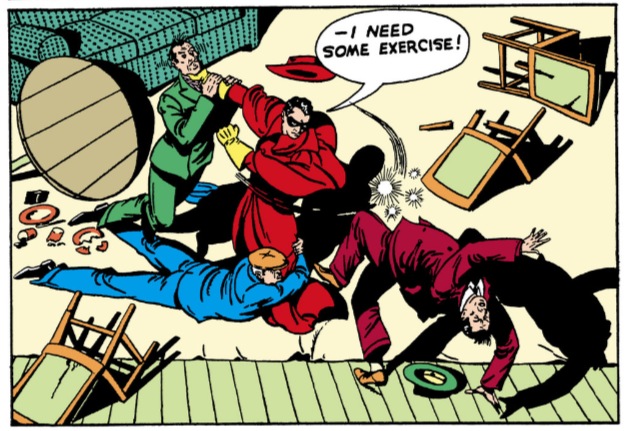
Adams and Robinson were both crusaders during the 1970s fight for creators’ rights. In the middle third of Smith’s interview Adams described how they teamed up to win recognition and pensions for Superman creators Jerry Siegel and Joe Shuster, as shown above. (Robinson is on the right, pre-toupée. Adams is the young man.) So I suspect Adams saw Robinson as standing out from the collective a bit.

10 April 2013

A Mystery with Not-So-Secret Identities

A while back, I had the idea for a mystery story set in the world of mid-1900s American comics publishing. I’m still working on that, but in the meantime I sampled Max Allan Collins’s A Killing in Comics, the first in a series of mystery novels set, well, in the world of mid-1900s American comics publishing.

I should have expected Collins to have worked out this idea already. He’s written many comics himself, including the Dick Tracy newspaper strip for many years, the Ms. Tree private-eye stories, and The Road to Perdition. Collins was the Batman scripter who gave the second Jason Todd his past as a runaway with criminal parents.

Collins is also a prolific writer of prose mysteries, including his award-winning Nathan Heller books, another series built around major modern disasters, and numerous novelizations. So basically he’s already worked out every idea for a mystery story.

A Killing in Comics is clearly inspired by Gerard Jones’s Men of Tomorrow, which has become the authoritative history of the start of the American comic-book industry. It’s a roman à clef about the first generation of DC Comics, or more particularly about the men who worked on its most famous creations, Superman and Batman. But in this book those trademarks are cleverly disguised as Wonder Guy and Batwing.

Thus, instead of Jerry Siegel and Joe Shuster, the book gives us Harry Spiegel and Moe Shulman—but they’re almost exactly as Jones characterized the Superman creators. On the Batman side, Bob Kane becomes Rod Krane, Bill Finger becomes Will Hander, and Jerry Robinson becomes…nothing, because unlike the other creators there’s no clear moral conflict in his career. Editor Mort Weisinger is on the scene at Sy Mortimer but as of 1948 hasn’t reached his full potential as a villain.

The detective, Jack Starr, is the troubleshooting vice president of a newspaper syndication service. Though he refers to his father as “the major,” reminiscent of Maj. Malcolm Wheeler-Nicholson, this business is actually successful. It’s also run by a version of Gypsy Rose Lee, a retired stripper of an intellectual kind. That’s the most fictional part of the book.

As with Oz the Great and Powerful, the story is a little less interesting than watching it play out just on the edge of its source material without stepping over the line onto that territory. In this case, the mystery depends on all those comics pros being capable of killing the equivalent of the president of DC Comics. So of course “any resemblance to actual persons…is entirely coincidental,” as the copyright page says.

Further volumes in Collins’s Jack Starr series appear to be inspired by the Li’l Abner Broadway show of 1956 and its roots in newspaper comics, and by Dr. Fredric Wertham’s anti-comics crusade.

19 August 2012

A Full Look at Detective Comics, #38

Comixology’s Nightwing 101 sale (ending this evening) offered me a 99¢ look at the whole of Detective Comics, #38, the magazine which introduced Robin as the Sensational Character Find of 1940.

As I’ve written previously, this was Whitney Ellsworth’s first issue as chief editor, and he replaced the story originally slated for this issue with Robin’s debut. Within a short time, Ellsworth instituted new rules about guns and killing in Batman tales.

But the Batman cover feature was only the first of several stories in that issue of Detective. At twelve pages it was the longest, but the whole magazine contained 58 pages of comics and a couple of prose items (not included in the Comixology download).

The other graphic features were episodes of “Spy” and “Slam Bradley,” both written by Jerry Siegel; “Red Logan,” an American reporter in London; “The Crimson Avenger,” a Green Hornet knock-off; “Cliff Crosby,” a “Terry and the Pirates” knock-off; “Speed Saunders, Ace Investigator”; and “Steve Malone, District Attorney.” The Crimson Avenger had preceded Batman as a masked hero, but the rest of the magazine’s heroes were square-jawed young white men in suits. (Well, Cliff Crosby wears flying gear and spends an unusual amount of time shirtless at the North Pole.)
Aside from Dick Grayson and the newsboys he encounters, the magazine shows only two recognizable children: a girl and “crippled boy” whom Slam Bradley and his grotesque sidekick rescue from a fire. Within a year, boy sidekicks and heroes would proliferate as the success of Captain Marvel and Robin sent the industry chasing after its main readership. Cliff Crosby was soon dubbed “Young America’s Hero” rather than “Famous Explorer.”

Another striking aspect of the magazine is that the Batman and Robin story is much better than the rest. Granted, scripter Bill Finger had more pages to work with, but a lot of the other tales make little sense, relying on coincidences, leaps of logic, and ludicrous action sequences.

In contrast, Batman and Robin’s drive to shut down Boss Zucco’s protection racket proceeds rationally, building to a night-time battle on the skeleton of an unfinished building. For that fight Jerry Robinson designed pages of dark panels alternating with light, full moon in the background.

Bob Kane and Robinson’s draftsmanship wasn’t as good as that of some other artists in this early comic, but their composition was much better. Only Jack Lehti’s work on the Crimson Avenger finds as much depth and variety in the panels. (Kane and his crew were working with a varied three-tier page structure. Fred Guardineer used a more uniform three tiers in “Speed Saunders,” and all the other stories are told in four tiers, like Kane’s original, six-page Batman tale.)
The coloring on most pages is awful. There was a limited palette, and the colorists deployed it poorly. One page of “Speed Saunders” shows three different women in red tops and green skirts, making it easy to confuse them; on another, two planes keep switching colors. In “Cliff Crosby,” the polar bears are brown. And this is supposed to be an English village landscape at night from “Red Logan.”
With that baseline, Robin’s costume of red, green, and yellow doesn’t seem so unusual.

01 August 2012

Not to Be Overlooked

Yesterday I was walking around a scenic overlook off Mulholland Drive in Los Angeles with some friends from college. I lifted a colorful page of newspaper off the ground, thinking I’d find a trash bin somewhere.

It turned out to be a page of Sunday funnies from the Los Angeles Times. Dated 21 July 1946.

Atop the first page is a Superman strip from the Sunday series titled “The Unhappiest Clown in the World.” At this time the newspaper strip was still credited to Jerry Siegel and Joe Shuster, though it seems clear Shuster didn’t draw these panels. In another year the team would sue DC and lose their legal claim on the character for decades. Funny thing is, my friends and I had just been discussing Superman.

Below the Superman strip are sequential-art ads for Colgate (“It Cleans Your Breath While It Cleans Your Teeth!”) and Veto (“Colgate’s Amazing New Antiseptic Deodorant” endorsed by four registered nurses).

On the reverse side are the strips “Harold Teen” (hijinks of a lovelorn fellow at the beach), “Grin and Bear It” (a collection of single-image gags, including a kneeslapper about the postwar housing shortage), and “Napoleon” (about a big dog who’s read Aesop’s Fables). Finally there’s an one-color sequential-art ad for Alka-Seltzer as cold relief.

The page is in good condition, considering it had been lying on the ground in a scenic overlook for an unknown time. There’s some discoloration and a small tear. Now all I have to do is figure out how to get it back home.

17 November 2011

“Characters were constantly speaking to themselves out loud”

At a new blog called Comics Without Frontiers, Miguel Rosa traces the development of thought balloons in the first year of Superman and Spirit comics.

[Rosa started his blog to promote discussion of comics from outside the US, but a lot of the postings are on the standard American superhero stories. Not that there’s anything wrong with that.]

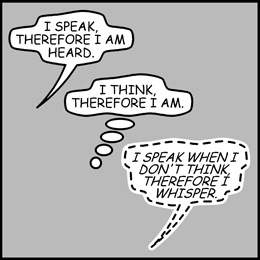
This posting complements my discussion of the same topic, which watched how thought balloons developed alongside whisper balloons since early on characters often seemed to be voicing asides to the audience.

Rosa writes:
I realized that one of the reasons why thought balloons were seldom used in those years was because the characters were constantly speaking to themselves out loud, like in this panel from Action Comics #1. In many of these cases, thought balloons should have been used instead. Rather than speaking out loud, a thought balloon containing a line like, “The cops are coming; I better change to my civilian clothes!” would make more sense.
He also reprints a delightful Spirit panel which shows the hero trapped under water and saying out loud: “I...can’t... hold...my...breath... much...longer!”

Soon, however, the thought balloon became a standard part of American comics punctuation, avoiding such unrealistic moments. Because superhero comics had to be realistic.

TOMORROW: Who started the thought balloon’s hibernation over the last thirty years?

23 June 2011

“Just an amazingly good looking guy.”

Folks in the Boston Comics Roundtable alerted me to a new blog by Jim Shooter, editor-in-chief at Marvel Comics during the late 1970s and 1980s, when the company overtook DC not only in innovation but in sales. He began work in the industry at thirteen, scripting stories for DC’s Legion of Super Heroes.

After work at other companies, DC hired Shooter to script some new Legion stories in the past decade. Among the assignments was to take a stab at creating a new Superboy since the courts might assign the copyright of that character to the heirs of co-creator Jerry Siegel. (Long story.) Shooter shared his response in a posting titled “Super Lad.”

I’m among the many people who can’t keep the Legion straight, and I don’t care about the original Superboy. What interested me about Shooter’s posting is what he, as an industry vet, saw as the necessary essence of Superman. In other words, what DC had to retain for a “Super” character if they couldn’t use any of the character history that would become the intellectual property of the Siegel family:
If a Super were anything but a noble being with an iron will and tremendous self control, impervious to the failings bad writers nonetheless foisted upon him or her, the Super would have been a villain. Period. And all the rest of the heroes, all the world for that matter, would have had nothing on their minds, and nothing else worthy of devoting their efforts to than destroying the Super. Period. 
. . .

I see him as a genuine good guy. Someone who does the right thing, who has tremendous willpower and courage, who is smart and reasonable. Smart about using his powers, as he learns how. The nicest, best guy you ever met. NOBLE, in the best senses of the word. Not that he can't make mistakes, not that he doesn't have humanity--but he's the best of humankind, one of the few survivors of his particular kind, determined, therefore, to give a good account of himself. 


Elliot S! Maggin once wrote an imaginary story in which Kal-el did not become Superman. Since that didn't occur, he was chosen as the Green Lantern of his sector because he among all beings there had the greatest courage, greatest will and noblest spirit. Right on. That was ES!M's finest hour.

Fair enough. But comics are a visual as well as verbal medium. How would that character be embodied in art? Shooter wrote:
- A strong, young man's physique. NOT overbuilt, NOT Hercules. Strong-looking but slim. Like Ditko's early Spider-man. An ATTAINABLE build. He's Kryptonian. He doesn't have to be absurdly musclebound.


- Handsome. A really, really good looking guy. No lantern jaw, no jock sensibility. Just an amazingly good looking guy. 


- Haircut: timeless. A haircut that wouldn't look out of place in almost any era. I wouldn't mind something pretty close to Superman's. Nothing dated or trendy. No mullet, no crew cut, no high-and-tight, no long hair, no Pet Detective, no spike-y do, no dreads, no curls, no mop. Timeless.
In sum, a good superhero has to look good. Really good. Even if he’s not musclebound or lantern-jawed, he has to be “amazingly good looking.” Or, as critic Douglas Wolk put it in Reading Comics:
The default style of the superhero mainstream [is] designed to read clearly and to provoke the strongest possible somatic response. You’re supposed to react to it with your body before you think about it. Most of its characters, especially the heroic ones, are drawn to look as “sexy” as possible…
The result is that the most underrepresented group among superheroes isn’t women, or non-white ethnic groups, or sexual minorities—not that those people aren’t underrepresented relative to their proportion of the general public. It’s people who are plain or unattractive.

Male or female, young or old, whatever color or orientation, superheroes are almost all drawn as physically attractive people. The main alternative is physically attractive people who turn into wildly exaggerated monsters.

Comics readers have long pointed out how artists routinely draw female heroes with big busts and little costumes, but are there any female heroes who aren’t conventionally attractive to begin with? As for men:
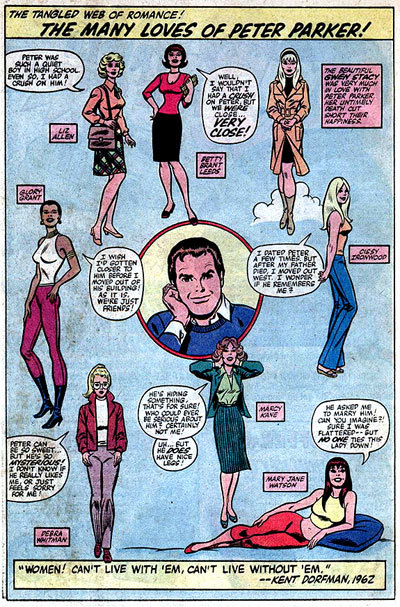
This is, after all, a genre in which Peter Parker was created to represent nerdy guys.

29 April 2011

Superman as “Meretricious Dreck”

From the Comics Journal’s appreciation of comic-strip collector and scholar Bill Blackbeard, who just died after a lifetime of preserving the nation’s daily verbal-visual entertainment:
“Far from being overwhelmed when Action came out with Superman,” he continued, “I thought it was meretricious dreck. I liked the art. I’d been following Slam Bradley [also by Jerry Siegel and Joe Shuster] in Detective Comics. And I liked the art and the storyline; I thought that was fine. But the Superman content did nothing for me because I immediately saw what many other people saw: there’s no story here. If he can do anything he wants to, who cares? Why bother? But the art did appeal, and I looked at it occasionally. It was nicely drawn.

“Then the whole superhero thing came in, and I recall thinking in the early forties that certain things—like Sub-Mariner and the Human Torch—I thought those were psychotic, the work of a lunatic. And of course Mickey Spillane was scripting, so I wasn’t that far off. I couldn’t understand how anyone would want to immerse themselves in such stuff.
Spillane did write some scripts and prose stories about the Torch and Sub-Mariner, but he didn’t create those characters. Ironically, Spillane’s biggest success came after he failed to sell a comic-book private eye of the Slam Bradley type. Unable to find a publisher for “Mike Danger,” he rewrote his script into a prose novel featuring Mike Hammer.

02 April 2010

Superman Battles the Challenge of Thought!

This panel is from Action Comics, #6, the sixth comic book to contain a Superman story. Lois Lane and Clark Kent are building that wonderful relationship which, a mere half-century later, convinced fans they were meant to be together forever.

In this panel, writer Jerry Siegel and artist Joe Shuster clue us in on Lois and Clark’s unexpressed thoughts. But to understand that, we have to know the code the creators used to set off characters’ thoughts from their spoken words in the same balloon: parentheses, dashes, and quotation marks.

I assume some American comic-strip creators tackled the challenge of showing thought before Siegel and Shuster, but I don’t know what they came up with. The early strips I could find are surreal tales like Winsor McCay’s Little Nemo in Slumberland and George Herriman’s Krazy Kat, and those characters rarely had unexpressed thoughts. (When Ignatz was puzzled in this strip, Herriman gave him a regular word balloon filled with a big question mark.)

That approach wouldn’t work in a more realistic scene. It’s notable that these examples show Clark Kent thinking secretly; Superman didn’t need to conceal his thoughts in these early stories.

In Action, #11, Clark expressed his thinking inside what later became codified as a “whisper balloon.” Indeed, it’s possible that Clark is whispering to himself here, the way a character in a radio or stage play can speak thoughts aloud while all the other actors pretend to ignore him. But that solution is obviously limited. A hero wouldn’t want to give away his game plan, even quietly, when he was around the Ultra-Humanite or some other villain.

In the early 1940s most American comic books adopted a standard form for showing thoughts: the thought balloon. These word balloons had a trail of ovals to the thinking character rather than a sharply pointing tail, and borders that differed from those of speech balloons, usually by being more cloudy.

Even so, the first of these panels from Action, #64, in 1943 show Siegel and Shuster’s successors pulling out the old technique of parentheses, hyphens, and quotation marks to squeeze a thought into a crowded panel. And they still use dashes and quotation marks inside Superman’s thought balloon to make its meaning doubly clear.

06 March 2010

Getting to Know the Spectre

If Superman grew from Jerry Siegel’s fantasy of how a near-sighted, Aspie nerd could beat up bullies, the Spectre was his fantasy of righting all the injustice in the world—and beat up bullies so bad they’d never walk again, or possibly even have legs.

Siegel created the Spectre in 1940, two years after the first issue of Action Comics introduced readers to Superman. Hard as it is to imagine, the Spectre was actually more powerful than the Man of Steel, and has stayed so, even as Superman’s strength grew to planet-moving levels.

In fact, the Spectre has so much power that he’s a plotting challenge. No force seems capable of standing up to him. In the Spectre story reprinted in Jules Feiffer’s The Great Comic Book Heroes, the hero investigates a tenement fire by interviewing a soul, seeping through a roof, flying, becoming invisible, paralyzing a man’s legs, turning flames to ice, growing gigantic, reading a man’s mind, and finally just willing the main villain to die. And he makes it look easy.

The thrill in these stories can’t come from worrying about the Spectre when he seems to be beaten. Instead, it lies in seeing what awesome new power he comes up with next. Among comic-book heroes, only Fletcher Hanks’s Stardust doled out more overpowering vengeance in every story, and Hanks was actually insane.

Comicvine lists the Spectre’s “usual” powers as:

  • Intangibility
  • Flight—fly at any speed
  • Invisibility
  • Teleportation
  • Fear Projection—can project fear into the heart and souls of adversaries
  • Inanimate Possession—inhabit and animate inanimate objects
  • Illusion Casting—ability to project realistic illusions
  • Magic Mastery—various mastery over virtually all forms of magic
  • Discern Motivation—can sense the intentions of people
  • Cosmic Awareness—knows many secrets of the universe
  • Precognition—sometimes gets glimpses into the future
  • Superhuman Strength
  • Superhuman Stamina
  • Superhuman Speed
  • Invulnerability
And that just scratches the surface. In the Spectre’s case “Superhuman Strength” is more like “as strong as the gravitational pull of small stars.”

The Spectre uses all those powers for just one thing: vengeance. He’s so single-minded that in the 1980s DC’s writers decided that the Spectre is in fact the wrath of God. He feels no mercy, no compassion, and no limits. He plows through the world unstoppably, leaving the evildoers who catch his attention as quivering, half-human wrecks.

The magazine that featured most of the Spectre’s early adventures was called, naturally, More Fun.

TOMORROW: The Spectre’s judgment on Robin.

10 October 2009

Superhero Comics as a “Novel of Ideas”

When I started to explore superhero comics again after a gap of over twenty years, I found the task of interpretation (as in, “figuring out what the hell was going on”) greatly helped by these passages from Douglas Wolk’s Reading Comics: How Graphic Novels Work and What They Mean:

Superhero comics are, by their nature, larger than life, and what’s useful and interesting about their characters is that they provide bold metaphors for discussing ideas or reifying abstractions into narrative fiction. They’re the closest thing that exists right now to the “novel of ideas.”

That’s what’s kept this particular weird little genre so closely connected to its much broader medium: a form that intrinsically lends itself to grand metaphors and subjective interpretations of their visual world goes well with characters who have particular allegorical values. . . .

Virtually every major superhero franchise, actually, can be looked at in terms of a particular metaphor that underscores all of its best stories. . . . that subtext deepens the experience of the surface text, and over time it makes characters meaningful parts of the master “universe narratives.”
That last remark about universes reveals how Wolk’s thinking is most influenced by, and most applicable to, the American comics of the last quarter-century. In that period, the major superhero publishers have cross-pollinated character histories and plot lines as they chased an aging and shrinking readership.

In the industry’s early decades, comics creators were interested only in telling adventure stories effectively enough to keep food on the table. Sure, their major characters embodied forms of wish-fulfillment: the nerd who could secretly beat everyone up, the towering and omnipotent bringer of vengeance—and those were just Jerry Siegel’s creations! But they would have laughed at the notion of deeper symbolic significance.

Subsequent generations of readers grew up thinking about those heroes, perhaps too much, and then got the chance to develop those characters further and add new ones. Crossovers, team-ups, and landmark events became more important in superhero storytelling, forcing writers to find ways to differentiate one hero from another. And eventually cookie-cutter characters came to represent different approaches to heroism.

For example, Aquaman’s personality was originally quite like that of DC Comics’s other heroes—he just lived in the ocean and ordered fish around. In recent decades, however, writers have emphasized Aquaman’s separation from land-dwelling humanity, his environmental concerns, his status as king of Atlantis. He’s come to represent an elemental force on DC’s Earth rather than just a watery Superman.

As another example of what this means in practice, here’s what Wolk sees as the idea behind/represented by the Caped Crusader, at least since the 1980s:
Batman...has pushed himself to the edge of being greater-than-human—and what he’s defined as the peak of humanity is dangerousness and a lack of weakness. His relentless drive, though, had made him (for all practical purposes) psychotic: he’s a benign psycho but barely functional as a person.

His enemies mostly get sent to an insane asylum rather than a prison—they’re like him but malign rather than benign, as virtually everyone who’s written Batman comics over the last few decades has hammered in. And his drive is the kind that parents often pass on to their children; hence his parental relationship with Robin...
TOMORROW: Reason for Robin, #9—what idea Robin represents.

09 August 2009

The Other Boy Wonders of 1940

As I described yesterday, in late 1939 American comic-book publishers apparently realized that preteen boys were their biggest audience, and scrambled for ways to appeal to those readers even more. Captain Marvel--a kid who turned into a super-powered adult--was one response. Robin--a kid who fought criminals in costume without any fantastic powers--was another.

Then in issue #41 of Detective Comics (cover date July 1940), the last panel of the Batman stories started describing Robin as "the ORIGINAL Boy Wonder." Which made me wonder: What other kid heroes was the magazine trying to dismiss as wonders-come-lately?

I turned to Don Markstein's Toonopedia. It doesn't offer a one-stop answer to the question of "Who was the second boy wonder in superhero comics?", but it is indeed a "Vast Repository of Toonological Knowledge" (and some historical poppycock).

The first issue of Blue Bolt, dated June 1940, featured the adventures of Dick Cole, the Wonder Boy. Like Dick Grayson, he had no special powers but excellent conditioning. This Dick didn't boast the costume and secret identity of a superhero, however; he was more a descendant of dime-novel heroes like Frank Merriwell. The publisher also didn't feature him so prominently; Dick Cole didn't appear on the magazine cover until issue #10 (shown at top).

The next month, Quality's National Comics offered a six-page back-up story of Wonder Boy, who came to Earth with powers and abilities far beyond those of mortal teenagers. Wonder Boy wasn't featured on a comic-book cover at all until 1944, when another company reprinted his stories in Bomber Comics.

Top-Notch Comics, #8, dated September 1940, offered "The Marvel of 1940--Roy...the Super-Boy!" He was a new sidekick for the Wizard, and like Robin wore a tiny cape and shorts.

[ADDENDA: I missed Marvel Boy! Of course, he appeared only in the September 1940 issue of Daring Mystery Comics, and in a second story published in 1943. But he was a creation of Joe Simon and Jack Kirby. And he was yet another teenager gaining superpowers in that watershed year.

And yet another September arrival: “The Amazing Boy Richy the Rang-a-Tang Kid! Brand New!!” in Blue Ribbon Comics, #6. The cover shows Richy helping “Rang-a-Tang the Wonder Dog” to rescue Charlie Chaplin. In this case, the boy sidekick actually replaced the star canine’s adult sidekick.]


[FURTHER ADDENDA: Weird Comics, #3, with a cover date of August 1940, gave us the Dart and his teen sidekick Ace Barlow. Young Ace was called “the Amazing Boy,” but as he threw himself into fights (usually throwing himself head-first into a crook’s abdomen) he tended to announce himself as “Ace Barlow.” Nevertheless, the identity of the Dart and his amazing pal was still a mysterious secret.]

In fall 1940 the Marvel company launched The Human Torch magazine with issue #2 [don't ask], giving one of its top heroes a title of his own. And a sidekick as well--that magazine's first story was "Introducing Toro, the Flaming Torch Kid."

Though the cover showed Toro alongside his mentor, there was no blurb to identify him as a teenager, and it's really hard to tell one person engulfed in flames from another. Nonetheless, of all these young characters, Toro has had the longest career in comics; he even shows up in this summer's Young Allies special.


Finally, Pep, #11, dated January 1941 but on newsstands before the end of the previous year, brought on Dusty the Boy Detective as a sidekick for the Shield. Months later, Dusty even started teaming up with Roy the Super-Boy.

By 1941, boy sidekicks were no longer a novelty. Indeed, they were almost required. Captain America charged onto the scene with Bucky at his side in his very first issue. To do something new, writers had to upend that relationship, as Jerry Siegel did with the Star-Spangled Kid and Stripesy--kid hero, adult sidekick.

Cover images from the Grand Comics Database.

27 March 2008

The Emergence of the Comic-Book Supervillain

There were larger-than-life villains in popular literature before comic books: Prof. Moriarty, Dr. Fu Manchu, and, as far back as 1862, Jean Diable. But the character type really took off after American comics created a world of superpowers and colored costumes.

The first supervillain naturally faced off against the first superhero, created by Jerry Siegel and Joe Shuster. In the thirteenth issue of Action Comics, with a publication date of June 1939, Superman met:

the Ultra-Humanite!

Until then, Superman had been battling natural disasters, economic injustice, and human evildoers who couldn't possibly match his strength. His antagonists in his first year included a wife beater, kidnappers, warmongering munitions dealers and their lobbyists, the owner of an unsafe mine, a hit-and-run driver, gamblers trying to fix a college football game, crooked stock brokers, and a fraudulent licensor of the valuable Superman trademark.

The Ultra-Humanite looked like he could be a real threat. Like Superman, he represented a further stage in human development. But while Superman was physically superior, this villain was physically debilitated--confined to a wheelchair, his hair sparse and white. The Ultra-Humanite claimed intellectual superiority to the rest of humanity. And while Superman was waging a "one-man battle against the forces of evil and oppression," the Ultra-Humanite was out for power.

Yet I can't help but note that Superman tracked down the Ultra-Humanite through a racket called the "Cab Protection League." Was this ultra-genius really expecting to achieve "DOMINATION OF THE WORLD" by forcing one city's independent taxi owners into an association? I imagine him skulking in his lair, boasting to himself:
"Why, soon I'll be taking in $300 or even $400 a week! At that rate, how long could it be before I can finance my death-ray construction plans?

"Let's see...multiply by 52 weeks, carry the 2,...

"That can't be right. I'm an evil genius. Let me do this again...."