Showing posts with label AUTHOR Tamora Pierce. Show all posts

18 March 2007

So What's "Temporal Perspective"?
Lee of the Mortal Ghost blog novel sent this comment to one of last week’s posting:

Will you please explain what you mean by 'temporal perspective'?
Which left me confused because I hadn’t used that term recently. But by using the search function, I found that Lee must have followed links back to a posting about narrative voices last year. That mentioned a presentation I gave at last year’s SCBWI New England conference about the parameters of narrative voice in fiction.

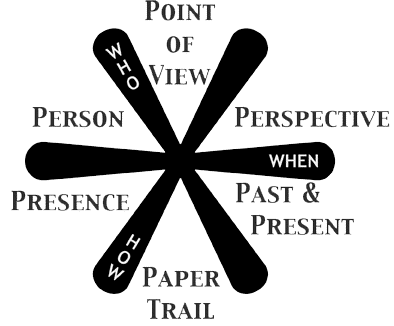
One of those parameters, I posit, is Perspective. (I gave all six parameters labels that begin with P, just because.) In my thinking, Perspective refers to the amount of time that’s passed between the events in a story and the storytelling itself. Does the narrator indicate that he or she knows how the story ends? Is the narrator looking back on the events from years later? Does the narrator’s Perspective shift with events, as in an epistolary novel?

In my talk I used the openings of three novels to show different common Perspectives--

Immediate
“Too many!” James shouted, and slammed the door behind him.

“What?” said Will.

“Too many kids in this family, that’s what. Just too many.” James stood fuming on the landing like a small angry locomotive, then stumped across to the window-seat and stared out at the garden.
--Susan Cooper, The Dark Is Rising (1973)
That appears to be the default Perspective today: get us right into the action, with no hint that the narrator has any knowledge of what’s to come. (Curiously, this opening suggests that James is the character with a problem; Cooper does a deft shift in the next paragraph to put us in Will’s head instead. But that’s a matter of what I call Point of View.)

Recent
I don’t know just why I’m telling you all this. Maybe you’ll think I’m being silly. But I’m not, really, because this is important. You see, it was different! It wasn’t just because it was Jack and I either--it was something more than that.
--Maureen Daly, Seventeenth Summer (1942)
This narrator does know what will happen in her story. But she’s still close enough to those events to believe that they’re really important, and deep. This story about adolescence thus comes from an adolescent Perspective. Other novels about that time in life are written from a more distant, adult Perspective. I think that’s one of the significant differences between true YA fiction and coming-of-age novels for adult readers.

Retrospective
My brother Tom and eldest brother Sweyn arrived home for summer vacation on Sunday, June 5, 1898. I remember the date very well because, just two weeks later, the entire town of Park City was destroyed by the worst fire in the history of Utah.
--John D. Fitzgerald, The Great Brain Reforms (1973)
This narrator not only knows what’s upcoming two weeks after the opening moment, but is also distant enough from those events to say, “I remember the date” and “the history of Utah.” This Perspective adds to the sense that the novel might be the true recollection of an aged Utahan. And it hints at entertaining chaos to come.

Telling a story in diary form forces an author to adopt a certain Perspective: each diary entry describes what the character writing believes and feels at that moment, not while the events take place, nor the next day with more knowledge. Often this can interfere with a sense of immediacy and produce less suspense for readers. In Beka Cooper: Terrier, Tamora Pierce wrestles with this problem on page 364 by having her heroine write:
I must write about today, because so much has happened. I think the only way I can write it is to write of my watch, and do so as I lived it, without knowing how it will end.
As I wrote earlier, eschewing the diary format for an immediate Perspective would have let Pierce launch straight into the episode without this apology for doing so.

Lee added in an email:
Have you done any reading in neuroscience or cosmology regarding time? Terribly complex for someone like myself, but fascinating nevertheless. I'm currently working my way through Benjamin Libet's Mind Time: The Temporal Factor in Consciousness.
No, I haven’t explored that far, and I’m not sure my concept of Perspective is up to that level of sophistication. It’s simply a parameter writers might choose when considering various ways to tell a story. The same events can look quite different from the distance of a few minutes, a day, a year, or many years. One story might work best with one Perspective while another story wouldn’t work that way at all. And breaking out of the Perspectives we’re used to (as in, say, the movies Groundhog Day and Memento) can be very powerful.

14 March 2007

Cybils Nominee Beka Cooper: Terrier

I’m sure the Chicago Manual of Style has rules on how to render the title of a novel in a series, but I’m not bothering to look them up. What I’m calling Beka Cooper: Terrier, by Tamora Pierce, is the first in a new series named after its heroine, a young woman named Beka Cooper. I suspect each volume will show her at one stage in her law-enforcement career. In this one she’s a trainee (“Puppy”) who proves herself a dogged “Terrier.” Sort of like Cherry Ames, Rookie Cop.

The book takes place in Pierce’s Tortall realm centuries before the action of her first novel, Alanna. The card page (“Other Books By...”) lists three other Tortall quartets and a twosome. So while I hadn’t read any of Pierce’s books before, it wasn’t for lack of effort on her part.

Beka Cooper: Terrier is a police procedural and coming-of-age story set in a fairly “high” fantasy world (no dragons, but mages, knights, etc.). It’s not a mystery, really. Beka and her police colleagues undertake two parallel investigations, but fairly early on they guess the answer to one, and for the other there are no solid red herrings and only a couple of concealed clues. But many police procedurals aren’t built around solving whodunits; the challenge for the cops is amassing evidence before the criminal strikes again, and that’s how this story works, too.

I know this observation might perpetuate gender stereotypes, but female readers, especially those who know Pierce’s other books, seem most excited about figuring out the relationships among the characters: What fella is Beka going to end up with? How is she related to descendants in other volumes? The other male Fantasy/Science Fiction Cybils judge and I focused on the magical milieu, and were left unexcited: it’s a standard sword-and-sorcery world. (But to break that gender stereotype, Pierce herself is reportedly most interested in the magic and weaponry, a little baffled by her fans’ excitement about who likes whom.)

In the book’s prologue we meet Beka as a girl of eight years, bold enough to grab the Lord Provost’s attention by grabbing his horse’s bridle. Impressed, he takes her and her family into his noble household. Yet when we next meet Beka, six years later, she’s cripplingly shy, peering out at the world through her bangs and able to croak out only a few words in front of an audience. The better for reader identification, perhaps?

In fact, Beka has so much going for her, it’s almost complete wish-fulfillment for a teenaged police officer (or teenaged reader). Her cat talks to her. Pigeons talk to her (well, the troubled souls of dead people who ride on the pigeons’ backs do). Dust devils talk to her. As someone said last year about Chasing Vermeer, this is a book in which clues find the kid rather than the kid finding the clues.

The book started slow for me, but eventually I found myself intrigued by Beka’s story and rooting for her success. What stopped me from fully enjoying Beka Cooper: Terrier is how Pierce wrote it in diary form. In fact, I thought it was one of the least convincing, least compelling fictional diaries I’d read in a long time. Shortly after finishing the book, I heard Pierce’s Random House editor speak at the SCBWI conference in New York. She reported that this was the first novel Pierce wrote in the first person, so I suspect she chose the diary form to feel more comfortable in that mode.

Personally, when I read (or write) a book in diary form, I want the document itself to play a role in the story. In this case, for instance, Beka could have looked back in her journal and seen clues that she’d forgotten. A diary might also be commented on, stolen, lost, abandoned and resumed, and so on. I guess this is a variation on the Heisenberg Principle: once a character starts recording her life in a diary, that life shouldn’t be the same anymore.

Why? Because we need an extra dimension of interest for all the limitations that come with a diary. In a realistic diary, especially one written for the diarist alone, the perspective of each entry is how the character feels when he or she write, not earlier in the day. Thus, if I’m writing a diary entry after breaking my leg, I’m going to start with my broken leg and how that’s making me feel right now. I’m not going to start by painting a picture of how my day began hours before. My leg hurts, dammit! So that makes a realistic diary a difficult narrative tool; it offers immediacy, but immediacy to the moment of writing, not the moment of action.

Beka Cooper: Terrier is full of moments narrated in great detail, external and internal, which means that its diary entries are completely unrealistic. On page 80, Beka arrives home physically exhausted--and proceeds to write more than 52 pages! And that's on top of 12 pages written at some point that morning--exactly when she finds the time is unclear.

There are a few writerly tricks to remind us we’re supposed to be reading a document, like a smear of ink on one page. But those tricks don’t really work. One night Beka comes home a little tipsy (page 350), so her diary includes typos: “teh Fog Lanterun.” We make errors like that when we type drunk, not when we write with a quill pen drunk. The prologue includes a diary entry from a semi-literate relative. But semi-literate people don’t keep detailed diaries. Most important, those types of narrative intrusions (what I called a “Paper Trail” in a presentation last spring) distract from the story rather than adding to it.

Three hundred years ago, as the novel was just being established in English literature, readers may have expected the frame of a memoir, biography, series of letters, or diary to explain why someone is telling us all this. But we don’t need those crutches anymore. We’re happy to follow a character describing his or her story in detail for no explicit reason at all--as long as that story is exciting. And Pierce’s story is exciting enough. It would have been more graceful without the unnecessary diary format, and I hope Pierce has the confidence to ditch that element for her next Beka Cooper volume. Her first-person voice works just fine.

29 January 2007

A Look into the Future Tomorrow

The Foundation for Children’s Books will host the following event tomorrow night at Boston College:

Roger Sutton of the Horn Book magazine talks with a panel of senior editors from publishers small, medium and large--Judy O'Malley of Charlesbridge Publishing, Elizabeth Bicknell of Candlewick Press and Margaret Raymo of Houghton Mifflin--about the changing nature of publishing books for children and youth. Topics will include the reign of fat fantasy, the decline in picture books, and the future of the new kid on the block--graphic novels. Where will we go from here?
Admission is $15 if you’re not already a member of the FCB.

Speaking of “fat fantasy,” a word about Beka Cooper: Terrier (unless that should be Terrier: Beka Cooper--it’s the first in a coming series), by Tamora Pierce. This book is 581 pages long, blocky enough to stand up in a moderate wind. Random House achieved that full heft in the typesetting; I think the technical term for the book's type size is “honking big.”

As I said about the U.S. edition of The Pinhoe Egg, this book could have been printed on considerably fewer pages without looking cramped. It was by no means short to begin with, but the fashion in fantasy today is thick as a pound cake. So designers are using a little magic to make moderate manuscripts into behemoths. After all, it's only trees.