Showing posts with label Glinda. Show all posts

21 January 2025

Two More Oziana Short Stories

Last week’s posting about a mystery story in Oziana 2024 made me realize I’d never noted Oziana 2023, which contains two of my stories.

As I reported last week, I’ve been seeking inspiration for new stories from pairing two recurring characters in the Oz books, as L. Frank Baum did in his Little Wizard Stories of Oz.

“The Soldier with the Green Whiskers and the Guardian of the Gates” is a natural pairing: two officers of the Wizard’s Emerald City government who kept their posts under the Scarecrow and then Princess Ozma, working together as friends.

The Oziana 2023 stories, in contrast, pair characters who have little in common and start out at odds with each other.

“Button-Bright and the Professor” shows the small boy from Philadelphia and the highly educated Wogglebug quarreling over directions before they’re forced to deal with a giant riddle-loving pangolin. This story was illustrated by Marcus Mébes.

“Glinda and the Glass Cat” follows the transparent feline to the China Country, the Hammerheads, and the Fighting Trees while the powerful sorceress seeks to make her curb her willful instincts. Anna-Maria Cool supplied fun art for this tale, and for the magazine’s cover.

Like other recent issues of Oziana magazine, the 2023 collection is sold through Lulu.

18 June 2024

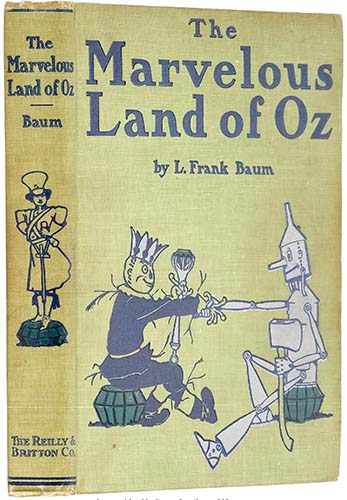
The Missing Princess of the Marvelous Land

I’ve been thinking about how The Marvelous Land of Oz could be more of a mystery. As it is, the book is a roller-coaster ride of political events. Every so often it raises the question of who should rule the Emerald City. But the book doesn’t give us all the clues to its ultimate answer until quite late.

Baum and his colleagues had introduced the character of Pastoria, former king of Oz, in the 1902 stage extravaganza The Wizard of Oz. Therefore, when the Scarecrow mentions his name in the sixteenth chapter of Land, it wouldn’t have been a complete surprise to all readers.

Nonetheless, that was two-thirds of the way through the book. Furthermore, Glinda doesn’t drop the bombshell that Pastoria left a missing daughter until four chapters later. That means readers have only three chapters to be thinking about this mystery, on which the conclusion of the story will hinge.

There are plenty of signs that Baum didn’t like going back to revise. He occasionally excised whole chapters or inserted new passages, but his surviving manuscripts and correspondence show none of the fiddling with details that other writers regularly performed.

I don’t think it would have taken much revising to cue readers into thinking about Pastoria and his daughter for much of the book. Here are some slightly rewritten passages in which characters discuss the history of Oz.

In Chapter 3, the boy Tip is trying to orient his creation, Jack Pumpkinhead:
“Where are we going?” asked Jack, when they had resumed their journey.

“I’m not exactly sure,” said the boy; “but I believe we are headed South, and that will bring us, sooner or later, to the Emerald City.”

“What city is that?” enquired the Pumpkinhead.

“Why, it’s the center of the Land of Oz, and the biggest town in all the country. I’ve never been there, myself, but I’ve heard all about its history. It was built by a mighty and wonderful Wizard named Oz, around the estate of the former king Pastoria, and [later] . . . the people of the Emerald City invited the Scarecrow to rule them.”

“Dear me!” said Jack. “I’m getting confused with all this history. Who is the Scarecrow?”

“Another friend of Dorothy’s,” replied Tip.

“And who is Dorothy?”

“She was a girl that came here from Kansas, a place in the big, outside World. She got blown to the Land of Oz by a cyclone, and while she was here the Scarecrow and the Tin Woodman accompanied her on her travels.”

“And where is she now?” inquired the Pumpkinhead.

“Glinda the Good, who rules the Quadlings, sent her home again,” said the boy.

“Oh. And what became of the Scarecrow?”

“I told you. He rules the Emerald City,” answered Tip.

“I thought you said it was ruled by a wonderful Wizard,” objected Jack, seeming more and more confused.

“Well, so I did. Now, pay attention, and I’ll explain it,” said Tip, speaking slowly and looking the smiling Pumpkinhead squarely in the eye. “Around the time King Pastoria vanished, the Wizard came and built the Emerald City and ruled for many years. Dorothy went to the Emerald City to ask the Wizard to send her back to Kansas; and the Scarecrow and the Tin Woodman went with her. But the Wizard couldn’t send her back, because he wasn’t so much of a Wizard as he might have been. And then they got angry at the Wizard, and threatened to expose him; so the Wizard made a big balloon and escaped in it, and no one has ever seen him since.”

“Now, that is very interesting history,” said Jack, well pleased; “and I understand it perfectly all but the explanation.”
After Jack and Tip get separated, the boy meets a pretty young woman in a colorful military uniform. With a little tweaking, this conversation could have been part of that Chapter 8:
“I am General Jinjur,” was the brief reply.

“Oh!” said the boy surprised. “What sort of a General?”

“I command the Army of Revolt in this war,” answered the General, with unnecessary sharpness.

“Oh!” he again exclaimed. “I didn’t know there was a war.”

“You were not supposed to know it,” she returned, “for we have kept it a secret; and considering that our army is composed entirely of girls,” she added, with some pride, “it is surely a remarkable thing that our Revolt is not yet discovered.”

“It is, indeed,” acknowledged Tip. “But where is your army?”

“About a mile from here,” said General Jinjur. “The forces have assembled from all parts of the Land of Oz, at my express command. For this is the day we are to conquer His Majesty the Scarecrow, and wrest from him the throne. The Army of Revolt only awaits my coming to march upon the Emerald City.”

“Well!” declared Tip, drawing a long breath, “this is certainly a surprising thing! May I ask why you wish to conquer His Majesty the Scarecrow?”

“Because the Emerald City has been ruled by men long enough, for one reason,” said the girl. “Before the Scarecrow there was the Wizard, and before the Wizard, or even the city as it stands today, there was King Pastoria. Some people say Pastoria had a daughter who was meant to rule over us, meaning that we should have had a girl ruler by this time, but no one has seen that child for years.”

That lost heir was not part of the history of Oz that Tip had heard from Mombi. He puzzled over this rumor as Jinjur went on:

“Moreover, the City glitters with beautiful gems, which might far better be used for rings, bracelets and necklaces; and there is enough money in the King’s treasury to buy every girl in our Army a dozen new gowns. So we intend to conquer the City and run the government to suit ourselves.”
Tip and Jack Pumpkinhead reunite in the Scarecrow’s palace, only for General Jinjur to seize the Emerald City. Later the Scarecrow seizes the palace back with the help of his close friend, the Tin Woodman. But at that point in Chapter 16, the straw-man ruler is ready to abdicate:
Tip soon cut the stitches that had fastened the crown to the Scarecrow’s head, and the former monarch of the Emerald City removed it with a sigh of relief and hung it on a peg beside the throne.

“That is my last memento of royalty,” said he; “and I’m glad to get rid of it. The former King of this City, who was named Pastoria, lost the crown to the Wonderful Wizard, who passed it on to me. Now the girl Jinjur claims it, and I sincerely hope it will not give her a headache.”

“A kindly thought, which I greatly admire,” said the Tin Woodman, nodding approvingly.

“Have you ever heard,” Tip asked the straw man, “that King Pastoria had a daughter who disappeared?”

“Some people do say that,” answered the Scarecrow, “and some say otherwise. That happened well before my time, so I cannot say anything about it. Why—do you think General Jinjur is this lost heir to Pastoria?”

Tip shook his head. After all, Jinjur was the person who had first told him about the missing princess, and she had made no claim to rule the Emerald City other than by force and cunning.

“Well, now I will indulge in a quiet think,” continued the Scarecrow, lying back in the throne.
Finally, the Scarecrow and his supporters reach Glinda’s palace in Chapter 20:
“Therefore I have come to beg your assistance,” resumed the Scarecrow, “for I believe you are always glad to succor the unfortunate and oppressed.”

“That is true,” replied the Sorceress, slowly. “But the Emerald City is now ruled by General Jinjur, who has caused herself to be proclaimed Queen. What right have I to oppose her?”

“Why, she stole the throne from me,” said the Scarecrow.

“And how came you to possess the throne?” asked Glinda.

“I got it from the Wizard of Oz, and by the choice of the people,” returned the Scarecrow, uneasy at such questioning.

“And where did the Wizard get it?” she continued gravely.

“I am told he took it after Pastoria, the former King, had not been heard from for some time,” said the Scarecrow, becoming confused under the intent look of the Sorceress.

“Then,” declared Glinda, “the throne of the Emerald City belongs neither to you nor to Jinjur, but to this Pastoria from whom the Wizard usurped it.”

“That is true,” acknowledged the Scarecrow, humbly; “but Pastoria has been gone for many years now, and some one must rule in his place.”

“Pastoria had a daughter, who is the rightful heir to the throne of the Emerald City. Did you know that?” questioned the Sorceress.

“Not for certain,” replied the Scarecrow. “But if that girl still lives I will not stand in her way. It will satisfy me as well to have Jinjur turned out, as an impostor, as to regain the throne myself. In fact, it isn’t much fun to be King, especially if one has good brains. I have known for some time that I am fitted to occupy a far more exalted position. But where is the girl who owns the throne, and what is her name?”

“Her name is Ozma,” answered Glinda. “But where she is I have tried in vain to discover. For the Wizard of Oz, when he stole the throne from Ozma’s father, hid the girl in some secret place; and by means of a magical trick with which I am not familiar he also managed to prevent her being discovered—even by so experienced a Sorceress as myself.”
By that point, readers would have been thinking about the Emerald City’s deep history for most of the book, and the mystery of the missing heir for a dozen chapters. Where could that child be?

04 April 2022

The Opening of the Emerald City

My last posting explored the location of the original gateway into the Emerald City, the one Dorothy and her friends use in L. Frank Baum’s The Wonderful Wizard of Oz.

The travelers come to an emerald-studded gate at the end of the Yellow Brick Road. That outer gate leads to a room inside the thick wall with an inner gate on the other side. The little man inside is therefore called the “Guardian of the Gates” even though there is only one opening the in wall. (With his typical inconsistency, Baum also called this character the “Guardian of the Gate,” sometimes within the same chapter.) Thus, the many early references to the city “gates” don’t mean there’s more than one gateway through the wall.

When characters arrive at the city in The Marvelous Land of Oz, Baum describes their experiences in much the same way as in the first book. The Guardian of the Gates greets them and hands them off to the Soldier with the Green Whiskers. Characters speak of “the gate” of the city.

At the same time, it’s clear that there have been changes in the Emerald City. While before the gate was studded with emeralds, the jewels inside the city only appeared to be emeralds because people wore green spectacles. In Land the city contains some real jewels. General Jinjur and her soldiers don’t fear blindness without the spectacles.

More pertinent to this inquiry, in Wizard the Guardian tells Dorothy and her friends there’s no road to the west because no one ever travels that way for fear of the Wicked Witch. In Land the Sawhorse follows “the road to the West.” It’s not clear whether this path begins at the same gate where the Yellow Brick Road ends.

Finally, toward the end of Land Baum tells us that “Jinjur had closed and barred every gateway” into the city. While other passages in that book refer to “the gate” as if there’s still only one, the phrase “every gateway” definitely implies that by the time of Jinjur’s brief rule the city had more entrances.

Once again, this fits with what we know about overall politics in Oz. When the Scarecrow becomes ruler of the Emerald City at the end of Wizard, the Wicked Witches of the East and West have been eliminated. He’s on good terms with Glinda to the south. His friend the Tin Woodman will now govern the west. It would be safe to welcome visitors to his city.

I therefore surmise that between Wizard and Land the Scarecrow began the process of building more gates into the Emerald City walls. Perhaps not as large as the original gate, or perhaps (given the peacetime conditions) larger. Likewise, the Scarecrow and Tin Woodman probably promoted the new road from the city to the west.

Commerce and travel between the parts of Oz was probably still slow in this period. The Scarecrow met Gillikins so rarely that by the time of Land he hadn’t learned they speak his language. Yet General Jinjur could assemble an Army of Revolt of young women from all four outer realms of Oz. (Indeed, Jinjur’s uprising might have been the first pan-Oz movement, at least for several decades.)

Another sign of Oz opening up to travelers appears when we consider the “road to the South” to Glinda’s castle. At the time of Wizard, that route ran into the Fighting Trees, the walled China Country, a dark and boggy forest, and the Hammerheads, who refused to let anyone hike over their hill. None of those obstacles ever appear in the Oz books again, and characters make many easy land journeys from the Emerald City to Glinda’s home. 

What could produce that change? The most likely answer is Glinda the Good Sorceress. With the Wizard in power, she might well have appreciated having several difficult obstacles between his power base and her castle. But once the Emerald City was under a friendly straw-man regime, Glinda probably preferred easier travel.

In The Emerald City of Oz we learn that Glinda has established several protected little communities in Quadlingland and even manipulates the weather over one of them, Miss Cuttenclip’s village. At the end of that book she unilaterally cuts all of Oz off from our Great Outside World. Tik-Tok of Oz shows us Glinda’s moving a mountain pass to divert a hostile army outside of Oz—and so casually she doesn’t bother to remember that she’s done so.

Given that record, it’s easy to imagine Glinda magically shifting the road from the Emerald City to her castle to be straighter or safer, or shifting the Fighting Trees, Hammerheads, and other relentlessly hostile obstacles away from it.

The process of connecting the Emerald City to the rest of Oz no doubt accelerated after Princess Ozma took the throne at the end of Land. Unlike the Scarecrow, she claimed dominion over all of Oz. Her realm is largely peaceful and her rule increasingly secure. It’s no surprise, therefore, that years later The Patchwork Girl of Oz assures us there are four gateways into the city, one for each quadrant of Oz.

18 July 2020

OzCon Preview: “Glinda the Good and Powerful” Panel


Tonight I’ll be moderating a panel discussion for OzCon 2020, which because of the pandemic will be online instead of in California.

Our topic is “Glinda the Good and Powerful.” The panelists are Mari Ness, Caroline Spector, and Atticus Gannaway, all of whom are practiced fiction writers as well as knowledgeable critics and scholars of fantasy literature.

We’ve recorded the first half of our discussion, and the video above is a one-minute preview of snippets. After playing that, we’ll shift to real-time live discussion with questions from the audience. Part of my job will be vacuuming up those questions from various forums.

Though the magic of YouTube has made Billie Burke the face of Glinda in the image above, most of our conversation will be about the Oz books, and particularly L. Frank Baum’s books since that’s where Glinda looms the largest.

The discussion will take place on Zoom starting at 8:00 Eastern time. We’ll post a recording on the OzConnection channel on YouTube.

01 December 2015

Oz Art to Wish for from Linda Medley

This is one of the most potent images from the Oz book mythos: Dorothy is wearing the Magic Belt and making a wish. Something’s gonna happen. Somebody’s going down.

This illustration comes from Linda Medley, the comics artist best known for Castle Waiting and a long-time fan of the Oz books. It’s one of five greeting cards featuring Oz characters that she just offered on Etsy. The others show Scraps, Jack Pumpkinhead, the Wizard, and Glinda.

Medley has also created a print of Ozma, the Wizard, and Dorothy (and Toto, too). Her picture of Dorothy is an enthusiastic little girl, notably younger than Ozma and ready for adventure.

28 March 2013

The Wonderful Wizard of Oz and the Bechdel Test

Critics of Oz the Great and Powerful have been lauding L. Frank Baum’s The Wonderful Wizard of Oz as a first-wave feminist fable, but I started to wonder: Does it pass the Bechdel Test? It certainly has more than two female characters, and they certainly do talk to each other. But do they talk about something other than a man? That last question looks a bit iffy for a while.

Dorothy and Aunt Em don’t actually have a conversation in the first chapter. Aunt Em just calls out, “Quick, Dorothy! Run for the cellar!”

The first woman (or character) Dorothy has a long conversation with is the Good Witch of the North, and that conversation eventually focuses on a man: the Wizard.

In her journey to the Emerald City, Dorothy talks with two more female characters: the Queen of the Field Mice and a housewife outside the city. But they both talk about the scary Cowardly Lion.

In the city itself, Dorothy chats with a young maid in the palace; later Baum named this character Jellia Jamb. They discuss clothes and the Wizard.

Dorothy then sets off to kill the Wicked Witch of the West. The Witch captures the little girl with the help of her winged monkeys, and at last there’s an extended exchange of words that’s not about the Wizard or the Lion. So in chapter 12 The Wonderful Wizard of Oz does indeed pass the Bechdel Test. Of course, the conversation between those two female characters is all about shoes. (Way to undermine the stereotype!) And it doesn’t end well for both parties.
In the rest of the book, Dorothy converses again with the Queen of the Field Mice about the Golden Cap. On her journey to the south she talks with the Princess of the China Country. And finally she meets Glinda and has a really substantive conversation about her adventure, who should rule parts of Oz, and how to get home.

By that point in the book, the Wizard is no longer a factor; both his humbug magic and his shaky ballooning skills have come up short. Dorothy has learned to stop relying on that man.

That’s when The Wonderful Wizard of Oz gives up the pretense of revolving about its title character and focuses on its real center: the change Dorothy unleashes everywhere that she and her companions go. That’s one reason I think the book’s final act, which can seem like an anticlimax, are in fact crucial to its tale.

26 March 2013

Gender Politics in the Latest Oz

I’ve noted a couple of feminist critiques of Oz the Great and Powerful, one from Aisha Harris based on early previews and another from Elisabeth Rappe based on seeing the whole movie. I thought those critics made good points about the irony of taking L. Frank Baum’s fairyland, where little girls overthrow humbug rulers and the most powerful person is a sorceress, and pulling out a story all about a man.

But I wasn’t convinced that the main female characters in the new movie—the three witches Theodora, Evanora, and Glinda—really went gaga over the humbug Oz. And did even Glinda lack all “agency,” or independent thought and action? Having now seen Oz the Great and Powerful, I think those critiques were a little overblown. But in the main they’re sound analyses of how the Hollywood moviemakers adapted Baum’s mythos to mainstream storytelling expectations.

From the start, much of this project’s attraction for producer Joe Roth was the man at its center, as he told Jim Hill: “During the years that I spent running Walt Disney Studios, I learned about how hard it was to find a fairy tale with a good strong male protagonist. You’ve got your Sleeping Beauties, your Cinderellas and your Alices. But a fairy tale with a male protagonist is very hard to come by.”

In fact, as the recent Jack and the Beanstalk movie shows, there are many fairy tales about young men, and adapting those for the big screen is no guarantee of box-office success. Still, Hollywood producers believe, and with some reason, that the key to an international blockbuster that can pay for a production budget of well over $100 million is to bring in lots of male moviegoers, and for that it helps to have a male protagonist.

Once the moviemakers put the man called Oz at the center of their tale, his desires and character development defined their plot, according to the tight storytelling approach that Hollywood usually uses. Other characters, male and female, work around him, talk about him, and react to his actions and desires. In that respect Oz the Great and Powerful is no different from Lincoln.

Within the fiction of Oz the Great and Powerful, the inhabitants of Oz are in the grips of a religious belief. Their king with magical powers has been killed, and they eagerly await his return or the arrival of his successor, also with magical powers, to put everything right. Folks who grew up in western civilization shouldn’t have a hard time recognizing the durability of this way of thinking. That milieu explains why, as Rappe says, “the witches Glinda, Theodora, and Evanora now clasp their hands at [Oz’s] arrival, thrilled the prophesied hero has arrived.”

But of the three witches, only Theodora turns out to really believe in Oz’s magic and his amorous hints. Evanora pretends to share her sister’s faith, but views it and Oz as threats to her own power. Glinda is also happy to harness the popular belief in Oz to her own, more beneficent ends. So it’s inaccurate to say that all three witches, or even most of them, fall for Oz’s appeal. Two of the three quickly recognize him as a humbug.

I wasn’t surprised to find that Glinda sees through Oz but recognizes his potential to benefit the oppressed people. I was surprised, however, by the very late scene in the movie of Oz and Glinda sharing an amorous kiss. There’s no precedent for that in Baum’s novels or in the new movie’s real source material, the 1939 MGM film. It doesn’t seem to fit Glinda’s character even in this movie up until that point.

But evidently the moviemakers felt that a romantic pairing was necessary for a happy ending. Perhaps that’s because Oz’s seductions were an important element of the preceding plot, so that thread needed to be knotted off. But was it thought impossible for Glinda to have led on the foolish man, turn him aside, and yet remain Good? I’d have preferred Oz to realize that  Glinda had pushed him into growing as a man but he still had a way to go before he could win her, if ever.

TOMORROW: A strong female character?

20 March 2013

What Oz the Great and Powerful Draws from Baum’s Works

The credits for Oz the Great and Powerful say the movie is “Based on the Works of L. Frank Baum.” Those works are in the public domain, meaning the moviemakers could use as many details from Baum’s Oz books as they wanted for free.

In fact, the moviemakers used very few details from those books, aside from The Wonderful Wizard of Oz itself, filtered through other versions (more on that tomorrow). Fans of the series have been tallying the items they recognize from the later books, and the list is short:
  • The Wizard’s full name is as stated in Dorothy and the Wizard in Oz (1908). That book also adds a few details to what the Wizard told Dorothy earlier about his arrival in Oz and finding himself caught between the witches.
  • When a map of Oz appears, it includes the name “Wogglebug.” Baum introduced that character in The Marvelous Land of Oz (1904), and the maps credited to his highly educated self appeared in Tik-Tok of Oz (1915).
  • A group of mechanically inclined inventors is called the Tinkers, and Ozma of Oz (1907) includes a Mr. Tinker as co-inventor of the Tik-Tok the clockwork man.
  • As discussed yesterday, The Road to Oz (1909) introduced the notion of traveling inside a bubble. That main inspiration for that detail of the new movie nonetheless appears to be its reappearance in the 1939 movie.
  • Oz has to escape from aggressive plants in a forest, reminiscent of man-eating flowers in The Patchwork Girl of Oz (1913). However, since both the book and movie forms of The Wizard of Oz include aggressive plants, Patchwork Girl might not be the source.
  • The land of Oz’s recent history echoes the situation Glinda explains in The Marvelous Land of Oz: the last rightful king was deposed and destroyed, leaving a daughter out of power. In the books, that daughter is Ozma. In Oz the Great and Powerful, that daughter is Glinda herself.
That last tidbit demonstrates the new movie’s real relationship to Baum’s books. While crediting them as its basis, the new movie’s story is incompatible with them.

In The Wonderful Wizard of Oz, for example, the Wizard explains that he oversaw the building of the Emerald City and had his subjects wear green glasses, ostensibly to shield their eyes but really to make the city glow like emeralds. In the new movie Oz arrives at the Emerald City, its green towers already scraping the sky. That leaves less for him to do.

And there’s no way for this land of Oz to become the fairyland of The Marvelous Land of Oz and beyond because there’s no way to fit Ozma into that political history. The new movie’s Glinda is not only the Good Witch of the South as in the books and the obvious analogue of the Good Witch of the North in the 1939 movie, but also the rightful heir to the throne of the Emerald City.

There’s nothing wrong with offshoots of the original mythos. Indeed, Baum was so unconcerned with consistency that he created offshoots in his own books and plays. But this latest version of Oz isn’t on a trajectory to end up at the happy paradise under Princess Ozma where Baum ultimately left us.

19 March 2013

Inspiration Bubbling Up

Even with the relatively awkward special effects of 1939, Glinda’s pink bubble in The Wizard of Oz is an American icon. So much so that the Wicked stage show reproduced that entrance.
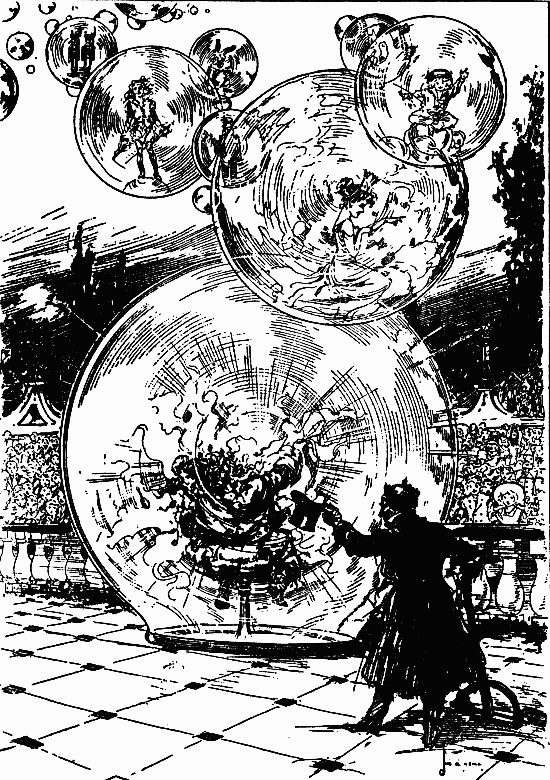
The new Oz the Great and Powerful movie is not supposed to infringe on the 1939 film’s copyright, however. Fortunately for its makers, L. Frank Baum and John R. Neill portrayed travel in giant bubbles at the end of The Road to Oz. (Curiously, it’s one of the few adventures Dorothy turns down.)
With that book in the public domain, Sam Raimi and company could show people in bubbles, and even make them Glinda’s thing, as long as they weren’t perfectly round and pink. In fact, with CGI animation they could show the Wizard’s weight bending his bubble out of its spherical shape. But there’s really no doubt those bubbles are supposed to evoke the 1939 movie, not Baum’s lesser-known 1909 sequel.
For the next couple of days I’ll discuss the sources of Oz the Great and Powerful—the official sources and the real ones.

07 March 2013

Of Witches and Women

At Film.com, Elisabeth Rappe offers an essay titled “Why ‘Oz the Great and Powerful’ Is a Major Step Back for Witches and Women.” It builds on the questions that Aisha Harris raised in Slate last fall, but Rappe has the advantage of having actually seen the movie.

Rappe makes some mistakes in describing L. Frank Baum’s work. She says, “He wrote 17 Oz books,” though the usual enumeration is fourteen Oz novels. We can get to seventeen by adding the Little Wizard Stories of Oz collection and the allied books Sea Fairies and Sky Island, but should we then also add Baum’s other non-Oz fantasies tied into the same magical region?

More problematic, the essay later lists Trot among the series’ male heroes, and says she, Cap’n Bill, and Ojo are “one-offs, never to return.” It would strengthen the essay’s argument about the importance of Baum’s female characters to note that Trot is a little girl, and she plays a major role in four of the seventeen books listed above as well as going along on two more adventures.

Later Rappe says Susan B. Anthony was a “frequent visitor” at Baum’s house. Anthony definitely visited his mother-in-law Matilda Joslyn Gage’s house in Fayetteville, New York, but I’m not sure she dropped in on the next generation. Again, Rappe’s underlying statement that Baum wrote from within the first wave of American feminism is accurate, but unreliable details undercut the essay’s authority.

The essay states:
Baum…made a decided choice to make women front and center of the series. They’re princesses, ordinary farmgirls, witches (both good and bad), rag dolls, generals, pastry chefs, and problem-solving faeries. They have adventures, lead search parties, rescue one another, solve difficulties, and challenge the Nome King in combat. Perhaps most significantly, none of the characters—not Ozma, Glinda, Betsy or Dorothy—ever engage in romantic relationships. Baum made a point of avoiding such trappings as love interests, because he believed children would find passionate romance boring, and an emotional element which they wouldn’t truly understand.
All true, except that Baum included romantic subplots in Tik-Tok of Oz and The Scarecrow of Oz. He maintained Dorothy, Ozma, and his other main heroines as preadolescent, not ready for romance. In Baum’s books, only Glinda is eligible for a love interest, and she’s not interested in men.

Which brings us to Rappe’s critique of the new movie’s storyline:
In a bitter reversal of Baum’s stories, “Great and Powerful” casts the women as the sidekicks, standing by to aid the Wizard should he need it. No longer instigators of action, the witches Glinda, Theodora, and Evanora now clasp their hands at arrival, thrilled the prophesied hero has arrived (“Aren’t you the great man we’ve been waiting for?” asks Theodora, voice trembling. Actually, all the female dialogue seems to be on the wobbly verge of tears). Whereas Baum’s charlatan Wizard accidentally became ruler of Oz, making a mess of things in the process, now we have one who has a place carved out for him, and is hailed as the man “who can set things right” . . .

Yes, Michelle Williams’ Glinda is smart enough to see through our hero’s lies and bluster, but otherwise she’s completely stripped of any real agency. “Great and Powerful” corrects Baum’s grievous abstinence, and reminds us all women must fall for a handsome traveler. The modern day Wizard now wins at least 2/3 of the onscreen hearts instead of being shamed as a liar.
Again, this overstates the case a bit. Baum’s books didn’t say the Wizard “accidentally became ruler of Oz, making a mess of things in the process.” He carved out a witch-free zone in the center of the country, built the land’s major metropolis, and maintained a peaceful prosperity for his subjects for many years. Of course, it took Dorothy and Glinda to restore the proper Ozian order, but the humbug Wizard was actually a moderate success.

That sort of slant makes me wonder if Oz the Great and Powerful really shows its Wizard succeeding so easily, or whether most of the movie is his struggle to fill the role the witches expect of him when he arrives, reforming himself in the process? Is Glinda truly “stripped of any real agency,” or is she happy to let this new arrival bumble along as she protects her own realm and bides her time? I suspect Rappe is on target about the movie, but the essay’s little errors make room for doubt.

Gili Bar-Hillel, a scholar of fantasy literature who’s seen the movie already, responded to the critiques from Rappe and others by noting that Oz the Great and Powerful doesn’t pass the Bechdel Test: “(1) It has to have at least two women in it, (2) who talk to each other, (3) about something besides a man.” As a Hollywood picture made by men and titled for a male character, that’s not surprising. But considering the feminist source material, it’s a missed opportunity.

05 March 2013

Yes, I’ve Heard About the New Movie

Soon after I first joined the International Wizard of Oz Club in late 1976, its journal, The Baum Bugle, was full of articles about the making of the The Wiz. How many stars the movie would have! How many costumes had been sewn! How many square miles of yellow linoleum had been laid in New York City to simulate the Yellow Brick Road!

Then the movie came out, a critical and financial disappointment. Bad casting and overproduction not only sank the film but in some ways ended the “blaxploitation” business for years.

A few years later, the journal reported the imminent arrival of Return to Oz, Disney’s first big-budget attempt to use its movie rights to L. Frank Baum’s later Oz books. Again, the technical aspects of the production caught the attention of the press, particularly the appearances of many Baum characters and such feats as filming in a hall of mirrors.

Then the movie came out. As Buzzfeed’s article “The 11 Most Traumatizing Moments from Return to Oz catalogues, it was a dreary, anxiety-ridden mashup of two of Baum’s most popular novels. The movie has many moments straight from my childhood favorites, all in a tone that made me wonder why they had ever appealed to me so strongly.

That track record is why I haven’t been writing enthusiastically, or even mildly optimistically, about Oz the Great and Powerful, due out this weekend. I’m curious about this new movie, but I’ve been disappointed before.

Newspapers and magazines, needing content to separate one movie studio’s ads from another, have offered many articles this month on the production and the Oz mythos. The New York Times’s contribution on Sunday started out by spelling the name of the Good Witch of the South as “Glenda.” The Boston Globe’s design-driven discussion of Oz’s influence on American culture didn’t even mention Dunkin’ Donuts Munchkins. So I’m not becoming any more optimistic.

29 January 2013

A Darker Dorothy in London

Opening next month at the Immersion Theatre in London, Dorothy in Oz, a “skewed adaptation” of L. Frank Baum’s The Wonderful Wizard of Oz. The troupe promises “a piece unlike anything that has ever been seen on the London fringe circuit.”

What does that mean? When playwright James Michael Shoberg directed his own company’s premiere of the drama in 2009, the Pittsburgh City Paper said:
Shoberg, Pittsburgh’s self-styled striver after “darker tastes in art,” usually combines a fixation with sex, drugs, rock ’n’ roll and dazzling costumes with cumbersome scene changes and sloppy projections. Forcing the often-rambling style of Shoberg and/or his players onto a smaller stage, much closer to the audience, focuses the production. . . .

His Dorothy in Oz includes winking references from various versions of the story—The Wiz as well as generous dollops of the iconic 1939 movie—as he twists the familiar characters and their journey. The new setting is a psychiatric hospital for the unfortunate Dorothy, here named Dottie. . . .

The most fun comes from Carrie L. Shoberg’s glitzy and ditzy portrayal of Glinda, and from the stunning ensemble—costume, props and performance—of Brittany Spinelli as the doctor’s secretary. The three companions are a mixed bag: Chucky Hendershot almost boneless as he wrestles with gravity and a heroin addiction as a Goth “Skarekrow”; Sean Michael Gallaher appropriately loud as the anger-challenged multi-pierced punk “Rusty Tinneman”; and Joseph A. Roots totally smooth as the repulsive “Harry Lyons.” In the title role, Adrienne Fischer is credible and credibly brave, but the character just doesn’t have the fun the others do.
Dorothy in Oz is scheduled to run in London 26 Feb-17 Mar 2013.

08 January 2013

Prince Bobo’s Place in Nature

This is the frontispiece from Thomas Huxley’s Evidence as to Man’s Place in Nature (1863). It shows the skeletons of four apes and a human being.

Huxley’s point was that these skeletons had so much in common that they showed a common ancestry. However, it was easy for Englishmen, reading left to right, to view this lineup as the track of evolution itself rather than the present state of five parallel species. (In other words, to come away with the understanding that the human was supposed to have evolved from the gorilla rather than the human and gorilla having a common ancestor in the past.)

For an article in progress, I’m wondering whether I can make the case that that illustration inspired this lineup of characters drawn by John R. Neill in Rinkitink in Oz (1916).

.
These drawings show the series of transformations that Glinda performs to ***SPOILER*** turn Bilbil the Goat back into his rightful form as Prince Bobo of Boboland.

In that scene L. Frank Baum defined the Tottenhot as “a lower form of man,” closest to animals, echoing a racist western belief about the “Hottentots” almost two centuries old by that point. That idea connects to the medieval concept of the Great Chain of Being. But did it also link, perhaps by parody, to the late Victorian understanding of human evolution?

06 December 2012

Glinda by Thomas Haller Buchanan

While working on the last couple of posts about Glinda, I ran across this portrait of the Good Sorceress by Thomas Haller Buchanan. A watercolor sketch for a project that never came to fruition, Buchanan featured it on his blog fifteen years later. Maybe if we all ask him he’ll make this available as a print or a cover for the Int’l Wizard of Oz Club’s magazines.

05 December 2012

Glinda as a "respectable sorceress”

As I wrote yesterday, in The Marvelous Land of Oz (1904) L. Frank Baum started describing Glinda the Good as a “Sorceress” instead of a “Good Witch.” In later books he referred to her as “the Royal Sorceress” or “the Good Sorceress.” But Glinda wasn’t his first sorceress.

The first in Baum’s oeuvre was Maetta, a Glinda-like character in A New Wonderland, completed in the mid-1890s and finally published in early 1900. Three years later that book was republished as The Magical Monarch of Mo. The second sorceress was Gayelette, who created the Golden Cap that enslaved the Winged Monkeys at some unspecified time before the Wizard’s arrival in Oz.

The Wonderful Wizard of Oz mentions sorceresses elsewhere as well. The Good Witch of the North says, “In the civilized countries I believe there are no witches left, nor wizards, nor sorceresses, nor magicians.” The Munchkins keep calling Dorothy a sorceress because she’s killed the Witch of the East and taken her shoes, and because she wears white: “only witches and sorceresses wear white.”

Those statements suggest that “witch” and “sorceress” are similar, overlapping categories. But then there’s this remark early in The Marvelous Land of Oz:
Mombi was not exactly a Witch, because the Good Witch who ruled that part of the Land of Oz had forbidden any other Witch to exist in her dominions. So [she], however much she might aspire to working magic, realized it was unlawful to be more than a Sorceress, or at most a Wizardess.
That implies that a Wizardess was somehow superior to a Sorceress, and both inferior to a Witch.

However, later in that same book Glinda herself suggests that a major difference between a Sorceress and a Witch involves the type of magic each does:
“Really,” said the Sorceress, “that is beyond my magic. I never deal in transformations, for they are not honest, and no respectable sorceress likes to make things appear to be what they are not. Only unscrupulous witches use the art…”
That said, in Rinkitink in Oz (1916), Glinda disenchants a character without discussing such scruples. So it’s not that she can’t do transformations as a sorceress; with Mombi available to reverse her own spell, Glinda chooses not to.

Baum often has characters discuss different types of magic, as in Ozma’s remark to Dorothy in his last book, Glinda of Oz (published 1920):
“I am a more powerful fairy than any other inhabitant of Oz, I am not as powerful as Glinda the Sorceress, who has studied many arts of magic that I know nothing of. Even the little Wizard of Oz can do some things I am unable to accomplish, while I can accomplish things unknown to the Wizard. This is to explain that I’m not all-powerful, by any means. My magic is simply fairy magic, and not sorcery or wizardry.”
That novel also introduces a “krumbic witch,” who esoteric spells baffle even Glinda, and offers our second view of a “yookoohoo,” a magician who specializes in transformations.

Baum was not a consistent writer, and he never laid out all his different forms of magic and which type of magician was more powerful than another. If he had done so, he might well have contradicted that system a few books later when he had a better idea.

But one thing Baum was consistent about was that Glinda is the most powerful magician in Oz. That might imply that a Sorceress is more powerful than a Witch, but perhaps that particular Sorceress is simply more powerful than any Witch. In any event, if Glinda wants to call herself a Sorceress, not many people would dare to object.

04 December 2012

“Baum’s audience sensed a threat”?

In an essay on witches in The New Yorker last month, Michelle Dean wrote:
We’ve always had a good witch to go with the bad, of course. Glinda, the Good Witch of the North (though it was South in the books) was no innovator there. She was just a modern ambassador for an ancient tradition of wise women and cunning folk, her powers submerged in yards of tulle and masked by a treacly voice. But as Alison Lurie once pointed out, just the word “witch,” applied to an allegedly good character, once held enough menace for [L. Frank] Baum to be forced to change it (Glinda is called a “sorceress”). Baum’s audience sensed a threat in there, the kind of thing feminists will tell you is really an instance of the fear of the uncontrollable wildness of the feminine. The good witch was not approachable, because even in her beneficence she had a certain unpredictability; hold her close, and she might cut you.
I agree that Glinda is a formidable character, though not unpredictable. And Lurie is a true Oz fan. But I think she read too much into Baum’s choice to change Glinda from a “Good Witch” to a “Good Sorceress.”

It’s true that once Baum reintroduced Glinda in The Marvelous Land of Oz (1904), he referred to her only as a “Sorceress,” no longer a “Witch.” However, in Dorothy and the Wizard in Oz (1908), the Wizard recalls Glinda as a “Good Witch,” and Ozma doesn’t correct him.

Furthermore, Baum continued to refer to the Good Witch of the North by that name in The Road to Oz (1909) and other books. Sky Island (1912) introduces an admirable character named Rosalie the Witch, who tells Trot, “I've always tried to be a good witch and to do my duty." For Glinda of Oz (published 1920) Baum created the Three Adepts of Magic, using a theosophical term; they “practiced only good witchcraft,” he wrote.

Baum’s clearest statement about “good witches” appears in his short story “The Witchcraft of Mary-Marie,” added to American Fairy Tales in 1908. A character tells the heroine: “You may find good people and bad people in the world; and so, I suppose, you may find good witches and bad witches.” Read the full conversation here.

Baum’s writings thus show that he never backed away from the concept of a “good witch.”

TOMORROW: So why did he make Glinda a sorceress?

27 November 2012

Oz, the Small and Meek

At Slate, Aisha Harris raised some serious questions about Sam Raimi’s upcoming movie Oz, the Great and Powerful, based on the most recent online trailer:
“You are here at last, and the prophecy shall be fulfilled,” says one witch. “I’ve waited for you to come and set things right,” says another. Is Oz slipping into an old-fashioned story about women needing a great male savior? Why are all these women with their own supernatural powers waiting around for an ordinary guy to come along and save them all?

L. Frank Baum’s original Oz books were published during the peak of the suffragette movement, and they were quite progressive in their depictions of a young female hero. Dorothy Gale, who ultimately reveals the man behind the curtain as the fraud that he is, was inspired by pioneer women and has been championed by some as the “first feminist role model.”
All that’s true. Not only was Dorothy the main protagonist of the Oz series, but the most powerful rulers in Oz were Ozma and Glinda.

I think Harris overstated her case, however, when she went on to say: “The 1939 film The Wizard of Oz stayed impressively true to this vision, giving us Judy Garland as an independent, curious young woman who aids a group of hapless men on their quest to see the wizard.” No, Judy Garland plays a breathy, largely reactive adolescent who decides she should never leave her own backyard to find her heart’s desire. The movie turned Dorothy’s happenstance visit to Oz from an adventure to a lesson about the dangers of running away, and thus into a punishment. In contrast, we next see Baum’s Dorothy on a voyage to Australia. Now that’s independent and curious.

But back to the Wizard. The whole point of The Wonderful Wizard of Oz is that “Oz, the great and terrible” (the book’s words) is a humbug. And that’s clearly part of Raimi’s story as well. When a movie sets up a character as “Great and Powerful” in the title, we know that has to be ironic or a challenge. Otherwise, there’d be no place for the story to go, nothing to reveal.

Back in July, the director laid out the main character arc:
As for the plot itself, everything is centered around [James] Franco’s Wizard, who is kind of a dick. “It’s the story of a selfish man, who’s a little bit of a lothario, a little bit of a cad.” Oz is “a land of second chances” for the Wizard, who’s also redeemed by the love of Glinda, the Good Witch. “It’s how he became ensconced in the Emerald City,” said Raimi. “By the time this picture ends, the audience has one interpretation of how it all came to be [...] how he became the protector of that great city.”
The phrase “love of Glinda” gives me pause because the Good Sorceress has no—needs no—love interest in the books. But will this movie’s Glinda offer Oz romantic love, or does he merely assume so? Does he set out to show himself protecting Oz just to impress Glinda and become a bigger, better man along the way? We’ll see next year.

16 October 2012

Theories of the Great Book of Records

In the third issue of his Ozopolis comic book (available here), Kirk Kushin offers a theory about Glinda the Good’s Great Book of Records.

L. Frank Baum introduced that book at the end of The Emerald City of Oz. It records everything that happens in the world—with very little detail, naturally. Glinda reads the book regularly to keep watch on threats to Oz.

Sometimes the Book of Records is useful for setting plots in motion, as when Dorothy and Ozma read about a war between the Skeezers and Flatheads in Glinda of Oz and decide to go put things right. At other times the book provides a quick explanation for a necessary plot twist, as in Tik-Tok of Oz. But most often it, like Ozma’s Magic Picture, is an obstacle to building a suspenseful plot. Since the rulers of Oz can very quickly learn what’s going on, how can anyone threaten Oz? How can anybody from the Emerald City get into trouble?

Despite all he and his successors wrote about the Great Book of Records, Baum never explained how it worked (besides “magic”) and how Glinda came to possess it. In The Marvelous Land of Oz, Glinda tells the Scarecrow that she has a book with lots of facts about the Wizard, of the same level of triviality and limited helpfulness that the Book of Records is later shown to provide. But the sorceress says she came by that information from spies.

The Ozopolis theory ties the Great Book of Records to the beautiful young women whom Glinda recruits as her handmaidens. Baum mentioned them multiple times, always describing them doing ordinary genteel handwork.

Kushin’s artist, Gonzalo Martinez, instead shows a couple dozen seated in front of a giant crystal, blindfolded and writing with quills in small notebooks. “The same thaumaturgical engine that powers Ozma’s Magic Picture enhances the scope of my maidens’ visions,” says Glinda. What they write in those notebooks gets magically transcribed into the Great Book. This system “was created soon after Ozma’s coronation,” Glinda says, and the passive voice doesn’t conceal that she herself seems to be the driving force behind the creation.

I have a different theory, but I view Glinda as practicing more realpolitik and secrecy than some like. I posit that the fairy queen Lurline created the Great Book of Records for Ozma’s adoptive father Pastoria, king of Oz. He wasn’t able to keep up with its information before being kidnapped and enchanted. Glinda took possession of the book for the sake of the country, at first concealing its existence through her cover story about the spies. After Glinda helped Ozma ascend to the throne, Lurline gave the new little queen the Magic Picture and Glinda got to keep the book. As for how it actually works, I go back to “magic” and let the handmaidens tend to their embroidery.

There are no doubt other theories to explain the Great Book of Records. In fact, there’s probably a one-to-one correlation between Oz fans and theories about Oz’s mysteries.

30 May 2012

Reconciling with the Wizard of Oz

Yesterday I described a review of a latter-day Oz book by Hugh Pendexter III. Among Oz fans he’s best known for his short book Oz and the Three Witches, published in 1977. It was inspired by two contradictory passages that L. Frank Baum left us about the Wizard of Oz, the evil witch Mombi, and the baby princess Ozma.

First, near the end of The Marvelous Land of Oz (1904), Baum narrated Glinda the Good’s interrogation of Mombi this way:
“I will ask my first question: Why did the Wizard pay you three visits?”

“Because I would not come to him,” answered Mombi.

“That is no answer,” said Glinda, sternly. “Tell me the truth.” . . .

Mombi now saw how useless it was to try to deceive the Sorceress; so she said, meanwhile scowling at her defeat:

“The Wizard brought to me the girl Ozma, who was then no more than a baby, and begged me to conceal the child.”

“That is what I thought,” declared Glinda, calmly. ”What did he give you for thus serving him?”

“He taught me all the magical tricks he knew. Some were good tricks, and some were only frauds; but I have remained faithful to my promise [to hide] the Princess Ozma—the child brought to me by the Wizard who stole her father’s throne.“
Baum wrote that book because of the popularity of the 1902 stage extravaganza adapted from The Wonderful Wizard of Oz. That show used the Wizard as an antagonist, a charlatan and mountebank who had stolen the rightful king’s throne, and the book reflected that characterization.

But in Dorothy and the Wizard in Oz (1908), Baum brought the Wizard back as a capable and reliable protector for Dorothy. What happened when they reached the Emerald City and the Wizard met up with its new ruler, Princess Ozma? She asks him about his first arrival in Oz.
“At that time,” continued the Wizard, busily eating his soup while talking, “there were four separate countries in this Land, each one of the four being ruled by a Witch. But the people thought my power was greater than that of the Witches; and perhaps the Witches thought so too, for they never dared oppose me. I ordered the Emerald City to be built just where the four countries cornered together, and when it was completed I announced myself the Ruler of the Land of Oz. . . .”

“That is quite a history,” said Ozma; “but there is a little more history about the Land of Oz that you do not seem to understand—”
Aha—the J’accuse moment when Ozma confronts the Wizard with his misdeeds: “Do you remember the child you handed over to an evil crone? I, sir, was that little baby you sold into slavery!”

But no. She continues:
“Many years before you came here this Land was united under one Ruler, as it is now, and the Ruler’s name was always ‘Oz,’ which means in our language ‘Great and Good’; or, if the Ruler happened to be a woman, her name was always ‘Ozma.’ But once upon a time four Witches leagued together to depose the king and rule the four parts of the kingdom themselves; so when the Ruler, my grandfather, was hunting one day, one Wicked Witch named Mombi stole him and carried him away, keeping him a close prisoner. Then the Witches divided up the kingdom, and ruled the four parts of it until you came here. That was why the people were so glad to see you, and why they thought from your initials that you were their rightful ruler.”

“But, at that time,” said the Wizard, thoughtfully, “there were two Good Witches and two Wicked Witches ruling in the land.”

“Yes,” replied Ozma, “because a good Witch had conquered Mombi in the North and Glinda the Good had conquered the evil Witch in the South. But Mombi was still my grandfather’s jailor, and afterward my father’s jailor. When I was born she transformed me into a boy, hoping that no one would ever recognize me and know that I was the rightful Princess of the Land of Oz. But I escaped from her and am now the Ruler of my people.”

“I am very glad of that,” said the Wizard, “and hope you will consider me one of your most faithful and devoted subjects.”
And nothing more is said of kidnapping and baby-selling and other disagreeable subjects.

Ruth Plumly Thompson explored the history of Ozma’s father and Mombi in The Lost King of Oz (1925), but many gaps and inconsistencies remained. (Indeed, we haven’t even touched Baum’s later statement that Ozma was really a fairy left by a fairy queen in the far distant past.)

Pendexter’s Oz and the Three Witches picks up after the second conversation above as Glinda comes to the Emerald City to quiz the Wizard about the whole Ozma matter. The result is a lively little tale of the Wizard trying to fend off the Wicked Witches of East and West through his humbug illusions while navigating the tricky politics of pre-Dorothean Oz. He doesn’t realize who Mombi is, and he’s very, very sorry. All in all, it’s about as good a reconciliation of Baum’s contradictory statements as possible.

First published in 1977, Oz and the Three Witches was reprinted in its entirety with Patricia Ambrose’s quite competent illustrations in Oz-Story, #6.

10 April 2012

Children Got Travelin’ Shoes

Rehearsals continue for Brooklyn P.S. 29’s fifth-grade production of The Wizard of Oz, as chronicled by co-director Helene Stapinski:
At his first rehearsal, [new pianist/music director] Allan takes all the leads and has them sing their signature songs to his accompaniment to help find the right keys. One by one they climb on stage and let it rip. The rest of the cast is seated, silently, in the auditorium, reading and doing homework, their heads down.

Glinda gets up to sing “Come Out, Come Out Where Ever You Are.” When she delivers the line, “Kansas, she says, is the name of the star,” she is joined spontaneously by a multitude of munchkins, who don’t even raise their heads from their books, but deliver their echo on cue, in unison — “Kansas, she says, is the name of the star.” Their small voices rise up from the dark auditorium, giving me chills.

When Mary Leigh belts out “Somewhere Over the Rainbow,” everyone in the auditorium just stops what they’re doing and looks up. They sit there, mouths open, as Mary Leigh knocks it out of the park. It’s so beautiful with Allan’s piano accompaniment that I have to fight back a terribly strong urge to sob right there in the auditorium. I just stand there in the aisle and bite my lip and swallow hard.

I realize that it’s not just the song that’s killing me. I look around the auditorium. Aidan, Dean, Eggy (real named Edward), Maddie, Bit, Nicky, and the rest of the munchkins, they’re all slumped or sitting up straight in their wooden backed chairs, but are all paying proud, full attention to their friend and co-star. They look so much older than they did six months ago.
There’s also the challenge of “how to make the ruby slippers magically appear on Dorothy’s feet”—i.e., recreating a movie special effect on the stage. Of course, that wouldn’t be an issue in adapting from L. Frank Baum’s book, where characters handle the silver shoes in a down-to-earth way:
The feet of the dead Witch had disappeared entirely, and nothing was left but the silver shoes.

“She was so old,” explained the Witch of the North, “that she dried up quickly in the sun. That is the end of her. But the silver shoes are yours, and you shall have them to wear." She reached down and picked up the shoes, and after shaking the dust out of them handed them to Dorothy.
Dorothy sensibly puts her shoes on one foot at a time even after she’s inadvertently offed her second witch:
With these words the Witch fell down in a brown, melted, shapeless mass and began to spread over the clean boards of the kitchen floor. Seeing that she had really melted away to nothing, Dorothy drew another bucket of water and threw it over the mess. She then swept it all out the door. After picking out the silver shoe, which was all that was left of the old woman, she cleaned and dried it with a cloth, and put it on her foot again.