Showing posts with label comics. Show all posts

04 June 2026

“Expands into a fluffy cloud when microwaved”

In yesterday’s New Yorker crossword puzzle, clue 27 Down was:
Brand-name bath bar that expands into a fluffy cloud when microwaved
I’ve already stated my claim to be the first person to try microwaving bars of soap, or at least the first person to publish the eye-opening results of the process on one well-known brand, in my 1993 book Soap Science.

But I haven’t mentioned that I told that story for a short comic drawn by Dan Mazur in the Boston Comics Roundtable anthology Boundless, edited by Olivia Li, Jordan Stillman, and Neil Johnson in 2016.

That comic includes depictions of me and my dad in the 1970s and 1990s. In fact, the editors told me that the script won them over as soon as it called for pictures of me as a child. 

06 December 2024

“Finding Friendships: Middle Grade Comics” Panel at MICE 2024

The Massachusetts Independent Comics Expo (MICE) takes place this weekend in the Fuller Building at Boston University, 808 Commonwealth Avenue.

MICE has been in that building for the past few years, but this is the latest the show has been scheduled, in the gift-buying season.

On Saturday, 7 December, I’m going to moderate a panel discussion at MICE titled “Finding Friendships: Middle Grade Comics.”

The four panelists are, in alphabetical order with their middle-grade books:
One thing that struck me in reading these creators’ work is how they all came to middle-grade storytelling from different directions.

Christmas was one of Margaret Atwood’s collaborators on Angel Catbird and drew or wrote other adventure comics for adults like Tartarus and Alien 3. Fong illustrated prose books for young people, including the YA anthology Banned Together. Hunsinger was best known for her short comic “How to Draw a Horse,” published in The New Yorker. She’s also co-created a picture book, My Parents Won’t Stop Talking. Lu is an educator here in greater Boston whose projects included a community mural in Chinatown.

It’s usually easy to see connections from these artists’ earlier work to their new books. For instance, Lu’s Noodle & Bao is about gentrification in an urban neighborhood. Hunsinger’s How It All Ends and “How to Draw a Horse” both start with sharing adjoining desks in a high-school class.

I interpret this confluence as a sign of the strength of the market for middle-grade graphic novels in recent years. Agents and publishers drew in talent from all directions, and we have a wider range of stories as a result.

17 April 2024

“Outside the Box” Opening Reception in Jamaica Plain, 21 April


With friends from the Boston Comics Roundtable, I’m helping to organize an exhibit of comics art in the gallery of the Footlight Club, America’s oldest continuously running community theater. It’s on Eliot Street in the Jamaica Plain neighborhood of Boston.

A few weeks back, a volunteer at that theater contacted our group about assembling a show. Its current production is Tuck Everlasting, a family musical based on Natalie Babbitt’s novel, so he wanted to showcase art that would appeal to kids.

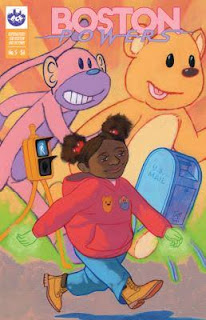
Many B.C.R. members have created comics for kids, and co-founder Dan Mazur published Boston Powers, a comic book with short, local superhero stories. So there was a good talent pool to choose from.

The exhibit has ended up featuring thirteen artists, including Boston Powers contributors, folks publishing on their own on paper or the web, a couple of graphic novelists (Jonathan Todd, Jerel Dye), and even a picture-book artist who works in comics form (Lindsay Leigh).

I’m represented through the work of Brendan Tobin, with pages from our “Stupendo and Secret Girl” collaboration.

This Sunday, 21 April, at 1:00 PM we’ll have a reception to celebrate the exhibit before a matinee performance of the musical. The art will remain up before, during, and after every show for families to enjoy. 

15 January 2022

Stupendo, Secret Girl, and Boston Powers, #5

The Boston Comics Roundtable just published Boston Powers, #5, its latest superhero comic book for young readers. For now it’s available at local events, and there are, alas, few local events, but I hope to share order information soon.

This magazine includes the second tale of Stupendo and Secret Girl, story by me and art by Brendan Tobin. This episode starts almost immediately after the pair’s first published adventure in Boston Powers, #2.

As you recall, Stupendo is a very strange visitor from another planet, and Secret Girl is a youngster from suburban Boston who’s taken on the task of turning Stupendo into a successful superhero.

In this installment, Emma’s parents are worried about her going along on Stupendo’s missions while someone in greater Boston is making things like babies and puppy dogs into gallumphing giants. Is this the end of the team of Stupendo and Secret Girl?

(No, it isn’t. I’ve already written the third and culminating episode in this story arc. But that, too, ends with the question: Is this the end of the team of Stupendo and Secret Girl?)

17 October 2020

The “Thomas Nast” Art Team, Part 2

With the next set of pictures for “Thomas Nast: A Life in Cartoons,” we got into the political part of his career. And the three cartoonists drawing those moments all have experience in political art.

Nast joined the staff of Harper’s Weekly in 1859, just in time for the US Civil War. Some of the magazine’s artists, such as Winslow Homer, drew battle scenes from life. Nast, though he took some trips to camp, preferred symbolic scenes with unmistakable pro-Union messages. His images could be so powerful that the Republican Party adopted them as campaign material.

We illustrated that connection with a symbolic meeting between Nast and President Abraham Lincoln, drawn by Shea Justice. Lincoln voices oft-quoted praise for Nast’s work in front of three of his most famous works from the war years. I suggested adopting elements from two cartoon traditions: making Lincoln and Nast into a “Mutt and Jeff” pair, and borrowing Tom Toles’s technique of adding commentary on the main scene from a couple of characters in the corner.

As for that commentary, that grew from my inability even in the age of Google to find any source for Lincoln’s praise before A. B. Paine‘s 1904 authorized biography of Nast. Fiona Deans Halloran wrote the same in her modern biography, expressed in the polite language of a footnote.

Stated more bluntly, this “Lincoln quotation” seems to have come from, or at least through, Nast himself. After consulting with Halloran, we made her the voice of doubt (or reason) while Nast speaks up for printing the legend.

Shea Justice, MFA, is a teacher at Lincoln-Sudbury Regional High School and a member of the African-American Master Artists in Residence Program. His portraits of figures from African-American history have been collected in this volume.

To hear from Dr. Fiona Deans Halloran herself, check out this video of her far-ranging conversation with longtime political cartoonist Pat Bagley for the Massachusetts Historical Society.

The next cartoon looks at Nast’s campaign during Reconstruction for basic equality for all Americans, built around his iconic cartoon “Uncle Sam’s Thanksgiving Dinner.” Nast’s vision of equality was limited, though. His take on, and caricatures of, non-white Americans could be quite disparaging. And he particularly disliked Irish Catholics, as this cartoon highlights.

Originally I had Nast saying, “Except for the Irish Catholics!” But then my artistic colleagues noticed that one of the figures at Uncle Sam’s table—on the right, near where his finger rests—had the profile that Nast typically gave to his Irishmen. So I tweaked the wording to acknowledge that Nast even gave an Irish couple a seat at Thanksgiving.

E. J. Barnes drew this panel, as well as serving the whole project as art director. She did admirable work assembling all the images, a job that turned out to include not only cajoling the cartoonists but also securing workable reproductions of Nast’s drawings and inserting them into our modern drawings in the midst of the pandemic shutdown. E. J. sells her artwork and comics stories through Drowned Town Press.

The next panel dramatizes one of the most famous episodes in Nast’s career, the second time he helped to bring down William “Boss” Tweed of Tammany Hall. Nast drew a lot of cartoons about Tweed, rousing public opinion enough for other legal authorities to move in. When Tweed fled US custody to Spain, police there recognized him as a wanted man from a cover of Harper’s Weekly—though they weren’t clear about what he was wanted for. Information from across the Atlantic is easier to come by these days, as I found when I sought period images of Spanish police uniforms.

The artist for this panel is Heide Solbrig, another colleague from the Boston Comics Roundtable. With a doctorate in communication from UCSD, Heide has taught arts and media studies at various colleges in New England. She’s working a graphic memoir called The Dandelion King and a series of comics journalism reports about the US-Mexico border. I see a reflection of her interest in immigration at the center of her panel as people line up in front of that transatlantic ship.

COMING UP: Part 3.

15 October 2020

The “Thomas Nast” Art Team, Part 1

Here’s commentary on the “Thomas Nast: A Life in Pictures” web exhibit and how the pictures came together.

The exhibit starts with a portrait of that nineteenth-century political cartoonist by Paul Szep, twentieth- and twenty-first-century political cartoonist. He also did a video interview about political cartooning for the Massachusetts Historical Society this fall.

Szep was the Boston Globe’s cartoonist during the 1970s when I was growing up. I enjoyed finding his picture in each day’s paper, learning about what news stories he was addressing, looking for his daughter Amy’s name hidden in the hatching. I even remember getting his autograph on a Watergate-era collection at a book festival when I was about nine. I suppose Szep was the first professional cartoonist I ever met. So it’s nifty to see him involved in this exhibit.

The first cartoon my team created for the exhibit covers Thomas Nast’s childhood immigration from Bavaria to the US. Initially I imagined a single panel of a little boy in stereotypically German costume on a ship’s deck or a dock, mixed in with other immigrants. But I couldn’t find a Nast print of a nautical scene as a model.

Instead, I alit on a “diary comic” that Nast drew on his first trip across the Atlantic the other way when he was a young journalist, not published until Alfred Bigelow Paine’s 1904 biography. That page provided the structure. The impressionistic memories of the trip that Nast recounted to Paine provided the content—each vignette reflects a real recollection from early childhood.

Catalina Rufin, who’s creating stories about growing up, daily life, and fairies, made a great match for the concept of this cartoon.

The next panel shows Nast as a teenager handing in his first assignment to magazine publisher Frank Leslie. In looking for a Nast picture of an immigrant-crowded dock, I came across a print of the Hoboken ferry landing on eBay. From an anecdote and a little image in Paine’s book, I realized that was Nast’s first published work. So that print is now part of the Massachusetts Historical Society collection, and it became the focus of this cartoon.

Both artist Jerel Dye and I hunted for visual references to provide a reasonably accurate representation of Leslie’s workspace, down to that desk calendar. We used this panel to show how Leslie used assembly lines of artists to produce art for the press. At first Jerel drew Tommy Nast with a little wispy beard, but I objected that he was only fifteen at this time—he didn’t grow a little wispy beard until the next cartoon! Nast’s own caricature of his first meeting with Leslie appears here.

Jerel Dye drew the art for the graphic novel Pigs Might Fly, written by Nick Abadzis, and has created several short comics on his own. In healthy times he teaches at the Eliot School of Fine & Applied Arts. One day I hope to fly on one of Jerel’s spaceships.

COMING UP: Part 2.

06 October 2020

Making Space for Thomas Nast

Early this year, folks at the Massachusetts Historical Society contacted me and colleagues in the Boston Comics Roundtable and invited us to help create part of a new exhibit on political cartoons in American history. 

Our role would be to depict the life of Thomas Nast, the leading American political cartoonist of the late nineteenth century, in a series of new drawings. A particular room in the MHS’s handsome building on Boylston Street was reserved for this part of the exhibit. 

That room is round. It has two doors, three large windows, and a fireplace. There’s handsome wooden paneling up to about chest height. In other words, it’s not a simple box with off-white walls ready to be a neutral enclosure for art.  

Measuring the room and the available materials, I mapped out a display customized for that space. There would be nine rectangular panels around the edge of the room, one with introductory text and eight with cartoons tracing Nast’s life. Each new cartoon would incorporate Nast’s own artwork, either within the scene or as inspiration, showing the course of his career. 

As for the room’s quirks, I made them part of the display. The three cartoons set in the tall window spaces, depicting the height of Nast’s influence, would be augmented above and below with reproductions of his own caricatures and icons. Beside the fireplace would stand a cut-out of one of Nast’s famous drawings of Santa Claus. In the center of the room, a display case would showcase Nast’s pages for Harper’s Weekly from the MHS collection. It was a pretty clever scheme, if I say so myself. 

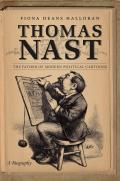
My colleagues recruited artists while I researched Nast’s life to find iconic moments and details. While there are many collections of his artwork, the best sources for biographical detail were Albert Bigelow Paine’s 1904 Th. Nast: His Period and His Pictures, based on conversations with the artist and published soon after his death, and Fiona Deans Halloran’s thorough, nuanced study, Thomas Nast: The Father of Modern Political Cartoons.

Then the virus arrived. We all hunkered down in our houses for a while. I continued the research. In fact, I’d just taken a bunch of Nast books out from the local library, and all their due dates were helpfully extended, and extended again. On eBay I found Nast’s first published print for Frank Leslie’s Illustrated Newspaper, cheap because the seller hadn’t recognized the artist. Some of my early ideas for cartoons didn’t work out. The MHS asked for more Massachusetts content. I revised and polished with my collaborators’ help. 

And then the virus stayed around. The MHS decided its building had to stay closed to the public through the fall. The exhibit built around a particular space would not appear in any space at all. 

12 March 2020

Stupendo Takes Off!

I’m pleased to report that the Kickstarter crowdfunding campaign for Boston Powers, the Boston Comics Roundtable’s collection of all-ages superhero comics, was successful.

And Brendan Tobin has done wonders with the art for our story. Here’s a slightly blurred preview as Stupendo and Secret Girl discuss the challenge of being a hero from another planet.

11 February 2020

Helping Stupendo Take Off

This picture shows Stupendo and Secret Girl, a superhero team I dreamed up a couple of years ago in a burst of short comics scripts for kids.

Stupendo is a very strange visitor from another planet. Secret Girl is a young suburbanite determined to help Stupendo to fit in and be all the hero he can be.

They’re being made flesh by Brendan Tobin, the artist behind Tolerable Tales of the Adequate and The Protagonist. Check out his blog.

Brendan and I are sharing “Hero Helper,” Stupendo and Secret Girl’s first published adventure, in Boston Powers, an all-ages comic book featuring original stories of superheroes from greater Boston. Conceived and edited by Dan Mazur, this project just launched its Kickstarter campaign, and it’s got a delightful video. Check it out!

03 October 2018

Launching Jitney with Jex and Ticca

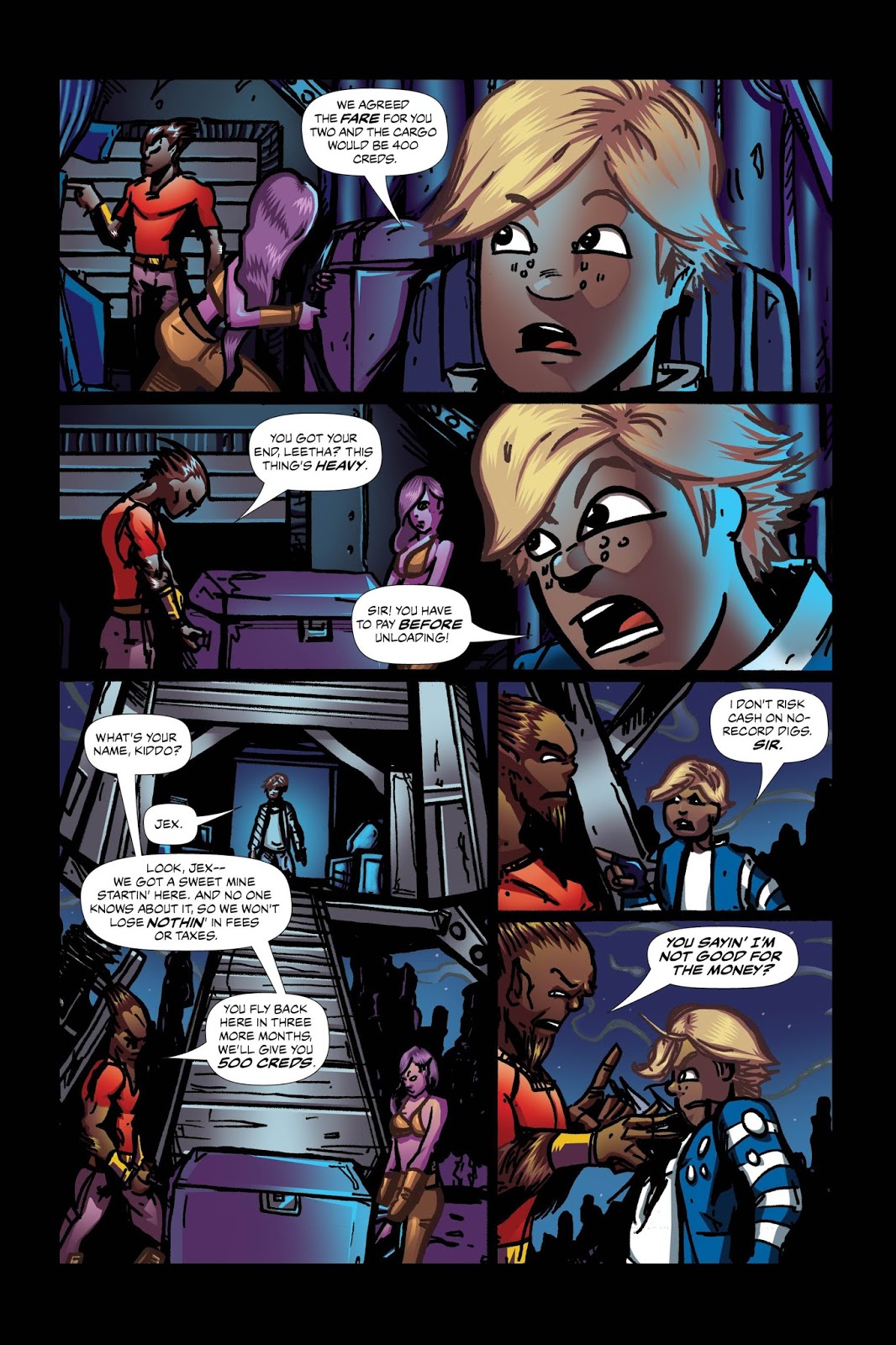
This is the first page of “Mine: A Tale of the Jitney,” a short comics story I wrote and saw come to life through the artistic talents of penciler Tim Teague, inker Kendra Hale, colorist Reggie Themistocle, and letterer Alex Giles.

In this story, Jex is an orphan kid piloting his own spaceship. Ticca is the stickbug who keeps the ship in barely working order. Since no sane, upright person would hire their rickety rocket, they end up hauling unwanted freight and disreputable passengers. That offers a lot of opportunity for Jex and Ticca to get into and out of trouble, as in these five pages.

I created this tale for Wonderfunders, a comics-making collective organized on Facebook by publisher James Lynch. That group invited writers to script five-page stories with proposals for longer stories. Then teams assembled to complete the short stories.

“Mine: A Tale of the Jitney” is one of four short stories in this issue of the Wonderfunders Anthology series, available in digital and paper forms through IndyPlanet.

18 October 2017

“Comics and Medicine” Coming to MICE, Oct. 21

The Massachusetts Independent Comics Expo (MICE) is coming up this weekend, and on Saturday I’ll moderate a panel on “Comics and Medicine.”

This session is being organized by Matthew Noe, the Graphic Medicine Specialist for the National Network of Libraries of Medicine, New England Region. He wrote about it here on the agency’s blog.

Here’s an extract from Matthew’s posting:
In anticipation of this panel, I asked each panelist to say in a few sentences what graphic medicine is to them. Here are their responses – a bit of a teaser of the panel to come!

Cathy Leamy: Graphic medicine is anything involving comics/cartooning and health and illness. I love that it’s not rigid and nailed down; the door is open for all kinds of explorations and investigators. Health education comics, illness memoirs, analysis of comics for medical themes, art therapy, teaching self-expression and empathy through comics making – so many applications are possible, and we all benefit from the cross-pollination of being exposed to them.

Kriota Willberg: My goal as a cartoonist making GM is to normalize medicine and the body. I hope to make illness, anatomy, and science a benign and familiar trio of actors in our lives, thereby mitigating the anxiety and confusion that often effects patients and their families, and stigmatizes the ill.

Iasmin Omar Ata: [To me, graphic medicine is] using unique mediums to heal through the power of art. Particularly in comics and games, there exists such an opportunity for those with illness to speak, be heard, listen, and heal.

Matthew Noe: Graphic medicine, beyond the strict definitions and the difficult task of reigning in what exactly it means to be a comic, is about communication. Patients communicating with physicians. Physicians communicating with patients. Family communicating with family. Comics can give voice to the voiceless, clarity to the unclear, and can help us refocus medicine on the human.
I’m looking forward to hearing more! Our session is at 11:00 A.M. on Saturday in the Auditorium of University Hall, 1815 Massachusetts Avenue, Cambridge.

01 May 2017

29 November 2015

We Are Dead Robins?

In DC’s current continuity, there have been four official Robins, and three of them have been dead for times ranging from a few minutes to maybe a year or so. (The second Tim Drake is the one who’s never died, even a little. Yet.)

But for the seventy-fifth anniversary of the Sensational Character Find of 1940, the publisher has unleashed a big crop of wannabe Robins in a magazine called We Are Robin. That provides lots of young people to die heroically before their time. Indeed, one character died in the first story arc, and the current crossover is titled “The Robin War,” so there will be more casualties.

The first few issues of We Are Robin reminded me most of the opening issues of Runaways, a series that Brian K. Vaughn and Adrian Alphona created for Marvel Comics back in 2003. Both stories follow a band of teenagers with a wide range of ethnicities, class backgrounds, personal looks, and speaking styles. So far, however, none of these Robins has grown on me, and that’s kind of important if I’m going to care about whether they’ll die.

I do like the idea of ”Robin” as not simply an individual or a job, but an ideal.

10 November 2014

Hellcat Press Wants Horror Comics from Female Creators

Lindsay Moore, a Boston comics writer who has had several stories published in Hellbound, In a Single Bound, and other local anthologies, and who has shepherded her own pop-music superhero comic The Quartette into print, has announced the formation of Hellcat Press to publish horror comics.

Hellcat’s first anthology, scheduled for publication next fall, will be titled Dark Lady. From the press’s Facebook page, here are extracts from that call for submissions:
Dark Lady is an all-female horror anthology. If you’re a woman with a horror story to tell, then Hellcat Press wants to read it!

All stories must fall under the horror genre. That being said, the horror genre is vast and all-encompassing.

Can I adapt a pre-existing short story (such as “The Black Cat” by Edgar Allan Poe) into comic-book format?
No. We are looking for original work.

If my story is accepted and published, can I still print minis and sell them at conventions?
Yes.

If my story is accepted and published, can I still submit it to other anthologies?
Yes.

What will I get out of this?
In addition to having your work published, you will receive one (1) free copy of the book and ten (10) dollars. As of right now, ten dollars is all that Hellcat Press can provide. You may receive more depending on sales.

What are the specs?
The book will be printed in black and white. The pages are 8.5 x 11 inches (standard magazine size). Keep all type 1/4" away from the edge to ensure that no text is cut off. Please keep your stories ten pages or under.

Is there a submission process?
Yes, there is! Please email me with your pitch before February 1, 2015. Please send in either a detailed outline/synopsis of your story or a full script (if you have one). Anything submitted after February 1, 2015 will not be considered. If your proposal is accepted, you will be notified as quickly as possible.

What is the deadline for finished artwork?
August 1, 2015.

Where will you be selling this book?
Hopefully, at all the conventions that the Boston Comics Roundtable attends (Boston Comic Con, MECAF, MICE, Hartford Comic Con, New York Comic Con, etc). I also hope to get it into a few local stores (Comicazi, The Million Year Picnic, The Outer Limits, Comicopia, etc). Once Hellcat Press’s website launches, we will also sell copies online.

Can you pair me with an artist/writer?
I cannot guarantee anything, but I will try.
Future collections may feature male artists and writers, or other themes.

Here are the technical specs for people preparing files to submit, an announced on the email list of the Boston Comics Roundtable:
The book will be printed in black and white. The pages are 8.5 x 11 inches (standard magazine size). Please keep your stories ten pages or under.
Safe image area: 8" (width) by 10.5" (height)
Full bleed: 8.75" (width) by 11.25" (height)
Trim size: 8.5" (width) by 11" (height)
NOTE: Keep all type 1/4" away from the edge to ensure that no text is cut off.
Please deliver files as .pdf files at 300 dpi, grayscale, at the final size. Please flatten your files before sending them.
These long wintry nights are a fine time to start working on stories for next year.

20 October 2014

04 October 2014

Colonial Comics Arrives at MICE This Weekend

This morning at 11:30, I’m moderating a panel on “History in Comics” at the Massachusetts Independent Comics Expo in Porter Square, Cambridge.

This year’s special guests are Raina Telgemeier, James Kolchaka, Dave Roman, Box Brown, Emily Carroll, and Paul Hornscheimer. And there will be scores of other comics creators showing their latest creations.

Among the debuts of the show is Colonial Comics: New England, 1620-1750, a collection of history comics edited by Jason Rodriguez, A. Dave Lewis, and me. I’m also in that book as a contributor, having created a story about the start of slavery in Massachusetts with Joel Christian Gill.

MICE is free, though it’s hard to walk through the exhibit space without seeing something you might want to buy. The show runs 10:00 to 6:00 on Saturday and 11:00 to 4:00 on Sunday, which also has special workshops for kids. Concurrent with MICE on Sunday is a “Comics in the Classroom” symposium starting at 10:00.

04 September 2014

Viewing Bad Houses

While reading Bad Houses, a graphic novel by Sara Ryan and Carla Speed McNeil, I got to thinking about the trope of the “Manic Pixie Dream Girl.”

Because one of the story’s main characters, Anne, could fit that mold. She dresses quirkily. She has interesting hair—with a stripe of dye and locks designed to look like a sunflower, as revealed by making-of pages in the back of the book. And her romantic interest definitely jolts the story’s young male lead, Lewis, out of a rut.

But Anne’s not a “Manic Pixie Dream Girl” because the story isn’t told just from Lewis’s point of view. We also get to see Anne’s story, including her background and secrets, down to her embarrassment about the hole in her bright striped stockings. We also see the stories of the young people’s mothers, one a hoarder filling up a house and the other an estate-sale specialist emptying them.

So one key to avoiding the cliché of the “Manic Pixie Dream Girl” may be—surprise!—to treat young women as full characters in their own right.

27 August 2014

Images of Oz Coming Through

Images of Oz is an eighty-page 6x9 paperback showcasing the Oz illustrations of S. P. Maldonado.

It includes an Oz comic that Shawn and I did together a few years back titled “The Ransom of Button-Bright.”

There’s also an Oz comic by Shawn and Jared Davis, as well as many standalone illustrations of Oz characters.

Images of Oz is available only through Lulu.com.

21 November 2013

Creating a Safe Place

As long as I’m linking to videos, I’ll add this time-lapse record of Dean Trippe’s work drawing a significant page in his autobiographical Something Terrible comic, available here.

The completed image, titled “You’ll Be Safe Here,” reflects what heroic fiction can provide to troubled readers. Most of the comic is in muted two colors, but for this image Trippe bursts out in full, bright coloring, as the last seconds of the video shows.

The video was created by Scott Fogg, writer of a comic-in-progress called Phileas Reid Knows We Are Not Alone. The artist is Marc Thomas. Trippe is slated to do the coloring and Vito Delsante the lettering. There’s a Kickstarter campaign for the book going on now.


31 October 2013

Where to Find the Essex County Wax Museum

As a Halloween treat I offer an online pointer to “The Essex County Literary Wax Museum & Menagerie,” a four-page comics story scripted by me and brought to life by Alex Cormack, with an editing assist from Jesse Lonergan.

This story appears in Minimum Paige, a comics anthology published by the Harvard Book Store a couple of years back. It’s also collected in Alex’s new art book.