Showing posts with label AUTHOR Kyle Higgins. Show all posts

26 October 2014

What Is Dick Grayson’s Core?

Kyle Higgins appears to be wrapping up his current work on the Dick Grayson character. The latest stories in Batman Beyond 2.0, including an upcoming chapter titled “The Final Fate of Dick Grayson,” have Alec Siegel’s name as co-writer, and Siegel’s the one signing the footnoted cross-references. (Wasn’t that once the editor’s prerogative?)

Therefore, even though Higgins is back on the Batman beat as one of the writers scripting the final stretch of Batman Eternal, and though he says he’ll likely return to Dick Grayson someday, his recent interview with Crave Online reads like a farewell retrospective:
Your work on Nightwing really expanded the character. Was everything in place from day one, or did it come as you wrote the story?

I had an idea from the start, but I learned so much along the way. I remember having a conversation with one of my best friends, who is an incredibly talented writer who works in TV and did some Gates Of Gotham with me [Ryan Parrot]. We said, when you boil Dick Grayson down, how do you describe him in a few sentences. What is his core? We did it as an exercise with Superman, Spider-Man, Batman, and boiled all them down to their central drive.

With Dick Grayson I couldn’t do it, I had a really hard time with it. I realized that was a problem. I know who the character is, but I can’t fully articulate why I love the character. It wasn’t until I settled on this idea that he grew up in a circus, so he’s all about catching people when they fall. That’s actually the final line of my final issue. I sat on that for over a year.

Dick seems more involved with the people he’s helping.

It’s about the empathy for who he saves. Every superhero, in one way or another, does it for the good of so-and-so, and they want to help people, but Dick Grayson more than all is about the people. He’ll save you from a mugger, tie your shoe and buy you a beer.

Dick and Bruce are very similar, but very different. Why?

Well, in a weird way one is more focused on his parents’ deaths, and the other is more focused on his parents’ lives. To me Dick and his Nightwing persona is more about spectacle than Batman. He’s sailing between buildings, it’s a performance and people can see him. He’ll operate in the daylight. It’s much more about the circus life and how he was brought up and the show. Nobody wants a brooding mopey Dick Grayson.
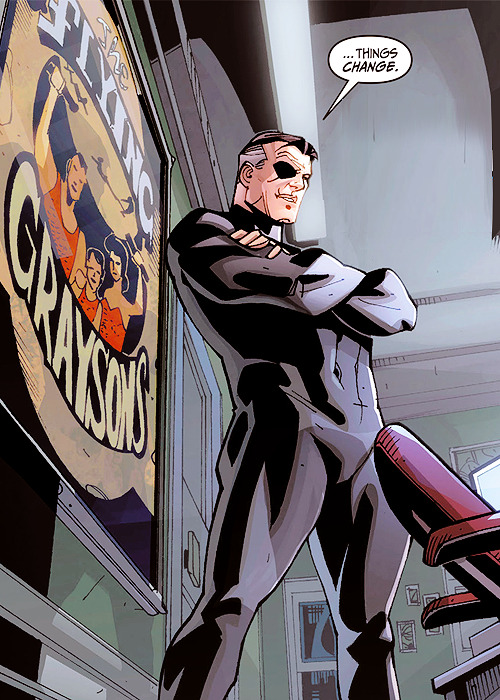
Another reason why the grim, one-eyed Dick Grayson in Batman Beyond 2.0 is a signal of a dystopic future.

Higgins continues to work on C.O.W.L., his story of a superhero labor politics in post-WW2 Chicago, for Image. We have yet to see the equivalent of Dick Grayson in those comics, but one did appear in Higggins’s student film, apparently set in the same world. And, to be frank, that character’s kind of mopey.

28 September 2014

Beyond Batman Beyond

It’s interesting to watch what DC Comics has done with its Batman Beyond storyline this year, reflecting changes in its target audience.

Batman Beyond was a spin-off of the very successful 1990s Batman TV cartoons of the 1990s. Les Daniels’s Batman history states, “a new show was requested that might skew toward younger viewers.” The resulting cartoon was set in the future when the world has more advanced technology and Bruce Wayne is a goddamn octagenarian. The new Batman was a hot-tempered teenager named Terry McGinnnis.

This show was an extension of the DC Animated Universe, thus not tied to the publisher’s main comic-book continuity. There was an accompanying comic book in 1999-2001, but readers were supposed to keep it separate in their minds from the main Batman titles of the time.

In this version of the future, Barbara Gordon has long ago retired as Batgirl and now holds her father’s old job as police commissioner. She was romantically involved with Dick Grayson when they were college-age, then later with Bruce Wayne for some unspecified period, and is now married to someone else. Dick himself, having established himself in the DCAU as Nightwing, has left Bruce’s team and is nowhere to be seen.

Batman Beyond lasted for 52 episodes plus a TV movie—a respectable but not sterling run. Nevertheless, it made a strong impression on a lot of viewers, including Kyle Higgins. He told Comics Alliance:
I was such a huge fan of the show. The DC Animated continuity was my introduction to DC Comics growing up. So I know that stuff inside and out, and I actually know it better than the books.
Higgins’s fondness for the cartoon is also evident in how he spoke about it on Kevin Smith’s podcast and in other interviews.

In 2010, DC launched a series of new Batman Beyond runs scripted by Adam Beechen. One of his mandates was to tie the world of the TV cartoon more closely to the DC comics (though those were about to go through some sudden changes themselves). Beechen brought back Dick Grayson, revealing that he’d stepped away from crime-fighting and from Bruce Wayne after losing one of his eyes in a fight.

That was the history Higgins inherited when he took over DC’s digital-first Batman Beyond series in 2013. His series was subtitled “2.0” because it showed Terry McGinnis breaking away from Bruce as mentor and working instead with Dick. Higgins was thus writing two different versions of Dick Grayson as he finished his Nightwing run and started this series.

In a story titled “Mark of the Phantasm” (digital issues #25-31), Higgins and co-writer Alec Siegel dug deeper into the relationships among Barbara, Bruce, and Dick. Craig Rousseau provided the art for the scenes set in the future, adhering to the standard Batman Beyond style. Phil Hester penciled scenes set in the past, following the style of the earlier Batman: The Animated Series cartoon and its spin-off comics.

Issue #28 shows Barbara and Dick telling Terry how they broke with Bruce. In their early twenties they had started to rekindle their relationship and Dick was ready to propose, only for Barbara to discover she’d become pregnant by Bruce—only for Barbara to miscarry after intervening in a mugging.

Remember, this story appeared in a continuity created to “skew toward younger viewers.” But that was back in 1999. Those same viewers have aged fifteen years and are ready for plot twists based on sexual relationships and spontaneous abortion. They got that more adult story even within the nostalgic visual style that Hester provided.

In another sign of the DCAU’s hold on today’s comics readers, the main DC Comics continuity is being disrupted by a crossover story called “Future’s End,” and Terry McGinnis as a next-generation Batman is in the middle of it all. While he still represents only one possible future for the company’s main continuity, he’s also what the company thinks its present-day readers want to see.

11 May 2014

Not-So-Secret Origin

Before DC published Secret Origins, #1, with the origin stories of Dick Grayson as Robin as well as Superman and Supergirl, scripter Kyle Higgins said in an interview that his final issue of Nightwing actually “says everything I have to say about the character.”

Unfortunately, he was right. The twelve-page story in Secret Origins goes over old ground. The art, penciled by Doug Mahnke, is pretty, just as in the recent Batman and Robin Annual. The story confirms some things already established in DC’s “New 52” continuity, such as Dick already being in his mid-teens when he meets Bruce Wayne. The title “The Long Year” provides another temporal fact for readers who care deeply about such things.

But the problem is that the first Robin’s origin just isn’t secret anymore. In fact, it’s so well known among superhero fans that storytellers can evoke it with just partial images, such as a Flying Graysons poster or the broken trapeze rope swinging into the frame in the TV cartoon episode “Robin’s Reckoning.”

While the stories of how Jason Todd and Tim Drake became Robin have been significantly reworked, Dick Grayson’s has remained basically the same since 1940. The only changes have been at the margins: whether the authorities sent Dick to an orphanage instead of apparently straight to Wayne Manor, whether Tony Zucco or his family are still around.

The radical changes have been Frank Miller’s story of Bruce kidnapping Dick over several long issues of alternative-continuity All-Star Batman and Robin and Scott Snyder’s decision to make the Haly Circus a training ground for athletic assassins—which plays no role in Higgins’s new story.

So Higgins’s origin story has almost no place original to go. We see the robin bracelet he already established in Robin, #0. We see Tony Zucco threatening the circus. We see the death of Dick’s parents as Bruce Wayne watches, and an orphanage. Dick tries hunting his parents’ killer and has to be rescued by Batman, but we’ve seen that before, too.

Higgins said the one idea he had left to explore was the origin of the Robin name, mostly because DC’s new editors had nixed the idea of inspiration from Robin Hood movies. (Apparently Kevin Costner’s and Russell Crowe’s versions don’t have the cultural resonance of Errol Flynn’s.) So we have a page of Dick thinking about what his crime-fighting identity should be and seeing a robin fly by—the same scene we saw with Bruce Wayne and a bat back in 1939.

The last panel on that page drives home the symbolism with Bruce speaking of the robin as a symbol of “growing up,” which is what Robin/Dick Grayson has meant in the DC mythos since the following year. But we already knew that.

06 April 2014

Kyle Higgins’s Two Dick Graysons

In this recent interview with Newsrama, Kyle Higgins discussed the challenge of writing the character of Dick Grayson in two storylines.

One was the “in continuity” Nightwing title (about to be concluded, with a new magazine called Grayson coming this fall). The other was the possible-future, non-continuity, digital-first Batman Beyond, which grew out of DC’s 1990s TV cartoons.

Higgins replied:
But I differentiate between the two Dick Graysons. You know, the whole DC animated universe is a favorite of mine, and when I write Dick Grayson in Batman Beyond, I hear Loren Lester’s voice. But when I write him in the regular DC continuity, I don’t.
Lester was the voice actor who performed the role of Dick Grayson in Batman: The Animated Series (1992-1995) and The New Batman Adventures (1997-1999).

That intrigued me, so I went looking and found that last year Higgins expanded on that topic to Comicosity as he started to write Batman Beyond:
They are completely separate people to me. The reason why is that the animated series version of Dick Grayson was always very different than the comic version of Nightwing. Chuck Dixon and Scott McDaniel’s stuff that I grew up on was definitely a bit lighter and quippier than the animated series version was. The animated series’ interpretation was a lot more brooding, a lot more “Batman.” That worked really well because you were transitioning from a light, jovial Robin to a few years later where Dick Grayson is a bit hardened. Loren Lester played the character a lot more even keel and darker — almost evolving into Batman. The comics went the other way with that.

Whenever I write Nightwing in the New 52, I’m writing him in a lot of ways closer to Loren’s portrayal of Robin in the animated series. Whereas in writing Dick Grayson in the Beyond book, I’m deliberately writing him more in line with Loren’s portrayal of Nightwing, if that makes sense. I try not to think about it too much, but when I write the New 52 Nightwing, I don’t always hear Loren’s voice for the character. When I write Dick Grayson for Batman Beyond, however, not a line goes on that page that Loren’s voice hasn’t influenced.
In Higgins’s Batman Beyond story, a middle-aged Dick Grayson takes over the role of mentor for Terry McGinnis, the latest teen-aged protégé to have friction with Bruce Wayne. Higgins said:
One of the things I find so interesting about Dick Grayson in this era and at this age is that Dick has already gone through a lot of the experiences that Terry is now going through—having a fallout with Bruce, working to get out from under Bruce’s shadow. The thing that is often very interesting to me is that while Bruce could always give crime-fighting advice to Terry, he couldn’t give Terry the advice of what it’s like working with Bruce. So now someone like Dick can actually empathize with Terry as to what he’s gone through.

And from a personality standpoint, even though Dick Grayson is a little more hardened over the years now, he still is a character who enjoyed what he did. His persona lends itself toward being a little more lighthearted, with a few more quips. He’s a bit looser than someone like Bruce is. That is very similar to how Terry operates. Terry has gotten more serious as the show and the book progressed, but at his core, he’s still a late teenager.
Batman Beyond, digital #16, is Higgins’s single-issue (or half-issue in print) story about Dick and Barbara Gordon talking out their relationship in that future. In the main DC universes, their on-and-off relationship has been fraught, but that’s nothing compared to the DC Animated Universe. In that continuity Barbara once had a romantic relationship with Bruce before marrying Sam Young, eventually Gotham’s District Attorney. Meanwhile, this Dick Grayson doesn’t seem to have any equivalent of Koriand‘r (Starfire) or his other girlfriends to distract him from pining over Barbara.

02 March 2014

Kyle Higgins’s Last Words on Dick Grayson?

DC Comics is touting an upcoming issue of Secret Origins as writer Kyle Higgins’s last word on Dick Grayson, whom he’s been writing in Nightwing for the past two and half years.

Higgins sounded a bit bemused when he told Kiel Phegley at Comic Book Resources about that story:
The Secret Origins one-shot is a little weird. It’s something they asked me to do while I was wrapping my run on Nightwing, and in some ways, I did a lot on Dick’s early days in our issue #0. So this was about trying to find a different point of view on a lot of the ideas we’d already introduced. . . . Honestly, my final issue of Nightwing kind of says everything I have to say about the character, so it’s a little weird to be doing this origin story too, but it’s fun.
I should note that Higgins’s last issue of Nightwing will be followed by a final issue written by a different team, which completes a story being told in a miniseries titled Forever Evil. That magazine has already shown Dick Grayson being unmasked, which would certainly force major changes in his career as a mysterious vigilante. DC is of course trying to play up fears that that storyline will end with Dick dying.

But back to Higgins and “Dick’s early days”:
The one story point that I really wanted to explore was the Robin name. It’s something I hadn’t done in issue #0, and it was something that I’d had an idea for for a while. We had kind of touched on the bracelet [with a robin motif] that Dick gave his mother in issue #0 as the origin of why he ultimately took the Robin name, but there’s a little bit more to it than that. What a Robin actually means to Dick Grayson hasn’t been defined, and that’s something I wanted to bring into his origin. Originally, the Robin identity came out of Errol Flynn and the Robin Hood movie, but that’s not exactly the direction DC wanted to go with the New 52 version, so this was all about finding a new spin on the Robin moniker. We’ll show where it comes from and what it means to Dick in this Secret Origins story in a pretty cool way.
Actually, Jerry Robinson’s inspiration for Robin came from his memory of N. C. Wyeth paintings of Robin Hood, not the 1938 Errol Flynn movie (though its popularity couldn’t have hurt). Narrative captions in the first comics that featured Robin made that link to British mythology explicit. But it wasn’t till later retellings of Robin’s origin that DC’s writers showed Dick identifying himself as a Robin Hood fan. Subsequently a Robin Hood painting became a staple of his bedroom in Wayne Manor.

And there’s a curious story from Detective Comics, #226, in 1955 called “When Batman Was Robin,” which showed young Bruce Wayne dressing in the oh-so-inconspicuous Robin costume to get tutoring from the famous detective Harvey Harris. Seeing the kid in the red jerkin, Harris says he looks “as brilliant as a robin redbreast” and dubs him Robin.

That story by Edmond Hamilton undercuts the Dynamic Duo mythos in a couple of ways. Since it was set before Bruce’s parents were killed, it meant their murder wasn’t actually what set him to dressing up in a cape and mask and fighting crime. And it meant Bruce gave Dick the name Robin and the same type of costume he’d worn as a teenager without ever explaining their history.

But to get back to Higgins once more, is this really his farewell to Dick Grayson, or just to DC’s main, official, present-day version of that character? In January Higgins told Vaneta Rogers at Newsarama, “I’ve got some huge Dick Grayson/Nightwing stuff coming up in Batman Beyond 2.0…which I can’t urge you enough to pick up. . . . It’s the best stuff I’ve done at DC.” That digital-first magazine is set in one possible future for the DC heroes, spun off the animated cartoons rather than the main comic books, so it’s not quite so official.

In addition, Higgins has an upcoming series from Image called C.O.W.L., set in an original superhero universe. Higgins started to build that world with his student film The League, which featured an equivalent of Dick Grayson named the Sparrow or, later, the Wraith. Interviews don’t indicate if that character shows up in The C.O.W.L., but a version of his mentor does, so there’s a strong possibility.

30 June 2013

But Who Would Be More Insulted by “Blind as a Bat”?

At Comic Vine, Gregg Katzman summarized last month’s discussion on the all-important question: Who would win in a fight, Nightwing or Daredevil?

Even current Nightwing scripter Kyle Higgins weighed in:
In my opinion, it all depends on how quick (if at all) Nightwing can figure out that Daredevil relies on heightened senses/radar. If he can deduce that, he’s a few gadgets away from screwing with DD’s navigation system enough to make it a fight. Of course, there’s also the variable of “what kind of mood is Mark Waid in while he’s writing this” (come on, is there ANYONE else you’d rather see write this fight?!?). I’m pretty sure he could come up with sixteen clever ways to take down either character without the other breaking a sweat.
Higgins’s comment acknowledges the dirty little secret of superhero battles: the fix is always in. The outcome of the fight depends on what’s necessary for a compelling, satisfying narrative. Early in a story, we’ve seen the Condiment King take down Robin and Black Canary together. But at the end of a rousing tale, and given the right circumstances, Jason Todd can conquer Mongul.

Adding fan popularity to the question further complicates the issue. In 1996 DC and Marvel collaborated on a miniseries that pitted a number of their brands against each other. The outcome of the major battles was determined in advance by readers’ votes. That resulted in the extremely popular Wolverine and Spider-Man beating the extremely powerful Lobo and Superboy.

That miniseries didn’t include Nightwing or Daredevil, but it did feature Tim Drake as Robin. He was set against Jubilee, a young mutant in the X-Men who could generate fireworks. Despite having no powers, Tim sneakily managed to pin Jubilee down without hitting her (he has trouble hitting girls), and they ended up making out, thus satisfying nearly all readers. Simpler times.

(Photo at top by Osvaldo Eaf 2, via Flickr.)

27 January 2013

Kyle Higgins’s First Version of Nightwing

Kyle Higgins, current scripter of DC's Nightwing magazine, studied filmmaking at the University of Iowa and Chapman University. Before he got into comics, Higgins and his friend Alec Siegel co-wrote and directed the short film “The League” with a lead character inspired by Nightwing. As its website says, it’s available through iTunes.

“The League” starts in 1946. Chicago’s heroes include the Blue Blaze, the Gray Raven, and the latter’s chirpy teen-aged sidekick Sparrow; any resemblance to the Green Lantern, Batman, and Robin is purely intended. Their nemeses are Cold War villains with scowls and Russian names.

The action then jumps forward to the early 1960s. Sparrow, having been badly wounded, has broken from the Gray Raven and become the Wraith (though I didn’t realize his new crime-fighting name until the closing credits). As the League prepares to go national, someone is killing off the Windy City’s old villains, and the Wraith returns to investigate that mystery.

Like Nightwing in the standard DC mythos, the Wraith is an athletic detective but has no other special powers. His relationship with his old mentor is strained. But, and this is very important in the story, the Wraith isn’t evil.

The film’s special effects are very good, especially considering its $40,000 budget. Higgins’s specialty as a filmmaking student was in sound design and other postproduction skills, so the movie has a gratifyingly professional look and sound. I found the story hard to follow at times, such as the role of the character named Eclipse, but the overall plot is clear.

I learned about “The League” from Higgins’s conversation with Kevin Smith on the Fat Man on Batman podcast, which is also well worth a download. The poster shown above is by artist Eoin Colgan.

09 December 2012

The Handsome Young Man on the Flying Trapeze

Nightwing: Traps and Trapezes is the first collected volume of Nightwing comics since the launch of DC Comics’s “New 52” universe. Written by Kyle Higgins and penciled mainly by Eddy Barrows, these installments of the ongoing series reestablished Dick Grayson’s character by showing his return to the Haly Circus—evidently his first significant visit since his parents’ deaths.

That, of course, wipes out the visits we’ve seen in previous universes. Indeed, returning to the circus where he grew up is a staple of stories since Dick Grayson became a man. It was while on the flying trapeze that he expressed his independence in Detective Comics in the early 1980s. Dick was buying the circus when he befriended Tim Drake in New Teen Titans. In the first season of the Young Justice TV universe, teen-aged Dick returned to the Haly Circus as a masked teenager, fooling no one.

All those stories portray the Haly Circus as a welcoming home. The elephants remembered Dick well, of course, and so did the regular performers. While the traveling tent show was often in dire economic straits and/or threatened by mysterious crime that only an acrobatic young detective could solve, it was a refuge for Dick from troubles at Wayne Manor, Titans Tower, or elsewhere. At the end of those tales he always realizes he can’t stay; he has responsibilities elsewhere. But Dick can feel happy that the circus will always be there.

(The one exception is Dick’s visit in Batman and Robin Adventures, #15, spun off the animated cartoons of the 1990s. There the circus owner is named Haley, perhaps writer Ty Templeton’s tip-off that this is a different reality but more likely just normal inconsistency.)

Traps and Trapezes rewrites Dick Grayson’s origin, and not just by saying he was with the circus until he was about sixteen, or five years before the present. As part of the “Court of Owls” storyline that Scott Snyder was directing from the Batman magazine, it reveals the Haly Circus to be a breeding-ground for young assassins.

We might ask why gangster Tony Zucco would try to shake down an enterprise connected to the Court of Owls. Nonetheless, he did, and he killed two-thirds of the Flying Graysons (as in every iteration of the Batman universe since 1940), causing Dick to leave the show and start living in Wayne Manor. That’s the only thing, it turns out, which preserved Dick from becoming just another assassin. Everything was already set up, including the dental plan.

The two magazines’ combined storyline thus plays on fans’ visceral dismay at any violation of Reason for Robin, #10: “Robin isn’t evil.” In addition to the overarching narrative, the first issue of the new Batman ends with Alfred finding Dick’s DNA under the fingernails of a murder victim. This Traps and Trapezes volume ends with one of our hero’s escrima sticks showing up at another crime scene. But in all cases the dénouements assure us, after the requisite worry in the middle acts, that Nightwing isn’t evil.

The other thing that this volume reassures us hasn’t changed in the new universe is that Dick Grayson is the pretty one. We see that even in the flashbacks that show him with other circus kids. The boy named Zane has a big, unexplained scar down one side of his face. Another boy, Raymond, starts out basically indistinguishable from young Dick, except perhaps not smiling as much, but he returns with terrible scarring around his eyes. (A detail apparently not yet settled when the first issue showed him taking off his sunglasses.)

And Dick? Despite spending five years in a business that involves being kicked in the face, he remains unblemished and oh-so-handsome. Barrows supplies many pinnable pictures of Nightwing swinging through the urban skies, muscles flexed and hair flowing. The new Nightwing uniform, while not as sleek and distinctive as the blue “fingerstripes” package, is skintight and shiny. Barrows also designs a lot of those panels that show a series of Nightwings bouncing across the rooftops.

Will the surviving traits be enough to keep Dick Grayson as a distinctive character with his own following? The new universe has replaced his long history as Robin with a couple of years at most. It’s wiped out his ascendancy with the Titans. There’s no hint of his years in Blüdhaven or his team-ups with many other heroes. But he does look pretty.

29 January 2012

Three Dick Graysons and the Representation of Change

Reviewing the Robin news this week, I was struck by a statement in Vaneta Rogers’s interview at Newsarama with current Nightwing scripter Kyle Higgins:
Nightwing is one of those few characters that is actually defined and built on a core of change, which is very weird in an industry and a medium that relies on the illusion of change. Dick Grayson is one of the few characters that are built around the idea of growing up.
Dick started out serving Reason for Robin, #9: Robin is still a kid. He represented potential. He was learning, making mistakes, but held the promise of being better. For almost thirty years he barely changed, but he always represented the possibilities of change in the future.

When Dick Grayson became Nightwing in the 1980s, he gained a new symbolic significance. He had been a kid; now he was a young man. But he was still younger than Batman, Superman, and the other heroes he’d looked up to. As Higgins says, his growth now defined his role in the DC Universe saga. He was a twentysomething looking for his place in the world. Would he ever match up to his mentor, or had he unknowingly already done so?

Grant Morrison’s proposal to make Dick Grayson into Batman brought that grand storyline to a close. Dick stepped into his mentor’s boots, and successfully. There was no place new for him to go, or grow. DC Comics would almost certainly have made him Nightwing again, to preserve the trademark if for no other reason, but the company never came up with a satisfactory way for Dick to make that choice which would imbue his character with significance again.

Instead, for a variety of commercial, legal, and creative reasons, the publisher rebooted its entire universe. That change let the editors put Dick into a new Nightwing costume, a few years younger than before. We never saw his choice to step away from being Batman; characters seem to treat his time in the cape as a job everyone knew would be temporary, as in Batman: Prodigy. Once again Nightwing is a young man looking for his place in the world. Higgins’s first story even took him back to his roots at the Haly Circus.

I view the current Dick Grayson character as separate from the character of 1964 through 2011, just as that was a different character from the Dick Grayson of 1940 through 1964 and beyond on Earth-2. The original Dick Grayson came of age as an adult Robin. The second came of age as Nightwing and took over as Batman when almost everyone thought Bruce Wayne was dead. Now we have a third Dick Grayson, also Nightwing. What will his future hold? The possibilities are open once again; all we know is that he still symbolizes growth and change.

In other Robin news, Bleeding Cool reported a rumor that Jeff Lemire would write an adventure for the present DC Universe’s four former and current Robins. But can we trust a gossip website that can’t even spell Damian Wayne‘s name right?

Probably so, for two reasons. Once ideas leak, it appears they’ve been approved. Furthermore, this idea is a no-brainer in terms of serving fans’ wishes. Of course, the potential for disappointment is very high since no actual all-Robins adventure comic could satisfy everyone’s hopes. There’s too much nostalgia to compete with.

Finally, Bully had the Dynamic Duo meet the Infinite Canvas of Scott McCloud. Even more impressive, the little stuffed bull got that scene to work within the confines of a Blogger template!