Showing posts with label ARTIST Scott McDaniel. Show all posts

06 April 2014

Kyle Higgins’s Two Dick Graysons
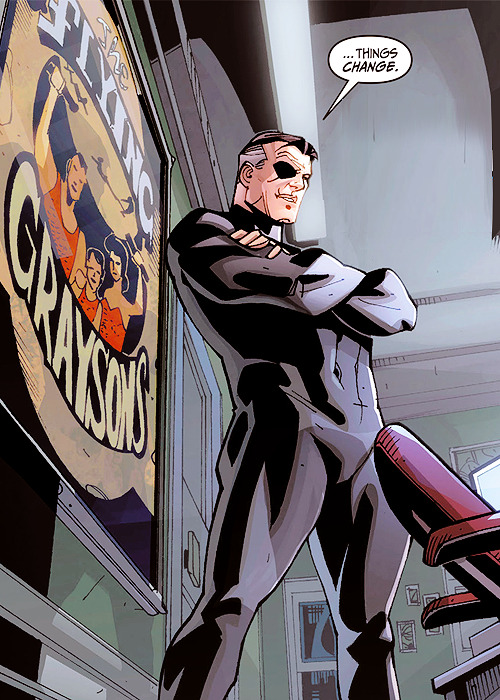
In this recent interview with Newsrama, Kyle Higgins discussed the challenge of writing the character of Dick Grayson in two storylines.

One was the “in continuity” Nightwing title (about to be concluded, with a new magazine called Grayson coming this fall). The other was the possible-future, non-continuity, digital-first Batman Beyond, which grew out of DC’s 1990s TV cartoons.

Higgins replied:
But I differentiate between the two Dick Graysons. You know, the whole DC animated universe is a favorite of mine, and when I write Dick Grayson in Batman Beyond, I hear Loren Lester’s voice. But when I write him in the regular DC continuity, I don’t.
Lester was the voice actor who performed the role of Dick Grayson in Batman: The Animated Series (1992-1995) and The New Batman Adventures (1997-1999).

That intrigued me, so I went looking and found that last year Higgins expanded on that topic to Comicosity as he started to write Batman Beyond:
They are completely separate people to me. The reason why is that the animated series version of Dick Grayson was always very different than the comic version of Nightwing. Chuck Dixon and Scott McDaniel’s stuff that I grew up on was definitely a bit lighter and quippier than the animated series version was. The animated series’ interpretation was a lot more brooding, a lot more “Batman.” That worked really well because you were transitioning from a light, jovial Robin to a few years later where Dick Grayson is a bit hardened. Loren Lester played the character a lot more even keel and darker — almost evolving into Batman. The comics went the other way with that.

Whenever I write Nightwing in the New 52, I’m writing him in a lot of ways closer to Loren’s portrayal of Robin in the animated series. Whereas in writing Dick Grayson in the Beyond book, I’m deliberately writing him more in line with Loren’s portrayal of Nightwing, if that makes sense. I try not to think about it too much, but when I write the New 52 Nightwing, I don’t always hear Loren’s voice for the character. When I write Dick Grayson for Batman Beyond, however, not a line goes on that page that Loren’s voice hasn’t influenced.
In Higgins’s Batman Beyond story, a middle-aged Dick Grayson takes over the role of mentor for Terry McGinnis, the latest teen-aged protégé to have friction with Bruce Wayne. Higgins said:
One of the things I find so interesting about Dick Grayson in this era and at this age is that Dick has already gone through a lot of the experiences that Terry is now going through—having a fallout with Bruce, working to get out from under Bruce’s shadow. The thing that is often very interesting to me is that while Bruce could always give crime-fighting advice to Terry, he couldn’t give Terry the advice of what it’s like working with Bruce. So now someone like Dick can actually empathize with Terry as to what he’s gone through.

And from a personality standpoint, even though Dick Grayson is a little more hardened over the years now, he still is a character who enjoyed what he did. His persona lends itself toward being a little more lighthearted, with a few more quips. He’s a bit looser than someone like Bruce is. That is very similar to how Terry operates. Terry has gotten more serious as the show and the book progressed, but at his core, he’s still a late teenager.
Batman Beyond, digital #16, is Higgins’s single-issue (or half-issue in print) story about Dick and Barbara Gordon talking out their relationship in that future. In the main DC universes, their on-and-off relationship has been fraught, but that’s nothing compared to the DC Animated Universe. In that continuity Barbara once had a romantic relationship with Bruce before marrying Sam Young, eventually Gotham’s District Attorney. Meanwhile, this Dick Grayson doesn’t seem to have any equivalent of Koriand‘r (Starfire) or his other girlfriends to distract him from pining over Barbara.

11 November 2012

The Exaggerations of Dick Grayson’s Love Life

A couple of weeks ago, the weekly Robin discussed how in 1984 Dick Grayson was the first hero DC Comics clearly showed having a sex life—and outside of marriage yet! However, his relationship with fellow Titan Koriand’r was always presented as a long-term commitment.

Indeed, for the rest of the 1980s that relationship was one of the tent poles of the Titans franchise—which meant Marv Wolfman and his artists were constantly shaking it to make readers worry. Kory contracted a political marriage for the sake of her home planet, and Dick couldn’t handle it. Teammate Raven had sexual fantasies about Dick, and Kory could handle it. A freedom fighter from an alternate future disguised herself as Kory to have sex with Dick.

The relationship endured until New Titans, #100, when Dick and Kory tried to get married and everything went horribly, horribly wrong. Dick and Kory broke up, and that Titans team itself went separate ways—which just shows how much of a tent pole it was.

That left Dick Grayson unattached for the first time in years. He kept busy being Batman for a while, but then DC’s writers happily seized the chance to use “Dick has a new girlfriend” as the starting-point for stories.

Meanwhile, the internet enabled fanfiction to spread, and that area of writing has never been bound by what official continuities say about heroes’ love lives. As a result, Dick Grayson became a “fandom bicycle” on which everyone got a ride. TV Tropes lists him as DC’s top “Launcher of a Thousand ’Ships,” saying: “It's a running gag in the DC Universe that virtually every female that comes in contact with Nightwing falls in love with him.” In fanfiction, that group expands to include every male.

Despite Dick being a symbol of sexual appeal, however, his romantic/sexual activity within the comics was exaggerated. Here’s a conversation on the topic between Dick and Tim Drake, his successor as Robin, in Nightwing, #25 (dated October 1998, script by Chuck Dixon, art by Scott McDaniel). The boys are, naturally, standing on the back of a freight train while blindfolded—Dick’s told Tim this is good training. Tim manages to say the only thing that can throw Dick off balance.
Dick asks Tim if perhaps he could choose a girlfriend who’s not an “Afterschool Special,” knowing that won’t happen. Tim responds by showing off how much of a Dick Grayson fan he is.
Tim lists six women whom Dick has had a relationship with since Crisis on Infinite Earths. But in fact that list is exaggerated, even more than Dick’s response in the following panel lets on.

His relationship with Koriand’r was more than “a need…for affection”—it was a multi-year, live-in relationship that came close to marriage. It was precisely the opposite of casual.

As Dick reminds Tim, he and Donna Troy never “really dated.” They never dated at all. Wolfman did propose to “have very slowly had Dick and Donna get together,” “if only for them to see that they were too similar to be together.” But that never happened.

Miggie Webster appeared in the Nightwing miniseries by Dennis O’Neil and Greg Land. Dick was apparently depressed at the time—or maybe just weighed down by his hair. In any event, he became briefly infatuated with Miggie because he thought she represented a normal, happy family life—only to see her kill her abusive father. And as far as I can tell, they never even went on a date.

Emily Washburn married Dick in Nightwing Annual, #1 (cover shown above). That was part of a 1997 DC tribute to pulp fiction, and the story was a James M. Cain-style take on a murderous marriage. Dick married Emily as part of his investigation. After he identified the killer, he offered to remain her husband and help raise her son—again with the monogamous values!—but she declined. It’s unclear whether the marriage was consummated, but given scripter Devin Grayson’s take on Dick as a very physical and open person, it probably was.

Meanwhile, in 1996 DC launched the Nightwing series written by Dixon. Among its subplots was Dick’s friendship—or would it be something more?—with the superintendent of his apartment building in Blüdhaven, Bridget Clancy. Dixon was a master at playing out conflicts over many issues, but this relationship never reached the level of dating.

Instead, at the time of this train-top conversation, Dixon was gradually moving Dick toward a second serious, multi-year relationship: with Barbara Gordon, daughter of the Gotham police commissioner, former Batgirl, and at that time Oracle. Dick had shown interest in her in the 1970s, but fans then pointed out that she was several years older than he. At the time of this issue, Nightwing, #25, it was still unclear whether they would become an item.

Thus, of the six women Tim reeled off, Dick had actually had serious and/or sexual relationships with only two, and in one of those (Emily Washburn) he was working on a case. That exchange thus leaves a misleading impression.
Of course, I have to acknowledge a seventh relationship that Tim, despite his snooping, doesn’t know about until Dick reveals it. Dick is just coming off the 1998 Nightwing/Huntress miniseries, once again scripted by Devin Grayson and drawn by Land. That shows his brief affair with Helena Bertinelli, the Huntress. It’s clearly sexual. (“Tunnel”!)

But in that miniseries Dick is looking for something long-lasting. (He’s evidently drawn to strong women who need rescuing.) The story ends with Helena seeing the chemistry between him and Barbara and chuckling that they don’t notice it themselves. In other words, even this example of Dick having a sexual fling points to him as a man seeking a committed love.

From the No Man’s Land crossover (1999) through Infinite Crisis (2006), Dick and Barbara were usually a couple. Since then, each new regular Nightwing scripter came up with a new love interest: a fashion designer, a criminal who lured a teen-aged Dick away from Wayne Manor, a librarian. Judd Winick has put him back in bed with Kory a couple of times. But only the unfortunate Nightwing Annual, #2, portrayed him as anything other than a one-woman man.
