A Shirt Is a Terrible Thing to Waist
Yesterday I quoted L. Frank Baum’s description in The Patchwork Girl of Oz of a Munchkin boy wearing “a blue ruffled waist.” When I first read that book, I must have glossed over the phrase because:
- John R. Neill’s pictures show Ojo wearing a white shirt with a ruff around his neck.
- I had no idea what a “ruffled waist” might be.

The magazine also used “waist” to mean a person’s midriff or its circumference, as we still use the term (and once in a metaphor for how “the Chesapeake, like a great arm, reaches up and entwines itself about the waist of Maryland”). But obviously turn-of-that-century readers understood that the word could mean a garment of the sort we’d call a shirt.
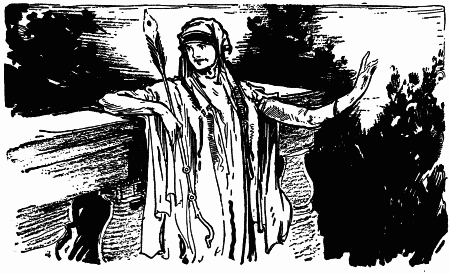
Thus, Baum described Ojo wearing a blue ruffled shirt, perhaps with vertical ruffles like this lady. And Neill chose instead to draw Ojo with a ruff around his neck and a plainly sewn, if floppy, white shirt.
Baum used “waist” in similar ways in his other fantasy novels. In Sky Island he described the boy Button-Bright this way: “He wore a blouse waist, a short jacket, and knickerbockers.” And in The Scarecrow of Oz, Button-Bright looks like this: “He was dressed in a brown velvet jacket and knickerbockers, with brown stockings, buckled shoes and a blue shirt-waist that had frills down its front.”
Baum always portrayed Button-Bright as an upper-class, fairly precious (though indestructible) little American boy. His mother or governess (he had both) therefore dressed him in loose, frilly shirts. Or, as his contemporaries would say, waists.