Showing posts with label valuable lessons about life. Show all posts

24 December 2019

Life Lessons from the MGM Movie

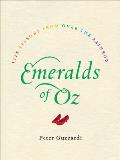
Emeralds of Oz: Life Lessons from Over the Rainbow is a short but not insubstantial riff on the MGM Wizard of Oz. The author, Peter Guzzardi, is a veteran book editor, but this is the first book published under his own name, several years in the making.

Emeralds of Oz is not based on the Oz mythos as a whole—just the famous movie. Guzzardi writes nostalgically about watching that film on television with his family but shares no fond memories of reading the Oz books as a child. He read a lot, but his taste leaned toward boys’ adventures. It takes over a dozen pages before Guzzardi even mentions L. Frank Baum, and there are only a couple of times when the book invokes parts of Baum’s story that didn’t make it into the movie.

Guzzardi isn’t just playing to the MGM movie’s larger contemporary fan base. That movie really defines his idea of Oz. At one point he recalls a difficult journey, noting he was about the same age as when Dorothy went to Oz. Context makes clear that he’s picturing the young adolescent Dorothy portrayed by Judy Garland, not the little girl drawn by W. W. Denslow.

The bulk of the book consists of lessons drawn from rewatching the MGM movie, rather like a sincere Mystery Science Theater 3000 viewing. A fair number of these homilies actually grow out of the vaudeville-style jokes mixed into the screenplay. There are longer meditations on the movie’s more explicit lessons, and of course a struggle at the end because of the screenplay’s ethical knots.

The “Emeralds of Wisdom” found in the movie tend toward pleasant reminders to keep doing what we normally do or know we should do, not deeper digs into the philosophical and ethical questions that the movie could raise. (Can one be a very good man while pretending to be a wizard?) The working title was All I Need to Know I Learned from the Wizard of Oz, with the implication that we knew it all from when we were young. Guzzardi drops mentions of the Kabbalah, mantras, Maslow’s hierarchy of needs, and other mainstays of modern self-help books. The more interesting commentary grows from his own life, however.

As an editor, Guzzardi’s specialty was crowd-pleasers, sometimes with fantastic results—Stephen Hawking’s A Brief History of Time, most notably. Emeralds of Oz grew out of that same commercial impulse. It’s designed as a gift, with glittery emerald endpapers, deckle edges, eye-catching interior design, and other hallmarks of the book as object. For people who like the movie and this sort of advice, it’s a fine package. But its strength comes from Guzzardi’s sincerity as he seeks guidance in the question, “What Would Dorothy Do?”

23 October 2019

Raymie: “Everybody’s Kind of Movie”?

I’ve been noodling out a story about kids in a seaside town, so I tracked down the 1960 movie Raymie for visual inspiration.

Raymie came from Allied Artists Pictures, which grew out of the Monogram, one of the “Poverty Row” studios of the 1930s. Allied still took pride in keeping budgets low. There’s a small cast, a limited number of settings, only one action scene, and not a little stock footage.

I hoped the picture would be an interesting exploration of the young title character, played by Hollywood scion David Ladd. Raymie is indeed at the center of the story, his quest to catch a legendary barracuda defining the plot. But there’s a lot more footage of adults discussing Raymie than of the boy expressing himself. Some scenes are outside of his point of view. I believe Ladd was twelve when the movie was made, but he’s playing a simple nine-year-old.

Instead of a character study, Raymie really lays out the culture of a fishing pier somewhere along the California coast. A bunch of white men who have nothing better to do spend their days fishing off the pier, trading stories and jibes. Raymie’s widowed mother works at a diner on the pier, so he gets to fish, too, without paying.

One of the men is a grouch who dislikes Raymie’s presence. The rest use him as an object of their opinions and advice. There’s a wealthy older man who suffers a health crisis partway through the movie. There’s an African-American worker who shares wisdom in scenes with Ladd and no other actors, making me think they were shot separately and possibly ready to trim for certain audiences. And there’s John Agar as Ike, an off-season construction worker who’s trying to woo Raymie’s mother, played by Julie Adams.

In a vaguely Freudian way, some of the action turns on a fishing knife that Raymie inherited from his late father. (The father died in the Korean War, when the boy was an infant.) After resisting for two-thirds of that movie, Raymie trades that knife for the bait he needs to catch the barracuda. Then at the climactic moment he picks up Ike’s knife instead. That change presages how Raymie’s mother, seeing Ike standing up for her son, finally accepts him as a suitor.

Raymie’s mother doesn’t know that, much earlier in the movie, Ike dove off the pier to protect her son from a shark. Presumably she would have warmed up to him earlier if she were aware. But all the men on the pier, and Raymie, conspired to deceive her about how he got knocked into the water. In other words, the pier culture stretched out the movie.

The Raymie theme song was recorded by Jerry Lewis, then at the height of his stardom. He was even featured on the posters, as shown above. I’ve seen reports that a legal dispute over that recording has prevented the movie from being rereleased in any new format. Whether or not that’s true, in order to watch Raymie I had to download a bootleg file made from a scratched 16mm print found a few years back in Australia. It’s available for the curious, but I’m not recommending it as a sadly lost classic.

19 August 2019

Rethinking a Decision at Sundown

I thought I’d watched all seven movies in the “Ranown Cycle” of westerns directed by Budd Boetticher and starring Randolph Scott, most produced by Scott and Harry Joe Brown and written by Burt Kennedy. But I’d missed Decision at Sundown—until last week.

As in most of the cycle, Scott (almost sixty years old in 1957) plays an experienced westerner on a mission of revenge. In this case, he comes to the town of Sundown to call out a man he holds responsible for his wife’s suicide.

A hallmark of these westerns is that their villains can be as charismatic and more rounded than Scott’s protagonists. Indeed, sometimes the villain in one movie even echoes the lines of the hero in another. They’re all men who refuse to change, heading for a collision.

Decision at Sundown takes that mirroring to its furthest point. Scott’s character first appears stopping a stagecoach at pistol point. Meanwhile, his antagonist, played by John Carroll, is treating the whole town to drinks to celebrate his wedding.

Of course, that antagonist is a crooked town boss. He’s throwing over his long-time lover for this advantageous marriage. Yet he’s also in love with his new bride. Most striking, he doesn’t hide his past or his methods—he’s one of the movie’s truth-tellers.

Scott’s character interrupts the wedding and winds up besieged in a livery stable. The boss sends his hand-picked sheriff and deputized gunmen after the interloper as the cowed townspeople wait out the conflict in the saloon.

As the action rises, however, the main characters decline. Of course, in this sort of story we expect the villain to be cut down. But the action reveals Scott’s character as more petty than principled, and he gets his only friend killed to preserve a delusion. In the end, both main characters ride out of Sundown diminished.

Boetticher considered Decision at Sundown to be a failure. Certainly other films he made with Scott and Brown, such as Seven Men from Now and Ride Lonesome, are more stirring. But this one is an effective, character-driven story, not to be missed in the bunch.

14 August 2017

“Dark stuff for 8–12 year olds”

Highlighting Patrick Hogan’s essay “A Children's Book About Aliens Turned Me Into a Socialist” at Splinter, about the My Teacher Is an Alien series by Bruce Coville:
When I spoke with Coville over the phone, he said the social justice bent of the series was a bit of an accident after the surprise success of the first book, which was intended to be a one-off adventure novel. His other novels (and he has written a lot of novels) rarely indulged in politics, but he was inspired to add an element of social criticism the Teacher is an Alien series after reading the book Savage Inequalities by Jonathan Kozol.

“The pleasure of writing about aliens is they could see our nonsense from the outside,” Coville told me. “It’s an insane way to live.”

In the final book, My Teacher Flunked the Planet, the child protagonists of the first three volumes are given the task of convincing the Interplanetary Council to not blow Earth up (the planet having, as the title hints, flunked its alien evaluation). As part of the assignment, their alien teacher, Broxholm, takes them on a tour of Earth and asks them to answer for humanity’s behavior. They hit up war zones, impoverished cities and, most notably in my memory, a refugee camp . . .

That’s dark stuff for 8–12 year olds. It was dark for Coville, too, who said the research he conducted for the segment of impoverished and war-torn areas of the world was harrowing.

“I got away with it because it was the fourth book of the series,” he said. “That book sold a million to a million-and-a-half copies but I feel like a lot of it was a secret between me and the kids who read it.”
Hogan recalls only one other title in his school library with a waiting list: How to Draw Comics the Marvel Way.

22 December 2015

Slice of Life

At the Hungry Tiger Talk blog, David Maxine has written about the one-of-a-kind Oz-related item that was part of our first meeting, when we were teenagers. This is my side of the story.

Back in 1979, at the age of thirteen, I attended my first International Wizard of Oz Club convention. This was the Munchkin Convention, meaning it drew Oz fans from the eastern part of the United States. In the books, you see, the Munchkins live in the eastern part of Oz. (In most of the books. It’s a long story, which David summarized here.)

That year the Munchkin Convention was in Cherry Hill, New Jersey, a reasonably short car ride from my grandparents’ home in suburban Philadelphia. I’d already done some air travel by myself, so I felt confident flying down to visit Grandpa and Grandma.

I wasn’t so confident about meeting the Munchkin conventioneers. I was a shy kid, and I’d never been at that sort of gathering before, much less on my own. It turned out to be a milestone event because it was the first time adult strangers treated me as a peer. For that, I’ll always be grateful to the Oz Club.

There were other teenagers there as well, or at least one: Judy Bieber. But she intimidated me. I was thirteen, and she was (and remains) a couple of years older, which felt like an incredibly significant gap. She was also smart, pretty, and seemingly very much at home in Munchkinland. She created the quiz about the Oz books for that year. She and her father Herm were selling older Oz editions. She appeared to have everything.

To the surprise of the room, and the astonishment of myself, I won Judy’s quiz. The Oz books were the first field of knowledge I really tried to master, and my brain is good at retaining trivial information. And, though I didn’t know it at the time, previous winners were probably sitting out that event. The prize that Judy supplied was an abridged “Junior” edition of Rinkitink in Oz with some John R. Neill color plates. I’m sure that was the first time I’d ever seen one of those abridgments. It may have been the first time I ever knew about them.

By the end of that day, while I was waiting for my grandmother to pick me up, I was already worrying about my responsibilities for the following year. The winner of each year’s quiz had to write the next year’s quiz and supply the prize. I remember another attendee congratulating me on winning and asking if I was already thinking about new questions, and me replying that I was already thinking about the prize.

Making the quiz was fun. I decided to base it on Neill’s pictures and books, and I had fun laying it out. But for a prize? I didn’t have much money to spend, I didn’t know the range of possibilities, and I wasn’t linked into collectors’ networks. I also wasn’t good at asking for help (I’m still not). I wanted to solve this problem on my own—since I was acting as an adult, and all that.

So I decided to use my time in woodworking class to make a prize. A pair of O and Z bookends didn’t work out, but I grabbed a piece of mahogany and figured out a design for a cheese board that incorporated Neill’s OZ symbol in its handle. I didn’t do a great job with the carving, but it was a one-of-a-kind Oz-related trophy. And its real value was symbolic, right?

As David guessed, during the 1980 Munchkin Convention I decided to augment that cheese board with an edition of The Wizard of Oz autographed by Margaret Hamilton, who was there. So now I can also say that I had a brief conversation with her. Very brief.

The person who won my quiz was David Maxine, who had come from out west all the way to Cherry Hill. He was also a teenager. But, like Judy, he was (and is) a couple of years older than me. The difference is minuscule now—we’re all part of what I called the “white cover generation” of Oz fans. But back then David was also daunting.

Looking back, I realize that my thinking at thirteen was skewed by the universal adolescent assumption that every other teen is having more fun than you. To me David seemed like an old hand at Oz conventions and collecting and life. I should have perceived that this was his first time at the Munchkins, and he had no idea I was at just my second gathering. We had more in common than I realized.

If I’d known the winner of my quiz was going to be another teen, I probably wouldn’t have made a kitchen implement. If I’d had the boldness to befriend Judy the year before, I could probably have asked her and Herm to snatch up one of those abridged editions for the 1980 prize. But I couldn’t see any of those possibilities at the time.

I also couldn’t see that David and I would reconnect in something called “online” almost twenty years later. During some Ozzy conversation he mentioned that he still had the cheese board, which was both astonishing and gratifying. (As he’s pointed out, it’s compact and almost impossible to break.) And now that we’re both adults and have had online exchanges about such things as Swiss chard, a kitchen implement turns out to have been more appropriate than we knew. It’s come to symbolize a real-world friendship rooted in Oz.
08 November 2014

Where Serials End Up

Someone else considering the workings of serial fiction this week was Linda Holmes, writing for NPR on the public-radio-related podcast Serial, reinvestigating a murder.

Holmes notes how many listeners are trying to view the podcast through the lens of the recent limited television series True Detective, Fargo, and Lost. In other words, they’re asking for a clear conclusion even if (as in two of those examples) it ends up disappointing a lot of the audience.

Holmes writes:

What’s good about this wrinkle, and what seems healthy about it, is that it raises the question of what stories are for. Must there be a lesson or a moral? Must we sense a particular idea about life at the end, and can it be futility? If you raise a question, do you have to answer it? In real life, of course, Chekhov’s gun need not come to anything in the third act just because it was shown in the first. If this makes a good true story but would not make a good piece of dramatic fiction, why is that?

Assuming people do find the [Serial] ending satisfying despite what almost must be its messiness, is it possible that a piece of serial crime reporting with no conclusion will point to the idea that we've perhaps become overly obsessed in judging an entire piece of storytelling on whether we get the perfectly symmetrical, flawless, balanced, wry, doubt-drowning ending we deserve?
I find it telling that Holmes’s essay doesn’t mention what until recently was the necessary name-drop in any article on quality television: The Sopranos. That show famously ended without resolution, just a sudden black screen. And people were pissed. So it fits right into Holmes’s thesis.

23 October 2014

No Justifiable Homicides for Superheroes

Recapping network television episodes seems to be big business for entertainment websites these days. I did it myself for Den of Geek and the first season of Turn.

For the new Flash series, Playboy evidently has the money to go straight to the top because the magazine’s recapper is Mark Waid, who wrote scores of highly regarded issues of that comic book and its spin-offs in the 1990s.

In his discussion of episode 3, Waid starts by analyzing a superhero trope that goes all the way back to when the genre was codified in the 1940s. He recaps his argument with an iconoclastic comic-book publisher about the rule against superheroes solving problems by killing bad guys:
Yes, there is absolutely such a thing as justifiable homicide, but it’s a last resort, not a method of operation. The concept that life in all forms is sacred isn’t just a throwback to fairy tales or simpler times, I argued; it’s a philosophy as old as realized religion.

Okay, yeah. Cops have to shoot robbers sometimes. Soldiers have to kill. Homicide detectives and private investigators, real or fictional, sometimes kill. They’re people just like you and me, with limited abilities and limited tools.

But super-heroes were created specifically, from the imaginations of the young and the young at heart, to do the impossible — to defy gravity or bounce missiles off their chest or outrun speeding bullets. It’s baked into their DNA. To find a perpetual audience, super-heroes must seem relevant and relatable and admirable, but they are still creations of fantasy.

We read their comics and watch their TV shows and movies to see them do the things we can’t, to triumph heroically against odds that would flatten you and me...not to suffer with them as they’re forced into the trauma of making the same real-world choices that you and I, mere humans, would have to make if we [were] caught helpless with our only available weapon one that was designed explicitly to kill.
To be sure, some costumed heroes, like Marvel’s Punisher and DC’s Vigilante, are specifically designed to go against the no-killing rule. But it’s notable that neither of those characters has fantastic powers. And the companies’ biggest brands avoid killing even if (as in the case of Wolverine) they talk about being willing to do it.

Waid’s faith in that dictum is what got him in trouble in viewing Man of Steel a couple of years back, as he so memorably described:
Superman wins by killing Zod. By snapping his neck. And as this moment was building, as Zod was out of control and Superman was (for the first time since the fishing boat 90 minutes ago) struggling to actually save innocent victims instead of casually catching them in mid-plummet, some crazy guy in front of us was muttering “Don’t do it…don’t do it…DON’T DO IT…” and then Superman snapped Zod’s neck and that guy stood up and said in a very loud voice, “THAT’S IT, YOU LOST ME, I’M OUT,” and his girlfriend had to literally pull him back into his seat and keep him from walking out and that crazy guy was me.

That crazy guy was me, and I barely even remember doing that, I had to be told afterward that I’d done that, that’s how caught up in betrayal I felt. And after the neck-snapping, even though I stuck it out, I didn’t give a damn about the rest of the movie.
And in that Waid was exactly right. Flash is not exhibiting the same problem.

17 April 2014

Some People Just Can’t Lego

When The Lego Movie came out this spring, it prompted debate about its political implications. Kyle Smith at the New York Post offered a round-up of different interpretations, including:
The Economist noted that whatever its story might imply, “The film is also an hour-and-a-half-long commercial for costly toys made by a multinational corporation based in Denmark; a commercial, moreover, that people must pay to see.”

Almost alarmingly full of spectacle and movement, The Lego Movie offers us storytelling irony with sprinkles on top and let us eat it, too. It made fun of the clichés of “chosen one” plots, and it still showed the designated hero saving the day. It let us laugh at the notion of a made-up prophecy that must be true because it rhymes, and it let us believe wise words must be true because they come in the voice of Morgan Freeman. It offered a chance to laugh at cookie-cutter, feel-good pop culture, and it costarred Lego Batman.

The political “message” of the movie came in how its chief villain is Lord Business, who has also made himself President Business. Different critics emphasize different parts of his symbolic meaning, depending on how they feel about business or, at this historical moment, Presidents. In fact, he’s a plastic avatar of a suburban father who doesn’t have time to play with his son (though he does have time to play with his Legos). “Business” here has no economic or political import; it’s just what keeps Dad in the office.

The end of the movie assures us that it’s crucial to express yourself fully and flexibly, and spend time with your family, as long as you do that with lots of Legos. Lots and lots of Legos.

(I have to acknowledge here that I hardly ever played with Legos at home. We were a Tinkertoy family.)

08 September 2013

The Amorality of Teen Titans Go

I had something else in mind for this weekly Robin, but today I saw reports of DC Comics’s plan to publish a Teen Titans Go comic book (the second of that name, the first being a spin-off its earlier Teen Titans cartoon). Comics Alliance says this will be a digital comic, taking advantage of ComiXology’s “guided-view” feature to create more page turns, before being printed in a standard magazine format. And I doubt I’ll be buying it.

Bleeding Cool’s article “Could Teen Titans GO! Be The Most Amoral Comic That DC Publishes?” echoes why I gave up on the show:
It’s actually quite vicious and surreal, often ending with all the Titans dead or permanently maimed. . . .

The most subversive episode is one where Robin decides he’s sick of being the only one without superpowers on the team because he has to work harder than everyone else. They tell him that superpowers are a curse. A CURSE! He will be forever a stranger, an outsider.

He insists he wants powers, so Raven gives him the gamut of powers, warning him he’ll live to regret it. NOPE. He goes off and solves all crime, ends world hunger and everything’s great. Except that means superheroes are out of a job. The team disbands. Robin has to find a crappy, boring 9 to 5 job. He toils at this job for the next 50 years until he falls over and ends up in the hospital on his death bed. . . .

The sheer amorality of the characters throughout the series is brilliant.
I recognize the talent and imagination involved in these stories. For instance, when Robin gets superpowers, he also gains a Superman-style spit curl. The show doesn’t call attention to that detail, Superman himself never appears in this universe—it’s just a little touch for fans.

The problem is that in any episode featuring Robin, he comes across as egotistical, bossy, short-sighted, lazy, and otherwise less than heroic. And so do all of the other male Titans, and sometimes the females. We hardly ever see them do anything nice for each other, or for anyone else.

What’s worse, in that episode Robin does end crime and save the world, as the summary says. And the show depicts that as a bad thing. Robin becomes a middle-aged adult (always a bad sign) and dies in a hospital bed. Because, you know, kids love that stuff.

At his Batwatch site Jeremy Sims mixes up “amoral” and “immoral,” but recognizes the same problem:
I really enjoy Teen Titans Go! but I'm not sure that I would want my kids to watch it. The characters almost always act immorally and almost never suffer the consequences, and they are supposed to be heroes.
As I groused back in June, “There is, as far as I can tell, almost no heroism in Teen Titans Go.” And the overarching theme of superhero stories, I think, is the nature of heroism in different circumstances. Teen Titans Go is no more concerned with heroism than the average Heckle and Jeckle cartoon.

As is to be expected, the cover of the first issue of the new comic book shows the Titans, particularly Beast Boy, eating.

28 August 2013

“A kind of literary amnesia” about Violence

The Boston Globe’s recent interview with Michelle Ann Abate, professor of children’s literature at Ohio State, included this discussion of violence in books for young readers:
IDEAS: You went back and reread children’s books from throughout history for your research. Did those books become more violent and realistic over time?

ABATE: It’s actually the opposite of that. I was also surprised by the level of specificity and by the sensational nature of what I was reading. We tend to think of today’s young adult books as being more realistic. But the earlier books were incredibly graphic and violent. Edgar Rice Burroughs’s “Tarzan of the Apes,” which was first released as a magazine serial in 1912, is a great example. There are tons of killings—people killing people, people killing animals, animals killing people. All of them are really gruesome and gory. The same thing’s true of “Alice in Wonderland” and a bunch of other classics, books that would never be challenged today. These examples are all conveniently forgotten when there’s a public outcry about a particular book for being so graphic and so violent. It’s almost a kind of literary amnesia.

IDEAS: It sounds like you’re talking about “The Hunger Games.”

ABATE: It’s funny—“The Hunger Games” gets so much bad press for promoting violence. But actually the books are doing the exact opposite. The entire first book is a cautionary tale about the horrors of violence and the senselessness of killing. It’s not glorifying violence, it’s condemning it with very little ambiguity. When you have a parent or a school board complaining about these books, in many cases they haven’t read the books themselves, or they’re picking out a chapter, a page, a scene.
The Tarzan books don’t seem to be written for children, but then neither did Suzanne Collins write The Hunger Games for all ages.

Abate is author or editor of half a dozen books of literary criticism, including Bloody Murder: The Homicide Tradition in Children’s Literature, Raising Your Kids Right: Children’s Literature and American Political Conservatism, and Over the Rainbow: Queer Children’s and Young Adult Literature, with Kenneth B. Kidd.

22 July 2013

The Real Story of Horton the Elephant

When Dr. Seuss was asked about the genesis of his 1940 picture book, Horton Hatches the Egg, he usually told some variation on the story quoted here at Mental Floss:
I was in my New York studio one day, sketching on transparent tracing paper, and I had the window open. The wind simply took a picture of an elephant that I’d drawn and put it on top of another sheet of paper that had a tree on it. All I had to do was to figure out what the elephant was doing in that tree.
Charles D. Cohen’s “visual biography” of Seuss is titled The Seuss, the Whole Seuss, and Nothing But the Seuss in part, I suspect, because it seeks to get to the truth behind such anecdotes.

When it comes to Horton Hatches the Egg, Cohen shows that:
  • Seuss had drawn a whale up a tree for Judge magazine in 1927, a dachshund hatching a stork’s egg for Life in 1929, and a walrus hatching eggs in a tree for Judge in 1931.
  • He had drawn elephants with wings for Life in 1930 and a book called Spelling Bees in 1937.
  • He had drawn an elephant sitting on an egg for Life in 1934.
And in 1938 Judge published a one-page “Dr. Seuss Fable” titled “Matilda, the Elephant with a Mother Complex,” about a childless elephant who sits patiently on a chickadee egg, enduring the scorn of her fellow animals, until it hatches. Matilda didn’t go up a tree to do so, but clearly Horton Hatches the Egg had been gestating in Dr. Seuss’s mind for years rather than being inspired by a fortuitous breeze.

The really significant changes are that all those previous cartoons and stories had been for adult audiences, and almost all presented the odd mammal as misguided rather than heroic. The egg-sitting walrus was part of “The Truly-Dumb Animal Shoppe”; the first winged elephants were the product of delirium tremens; the elephant from 1934 cracked the egg’s shell.

As for Matilda, she managed to hatch the chickadee, but it took one look at her, “cried out in terror,…and flapped off frantically.” The moral of that story is: “Don’t go around hatching other folks’ eggs.” That, of course, is quite a different outcome from Horton’s pride at hatching an elephant-bird.

When Dr. Seuss went back to that idea as a recently-hatched children’s-book author, he was able to embrace the nonsense of the image of an elephant in a nest in a tree and create an ending that adults might know is unreal but which rewards Horton. For young readers, Dr. Seuss took his old elephant who defied convention and made him heroic rather than pathetic.

The Seuss, the Whole Truth, and Nothing But the Seuss analyzes other oft-told aspects of Dr. Seuss’s life as well, such as when and why he adopted pseudonyms and the critical response to The 5,000 Fingers of Dr. T. It’s worth a look.

16 June 2013

Teen Titans Gone Bad

Every so often I’ve peeked in on Cartoon Network’s Teen Titans Go, and I’ve been increasingly disappointed. After watching the recent episode about Beast Boy turning into a gorilla and challenging Robin for alpha-male status, I’ve decided to give up on the series entirely.

There is, as far as I can tell, almost no heroism in Teen Titans Go. The plots are built around the boys’ gluttony, laziness, or egoism. (The female characters react but have rarely driven the action.) The cartoons end with few valuable lessons about life, particularly by the standards of children’s television, and no development from one episode to the next.

Every so often the cartoons show us a villain from the old Teen Titans cartoon. Usually that character has no lines, thus saving on voice-actor costs. (Most of the episodes have been performed solely by the regular cast. Scott Menville as Robin once did double-duty as that character’s rival Speedy.) But we rarely see the team defeat those villains. In some cases, they don’t even notice their old enemies. And in the gorilla episode, Beast Boy actually refuses to stop the bad guy.

There’s a lot of action in Teen Titans Go, to be sure, but these Titans rarely use their powers for anyone else’s benefit. Instead, they’re usually trying to get more stuff—especially food—for themselves. So far I’ve seen the team’s activity help Jump City only once as they defeated some sort of slime monster, and the story that followed was all about Robin trying to sneak out of doing the laundry.

And that’s just wrong. That’s not what Robin, or any other hero, would do. Those characters aren’t defined by their powers and abilities—they’re defined by what they do with those powers and abilities. A Robin or ex-Robin has usually led the Teen Titans not because his ego demanded it but because he’s devoted to justice and helping people, and ultimately more badass-effective than anyone else.

Of course it’s possible to create Teen Titans drama around leadership conflicts, insecurity, wish for recognition, and other foibles. But the best stories show that drama playing out within a plot of actual heroics—i.e., helping other people. The producers have presented Teen Titans Go as what the old team does in their off-hours, but their stories depict those characters as petty and foolish and ultimately unheroic.

All that said, the network just ordered new episodes, so the series is apparently working on a commercial basis. I suppose all those stories based around eating might do a good job selling fast-food and candy commercials.

05 November 2012

With YA Power Comes YA Responsibility?

At the CBC Diversity blog, author and digi-editor Daniel Nayeri shared an essay on an apparent double standard in discussions of Young Adult books:

These days every book festival has a YA panel, and every panel has a moment when a well-meaning attendee will stand up and ask: Are YA novels becoming more perverse? . . .

several times I’ve heard authors say, “Well, we can’t take responsibility for what a reader will take from a book. It could be anything.”

Dylan Klebold and Eric Harris could have been reading Judy Moody just as easily as The Catcher in the Rye.

It’s a tempting idea for anyone who has ever written anything. You write what you write. Readers take whatever they want from it. . . .

ten minutes later—still at this hypothetical YA panel—a different panelist will mention all the good that their book might have done. A young fan wrote in with news of recovery, and the author glows with pride. . . .

We believe in the power of writing, and we accept the good it can cause in the lives of young readers, but we reject even the notion that it can also do harm.
In fact, the CBC Diversity blog itself is based in part on the idea that books can harm young readers by not portraying a diverse set of people or by portraying certain people in insulting or stereotypical ways. That acknowledges the power of writing. 

01 November 2012

When Authors Set Their Own Prices

For decades now, books have been one of the few American products that come with their price tags not just attached but integrally incorporated into them. That’s limited the flexibility of retailers. One of the changes wrought by digital publishing is that retailers can change the price of a product (or, to be precise about the big companies’ legalities, license) instantly.

The big bookselling sites offer that flexibility to self-publishers, and a couple of colleagues are taking advantage of it today.

Jason Rodriguez writes:

I just published my new sci-fi short, “The End of Stars,” to Amazon. It will be free on Monday but right now it is priced at 99-cents.

“The End of Stars” is a climate change fairy tale about a young girl who discovers that the sky is falling and tries to warn her neighbors before the village is destroyed. Due to the message in the story, I decided to donate all residuals made off of the book (I get 35-cents per download) through Sunday (and then it becomes free) to the Red Cross relief efforts centered on rescue and recovery following the destruction caused by Hurricane Sandy.

And, to sweeten the pot, I will also donate all of the residuals made off of my other sci-fi shorts over the next four days to the Red Cross, as well. For more info, please feel free to go to this link.
In addition, Chris Eboch has extended her Halloween special for the ebook edition of her novel The Ghost Miner’s Treasure through today. She writes:
This is book 4 of my Haunted series originally published by Aladdin/Simon & Schuster. My editor got fired and the publisher dropped the series, so I finally decided to self-publish the fourth book, which was already written. Book 4 can be read on its own. It’s spooky but not gory, much more a comedy/mystery than a horror novel, suitable for ages 8+.
The Haunted series features two siblings working with a “ghost hunter TV show” that (unlike most of them) finds actual ghosts.

30 September 2012

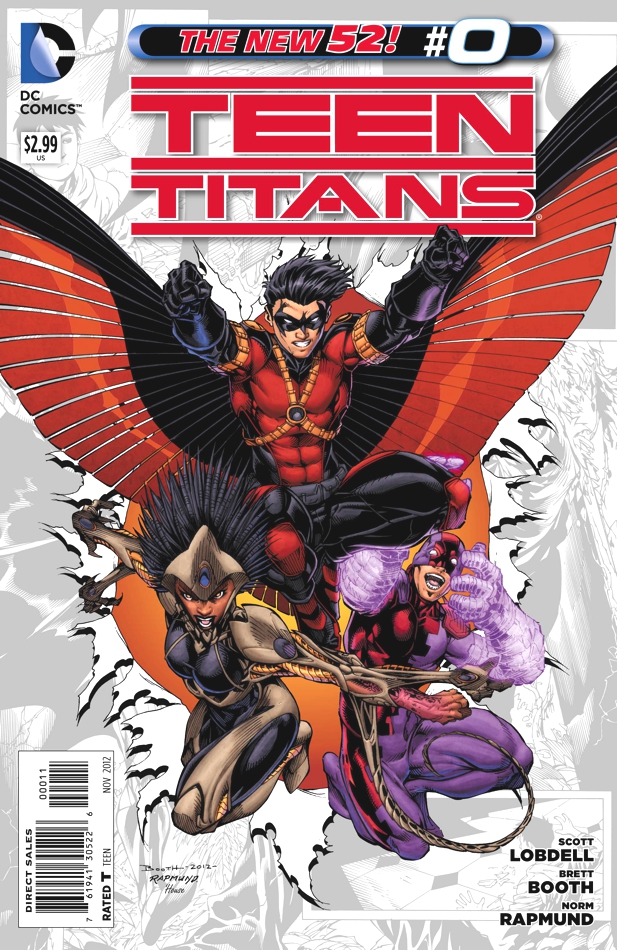
What Teen Titans, #0, Tells Us About the New Tim Drake

The last weekly Robin offered a rewrite of a scene from this month’s Batman, #0, based on my impression that Tim Drake was never as boastful as that boy’s dialogue portrayed him. This week’s Teen Titans, #0, scripted by Scott Lobdell, revealed that that exercise was based on a faulty premise. The boy in that scene wasn’t Tim Drake.

In Teen Titans, #0, the first thing that boy tells Batman is: “Honestly? It [discovering your secret identity] wasn’t as hard as it would seem.” That’s the same sort of bragging that the character had done in Batman, #0: “You’re not going to throw out the best student in the school”; “I thought it’d be more fun to catch you in the act…a challenge, you know? But you made it ridiculously easy.”

Batman’s response to that boy is, “Hubris is an unattractive quality, Tim.” And indeed the story of Tim in those two magazines is a story of hubris: a teenager so convinced of his intellectual capabilities that he sets out to deduce Batman’s identity and apply for the job of Robin. Furthermore, when Batman doesn’t accept his application, Tim forces the Caped Crusader’s hand, taking a potentially fatal risk that costs him his loving family. The story of Teen Titans, #0, is thus about Tim learning a valuable lesson about life.

Last week I wrote:
Perhaps this is a new characterization of Tim as intellectually snobbish. Stories about him overcoming that flaw could be interesting, though I think they’d undermine some of his appeal for readers. (Shall we see what Teen Titans, #0, brings?)
And now we know. James Tynion IV carried out his Batman, #0, assignment to write dialogue not for the Tim Drake most comics fans are familiar with but for another character named Timothy. I still question how his scene makes the SAT the final revelation instead of the police, and the vagueness of the line, “The way you treat your students and your faculty…you’re a bad man, Mr. Renfield.” But in terms of the boy’s characterization, Tynion was right on target.

Teen Titans, #0, also tells us that the Tim in those episodes didn’t have the surname Drake until he became Batman’s partner as Red Robin (wearing the 2006-2009 costume). That name change was a last-minute decision by DC Comics editors, Lobdell told CBR. So literally the boy in those scenes was not Tim Drake yet.

I’ve habitually referred to the first and second Jason Todds because I see a major distinction between the pre-Crisis character of that name and the post-Crisis character that everyone now remembers. DC Comics’s recent reboot has preserved the basics of the second Jason Todd even as it added a new layer of details. The iconic origin of Dick Grayson remains fundamentally the same, as always. But the comics now have the first and second Tim Drakes. (The TV cartoon already combined Tim’s name with the second Jason’s history, but that’s another story.)

The first Tim Drake was dedicated and convinced that Batman needed a Robin, but never hubristic like the second. The first Tim had a special link to Dick Grayson; the second has no direct connection. The first Tim figured out Batman’s secret identity; the second only thought he had. The first had a deep unconscious desire for a father figure due to absent and inadequate parents; the second had very supportive parents, whom he endangered and then had to give up to save their lives. Obviously the symbolic value and thus the appeal of the two characters will be different.

There’s plenty of story potential in the second Tim Drake: his feelings of love and guilt for his parents, now in witness protection (and having more children?); his intellectual rivalry with Batman; his need to guard against hubris. Even the enmity of disgraced headmaster Renfield might become the seed for a future plot. But this is not the character fans have followed since 1989.

Another notable pattern from this month’s rebooted Robins is how they’ve been assigned details that once distinguished Batman’s female allies. Nightwing, #0, gives Dick Grayson a highly developed ability to read body language, formerly the hallmark of Cassandra Cain. Teen Titans, #0, shows Tim hacking money from criminals, as Barbara Gordon did when she was Oracle. The same magazine shows Tim tweaking the Gotham underworld to gain Batman’s attention and having that blow up in his face, just as Stephanie Brown did in the War Games crossover. That seems to leave less room for Cassandra and Stephanie to reappear as they did before, but then the Tim Drake they knew has disappeared as well.

15 February 2012

Fangbone Through the Portal of Time

Fangbone: Third-Grade Barbarian is a new book-length comic for middle-grade readers by Michael Rex. It’s a story about believing in yourself, accepting differences, being loyal to friends, and cooperating to fight off bad guys. In sum, the same themes as in many other modern stories for children. Not that there’s anything wrong with that.

The premise is that Fangbone, a boy growing up in the sword-and-sorcery genre, must undertake a magical quest that brings him to North America today. Not unlike Beastmaster 2: Through the Portal of Time, in fact. Fangbone has to deal with modern plumbing, spicy chicken wings, and the overall rise in living standards.

I wonder whether the book’s target readers are familiar with the sword-and-sorcery genre. The heyday of Conan the Barbarian in pop culture seems as far back as the heyday of Conan in magical prehistory. So perhaps kids who really like this comic should also be treated to a family viewing of the sublimity that is the original Beastmaster.

I had bigger questions about Fangbone’s warrior tribe. It doesn’t appear to contain any women. It doesn’t appear to contain any other children. The adult male warriors don’t seem to recognize that Fangbone, whom they call a “runt,” is growing bigger day by day, and that in a few years they might depend on him.

Young Fangbone may be premature in claiming the status of a warrior, I thought, but simply by running with them he seems to be extraordinary in his world as well as in ours. The grown men’s contempt feels driven by a storytelling need to make Fangbone seem a little more put-upon and thus sympathetic.

Graphically, Fangbone is a two-color, “digest-sized” comic. Rex draws in a four-fingered cartoon style with a generally unvarying line. The art is deceptively simple, which might inspire readers to try their own comics stories. One interesting graphic element they can look for is how Rex’s panels break out of the orthogonal grid at moments of conflict and, especially, action.

TOMORROW: Fangbone and Room 3G.

(Comments based on autographed advance copy from Renin Publishing Services.)

02 January 2012

Cybils for 2011

The Cybils Award shortlists for 2011 have been announced, representing blogging volunteers’ judgments of what children’s books offer the best combination of quality and kid appeal.

There’s a new category this year of Book Apps. Nominees include three brand names established for decades (Harold and the Purple Crayon, Pat the Bunny, and The Monster at the End of This Book) and what look like four originals:

It’s notable that two of the three adaptations are of picture books that were interactive before electronics, and the third plays with the reality of its world. It’s also notable that the originals lean toward the didactic. I’ll probably try some of these out now that iHave an iPad.

22 December 2011

“The lessons they want to hand down”

The Horn Book just sent me editor Roger Sutton’s interview with Daniel Handler on the textual side of Why We Broke Up. I don’t think it’s yet on the web, so this might be a reminder to sign up for the Horn Book’s electronic newsletter.

In any event, at one point Handler (né for book-buying audiences Lemony Snicket) says:
I don’t quite understand what YA literature is. To me it’s the genre where the authors publicly talk the most about the lessons they want to hand down to the reader, even more so than in picture books, I’d say. It seems like everybody who's writing a book for a fifteen-year-old is trying to save a particular kind of fifteen-year-old from a particular kind of thing.
That’s just not true. There’s a whole ’nother kind of YA lit whose valuable lesson about life is reassuring a fifteen-year-old that others are going through a particular kind of thing just like them, so they don’t need saving.

(Unless, of course, the “particular kind of thing” is the adolescent belief that nobody is suffering just like them, that everyone else in high school is having more fun than they are.)

But does Why We Broke Up at the end offer a sense of hope?

03 November 2011

The Phantom Tollbooth in Its Time

In a New Yorker article about the fiftieth-anniversary editions of Norton Juster’s The Phantom Tollbooth, Adam Gopnik wrote:
It’s a commonplace of scholarship to insist that children’s literature came of age when it began to break away from the authoritarian model of the moralizing allegory. Yet “The Phantom Tollbooth” is an old-fashioned moralizing allegory, with a symbolic point at every turn.
And that’s why the book can grate on adults like Peter Sagal.

The “coming of age” that Gopnik mentions occurred decades, perhaps a century, before Juster started writing. Such obvious “moralizing allegory” was long gone. Sure, there were still moralizing tales like Betty MacDonald’s Mrs. Piggle-Wiggle (1947-), and William Pène du Bois was about to tackle the deadly sins (1966-). Even today, most people expect novels to leave children with a sense of hope and other subtle nudges in a right direction. But allegorical characters that spell out their valuable lessons about life without a wink—those were as old-fashioned as Pilgrim’s Progress.

The Phantom Tollbooth brought back the form, but its characters have less to say about morals than about intellect. Milo learns to see the world from different perspectives, not to jump to conclusions, and other rules of proper abstract thought. The book depicts using one’s intellect to be as important as much earlier allegories had urged readers to use their piety and/or moral sense.