Showing posts with label childhood books revisited. Show all posts

21 July 2020

Plotting Magic

The Magic of Oz remains one of my most favorite Oz books by L. Frank Baum because of how its plot works so well.

The book has three narrative threads:
  • A sulky Munchkin adolescent and the exiled Nome King plot to take over Oz using a secret word that can transform anything or anyone into something else.
  • Dorothy leads the Wizard, the Cowardly Lion, and the Hungry Tiger to the Gillikin Forest to recruit monkeys as part of a birthday present for Ozma.
  • Trot and Cap’n Bill follow the Glass Cat to another wild part of the Gillikin Country to retrieve a magic flower for Ozma.
Ultimately, each of these plots intersects and helps to resolve the other two. Dorothy and the Wizard’s unexpected arrival in the forest disrupts the villains’ plans. After Trot and Cap’n Bill are trapped and dwindling away, the Glass Cat rushes to fetch help and ends up both finding the Wizard’s bag of magic and bringing him back. And the only way the Wizard can rescue Trot and Cap’n Bill, it turns out, is using the secret word of transformation.

And then…there’s a bit more book. The Magic of Oz was running short, under 40,000 words. The average of the previous six Oz books, since Baum resumed the series in 1913, was over 50,000 words. He thus still had pages to fill.

Baum therefore wrote a bit more action as the adventurers return to the Emerald City, and then as they celebrate Ozma’s birthday, and finally as they deal with the villains. That’s a long denouement that I must admit borders on the anticlimactic.

Along with how slipshod some of Baum’s other plots were, it reminds me that he probably just lucked into the cleverly intersecting plot lines I described above rather than building The Magic of Oz around them.

25 May 2017

The Missing McCloskeys

Tonight I took in the Robert McCloskey exhibit at Boston’s Museum of Fine Arts through 18 June. And I realized I deeply know only half the man’s work—the first half.

In the 1940s McCloskey put out four fine books, including three extraordinary ones: Lentil (1940), Make Way for Ducklings (1941), Homer Price (1943), and Blueberries for Sal (1948). I grew up with copies of all those books in the house, along with Centerburg Tales, the 1951 sequel to Homer Price.

But I didn’t grow up in an intimate relationship with One Morning in Maine (1952), Time of Wonder (1957), or Burt Dow, Deep-water Man (1963). I knew those books from the library, perhaps, but at a much shallower level. Most of the art felt new to me.

All of McCloskey’s books were published before I was born and were thus available to me as a child. But only the first batch were published before my mother’s adolescence. So perhaps she chose those for me because she remembered them fondly from her own childhood.

Notably, this one-room exhibit didn’t include work from any of the books McCloskey illustrated without writing, such as Journey Cake, Ho by his mother-in-law Ruth Sawyer (1953, a Caldecott Honor Book) and the Henry Reed books by Keith Robertson (1958-1970). Both of which I recognize immediately without remembering anything about their contents. In fact, I realize I’ve got the latter series amalgamated with the Henry Huggins books by Beverly Cleary. Much to revisit.

15 December 2015

Marvelous Land in Minneapolis

Back in 1981, the Children’s Theatre Company and School of Minneapolis staged a production of L. Frank Baum’s The Marvelous Land of Oz. On its blog the company has posted some photographs and videos of the show, along with these production notes:
Originally, the production was to be mounted by a guest writer/director but, ultimately, his concepts were felt not to be a good aesthetic match with the Company and so, fairly last-minute, the production team changed. Artistic Director John Clark Donahue assumed the role of stage director and Thomas W. Olson, resident playwright who previously that season had created the scripts for "The Story of Babar, the Little Elephant" and "The Clown of God," quickly began working on a new adaptation, while Gary Briggle was engaged to write lyrics with Richard A. Dworsky's music. . . .

At the time, ticket prices were $6.95 for adults and $4.95 for children, general seating. . . .

With "The Marvelous Land of OZ," the Company embarked on a three-year relationship with professional video producers The Television Theatre Company, shutting down the theatre for two weeks at the end of the season and transforming the auditorium into a video soundstage. The following winter, "The Marvelous Land of OZ" was distributed by MCA/Universal for cablecast on Showtime/HBO (winning a cable ACE award for outstanding family entertainment) and was also made available for home purchase on videocassette.
I saw the show when it was on cable TV and was impressed by how closely it followed the book. It was obviously a filmed stage production, not a movie, but it was a good one.

At the bottom of this posting about the CTC’s 1980-81 season are more photos from The Marvelous Land of Oz, what looks like a complete scan of the program, and the Minneapolis Tribune review. Plus some shots of Edward Albee looking grumpy and (connected to a previous show) Tomie De Paola looking svelte.

02 December 2015

William Pène du Bois’s Work Before It’s Gone

One of the children’s-book author-illustrators I really liked when I was young was William Pène du Bois. I got deep into his catalogue. The Three Policeman. Those koalas. Emil Bandicoot. Peter Graves before he became a square-jawed movie actor.

I see that this month the Eric Carle Museum is opening an exhibition of his work, titled “A Taste for Adventure”:
This exhibition marks the centenary of William Pène du Bois’s birth (1916-1993). Featured are illustrations from his 1947 Newbery Award-winning book, The Twenty-One Balloons, the fantastic story of Professor William Waterman Sherman’s around-the-world balloon voyage of 1883. Also on view are illustrations of Giant Otto, a large yellow hound who uses his size and strength to perform good deeds. Other endearing Pène du Bois characters come to life in Elizabeth the Cow Ghost, The Horse in the Camel Suit, and Porko von Popbutton. Pène du Bois’s illustrations animate text by such legendary authors as Isaac Bashevis Singer and local professor and two-time Pulitzer Prize winner Richard Wilbur.
I’ll have to get out to Amherst before May Day, when the exhibit closes. I also see that most of Pène du Bois’s books, aside from the Newbery winner (which is unusual, both in his oeuvre and among novels for young readers), are out of print.

02 November 2014

“That history will always be in the background”?

In an interview with Comic Book Resources, Grayson co-scripter Tom King spoke of his particular fondness for the character of Dick Grayson:
You’ve said a few places that Dick was always your favorite DC character thanks to his accessibility. With that in mind, what were the big stories that first brought you into his world? Are any of them the kind of thing you’ll look to fold into the background of this book?

I came into DC comics with Tim being Robin and Dick being the ex-Robin, the man who had gone through that uniquely frightening experience and emerged as someone uniquely brave. I remember buying my first trade, A Lonely Place of Dying, and obsessing over the Tim/Dick/Batman interaction. There was this essential question there about how do you leave childhood without losing who you were as a child. I read that thing to pulp. The first time I got to write my own complete script for the series, I titled it “Only a Place for Dying,” as a tribute to that experience.

Some of my other favorite Grayson stories are:

Birds of Prey #8 (the Barbara/Dick date issue), which is where Agent 8 from Grayson #3 gets her name; Batman #156 (“Robin Dies at Dawn”), which will play a role in an upcoming issue; and, probably my favorite Dick Grayson story of all time, Secret Origins Annual #3, which I haven’t yet figured out how to squeeze story out of — but I will! Dick Grayson has a 74-year history, and though Grayson is a book solidly set in the New 52 featuring a very modern take on the hero, that history will always be in the background and will always haunt and elevate our hero.
That’s almost sad. Secret Origins Annual, #3, was a story scripted by George Pérez in 1989 which synthesized the whole history of the Titans up to that point, both pre- and post-Crisis on Infinite Earths. It sought to build coherence and depth from the illogical late-1960s storylines of Bob Haney, revealing a series of villains to be one foe in different guises trying to undermine Dick Grayson.

That story also restored a version of Betty Kane, the first Bat-Girl, who had been abandoned with the “New Look” back in 1964. It reestablished the basics of Titans history as written in the 1960s, 1970s, and early 1980s within DC’s new continuity. And in doing all that, it reflected the importance of Nightwing and his team to the company at that time.

In contrast, the “New 52” reboot of the DC Universe that King and his co-writer Tim Seeley are working within wrote off Dick Grayson’s version of the Titans, and most of the characters and relationships that Pérez’s story stitched together. Grayson has left the character even more alone within the DC Universe. The scripts might contain slight allusions to beloved older stories for long-time fans, but I don’t see how this Dick Grayson can be haunted by a history that he never had.

19 October 2014

Loeb’s Untraveled Road

This month John Siuntres’s Word Balloon podcast reran excerpts from some past years’ interviews with Batman story creators. Starting about 54 minutes into the recording, scripter Jeph Loeb described a story of the Dynamic Duo that never got off the ground:
My pitch on the original All-Star Batman and Robin, which is a book that I was writing when I left for Marvel and then got replaced by Frank Miller—and if you've got to get replaced by somebody, that's not a bad choice—…was going to be Jim [Lee’s] and my return to the character. . . .

At the beginning we really didn’t understand what All-Star was. The first time it was pitched, it was, “Take these characters as though it’s 1968, that’s the continuity you’re using.” And I was like, “So, basically, what you’re saying is that Barbara Gordon hasn’t been shot. I mean, is there anything different?” Because I really thought it all should have been Year One, and you should take it from there, and that way you could do whatever you wanted. And then I didn’t know how much you could change stuff around. I never had any idea they were going to change things as much as they were, like, you know, the Black Canary playing such an important role in Batman’s world. . . .

The story that I wanted to tell was that Jason was the first Robin, and that he’d been killed, and that Batman…hid the fact that Jason had died, and then met Dick in the same way that he always met Dick. And decided that there was a way that all the mistakes that he had made with Jason he could rectify with Dick. Which is a little bit more like what he did with Tim Drake, having failed with Jason.

But what I liked about this story was that the only two people who knew what he had done were Gordon and Superman, both of whom came to Bruce and said, “What the hell are you doing? Like you’ve already gotten one child killed, why would you do this again?” And then you really saw Batman’s arrogance about it, that he thought that he could make up for the death of this child by making it right with another child.

But that was not a story that ever got told.
That apparently would have been Loeb’s second take on how Dick Grayson came to be Robin, following Dark Victory. Then again, considering that All-Star Batman and Robin the Boy Wonder fans are still waiting for Lee to finish the issues Miller mapped out years ago, it might be more accurate to say it would have Loeb’s take one-and-a-half.

15 October 2014

The Gardner Centennial

I left my testimonial about what Martin Gardner’s writing meant for my intellectual development.

28 September 2014

Beyond Batman Beyond

It’s interesting to watch what DC Comics has done with its Batman Beyond storyline this year, reflecting changes in its target audience.

Batman Beyond was a spin-off of the very successful 1990s Batman TV cartoons of the 1990s. Les Daniels’s Batman history states, “a new show was requested that might skew toward younger viewers.” The resulting cartoon was set in the future when the world has more advanced technology and Bruce Wayne is a goddamn octagenarian. The new Batman was a hot-tempered teenager named Terry McGinnnis.

This show was an extension of the DC Animated Universe, thus not tied to the publisher’s main comic-book continuity. There was an accompanying comic book in 1999-2001, but readers were supposed to keep it separate in their minds from the main Batman titles of the time.

In this version of the future, Barbara Gordon has long ago retired as Batgirl and now holds her father’s old job as police commissioner. She was romantically involved with Dick Grayson when they were college-age, then later with Bruce Wayne for some unspecified period, and is now married to someone else. Dick himself, having established himself in the DCAU as Nightwing, has left Bruce’s team and is nowhere to be seen.

Batman Beyond lasted for 52 episodes plus a TV movie—a respectable but not sterling run. Nevertheless, it made a strong impression on a lot of viewers, including Kyle Higgins. He told Comics Alliance:
I was such a huge fan of the show. The DC Animated continuity was my introduction to DC Comics growing up. So I know that stuff inside and out, and I actually know it better than the books.
Higgins’s fondness for the cartoon is also evident in how he spoke about it on Kevin Smith’s podcast and in other interviews.

In 2010, DC launched a series of new Batman Beyond runs scripted by Adam Beechen. One of his mandates was to tie the world of the TV cartoon more closely to the DC comics (though those were about to go through some sudden changes themselves). Beechen brought back Dick Grayson, revealing that he’d stepped away from crime-fighting and from Bruce Wayne after losing one of his eyes in a fight.

That was the history Higgins inherited when he took over DC’s digital-first Batman Beyond series in 2013. His series was subtitled “2.0” because it showed Terry McGinnis breaking away from Bruce as mentor and working instead with Dick. Higgins was thus writing two different versions of Dick Grayson as he finished his Nightwing run and started this series.

In a story titled “Mark of the Phantasm” (digital issues #25-31), Higgins and co-writer Alec Siegel dug deeper into the relationships among Barbara, Bruce, and Dick. Craig Rousseau provided the art for the scenes set in the future, adhering to the standard Batman Beyond style. Phil Hester penciled scenes set in the past, following the style of the earlier Batman: The Animated Series cartoon and its spin-off comics.

Issue #28 shows Barbara and Dick telling Terry how they broke with Bruce. In their early twenties they had started to rekindle their relationship and Dick was ready to propose, only for Barbara to discover she’d become pregnant by Bruce—only for Barbara to miscarry after intervening in a mugging.

Remember, this story appeared in a continuity created to “skew toward younger viewers.” But that was back in 1999. Those same viewers have aged fifteen years and are ready for plot twists based on sexual relationships and spontaneous abortion. They got that more adult story even within the nostalgic visual style that Hester provided.

In another sign of the DCAU’s hold on today’s comics readers, the main DC Comics continuity is being disrupted by a crossover story called “Future’s End,” and Terry McGinnis as a next-generation Batman is in the middle of it all. While he still represents only one possible future for the company’s main continuity, he’s also what the company thinks its present-day readers want to see.
15 September 2014

Another Childhood Illusion Shattered

Tonight I attended Leonard Marcus’s talk about Robert McCloskey on the centenary of the author-illustrator’s birth. (It turns out he was born in Hamilton, Ohio, now home of this sculpture. But I digress.)

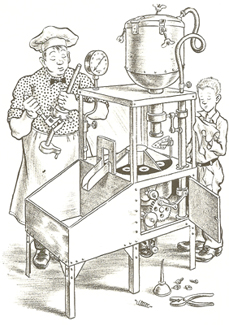
Marcus showed a photo of the doughnut-making machine from Homer Price and remarked how there are only two places to see such a machine now.

“Well, it’s good that someone preserved that model of doughnut-maker,” I thought. “I’m surprised there are so few left—maybe it really didn’t work well, so most of the machines were pulled apart.”

But that wasn’t what Marcus was saying. If I understood him correctly, only two examples of that machine were ever made. One was for the Walden Wood film studio when it adapted Homer Price as a short film in 1963. McCloskey was a friend of the studio owner and spent a lot of time there in later life; as a lifelong tinkerer, he might well have helped to build that machine.

The other was a replica built and displayed in the Municipal Building back in Hamilton, amid McCloskey’s architectural decorations. It’s not clear whether that one was made to work or just to look like the picture in the book.

All along I’d thought that was a standard type of doughnut-maker from the 1940s. After all, I’d seen it in action in that movie, operated by a boy who looks just like Homer Price (and couldn’t act for beans).

But it sounds like McCloskey made it up, based on real, less compact doughnut-making machinery. I feel like Freddy and Louis discovering that the Super Duper can’t lift his car out of the ditch.

06 September 2014

Jesse Lonergan, Kids, and the Human Condition

From the Comics Alternative interview with Jesse Lonergan, author-illustrator most recently of All Star:
When I first got into [making] comics, the only ones that I was really into were comics that were based in some form of reality, and I was pretty disdainful of everything else. I was very much taken with the low-concept idea of narrative. The kind of stories where people would ask what it was about, and the only thing I could say was, “It’s about life!”

As I’ve gotten older that’s changed, and now I find myself more interested in high-concept ideas. I find myself returning to the things I liked in childhood. I, like most kids, wasn’t so concerned with the human condition then.
Ironically, All Star is set in the sort of small Vermont town where Lonergan was a kid. It’s very much about life. But his new projects are about larger-than life rock bands, Formula 1 drivers, and mythical figures from the Old West.

11 May 2014

Not-So-Secret Origin

Before DC published Secret Origins, #1, with the origin stories of Dick Grayson as Robin as well as Superman and Supergirl, scripter Kyle Higgins said in an interview that his final issue of Nightwing actually “says everything I have to say about the character.”

Unfortunately, he was right. The twelve-page story in Secret Origins goes over old ground. The art, penciled by Doug Mahnke, is pretty, just as in the recent Batman and Robin Annual. The story confirms some things already established in DC’s “New 52” continuity, such as Dick already being in his mid-teens when he meets Bruce Wayne. The title “The Long Year” provides another temporal fact for readers who care deeply about such things.

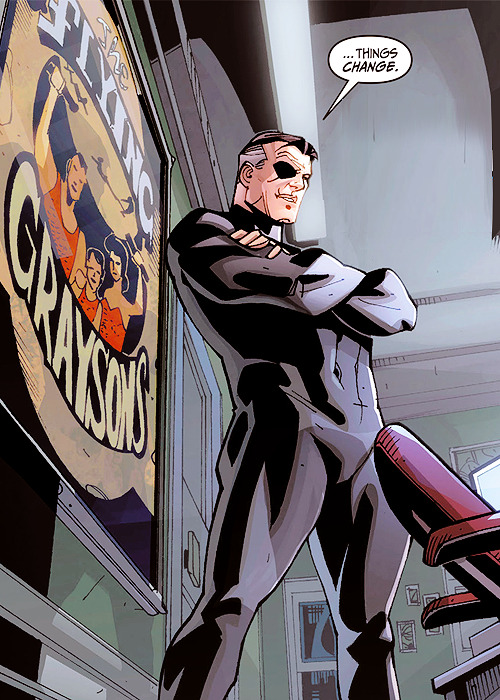
But the problem is that the first Robin’s origin just isn’t secret anymore. In fact, it’s so well known among superhero fans that storytellers can evoke it with just partial images, such as a Flying Graysons poster or the broken trapeze rope swinging into the frame in the TV cartoon episode “Robin’s Reckoning.”

While the stories of how Jason Todd and Tim Drake became Robin have been significantly reworked, Dick Grayson’s has remained basically the same since 1940. The only changes have been at the margins: whether the authorities sent Dick to an orphanage instead of apparently straight to Wayne Manor, whether Tony Zucco or his family are still around.

The radical changes have been Frank Miller’s story of Bruce kidnapping Dick over several long issues of alternative-continuity All-Star Batman and Robin and Scott Snyder’s decision to make the Haly Circus a training ground for athletic assassins—which plays no role in Higgins’s new story.

So Higgins’s origin story has almost no place original to go. We see the robin bracelet he already established in Robin, #0. We see Tony Zucco threatening the circus. We see the death of Dick’s parents as Bruce Wayne watches, and an orphanage. Dick tries hunting his parents’ killer and has to be rescued by Batman, but we’ve seen that before, too.

Higgins said the one idea he had left to explore was the origin of the Robin name, mostly because DC’s new editors had nixed the idea of inspiration from Robin Hood movies. (Apparently Kevin Costner’s and Russell Crowe’s versions don’t have the cultural resonance of Errol Flynn’s.) So we have a page of Dick thinking about what his crime-fighting identity should be and seeing a robin fly by—the same scene we saw with Bruce Wayne and a bat back in 1939.

The last panel on that page drives home the symbolism with Bruce speaking of the robin as a symbol of “growing up,” which is what Robin/Dick Grayson has meant in the DC mythos since the following year. But we already knew that.

25 February 2014

Off to Australia

Elizabeth Gilbert, author of Eat, Pray, Love, provided the Sydney Morning Herald with a list of “Books that changed me.” The first on the list:
The Wizard of Oz series - L. Frank Baum

This is my origin story. I grew up with well-worn copies of these books - books that had been handed down through my family for several generations, complete with the stunning art deco illustrations. The Oz stories were tales of a farm girl (which I was) who went on otherworldly adventures (which I wanted to do) and who was incredibly brave (which I still want to be). I always credit these books with making me into a traveller and a writer. If you have an especially dreamy little girl in your house, forget about Disney videos - get her a box set of these babies.
Dorothy herself visits Australia in the series’s second book, Ozma of Oz. Of course, first she gets castaway at sea, bests the Wheelers and the Nome King, befriends Ozma, and visits Oz for the second time.

Two years ago, Gilbert similarly praised the series in the New York Times Book Review.

(Hat tip to Blair Frodelius’s Daily Ozmapolitan.)

10 February 2014

The Farflung Farfans

Armando Farfan, Jr., nicknamed “Tato” when he was the focus of Jill Krementz’s A Very Young Circus Flyer in the 1970s, still works in show business. But he spends more time behind the scenes now.

As the Las Vegas Review-Journal reported in 2011:
Farfan currently works as a rigger for one of the Cirque du Soleil shows…and said his schedule allows him the time to work on his sculptures and art.

Farfan said he also has designed aerial arts for venues around the world, including projects for MGM, Mandalay Bay, Treasure Island, Bellagio and Studio 54.
He also designed wings for the models in a Victoria’s Secret show.

Farfan still occasionally performs, as in the Broadway Bares XX benefit. As recently as 2008 other members of the family were performing as the Flying Farfans in Germany.

As I recall, the book said Tato’s older brother Gino wanted to be the first flyer to land a quadruple somersault; he instead holds the record for youngest ever (fourteen) to catch a triple, and worked his way to a three-and-a-half before another teenager managed the quad. As of 2011 Gino was teaching at the Circus Warehouse in Long Island City, New York. The tradition carries on.

09 February 2014

A Real Young Circus Flyer

In 1979 the photographer Jill Krementz published A Very Young Circus Flyer, about a nine-year-old trapeze artist working with the Ringling Bros. Circus. This was an unusual volume in her Very Young series because it focused on a boy rather than a girl. But there weren’t a lot of headlining circus flyers to choose from.

Tato Farfan was a sixth-generation circus acrobat. With his father, mother, and older brother, he made up that period’s Flying Farfans. The book showed their life traveling by train with America’s biggest circus, practicing their routine, and putting on the show. It also showed other backstage details of the circus.

I liked this book a lot when I was younger. It also told me that, contrary to some tellings of the Batman mythos and somewhat to my dismay, Dick Grayson’s Robin costume has nothing to do with the circus. In fact, it would be dangerous to dress that way while flying on a trapeze.

Tato Farfan wore tights so his father could grab his ankles; bare legs could hurt, and boots with a flare at the ankles would have gotten in the way. Tato taped his wrists since circus flyers grip each other’s wrists rather than cling hand-to-hand; flaring gauntlets would have been dangerous.

And as for a cape, the Flying Farfans wore sequined floor-length capes for their entrances and exits on the floor, but certainly not while on the trapeze. Up there, a big sheet flapping around would just get in the way. (Of course, Tato still liked swirling his cape backstage.)

To be fair, even back in Detective Comics, #38, Jerry Robinson drew young Dick in a traditional aerialist costume while he was with the circus, looking much like Tato. So have most artists since, though some have also showed an older Robin performing trapeze tricks in his costume, cape and all.

Jerry Robinson’s inspiration for the Robin costume wasn’t the circus but, as he always said, N. C. Wyeth’s paintings of Robin Hood in late medieval style. The boots, gloves, cape, jerkin, and mail trunks have their roots in that art, not in the circus.

TOMORROW: Where is Tato Farfan now?

18 January 2014

Free to Be…You and Me in Retrospect

The H-Childhood list just published a review of When We Were Free to Be: Looking Back at a Children’s Classic and the Difference It Made, a scholarly anthology looking back on Free to Be…You and Me edited by Lori Rotskoff and Laura L. Lovett:
In their introduction to the collection, Rotskoff and Lovett note that “the landscape of childhood (now) harkens back to the sharply divided sex roles of the Leave It to Beaver era,” a shift that left them asking: “What happened to the ideals that inspired Free to Be ... You and Me?” (p. 2). It is this broad and deeply important question that motivates the book, a nostalgic look back that is firmly rooted in a thoughtful social and political analysis. They treat the original text “as an artifact that registered concerns unique to the moment that produced it, and as a cultural landmark that still generates new meanings today” (p. 3). Overall, the collection attends not only to questions of gender, which are of course central, but also to their intersections with questions of race, ethnicity, and to some extent sexuality. . . .

One of the many strengths of this collection comes from the great variety of vantage points from which the contributors reflect on and analyze this cultural phenomenon and its impact forty years later. Rotskoff and Lovett are historians, and the collection includes pieces by other academics: specialists in history, sociology, psychology, politics, gender studies, and cultural studies. Some contributors are celebrity artists and activists, like Free to Be’s creator Marlo Thomas herself, as well as Alan Alda and Gloria Steinem. They are joined by composers, producers, television and film writers, and performing artists of many stripes. Some contributors are leading journalists and bloggers who write about gender issues, family, media, and politics. . . .

Right from the outset, in their introduction, the editors explicitly welcome readers drawn to the title by their own personal memories of Free to Be, and the book is written and edited in a manner that will indeed welcome those readers. But there is also thoughtful, nuanced work of scholarship here. The essays engage Free to Be from a diverse array of perspectives, situate it in a clear and compelling historical context, and bring to bear satisfying cultural analysis and cultural criticism.
Free to Be…You and Me wasn’t one of my favorite books by any means, but it was certainly a touchstone of my childhood. I recall school chorus presentations based on it. In college I became friends with a girl who appeared in the accompanying movie.

In fact, growing up in a progressive family and suburb, it was hard to imagine anyone rejecting its affirmations. Even now I find myself considering issues of gender through the lens that Free to Be provided (which actually feels somewhat limiting when it comes to transgender issues).

25 November 2013

“This gentle, kindly naturalist”

From the New York Times Book Review’s “By the Book” interview with Richard Dawkins:
Did you identify with any fictional characters as a child? Who was your literary hero?

I didn’t know children were expected to have literary heroes, but I certainly had one, and I even identified with him at one time: Doctor Dolittle, whom I now half identify with the Charles Darwin of Beagle days. This gentle, kindly naturalist, who could talk to nonhuman animals and commanded godlike powers through their devotion to him, is nowadays unfashionable — and even banned from libraries — because of suspected racism. Well, what do you expect? Hugh Lofting was writing in the 1920s, and the ubiquitous racism of England at that time can be seen in so much fiction, including Agatha Christie, Sapper (“Bulldog Drummond”) and many other popular writers for all ages. This is not to excuse it, but Lofting’s racism was paternalistic rather than malign and, in my opinion, sufficiently outweighed by the admirable anti-speciesism of all his books.
Dawkins grew up to be an evolutionary biologist, ethologist, and proponent of secular rationalism.

07 October 2013

Al Jaffee Archive Folded into Columbia Library Collection

When I was a boy, my favorite in MAD’s “usual bunch of idiots” was Al Jaffee. I especially liked his Snappy Answers to Stupid Questions series. I can’t really say why I bought those paperbacks more than those from any other cartoonist in the magazine, but I did. Jaffee was also known, of course, for the magazine’s last-page fold-ins.

In July, the Rare Book and Manuscript Library at Columbia University announced that it had acquired Jaffee’s archives. Its press release stated:
Jaffee was in the first graduating class of the LaGuardia-founded High School of Music & Art, where he met his long-time colleagues Will Elder, Harvey Kurtzman, and Al Feldstein. Jaffee began his cartooning career working for Stan Lee on comic books such as Patsy Walker and Ziggy Pig and Silly Seal, and his Tall Tales comic strip appeared in the New York Herald Tribune for six years.
Plus MAD, which Jaffee has contributed to for nearly sixty years.

The New York Times just reported on the impending arrival of the first batch of material, and also provided more facts on the gift. Most notably, the librarian who approached Jaffee at last year’s New York Comic-Con, Karen Green, started as a specialist in ancient and medieval history. But she also “led a secret life as a cartoon and comic book fan.”

Green is now the library’s graphic novels specialist. And the Rare Book and Manuscript Department also houses material from former Columbia student Jerry Robinson (I think he dropped out after finding work on Batman) and X-Men scripter Chris Claremont.

16 September 2013

Tim Drake’s “happy personal life”?

As part of a sometimes heated internet discussion on DC Comics’s decision not to approve a storyline about Batwoman getting married, Gavin Jasper quoted the company’s co-publisher this way:
As it turns out, this is what Dan Didio had to say at Baltimore Comic-Con the other day. “Heroes shouldn’t have happy personal lives. They are committed to being that person and committed to defending others at the sacrifice of their own personal interests. That’s very important and something we reinforced. People in the Bat family, their personal lives basically suck. . . . It’s wonderful that they try to establish personal lives, but it’s equally important that they set them aside. That is our mandate, that is our edict and that is our stand.”
In response, Jasper wrote that “Tim Drake was able to make ‘having a family’ work for fifteen years.” And I suspect that Jasper became a fan during that period, perhaps while he was twelve. Not that there’s anything wrong with that, but we do tend to like the superhero stories we grew up with.

J. Caleb Mozzocco picked up on the same point:
…it is interesting to look back to the character’s creation and realize that various editors and writers decided not to make him an orphan right off the bat (sorry; that really was unintentional), but used the ways his life and background varied from Bruce Wayne’s (and Robins I and II) not only to differentiate the character from those others, but as a source of drama (Trying to be a 15-year-old crime-fighting vigilante while keeping it secret from your dad and step-mom, for example).
To be exact, writer Chuck Dixon has said that he argued long and hard against the company’s initial plan and kept Tim’s father alive through the 1990s. He took as his model the Amazing Spider-Man of the 1960s, with Peter Parker as a teenager hiding his arachnid activities from Aunt May.

Dixon’s approach worked and, as Jasper and Mozzocco note, made Tim Drake different from the other characters around him. But it’s also important to note that Tim didn’t have a happy personal life as a result. He had a reasonably happy family that caused him no end of low-level trouble—especially from his clueless, distant, yet often overbearing dad. Tim also had girl trouble, friend trouble, school trouble, and so on.
That provided the right level of drama for the stories Dixon wrote about Tim because it matched the audience, or at least the sensibility, those stories were aimed at. They symbolically explored American adolescence, with Tim feeling capable of acting like an adult and yet held back by his father—just as many teens feel. After years of stasis in that situation, DC moved Tim to a higher level of independence, which involved killing his father and breaking ties with his stepmother.

Batwoman offers a different story. Its hero, Kate Kane, was drummed out of the US military for being gay and took up costumed vigilanteism as a way to make use of her skills. The book is suffused with an apocalyptic Gothic vibe, playing to its artists’ strengths. That means the stakes of its stories have to be higher than Tim’s 1990s worries about his high-school friends.

What would happen if Kate Kane and Maggie Sawyer got married? There would be a big wedding issue. And then there would be trouble. As DiDio said (and Leo Tolstoy hinted before him), there’s not a lot of drama in a happy household. Most likely, Maggie would be put in danger and/or killed so Kate would have a big reason to react—and of course the internet would have a big reason to react, too. That’s the way modern superhero stories work.

TOMORROW: And who bears responsibility for that approach?

10 September 2013

Ojo’s “Ruffled Waist”?

This is the cover of The Patchwork Girl of Oz as redesigned and redrawn by Dick Martin, based on John R. Neill’s art for the first edition’s dust jacket. (See David Maxine’s masterful dissection of this edition at the Hungry Tiger Press.) This is the cover art of the edition I read as a boy.

In chapter two, L. Frank Baum described the young Munchkin hero Ojo’s appearance this way:
He wore blue silk stockings, blue knee pants with gold buckles, a blue ruffled waist and a jacket of bright blue braided with gold. . . .
I don’t recall being held up by the phrase “blue ruffled waist,” though if I’d thought about it, it wouldn’t have made any sense to me. I could see in the illustrations that Ojo wore an elaborate ruff around his neck, not his waist. In fact, how could anyone wear a “waist” since that’s part of the body?

TOMORROW: What a waist was.

05 September 2013

A Reading Incentive

Thriller author Chelsea Cain’s memory of summers in the children’s mystery section of her local library in Key West:
On weekends, when the grown-ups were around, we went to the beach or out on the water. I found a lot of 20-dollar bills floating in the ocean in those days. I used to take the limp wet cash to the T-shirt shop on Duval Street, and they’d press it dry with their decal iron until it looked brand new.

Twenties make excellent bookmarks. On Monday I’d be back at the library, another five books in my arms. I would read for hours, marking my favorite scenes with crisp 20s, before returning the books to the shelves.

Funny, what we don’t question in childhood. It was many years later that I realized that my windfall of floating cash had not been lost by careless swimmers, but instead dumped by smugglers about to be boarded by the Coast Guard. By then it was too late. I had already filled the library’s collection of Nancy Drew books with drug money.
That appeared in the New York Times Book Review in the spring.