Showing posts with label classy classics. Show all posts

09 September 2014

Graphic Design in Oz

This week brought news of a couple of new editions of The Wizard of Oz that concentrate on visual detail.

As the Deseret News reported, Gibbs Smith’s BabyLit line is publishing a board-book abridgment of L. Frank Baum’s story that uses its emphasis on color:
“The Wonderful Wizard of Oz: A Colors Primer” reflects the colorful, busy world of Oz. Each page is based on one of the story’s key features or characters of that color surrounded by many other objects. For example, the yellow brick road fittingly represents the color yellow while the Tin Man represents the color silver.
There are no ruby slippers in this edition, of course. The text is by Jennifer Adams and the art by Alison Oliver.

Rockport Publishers is issuing an edition of the full novel in its Classics Reimagined series, with new art by Olimpia Zagnoli. (Note her initials.) All Zagnoli’s illustrations are in black, white, green, and gold, combined in minimalist graphics. The Huffington Post featured a number of those graphics. They’re striking but not warm, leaving me to wonder what the target audience for this edition is.

23 January 2014

Historical Fiction from Ancient History?

At the Oxford University Press blog, Yale professor Colleen Manassa suggests that ancient Egypt’s New Kingdom (1550-1070 BCE) saw the birth of historical fiction:
During the New Kingdom, particularly the Nineteenth and Twentieth Dynasties, the “Ramesside Period,” another literary efflorescence occurred. Among the genres of this new corpus of literary productions are stories that can be most properly described as works of “historical fiction.” Set in the past with attested historical characters, these works of historical fiction are an ancient Egyptian counterpart, albeit ultimately unrelated, to the mammoth corpus of modern historical fiction from Sir Walter Scott, Patrick O’Brien, and George McDonald Frasier to Ken Follett and Philippa Gregory. . . .

The second story, known by its modern title The Capture of Joppa, opens with an Egyptian army besieging ancient Joppa, located near modern Jaffa. The beginning of the story is lost, but the preserved portion describes a group of drunken individuals and chariot horses being safely put away lest they be stolen by the Apiru, a group of local brigands. The Egyptian general Djehuty — another attested historical individual — is holding a conference with the enemy rebel of Joppa, apparently in a neutral space outside of the city walls. The enemy ruler of Joppa, who remains unnamed, is obsessed with seeing the staff of pharaoh, and in a moment of slap-stick humor, Djehuty obliges by smiting the ruler with the staff.

With the ruler of Joppa incapacitated, but not dead, Djehuty puts into motion one of the first attested ruses in ancient military history: he pretends to surrender to the city of Joppa, presenting hundreds of baskets as the “tribute” of his capitulation. Unknown to the citizens of Joppa, Egyptian soldiers are hidden within the baskets, and they promptly capture the city in what can only be described as a Trojan-horse style story. While the basket stratagem is in the realm of fiction, the setting of the story, Joppa, and its protagonist, Djehuty, are known through archaeological and textual sources — The Capture of Joppa truly is one of the world’s first examples of historical fiction.
One of the hallmarks of historical fiction, I believe, is that both authors and readers understand that it’s fiction. Even something as carefully researched to accord with documented events as Hilary Mantel’s Wolf Hall is nonetheless presented as one author’s imagined recreation of the past, not as how people actually thought and events definitely occurred. How did the Egyptians of the New Kingdom understand these tales about figures and events they knew from their history? Did they consider The Capture of Joppa as an entertaining legend or as history?

Another hallmark of historical fiction for me is the determined effort to depict the past as different from the present. That makes it a different mode of storytelling from realistic contemporary fiction, more akin to fantastika in the challenge of smoothly introducing readers to an unfamiliar setting. Again, does that criterion apply to The Capture of Joppa and Manassa’s other examples of ancient historical fiction? Did Egyptians enjoying the story of Djehuty also hear clues that his world was not like theirs?

14 November 2013

The Wonderful Wizard of You

A tweet alerted me to this service, which offers to create an edition of L. Frank Baum’s Wonderful Wizard of Oz customized for yourself or a person of your choice.

This consists of stuffing your specified names (and, curiously, eye color) into the novel’s public-domain text. I tried it out, and this is part of the resulting preview:
They walked along listening to the singing of the brightly colored birds and looking at the lovely flowers which now became so thick that the ground was carpeted with them. There were big yellow and white and blue and purple blossoms, besides great clusters of scarlet poppies, which were so brilliant in color they almost dazzled John's brown eyes.

"Aren't they beautiful?" the girl asked, as she breathed in the spicy scent of the bright flowers.

"I suppose so," answered Buckingham Scarecrow. "When I have brains, I shall probably like them better."

"If I only had a heart, I should love them," added Pablo the Tin Woodman.

"I always did like flowers," said Harold the Cowardly Lion. "They seem so helpless and frail. But there are none in the forest so bright as these."

They now came upon more and more of the big scarlet poppies, and fewer and fewer of the other flowers; and soon they found themselves in the midst of a great meadow of poppies. Now it is well known that when there are many of these flowers together their odor is so powerful that anyone who breathes it falls asleep, and if the sleeper is not carried away from the scent of the flowers, he sleeps on and on forever. But John did not know this, nor could she get away from the bright red flowers that were everywhere about; so presently her eyes grew heavy and she felt she must sit down to rest and to sleep.
I think we might agree that there’s still one bug in the system.

The same site offers to treat various other classic (i.e., public-domain) texts in the same way. That means, I presume, you can stand in for Hercule Poirot in Agatha Christie’s first mystery novel, insert your name in Jane Austen’s roundelays, or head off to Treasure Island with Long John Silver—or rather Long Jason Silver if you prefer.

COMING UP: But wait! There’s more!

05 February 2013

Parsing the Class Status of Toto and Duke

Dorothy and Toto made a curious cameo appearance in The New Yorker dated 4 February. In a review of books about Richard Nixon, Thomas Mallon judges Kevin Mattson to be looking too hard for reasons to criticize that President in a study of the Checkers speech titled Just Plain Dick. Specifically:

When it comes to Checkers himself, Mattson makes a pronouncement as startling as its grammar is shaky:
By 1952, owning a dog constituted a democratic rite of passage, no longer the exclusive possession of America’s wealthy aristocrats, who were known to prance around with their purebreds in places like the Upper East Side of Manhattan.
Who knew that, decades earlier, Penrod and Dorothy Gale had been putting on such airs when they took Duke and Toto out for a walk down the small-town lanes of Indiana and Kansas?
In fact, there is a whiff of aristocracy in naming a dog Toto, as I documented back here—but by 1900 that name was verging on cliché.

Similarly, the name Duke obviously has aristocratic roots, but there’s nothing fancy about Penrod Schofield and even less about Duke:
The dog’s name was undescriptive of his person, which was obviously the result of a singular series of mesalliances. He wore a grizzled moustache and indefinite whiskers; he was small and shabby, and looked like an old postman.
Now that is some fine canine characterization.

14 February 2011

Cybils Award Winners for 2010 (with a few comments)

The 2010 Cybils Award list was announced this morning. I wasn’t involved in the judging, unlike past years, because of a big writing deadline. But I’m pleased to see the judges liked some of the books that struck me over the past few months, whether or not I got around to writing about them. And I’m delighted to have the whole lists of winners and nominees to consider in the months and years ahead.

And the winners are…

Fiction Picture Books
Interrupting Chicken, by David Ezra Stein

Nonfiction Picture Books
The Extraordinary Life of Mark Twain (According to Susy), by Barbara Kerley

Easy Readers
We Are in a Book!, by Mo Willems

Short Chapter Books
Zapato Power: Freddie Ramos Takes Off, by Jacqueline Jules; illustrated by Miguel Benitez

Poetry
Mirror Mirror Mirror Mirror: A Book of Reversible Verse, by Marilyn Singer, illustrated by Josée Masse
Nifty. Singer uses our familiarity with classic fairy tales to sum up some of those stories in “reversos,” free-verse poems that read the same whether from first line to last, or last line to first. As a bonus, the reversos usually provide a new perspective on the tales: from a different character, or a different point in time. Masse’s illustrations expand on the themes of mirroring and symmetry.

Graphic Novels
Meanwhile Meanwhile: Pick Any Path. 3856 Story Possibilities, by Jason Shiga
I wrote about Shiga as a “math cartoonist” back here, and about the possibilities of branching paths in traditional comics here. Meanwhile has gotten most of its attention for its algorithmic structure. However, the crazy scientific devices that the hero encounters also leave readers with interesting logical questions. For example, if you have a machine that wipes everything out of existence, can you ever experience having pushed that button?

Fantasy & Science Fiction
The Shadows: The Books of Elsewhere, Vol. 1, by Jacqueline West

Middle Grade Fiction
Yoda The Strange Case of Origami Yoda, by Tom Angleberger
I admire any author who can find fun in middle school. Another interesting aspect of this novel is the notion, raised by some readers, that one crucial character has Asperger’s syndrome. The past decade has brought a number of fine books touching on that condition, some with “Aspie” protagonists figuring out the world and others with protagonists living with “Aspie” relatives. Here the character, if indeed he qualifies, is simply one of many quirky kids in the quirky middle-school culture.

Young Adult Non-fiction
The Secret of the Yellow Death: A True Story of Medical Sleuthing, by Suzanne Jurmain

Young Adult Graphic Novels
Yummy Yummy; The Last Days of a Southside Shorty, by G. Neri, illustrated by Randy DuBurke
My still-somewhat-in-shock review here, and remarks on how Randy DuBurke worked with his collaborators here.

Young Adult Fantasy & Science Fiction

Rot & Ruin, by Jonathan Maberry

Young Adult Fiction
Split, by Swati Avasthi

31 March 2010

Derivative Works—Revisited

Back in December, I wrote about our artistic culture’s valuing of originality:

our literary and artistic culture has, probably since the Romantic period in literature and for over a century in the visual arts, valued originality more than highly competent reworkings. If we look back on the art and literature of previous centuries, we see artists and writers unabashedly exploring the same topics and tales. The competition among artists over the same ground fueled both technique and creativity.
I used the example of the Trojan War as a subject that storytellers and artists reworked for centuries until the modern age, and asked:
So how are storytellers exploring the Trojan War legend today? Not in “literary fiction”; most novels about it are published as genre fiction.
Just in time for the publication of three books that Eric Mendelsohn reviews in this week’s New Yorker:
  • John Banville’s The Infinities, “a more or less contemporary tale over which the Greek gods Zeus and Hermes rather startlingly preside.”
  • David Malouf’s Ransom, “a riff on the twenty-fourth (and final) book of the Iliad” in the form of a serious novel that happens to be about Priam.
  • Zachary Mason’s The Lost Books of the Odyssey, which seems to be a more typically postmodernist arch manipulation of older texts.
So I guess there’s some literary life in that old war story after all.

15 November 2008

Gaiman on Milne on Grahame

With the twentieth anniversary of The Sandman comics, new novels coming out, an upcoming gig on the last days of Batman, and a movie adaptation of Coraline under way, Neil Gaiman is on a roll. But this 2001 interview with the online magazine January shows he has a keen sense of how popular authors can be forgotten:

1930. Probably the most prominent English essayist was A. A. Milne: the editor of Punch, famed for his comedic essays, and a man with several plays running in the West End concurrently. A man who had bestselling books with titles like The Daily Round and hilarious collections of essays and sketches. One of the funniest writers of his generation and an accomplished playwright.

I did an Amazon search several months ago just out of interest to see just what of his was actually in print. And it listed 700 books: all of which, as I went down page after page, were variant editions of the two Winnie the Pooh books and the two books of comic verse for children that he wrote. And that's all that we have left of A. A. Milne, and he's in better shape than most of his contemporaries whose names we do not remember at all. . . .

There's one other thing we remember [Milne] for. His attempt to revive something forgotten which, again, worked brilliantly. To the point now where we didn't even know that it ever was forgotten. He wrote Toad of Toad Hall as a stage play, because he loved--and was furious that it had been forgotten--The Wind in the Willows.

And Kenneth Grahame's book came out [in 1908] and was a huge dud. Kenneth Grahame's other two books--Dream Days [1898] and The Golden Age [1895]--now completely forgotten. Portraits of sort of being a child in early Edwardian, Victorian days--were seized on and loved by the Edwardians as these beautiful, sentimental portraits of childhood. These were Grahame's bestselling books.

And The Wind in the Willows was a dud: it was completely forgotten to the point where A.A. Milne wound up writing an essay in the 1920s saying: Let me tell you about one of the best books in the world, and you have never heard of it. It was called The Wind in the Willows, and [Milne] went on and did Toad of Toad Hall, the theatrical adaptation, which then revived the book to the point where it's now considered one of the great children's classics.
Actually, I own Grahame's Dream Days and The Golden Age, with Maxfield Parrish illustrations. Gaiman is right that the text hasn't survived as well. The same sentimentality plays better with water rats and moles.

11 June 2008

The Bones Give a Book Talk

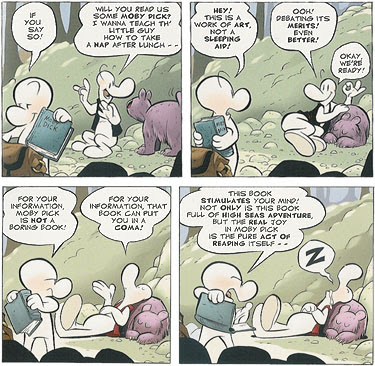
Fone Bone, the central character of Jeff Smith’s Bone comics, and his contented cousin Smiley Bone look for different things in a work of literature.

“Debating its merits,” indeed.

These panels, as is evident from the color, come from the ongoing reissue of Bone by Scholastic. Specifically, from volume 5, Rock Jaw: Master of Eastern Border. Read them all.