Showing posts with label nature red in tooth and claw. Show all posts

10 July 2020

How a Real Story Became Incident at Hawk’s Hill
In 1873, a young boy went missing from his family’s farm in Manitoba. After more than a week, a man of Native and European ancestry found him hiding in a badger hole. That much we can read in nineteenth-century sources from Winnipeg.

In the early 1900s the nature writer Ernest Thompson Seton picked up that story from some Manitobans. He published a version that went into much more detail about how the little boy had actually shared that hole for days with a mother badger that had recently lost its young. Seton or his informants turned the mysterious event into a morality tale, which he published in at least three books.

This 1960 article from the Manitoba Historical Society’s Manitoba Pageant magazine mentions some other local recountings: by Archbishop Samuel Matheson in 1936, in Country Guide in 1951 by Margaret Arnett MacLeod, by the Manitoba Free Press in 1953. I haven’t seen those versions, so I don’t know what new details they provide and what evidence they were based on.

At some point the American writer Allan W. Eckert (1931-2011) came across Seton’s version of the story. Eckert had made himself a specialist in ecological writing, penning most of the scripts for Mutual of Omaha’s Wild Kingdom. He also found a niche writing on Native Americans, including outdoor dramas about Tecumseh and Blue Jacket. (That pairing of nature and Native Americans probably reflects a bias within our culture.)

Eckert’s nonfiction tended toward the imaginative. One of his early magazine sales was an article for the American Legion magazine in 1962 about the disappearance of the US Navy air training mission Flight 19 off the coast of Florida. Eckert appears to have added details not in the documentary record, and that event later became a keystone of the “Bermuda Triangle” legend.

Likewise, Kirkus said of Eckert’s 1992 biography of Tecumseh, A Sorrow in Our Heart, “in its interpretative zeal it strays from, or at least embellishes, the historical record to the point of being suspect.” Even Kirkus’s good review of That Dark and Bloody River noted Eckert’s method of “'reconstituting' credible dialogue among people in briefly reported events.”

On the other hand, Eckert’s fiction was often based closely on historical fact. His first novel was about the extinction of the great auk. Another was based on an event in the life of Daniel Boone. In the late 1960s Eckert started a series of historical sagas about the “Winning of America.”

Eckert saw the skeleton of a novel in Seton’s tale of the lost boy and the badger. The tale offered a chance to write about both the frontier past and the natural world. And it came with the gloss of nonfiction. When Eckert published his novel Incident at Hawk’s Hill in 1971, he stated up front in a short author’s note, “The story which follows is a slightly fictionalized version of an incident which actually occurred at the time and place noted.” Toward the end of the book, Eckert introduced characters who shared the names of two of Seton’s informants.

Eckert changed some details of the story, starting with calling the little boy not Harry (or Willie) Service but Benjy MacDonald. Seton had written that the event took place near “Bird’s Hill,” and Eckert turned that into “Hawk’s Hill,” named after a hawk the MacDonalds see. (The original Manitoba landmark was named after a settler named Bird, not an actual bird.)

Many other details and the plot of Eckert’s story came directly from Seton’s narrative. From the outset, the little boy shows more affinity for animals than for people. Seton’s villain—a nasty neighbor named Grogan—appears under the name of George Burton. He’s not a “half-breed,” however; in fact, he’s cruel to Natives as well as animals. As in Seton’s story, Benjy wanders away after a prairie chicken and needs to take shelter from a storm. A mother badger has been injured in the villain’s trap and lost her babies, leaving her with unfulfilled maternal instincts.

The real boy was lost for about ten days, but Incident at Hawk’s Hill draws that time out to two months. Eventually, Benjy is rescued by a relative rather than (as with the real boy) a stranger; where Seton wrote that that relative was a cousin, Eckert found more drama in making the rescuer a brother.

When Benjy returns, he initially behaves like a badger, but eventually returns to human behavior, stronger for his experience in the wild. Finally, just as in Seton’s telling, the villain shoots the badger, not realizing it has become a family companion, and the family unites to drive him away. The experience brings the MacDonalds closer, particularly father and son. But the family has also decided, with a visiting archbishop’s help, to keep the full story secret so as not to make Benjy appear stranger than people already think of him.

Eckert didn’t write Incident at Hawk’s Hill for children. The point of view skips around among many characters—adults, children, badger, and omniscient narrator. Though six-year-old Benjy is a central character, for many pages Eckert describes him entirely from the outside, and not in appealing terms—he’s small for his age, developmentally odd. It takes several chapters before readers are privy to Benjy’s thoughts, and then only when he’s the only human in the scene. Much of the book follows the drama of the MacDonald family searching for him or reacting to his return.

The early reviews treated Incident at Hawk’s Hill as an adult novel. Critics focused on Eckert’s reputation as a nature writer, with the New York Times calling the book a “folk fable” written “without recourse to undue anthropomorphism.” Kirkus’s reviewer, who could barely stand the story, concluded, “Were it not for Mr. Eckert’s natural history credentials one might think he had been sniffing too much meadow grass.”

Soon, however, people began to view Incident at Hawk’s Hill as a book for children. It was, after all, about a young boy and an animal making friends. It was on the short side, well under 200 pages. And it had pictures. Little, Brown commissioned scratchboard art from John Schoenherr, who had illustrated Sterling North’s Rascal (1963) and Walt Morey’s Gentle Ben (1965)—two novels about boys and animals written for children. (Schoenherr had an earlier career as a science-fiction illustrator. He would go on to win the Caldecott Medal for Owl Moon.)

The Bulletin of the Center for Children’s Books deemed Incident at Hawk’s Hill “An adult novel that should appeal to many young readers.” And in 1972 the novel was named a Newbery Honor Book. That year the judging committee appears to have been unusually generous, naming five Honor Books, more than in any other year in the 1960s and 1970s. From then on, Eckert’s novel was treated as a children’s book.

Disney adapted Incident at Hawk’s Hill into a 1975 television movie called The Boy Who Talked to Badgers. This treatment made Benjy, played by ten-year-old Christian Juttner, more of a likable hero. It switched some episodes around, but the basics of Seton’s and Eckert’s story remained. One notable addition was Denver Pyle as narrator, revealed at the end to be Benjy grown up.

Almost two decades later, in 1998, Eckert published Return to Hawk’s Hill, starting at the end of the first novel and then going over much the same ground. Benjy, a little older, wanders off again. Even the villain returns, despite having been run off before. But the new story had one major difference. This time, instead of a badger Benjy falls in with a community of mixed Cree and French descent who look after him, and his father learns to apologize for his prejudice against these Métis.

Return to Hawk’s Hill thus restored the helpful role of Métis in the real story of the lost boy in Manitoba. As specified in the nineteenth-century sources, a man of Cree and European ancestry rescued the boy from the badger hole. Seton’s early-1900s version had not only erased that rescuer from the story but made the villain a “half-breed.”

I have no idea whether Eckert had learned of those original sources by the time he wrote Return to Hawk’s Hill and set out to fill a deficit in his earlier novel. He may simply have wanted to create a sequel to one of his most successful books and looked to his interest in indigenous North Americans for inspiration. Either way, he added yet more significance in the mysterious story of a lost boy in the badger hole.

TOMORROW: Further meaning for 21st-century readers.

09 July 2020

How a Lost Boy Met a “Kindly Badger”

Yesterday I quoted two period sources about a Manitoba boy who was missing for over a week on the prairie before being discovered in a badger’s hole.

One of those items was a newspaper article from 1873, days after the boy’s return, the other a longer account from a local journalist about the search and discovery published in 1881. Those sources establish the basic veracity of the story of the missing boy.

Those sources also leave a lot of mystery. They have little to say about what the boy experienced. They say nothing about the badger that dug the hole where the child hid. It’s not even clear that there was a badger present—that hole might have been abandoned.

Decades later, in 1909, the nature writer Ernest Thompson Seton (1860-1946) included a version of the same story in his two-volume Life-Histories of Northern Animals. This account was independent of the sources published in the nineteenth century, which Seton probably never saw.

Instead, in 1909 Seton stated: “This was related to me by George Fraser, a native of Manitoba, and corroborated by his mother, Mrs. Fraser, of Kildonan, and Archbishop Matheson.” In publishing a longer version of the tale in 1913, Seton said skeptics could speak to “Archbishop Matheson, Dr. R. M. Simpson, or Mrs. George A. Frazer of Kildonan.” As I noted yesterday, people heard Archbishop Samuel Matheson retelling the story of the boy in the badger hole (including a detail contradicting the earliest accounts) as late as 1936.

Seton presented his version as based on what the little boy told his family after his return, which neighbors then passed down to him. Some of that information might have been garbled, smoothed, or augmented in transmission over the decades. Seton’s date for the event was off by two years, for instance. He called the boy “Harry” while the 1881 account used the name “Willie,” though I haven’t found confirmation of either. Most important, while the earliest sources were about the search for the boy, Seton wrote in confident detail about how the little boy survived outdoors for more than a week.

The 1909 version from Seton stated:
In 1871, a little seven-year-old boy, named Harry Service, wandering from his father’s house at Bird’s Hill, near Winnipeg, was lost for two weeks. When found, he was living in a den with a Badger. His clothes were torn so that he was nearly naked, and his face was all scratched. He told his parents that he had taken shelter in the hole during a rain-storm, and that the Badger came later and scratched his face. At first they fought, but the child was plucky and would not give up the hole. Later the Badger brought some food and, after another quarrel, allowed the child to eat some of it. In the days that followed the Badger brought him food several times. The beast always entered the den by one of the entrances not used by the child.

When found they were on terms of friendship, and the child cried bitterly when taken from his savage friend. The boy’s story, however, was not clear. He said at one time that he lived on mud. His face, mouth, and tongue were black with mud and much swollen. Nevertheless, his description of the Badger was beyond question. He even said it had five toes on one foot and four on the other.
Four years later, Seton published a longer version of the same story in his book Wild Animals at Home and in Boys’ Life. (In 1932 that version reappeared in Seton’s Famous Animal Stories.) In the book the tale was titled “The Story of the Kindly Badger.” In the magazine it became “The Badger Who Was Brother to a Boy,” though Seton was clear that the badger was acting as a mother.

This longer version left little room for what “was not clear” about the incident. It even explained why the number of toes on the animal’s feet mattered.

“The Story of the Kindly Badger” stated at the outset that Harry Service “was a strange child, very small for his age, and shy without being cowardly.” He followed animals, imitating their noises and behavior. Indeed, following a prairie chicken was how Harry got lost.

Another addition to the established tale was a neighbor Seton named as Grogan and labeled “The Evil One” and “The Human Brute.” A week before Harry wandered off, Grogan had killed a father badger and trapped a mother badger until she “chewed off one of her toes” to escape, but by the time she returned to her burrow her children were dead.

Lost on the prairie, Seton said, young Harry took shelter from a thunder storm in a badger hole. Then that mother badger with the missing toe came back. The two refugees fought over the space. Seton quoted Harry as saying, “I scratched the badger’s face and she scratched mine.” But then they accepted one another.

The badger brought in a prairie chicken, an egg, and other food for her dinner, and Harry was able to take some. Seton explained, “The child could not know, but the parents discovered later that this was a mother badger which had lost her brood and her heart was yearning for something to love.” Harry could only drink from mud, and “Possibly the mother badger wondered why he did not accept her motherly offerings,” which is as explicit as Boys’ Life could get about breast-feeding in 1913.

In this telling, Harry saw Grogan ride by and hid from him, as well as from other men. He developed the habit of running on all fours. Finally Harry’s “Cousin Jack” spotted him and dug him out of the hole, bringing him home by force with the mother badger following for a while.

At home, Harry behaved like a wild animal for a while until his mother’s “magic touch on his brow” calmed him and he began to speak. Then the badger appeared in the doorway. “My Badgie, my Badgie,” Harry cried while hugging her. The boy made a pet of the badger for a while, feeding her, sleeping with her, and playing with her on a dirt pile outdoors.

According to Seton, Harry Service said he hated his father because “he passed me every day and would not look at me.” That might be a remnant of the detail from the very first newspaper account, which reported that the little boy had once seen his father ride by and couldn’t get his attention.

But the real villain of this tale was Grogan, who reentered for the final act. Playing off the stereotypes of his time, Seton labeled Grogan a “hulking half-breed.” In fact, according to the nineteenth-century accounts, a “Half breed,” possibly Peter Fidler, Jr., was the hero who found the little boy and brought him back to his parents. Seton’s telling erased that figure from the story and credited one of the boy’s cousins with rescuing him instead.

As Seton recounted it, Grogan spotted the badger in the Services’ yard, assumed it was a wild pest, and shot it. Harry’s father ordered the man away. It took three weeks for Harry to recover from the loss. This tale concluded:
He grew up to be a fine young man, but he took no pleasure in the killing that was such sport to his neighbors’ sons, and to his dying day he could not look on the skin of a badger without feelings of love, tenderness and regret.
The 1913 version of the story was thus invested with much more meaning than all the earlier accounts. It’s impossible to know how much of that meaning came from what the boy actually told people, how much from the intervening informants, and how much from Seton’s recounting. The published tale certainly fit in with his approach to nature writing, which imbued animals with moral motivations. Seton got into debates with other naturalists about this attitude. He even wrote a book called The Natural History of the Ten Commandments (1907), later retitled The Ten Commandments in the Animal World (1925).

Fitting into that pattern, Seton’s 1913 tale had a moral about the importance of kindness to animals, and animals’ capacity to be kind to little humans in return. The Service boy’s survival was an utter mystery in the nineteenth-century stories, but Seton offered answers. The boy was unusually attuned to animals. The badger, missing her young, was “kindly” and “maternal.” Therefore, they got along fine (after a little scratching). Seton’s telling also provided a clear villain, a man who trapped and killed animals cruelly instead of recognizing their worth, and was non-white besides.

In sum, regardless of how much Seton deliberately fictionalized the mysterious 1873 incident of the boy in the badger hole, he assembled an intellectually and emotionally meaningful narrative, which is what we seek in fiction.

TOMORROW: The fully fictionalized version.

08 July 2020

The Boy in the Badger Hole

In June 1873, a young boy living on a farm in Springfield, Manitoba, outside Winnipeg, went missing. His family and neighbors searched the prairie. After a week, people despaired of finding the boy alive.

On 19 July, however, the Manitoba Free Press reported this news:
FOUND.—The little lost boy of Springfield has turned up alive and well, after a ten days subsistence on swamp water and what few strawberries the grasshoppers left for him. A Half-breed who resides in St. Paul’s, whose name we did not learn, discovered the little fellow at Little Lake, some eight miles from his father’s house. On seeing the man coming the little fellow became alarmed and concealed himself in a badger hole which for some time he had made his dormitory. On the day previous to his recovery, and [sic] boy had seen his father (who had been constantly searching for him since he had been lost) passing near, and ran shouting after him, but failed to attract his attention. We don’t know when we heard anything that surprised and pleased us so much as the above piece of news.
In 1881 a reporter for that newspaper, J. F. Galbraith, published a roundup of stories about life in the province under the pseudonym Jeff. Gee. That book, A Sketch of Both Sides of Manitoba, offered more detail about the case of the lost boy, starting:
There is, I have observed, in all very new countries, or sections of country, a bond of sympathy, that unites each man to his neighbor. So, when, one morning in June, a messenger arrived from Springfield with the announcement that a little four-year-old son of Mr. Wm. Service had strayed away from his home two days before, and all efforts to find him had been fruitless, there swelled through the Winnipeg pulse a great throb of sympathy. . . . Would Winnipeg supply fresh search parties? I should say so. Every man, woman and child wanted to turn out: the entire community would respond en masse, if need be.
Six days of searching didn’t turn up Willie Service, as Galbraith called him. The authorities offered a $200 reward. On the tenth day, however, the boy was found.

Galbraith then wrote more than two pages in the voice of the man who found the boy, whom he called a “French half-breed.” According to this account, the man saw cranes fly from a particular spot and decided that something around there must have disturbed them. He persisted in searching that area (with breaks for tea) even after his son and son-in-law gave up. And then he heard a strange noise.
“I get my gun ready and go on e-easy. Hear queer noise again, eight, ten yards off. I look: see dirt like badger hole. I stop. Then I put out my gun and walk close, slow. I point my gun, and look down. Hole dark; can't see nothing. I bend my head and look down, close. See hand—black, black; four fingers, no thumb. I draw back. I not afraid; but queer noise and black hand without thumb—don’t like it. I look again; hand move, and thumb come out from under. Then I make little noise, and two big eyes look up—wild wild. I see face. I drop gun, put out my hands and say,

“‘Oh, my poor little boy, come out, come out. Your father and mother look all over prairie and can’t find you. Come out and I take you to your mother.’

“He say nothing, but look—big eyes, scared. I ask him again come out, but he not move. Then I kneel down, and say,

“‘My poor little boy, come out, and I take you to your mother, I give you plenty bread, plenty tea, you poor little boy, you must be hungry. Come with me—I feed you, I warm you, I bring you home.’

“I reaching down all the time, and then I catch him by the hand, and say,

“‘Now, my little boy, I got you, I bring you to my wife. Don’t be afraid; I not hurt you.’

“He draw back, but I take him out, and put my arms around him, and hold him up tight, and pat him on the head, and he never say nothing. Then I take him to my wife, and my wife, and my daughter, and my son’s wife, hurry up, and make broth, and give him some in cup. My, but he hungry. Want to drink it all; but my wife say,

“‘No, not too much; I give you more after awhile.’

“Then he go to sleep, and my wife wake him soon and give him more broth. Then he sleep again, and my son go and tell his mother, and his mother come and take him away.”
Galbraith didn’t name the man who found the little boy.

According to a 1960 article in the Manitoba Pageant, transcribed here, that rescuer was Peter Fidler, Jr. (1820-1881). I don’t know the basis of that identification and thus how reliable it is. Fidler’s mother Mary was Cree; his father was not French but English by birth.

The same Manitoba Pageant article showed another way the story changed over time as people sought meaning in it:
When Archbishop [Samuel] Matheson told the story of Billy Service in 1936, he stated that Mrs. Fidler was said to have had a dream in which it was revealed to her that the boy could be found in a badger hole and that she induced her husband to go out and look for him.
In the 1880 account, the man who found the boy said nothing about a dream. He noticed unusual bird behavior, meaning he relied on experience in the world, not supernatural guidance.

TOMORROW: Another version of the same story, based on oral traditions.

04 November 2014

The Return of the Cowardly Lion

On 24 November, the Bonham’s auction house will offer a collection of Hollywood memorabilia that includes Bert Lahr’s Cowardly Lion costume from the 1939 MGM Wizard of Oz.

The auction house says:
For famed MGM costume designer Gilbert Adrian, the only option for creating a realistic lion costume in 1938 was to fashion it out of actual lion hides. He was challenged with locating several that visually matched each other so a few costumes could be made and used interchangeably throughout filming. Adrian soon discovered, however, that every available lion hide had very distinctive colors, hair patterns and scars, so he had no choice but to dress Lahr in a single costume for much of the filming.
An auction house expert told the Los Angeles Daily News states:
“According to various histories of the film, Lahr’s costume was drenched with sweat at the end of every day, and so (it) was removed and placed in drying bins overnight so it could be used again the next (day),” Williamson says.
She added that another lion costume survives which Lahr probably wore for publicity stills, and there was at least one for Lahr’s double or stand-in as well. But only this one matches the details in scenes throughout the movie.

Back in 2006, the Profiles in History company sold that other Cowardly Lion costume for over $800,000. In 2011 the owner of this costume also offered it through Profiles in History with an estimated price of $2 to $3 million. Evidently bids didn’t meet the reserve because it’s available once again, in the movie’s 75th-anniversary year.

16 September 2014

Breakfast in Oz

Perhaps L. Frank Baum’s biggest strength (and occasional weakness) as a writer was in how he exhibited all of his characters’ different outlooks and habits—usually without judgment.

For example, here’s a moment from The Lost Princess of Oz, as Scraps the Patchwork Girl, who doesn’t have to sleep, explains what she’s found in the night, and other characters eat their morning meals:
“The Sawhorse and I made a journey in the dark, while you were all asleep, and we found over there a bigger city than Thi. . . . It isn’t far to the city. We can reach it in two hours after you’ve had your breakfasts.”

Trot went back and, finding the other girls now awake, told them what Scraps had said. So they hurriedly ate some fruit—there were plenty of plums and fijoas in this part of the orchard—and then they mounted the animals and set out upon the journey to the strange city. Hank the Mule had breakfasted on grass and the Lion had stolen away and found a breakfast to his liking; he never told what it was, but Dorothy hoped the little rabbits and the field mice had kept out of his way. She warned Toto not to chase birds and gave the dog some apple, with which he was quite content. The Woozy was as fond of fruit as of any other food, except honey, and the Sawhorse never ate at all.
It all sounds very pleasant, except for those little rabbits and field mice Dorothy is worried about. But nobody says nothing.

21 May 2014

Tik-Tok and a Kalidah Walk into a Bar

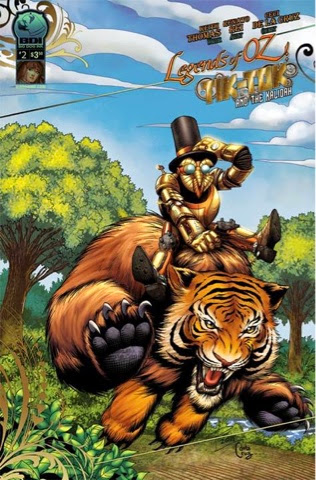
The comics universe of The Legend of Oz: The Wicked Witch and Legends of Oz: The Scarecrow will expand a little this summer as publisher Big Dog Ink releases a comics miniseries subtitled Tik-Tok and the Kalidah this summer.

As created by Tom Hutchinson, this comics continuity “mashes up the Land of Oz with a classic Western,” in the words of Rob Anderson. Anderson pitched the idea of Tik-Tok, the mechanical man, as a bounty hunter in that universe.

Tik-Tok’s partner is a kalidah, a creature L. Frank Baum invented in The Wonderful Wizard of Oz. Kalidahs are crosses between bears and tigers. They’re smart, they’re nasty, they’re carnivorous. They can swim like ducks. Their king knows a bit of magic. In sum, they’re extremely dangerous. And it’s hard to imagine a kalidah partnering up with anyone except another kalidah.

The miniseries is scripted by Anderson and Keith Thomas, with art by Renato Rei and Ceci de la Cruz. It looks like they’ve redesigned Tik-Tok significantly. It’s harder to tweak a kalidah.

27 August 2013

Ruffles and the Invaders

Here’s a magical moment from L. Frank Baum’s Queen Zixi of Ix, first published in St. Nicholas magazine under the title (for reasons that become obvious) “The Magic Cloak”:
Today, as they came slowly down the garden walk, Tallydab noticed a splendid cloak lying upon the path. “How very beautiful!” he exclaimed as he stooped to pick it up. “I have never seen anything like this since the Princess Fluff first rode into Nole beside her brother the king. Isn’t it a lovely cloak, Ruffles?”

The dog gave a subdued yelp and wagged his stubby tail. “How do I look in it, Ruffles?” continued the lord high steward, wrapping the folds of the magic cloak about him. “How do I look in such gorgeous apparel?”

The dog stopped wagging its tail and looked up at its master earnestly. “How do I look?” again said Tallydab. “I declare, I wish you could talk!”

“You look perfectly ridiculous,” replied the dog in a rather harsh voice.

The lord high steward jumped nearly three feet in the air, so startled was he at Ruffles’ reply. Then he bent down, a hand on each knee, and regarded the dog curiously. “I thought at first you had spoken!” said he.

“What caused you to change your mind?” asked Ruffles peevishly. “I did speak, I am speaking. Can’t you believe it?”

The lord high steward drew a deep sigh of conviction. “I believe it!” he made answer. “I have always declared you were a wonderful dog, and now you prove I am right. Why, you are the only dog I ever heard of who could talk.”

“Except in fairy tales,” said Ruffles calmly. “Don’t forget the fairy tales.”

“I don’t forget,” replied Tallydab. “But this isn’t a fairy tale, Ruffles. It’s real life in the kingdom of Noland.”
Noland suffers a couple of invasions in the course of this book, and both times Ruffles proves his loyalty by helping out his master and the regime. The second and more dangerous set of invaders are the Roly-Rogues, shown above. Earlier the encroachment came from Ix:
When the army of Ix had climbed the mountain and was marching down again toward Nole, the lord high steward [of Noland] sent his dog Ruffles to them to make more mischief. Ruffles trotted soberly among the soldiers of Ix, and once in a while he would pause and say in a loud voice, “The army of Noland will conquer you.”

Then all the soldiers would look around to see who had spoken these fearful words, but could see nothing but a little dog, and Ruffles would pretend to be scratching his nose with his left hind foot and would look so innocent that they never for a moment suspected he could speak.

“We are surrounded by invisible foes!” cried the soldiers, and they would have fled even then had not Queen Zixi called them cowards and stubbornly declared they only fancied they had heard the voices speak. Some of them believed her, and some did not, but they decided to remain and fight since they had come so far to do so.
Psychological warfare is so much easier if you have a talking dog.

22 July 2013

The Real Story of Horton the Elephant

When Dr. Seuss was asked about the genesis of his 1940 picture book, Horton Hatches the Egg, he usually told some variation on the story quoted here at Mental Floss:
I was in my New York studio one day, sketching on transparent tracing paper, and I had the window open. The wind simply took a picture of an elephant that I’d drawn and put it on top of another sheet of paper that had a tree on it. All I had to do was to figure out what the elephant was doing in that tree.
Charles D. Cohen’s “visual biography” of Seuss is titled The Seuss, the Whole Seuss, and Nothing But the Seuss in part, I suspect, because it seeks to get to the truth behind such anecdotes.

When it comes to Horton Hatches the Egg, Cohen shows that:
  • Seuss had drawn a whale up a tree for Judge magazine in 1927, a dachshund hatching a stork’s egg for Life in 1929, and a walrus hatching eggs in a tree for Judge in 1931.
  • He had drawn elephants with wings for Life in 1930 and a book called Spelling Bees in 1937.
  • He had drawn an elephant sitting on an egg for Life in 1934.
And in 1938 Judge published a one-page “Dr. Seuss Fable” titled “Matilda, the Elephant with a Mother Complex,” about a childless elephant who sits patiently on a chickadee egg, enduring the scorn of her fellow animals, until it hatches. Matilda didn’t go up a tree to do so, but clearly Horton Hatches the Egg had been gestating in Dr. Seuss’s mind for years rather than being inspired by a fortuitous breeze.

The really significant changes are that all those previous cartoons and stories had been for adult audiences, and almost all presented the odd mammal as misguided rather than heroic. The egg-sitting walrus was part of “The Truly-Dumb Animal Shoppe”; the first winged elephants were the product of delirium tremens; the elephant from 1934 cracked the egg’s shell.

As for Matilda, she managed to hatch the chickadee, but it took one look at her, “cried out in terror,…and flapped off frantically.” The moral of that story is: “Don’t go around hatching other folks’ eggs.” That, of course, is quite a different outcome from Horton’s pride at hatching an elephant-bird.

When Dr. Seuss went back to that idea as a recently-hatched children’s-book author, he was able to embrace the nonsense of the image of an elephant in a nest in a tree and create an ending that adults might know is unreal but which rewards Horton. For young readers, Dr. Seuss took his old elephant who defied convention and made him heroic rather than pathetic.

The Seuss, the Whole Truth, and Nothing But the Seuss analyzes other oft-told aspects of Dr. Seuss’s life as well, such as when and why he adopted pseudonyms and the critical response to The 5,000 Fingers of Dr. T. It’s worth a look.

19 June 2013

Suburb Reverting to Nature?

Early this month, a coyote bit the dog of one of my writing-group friends, Karen Day. This was, the local newspaper reported, one of more than fifty recent coyote sightings in town.

In addition, our suburb’s police killed a black bear that was hanging in a tree over the highway. Wild turkeys are walking the roads—twenty roosted in my side yard a couple of years ago. I routinely see rabbits on the sidewalks.

Indeed, there are so many rabbits in the suburbs close to Boston that Longfellow House–Washington’s Headquarters has invested in a artificial coyote (as shown above) to scare them away from the plantings. It doesn’t seem to be working; the site’s Facebook page featured a photo of a rabbit sitting happily beside the coyote figure. But perhaps the coyote that bit Karen’s dog will make its way there.

I grew up in this area, and the only wild mammals I remember seeing are raccoons, squirrels, and chipmunks. I saw ducks and geese down at the ponds but no turkeys. I was a kid; I would’ve gotten all excited about bunnies, and my parents would certainly have taken note of coyotes and bears.

What’s changed? One possibility is that we’re simply seeing the result of population cycles among those species. Another is that decades of environmental improvements have made this neighborhood more hospitable to turkeys, rabbits, and other wildlife, and the predators have followed. And then there’s the opposite explanation: that more development further out from the city has driven those animals out of their previous homes into ours.

09 June 2013

A More Realistic Robin

Cartoonist Dan Piraro once again explored the nuances of Batman and Robin in today’s Bizarro.

And on his blog, Piraro reveals that he took another stab at the same joke in 2010.

05 May 2013

Don’t You Hate When This Happens?

Dick Grayson has always been good with exotic megafauna or, in other words, circus animals. That was clear in his first visit back to a circus in Batman, #2, when he hitched a ride on an elephant while looking for an escaped giant. More recent comics and cartoons have made much of his relationship with the Haly Circus elephants Elinore and Zitka. So I have to believe this lion is just enthusiastically showing affection.

20 January 2013

Reading the Memo on Damian Wayne

One of the most interesting elements of Batman and Robin: Born to Kill, by Peter J. Tomasi and Patrick Gleason with Mick Gray, is the “story proposal” printed at the end of the book. Of its fourteen paragraphs, all but three are an analysis of the relationship between Bruce and Damian Wayne.

The other paragraphs introduce the story’s villain and his motivation, rooted in his history with Bruce Wayne, but not his powers or working methods. Also missing from the proposal is a storyline with plot points, emotional moments, rising action, and so on. It mentions only one corner of the plot, the climax at the end of what turned out to be issue #7.

Instead, Tomasi’s memo is all about Batman and Robin’s differing symbolism, motives, and approaches to attacking crime. All very important in the superhero genre, but I doubt such a memo would have been enough for DC Comics’s editorial team if it hadn’t come from Tomasi. He was a DC editor himself until a few years ago and a successful utility player since. As the company planned its “New 52” reboot, its honchos probably wanted to keep working with Tomasi. The question was how to make this Batman book different from half a dozen others. His proposal supplied an answer:
Our “A” story, the emotional and psychological backbone of the book[,] will be laser-focused on the relationship between Bruce and Damian.
Eventually the story reaches a common point in superhero comics: the hero appears to face dire consequences unless he compromises his values—in this case, Bruce Wayne’s commitment not to kill. Of course, Damian Wayne has a different approach to that dilemma.

Indeed, Damian is quite the troubled ten-year-old in this volume. He sits at a drawing board sketching gory pictures—a hobby that could lead only to the horror of being a comic-book artist. He crushes small animals. (The story proposal says he kills “a sick bat that’s fallen to the cave floor,” but that’s not how the scene plays out.)

I’ve seen some readers complain that this volume doesn’t show Damian having learned and grown from his training with Dick Grayson. In fact, some of the story’s noteworthy moments echo similar moments from earlier months: Damian insists on going out by himself, the R symbol gets ripped from his chest, another crime-fighter tempts him to change mentor, etc. And at the end, he can’t match his father’s commitment.

But if Damian changes greatly, there would be no story. The difference between the two Waynes isn’t simply the subject of this volume. It’s also the Unresolvable Foundational Conflict of this series. In issue #8 the villain is gone and there’s no trouble for the heroes after page 6—except the trouble they pose for each other. And that’s one of the most compelling chapters of the volume. The relationship really is the “A” story.

Tomasi expresses his theme as “nature versus nurture.” At least as Bruce sees it in issue #2, “I have to find a way to push him past the obscene indoctrination of his early years and hope nurture wins out over nature.” That seems like a misunderstanding of what “nature versus nurture” means, however. The conflict is between the two ways Damian has been nurtured by his two parents. We don’t know how he would have developed normally. We don’t know what his innate qualities are.

Another notable element of Tomasi’s proposal is how he linked his new villain with Grant Morrison’s Batman, Inc. narrative, about a worldwide crime-fighting enterprise led by Bruce Wayne and a worldwide criminal enterprise led by Damian’s mother. The villain had a personal reason to attack Batman, but Tomasi had him resent Batman, Inc. I think Tomasi is still loyal to the pitch he heard from Morrison as an editor years ago. The other main Batman comics seem to be working independently of Morrison’s storyline, but Tomasi is still trying to keep the continuity together.

08 January 2013

Prince Bobo’s Place in Nature

This is the frontispiece from Thomas Huxley’s Evidence as to Man’s Place in Nature (1863). It shows the skeletons of four apes and a human being.

Huxley’s point was that these skeletons had so much in common that they showed a common ancestry. However, it was easy for Englishmen, reading left to right, to view this lineup as the track of evolution itself rather than the present state of five parallel species. (In other words, to come away with the understanding that the human was supposed to have evolved from the gorilla rather than the human and gorilla having a common ancestor in the past.)

For an article in progress, I’m wondering whether I can make the case that that illustration inspired this lineup of characters drawn by John R. Neill in Rinkitink in Oz (1916).

.
These drawings show the series of transformations that Glinda performs to ***SPOILER*** turn Bilbil the Goat back into his rightful form as Prince Bobo of Boboland.

In that scene L. Frank Baum defined the Tottenhot as “a lower form of man,” closest to animals, echoing a racist western belief about the “Hottentots” almost two centuries old by that point. That idea connects to the medieval concept of the Great Chain of Being. But did it also link, perhaps by parody, to the late Victorian understanding of human evolution?

15 December 2011

The Whole Tooth and Nothing But

In last Sunday’s New York Times a frustrated parent (who on second look I find is my college classmate Bruce Feiler) laid into the tooth fairy tradition:
Over the centuries, many cultures developed rituals to mark children’s loss of their deciduous teeth, which usually begins around 5 or 6. In some societies, witches were believed to covet discarded teeth for spells, so proper disposal was paramount. Children have variously tossed their teeth onto the roof (Vietnam, Haiti), buried them with ancestors (New Guinea), fed them to mice (Mexico, Afghanistan) or even burned them.

Americans were the first to popularize the idea of a tooth fairy early in the 20th century, though the custom did not become widespread until the 1950s, according to research by Rosemary Wells, a dental lecturer who lived in Chicago. American parents introduced two wrinkles to the age-old ritual, neither one for the better.

First, in the prosperity-obsessed climate of the 1950s, the tooth fairy began compensating children with cash for the alleged trauma of losing a tooth. Leave it to Americans to debase a perfectly good 3,000-year-old tradition by making it all about money.

Second, and even worse, while nearly all cultures mark the falling out of the first tooth, Americans extended the ritual to cover every tooth, a number that usually reaches 20. These days, losing a tooth is not a quaint right of passage, it’s the Ironman triathlon of parental obligation.
I can’t imagine that inflation has made this ritual any easier for parents. This year’s Visa survey of how much money the tooth fairy leaves per tooth found that the national average is $2.60. (In trying to calculate the median, I discovered that the proffered numbers on how many children receive what amount add up to only 82%, so who knows?)

I don’t think my brother and I ever saw more than small change from the tooth fairy back in the 1970s. Nowadays the idea of putting a dime or quarter in a child’s bed probably seems ridiculous. And what if she swallows it in her sleep and chokes?!

17 October 2011

Terrible Lizards and Giant Squids

I spotted this “Raptor Hoodie” in a catalogue last week.

Originally raptors were daylight birds of prey: hawks, eagles, harriers, falcons, and so on. Paleontologists borrowed the term as a suffix for a set of dinosaurs: Velociraptors, Utahraptors, Pyroraptors… One Jurassic Park phenomenon later, and the dinosaurs have totally stolen the term “raptor” from the birds. Is that any way to treat your evolutionary descendants?

In other paleontological news, I checked in on “Giant prehistoric krakens may have sculpted self-portraits using ichthyosaur bones” at io9.com. A geologist suggested that an unusual formation of ichthyosaur fossils was created by a Triassic giant squid arranging them so their vertebrae formed a picture of itself on the ocean floor. Because giant squid used to be that vain.

Good comments sections are all too rare in today’s internet, but I appreciated artiofab’s remark on that story:
I think I speak for the entire paleontological community when I say: This is not what most of us do with our time, honestly.

03 March 2011

“She Never Slapped Her Hippopotamus”

This is a passage from E. Nesbit’s “Uncle James, or The Purple Stranger,” a story collected in The Book of Dragons. It introduces one of the main characters, a little princess.

She was always kind to her pets. She never slapped her hippopotamus when it broke her dolls in its playful gambols, and she never forgot to feed her rhinoceroses in their little hutch in the backyard. Her elephant was devoted to her, and sometimes Mary Ann made her nurse quite cross by smuggling the dear little thing up to bed with her and letting it go to sleep with its long trunk laid lovingly across her throat…
Alas, a few paragraphs further comes an explanation that erases the visual image this passage alone provides. But it’s delightful while it lasts.

28 February 2011

Making a Splash in Washington

Earlier this month on the New York Times oped page, Colin H. P. Buckley reveals how politics, a children’s picture book, and compassion mixed as he served an internship in the office of the ailing Sen. Ted Kennedy:

The senator, she explained, had recently written a children’s book called “My Senator and Me.” The book depicts a day in his life from [his dog] Splash’s perspective. Someone — I’m not sure who — suggested including an e-mail address where curious young readers could reach the supposedly computer-savvy Splash.

That’s where I came in. Someone had to reply to Splash’s e-mails, in his voice, lest the children think the dog had let the thrill of being a published author and Washington power broker go to his head. . . .

But beyond Splash’s indiscriminate eating habits and love of tennis balls, he was little more than a furry mystery to me. What would he say in response to the hundreds of e-mails that came to him from children across the country? School simply hadn’t prepared me for this.

Most of his messages went something like this:
Dear Splash,

My teacher read us your book. You are so cute! Can you come over and play with my dog? What kind of dog food do you like? My mom says your senator is a great man. I hope he feels better.
After checking with the senator’s assistants on Splash’s preferred dog food brand, and then reading the book myself to better prepare for my role, I answered every single e-mail, ending each reply with the mandatory “WOOF WOOF!! Splash.”
(My Senator and Me is a “celebrity picture book,” a species unloved by children’s-lit critics and bloggers. It came out in 2006, with illustrations by David Small. According to a reader comment at the Fuse, Small was already working on his graphic memoir Stitches, though he didn’t start final artwork till mid-2008. My Senator and Me, and its celebrity-level royalties, probably helped Small carry out the much larger project of developing and completing Stitches, which will probably now have a longer life in print.)

16 February 2011

Supervillains Who Aren’t Really That Scary, #1

After World War 2, Joe Simon and Jack Kirby, creators of Captain America, tried to get back into the superhero comics business with their own magazine, Stuntman Comics. (Discussion of what Stuntman owed to Robin the Boy Wonder here.)

That comic book lasted only a couple of issues before succumbing to market realities. Some of the material the team had prepared went back into Simon’s files, not to be published until last year’s Simon & Kirby Superheroes collection.

Among the unpublished material was a double-page spread that promised “the most insidious, cold-blooded character yet seen in comics pages!!!”

That was…The Panda!

Wielding the superpowers of…eating bamboo and not mating easily!

Kirby’s art suggests that the Panda commanded giant insects. Maybe giant insect robots. The way pandas do.

All considered, it was probably okay for this story never to have been completed and published.

07 February 2011

Brian Jacques and Death

This morning I read of Brian Jacques’s death at age seventy-one. I didn’t grow up with his animal-adventure novels, and they proved to be hit-or-miss for me. I enjoyed his audio production of Redwall, with Jacques himself among the heavily-accented performers, but couldn’t finish his Castaways of the Flying Dutchman.

One lesson has stuck with me, however. Chapter 2 of Redwall introduces the story’s villain, a rat named Cluny. (As in other modern British fantasies, the villain is from the Continent, with a particularly Gallic tinge.) The chapter tells us—Jacques was a great one for telling—that Cluny killed the pike who injured his eye. Cluny killed the ferret whose skull tops his standard. Within a few more chapters, Cluny’s cart rolls over two of his own followers.

Jacques thus sets out the stakes for Redwall. This book about little talking animals isn’t cute. It isn’t afraid to draw blood. The battle for Redwall Abbey will be a battle for life and death.

11 September 2010

Megafauna

The last two shortlisted titles for last year’s Cybils Award for Non-Fiction Picture Books make an interesting pair.

Both Down, Down, Down: A Journey to the Bottom of the Sea, by Steve Jenkins, and Life-Size Zoo, by Teruyuki Komiya, director of the Tokyo Ueno Zoo, with photographs by Toyofumi Fukuda, introduce readers to various animals. But the two books approach their topics in opposite ways, and each one’s strengths are the other’s weaknesses.

Life-Size Zoo was originally published in Japan, which probably accounts for its attention to pooping and peeing. As its title promises, it offers life-size photographs of a variety of mammals found in many zoos. The book is 10.5" x 14.5", which is oversized to begin with. Some pages are designed to be tilted, and double foldouts accommodate the head of a giraffe and most of the heads of an adult elephant and a rhinoceros.

Although each page spread provides background facts about the animal in simple text and drawings, the photos are the main attraction. The detail is amazing, from the hairs on a zebra’s muzzle to the teeth in a tiger’s mouth. One spread shows images of a hedgehog and an armadillo, each rolled up against predators. The animals all stand out from a blank white background in the old Dorling Kindersley style, and they all look life-size, creating the illusion of being even closer than we can get in zoos.

In contrast, Down, Down, Down uses cut-paper illustrations (with some drawing and painting) to introduce readers to various forms of underwater life. Its page spreads are arranged according to depth, with a scale along the right margin to show how far beneath the ocean surface one has traveled.

Which brings me to the two books’ complementary strengths. Life-Size Zoo is all about scale, showing us exactly how large each animal is. In Down, Down, Down creatures that live at the same depth all appear on a spread with no clue about how large they are relative to each other. Only in the back can one figure out the scale. Thus, on one spread the oarfish takes up about the same space as the snipe eel, the nautilus, and the goblin shark. The back pages tell us that the eel and nautilus are comparable in size to an adult human's hand, but the shark is the size of that human, and the oarfish up to 36 feet long.

Down, Down, Down is all about habitat, and the unfamiliar forms of life that have evolved to live at different depths. Life-Size Zoo devotes only a few quick lines to the animals’ habitats. It’s not unlike an antiquated zoo, seeing beasts in concrete cages.

Down, Down, Down highlights creatures we rarely see, and may even have trouble imagining. Life-Size Zoo features very familiar and appealing animals (charismatic megafauna, in zoologists’ terms). We know them well enough that we can fill in their bodies from a look at their giant heads.

Steve Jenkins’s cut-paper pictures represent each species, but he doesn’t put them forward as exact representations. Toyofumi Fukuda’s photographs are precise portraits of individual animals. And the text doesn’t tell us how typical they are. For example, Kometaro the aardvark “lost part of one ear before he got to the zoo.” Is this common? Do aardvarks fight, or was Kemotaro attacked by a predator? There’s no further explanation.

Both books succeed at what they set out to do (as do all the Cybils shortlisted titles). Of this pair, I give an edge to Life-Size Zoo because it does something I hadn’t seen in other picture books. It’s a stunt (which has been duplicated in two sequels), but a very impressive one.