Showing posts with label don't mess with Dorothy Gale. Show all posts

15 August 2023

“Dorothy the Conqueror” Now Online

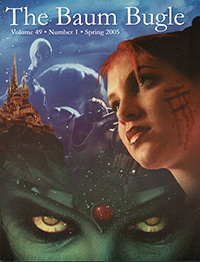
Back in 2005, the International Wizard of Oz Club’s journal, The Baum Bugle, published my article “Dorothy the Conqueror.”

It discussed the character of Dorothy Gale as L. Frank Baum developed her, from a little girl who called herself “small and meek” into a bold adventurer. That boldness had always been part of her character, but after her first trip to Oz she knew it. By the end of Baum’s series, she was happy to set out for unknown parts of Oz because “all excitement is fun.”

The article also points out ways that the MGM movie’s treatment of Dorothy doesn’t reflect that character, especially in her baffling speeches at the end.

The Oz Club has now made the text of “Dorothy the Conqueror” available for anyone to read through this webpage. It even comes with citations in both Chicago and MLA style.

07 August 2018

Heading Out to Oz

“In May I began describing, photographing, and re-housing a discrete collection of posters within the Ludlow-Santo Domingo (LSD) Library collection,” Rachel Parker writes on the blog of the Houghton Library at Harvard. “Tackling the Ludlow-Santo Domingo Library poster collection has been exciting, in part because of the descriptive challenges in title creation.”

Elsewhere the library explains, “The Ludlow-Santo Domingo Library is the world’s largest private collection of material on altered states of mind.” Which is to say, “The 50,000-plus-item collection documents psychoactive drugs and their physical and social effects.”

One suspects the initials LSD don’t just stand for Ludlow–Santo Domingo, even if the collection was produced by “Julio Mario Santo Domingo Jr.’s acquisition and integration of the Fitz Hugh Ludlow Library of San Francisco in 2001.”

The Houghton library blog credits the poster above to “James McMullen” at an unknown time. That artist spells his name James McMullan. Another website credits it to “The Push Pin Graphic, Issue 52 (1966).” (Seymour Chwast authored a 2004 book looking back on The Push Pin Graphic, and some poster-reprinting websites carelessly credit the image to him.)

In other news, I’m heading out to OzCon this week.

08 December 2015

Fierstein Adding “a Little More Sense” to Oz

Last week NBC broadcast a restaging of The Wiz that’s also slated for Broadway next year. It has a new book by Harvey Fierstein, who boasted about his improvements in an interview with BroadwayWorld:
I've loved Wizard of Oz my whole life but have had questions. I was always a questioning kind of kid. I got to answer all the questions that I had. Where did Dorothy's parents go? There's this girl living with her aunt and uncle... well I killed off the uncle; he doesn't do anything anyway. Do we care about him just sitting on the porch rocking away? You have a girl living with her aunt, and it's never mentioned what happened to her parents. Dorothy's such a victim. She didn't create that storm; she gets taken away. She doesn't kill the witch; the house falls on her. She doesn't kill the other witch; she throws water to save her friend. She's just a victim. I said, "Why should she be just a victim? It's her dream! It's her fantasy!"

So I gave her a story, and we open with her running away from home trying to get home to Omaha where she was actually born. Her parents are dead. She hates her school; she hates Kansas. "I hate this place; I hate being out in the cornfield. I want to go home." Her answer is this is your home but your too old for me to tell you what to do. I could keep you here and force you, but at some point in your life you have to figure out where you really belong. She's sent off on this very different journey of going home to Omaha. She ends up in this place that's not Omaha and becomes much more of an active participant in it. In the end, when the Wiz turns out to be from Omaha when they get in the balloon. Instead of missing the balloon, I have her walk away from the balloon an say you're going to your home, I'm headed somewhere else. She finally figures out home is not where your feet are; it's where your heart is.
Clearly Fierstein’s playing off the 1939 MGM adaptation rather than L. Frank Baum’s novel. In the original, Dorothy doesn’t throw water on the Wicked Witch of the West to save the Scarecrow; she does so because she’s ticked off (a situation Fierstein rediscovered). Uncle Henry does more than sit on a rocker.

Fierstein’s characterization of Dorothy makes sense only if she’s a teenager, like nineteen-year-old Shanice Williams. Judy Garland was a teen, of course, but she played a younger girl. The Dorothy of the books is younger still.

In Baum’s books, the Wicked Witch of the East enchants the Tin Woodman because she (or another old woman) doesn’t want to lose the services of his beloved. Fierstein instead put those three characters into a love triangle:
I gave each of those characters a backstory that makes a little more sense. The Tin Man got turned into the Tin Man by the Wicked Witch because she had a thing for him. She caught him with this girl, and she blasted his ass and stole his heart. She said, "If I can't have your heart, no one can."
That “makes a little more sense” for an older audience, perhaps. But children haven’t had trouble understanding Baum’s original motivation for the witch.

Evidently the choice to cast Queen Latifah as the Wiz prompted Fierstein’s thinking about that character:
Queen Latifah's backstory [as the Wiz] is that she was a magician's assistant at a carnival so they gave balloon rides and all of that but you ever meet the person that is not bad enough they're unhappy, they have to make everyone unhappy and that was this guy. She jumps in the balloon to piss him off and this balloon landed me in Oz. Everyone came running so I put on the magic hat and did the magic act. They put me in here and I've been hiding ever since so nobody finds out that I'm not anything. I was the assistant. She is a woman escaping the world of men, which I thought would give a different color to Dorothy as well. It all has to come out of a little girl's imagination. If you don't believe it came out of her imagination it doesn't work.
Because then Oz would just be real, and who wants that?

01 December 2015

Oz Art to Wish for from Linda Medley

This is one of the most potent images from the Oz book mythos: Dorothy is wearing the Magic Belt and making a wish. Something’s gonna happen. Somebody’s going down.

This illustration comes from Linda Medley, the comics artist best known for Castle Waiting and a long-time fan of the Oz books. It’s one of five greeting cards featuring Oz characters that she just offered on Etsy. The others show Scraps, Jack Pumpkinhead, the Wizard, and Glinda.

Medley has also created a print of Ozma, the Wizard, and Dorothy (and Toto, too). Her picture of Dorothy is an enthusiastic little girl, notably younger than Ozma and ready for adventure.

29 September 2015

The Electric “Elements of Oz”

Elements of Oz is a new stage/video show that seems to combine an homage to the MGM movie with Ozma’s Magic Picture. (Which, as we all know, can show you any place or person you ask to see.)

Here’s a taste of the review in today’s New York Times:
At “Elements of Oz,” having its premiere as part of the Peak Performances season at Montclair State University here, viewers are encouraged to use smartphones or tablets during the performance. . . . You download a special app that instructs you to put your phone in airplane mode until the show starts. The app then provides access to various elements that enhance the production, primarily nifty filters that, when you point the phone at the stage, add new layers of imagery to the action. When Dorothy’s house in Kansas flies skyward, for example, you can hold up your phone and see a real corker of a tornado and slashing rain that isn’t apparent to the naked eye.

Directed by Marianne Weems, “Elements of Oz” was jointly created by James Gibbs and Moe Angelos. Ms. Angelos is also one of the three performers, alongside Sean Donovan and Hannah Heller. A loose, loopy and enjoyable seminar on the making of the movie and its influence on pop culture, the production combines live video and performance — several famous scenes from the movie are more or less filmed anew before us — with anecdotes about its production and other random arcana about the film and the book it was based on by L. Frank Baum. . . .

The live re-creations of scenes from the movie are technically marvelous; the digital video (by Austin Switser) is dazzlingly pristine, and it’s fun, at least for a while, to watch the wry comic impersonations of the performances in the movie. . . . But ultimately these sequences don’t provide enough comic stimulation to justify their length. It begins to feel a bit too much like a draggy day on the back lot, and you might find yourself tempted to escape the app and fire up the real movie on your phone…
The performers, who each play multiple roles, all get praise, as does Bert Lahr.

28 August 2014

Indomitable

Last weekend the New York Times Book Review ran an interview with Malala Yousafzai, the Afghan teenager attacked by Taliban gunsels because she continued to attend school. Her answers included this surprise:
Were there particular books that helped you get through the recovery process after the attack on you by the Taliban?

“The Wonderful Wizard of Oz” was the first book I read in the hospital. I had been having headaches and couldn’t read or focus properly for a while. It is a lovely book, and it was given to me by [Prime Minister] Gordon Brown — he sent me 25 books, and this was my favorite.
I like to think that the simplicity of that book’s storytelling, and its indomitable heroine, were what Yousafzai needed at that time.

25 February 2014

Off to Australia

Elizabeth Gilbert, author of Eat, Pray, Love, provided the Sydney Morning Herald with a list of “Books that changed me.” The first on the list:
The Wizard of Oz series - L. Frank Baum

This is my origin story. I grew up with well-worn copies of these books - books that had been handed down through my family for several generations, complete with the stunning art deco illustrations. The Oz stories were tales of a farm girl (which I was) who went on otherworldly adventures (which I wanted to do) and who was incredibly brave (which I still want to be). I always credit these books with making me into a traveller and a writer. If you have an especially dreamy little girl in your house, forget about Disney videos - get her a box set of these babies.
Dorothy herself visits Australia in the series’s second book, Ozma of Oz. Of course, first she gets castaway at sea, bests the Wheelers and the Nome King, befriends Ozma, and visits Oz for the second time.

Two years ago, Gilbert similarly praised the series in the New York Times Book Review.

(Hat tip to Blair Frodelius’s Daily Ozmapolitan.)

31 December 2013

The Two Dorothys

From the Charlotte Observer’s web coverage of an Oz exhibit at the local UNC library:
In the novels, Dorothy is a heroine, an adventurer who strikes out on her own and often saves the male characters in the story. But in the movie, she’s the damsel in distress, who needs men to lead her to safety.

“In the book, Dorothy kicks butt. She takes action. She’s on a quest. She is the person in charge,” said [English professor Mark] West. “In the movie, Dorothy says, ‘If I ever seek my heart’s desire again, I shall look no further than my own backyard.’ She is basically like a dog with her tail between her legs.”
To be fair, in the movie Dorothy wets the Wicked Witch of the West while she’s saving the Scarecrow from fire. But in the book she deliberately throws water on the old lady because she’s angry.

I blame MGM and Louis B. Mayer’s rah-rah ideology for the changes.

(Hat tip to Blair Frodelius’s Daily Ozmapolitan.)

28 November 2013

Let Us Be Thankful That This Isn’t Rerun Every Year

In 1980 the Muller Rosen animation company released a half-hour holiday special for television titled Thanksgiving in the Land of Oz. That show was then recut to remove the Thanksgiving references and released on video as Dorothy in the Land of Oz; as of this holiday, it can be watched in two parts on YouTube. In 1982 Romeo Muller adapted his screenplay into a short illustrated book titled Dorothy and the Green Gobbler of Oz.

Like most Oz videos in the television age, this cartoon was written to invoke MGM’s Wizard of Oz. Dorothy meets the Wizard in Kansas again, the Cowardly Lion is bipedal, there are songs, and so on. But the filmmakers also obviously knew the Oz books and used them as inspiration for characters, settings, and plots points, albeit without being faithful to those books.

Thus, for example, just as in L. Frank Baum’s original novel and the MGM movie, Dorothy and Toto accidentally travel to Oz and meet three male companions who help her on a quest to vanquish a villain. One of those companions is an animated refugee from a farm, another made of metal, and the third a big carnivore with gentle habits. But in this movie those characters are Jack Pumpkinhead, Tic Toc [sic], and the Hungry Tiger, whom Baum introduced in different ways in his second and third Oz books.

Jack lives in a pumpkin house, as John R. Neill drew it in The Road to Oz. Other Oz houses resembles those he and W. W. Denslow designed, and a sequence of children opening Christmas presents owes a lot to Denslow’s art, rendered with less character. However, a trip over a rainbow at the end is clearly inspired by the MGM movie’s most famous song.

The end of the cartoon shows Ozma as rightful ruler of the Emerald City, but there’s no explanation of how she came to the throne. This Ozma seems much older than Dorothy and more like the Glinda of the movie.

Another element that the filmmakers borrowed from Baum’s books appears at the start: Uncle Henry and Aunt Em are about to lose their farm to the bank. The couple plans to go into an “old folks’ home” while Dorothy will have to live somewhere far away with a cousin—perhaps Zeb Hugson from Dorothy and the Wizard in Oz. This is a better fate than what Baum wrote about in The Emerald City of Oz, which suggested Dorothy would have to go to work while her aged relatives might end up begging. Still, it was probably a shock to many viewers.

The big-name star of the production is Sid Caesar, who plays the Wizard and narrates the story in that role. Caesar also plays a mince pie that’s brought to life, takes the name U.N. Krust, and delivers every line in a different foreign accent. The pie and its speech patterns play no role in the plot; they seem to have been included just to put Caesar’s shtick to use. We haven’t seen so much ethnic humor in an Oz adaptation since the 1903 Broadway show.

Another notable casting detail: Joan Gerber supplied the voices for both Ozma and Tic Toc.

The cartoon includes a couple of forgettable songs. Dorothy uses one to convert the villain back into a benevolent toymaker, and at the same time deliver a paean to Christmas shopping. In that respect, this modestly produced special was a perfect start to commercial television’s holiday season.
22 October 2013

Remember When Oz Was on TV Only Once a Year?

Deadline has passed on the news of another television series based in some small way on the Oz mythos:
Lifetime has put in development Red Brick Road, from the Wolper Organization, Vertigo Entertainment and Warner Horizon. Written by Tim Schlattman (Dexter) based on an concept by artist Rob Prior and executive produced by Roy Lee and Adrian Askarieh, Red Brick Road is described as an edgy, Game Of Thrones take on the world of Wizard Of Oz.

In the classic 1939 feature, when Dorothy set off for the Emerald City, she followed the Yellow Brick Road. But among the yellow bricks at Dorothy’s feet, there was also a swirl of red bricks. They’ve been there the whole time in plain sight. Unnoticed. Unexplored. Which raises the question — just where do they go? Red Brick Road will answer that by following Dorothy down that fateful path, taking her to the oldest, darkest and most dangerous parts of Oz to find what became of her friends who all have gone missing.
Actually, the red bricks were just the negative space around the yellow bricks, but they’ve been intriguing fans of the movie since the video era began.

As Deadline notes, TV networks have bought four other Oz-themed projects recently, including:
  • “NBC’s drama Emerald City, a dark reimagining of the classic tale of Oz in the vein of Game Of Thrones”—there’s that comparison again.
  • “CBS’ Dorothy, a medical soap” noted back here.
  • “the CW’s Dorothy Must Die, a revisionist take on L. Frank Baum’s classic based on the upcoming young adult novel by Danielle Paige.”
  • “Syfy’s miniseries Warriors Of Oz from director Timur Bekmambetov, a fantasy-action reimagining of the classic story.”
Note how all claim both to be rooted in the beloved public-domain property and to offer a completely new, usually darker take on it. Odds are that most of these shows will never be broadcast as series, but some may end up competing against one another.

28 March 2013

The Wonderful Wizard of Oz and the Bechdel Test

Critics of Oz the Great and Powerful have been lauding L. Frank Baum’s The Wonderful Wizard of Oz as a first-wave feminist fable, but I started to wonder: Does it pass the Bechdel Test? It certainly has more than two female characters, and they certainly do talk to each other. But do they talk about something other than a man? That last question looks a bit iffy for a while.

Dorothy and Aunt Em don’t actually have a conversation in the first chapter. Aunt Em just calls out, “Quick, Dorothy! Run for the cellar!”

The first woman (or character) Dorothy has a long conversation with is the Good Witch of the North, and that conversation eventually focuses on a man: the Wizard.

In her journey to the Emerald City, Dorothy talks with two more female characters: the Queen of the Field Mice and a housewife outside the city. But they both talk about the scary Cowardly Lion.

In the city itself, Dorothy chats with a young maid in the palace; later Baum named this character Jellia Jamb. They discuss clothes and the Wizard.

Dorothy then sets off to kill the Wicked Witch of the West. The Witch captures the little girl with the help of her winged monkeys, and at last there’s an extended exchange of words that’s not about the Wizard or the Lion. So in chapter 12 The Wonderful Wizard of Oz does indeed pass the Bechdel Test. Of course, the conversation between those two female characters is all about shoes. (Way to undermine the stereotype!) And it doesn’t end well for both parties.
In the rest of the book, Dorothy converses again with the Queen of the Field Mice about the Golden Cap. On her journey to the south she talks with the Princess of the China Country. And finally she meets Glinda and has a really substantive conversation about her adventure, who should rule parts of Oz, and how to get home.

By that point in the book, the Wizard is no longer a factor; both his humbug magic and his shaky ballooning skills have come up short. Dorothy has learned to stop relying on that man.

That’s when The Wonderful Wizard of Oz gives up the pretense of revolving about its title character and focuses on its real center: the change Dorothy unleashes everywhere that she and her companions go. That’s one reason I think the book’s final act, which can seem like an anticlimax, are in fact crucial to its tale.

27 March 2013

Oh, Little China Girl

One of the new characters in Oz the Great and Powerful is the China Girl, an inhabitant of a village of china people who appear to have been genocidally destroyed by the Wicked Witch’s Flying Baboons. (She’s also the fairyland avatar of a disabled girl whom the carnival wizard can’t help back in Kansas.)

The china village is obviously inspired by a chapter L. Frank Baum interpolated into The Wonderful Wizard of Oz, in which Dorothy and her companions visit a China Country on their way south to Glinda’s palace. In that chapter, Dorothy wants to take a China Princess home to her aunt but is dissuaded. In the movie, China Girl demands that Oz take her along on his adventure.

There are various ways to read the character’s behavior in that scene. On the one hand, China Girl is insistent on her right to go on an adventure. On the other hand, she casts herself as a fragile little creature who shouldn’t be left on the Yellow Brick Road alone. Of course, she is a fragile little creature; we just saw her legs broken, and she’s less than a foot tall. China Girl clings weepily to Oz’s leg, but as soon as he agrees to take her she trots off happily. I think it’s clear that China Girl’s behavior is a ploy to manipulate Oz, the master manipulator. But in that effort she invokes gender stereotypes.

During the movie’s climax, China Girl plays an important role, bravely bringing Glinda her wand. (The fact that China Girl doesn’t use the wand herself implies the magic of this Oz differs from that in Baum’s Oz, where most magical tools can be wielded by anyone who holds them.) She’s also one of the two characters who asks anything specific of Oz beyond regime change, and ends the movie as his informally adopted daughter.

Illustrator Ben Wood noted a resemblance between the design of China Girl and how John R. Neill drew Dorothy in later Oz books, as he showed in the image above. He wrote, “It was a smart way to add her in without really adding her.” I’m not sure that’s what the moviemakers had in mind, but China Girl does provide more interest and, ironically, someone to identify with.

29 January 2013

A Darker Dorothy in London

Opening next month at the Immersion Theatre in London, Dorothy in Oz, a “skewed adaptation” of L. Frank Baum’s The Wonderful Wizard of Oz. The troupe promises “a piece unlike anything that has ever been seen on the London fringe circuit.”

What does that mean? When playwright James Michael Shoberg directed his own company’s premiere of the drama in 2009, the Pittsburgh City Paper said:
Shoberg, Pittsburgh’s self-styled striver after “darker tastes in art,” usually combines a fixation with sex, drugs, rock ’n’ roll and dazzling costumes with cumbersome scene changes and sloppy projections. Forcing the often-rambling style of Shoberg and/or his players onto a smaller stage, much closer to the audience, focuses the production. . . .

His Dorothy in Oz includes winking references from various versions of the story—The Wiz as well as generous dollops of the iconic 1939 movie—as he twists the familiar characters and their journey. The new setting is a psychiatric hospital for the unfortunate Dorothy, here named Dottie. . . .

The most fun comes from Carrie L. Shoberg’s glitzy and ditzy portrayal of Glinda, and from the stunning ensemble—costume, props and performance—of Brittany Spinelli as the doctor’s secretary. The three companions are a mixed bag: Chucky Hendershot almost boneless as he wrestles with gravity and a heroin addiction as a Goth “Skarekrow”; Sean Michael Gallaher appropriately loud as the anger-challenged multi-pierced punk “Rusty Tinneman”; and Joseph A. Roots totally smooth as the repulsive “Harry Lyons.” In the title role, Adrienne Fischer is credible and credibly brave, but the character just doesn’t have the fun the others do.
Dorothy in Oz is scheduled to run in London 26 Feb-17 Mar 2013.

15 January 2013

Become a Munchkinland Mogul

Last fall Spooky Cool Labs released a Warner Bros.–licensed Wizard of Oz game on Facebook. I, of course, haven’t played it. And even though several of my Facebook friends come from the world of Oz scholarship, I haven’t seen a lot of notifications about “Jenny has killed two Kalidahs!” or the like. Maybe I finally figured out how to work my settings correctly.

I therefore turned to Peter Davison’s review at Inside Social Games for more information. The game uses images, sounds, and footage from the 1939 movie, and the sight of Munchkinland above suggests it also owes something to McDonaldland (and thus to Sid & Marty Krofft).

Davison explains the gameplay this way:
Dorothy…meets Glinda the Good Witch of the North and discovers her quest to follow the Yellow Brick Road and make her way to Emerald City. Thus, most players would probably expect some sort of adventure/role-playing game experience, with players taking control of Dorothy (and later her companions) as they attempt to make the perilous but colorful journey.

Instead what we get is a title that is rather similar to CityVille at first glance. A very well-presented CityVille-alike, yes, and one with a few surprises up its sleeve, but a CityVille-alike nonetheless.

The player’s time in The Wizard of Oz is spent primarily rebuilding Munchkinland by constructing houses and resource-gathering buildings. More houses mean a higher population of Munchkins, who can subsequently be assigned to the production buildings in order to generate the resources required to continue building.
That doesn’t seem much in the spirit of either the movie or L. Frank Baum’s books. The latter eventually proclaimed that Oz was a moneyless economy with everything owned by Princess Ozma and distributed free on the basis of need—a system that no doubt works better in a land where bread and shoes grow on trees.

But social-media games have to make money in this world. Not only is the key to success in this Oz harnessing the work of little people, but players can use real money to buy emeralds that work as Ozian currency and speed up the process.

01 January 2013

“Nothing for Dorothy”?

The Daily Ozmapolitan tipped me to this recent profile of Andrew Lloyd Webber in the Toronto Globe and Mail. The occasion was the Toronto opening of Lloyd Webber’s reworking of the MGM Wizard of Oz for the stage as it creeps closer and closer to direct competition with Wicked on Broadway.

The Globe and Mail states:
He’s teamed up with his old writing partner [Tim] Rice to pen a number of new songs to add into this stage version of the 1939 movie, which he admires for having “arguably one of the best songs ever written” but he does not think works as well in the theatre: “It has nothing to set up Dorothy in Kansas; it has nothing for the Wizard; and there’s nothing for either of the witches.”
And here I thought Harold Arlen and E.Y. Harburg’s “Over the Rainbow” did set up Dorothy in Kansas. But the article goes on to quote Lloyd Webber explaining: “There’s nothing for Dorothy – she’s supposed to be this feisty little girl who wants to get out of Kansas and we don’t have anything that suggests [this].”

Indeed, that’s not how the MGM moviemakers dared to depict her. When their Dorothy does try to “get out of Kansas,” she’s punished with the cyclone and her nightmare journey to Oz. She ends up promising Glinda that she’ll never look for her heart’s desire any farther than her yard. MGM didn’t want Dorothy to be “feisty” or to be rewarded for being adventurous.

L. Frank Baum’s original Dorothy got carried off to Oz not because she’d been running away but just by chance. While there she learned about her own strengths. And although she finished that book telling Aunt Em it’s good to be home again, the next time we see her she’s on a ship to Australia during a storm. That’s feisty.

The paper also quotes Lloyd Webber as saying Avril Lavigne “would be good. Very, very good” as Dorothy. It’s a sign of my age that I have no idea what that implies.

25 December 2012

Who Brings Dad His Neckties and Stockings?

The last act of The Road to Oz is basically cross-marketing, with L. Frank Baum bringing in characters from most of the other fantasies he’d published in recent years as guests at Ozma’s birthday party.

Among those titles was The Life and Adventures of Santa Claus, whose title character makes a grand entrance, as I’ve quoted before:
“The most Mighty and Loyal Friend of Children, His Supreme Highness—Santa Claus!” said the Chamberlain, in an awed voice.

“Well, well, well! Glad to see you—glad to meet you all!” cried Santa Claus, briskly, as he trotted up the long room.

He was round as an apple, with a fresh rosy face, laughing eyes, and a bushy beard as white as snow. A red cloak trimmed with beautiful ermine hung from his shoulders and upon his back was a basket filled with pretty presents for the Princess Ozma.

“Hello, Dorothy; still having adventures?” he asked in his jolly way, as he took the girl’s hand in both his own.

“How did you know my name, Santa?” she replied, feeling more shy in the presence of this immortal saint than she ever had before in her young life.

“Why, don’t I see you every Christmas Eve, when you’re asleep?” he rejoined, pinching her blushing cheek.

“Oh, do you?”

“And here’s Button-Bright, I declare!” cried Santa Claus, holding up the boy to kiss him. “What a long way from home you are; dear me!”

“Do you know Button-Bright, too?” questioned Dorothy, eagerly.

“Indeed I do. I’ve visited his home several Christmas Eves.”

“And do you know his father?” asked the girl.

“Certainly, my dear. Who else do you suppose brings him his Christmas neckties and stockings?” with a sly wink at the Wizard.

“Then where does he live? We’re just crazy to know, ’cause Button-Bright’s lost,” she said.

Santa laughed and laid his finger aside of his nose as if thinking what to reply. He leaned over and whispered something in the Wizard’s ear, at which the Wizard smiled and nodded as if he understood.
Santa displays his magical power in two ways:

  • by awing not only Ozma’s chamberlain but Dorothy Gale herself. She hasn’t acted “shy” or “meek” since her first meeting with the Wizard.
  • by knowing where Button-Bright lives—something I’m not sure even Baum had settled on by that time.

On the other hand, even Santa’s power has limits: he can’t think of any better presents for Button-Bright’s dad than neckties and stockings. Dads can be like that.

27 November 2012

Oz, the Small and Meek

At Slate, Aisha Harris raised some serious questions about Sam Raimi’s upcoming movie Oz, the Great and Powerful, based on the most recent online trailer:
“You are here at last, and the prophecy shall be fulfilled,” says one witch. “I’ve waited for you to come and set things right,” says another. Is Oz slipping into an old-fashioned story about women needing a great male savior? Why are all these women with their own supernatural powers waiting around for an ordinary guy to come along and save them all?

L. Frank Baum’s original Oz books were published during the peak of the suffragette movement, and they were quite progressive in their depictions of a young female hero. Dorothy Gale, who ultimately reveals the man behind the curtain as the fraud that he is, was inspired by pioneer women and has been championed by some as the “first feminist role model.”
All that’s true. Not only was Dorothy the main protagonist of the Oz series, but the most powerful rulers in Oz were Ozma and Glinda.

I think Harris overstated her case, however, when she went on to say: “The 1939 film The Wizard of Oz stayed impressively true to this vision, giving us Judy Garland as an independent, curious young woman who aids a group of hapless men on their quest to see the wizard.” No, Judy Garland plays a breathy, largely reactive adolescent who decides she should never leave her own backyard to find her heart’s desire. The movie turned Dorothy’s happenstance visit to Oz from an adventure to a lesson about the dangers of running away, and thus into a punishment. In contrast, we next see Baum’s Dorothy on a voyage to Australia. Now that’s independent and curious.

But back to the Wizard. The whole point of The Wonderful Wizard of Oz is that “Oz, the great and terrible” (the book’s words) is a humbug. And that’s clearly part of Raimi’s story as well. When a movie sets up a character as “Great and Powerful” in the title, we know that has to be ironic or a challenge. Otherwise, there’d be no place for the story to go, nothing to reveal.

Back in July, the director laid out the main character arc:
As for the plot itself, everything is centered around [James] Franco’s Wizard, who is kind of a dick. “It’s the story of a selfish man, who’s a little bit of a lothario, a little bit of a cad.” Oz is “a land of second chances” for the Wizard, who’s also redeemed by the love of Glinda, the Good Witch. “It’s how he became ensconced in the Emerald City,” said Raimi. “By the time this picture ends, the audience has one interpretation of how it all came to be [...] how he became the protector of that great city.”
The phrase “love of Glinda” gives me pause because the Good Sorceress has no—needs no—love interest in the books. But will this movie’s Glinda offer Oz romantic love, or does he merely assume so? Does he set out to show himself protecting Oz just to impress Glinda and become a bigger, better man along the way? We’ll see next year.

30 October 2012

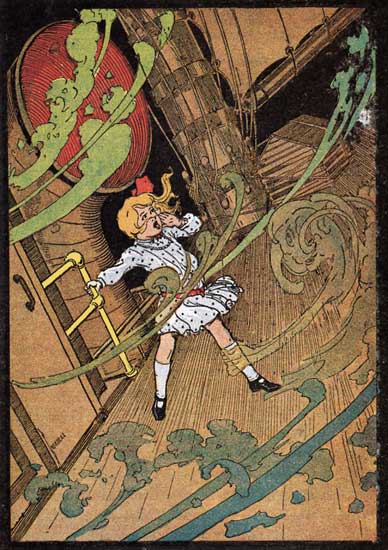
“A terrible storm”

The opening paragraphs of Ozma of Oz, by L. Frank Baum:
The wind blew hard and joggled the water of the ocean, sending ripples across its surface. Then the wind pushed the edges of the ripples until they became waves, and shoved the waves around until they became billows. The billows rolled dreadfully high: higher even than the tops of houses. Some of them, indeed, rolled as high as the tops of tall trees, and seemed like mountains; and the gulfs between the great billows were like deep valleys.

All this mad dashing and splashing of the waters of the big ocean, which the mischievous wind caused without any good reason whatever, resulted in a terrible storm, and a storm on the ocean is liable to cut many queer pranks and do a lot of damage.
Having sent Dorothy Gale to fairyland by cyclone (tornado), for her second trip Baum turned to this storm at sea. Next, in Dorothy and the Wizard in Oz, he used an earthquake. And then, since he’d exhausted the range of natural disasters, her next two trips were caused by magic from the Emerald City.

In The Scarecrow of Oz Baum had Trot and Cap’n Bill start their journey via a whirlpool—another type of nautical disaster. As with the earthquake suddenly opening a huge crack in the ground in Dorothy and the Wizard, people in the 1910s believed that such whirlpools existed in nature, but they don’t really. Does that mean magic must have been at work in those journeys too?

02 October 2012

No Climbdown from Baum on “Climb Down”

I started this series of postings with a quotation from L. Frank Baum’s Dorothy and the Wizard in Oz, with Dorothy admonishing a horse about how to talk properly:
“She couldn’t climb down, Jim,” said Dorothy. “To climb means to go up.”

“Who said so?” demanded the horse.

“My school-teacher said so; and she knows a lot, Jim.”

“To ‘climb down’ is sometimes used as a figure of speech,” remarked the Wizard.

“Well, this was a figure of a cat,” said Jim, “and she went down, anyhow, whether she climbed or crept.”
Soon afterward the horse tells another character, “You may go down, but you can only climb up.” But Jim does so “with a twinkle in his round eyes.” Evidently he still thinks this rule is silly.

And did Baum himself accept the proscription against “climb down”? A search through his books shows that he definitely didn’t.

The Wonderful Wizard of Oz uses five variations on the phrase “climb down.” Baum’s other fantasy for 1900, The Magical Monarch of Mo, uses three. That was the same year that The Inland Printer, a Chicago trade magazine that Baum knew well, advised against the phrase.

In The Life and Adventures of Santa Claus (1902), the title character “climbs down” chimneys five times. Other Baum novels that contain the phrase include Ozma of Oz (once), Rinkitink in Oz (twice), Sky Island (twice), and The Magic of Oz (three times). Those titles nearly cover the breadth of Baum’s novel-writing career.

In having Dorothy correct Jim’s grammar, Baum was probably just setting up a joke. But that scene also showed Dorothy’s somewhat bossy side (evident in other conversations in other books), and added to illustrator John R. Neill’s gentrification of a plain Kansas farmgirl. Despite her elided words, she was becoming more snooty about language than her creator.

24 September 2012

“She couldn’t climb down, Jim”


L. Frank Baum’s Dorothy and the Wizard in Oz contains this dialogue between Dorothy Gale and the old horse Jim about Dorothy’s pet kitten:
“Why, where’s Eureka?” cried Dorothy, suddenly.

They all looked around, but the kitten was no place to be seen.

“She’s gone out for a walk,” said Jim, gruffly.

“Where? On the roof?” asked the girl.

“No; she just dug her claws into the wood and climbed down the sides of this house to the ground.”

“She couldn’t climb down, Jim,” said Dorothy. “To climb means to go up.”

“Who said so?” demanded the horse.

“My school-teacher said so; and she knows a lot, Jim.”

“To ‘climb down’ is sometimes used as a figure of speech,” remarked the Wizard.

“Well, this was a figure of a cat,” said Jim, “and she went down, anyhow, whether she climbed or crept.”
I used the Google Ngram Viewer to test how often people writing in English used “climb/climbed/climbing down” over time.

The results show uses of “climb down” in various forms were relatively rare when Baum went to school. There was a marked ascent in the 1880s and ’90s, followed by a temporary turndown halfway through the next decade—precisely when Dorothy and the Wizard in Oz was published.

As a control, use of the verb “climb” in the same three forms rose steadily over most of the same period, with a much less pronounced dip (mostly for the “climbed” form) in the first decade of the 1900s.

That pattern seems consistent with “climb down” becoming popular in Baum’s adulthood, and thus coming to people’s attention as a “modern” usage even though there had been examples for decades earlier.

TOMORROW: And then there was a pushback.