Showing posts with label AUTHOR Bill Willingham. Show all posts

18 May 2014

Adam Beechen on Taking on Tim Drake

Several weeks back, the Nerdist Writers podcast had a discussion about the challenge in comic-book scripting of taking over an ongoing magazine. One of the regulars, Adam Beechen, spoke about his two experiences with that challenge, which both happen to have involved Tim Drake as Robin.

One was Robin itself at the “One Year Later” break after DC’s Infinite Crisis, issues #148-166. As Beechen says, he wasn’t picking up right after the previous scripter; the company had established an excuse for changing things, dropping threads, reworking the situation.

The second magazine was Teen Titans a short time later, with a transitional period of co-scripting with that volume’s founding writer Geoff Johns, issues #44-49. (Beechen briefly mentions his work launching a Batman Beyond comic and doesn’t mention his Batgirl miniseries.)

Along the way, Beechen, who came from the field of television animation, made a few notable observations:
  • DC’s only editorial mandate for Robin was that the first villain had to be Cassandra Cain, then Batgirl. That remains a very unpopular decision with her fans, for which Beechen is sometimes blamed. (I discussed the possible thinking behind DC’s mandate here.)
  • Beechen studied his predecessor Bill Willingham’s issues of Robin and tried unsuccessfully to contact him, and he read Chuck Dixon’s earliest issues, available in paperback. But he apparently didn’t check the bulk of Dixon’s run (nor the intervening stretch by Pete Wood).
  • Beechen didn’t study Batgirl. His comments implicitly acknowledge one result, the fan criticism of how he handled the question of Cassandra Cain’s difficulties with language.
  • Beechen came away with the idea that no one had explored Tim’s life as a teenager. Actually, that was the focus of most of Dixon’s issues. One result, it seems to me, is that after the initial storyline Beechen’s issues don’t really stand out. The small moments that are memorable, however, involve Tim’s relationship with Bruce Wayne.
As for Teen Titans, Beechen voices the usual complaints of a comics writer without the clout of Johns or Grant Morrison: sudden editorial changes, company-wide crossovers, having to cut a plotline short.

21 October 2012

Weekly Robin Historical Extra

Some comments at Scans_daily alerted me to a discrepancy in the corporate memory of Stephanie Brown’s brief time as Robin.

Back in December 2005, scripter Bill Willingham gave an interview to Comic Book Resources in which he said:
The death of Spoiler was locked in before I was asked to take over the series, but it was my idea to let her become Robin for a short time before that. My thinking is that it would be nice to give her at least one moment of glory, accomplishment and success, before all of those horrible things that were destined to happen to her.
Newsrama just transcribed remarks by DC Comics executive Dan DiDio at New York Comic-Con on the same storyline:
You know, me and Stephanie, we go way back. The story with Stephanie Brown goes, they came to me as Executive Editor with the War Games story, and said we’re going to kill Stephanie Brown. I knew Stephanie Brown for who she was, and said, “I don’t know, if this is going to be the big ending to your story it doesn’t feel big enough at the time, because the character wasn't strong enough yet.” So I said, “Why don’t we make her Robin for a short period of time, build some interest in her, and then we kill her!”
Big DC and Marvel superhero stories are the products of many minds working together, and scripter Dylan Horrocks has described bad memories of a weeklong discussion of that crossover plot. Undoubtedly both Willingham and DiDio could have had input into the storyline. But did they really come up with the same idea independently?

Willingham’s recollection came much closer to the event, at a time when that suggestion was still quite unpopular with a vocal set of fans and in an interview in which he was happy to state that other plot points were decided for him. I suspect it’s accurate.

I know this is a political period, but I can’t help but be reminded of how in the last Presidential debate Mitt Romney took credit for recruiting women for his gubernatorial administration:
And I said, “Well, gosh, can’t we—can’t we find some—some women that are also qualified?” And—and so we—we took a concerted effort to go out and find women who had backgrounds that could be qualified to become members of our cabinet. I went to a number of women’s groups and said, “Can you help us find folks?” And they brought us whole binders full of women.
But it turned out Romney was actually taking credit for a women’s initiative, as David S. Bernstein of Boston’s Phoenix newspaper explained:
What actually happened was that in 2002—prior to the election, not even knowing yet whether it would be a Republican or Democratic administration—a bipartisan group of women in Massachusetts formed MassGAP to address the problem of few women in senior leadership positions in state government. There were more than 40 organizations involved with the Massachusetts Women’s Political Caucus (also bipartisan) as the lead sponsor.

They did the research and put together the binder full of women qualified for all the different cabinet positions, agency heads, and authorities and commissions. They presented this binder to Governor Romney when he was elected.
And ten years later the governor convinced himself that that effort had been his idea all along, that approving an idea brought to him made it his idea. Did DiDio do the same?

28 June 2012

Bill Willingham on Oz in the Fables Universe

Sequential Tart interviewed writer Bill Willingham, who’s been slowly unrolling some Oz-themed storylines in his Fables comic book:

ST: I have a couple of questions about some of the current storylines. What led to the idea of Bufkin leading a revolution in Oz? Frank L. Baum had some strong political opinions; did that play into at all?

BW: To a certain extent. My reading of the Oz books was woefully antiquated in that I did it early on in life and hadn't revisited them as often as I should. And this is what I found out about Oz readers: Oz readers are fanatical readers. They want things correct. The few dips I've made into the Oz world had readers and some of the people who work in the Fables camp, like Eric Shanower, who has done the odd Fables book, and who, of course, is a massive Oz fan [Shanower writes Oz-themed comics for IDW and Marvel Comics], and Todd Klein, our letterer from day one: massive Oz fan — which apparently is a redundancy. There's no such thing as just a middle-of-the-road Oz fan. They called me out on the tiniest little thing. It is not the Lunchpail Tree; it is the Lunchbox Tree.

I realized that if I wanted to play in Oz at all, which I wanted Bufkin to eventually do again someday, I'd have to either have all my ducks in a row and massively re-immerse myself in the Oz stuff — or create a situation wherein I'm the only expert, [and can say], "Todd, Eric, what you don't understand is that when the Adversary conquered Oz, he made all these changes and all these changes are inscribed only in my mind, so nyah nyah, here's the way it is now, and you're just going to have to live with it."

I decided to go that route, so Bufkin finding that the whole place was conquered and overrun by the gnome king, who, when the big empire fell, continued on with his little local empire. Well, it was obvious that Bufkin, having defeated the djinn and slain Baba Yaga would think, "Overthrow a dinky little side-empire like this? Easy." It almost wrote itself, and it solved the problem of these guys who could so easily point out where I got things wrong.
I suspect Sequential Tart asked about Baum’s “strong political opinions” because he was progressive for his time while Willingham identifies himself as a conservative. But Willingham didn’t address that potential conflict.

I’ve written before about how the Ozma and Dorothy of Willingham’s Fables universe bear little resemblance to Baum’s characters. In contrast, Jack Pumpkinhead, the Sawhorse, and the Glass Cat act quite familiar. As for Bufkin, he’s a true original.

(Hat tip to Blair Frodelius’s Daily Ozmapolitan.)

17 July 2011

“The whole thing about her being Robin, was simply a trick”?

The comic book gossip website Bleeding Cool just highlighted a video from a New Zealand writers’ convention in which Batgirl scripter Dylan Horrocks shared his perspective on the Batman: War Games crossover of 2004-05.

In particular, Horrocks spoke about the death of Stephanie Brown, who had entered the Batman saga years before as a teen crime-fighter named Spoiler:
It was one of the most depressing weeks of my life, because we basically spent the whole week in this horrible office planning how to kill this poor teenage girl who I really liked. I thought she was a great character and she was one of the few friends that my character had, and I tell you the whole thing about her being Robin, was simply a trick.

The whole way through it was planned purely as a trick to play on the readers, that we would fool them into thinking that the big event was that Stephanie Brown would become Robin but we knew all along it was a temporary thing, and she was then going to die at the end of this crossover story.

It was really seedy, and I think about two days into it, I basically said look, I don’t want… because they planned this big long torture scene, I said I don’t want to really have anything to do with that. . . .

So when there was that big online debate about Stephanie Brown’s death I felt kind of really pleased and vindicated, and the other person who I think was probably happy about that but I don’t think she’s ever said so in interviews was Devin Grayson who was writing Nightwing at the time… she raised several issues during this meeting, she was one of the other writers in the meeting who said how come we’re always killing off the girls, and also how come we’re killing off the ethnic characters, there was a lot of debate in that meeting, well ultimately it all came down to this is what we’re going to do.
Another of the scripters in that conversation was Bill Willingham, then writing Robin. In 2005 he talked about suggesting that Stephanie Brown become the Teen Wonder:
The death of Spoiler was locked in before I was asked to take over the series, but it was my idea to let her become Robin for a short time before that. My thinking is that it would be nice to give her at least one moment of glory, accomplishment and success, before all of those horrible things that were destined to happen to her.
Thus, Stephanie’s death was long part of the company’s thinking, probably as part of a plan for Tim Drake’s maturation. Her becoming Robin was a later addition.

Horrocks’s perception of the storyline was: “we would fool them into thinking that the big event was that Stephanie Brown would become Robin.” Yet the new Robin debuted in several magazines that preceded War Games (many collected as War Drums). Readers knew that there would be another “big event” in the much-hyped crossover.

Did DC Comics raise the hopes of Stephanie’s fans by making her Batman’s sidekick? Certainly. Did they set up the progressive situation of a female Robin, only to snatch it away? No doubt. Was that in itself a “trick”? Not, I think, within the context of the genre.

Sudden narrative reversals have long been an integral part of superhero storytelling. The genre is designed to produce a roller-coaster ride for readers, with defeat snatched from the jaws of victory and vice versa. That’s why young acrobat Dick Grayson fell down so much. In recent decades, the low points of those rides have included the sudden deaths of major characters, even the most prominent.

At the 2004 Comic-Con, DC’s editorial and writing team promised just such a ride in War Games. While keeping tight-lipped about specific plot points, editor Bob Schreck said, “There’s stuff that's going to go on that’s going to aggravate people, hopefully in good way. . . . There’s going to be blood.”

Some savvy (or cynical) readers foresaw what would happen. In July 2004, before he became “Grumpy Old Fan” at Newsarama and Robot6, Tom Bondurant wrote:
Readers could be forgiven for any cynicism at this development. After all, this was the third Robin in twenty years. Besides, DC would never let Robin stay a girl — they’d have to crank out a whole new set of action figures, for one thing. (Female Robins had shown up in The Dark Knight [Returns] and other alternate-history stories, but never before in the “real” books.) For 64 years, in the comics, on TV, and in the movies, Robin has been a dark-haired boy, not a blonde. Changing the costume, as DC did with Tim in 1990, was one thing, but changing gender was something entirely different. Furthermore, DC is cranking up for a major storyline involving Gotham City gang wars, and promising carnage — and Stephanie would be a bigger casualty as Robin than as Spoiler. The whole thing smelled of marketing. . . .

I don’t hate Stephanie, but I can’t see her staying Robin for very long; so it looks like the wait is on for Tim’s comeback.
A clear sign of DC’s lack of commitment to Stephanie as Robin appears on the cover of Detective Comics, #796, the only issue of the two main Batman books to show her in the Robin costume before her death. “Batman & Robin… Together Again?” it asked. Not exactly a ringing endorsement, or a promise of a long partnership.

COMING UP: But it turned out that the trick was on DC.

22 February 2011

Bufkin the Bibulous, Bufkin the Brave

From the very first issues of Fables, scripted by Bill Willingham and drawn mainly by Mark Buckingham with Steve Leialoha, L. Frank Baum’s Oz universe has been represented by the character of Bufkin, a winged monkey working in the Fabletown mayor’s office.

As a bibulous office grunt, not to mention a monkey with wings, Bufkin was natural comic relief. Every so often he might show some hidden ambition.
But like so many filing monkeys, it seemed clear that Bufkin wouldn’t actually do anything. (That page of art is by Jim Rugg. Note how it gets away with stacking panels on the left through clever use of text and balloon tails.)

In the issues collected in Witches, Bufkin takes center stage for one plotline. Trapped in the office with the evil witch Baba Yaga and a bunch of disembodied heads, he has to figure out how to survive.

Critics of Fables have pointed out how so many of the series’s stories involve its young male characters turning out to be fearsome warriors and genius tacticians. The first example was Bigby, the Big Bad Wolf—of course, we’d expect him to be sly and bloodthirsty. In fact, Bigby’s character journey over the first volumes was to become a stable husband and father.

But in subsequent issues, we see the deadly skills of Little Boy Blue, carrying the vorpal blade. Then Prince Charming, who’s simply a handsome cad in the first issues. Aladdin, ambassador from the Arabian fairy tales. And even the Frog Prince, a gawky janitor turned warrior-king.

In fact, this repeated plot might be inescapable. Heroic characters are supposed to grow. Adventure comics involve plot twists, surprises, and big ups and downs. The good guys usually win. Fables is essentially a war comic. The comics form puts a premium on working out conflict through dramatic physical action. Put that all together, and you keep coming back to heads being sliced off.

Still, to see Bufkin embark on the hero’s journey in the Witches volume is a surprise. To Willingham’s credit, he writes it as a surprise for Bufkin as well. Our little monkey also ends up with a bit of a swelled head.

Bufkin’s story continues in Fables, #101, which has the additional delight of Eric Shanower as guest penciler. It looks like Vertigo hired him to give Buckingham a bit of a breather after a big anniversary issue. Whatever the backstage story, it’s delightful to see Shanower’s traditional characterizations of Jack Pumpkinhead, the Sawhorse, and the Glass Cat, and a new version of lunch-bucket trees.

21 February 2011

Fables and Ozian Decadence

Yesterday I quoted comics scripter Bill Willingham’s 2009 essay against “Superhero Decadence,” which appears to be a politicized way of expressing the common thought that superhero comics aren’t as good as they were when a person was twelve.

Willingham’s major work in comics now is Fables, which takes fairy-tale heroes and moves them to our world, where they live in secret among us. (Other authors exploring this idea include Michael Buckley in The Sisters Grimm and Sarah Beth Durst in Into the Wild and Out of the Wild.)

All public-domain fantasy characters are available to Willingham. The unusual copyright situation of Peter Pan caused him some troubles, but L. Frank Baum’s Oz characters are fair game. Glinda and her swan-drawn chariot appeared in one frantic panel of an early issue of Fables, and Dorothy Gale and her companions have shown up several times in the companion series, Jack of Fables.

The most prominent refugees from Oz in the Fables comic books are Bufkin the winged monkey, whom I’ll discuss tomorrow, and a young witch identified as Ozma in issue #87. She’s not precisely like Baum’s Ozma: there’s no mention of fairy ancestry, early life as a boy, or the throne of the Emerald City. But with a poppy in her hair, she’s clearly meant to evoke the little queen of Oz.

Except that Baum’s Ozma was entirely benevolent, sometimes naively so—as in The Emerald City of Oz, when she’s willing to let evil creatures overrun her kingdom because she can’t think of any way to stop them without hurting them, and Ozma of Oz and Glinda of Oz, in which she heads off to help other kingdoms without thinking of how to protect herself.

In contrast, Willingham’s Ozma is a little schemer, fairly ruthless at the internal politics of Fabletown and promising to be more ruthless about its latest adversaries. She’s also very good at magic, while Baum’s Ozma gains her magical knowledge gradually, and never seems as capable as Glinda the Good Sorceress.

Indeed, the character in Fables is a much better match for Baum’s Glinda, who is far more authoritarian, secretive, and militaristic than Ozma in her approach to protecting Oz. But Glinda doesn’t offer the striking visual paradox of a little girl acting like a tough commander.

Meanwhile, Cinderella, a Fables spin-off scripted by James Roberson, has featured another version of Dorothy Gale, as Jer Alford reports at Emerald Hearts in Oz. That magazine features Cinderella as a deadly secret agent, and Dorothy shows up as a rival assassin from Russia. She’s fully grown, and—based on this panel, which is all that I’ve seen—goes around pointing guns in her underwear.

Willingham and his colleagues have every right to use Baum’s characters as they choose, and Fables continues to be an entertaining adventure comic. I don’t insist that depictions of Oz remain pure and childish, having frequently pointed out Glinda’s realpolitik and even published an article titled “Dorothy the Conqueror,” about the character’s tendency to wipe out her enemies.

But Ozma’s different. Open, unadulterated, and sometimes heedless kindness is what defines Ozma in Baum’s books. Willingham’s rant about superheroes becoming “decadent”—straying from their traditional characterizations to become violent, selfish, and cynical—seems to apply even more to his series’ treatment of Ozma.

20 February 2011

Willingham’s oh-so-Brave Stand Against “Superhero Decadence”

Back in January 2009, comics scripter Bill Willingham offered the world a long grumble about superheroes not being as great as they were when he was a child: “The ‘super’ is still there, more so than ever, but there seems to be a slow leak in the ‘hero’ part.”

The essay appeared on one of Andrew Breitbart’s websites, so it’s no surprise that it contained factual omissions and right-wing spin. Willingham’s complaint about lesser heroism turned out to really be about fewer explicit links to America, particularly jingoistic America. “Superman…no longer seems to be too proud of America,” for example.

Unmentioned was how the Marvel comics that Willingham read in his youth also included grumpy heroes, reluctant heroes, and even a Watergate-era Captain America who took another identity after being disillusioned by a right-wing government conspiracy. He had a lot to say about the unsuccessful movie Superman Returns, but nothing about the successful All Star Superman comic.

As commenters pointed out, Willingham was part of the team that plotted War Games, one of the grimmest Batman crossover sagas. It ended with the apparent death of Stephanie Brown, the fourth Robin. Perhaps that experience helped to sour Willingham on “superhero decadence,” but he continued scripting the same series for years afterward.

The essay’s only mention of the Dynamic Duo was:

In my run writing the Robin series (of Batman fame), I made sure both Batman and Robin were portrayed as good, steadfast heroes, with unshakable personal codes and a firm grasp of their mission. I even got to do a story where Robin parachuted into Afghanistan with a group of very patriotic military superheroes on a full-scale, C130 gunship-supported combat mission.
Willingham thus equated being a “good, steadfast hero” with going on a “combat mission” in a country where US troops were also fighting. The actual purpose of that mission matters less than that it’s “gunship-supported.” (It involved monsters. Really.)

In my eyes, that stopover in the military, which appears in the collection Robin: Days of Fire and Madness, was:
  • not an example of Tim Drake’s “firm grasp of [his] mission”; it pivoted on him trying to figure out what his mission should be as he looked ahead to adulthood.
  • out of character for Tim, a Gotham-based crime-fighter sworn to a no-killing ethos.
  • unnecessary as a way of showing Tim to have old-fashioned heroic values. As Robin, he always showed those. His challenge wasn’t morality but capability, given that he was the littlest guy in the fight.
This story came near the end of Willingham’s assignment on Robin. To me it came across as an indulgence of the writer’s own interest in the military; Willingham grew up in a military family, served himself, and routinely addresses martial issues in his series Fables.

Willingham ended his essay with a peroration that worked up the Breitbart crowd, including some who expressed dislike of how “DC went around ‘multiculturizing’ much of their characters” or asked, “Is it America’s fault Belgium doesn't produce comic books?”:
No more superhero decadence for me. Period. From now on, when I write within the superhero genre I intend to do it right. And if I am ever again privileged to be allowed to write Superman, you can bet your sweet bootie that he’ll find the opportunity to bring back “and the American way,” to his famous credo.
Personally, I’d prefer for “the American way” to always align with “truth and justice,” and to let other nations make truth and justice their way as well. But some folks have always preferred the simplicity of “my country right or wrong.”

Having been told by huge media corporations on the political right that huge media corporations are hostile to right-wing ideas, some commenters expressed worry that Willingham would lose his job in comics publishing. I think that’s exactly the wrong way to view this essay.

In January 2009, as Willingham published, he had just started writing Justice Society of America, anchored by DC Comics’s older generation of heroes (i.e., white male heroes invented in the 1940s). I see his essay as the equivalent of promotional interviews on comics websites, the sort in which writer and artist discuss how exciting the upcoming stories will be. It simply spun that buy-the-next-issue message for a different audience: right-wing American men who believed that comic books (and everything else) had gone downhill since their youth.

This essay was simply part of the mainstream comics industry’s entertainment and marketing efforts—which doesn’t mean Willingham wasn’t sincere in his statements. He continued to write Justice Society for years, and his Fables remains the star on DC’s Vertigo list.

Willingham’s abjuration of “superhero decadence” came back to my mind this month as I read some of his latest Fables stories, using characters from the Oz books.

TOMORROW: How is the Fables universe using Oz?

26 January 2011

Yet More Oz Comics to Collect

The latest installment of Bill Willingham’s comic serial Fables, issue #101, offers yet another approach to creating Oz comics from Eric Shanower.

Shanower started out writing and illustrating his own comics stories, published in Adventures in Oz. He adapted Walt Spouse’s 1930s newspaper strip into a more modern format, published by Hungry Tiger Press. He’s now scripting Marvel’s ongoing series of L. Frank Baum adaptations for Skottie Young to draw, an effort that’s already won the team two Eisner Awards.

In this magazine Shanower’s creating art from someone else’s Oz-related script. Bufkin, the bibulous Winged Monkey who works for the Fabletown government, gets some spotlight time. Other Oz characters have appeared in Fables, and Shanower has illustrated a previous page, but I think this is the first time those beams have crossed.

In addition, I see that Willingham’s version of Ozma plays a prominent role in the next five-issue arc.

09 April 2010

The Eisner Award Nominations of Oz

Among this year’s nominees for Eisner Awards for excellence in American comics are three with an Oz connection.

Eric Shanower and Skottie Young’s adaptation of L. Frank Baum’s Wonderful Wizard of Oz was nominated for Best Limited Series or Story Arc, and for Best Publication for Kids. Shanower has won two Eisners for his Age of Bronze series, but for Young, judging by his reaction on Twitter, this is an exciting new honor.

Philippe Ghielmetti’s design for the Queer Visitors from the Marvelous Land of Oz collection from Sunday Press was nominated for Best Publication Design [and, the Wonderful Blog of Oz points out, for Best Archival Collection/Project—Strips]. This is a giant-size reissue of the newspaper comic page Baum wrote in the early 1900s, along with a competing series from his former colleague W. W. Denslow.

And, though it’s several steps off the Yellow Brick Road, the magazine Fables received nominations for Best Continuing Series and Best Writer in Bill Willingham. A young magic-worker named Ozma has been appearing in this comic book’s recent storylines.

David Small’s Stitches received nominations for Best Reality-Based Work and Best Writer/Artist–Nonfiction. It’s notable that this book was not nominated as Best Publication for Kids or Best Publication for Teens. Within the comics community, there’s no assumption that the comics form automatically makes a work suitable for younger readers.

13 November 2009

Let’s Examine That

I enjoyed the great march of Bill Willingham and (mostly) Mark Buckingham’s Fables comic to issue #75. In fact, I’ve been planning a “Willingham week” for a while; that prospect was both strengthened and postponed when I received a review copy of his new novel, Peter and Max.

Nonetheless, I haven’t read either of the Fables volumes that followed War and Pieces, the one that brought the heroes’ war against their Adversary to an end. I fear that further Fabletown stories would be an anticlimax, and am instead thinking about picking up the first issues in the deluxe edition.

But now I understand that a young magic-worker named Ozma is a major character in the current story arc. Here she is illustrated by Buckingham in issue #90, with the telltale poppy in her hair.

But didn’t John R. Neill drew Ozma with dark hair in most of the Oz books? Yes, but in the character’s first appearance in The Marvelous Land of Oz L. Frank Baum described Ozma’s hair as “tresses of ruddy gold,” and Neill’s one portrait of her is consistent with that. Only when Neill had started drawing Dorothy Gale as a blonde did he make Ozma and brunette. When Dorothy is brunette, as in the Return to Oz movie and in Fables, Ozma becomes blonde.

This isn’t the first time Willingham has borrowed characters from the Oz books for Fables. Early on we had glimpses of Dorothy and her companions, and of Glinda in her swan chariot. A bibulous winged monkey named Buffum is an ongoing presence, but his personality is Willingham’s own invention. Ozma seems to be the most prominent ongoing character from the Oz books to also become a prominent ongoing character in Fables.

However, there’s a lot more to Ozma than simply having a flower in her hair and being able to work magic (a talent she developed only late in Baum’s series). And the few preview pages I’ve seen don’t convince me that this girl is the real Ozma.

25 May 2008

Spoiler Alert for Robin

This past week turned out to be significant in Robin history. Robin, #174, confirmed what DC Comics magazines and editors had been hinting for months: that Stephanie Brown, the (by my count) fifth teenager to take the role of Robin, wasn't dead after all.

A little background. In 1992, shortly after Tim Drake debuted as the fourth Robin, the Batman comics introduced Spoiler: a female acrobatic masked vigilante in eggplant-colored tights and cape. Tim tracked down the Spoiler and identified her as Stephanie Brown, the teen-aged daughter of a minor villain named the Cluemaster. She was trying to fight crime--on a shoestring budget, with no mentor--out of embarrassment about her father.

The following year, DC launched the ongoing Robin comic book, and Tim's relationship with the slightly older Stephanie was a major plot engine over the next decade. As Chuck Dixon, the magazine's writer until 2002, said in a recent interview:

Frankly, Spoiler began as a pure plot device and evolved, because of fan interest, into a romantic foil for Robin. . . . It's also kind of cool that Robin has someone around his own age to run rooftops with. It's sort of a male fantasy to find a girl who shares your hobby.
Tim and Stephanie fell in love, had a baby (not his, but he helped at the birth), broke up, got back together, and went through other experiences of hormonal teenagers. On top of that, they had the typical experiences of comic-book heroes: finding out secret identities, switching bodies, having to fight their own parents, dealing with jealous ghosts, and so on.

In 2004, DC hired Bill Willingham to script the Robin series. I've mentioned Willingham's Fables comics favorably, and will have more to say about them in due course. Comic Book Resources interviewed Willingham about his eventful stretch of Robin comics:
CBR: While writing "Robin," the character has gone through some major changes, including his father finding out about his secret identity, the death of his father, the death of his girlfriend, and relocating to a new city. How many of these changes originated with you, and how many were given to you to explore by editors?

BW: What a nice way to put that - "...given to you to explore by editors" as opposed to, "inflicted on you against your will and better judgment," Well done. Very diplomatic. . . .

CBR: Despite all the changes the character has gone through, all of Robin's actions seemed true to his character.

BW: How nice of you to say, but some readers might disagree with that.
And so, it's apparent, might Willingham. The story of Tim Drake's father learning that he's been spending his nights as Robin, instead of, oh, playing in a midnight basketball league, appears in the collection Robin: Unmasked.

Tim's resignation for his dad's sake left Batman without a teen-aged partner. Meanwhile, the Batman editorial team had plans for a big "crossover" story to promote all their magazines, which would need some striking landmark event to drive the plot. These days, such comic-book events usually involve a character dying. Willingham had a bright idea, as he explained in that interview:
The death of Spoiler was locked in before I was asked to take over the series, but it was my idea to let her become Robin for a short time before that. My thinking is that it would be nice to give her at least one moment of glory, accomplishment and success, before all of those horrible things that were destined to happen to her.
Thus, Stephanie Brown became the first female Robin within the regular DC continuity. Most of the Batman stories in which she wears the red and green costume appear in a collection called Batman: War Drums. According to Willingham in an interview with Word Balloon quoted at evenrobins.net:
There was a nice spike in sales during that time and I wish her death hadn’t been so as locked in because when it started going really well, what I would have liked to have said was, "Let’s follow this for a while." That was not available as an option and you can’t really...do that same stunt over and over again. We had that momentum once, we lost it.
The long-planned crossover is archived in the three Batman: War Games volumes; many fans seem to feel that's three too many. Having been fired as Robin, Stephanie returns to her Spoiler role and ignites a gang war. A villain named Black Mask captures and tortures her. Tim Drake returns as Robin, sadder and madder. Batman beats up people. And, we are given to understand, Stephanie Brown dies for our entertainment.

Here's a passage from yet another interview with Willingham, from the AV Club, on his great notion:
My personal theory is that we've all got this bucket full of good ideas, and if you just hold onto them, your bucket never gets fuller. There's only so many you can hold at a time, but as fast as you use them up, it fills up again with more good ideas. My notion is to spend everything you've got coming through your head as fast as you can, and you're guaranteed to get more good stuff.

So while writing Robin and stuff like that, if I had good ideas, I'd try to pitch them and run with them. Sometimes it backfired. It was my idea to make Spoiler into Robin, just before she died horribly. I thought that would be a good thing for the character, but it turns out that legions of female fans now detest me for doing that.
Indeed, they did. Which seems unfair because DC's (outgoing) editorial powers had decided on the death of Stephanie Brown before Willingham took the job.

Critics saw Stephanie's violent death as fitting into a larger pattern of how comic books exploit supporting female characters to provide angst for leading male characters. Ten years ago the website Women in Refrigerators catalogued many other examples of female characters and their suffering. This list is not unlike the one about gay superheroes killed in mainstream comics that novelist Perry Moore assembled. I'd like to see a comparative analysis of straight male secondary characters and their fates as well; those guys may also be plot fodder.

Since DC killed and resurrected Superman in the early 1990s, death and rebirth have been superhero clichés. When a company could thrive while (temporarily) killing off even its oldest, strongest, and most lucrative trademark, a supporting character like Spoiler doesn't stand a chance of avoiding the grim reaper. But any comic-book death, unless it defines a hero's origin (as in the killing of Bruce Wayne or Dick Grayson's parents, Peter Parker's uncle, or the entire planet of Krypton), can be reversed when the market seems right.

Gail Simone, the creator of Women in Refrigerators, had a simpler argument for the superhero comics publishers: How will you attract female readers and stay in business if you keep killing off or hurting your female characters? Her criticism brought her to the attention of DC Comics, which hired her to script Birds of Prey, about an all-female superhero team (which had at times included Spoiler as a trainee), and now Wonder Woman.
The elimination of Stephanie Brown inspired more specific protest, such as this open letter from Katherine Keller and other internet essays. Fan anger focused around Project Girl Wonder, an email crusade to have the Batcave include a memorial for Stephanie, just as there was one for the third Robin, Jason Todd. (He's come back from the dead, too, a couple of years ago.)

As the clues piled up this spring that Stephanie would be brought back alive, the Girl-Wonder.org website suspended its campaign. Project Girl Wonder had probably played a role in the character's return--not by putting pressure on DC Comics in a political sense, but by showing that Spoiler had her own fervent fan base. [Girl-Wonder.org remains active as a source of commentary on the bigger, ongoing issue of females in superhero comics.]

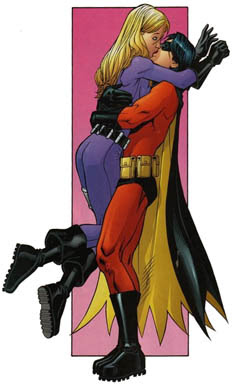
Now Stephanie's back. And as you can see in this image from the latest Robin, drawn by Chris Batista and Cam Smith, Tim's very pleased to see her. (Yes, he does have a bo staff on his belt, but he really is pleased to see her.) One question now is whether Stephanie Brown was popular because she was unfairly treated and cruelly killed off, or because of some internal appeal of her personality that can keep her around.

Next month brings a one-off Robin/Spoiler magazine. The cover by Rafael Albuquerque (at top) pays tribute to Carmine Infantino's iconic image from the late 1960s of Batman and Robin on a rooftop. Visit the ad-heavy Bat-Blog to see the original and some previous homages.

04 April 2008

It May Sound Harsh

The first Jack of Fables collection, The (Nearly) Great Escape (script by Bill Willingham and Matthew Sturges; art by Tony Akins and Andrew Pepoy) offers a--well, let's say rare picture of the most beloved Oz characters.

At some point I'll praise Willingham's Fables comics in more detail, but for now I'll just report that this volume is based on the premise that a bunch of characters from fairy tales, nursery rhymes, and fantasy literature are being held captive in a prison camp surrounded by tigers. (Don't you hate when that happens?)

The title character, Jack--as in Horner, Beanstalk, being nimble, etc.--masterminds a mass escape. And among the characters who make a dash for the fence are Dorothy, her three famous companions from Oz, and her little dog, too.

Dorothy is pictured as a teenager in cowboy boots, jeans, tight stomach-baring top, and hairband. Such a depiction is only to be expected in the Fables comics, since they're published by the adult division of DC and they show other human fairy-tale characters dressed (or undressed) like pretty young things of today. Plus, we've seen similar Dorothys in many other recent comics.

As this Dorothy and her friends climb the fence, a tiger roars up. Toto starts to snap and bark at it, just as he barks at the Cowardly Lion when they first meet.

And the tiger eats Toto. We see this in some detail. It's like a National Geographic special for a couple of panels.

Then Dorothy tells her other friends, "It may sound harsh, but I'm kind of relieved. That's the first time that flea-bitten mongrel's quit yapping in a hundred years!"

A couple of pages later, other characters explain, "killed Fables often get magically replaced by new versions of the same Fable." That should reassure us about Toto's ultimate fate, but the same panels offer another look at his half-eaten hindquarters.

Did I mention that the Fables comics are written for adults?
