Showing posts with label dangers of reading. Show all posts

05 January 2022

“You don’t expect a benefit”

From Ian Benke’s Authority Magazine interview with James Kennedy, author most recently of Dare to Know:
There is no benefit to reading science fiction. Or at least, I hope there isn’t. And if there is, I hope nobody finds out what it is.

The worst thing that can happen to art is for it to become respectable, to be considered as something that is “good for you.” Science fiction had its golden age when literary people considered the genre to be juvenile, unserious, and embarrassing. Now that science fiction has become more respectable, is it really as exciting? Vital, unruly punk energy resists being enlisted for causes, it rightfully doesn’t want to help you, it goes its own swinging way and if you’re lucky, maybe it’ll let you tag along.

The adventure of art is that you submit to it. You let it take you somewhere. You don’t expect a benefit, you don’t even want one. Maybe you’ll get hurt, maybe you won’t, maybe it’ll be a good experience, maybe bad, but for me, the whole thrill is surrendering myself to it, without any expectation of earning some new virtue or snagging some nugget of information. I just want to be overwhelmed, thrilled, transported.

26 March 2020

“Literary texts might be doubly infectious”

I just learned about this book, but I had a tag all set up for it already.

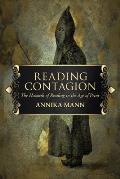
Reading Contagion: The Hazards of Reading in the Age of Print, by Annika Mann:
Eighteenth-century British culture was transfixed by the threat of contagion, believing that everyday elements of the surrounding world could transmit deadly maladies from one body to the next. Physicians and medical writers warned of noxious matter circulating through air, bodily fluids, paper, and other materials, while philosophers worried that agitating passions could spread via certain kinds of writing and expression. Eighteenth-century poets and novelists thus had to grapple with the disturbing idea that literary texts might be doubly infectious, communicating dangerous passions and matter both in and on their contaminated pages.

In Reading Contagion, Annika Mann argues that the fear of infected books energized aesthetic and political debates about the power of reading, which could alter individual and social bodies by connecting people of all sorts in dangerous ways through print. Daniel Defoe, Alexander Pope, Tobias Smollett, William Blake, and Mary Shelley ruminate on the potential of textual objects to absorb and transmit contagions with a combination of excitement and dread. This book vividly documents this cultural anxiety while explaining how writers at once reveled in the possibility that reading could transform the world while fearing its ability to infect and destroy.
This eighteenth-century worry seems to have resurfaced now that we’re are hunkering down with reading material and mail-order packages while word goes around that those same packages might carry the virus we’re hunkering down to avoid.

However, as science journalist Zeynep Tufekci tweeted: “Future generations will be driven batty by the amount of concern over contamination from cardboard boxes—a tail risk: porous surface, exponential decay—compared with protecting the pathways to OUR RESPIRATORY SYSTEM WITH MASKS FOR A RESPIRATORY ILLNESS WITH ASYMPTOMATIC SPREAD.”

19 November 2014

A Paradox of Geek Fandom

Last week I sat in on a discussion with Paul Levitz, former President at DC Comics, at MIT’s Media Lab. (The door to the building said I had to have an MIT identification to enter, but I rode up the elevator with Levitz and helped him find the auditorium, so I figured I deserved to stay.)

Levitz started at DC Comics as a sixteen-year-old freelance writer and editor, and is still scripting comics. From 1976 to 2009 he took on increasing internal responsibilities, spending the last seven years as President. Having long functioned as a big part of the corporate memory, he recently wrote a gigantic history of the company.

Among other observations at MIT, Levitz said that “geek culture” has overtaken “pop culture.” That reflects the popularity of videogames and of superhero and science-fiction movies and TV shows, of course, but it also speaks to a certain style of consuming entertainment.

I asked Levitz for his thoughts about one paradoxical aspect of “geek culture.” On the one hand, that form of fandom is very interested in seeing the process of storytelling:
  • comics collections often include early sketches, scripts, and creators’ discussions of roads not taken. We rarely see that in novels.
  • DVDs feature deleted scenes, commentary tracks, outtakes, and other peeks into the creation of the movies or TV shows they document.
  • TV “show runners” are becoming celebrities with their own following.
  • the moviegoing/viewing/reading/gaming public follows the creation of a new piece of entertainment earlier than ever; news that used to be restricted to the industry is now spread everywhere.
In sum, it’s more obvious than ever that those stories we like are artificial creations designed to entertain us and earn our dollars. And we enjoy the reminders of that.

And yet “geek culture” is also marked by a fervid, sometimes rabid, protectiveness about those stories and the characters in them, as if they were real or deserved to be. Fans want to guard their favorites from the very companies and people who have the assignment of keeping them alive.

Levitz could only reply that part of his job as a DC executive was to warn people adapting the company’s properties to other media when they were straying too far from the characters’ “core.” He found that he couldn’t define in advance what would raise most fans’ protective responses, but he knew it when he saw it. And that emotional attachment remains, still hard to map but perilous to cross.

15 October 2014

The Gardner Centennial

I left my testimonial about what Martin Gardner’s writing meant for my intellectual development.

21 December 2013

The Problem of Resentful Reading

Fifth-grade teacher Pernille Ripp in School Library Journal on “Why Reading Sucks: Talking honestly with kids might make them more passionate readers”:

On posterboard, I wrote the heading, “Why Reading Sucks,” and asked the kids to name their own reasons for why this might be the case. At first, the children darted glances at one another, not quite sure where this crazy teacher was headed. Then one student finally blurted out, “I don’t think a teacher has ever asked me that!” . . .

When we looked over the list we had created together, I agreed that these were valid reasons, indeed, why reading may not be the most favorite thing to do for a child or even many adults. Some children hate sitting still; others find reading boring, time consuming, or restrictive. They resent that they are forced to read certain books or at a certain time. They feel pressured, and some believe that they are bad readers. What it all adds up to is a miserable reading experience, and that is what we have to fight.

I thanked the kids for their honesty, and then asked them for their solutions. One after another my students raised their hands. “Can we pick our own books?” “Yes,” I replied. “Do we have to read a certain amount of minutes and log it?” “No,” I said. “I expect you to read every night and you only log it in [class].” “Do we have to finish every book we start?” “No,” I assured them.
Ripp originally wrote this piece for her blog in September. She also offers a survey asking kids how they are as readers.

The day after the SLJ site published Ripp’s essay, she had a baby.

29 October 2013

Games Acknowledgements Play

At the end of Fantasy Baseball, author Alan Gratz thanks a number of writing colleagues (including Laurel Snyder) for their support, and a number of literary estates, including those of Brian Jacques, Madeleine L’Engle, and the still-quite-alive Ingrid Law, for permitting him to use characters under copyright.

Also among the latter group is: “the estate of Ruth Spencer-Davies for letting me borrow the inimitable Nanny Mae and her feline companion Mrs. P.”

There was no Ruth Spencer-Davies.

Nanny Mae shares some characteristics with P. L. Travers’s Mary Poppins and perhaps Christianna Brand’s Nurse Matilda (better known as the cinematic Nanny McPhee). But, whether pushed by copyright requirements or not, she appears to be Gratz’s own creation.

The conceit of Fantasy Baseball is a boy caught in a realm of make-believe characters. We readers have to believe that Nanny Mae is such a character, from a series we’ve never read or perhaps one we’ve forgotten. And the line in the acknowledgements serves that fictional purpose.

I’m running this on a Tuesday because Dorothy Gale is a major character in Fantasy Baseball, founder of the team Alex Metcalf finds himself playing for. Other characters from the Oz books also appear, including Scraps, Tik-Tok, and Jack Pumpkinhead. The threat underlying the plot is that those characters will be forgotten in our culture and disappear from the playing field.

But if Nanny Mae lives on with no other evidence for her existence on the web, then surely Jack Pumpkinhead will, too.

06 August 2013

Why Thompson Oz Books Smell a Little Like Vanilla

Back in 2009 I wrote fondly about the smell of Ruth Plumly Thompson’s Oz books, as originally published by Reilly & Lee in the 1920s and ’30s. Lots of American books of that era shared the same perfume, though perhaps not as strongly, given that publisher’s low budgets.

This summer the Smithsonian blog noted an article from the International League of Antiquarian Booksellers on the chemistry of that smell:
Scientists say that “old book smell” is more than just mustiness; it contains hints of grass and vanilla. That’s because all the compounds used to make the book release distinctive odors as they break down. For example, lignin, which is present in all wood-based paper, is closely related to vanillin. As it breaks down, the lignin grants old books that faint vanilla scent.

It’s even possible to approximate the age of a book based on its smell. Chemists have identified 15 substances often present in books (known as VOC’s) that degrade (and therefore emit a gas) at a predictable rate.
The abstract of the underlying scientific paper, published in 2009, goes into more detail:
The main volatile degradation products of paper, constituting the particular “smell of old books”, were determined using headspace analysis after a 24 h predegradation procedure. Using supervised and unsupervised methods of multivariate data analysis, we were able to quantitatively correlate volatile degradation products with properties important for the preservation of historic paper: rosin, lignin and carbonyl group content, degree of polymerization of cellulose, and paper acidity.
Those scientists, some working with the Centre for Sustainable Heritage in Britain, appear to have been most interested in the preservation and dating of books. But I can also imagine interest in their findings from people who wish to create books as luxury items. What could be more luxurious than a book that smells wonderfully old but is actually in great shape?

01 July 2013

Bruised, Wiser and Triumphant

Yesterday’s New York Times Book Review included Adam LeBor’s
essay on the challenge of writing thrillers after journalistic training:

In theory, writing a thriller is simple. The basic formula reaches back through the ages, to the “Odyssey” and the Bible. Take a flawed but likable hero, send him on a perilous journey where he is forced to confront his inner demons, increase the danger at every stage, have an ally or two betray him, but ensure that he eventually vanquishes the enemy, emerging bruised, wiser and triumphant.

The practice, however, is rather more complicated. At first, I found my experience as a foreign correspondent a positive hindrance when it came to fiction. . . . The essence of journalism is revelation and explanation: We present the causes and consequences of an event for the reader. We answer the questions, convey the complexities and do the thinking so you don’t have to. Or not too much.

The essence of fiction, especially thriller writing, is exactly the opposite: obfuscation, mystery and deception loop through a maze of switchbacks — ideally strewn with the dead bodies of double agents, dupes, femmes fatales, sinister businessmen. “It’s important to be judicious with the facts in a novel,” the writer Alan Furst told me in a phone interview. “Not to give too much away too soon and to move the story along to keep the reader hooked.” A large part of the reader’s pleasure in reading thrillers and crime and mystery books is finding his way through and making the connections himself…
I recall hearing Mark Peter Hughes, author of A Crack in the Sky, speak to the same point in a workshop. Part of making a good plot is to throw up obstacles and frustrations in the way of your protagonist, he said—but what you’re really doing is throwing obstacles and frustrations in the way of your readers.

24 April 2013

Becoming an Author in the Worst Way

On Monday I attended an event at the Cambridge Public Library kicking off World Book Night, a European tradition that’s being promoted here. It involves applying for the privilege of giving away forty copies of a book to people who don’t read much. And somehow it’s connected to the date when Miguel de Cervantes and William Shakespeare died, except not really.

The event featured a panel of three local authors whose novels had been selected for this year’s World Book Night program:

The moderator began the session by asking the authors what books they wish they had written. The answers were, respectively, The Immortal Life of Henrietta Lacks, The Brief Wondrous Life of Oscar Wao, and The Lord of the Rings. But Gaiman’s answer came with a story, of course—a story about the nature of storytelling.

I see parts of this story on the web, so I know Gaiman has told it before. He might have adapted it for a character, as his memories of reading about fire hydrants and pizzas in America ended up in the mouth of John Constantine in The Books of Magic. But in any event, the full tale was new to me, so I’m sharing it.

Around the age of twelve, little Neil Gaiman desperately wanted to be the author of The Lord of the Rings. Not to write The Lord of the Rings, since that seemed like an unimaginable amount of work and J. R. R. Tolkien had already written it. Nor to write a new book that could stand beside The Lord of the Rings, since that was obviously impossible. Rather, he wanted to be able to hold himself up in the world as author of The Lord of the Rings itself.

So little Neil thought about the most likely way to achieve this goal. He decided to carry his copy of The Lord of the Rings with him at all times in case a trans-dimensional rift opened up and shifted him into another reality like our own in every way but one—it would have no Lord of the Rings.

Little Neil knew he couldn’t simply submit his paperback copy of the book to a publisher in that world; they would ask all sorts of questions about foreign rights. But he could, he decided, convince an adult to type out all of The Lord of Rings, put his name on the front page, and submit that manuscript to a publisher. And surely the firm would recognize the amazing value of this story by newcomer Neil Gaiman, and in that reality he would be forever and after author of The Lord of the Rings.

But then little Neil spotted a loose end that could jeopardize the whole plan: the typist would know that he hadn’t actually written the book. And he saw no way around that danger but to kill the typist.

At that point, Gaiman acknowledged, his younger self faltered on this ingenious plan. Even being author of The Lord of the Rings didn’t seem worth murdering another person. For a while he continued to carry around the book to be ready for the right trans-dimensional rift, but eventually he turned to other ways of becoming an author.
15 April 2013

The Mystery

You might remember this photograph from 2007. That is Godson’s Brother, engrossed in a mystery.

For their shared birthday I usually send Godson and his Brother books, sometimes comics and sometimes prose. My choice for Godson last month was Tui and Kari Sutherland’s The Menagerie. For Godson’s Brother, who reads everything that his eyes fall on, I sprang for two paperbacks: Ellen Raskin’s The Mysterious Disappearance of Leon, I Mean Noel and The Westing Game.

Their mother is a stickler for thank-you notes, which arrived this weekend. Godson’s says in part:
I am very much looking forward to reading them. Captain Awesome away!
(Captain Awesome, the other side of the notecard makes clear, has telekinesis.)

Godson’s Brother wrote:
I really enjoyed reading them!
Well, I thought, that’s what I should expect. Two books couldn’t keep him occupied for long. Probably onto four more by now. Hardly made a dent.

But it looks like Godson’s Brother’s use of the past tense might have been a little poetic license. Today their mother emailed me that Godson’s Brother
ran into our bedroom at 6:10 this morning and exclaimed, “EUREKA! I GOT IT! I FIGURED OUT”…waving The Westing Game around. He sat on the floor, started to read again and said “Ohhhhhhh…”, got up, and wandered out.

24 December 2012

Three Thieves and the Danger of Trilogic Assumptions

This weekend I read The Captive Prince, volume 3 of Scott Chantler’s Three Thieves series.

Back when I was enjoying the first volume, Tower of Treasure, I got the impression that this was a trilogy. And I wasn’t alone. At YA Books Central, editor Francesca Amendolia called that book “The first of a trilogy.” Stephen at Page 45 guessed the same. Robot 6 referred to the “Tower of Treasure trilogy” earlier this year (mixing up the series and volume titles).

Maybe the “Three” in the series title spilled over into our expectations for three volumes. Maybe the first volume announced a couple of titles ahead. Maybe a trilogy is a default setting for multi-volume fantasies. I note that even Chris Schweizer, who as creator of the Crogan Adventures series is certainly not wedded to three volumes, assumed back in 2009 that Chantler’s upcoming project would be “an adventure trilogy.”

That wouldn’t matter except for the expectations that assumption set up as I read The Captive Prince. The overarching plot of the series involves teen-aged acrobat Dessa’s search for her brother, kidnapped years before. In or just before the last volume, we can assume, she’ll discover her brother’s fate; odds are 99-1 that she’ll rescue him in some way.

This volume showed Dessa meeting a slightly smaller boy—the captive prince, oddly named Paladin. Naturally I expected that he’d turn out to be Dessa’s brother, adopted by childless royals. Or perhaps Dessa and her brother were royal all along. We’ve all seen that happen, right?

But instead The Captive Prince kept setting up Dessa and Paladin as a young romantic couple. And as the story moved closer and closer to the volume’s final pages, I started feeling like Han Solo in this viral video.

But it turned out that this wasn’t the series’s last volume. As Chantler assured me on Twitter, and as he assured Schweizer years back, he planned Three Thieves to fill seven volumes. So Dessa has plenty of time to find her brother and return to this prince. But first I need to reread The Captive Prince with an open mind. It’ll be much less creepy that way.

26 November 2012

The Life Behind A Wrinkle in Time

Yesterday’s New York Times Book Review asked Anne Lamott, “What book changed your life?” And she answered:
“A Wrinkle in Time” saved me because it so captured the grief and sense of isolation I felt as a child. I was 8 years old when it came out, in third grade, and I believed in it — in the plot, the people and the emotional truth of their experience. This place was never a good match for me, but the book greatly diminished my sense of isolation as great books have done ever since. I must have read it a dozen times.
The book never grabbed me that way, but it spoke deeply to many readers. Cynthia Zarin’s 2004 profile of Madeleine L’Engle included the author’s response to their passion:
One evening, while we were having supper together, I asked L’Engle about her relationship with her readers. “It scares me shitless!” she said. “Because it’s a responsibility. Over time, someone reads your book, and something happens. People want intimacy, and I have a terrible time saying no.” When people tell her, “You’ve helped me grow up, you’re my mother,” she tends to brush it off: her job, as she sees it, is to write stories, not to be known.
That warts-and-all profile appears to be a touchstone for many of the interviews in Listening for Madeleine, Leonard Marcus’s new oral history of L’Engle. The Book Reporter says of the book:
Most interesting are the voices from L’Engle’s childhood, through whom we learn about her distant relationship with her parents, particularly her father, and about her tendency to live her life through her imagination rather than through social relationships—more than one interviewee describes L’Engle as aloof or standoffish compared to her peers. Marcus seems to suggest that her lonely childhood and longing for her dad contributed to the number of absent fathers in her work, most notably Meg’s quest to rescue her father in A Wrinkle in Time.
One of those interviews, with a L’Engle cousin, is available from Macmillan. Publishers Weekly published three from colleaguesKirkus noted in its review:
An actor by training, L’Engle consciously constructed her own public persona, transforming her biography and history into “mythic material,” as with the ever-expanding number of rejections she received for A Wrinkle in Time.
The Oz and Ends take on that legend back here.

16 May 2012

They Grow Up So Fast

Back in 2007, I shared this photo of Godson’s Brother. It so captured the intensity of reading that a literacy organization contacted me to ask the photographer (Godson’s Mother) about using it in a report.

This is the latest photo of Godson’s Brother, on his way to the cricket pitch.

04 April 2012

The Sedentary Benedict Society

At one point in Trenton Lee Stewart’s The Mysterious Benedict Society, a character demands, “Is it really as great as all that? . . . Sitting in a stupid chair doing nothing?” She’s referring to the experience of being in the Whisperer, a mind-control device in the novel.

That description could also be applied to watching television, which the book is quite down on. In fact, the Whisperer involves kids going into a trance-like state and repeating an adult’s thoughts because, for the sort of fantastic reason necessary in middle-grade fiction, the machine needs preadolescents to be effective.

For that matter, “sitting in a stupid chair and doing nothing” might be one way some folks would describe reading.

Ironically, a great deal of the first chapters of The Mysterious Benedict Society consists of characters sitting in a chair doing nothing but listening to other characters. In that part of the book, Stewart sticks quite closely to the point of view of Reynie Muldoon, foremost of the book’s protagonists. Only later does the narrator move into the heads of Sticky Washington, Kate Wetherall, and other characters, and only later does the action heat up.

As a result, in those early chapters, we readers learn about the other characters’ experiences and the requisite Threat to the Entire World as Reynie listens, sitting in a stupid chair and doing nothing.

16 January 2012

Faust on Family Reading Rituals

Yesterday's Boston Globe asked Drew Gilpin Faust, Civil War historian and president of Harvard, about her reading. At the end, after name-checking Nancy Drew, she offered a provocative take on a beloved family tradition:

...in my family there were ritual occasions of adults reading to children. For example, my grandmother wanted to develop one-on-one relationships with us by inviting a single child to be read to.

I hated it. I wanted to read to myself. I didn’t want anybody between me and the magical world of the book. My brothers have these memories of sitting with my grandmother and drinking hot chocolate as they disappeared into King Arthur. I would have none of it.

07 January 2012

“Our brain wants to turn everything into a story”

At the Tottenville Review, poet R. Salvador Reyes agues that our brains are wired not just to recognize patterns but to recognize predictive patterns because that’s biologically useful. And that wiring is at the root of our human attraction to stories:
When you think about the kinds of patterns that are useful for prediction—patterns that are defined by a certain string of actions and reactions that occur within a specific set of conditions—it is easy to see that these types of patterns are, in essence, stories. Most predictive patterns are ultimately a type of narrative. Think again about how we just defined a pattern that’s useful for prediction: a certain string of actions and reactions that occur within a specific set of conditions. Aren’t those also descriptions of plot and setting? When we step back and look at how we experience our world, aren’t we always trying to turn the data from what we study and experience into a narrative pattern that we can make some sense of—and which, consequently, we might be able to make use of in the future?

…not only does narrative provide us with a pattern that can aid in future prediction, it first connects and arranges the data we’re consuming in order to give a comprehendible form and meaning to our experiences in the present. It’s another version of the way our eye and brain translate the tree’s raw pattern data into a macro tree. Our brain wants to turn everything into a story—the same way it wants to turn line, color, texture and light into objects that can be identified and managed by our consciousness. . . .

From this perspective, narrative no longer looks like an ancillary human intellectualizing tool, used primarily to help organize and communicate stories and events between humans. Instead, narrative looks like one of our brain’s core consciousness and universe-building tools. It’s something that we were using to assemble our understanding of existence long before we were using it to assemble the plots of our novels.
So far I’m with Reyes: narrative forms reduce the complexity of life into more understandable, meaningful, or emotionally fulfilling patterns.

But why do we keep seeking out new stories, especially those in modes like fantasy or historical fiction which don’t seem to have much value to our biological survival? Reyes suggests that’s because our narrative-seeking brain is also wired to seek out new stories to make sure it experiences everything useful:
The more unique a pattern is, the greater its potential usefulness. Keep in mind that our pattern junkie is a collector, he’s out to gather and hoard every different kind of pattern he can get his hands on. But like any maniacal hobbyist, he’s always looking for the pieces that he doesn’t already have in his collection.
Actually, unique and even impossible stories would seem to have less potential usefulness than mundane ones. This strikes me as a place to argue for an evolutionary adaptation that goes beyond what’s necessary. Not that there’s anything wrong with that.

Reyes throws out capitalized terms like Literary Darwinism and Story Theory, and goes into more detail on the “Narrative Complexity” part of his own website.

28 December 2011

Wisest Thing I’ve Read Today

Here’s a taste of economist and New York Times columnist Tyler Cowen’s remarks about storytelling at something called TEDxMidAtlantic (evidently the future is moving too fast for the spacebar to keep up).

I was told to come here and tell you all stories, but what I'd like to do is instead tell you why I'm suspicious of stories, why stories make me nervous. In fact, the more inspired a story makes me feel, very often the more nervous I get. So the best stories are often the trickiest ones.

The good and bad things about stories is they're a kind of filter. They take a lot of information, and they leave some of it out, and they keep some of it in. But the thing about this filter, it always leaves the same things in. You're always left with the same few stories. . . . There's monster, rags to riches, quest, voyage and return, comedy, tragedy, rebirth. You don't have to agree with that list exactly, but the point is this: if you think in terms of stories, you're telling yourself the same things over and over again.

There was a study done, we asked some people to describe their lives. And when asked to describe their lives, what's interesting is how few people said, "mess". It's probably the best answer; I don't mean that in a bad way. "Mess" can be liberating, "mess" can be empowering, "mess" can be a way of drawing upon multiple strengths.

But what people wanted to say was, "My life is a journey." 51% wanted to turn his or her life into a story. 11% said, "My life is a battle." Again, that's a kind of story. 8% said, "My life is a novel," 5% "My life is a play." I don't think anyone said, "My life is a reality TV show." Again, we're imposing order on the mess we observe, and it's taking the same patterns, and when something is in the form of a story, often we remember it when we shouldn't.

So how many of you know the story about George Washington and the cherry tree? It's not obvious that's exactly what happened. The story of Paul Revere, it's not obvious that that's exactly the way it happened. So again, we should be suspicious of stories. We're biologically programmed to respond to them. They contain a lot of information. They have social power. They connect us to other people. So they're like a kind of candy that we're fed when we consume political information, when we read novels. When we read nonfiction books, we're really being fed stories. Nonfiction is, in a sense, the new fiction. The book may happen to say true things, but everything's taking the same form of these stories.

So what are the problems of relying too heavily on stories? You view your life like "this" instead of the mess that it is or it ought to be. But more specifically, I think of a few major problems when we think too much in terms of narrative. First, narratives tend to be too simple. The point of a narrative is to strip it way, not just into 18 minutes, but most narratives you could present in a sentence or two. So when you strip away detail, you tend to tell stories in terms of good vs. evil, whether it's a story about your own life or a story about politics.
Even if we avoid the pitfall of assigning good and evil, we still face the other fallacies of seeking a well-constructed narrative: that things don’t just happen randomly, but for a reason already established in the story; that we as characters affect the outcome of events through our efforts (or fail because of lack of effort); that there’s a lesson or insight to be learned. In writing fiction, I’m eager to create good narratives. In studying history, I’m suspicious of them, yet it’s the natural way I lay out information.

Cowen’s whole talk can also be viewed as a video.

03 December 2011

Coming to Americus

I first sampled this story as the webcomic Save Apathea. In print form, the graphic novel by scripter M. K. Reed and artist Jonathan Hill is titled Americus. And what valuable lessons about life does it hold for its readers?

The one that came through most clearly for me was:
People with dark hair are good.
Any Americus character who appears for more than one scene and has inked-in hair is smarter, funnier, more tolerant, and more interesting than the average person. People with lighter hair, left uncolored in this black-and-white book, can be nice or nasty, but all the major nasty people have lighter hair. Only three minor characters with dark hair break this rule, two just by being boring.

Unfortunately, that simple dichotomy reflects the overall story, which follows a protest against a fantasy novel in the library of a small American town. The woman challenging the book is not only self-righteous, but also bigoted, duplicitous, tyrannical, violent, and—just to cap the stereotype—overweight. 

The further away the story gets from that central conflict, the more true-to-life it seems. The main character’s social struggles as a high-school freshman, the horizons that literature and music can open up, the potential depths in some supporting characters—those details seem real and intriguing. In that respect, the title Americus plays to the book’s strengths: the portrait of a community is stronger than the battle to save the Apathea books in the fictional town library.

27 June 2011

“A seemingly endless series of rich and unexpected interpretations”

More from Steven Knapp’s remarks on “The Enduring Dilemma of the Humanities”:
Defenders of scholarship in the humanities sometimes think the way to give it a social standing and public support equivalent to that of the sciences is to defend either the rigor and objectivity of its research or the social relevance and utility of its implications.

In fact, however, what the public values in the humanities is their relation to the particular power, prestige, and interest of the objects of humanities inquiry — not, I regret to say, the more general benefits allegedly derived from such inquiry itself. What matters to the public is Shakespeare, not the logic of theatrical representation. What matters is the story of America, not the ideological structure of American exceptionalism. . . .

Because, in my view, the humanities cannot escape this problem, the best approach is, and has always been, to embrace it and make the best of it. But how?

Well, decades ago, that kind of modus vivendi could be achieved by strongly connecting the professional academic pursuit of advanced humanities scholarship to the teaching of undergraduates; the unspoken assumption was that parents wanted their children to have contact with the prestigious histories imbedded both in classic works of literature and other arts and in the emergence of the modern world.

Perhaps the most brilliant example of that strategy, at least in the Anglo-American context, was the invention of the so-called New Criticism. For those who were never exposed to it or have since forgotten it, this was a set of techniques for generating close readings of just about any kind of text, although the objects to which it was mainly applied were shorter works — mostly poems — from the canon of English literature. By looking for certain kinds of paradoxes in a poem’s rhetorical structure, one could generate a seemingly endless series of rich and unexpected interpretations.

Because they were unexpected and in that sense apparently original, these readings were eminently publishable, so they helped fuel an explosion of academic publishing and formed the basis of countless academic careers. And because the technique itself was so eminently teachable, it enabled countless students with little or no background in literary history to produce extraordinarily sophisticated critical papers that made them seem astonishingly learned and cultured, to themselves and others. (I mean that statement less ironically than it may sound.)
Knapp is president of George Washington University. His books include Literary Interest: The Limits of Anti-Formalism, and an article he wrote in 1982 with Walter Benn Michaels titled “Against Theory” was an early sign of the crumbling appeal of New Criticism and the deconstructionism that followed.

17 August 2010

Had to Find Other Ways to Waste My Time

Despite my birthdate, I’ve never gotten into video games. At least, not since I enjoyed a simple Star Trek game that worked like Battleship with photon torpedos. That was in the late 1970s, I believe; my mom was bringing home an early Apple with a shoebox modem to work on her second bachelor’s.

Once that fun was over, however, I never spent an afternoon loading quarters into an arcade machine. I never owned any home system. I helped a friend get through one challenge in Myst, and then lost interest. I like sudoku and solitaire on my handheld, but those are simply paperless versions of the original.

Last month Godson showed me a version of Lego Batman on a handheld device. The particular challenge engrossing him at that moment involved running around Wayne Manor hitting things so they turned into checkers pieces. (I suppose those are Lego coins.) Robin tagged along, every so often hopping back out of Batman’s way. I silently lamented the lack of character development.

Given all that, I might seem like a poor candidate to enjoy Bryan Lee O’Malley’s Scott Pilgrim series and the new movie adaptation. Those stories reflect the outlook of a young man whose view has been colored by videogame pixels, so he thinks of life in character ratings (“awesome”), challenge levels, fights, and prizes.

But the details of Scott’s worldview aren’t hard to figure out. And its fundamentals are similar what we see in the story of Walter Mitty, Catherine Morland, or Don Quixote. All those characters try to view their worlds through the screen of some shiny, scary new storytelling form. And their basic narrative journeys all involve discovering what’s real about life, and what’s real about themselves. The rest is detail.