Showing posts with label AUTHOR Judd Winick. Show all posts

06 March 2011

A Month of Robin-Related Interviews

The past fortnight brought four notable web articles featuring scripters’ comments on past and present Robins. These being publicity interviews, all the writers are enthusiastic about us buying the next product, but amidst the marketing they make some interesting points. In particular, all talk about how mainstream superhero comics are a collaborative creation stretching back decades, so they have to work with other people’s ideas, sometimes on the fly.

Newarama had an essay examining the enduring appeal of Tim Drake. The article jumps straight from the company’s somewhat desperate introduction of the character in 1989-1991 to Tim’s dark period, starting with Identity Crisis and War Games in 2004.

But weren’t the intervening years part of building the character’s lasting appeal? There are no quotes, furthermore, from Chuck Dixon, the writer who scripted the Robin miniseries of the early 1990s and the first hundred issues of the comic book that followed—perhaps because he’s not working for DC Comics today.

DC’s own blog put the spotlight on Tim’s relationship with his successor as Robin, Damian, following their resentful team-up in Teen Titans. Scripter J. T. Krul spells it out:

Red Robin wants to show that he can treat Robin just like any other member of the team - bringing the tactical leadership and detachment that Batman seems to master so easily. But more importantly, or rather more personally, Tim wants to show (and perhaps even convince himself) that he doesn’t feel threatened by Damian - that he doesn’t fear being replaced in the eyes of the titans. As for Robin, he wants Tim to see that he can do just as good of a job as he ever did - that he can be a team player when needed. In other words, he wants to show his big brother that he’s no child.

On the surface, both Tim and Damian are seeking to convey the same notion - that they don’t care what the other one thinks about them - When the opposite is actually closer to the truth.

Ah, sibling rivalry.
That dynamic informs the page from Teen Titans, #92, shown with the essay. note how Krul and artist Georges Jeanty make the bottom panels into mirror images, visually conveying that these Robins are more alike than they’d care to admit. Krul’s essay seems unusual in spelling out his character motivations, but it comes at the end of a story arc, and thus isn’t giving any part of that story away, just reinforcing what’s already on paper. Did Krul or the company feel that we fans needed some extra explanation? Or do they hope that understanding the two characters in this way will make us more interested in following their relationship over the next few years?

Comic Book Resources ran a publicity interview with Judd Winick in advance of his issues of Batman and Robin, which bring Jason Todd back after his odd appearance in Grant Morrison’s issues of the same magazine. And by “odd appearance,” I mean that he literally appeared odd.

The first Jason Todd had red hair, which he eventually dyed black to please Bruce Wayne and DC’s licensees. The second Jason Todd had black hair, even when he was living rough on the street, walking the world half-dead, and living undercover. On coming back to Gotham, he also had a streak of white to symbolize his trauma.

Yet Morrison presented the character a redhead once again, talking about dyeing his hair—yet there was still that streak of white. Jason’s his new Red Hood costume was based on the original Red Hood in Detective, #168; I think that when even the Joker has abandoned a costume as too flamboyant, it’s time to move on. Normally I enjoy Morrison’s continuity syncretism, but I hope Winick can fix those details.

Since this interview comes at the start of a story arc, however, Winick says very little about future developments. He does, however, state:
Jason is a bad guy. I do Jason as a villain—a villain with very, very close ties to the home set which makes him way more difficult, and also heartbreaking.
I think of Jason as a troubled antagonist, rather than a villain, but of course in the superhero genre the people whom heroes fight must be either villains or very special guest stars.

In the Teen Titans page noted above, Damian uses the word “motif,” which I can’t imagine any ten-year-old doing. Winick echoes that point, saying:
Damian is not like any 10-year-old kid who ever lived! Damian is very much like a little adult, and I think Grant set the tone; it’s just a matter of following in Grant’s footsteps. He really has a terrific voice.
Finally, Comic Book Resources had a publicity interview with Art Baltazar and Franco about their assignment writing a Young Justice comic book alongside the Cartoon Network series. That series has an overarching narrative about the team’s dynamics, membership, and leadership, and the individual teens’ development. The comic book stories have to fit into that same narrative without giving too much away; it’s the tail, not the dog. Baltazar explains:
The first issue we have kind of takes place between scenes of the episodes on TV. Our comic almost fills in the blanks of what you don’t see on the show. . . . We’re writing really closely to the episodes, and we’re anxious, too, because when we write an issue, we'll know it fits between episode four and five or whatever.
Franco and Baltazar run ideas for using versions of other DC characters past the TV producers, and get approval, guidance, or veto based on plans for the cartoon.
I really like the Super Friends villains—you know, the Legion of Doom. So, so far we’ve been throwing Solomon Grundy and Bizarro at them for every issue. And they know that by the time it’s time for us to write the next issue, and they go, “Who do you want for villains?” we’ll go, “Solomon Grundy and Bizarro.” And they're like, “It’s the same thing we told you last time.”
So it doesn’t sound like we’ll see Bizarro soon in the Young Justice comic. (I suspect the explanation may lie in the series’ exploration of Superboy as a clone, and the current similarity between Bizarro and Match.) And I imagine Baltazar and Franco’s assignment will become even tougher when DC rolls out Young Justice on Ice! in arenas everywhere.

30 May 2010

When Robin Might Have Had AIDS

Mary Borsellino, co-founder of the Girl-Wonder.org website and author of Girl and Boy Robins, interviewed Judd Winick for Sequential Tart this week. The occasion was the release of the Batman: Under the Hood animated feature that Winick scripted, based on his comics storyline depicting the second Jason Todd’s return from the dead.

Borsellino wrote:

Deciding to put my disturbingly encyclopedic knowledge of all things Jason Todd to good use, I ask Winick if he’s ever heard about a storyline that was planned but never done, wherein Jason’s death would have been from AIDS.

“I think it was a stunning, unbelievable thing. In the time of fears and epidemic, to have had a superhero have it, I was stunned and proud to hear about that. But they were not able to do it. I always forget to ask Denny [O’Neil] about that, about what happened.”
Winick speaks from his present perspective, having become friends with AIDS educator Pedro Zamora on The Real World and writing Pedro and Me (2000), the most influential treatment of AIDS in the comics format (and also, I’ve argued, a milestone in the acceptance of graphic novels in American libraries).

However, the idea that Borsellino spoke of appears to have had a less noble beginning. Back in 2003, former Batman scripter Jim Starlin had this to say to Adelaide Comics:
I always thought that the whole idea of a kid side-kick was sheer insanity. So when I started writing Batman [in 1987], I immediately started lobbying to kill off Robin. At one point DC had this AIDS book they wanted to do. They sent around memos to everybody saying “What character do you think we should, you know, have him get AIDS and do this dramatic thing” and they never ended up doing this project. I kept sending them things saying “Oh, do Robin! Do Robin!” [laughs] And Denny O’Neil said “We can’t kill Robin off”.
Starlin eventually got to depict Jason Todd’s death in a different way. Such a slapdash way, in fact, that I’m pleased DC didn’t take up his idea for a storyline about Robin contracting HIV, which was clearly not motivated by a wish to educate the public or to explore the character. In fact, I doubt the company seriously considered his suggestion.

In 1987, American popular culture was just waking up to the reality of AIDS. That year brought ACT UP, the AIDS Memorial Quilt, and Randy Shilts’s And the Band Played On. Children like Ryan White and the Ray brothers were being kept from school even though experts said ordinary contact with HIV-positive people posed no unusual health risks.

In that environment, progressive executives at DC Comics might well have discussed how to use the company’s conduit to readers in their teens and twenties to spread useful information, as it had tried a few years before with the very special issues of New Teen Titans. But the corporation would surely have balked at linking one of its oldest and most valuable trademarks to the still-dreaded disease.

In 1988 DC Comics published stories about gay and HIV-positive characters in New Guardians, Swamp Thing, and Hellraiser, a title from its more mature Vertigo imprint. But those characters were new creations, and they weren’t teenagers.

In the early 1990s the company addressed AIDS in all its magazines by featuring its heroes in a series of one-page public-service advertisements. Some of those ads were nearly explicit about the fallacies behind gay-bashing mobs or assuming “nice women” couldn’t be infected.

But the popular new Robin, Tim Drake, was seen as a character for younger teens. The ad that featured him was therefore especially circumspect about AIDS. It offered reassurance that “casual contact” was safe, advice to learn more, and complete silence on how HIV is transmitted. Ironically, Tim complains, “Nobody tells us. It’s like adults think we can’t handle it or something.”(Remember when getting some facts meant leaving the supercomputer?)

07 February 2010

Behind the Scenes of Battle for the Cowl

As I discussed last week, in 2005 Grant Morrison proposed a Batman storyline that would result in Dick Grayson inheriting the role of the Caped Crusader from Bruce Wayne, with a new character—apparently Wayne’s son—as his Robin. DC Comics signed onto that plan.

Morrison was obviously interested in telling the story of Bruce Wayne taken to his limits, and the story of Dick Grayson taking over. But he wasn’t interested in the transition between those stories. Perhaps he didn’t think much transition was needed. After all, Grayson was the first Robin, and Robin has always been Batman’s natural successor.

DC Comics, on the other hand, saw potential in that shift. Perhaps editors felt the characters would need time to work through their grief at Wayne’s apparent demise. Perhaps they thought fans of Wayne’s other adopted sons and Robins—the second Jason Todd and Tim Drake—would want to see them considered as potential Batmans. Most likely the editors saw a boatload of money to be made from a very special miniseries that could keep fans in suspense about how things would turn out.

The company went looking for someone to script a “Battle for the Cowl”! The first choice appears to have been Judd Winick, who had written Grayson in The Outsiders and scripted Todd’s return from the dead in Under the Hood. But that didn’t work out. Last March Winick told Comic Book Resources:

I was writing “Battle for the Cowl.” I actually wrote the first two issues. And I was very, very ahead of schedule. I knew where things were going to end and I was excited to do it, so I decided to get a jump on it. So I had two issues in the can and was moving along while the other six [related] titles were picking the creative teams and getting going.

But once I sat down with the editors for these books, Mike Marts being one of them, because of the immensity of the story I was writing, we found I was actually mining territory that they wanted to touch upon in the other monthlies. I was burning a lot of fire wood, because those were my marching orders. I was supposed to tell this big, gigantic story of what got us here. . . .

All the characters were going to be represented. And I was robbing, inadvertently, all of this great story from the monthlies. And a lot of their motivations for things they were going to come to and what not, I was covering.

So everyone took a breath and they came back to me and first they said, “We have to scale it back.” And then [DC Executive Editor] Dan [DiDio] and Mike Marts just said, screw it. “We’re going to take 1/8 of the story you are working on, just this part, this part right here, and that’s the part we’re doing for ‘Battle for the Cowl.’ You take the rest of what you’re working on and put it in the [Batman] monthly. But let’s take these elements out, so the other monthlies can have it and go to work.”

And I offered to finish “Battle for the Cowl.” And they were like, “No, screw it. Go keep running with the monthly.” And I was pretty much on fire at that point. So instead of me going back and re-working it, they said, “Let’s give it to Tony. He’s geared up. He’s working on this story anyway. He’s right here.” Because Tony and I were going to do it together. “Let him do that. And you just merrily march forward with the monthly.” Which is what I did.
“Tony” is Tony S. Daniel, who was penciling Morrison’s Batman RIP issues. Three months before Winick’s interview, Daniel had told Newsarama how DC editors had decided to hire him to write and draw Battle for the Cowl:
I was casually talking to [editor] Mike Marts about the story and my thoughts on how great it could be. I consider myself a storyteller, so in my mind I guess the wheels of the story were naturally spinning. And in this case, you couldn’t shut me up.

I mentioned how this could be something really great and not just a stop gap before Grant’s or my return to the title. That we can really get behind the feelings and motivations behind the characters with this. But at the same time thinking this should be “John Woo” style, crazy, epic action. . . .

So after spilling my guts for about 10 minutes about the ideas that were pouring out of my head, I jokingly told Mike that I would gladly accept the invitation to write Battle for the Cowl. Only he hadn’t done that and we both laughed. But I emailed him later after thinking about it more and it was too late. I was ramped up on my second cup of Starbucks and there was no turning back. I asked him to consider it.

Dan DiDio called me after speaking with Mike, and he had liked what he heard. So by then I had been thinking over the weekend more about the story, and at that point, it started to really come together as a story. So I relayed some of the same ideas I told Mike, but much more in depth since I had the advantage of the 48 hours of the story percolating.
DiDio and Marts thus took Winick off the transition story because they wanted to spread the changes over a larger number of titles, and probably a larger number of issues. After all, their job is to sell the maximum number of magazines. Just how many titles and characters orbit Batman can be seen in the pair of interviews Marts granted to yet another comics-news site, IGN, in the same period.

The editors narrowed Winick’s focus, and he produced some well-regarded Batman issues after the transition before moving on to other heroes. Daniel got the tough assignment of pumping out a “Battle for the Cowl” miniseries, both script and artwork, on a fast schedule.

In fact, the need to give Daniel time to work might have been why the final issues of Nightwing and Robin were stretched out. In addition, Morrison ended up writing two more Batman issues after Bruce Wayne had disappeared from Gotham.

That time also allowed a big marketing build-up for Batman RIP, Neil Gaiman and Andy Kubert’s elegiac Whatever Happened to the Caped Crusader?, Daniel’s Battle for the Cowl, and a largely unnecessary Battle for the Cowl Companion, collecting stories of other characters’ reactions to the change.

Daniel’s story showed Dick, Jason, and Tim sitting down and talking about what Bruce Wayne meant to them and how they would carry on—No, of course it didn’t! This is the superhero genre. Characters work out problems by hitting things, particularly each other. If they can make long speeches about their values while hitting, that’s fine, but they have to hit.

Daniel’s story consisted of Robin #2 hitting crooks harder than a real Batman should, Robin #3 hitting Robin #2, Robin #2 hitting Robin #3 back harder, Robin #1 getting upset about Robin #3 and hitting Robin #2,… Lest that seem too much to read, last month J. Caleb Mozzocco at Every Day Is Like Wednesday summed up those developments succinctly and completely in three panels, of which this is the first.
Those are Robins #1, 3, and 2. Click on the panel to see how this gets resolved.

21 December 2009

What We Learned from Pedro and Me

In a look back at the last decade of children’s publishing at Fuse #8, Betsy Bird wrote of graphic novels as one major trend, stating at the outset:

I’m not saying there weren’t graphic novels in libraries in 1999. What I’m saying is that there weren’t half as many as you might find now. The reason for the change? I’m still trying to figure that out.
Here’s a hypothesis to test.

The breakthrough “graphic novel” in libraries’ teen collections was Pedro and Me: Friendship, Loss and What I Learned, by Judd Winick, published in 2000. Of course, it wasn’t a novel. It was, like many other top examples of the form, a memoir. And at that moment in publishing it was unstoppable.

To start with, because Pedro and Me had its roots in MTV’s The Real World series, it came with a mass audience. Though that season of the show had first aired six years earlier, the network had rerun the episodes, and millions of people remembered Pedro Zamora. Probably young librarians remembered Pedro Zamora. Many teens wanted to read his story.

More important, traditional objections to literature in comics form didn’t apply to Pedro and Me. It wasn’t escapist fantasy, the form that has dominated mass-market American comics. (Winick hadn’t yet started writing for DC Comics, where among other things he’s brought the third Robin back to life.)

In fact, the story of Pedro and Me was all too real. It carried serious and important messages of tolerance, safer sex (without being sexually explicit), and dealing with death. As Publishers Weekly reported in 2000, the book is “both a heartfelt account of Winick’s friendship with Zamora and also a source of frank and accurate AIDS awareness information.” How could any librarian or educator stand between that book and teens simply because it was in comics form?

Pedro and Me came through editor Marc Aronson, already respected as a champion and practitioner of good nonfiction for young people. It was published by an old and established press, Henry Holt, rather than part of the strange, separate comics industry. Aronson was candid about the struggle to figure out how to edit and publish the book, as in this article in Publishers Weekly:
Aronson cited Pedro and Me by Judd Winick, a graphic-novel/memoir released last month that discusses AIDS, as an example of a YA title that is crossing the typical genre boundaries. . . . “Right down to sales conference our sales force could not decide where to sell Judd’s book, in the adult catalogue or the children’s,” he said. “We felt strongly that it should be marketed as an older YA title,” as it was.
That helped position Pedro and Me as an exceptional book in comics form—the one “graphic novel” a collection needed to have, the one comic that serious people had to pay attention to even though it was full of pictures.

Pedro and Me came out with starred reviews in Publishers Weekly, Kirkus, and School Library Journal. It started racking up listings, nominations, and awards:
  • Publishers Weekly Best Book
  • Bay Area Book Reviewers Award for Best in Children’s Literature
  • Robert F. Sibert Informational Book Honor Award (the winner that year was Aronson himself for Sir Walter Ralegh and the Quest for El Dorado)
  • Notable Children’s Book Selection, American Library Association
  • YALSA Quick Pick for Reluctant Readers
  • Bulletin of the Center for Children’s Books Blue Ribbon Award
I’m leaving out the “special interest” awards for books in comics form, books on Latino subjects, and books on gay subjects not because they aren’t important but because this is all about how Pedro and Me became a necessary choice for the mainstream.

And once the field recognized Winick’s Pedro and Me as a powerful, important book that spoke to readers in a new way, people were eager to look at other books in the comics form.

12 July 2009

Why We Quip

This weekly Robin installment is a follow-on to the preceding essays about the Boy Wonder as comic relief, and DC's collective effort to develop established aspects of superhero characters into meaningful personality traits. In this case, it's about an unnecessary step in the same direction.

From the very beginning of American superhero comics, the heroes and villains have conversed while fighting. Usually the villain lobs threats and the hero makes jokes. We often see panels that contain both punches and a long word balloon--or two.

Some readers find that unrealistic. Obviously the punch takes place in less time than the speech. Folks can accept people with superhuman powers and/or outrageous costumes, but not those same characters puffing out witticisms during a fight.

Judd Winick is among the comic-book scripters who have tried to provide a logical explanation for that habit, as in this panel from The Outsiders.
And below is another explanation, based on personality rather than fighting tactics, from Dick Grayson to Damian Wayne in the latest issue of Batman--also scripted by Winick.

Such efforts strike me as both futile and unnecessary. Futile because no explanation really covers all the circumstances in which superheroes observe this convention. Plus, the notion that quipping offers an advantage in a fight would mean vigilantes would need gag writers as well as costume and weapons designers. ("Okay, so you start with a few 'Your mother's so ugly' jokes, and--What? Starro is an alien species with no mother?")

And unnecessary because the essence of all comics is words and pictures together--two types of visual information stimulating different parts of the brain. The words make superheroes and supervillains distinct, and add the symbolic weight which makes the better stories more than people in costumes hitting each other.

I figure superhero comics are unrealistic enough already that they can do stuff that doesn't make sense, that's in the story just because it's fun.

09 August 2008

Captain Marvel Takes Off Again

Readers eagerly awaiting the next volume of Jeff Smith's Bone comics as reissued by Scholastic should check out the big comics project he turned to next after completing Bone in its original, black and white form.

It's Shazam!: The Monster Society of Evil, created for DC Comics. This volume retells the origin and an early adventure of Captain Marvel, as well as his sister Mary Marvel. It also picks up elements of a 1940s Captain Marvel story arc, a rare multi-volume story from American comic books' "Golden Age." However, readers don't have to know anything about Captain Marvel before picking up this book.

Like Bone, Smith's Shazam! is both layered and easy to follow, poking at deep ideas but fun for all ages. The art reflects his personal style, which is in between the very simple cartoons that C. C. Beck used for the original Captain Marvel stories and the "default style of the superhero mainstream." Though it changes some elements of the Big Red Cheese's mythology, such as making Tawny Tiger a shape-changing ifrit instead of a tiger in a business suit, Smith sticks to the simple values beneath any good Shazam story.

For readers wanting more after this, Judd Winick and Josh Middleton's take on the first meeting of Captain Marvel and Superman, Superman/Shazam!: First Thunder, has some of the same simplicity and a few very good moments, but less depth in the end.

01 June 2008

Repeated Robins

One of the visual techniques of comics that I find most interesting is a sequence of similar panels. I'll explain what I mean with help from--who else?--Robin the Boy Wonder.

It's relatively rare to find such repetitive images in modern picture books because that form has come to emphasize visual variety and richness, usually just one full-spread image at a time. The technique depends on the readers' eyes quickly comparing two juxtaposed images, which is harder with a page turn in between. There are exceptions to that rule, of course; Ellen Raskin was a master at producing meaning from repetitive illustration, spread to spread.

One version of this technique is to show several instants in one scene from the same angle, with the same framing and the same background. That directs our eyeballs to what changes from one image to the next, usually the characters in action. This sequence of panels featuring the current Robin, Tim Drake, comes from Robin Plus Fang, script by Chuck Dixon, art by Anthony Williams and Andy Lanning.

The changes in similar panels don't have to be so physical, though. Here's a sequence from the first Nightwing miniseries, collected in Ties That Bind, by Dennis O'Neil and Greg Land. Dick Grayson has decided to get out of the vigilante business. (I suspect that his hair was taking up a lot more of his time than he'd expected.) He's telling Batman what to do with his costume.
With each panel, Dick's face grows darker, and the Batman more distant. The similar but changing images convey the protagonist's mood.

Repetitive images can also focus our attention on one changing detail which might otherwise be lost, such as the grin that appears on "Batman's" face in the second panel below. That's all the clue that Nightwing needs, trained detective that he is.
That sequence is from JLA/The Titans: The Technis Imperative, by Devin Grayson and Phil Jimenez.

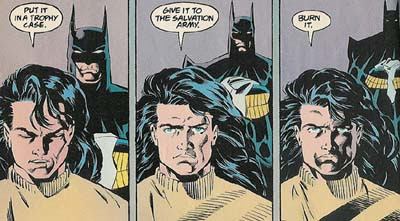
Repetitive images are also a tool for pacing. Seeing two similar panels, especially with no word balloons, tells us that time passes even when we don't see change. In the next sequence, Batman asks the third Robin, Jason Todd, to explain what happened to the rape suspect who was just with him on that balcony.
Batman's figure stays the same, so we sense he's waiting and waiting for an answer. These panels are from Batman, #424, script by Jim Starlin, art by Mark "Doc" Bright and Steve Mitchell.

Given how repetitive panels affect pacing, they can also be used for comic effect. After all, what's the key to comedy?


Timing. In the next sequence, the adult mentor of the teen-aged superhero group Young Justice orders Tim Drake as Robin and his speedy friend Impulse not to search for their missing comrade Secret.
This page comes from an uncollected issue of Young Justice, script by Peter David and drawing by Todd Nauck.

The brief, silent passage of time created by wordless panels in each of the last three examples is the equivalent of what screenwriters have come to call a beat. Such a silence can be hard to convey in prose, and The New Yorker has caught some lazy novelists instructing readers that characters "waited a beat" before they speak.

The visual dimension of comics makes it easy to convey that silent moment. Here's yet another example, from the current teen-superhero magazine to feature Robin, the third volume of The Teen Titans.
This deathless conversation was published in the volume Teen Titans/Outsiders: The Insiders. Scripted by Geoff Johns, penciled by Matthew Clark, inked by Art Thibert.

That last example also hints at something I don't like about how comics artists are applying this technique today. Many artists now work on computers ("penciled" and "inked" are just digital metaphors). That makes it awfully tempting to copy and paste an image from one panel to the next, especially when working under a tight deadline. The three-panel sequence of Nightwing and his hair far above is obviously hand-drawn, and the artists made many changes, large and subtle, from one panel to the next. But the two images of Robin above are identical down to the cross-hatched shadows and coloration.

A growing number of copy-and-paste jobs strike me as having been done without enough regard for the dramatic needs of the scene. This last example comes from Outsiders: Looking for Trouble, script by Judd Winick, art by Todd Raney and Scott Hanna. In these panels, it makes sense to draw the redhead the same because he's making a deadpan joke. His expression shouldn't change. But doing the same for Nightwing just looks like laziness. And using the same image for two panels with different characters talking apparently means that neither can be shown with his mouth open.
The only place I enjoy watching cardboard cutouts talk to each other like that is Wondermark.