Showing posts with label AUTHOR Jeff Smith. Show all posts

08 June 2010

Reasons to Smile

Today Roger Sutton announced that Raina Telgemeier’s memoir Smile is an Honor Book in the Nonfiction category of the 2010 Boston Globe/Horn Book Awards.

Even before that news, the book’s first printing sold out—despite the fact that it’s still possible to read Smile on the web. Like Jeff Kinney’s Diary of a Wimpy Kid (discussed here), Telgemeier’s book took a path to publication that seems paradoxical yet worked.

Both Kinney and Telgemeier shared their stories on the web before finding publishers. That exposure helped them to build a following as they developed their vision. Lots of people liked the result. Some of those people probably still see no need to buy the books, but many more did buy, and told their friends as well.

Since I ended my SCBWI New England conference workshop on comics scripting by suggesting that this model looked like the best route to publication, I’m delighted to have a new example of success to point to.

Jason Green interviewed Telgemeier for Playback:stl about her choice to display finished pages on the web as she created them, starting in 2004. Telgemeier explained:

I really love the print medium, and so [that] was always what I wanted to do, was to make books. And the webcomics thing happened because people kept saying, “Put your stuff on the web! Put your stuff on the web!” I didn’t know how to do that! I didn’t know what an FTP program was, I didn’t know how to get comics from my page to a screen. I had to have it all explained to me, over and over again, in detail, before I sort of figured it out.

And once I did, it was like, “Oh, I get it, you can get a much bigger audience this way, and you can really do a lot of interesting things with page layouts,” and stuff like that. But, because I came from print, I was still not stretching my wings too far as far as the format of the story, and I knew that I wanted to print it someday. So, I think it was like I was making a print graphic novel, but I was serializing it on the web on a weekly basis.
Before then, Telgemeier had self-published her mini-comic Takeout, another way of developing an audience. That route was easier years ago, given the economics of comics distribution, but today the web is clearly more affordable and powerful. Of course, you’ve gotta have appealing content and the energy to promote it.

In the same year that Telgemeier started to share Smile, Scholastic’s David Saylor announced that the firm had commissioned her to adapt Ann S. Martin’s Baby-Sitters Club into comics form. The success of those books helped put her name on booksellers’ computers.

Telgemeier could probably have published Smile herself, based on that success, but the effort would have taken a lot of her time. Instead, she signed with Scholastic. That firm has a powerful distribution arm, including those school book fairs. It has the capital to invest in color printing, as with Jeff Smith’s Bone, which sets the print edition of Smile off from the web pages. And there’s still cachet in coming out through a major publisher—but that’s not as valuable as an already established readership.

03 December 2009

Bone on a Phone

I flagged two items that Brigid Alverson highlighted at Good Comics for Kids, showing two ways of reading Bone by Jeff Smith that appear to be on a collision course with each other.

Back in January, Josiah Leighton discussed the movement depicted in two pages of Out from Boneville, as part of a discussion of how drawing for animation differs from drawing for comics. I’ll quote a bit of his analysis, but I recommend reading the whole thing alongside the pages:

Notice first how Smith expertly subdivides the action by tiers. Each horizontal is a distinct set piece of the ongoing chase. This is a great way to start laying out the page.

Notice also the big climax, the shift of the action that sends it down rather than across, is placed on the page turn. This is also the best method for deciding where one page ends and the next begins within a continuous scene, NOT the oft used oh-crud-I-ran-out-of-space-I-guess-it’s-time-to-start-drawing-on-the-next-piece-of-bristol method.
(That same sequence also shows Smith’s success in scripting dialogue. The phrase “Stupid, stupid rat creatures!” became the series’ first catch phrase, and proves useful in many situations.)

This month, Eric Federspiel discussed “Mobile Comics Apps in the Classroom,” at Graphic Novel Reporter. He makes the case for having students read comics—specifically, the same volume of Bone—on a smartphone, a format that shows only one panel at a time:
There are obvious shortcomings of such apps, including the relatively small size of the screen, splicing of large panels or two-page spreads into multiple viewable pages, oversimplification of page layouts, etc.

However, the comics nerd in me has to admit that as much as I enjoy seeing how an artist organizes his/her storytelling in terms of varied and unique page layouts, the truth is that my students have great difficulty with such organization. Considering how much emphasis traditional reading and writing instruction places on consistency and structure, it’s been my experience that seventh graders are not necessarily impressed by this kind of creativity. Most are purely seeking fun, simple storytelling.

Viewing one panel at a time, my students do not need to focus their attention on decoding the organization of multiple images on one page. Instead, they can focus on the simple relationships between text and images within each panel.
But viewing Bone one panel at a time means that the formatting Leighton discusses above—the tiers, the page turn—gets wiped away. Readers can see how panel shapes and scales change, but not how they relate to each other. It seems like the equivalent of reading a classic novel in an abridged version with all the hard vocabulary replaced with “fun, simple” synonyms.

09 August 2008

Captain Marvel Takes Off Again

Readers eagerly awaiting the next volume of Jeff Smith's Bone comics as reissued by Scholastic should check out the big comics project he turned to next after completing Bone in its original, black and white form.

It's Shazam!: The Monster Society of Evil, created for DC Comics. This volume retells the origin and an early adventure of Captain Marvel, as well as his sister Mary Marvel. It also picks up elements of a 1940s Captain Marvel story arc, a rare multi-volume story from American comic books' "Golden Age." However, readers don't have to know anything about Captain Marvel before picking up this book.

Like Bone, Smith's Shazam! is both layered and easy to follow, poking at deep ideas but fun for all ages. The art reflects his personal style, which is in between the very simple cartoons that C. C. Beck used for the original Captain Marvel stories and the "default style of the superhero mainstream." Though it changes some elements of the Big Red Cheese's mythology, such as making Tawny Tiger a shape-changing ifrit instead of a tiger in a business suit, Smith sticks to the simple values beneath any good Shazam story.

For readers wanting more after this, Judd Winick and Josh Middleton's take on the first meeting of Captain Marvel and Superman, Superman/Shazam!: First Thunder, has some of the same simplicity and a few very good moments, but less depth in the end.

21 June 2008

Well, They Both Smoke—But One Is Actually Capable

At A Year of Reading, Mary Lee posted a report on Scott McCloud's public interview of Jeff Smith, creator of Bone, in conjunction with those exhibits of Smith's work in Columbus, Ohio, last month. She wrote:

Insider trivia: Check for similarities between Smith's dragon and Doonesbury's Zonker.
Below is an image of a limited-edition, cold-cast statue of that red dragon, sculpted by Randy Bowen for Graphitti Designs.

11 June 2008

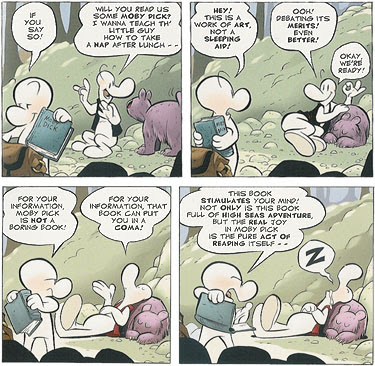
The Bones Give a Book Talk

Fone Bone, the central character of Jeff Smith’s Bone comics, and his contented cousin Smiley Bone look for different things in a work of literature.

“Debating its merits,” indeed.

These panels, as is evident from the color, come from the ongoing reissue of Bone by Scholastic. Specifically, from volume 5, Rock Jaw: Master of Eastern Border. Read them all.

10 May 2008

The Museum Exhibit That Actually Interests Me

The "Superheroes: Fashion and Fantasy" show at the Metropolitan Museum of Art in New York is getting lots of hype, but the more I read about it, starting with a bare mention in this issue of Vogue, the less it interests me. This exhibit led to Michael Chabon's New Yorker essay on superhero costumes--which I thought missed the point. Today's New York Times review reveals that, although the show claims to be about American superhero influence on fashion or vice versa, it includes only two American designers. The superhero theme looks like nothing but an excuse to dress manniquins outrageously.

Here's the museum exhibit that I'm sorry to be missing: the combined "Jeff Smith: Bone and Beyond" and "Jeff Smith: Before Bone" show opening today in Columbus, Ohio. Smith's website has featured many images of the exhibit being assembled. This page has a video about his start as a comics artist and how the exhibit came together.

For souvenirs, there's a poster, a catalog featuring articles by Scott McCloud and Neil Gaiman, and even a small, back-up catalog, among other stuff. Here's a Newsarama article on the exhibit with more detail, which is where I first learned about it.

10 March 2008

A Bone to Pick

Cynthia Leitich Smith's Cynsations provided a link to this BookPage article on comics artist Jeff Smith, creator of the delightful comic Bone.

The conversation offers this glimpse of Bone's transition from self-published comic magazine to multi-volume set from the major children's publisher Scholastic:

Smith encountered his own surprise when he began talking with Scholastic--namely, the suggestion that the Bone series be published in color. Smith says that, when he first created Bone, he stuck with black-and-white for several reasons, including a small budget, an affinity for newspaper comics and his desire to pay tribute to Art Spiegelman’s Pulitzer Prize-winning graphic novel memoir, Maus. . . .

"At first, I thought the idea was a little sketchy, that it would be like colorizing Casablanca," Smith says, adding that he's not comparing Bone to the classic movie. "But then, I felt we could do storytelling things with color: create depth, direct people's eyes, create a mood. If something is happening at sunset or twilight, you can only tell the reader or draw really long shadows [in black-and-white]. But if you throw a bright orange light on it, you can really change it. I've been won over."
Although Scholastic is sending Bone into children's libraries, Smith also says he originally created the magazine "for other cartoon-heads. . . I definitely wasn't picturing them as children's books."

That's another piece of evidence for something I've been ruminating about since reading Cybils graphic-novel nominees in January: that in American culture people are more apt to think that a book in comics form is for kids even when that's not very apt at all. Bone reminds me of nothing more strongly than Walt Kelly's Pogo, and although I and many other young readers enjoyed that newspaper strip it was definitely directed at grown-ups.