Showing posts with label folklore and other myths. Show all posts

25 September 2026

A False Lead on Mrs. F. E. Woodbury

While researching the story of Hal Roach’s first marriage, I encountered a story that appeared in many American newspapers in late 1915.

The earliest example in my databases was in the 1 October Reno Gazette, shown here. Its headline then was: “She Gets Rich by Swapping / Now She Has Bank Account”.

That article showed a photograph of Helen G. Woodbury taken in Calumet, Michigan, probably in the 1890s. That picture was labeled “Mrs. F. E. Woodbury.”

The story, datelined Los Angeles, started: “‘David Harum’ has been outdone by a woman.” David Harum was a bestselling novel by Edward Noyes Westcott published in 1898, largely a character study of a sharp deal-maker. A movie adaptation had been released earlier in 1915.

According to the article, “Mrs. F. E. Woodbury” had “started to barter ‘for the fun of it,’” trading her imported gowns for a piano, a dentist’s kit, bird specimens, paintings, and eventually real estate—$22,000 worth of new property in all.

The story ended:
She is at present in charge of a hotel here, but intends soon to raise hogs and alfalfa on a southern California ranch.
Appearing in the season when Helen G. Woodbury Roach filed for divorce, the story didn’t seem out of character for a person of whims. She wasn’t “at present in charge of a hotel,” to be sure, but she was found the following year to have invested a lot of money into a restaurant and hotel. So I put this article into my research file on Hal Roach’s first wife.

To be safe, I went looking for the original Los Angeles story. And I found it—sort of.

Almost exactly the same text had appeared on the front page of the Los Angeles Daily Herald on 20 September. The two big differences were:
  • The earlier story described the trading of “Mrs. E. F. Woodbury” instead of “Mrs. F. E. Woodbury.”
  • The Herald ran a different photograph of a different woman.
A little more digging, and I learned that Mrs. E. F. Woodbury was the former Joan Meta Hadenfeldt (1873–1969), second wife of Elmer Franklin Woodbury. She had sung in vaudeville, married in 1904, and was the second or third queen of the Rose Parade in Pasadena.

These Woodburys were in the hotel business. Elmer started by owning a restaurant in his home state of Maine. In 1908 “Mr. Woodbury and his charming wife” were managing the Hotel Pepper in Los Angeles, according to the Hotel Bulletin. That article said of Elmer, “As a hotel manager he is one of the greatest publicity getters whom I have ever seen.”

The 25 Feb 1909 San Francisco Call stated Woodbury had just bought the St. Mark Hotel in Oakland, adding:
For many years the new manager was connected with the Cadillac hotel of New York and the Brighton Beach hotel. He came to California three years ago and has been in charge of the Maryland and Casa Grande hotels in Pasadena.
In September 1911, the New York Times reported that Woodbury had overextended himself in buying “the Hotel Belleclaire, at Broadway and Seventy-seventh Street,” assuming its debts. He declared bankruptcy in New York but bounced back on the west coast.

On 11 Sept 1915, less than a week before Joan Woodbury appeared on the front page of the Los Angeles Herald, a big advertisement in the paper’s evening edition announced that she and Elmer were opening a new “Apartment Hotel” called the Stratford. They continued to advertise in that newspaper for weeks.

Thus, it appears that a Los Angeles news story about Mrs. E. F. (Joan) Woodbury trading goods, played up to publicize her husband’s new venture, was distorted outside the city into a story about Mrs. F. E. (Helen) Woodbury. Somehow Helen’s old photo got attached. And since those latter articles appeared far from Los Angeles, neither Mrs. Woodbury saw them and asked for a correction.

Contrary to that news item, Joan Woodbury didn’t leave the hotel business to run a ranch. In fact, in 1920 Elmer purchased a twenty-year lease on the Hotel Richelieu in San Francisco. That year’s US Census listed Joan as his assistant manager.

The same census also found the household included four-year-old Joan Elmer Woodbury and her eighteen-year-old governess, Marie Sandow. Five years later, Elmer and Joan Woodbury divorced. Five years after that, Elmer married Marie as his third wife.

As for little Joan Woodbury, she started performing in motion pictures as early as The Half Breed, produced in 1922 by Oscar Morosco (formerly producer of L. Frank Baum’s stage musical The Tik Tok Man of Oz). She returned to the screen in the late 1930s and performed in many B westerns over the next decade.

07 September 2026

The Real Story of How the Hal Roach Studio Began

The standard story of the founding of the Hal Roach Studio appears in Roach’s obituaries, in Richard Lewis Ward’s History of the Hal Roach Studios, and in Craig Calman’s 100 Years of Brodies with Hal Roach, among other sources.

That tale starts in 1914 when the struggling young movie actor Harold Eugene “Hal” Roach (1892–1992) came into money through an inheritance, often stated as $3,000.

Roach used that windfall to form a film production company with the businessman Dan Linthicum (1878–1952), combining the first letters of their last names to create the trademark “Rolin.”

Linthicum soon left the business, and a few years later Roach renamed the company after himself. His friend Harold Lloyd had become the studio’s star, first as Lonesome Luke and then in eyeglasses. Then came the Our Gang series, Charley Chase, and finally Laurel and Hardy. The independent Roach studio became Hollywood’s most successful and classiest supplier of comedy shorts.

That version of Roach’s story also says that in 1916 he married the actress Marguerite Nichols (1896–1941), and they had two children together. The year after Marguerite died, Hal married Lucille Prin (1913–1981), and they had four more daughters. Hal Roach’s obituaries referred to Marguerite as his “first wife.”

In fact, Marguerite was Hal’s second wife, and Hal didn’t receive an inheritance in 1914.

I started looking into this story in the spring after hearing Steve Massa speak about how Rolin got started on the “Becoming Harold Lloyd” episode of the Man in the Glasses podcast. Dave Lord Heath’s delight-filled website offers more details, as does Find a Grave, and I dug into newspapers for additional stories.

Like the great Hollywood story Citizen Kane, this tale begins with a mine.

TOMORROW: The fatal shaft.

11 July 2026

The Facts Behind the First News Stories about an “Our Gang Curse”

My last two postings have posited that the long-lived public discussion of an “Our Gang curse” started with a couple of wire-service articles in early 1959, spurred by the deaths of Carl “Alfalfa” Switzer and Don “Fats” Law.

Carl Switzer had indeed been a star of many Our Gang shorts. He had a bad death, shot in the groin in a fight over $50 for training a hunting dog. He was only thirty-one. Yes, that can sound cursed.

But Don Law, who “died of an intestinal disorder” a couple of weeks later, was never in the Our Gang movies, much less in twenty of them as his obituary claimed. That series never had a character named “Fats.” Law’s death got nationwide attention because it came so soon after Switzer’s, and that concatenation launched the “Our Gang curse.” Yet that coverage was based on a lie.

The long May 1959 article by Rick Du Brow about the Our Gang alumni as a “pathetic group of Hollywood ‘has-beens’” rested on similar misinformation. It offered a list of five Our Gang alumni who had “died in the past seven years” alone. Two were Switzer and Law, so right away the pattern was weaker than presented.

That list of recent deaths included the actress Helen Parrish, but she was never in the Our Gang series. Parrish had been a child actress in the 1920s, appearing in one Smitty short with Donald Haines, who was later part of the gang, but that’s as close as she got.

Clifton “Bobby” Young did appear in a bunch of Our Gang shorts in the late 1920s and early 1930s before his adult acting career. He died in a fire in 1951, and thus not in “the past seven years.”

Billy “Froggy” Laughlin (not McLaughlin, as Du Brow had it) was a regular in the late Our Gang shorts from MGM. He died at age sixteen after a motor scooter crash in 1948. Again, that wasn’t in the preceding seven years. Du Brow obviously stretched for examples to produce the illusion of a trend.

Du Brow also mistakenly listed Eddie Bracken and Nanette Fabray as Our Gang alumni. He wrote that embezzler Lea Artye Folz had been in the gang; she had small roles in three shorts but more appearances in rival series and features.

Du Brow said the Rev. Ben Griffith had played Mickey McGuire in Our Gang; that was the title character in a rival series, played by Mickey Rooney and Marvin Stephens. Griffith did claim to have played that part in Our Gang as early as 1950 and as late as his 1988 autobiography, but I don’t see confirmation anywhere.

I also mentioned a Miami News article from early 1959 listing four locals as Our Gang regulars. Only one was: Shirley Jean Rickert, who made six appearances in 1931 followed by an equal number of Mickey McGuire shorts in 1933–34. Geraldine Fay and Sy Rich had no discernible link to Hollywood. Jack Ray made a fleeting appearance in one Our Gang movie in 1926, but he never played “Freckles” in the series as the Miami story said. (Ray did, however, spend most of his childhood appearing in theaters across the US, Canada, and western Europe claiming to have played “Freckles” in Our Gang. I’m still collecting information on him.)

Thus, in 1959 a lot of people were telling false stories about being in Our Gang as children, possibly because of work on other series, possibly out of wishfulness. Yet Du Brow was actually in touch with Fern Carter, who knew exactly which kids she had taught. And he still got a lot of names wrong.

Bob Thomas’s earlier Associated Press article started with “the legend that the famed little rascals have been ill-fated,” but it was actually an interview with producer Hal Roach. He knocked down the idea of a jinx, saying that “176 kids” had appeared in his series, and many had “turned into happy respected citizens, including doctors and lawyers here in Los Angeles.” (Early Our Gang player Jack Davis was indeed a doctor. I can’t think of an alumnus who became a lawyer, though.)

Some newspapers therefore gave Thomas’s AP dispatch headlines like “‘Our Gang’ Normal Group of Kids—Roach” (Morris Herald-News, 17 February) and “Roach Denies Ill Fate Plagues ‘Our Gang’” (Duluth News-Tribune, 18 February). But that fact-based argument didn’t have the appeal of the “Our Gang curse.”

In his UPI story, Du Brow cited an even higher number of kids in the series—“more than 300 youngsters.” But then he ignored the consequences of that math. He wrote that four highly successful performers were “just a fraction” of the total while five deaths (which included two people with no part in the series) were representative of the larger group.

Clearly those reporters sensed that the public would lap up the idea of an “Our Gang curse.” And the longevity of that idea—bolstered, to be sure, by some sensational deaths after 1959—shows that their sense was right.

[The photo above shows Fern Carter teaching arithmetic to Pete the Pup, Allen “Farina” Hoskins, and Jean Darling during a publicity tour in 1928.]

10 July 2026

“Possibly the most pathetic group of Hollywood ‘has-beens’”

Yesterday I quoted the February 1959 story from the the Associated Press’s Hollywood columnist Bob Thomas that began:
The recent deaths of two former members of “Our Gang”—one shot in an argument over $50—adds to the legend that the famed little rascals have been ill-fated in later life.
That article ran nationwide under headlines like “Was ‘Our Gang’ Jinxed?” (Illinois State Register, 17 February) and “‘Our Gang’ Ill-Fated in Later Life” (Sarasota Journal, 20 February).

As I wrote yesterday, that’s the first example I’ve found of the American media portraying veterans of the Our Gang comedies as prone to suffering sad adult lives.

A couple months later, Rick Du Brow of United Press International filed a longer story expanding on the same topic. When it appeared in the San Francisco News on 9 May, the headline was “Tragedy Stalks ‘Our Gang’.” Du Brow began:
Possibly the most pathetic group of Hollywood “has-beens” are the many former Our Gang child stars who flickered briefly to fame and prosperity only to come to grief as adults.

Five members of the “Gang” have died in the last seven years—some violently. . . .

Some “Our Gang” graduates, of course, have achieved success. These include Jackie Cooper, Eddie Bracken, Nanette Fabray and Johnny Downs. But they represent just a fraction of the more than 200 youngsters who made up of the most famous “gang” of all time in the last 38 years.
Having interviewed George “Spanky” McFarland back in February, as mentioned yesterday, Du Brow ran those quotes again to indicate McFarland was “having trouble.”

Darla Hood (shown above in a shot for TV Guide in 1955) was noted for her appearances in night clubs, on radio, and in TV shows, but she wasn’t included in that initial list of successful performers.

Du Brow spoke to Fern Carter, the kids’ regular teacher at the Hal Roach and MGM studios. She kept in touch with as many of her former pupils as she could. I doubt she liked how this article portrayed them as adults with troubled marriages and worse.

The article listed these five recent deaths:
  • Carl “Alfalfa” Switzer, shot the preceding January.
  • “Helen Parrish, 35-year-old TV actress, died last February of cancer.”
  • “Don Law, who played ‘Fats,’ died of an intestinal disorder at the age of 38 in Meadsville, Pa.”
  • “Froggy McLaughlin…killed in a motor scooter accident several years ago near Huntington Beach, Cal.”
  • “Clifton Young…died in a 1951 Los Angeles hotel fire.”
Du Brow also noted Scotty Beckett’s well publicized troubles with the law, Shirley Jean Rickert’s appearances in burlesque, and Mickey Daniels having “fled to Africa in search of a new life” (he worked in construction and mining).

One paragraph stated:
Tough guy Mickey McGuire became the Rev. Ben Griffith, a Los Angeles evangelist. And Lea Artye Folz, 38, was placed on probation three years ago after being charged with embezzling $5000 from a bank.
Did being a minister cancel out being charged with theft? Or were both activities signs of a troubled adulthood?

As mixed up as that portrayal of the Our Gang cast was, articles like Thomas’s and Du Brow’s appear to have established the idea in American culture that those kids were unusually liable to have sad adult lives and early deaths. Even today, websites address the question of an “Our Gang curse.”

But both those nationwide wire service dispatches were full of bad reporting, spun out of sensationalism, shoddy math, and lies.

TOMORROW: The facts behind the headlines.

11 July 2020

Interpreting Incident at Hawk’s Hill through the Autism Lens

How are we to make sense of the 1971 novel Incident at Hawk’s Hill and the actual 1873 event at its root?

In 2004, Prof. Kenneth Kidd wrote about Allan W. Eckert’s novel for the children’s literature journal The Looking Glass. In that paper, titled “Leave It to Badger,” Kidd reported that he’d found no corroboration of Eckert’s claim that he had based the book on a real incident.

At the time, digital book and newspaper archives were in their infancy, so it wasn’t as easy to find the period sources I quoted back here, or the intervening secondary sources I analyzed here. Not only did Eckert have reason to believe he was working off a report of a real incident, but it’s clear that a lost little boy was indeed found in a badger hole in 1873 Manitoba. Would that knowledge have changed Kidd’s analysis?

Kidd made sense of the novel by applying the thinking in his book Making American Boys: Boyology and the Feral Tale. He discussed the story through the lens of folklore. Many cultures have stories about children being raised by animals, including such famous western examples as Romulus and Remus, Mowgli, and Tarzan. Viewed entirely as fiction, Eckert’s novel fits into that paradigm. Kidd saw an Oedipal dimension to such stories in general and Eckert’s novel in particular.

Of course, when the event at the core of Incident at Hawk’s Hill—a little boy lost on the prairie who survives by finding shelter in a badger’s hole—is real, then the ways people tell that story aren’t new examples of old folklore but attempts to understand what really happened. (Or, in the case of Eckert’s acknowledged fiction, to present what might have happened.)

Bruno Bettelheim’s paper “Feral Children and Autistic Children,” published in the American Journal of Sociology in 1959, was an attempt to explain similar events. Bettelheim posited that the root of many of those stories of children raised by animals is autism, a psychological condition he was groping to understand. Throughout history, he wrote, people had seen “severe cases of infantile autism with seemingly animal-like traits and habits” and explained that behavior by believing the children had been raised by animals.

Bettelheim’s own theory of autism was deeply flawed. In that same paper he posited that it was largely or entirely due to “extreme emotional isolation combined with experiences which they interpreted as threatening them with utter destruction.” As for the source of the emotional isolation, Bettelheim mostly blamed mothers (of course), saying they were the real “feral” ones.

While Bettelheim’s theories about autism and how to respond to it have fallen by the wayside, his suggestion that autism explains many examples of “feral children” has caught on. Uta Frith analyzed some historic cases of "feral children” in Autism: Explaining the Enigma (1989) and elsewhere. She suggested, “an unduly high proportion of feral children suffered from autism before they were abandoned. Indeed autism, with its often severe conduct problems, may be the cause for the abandonment in the first place.”

Frith’s book and others have helped to make our culture much more aware of autism since Incident at Hawk’s Hill appeared in 1971. We now recognize a spectrum of related conditions under the autism label. Not only do we better distinguish autism from other cognitive conditions, but we acknowledge autistic ways of thinking and viewing the world in high-functioning individuals.

That knowledge allows us a new perspective on how authors from earlier generations discussed the story of the little boy lost on the Manitoba prairie. The initial reports said almost nothing about the boy himself, only that he was scared when men came by. It’s not clear how much detail in the oral traditions is based on fact and how much was added by people seeking to comprehend the mystery. Nonetheless, the more detailed recounting by Ernest Seton Thompson and the fictionalized story of Allan W. Eckert lend themselves to interpretation through the lens of autism.

Seton was quite clear about little Harry Service not being normal:
He was a strange child, very small for his age, and shy without being cowardly. He had an odd habit of following dogs, chickens, pigs, and birds, imitating their voices and actions, with an exactness that onlookers sometimes declared to be uncanny.
For Seton, this affinity with animals was a strength. He linked kindness to animals with general goodness, and equated cruelty to animals with cruelty to people. Seton’s tale contained an explanation for how this boy survived in the badger’s hole—because the badger, having lost her own young, showed maternal kindness to this unusual newcomer. And he concluded with an optimistic suggestion that Harry’s experience with the wild badger cured him of his most obvious strangeness.

In Incident at Hawk’s Hill Eckert picked up on those details and made a major subplot of the boy’s parents wrestling with what we’d now call their youngest son’s special needs. Early in the novel, Bill MacDonald tells his wife:
“Oh, what’s the use of trying to fool ourselves? He isn’t normal, Esther, and we both know it, whether or not you’re willing to admit it. He not only isn’t normal physically, he’s not normal mentally, either. Look how he acts toward animals.”
When Eckert finally shifts his narration into the little boy’s own perspective, it states:
Ben had no idea why he was so afraid of people. He was not, as his father seemed to think, retarded in his mental processes. He was, in his way, quite intelligent. He could think things through very well for his age and he retained a surprising percentage of what was taught him by his mother and the others. It was just that he kept what he learned to himself. He didn’t like to talk to people.
Was this Eckert’s attempt to depict an autistic child? Someone he knew, something he felt? Or was he picking up imaginatively on the hints in Seton’s story? I have no idea. In the end, Eckert followed Seton’s line and portrayed the experience out on the prairie as making Ben open up more than ever, especially to his father.

Reflecting the greater awareness of autism today, many recent readers of Incident at Hawk’s Hill interpret Ben forthrightly as on the autism spectrum. Monado at Book Crossing describes him as “a boy, whom these days we’d describe as autistic,” while Lori Steinbach at enotes says he probably has “a condition something like autism.” The Home School Book Review said, “Ben would probably be considered somewhat autistic today.” At Goodreads, the Shayne-Train wrote, “now that I [re]read it with adult eyes, it may be the first novel I’d ever read that had an autistic protagonist.” And the study guide for the novel at Bookrags includes a whole section on autism.

Such a diagnosis is of course only a partial explanation for the character, or the history deep behind it. Did the little Service boy who got lost on the Manitoba prairie have some form of autism? How did that affect his lost time, or his family’s and neighbors’ interpretations of it? What experiences with autism, a condition not yet isolated and named in the early 1900s, did Seton have? What about Eckert, writing in 1971? Is it just coincidence that this modern example of a “feral child” story fits so easily with an autism reading, or are we still seeking an explanation with the partial knowledge we have?

30 September 2014

A Myth about Oz’s “Women in Strong Leadership Roles”

A new myth about banning The Wonderful Wizard of Oz has cropped up and spread on the web.

Back in March 2013, R. Wolf Baldassarro posted a blog essay about objections to the book. Baldassarro isn’t a librarian, educator, or scholar. He’s a “seasoned paranormal investigator” who happens to feel strongly about book banning.

I found several faults with that essay, including falling for a 2004 Deadbrain hoax about Jerry Falwell and misquoting sources.

Baldassarro’s essay also said about the book:
Nevertheless, it has come under attack several times. Ministers and educators challenged it for its “ungodly” influence and for depicting women in strong leadership roles. They opposed not only children reading it, but adults as well, lest it undermine longstanding gender roles.

In 1928, the city of Chicago banned it from all public libraries.
Note that the words “depicting women in strong leadership roles” were Baldassarro’s own. While ascribing that thought to “Ministers and educators,” he didn’t cite any source, person, place, or date for that complaint.

Despite (or because of) how it overstated the evidence, Baldassarro’s essay got quoted on Buzzfeed and other sites.

Then this February Kristina Rosenthal at the University of Tulsa’s McFarlane Library posted her own essay on the book’s troubles with librarians and censors, which said:
In 1928 all public libraries banned the book arguing that the story was ungodly for “depicting women in strong leadership roles”. This argument remained the common defense against the novels from ministers and educators through the 1950s and 60s.
Baldassarro’s statement about a supposed policy in Chicago thus became a statement about “all public libraries,” and his phrase “depicting women in strong leadership roles” appeared as if it were a direct quotation from those 1928 book banners. That’s shoddy scholarship.

Furthermore, that statement doesn’t stand up to the briefest historical scrutiny. In 1928, Reilly & Lee was publishing one book every year in the Oz series, and would continue to do so for over a decade. How would that have remained economic if “all public libraries banned the book”? Hollywood adapted The Wonderful Wizard of Oz as a feature film in 1925, a cartoon in 1933, and a major feature in 1939. If the book had so many opponents, why was it so broadly popular?

Was there really widespread opposition to “women in strong leadership roles,” even in a fairy tale, in 1928 America? Women had just finished serving as governors of Wyoming and Texas. In 1929 nine women took seats in Congress, including one elected from Illinois.

Finally, people who actually read The Wonderful Wizard of Oz know that its “women in strong leadership roles” consist of Glinda and possibly the Good Witch of the North; two others, the Wicked Witches, are actually eliminated. Meanwhile, the story shows the Scarecrow, Tin Woodman, and Lion all becoming males in strong leadership roles.

I don’t think there’s any evidence of widespread, powerful objections to The Wonderful Wizard of Oz or its sequels based on their depiction of Glinda, Ozma, or Dorothy as strong females. There’s certainly no evidence that was cited in 1928 as a reason for “all public libraries” or any to ban the book. That’s a myth based on our wish to see ourselves as greatly superior to the people of past decades.

25 September 2014

Crowdsourcing Archeology

I caught this interesting story from the Guardian earlier in the week.

It seems that back in September 1954, some archeologists were exploring a site in London before an office building went up there, and in the last hour of a Saturday afternoon they discovered a Roman temple. The Temple of Mithras, to be exact.

It’s almost unfathomable to me as a New World native, but the British authorities apparently have so many Roman ruins to oversee that they decided this one couldn’t interfere with the construction project.

To be sure, there was a lot of press attention, and crowds so large that police had to be called in, but in pretty quick order the temple ruins were simply “moved and haphazardly reconstructed on another part of the site.” Without good documentation or preservation.

The Guardian picks up the story:
Now Museum of London Archaeology (MoLA) experts are trying to recover as many memories of the site as possible, and hope to discover colour photographs or even paintings to help with the project to reconstruct it yet again, this time accurately and back on its original foundations.

Site records say the stones were originally joined with pink mortar, but apparently no samples were kept. They hope a visitor may have left with a souvenir piece of mortar in a pocket, and that it’s still out there in a cardboard box on top of a wardrobe.

Already a ticket has turned up that suggests some of the visiting public were allowed to help with the digging. A startling letter, evidently from the friend who secured it for the donor’s aunt, said: “One has to get a ticket from Humphreys of Knightsbridge. We did this and got one for you too because they say today is the last day! So do go along … We found bones and a tooth.”
So this is a project to recover memories and artifacts of an event sixty years ago, in order to better preserve a site (already disturbed) from somewhat less than two thousand years ago.

22 September 2014

Philip Pullman in Three or Fewer Dimensions

Princeton’s Cotsen Children’s Library has a podcast called “Bibliofiles,” and this comes from its new conversation with author Philip Pullman:
I’ve written four fairy tales. I call them fairy tales—I Was a Rat!, Clockwork, The Firework-Maker’s Daughter and The Scarecrow and His Servant. They’re different from my novels because the characters are flat rather than round. That’s the way I think of it.

When I’m doing a novel such as the Sally books or “His Dark Materials,” the purpose, what you’re trying to do, is make the characters as real as you can make them, which involves a certain amount of three-dimensionalism. Now you know they’ve got depths, depths sometimes which they’re not aware of themselves. So you want to make those characters as real as possible.

But in a fairy tale, such as the four books I’ve mentioned and of course, “Puss in Boots,” I've done that, and the Grimm tales, the Tales from the Brothers Grimm, character isn’t such an important thing. All the characters in a fairy tale are pretty flat, really. They don’t have much depth. And the interest of the story is not in the psychological complexity of the character so much is in the incident and what happens and what succeeds and will follow it. So they’re different kinds of writing.
Pullman is of course pulling from E. M. Forster’s Aspects of the Novel, as well as the Victorian distinction between “novels of incident” and “novels of character.”

29 May 2014

From Spring Heel Jack to Batman

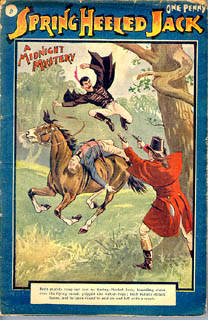
Among the ephemera on display in the “Comics Unmasked: Art and Anarchy in the UK” exhibit at the British Library is a penny-dreadful tale of Spring-Heeled Jack, which the curators suggest was an inspiration for Batman, pointing particularly to his horns.

I thought that was a stretch. Not that Bob Kane and Bill Finger were above borrowing plots, images, and details from other adventure stories of their time, acknowledged and unacknowledged. But how would two guys growing up in post-WW1 America have seen the Spring-Heeled Jack magazine serials from Victorian Britain? And wasn’t Spring-Heeled Jack a monster and/or troublemaker instead of a crimefighter?

At io9, commenter Michael Munro laid out a lineage of pulp fiction leading from London to California to Gotham:
Spring Heeled Jack…transitioned from London urban myth (1830s) to melodrama anti-hero (1870s) to prototype superhero (1880s-early 1900s). As written by "penny dreadful" author Alfred Burrage, SHJ was a wealthy aristocrat who assumed the disguise of a devilish, bat-winged avenger of the night, maintained a secret underground lair and used his athletic and technological skills to battle evil-doers - sounds familiar?
Expounding at more length, Munro wrote:
The several "penny dreadful" iterations of Spring Heeled Jack, many written by Alfred Burrage under the pseudonym "Charlton Lea", portrayed him as a nobleman who had been cheated out of his inheritance and who took up a devilish disguise to punish those responsible. Along the way, Spring Heeled Jack also rescued damsels in distress and generally stood up for the innocent and downtrodden. He wore a distinctive mask and costume and was capable of performing incredible leaps thanks to a special pair of boots, credited in one source to a secret mechanism invented by Indian street magicians.

Anticipating Zorro, Jack was fond of marking both enemies and territory by carving his initial with the point of his rapier. He also maintained a secret underground lair (in a converted crypt) and terrified his adversaries with his ringing laugh and catch-phrase, "The day is yours - leave the night to me!"
As Munro notes, the Batman team acknowledged Zorro, created by Johnston McCully in 1919, as an inspiration. Thus, Spring-Heeled Jack wasn’t a direct influence on Batman, and the horns/ears were a shared trope rather than deliberate borrowing.

25 December 2013

The Tradition of the Gävle Goat

For this holiday, Oz and Ends brings you the story of the Gävle Goat.

As Slate describes, the Gävle goat was instituted all the way back in 1966, when two brothers—an advertising consultant and a fire department chief—organized an effort in the city of Gävle to build a large straw statue of a goat for Christmas season. The goat represented one of the two that pull Odin’s chariot in Scandinavia’s pre-Christian pagan lore. It lasted just a few minutes into the New Year before it burned down.

Now you’d think that building a forty-foot-tall statue out of straw (over a metal frame) in honor of the winter solstice would just invite a bonfire. Even in Sweden, where there’s such a steady supply of snow to keep the straw cold and wet. But Gävle works to prevent its goat from burning. There are flame retardant chemicals, volunteer watches, police patrols, and webcams.

And those measures usually don’t work. The news reports I’ve seen differ on how often the Gävle Goat has been torched, though they agree that number is in the high twenties—i.e., more than half the time. The counts might be confused by the fact that it’s been destroyed in other ways: hit by cars and dismantled by hand (and foot). In 1970 the goat survived less than a day, though those young arsonists were caught. In 2005 people costumed as Santa Claus and the Gingerbread Man shot a flaming arrow at the goat and escaped.

In 2010 the goat survived the entire season, though there was a plot to steal it by helicopter. In 2011 it went up in flames on 2 December. In 2012 it survived until 12 December. This year, the goat went up in flames over the weekend. So at least it’s lasting longer.

Despite the widely reported tradition of destroying the Gävle Goat, it’s illegal to do so. In 2001 a visitor from Cleveland torched the goat, thinking he was participating in a local tradition. He was arrested, jailed for eighteen days, and fined SEK100,000, which he didn’t pay. Apparently the tradition is to set fire to the goat and get away.

24 December 2013

Santa Claus and the Modern World of Central Heating

One of the hallmarks of L. Frank Baum’s fantasy writing was the crossover—and often conflict or rivalry—of fairy-tale traditions with modern technology. Here’s a passage from the final chapters of The Life and Adventures of Santa Claus, published in 1902.
By and by people made ships from the tree-trunks and crossed over oceans and built cities in far lands; but the oceans made little difference to the journeys of Santa Claus. His reindeer sped over the waters as swiftly as over land, and his sledge headed from east to west and followed in the wake of the sun. So that as the earth rolled slowly over Santa Claus had all of twenty-four hours to encircle it each Christmas Eve, and the speedy reindeer enjoyed these wonderful journeys more and more. . . .

However, there was one evil following in the path of civilization that caused Santa Claus a vast amount of trouble before he discovered a way to overcome it. But, fortunately, it was the last trial he was forced to undergo.

One Christmas Eve, when his reindeer had leaped to the top of a new building, Santa Claus was surprised to find that the chimney had been built much smaller than usual. But he had no time to think about it just then, so he drew in his breath and made himself as small as possible and slid down the chimney.

”I ought to be at the bottom by this time,” he thought, as he continued to slip downward; but no fireplace of any sort met his view, and by and by he reached the very end of the chimney, which was in the cellar.

”This is odd!” he reflected, much puzzled by this experience. “If there is no fireplace, what on earth is the chimney good for?”

Then he began to climb out again, and found it hard work—the space being so small. And on his way up he noticed a thin, round pipe sticking through the side of the chimney, but could not guess what it was for.

Finally he reached the roof and said to the reindeer:

“There was no need of my going down that chimney, for I could find no fireplace through which to enter the house. I fear the children who live there must go without playthings this Christmas.”

Then he drove on, but soon came to another new house with a small chimney. This caused Santa Claus to shake his head doubtfully, but he tried the chimney, nevertheless, and found it exactly like the other. Moreover, he nearly stuck fast in the narrow flue and tore his jacket trying to get out again; so, although he came to several such chimneys that night, he did not venture to descend any more of them.

“What in the world are people thinking of, to build such useless chimneys?” he exclaimed. “In all the years I have traveled with my reindeer I have never seen the like before.”

True enough; but Santa Claus had not then discovered that stoves had been invented and were fast coming into use. When he did find it out he wondered how the builders of those houses could have so little consideration for him, when they knew very well it was his custom to climb down chimneys and enter houses by way of the fireplaces. Perhaps the men who built those houses had outgrown their own love for toys, and were indifferent whether Santa Claus called on their children or not.
Fortunately, the modern world also afforded Santa a solution for this problem.
“I will make all loving parents my deputies!” cried the jolly old fellow, “and they shall help me do my work. For in this way I shall save many precious minutes and few children need be neglected for lack of time to visit them.”

Besides carrying around the big packs in his swift-flying sledge old Santa began to send great heaps of toys to the toy-shops, so that if parents wanted larger supplies for their children they could easily get them; and if any children were, by chance, missed by Santa Claus on his yearly rounds, they could go to the toy-shops and get enough to make them happy and contented. For the loving friend of the little ones decided that no child, if he could help it, should long for toys in vain. And the toy-shops also proved convenient whenever a child fell ill, and needed a new toy to amuse it; and sometimes, on birthdays, the fathers and mothers go to the toy-shops and get pretty gifts for their children in honor of the happy event.
After all, Baum had been editor of The Show Window, a trade magazine for retailers, just two years before writing this book. He had abiding faith in the power of American shopkeepers.

19 December 2013

Merlin Then and Now

A year ago, Yale University Press published Anne Lawrence-Mathers’s A True History of Merlin the Magician. It was a “densely written monograph,” according to Publishers Weekly, which explored the cultural manifestations of Merlin in late medieval Europe, starting with mentions in Geoffrey of Monmouth’s supposedly nonfiction history of Britain.

The Guardian’s Kathryn Hughes just decided to review the book, and her review focuses on the shocking revelation that Merlin was fictional: “It turns out that Merlin isn't real. He is, in fact, a big fat hoax, made up by a writer who had run out of things to say and was getting desperate.”

Hughes highlights how Geoffrey’s original presentation of a British prophet at “a time of great dynastic insecurity” was reassuring, and even told his local readers that “Britain had always played a special part in God's great plan. In the process, a small island stuck on the edge of the known world started to believe that it might just matter.”

Does that mean Britain’s special place is based on fraud? Hughes’s review seems to suggest Britain is really special in another way: as a cultural leader, creating in Merlin a shape-shifting trickster that becomes popular across Europe and across time.

But note the comments on the article, with Welsh readers insisting that Merlin was a real figure from Welsh myth and that non-Welsh authors have robbed the nation of its cultural heritage.

10 December 2013

He Could Play the Wizard. Then Again, He Could Play Anybody.

For its latest “By the Book” column, the New York Times Book Review interviewed actor Bryan Cranston, who’s not an author but has read audiobooks, and is much more famous and admired than many authors. Among the questions:
If you could meet any writer, dead or alive, who would it be? What would you want to know?

The “Wizard of Oz” novelist, L. Frank Baum. . . If he really was a racist as is rumored. And if so, how could he write such a heartfelt story? Were the Munchkins a metaphor? Did he have the Wicked Witch of the West killed off because he hated green people?
The question of racism involves Baum’s editorials on the Sioux, which I discussed back here. The Munchkins as metaphor might refer to the silly Populist allegory theory. As for the Wicked Witch, she was green in MGM’s Technicolor movie; in Baum’s book, she had only one eye.

But Cranston’s fundamental question remains: What is the source of heart-warming art? Does it require an author to be pure of heart himself? Or is that a requirement we fans wish to impose?

05 December 2013

Princesses in Golden Dreams

Ruth Sanderson paints really nice fairies and princesses. She’s also really nice herself; we worked together on an SCBWI bookstore event this fall.

There’s an exhibition of Ruth’s work at the Norman Rockwell Museum right now through February: “Dancing Princesses: The Fairy Tale Art of Ruth Sanderson.” That museum now owns the original paintings for her version of The Twelve Dancing Princesses. The opening reception for this exhibit takes place on Saturday, 7 December, from 4:00 to 6:00 P.M.

In addition, Ruth is participating in the Cottage Street Open Studios in Easthampton, Massachusetts, on Friday (10:00 to 4:00), Sunday (noon to 4:00), and Saturday, 14 December (10:00 to 4:00).

And for folks who can’t make those events, she’s published a 224-page hardcover book titled Golden Dreams: The Art of Ruth Sanderson. Below, courtesy of Fairy Tale News, is an image showing how Ruth assembled the painting above with sketches and photo references.

04 November 2013

“Add a Manicule in the Margin,” Tom Said Pointedly.

I read a couple of interesting extracts from Keith Houston’s new book on typography, Shady Characters: The Secret Life of Punctuation, Symbols, and Other Typographical Marks, including an article on the history of the “manicule”: the pointing hand drawing readers’ attention to a particular line or passage.

Created by medieval scribes, that symbol was reproduced by early printers. The presence of the pointing hand in many early sets of lead type justifies Houston’s decision to treat it as a form of standard punctuation. Web-browser programmers adapted or reinvented it for designating hyperlinks as one moves a computer cursor over that part of the screen.

But what’s the standard term for the pointing hand? Houston uses the Latinate word “manicule,” which carries an air of antiquity. However, Michael Quinion reports in World Wide Words:
The history of manicule in English is a bit of a mystery. It isn’t recorded in the recent review of the letter M in the Oxford English Dictionary, nor is it in any other dictionary I’ve been able to consult. And I’ve found no example in print before 1996. However, William Sherman wrote in a detailed study of the sign in 2005 that he had been told it had become the standard term among scholars who study ancient manuscripts. I wonder if his informant actually had manicula in mind, either the Latin word or the identical Italian one; this has certainly been used in English-language works on manuscripts. Alteration of the final letter to turn it into an English equivalent seems to have happened very recently.
William H. Sherman’s essay was titled “Toward a History of the Manicule” (PDF download), and it became part of his 2009 book Used Books: Marking Readers in Renaissance England. Sherman noted a host of terms for the symbol:
I have now found 15 other names for what I prefer to follow the manuscript specialists in calling the manicule: hand, pointing hand, hand director, pointer, digit, fist, mutton fist, bishop’s fist, index, indicationum, indicator, indicule, maniple, and pilcrow. The last three terms are outright mistakes: indicule and maniple are mishearings, misrememberings, or conflations of similar words.
(Houston’s book also has a long discussion of the pilcrow, which is this: ¶.)

The official, and long-established, English term for the pointing hand is “index.” However, we use that word for other things in designing books today, so perhaps we should adopt “manicule” and pretend it’s much older than what the evidence points to.

23 September 2013

Me and the Massachusetts Independent Comics Expo, 28-29 Sept.

This weekend brings the Massachusetts Independent Comics Expo in Cambridge’s Porter Square, a free show featuring independent and small-press comics from the region’s top creators.

See new mini-comics, original art, and fine graphic novels. Special events for the kids! Hands-on workshops!

And if that’s not enough to get you interested, I’ll be moderator for two panels.

Saturday, 11am to 12 noon
Educating with Comics
A conversation with artists who create comics that entertain and inform, on topics including anthropology, primatology, astronomy and zoology. What are the approaches and techniques that cartoonists use to translate fact into fun? Featuring:
Sunday, 2:30pm to 3:30pm
Reinterpretations of Classics
Comics provides infinite opportunities to adapt, re-vamp and update classic texts, for readers of all ages, from the reverent to the ridiculous. A panel of writer-artists and editors talk about their work in this area, including adapations of Shakespeare, fairy tales, myths and the great works of literature. Featuring:
In addition, I’ll be the volunteer designated to help out at this panel, to be moderated by Brigid Alverson (which is my way of making sure I won’t miss it).

Sunday, 11:30am to 12:30pm
Why YA Comics?
The challenge of creating graphic novels for teens and tweens is finding an authentic voice—one that comes from within rather than above. How have independent creators managed to connect with teens at their own level? What sorts of stories resonate with then? And can anyone over 20 really be trusted? Featuring:
How could you plan to be anywhere else?

22 July 2013

The Real Story of Horton the Elephant

When Dr. Seuss was asked about the genesis of his 1940 picture book, Horton Hatches the Egg, he usually told some variation on the story quoted here at Mental Floss:
I was in my New York studio one day, sketching on transparent tracing paper, and I had the window open. The wind simply took a picture of an elephant that I’d drawn and put it on top of another sheet of paper that had a tree on it. All I had to do was to figure out what the elephant was doing in that tree.
Charles D. Cohen’s “visual biography” of Seuss is titled The Seuss, the Whole Seuss, and Nothing But the Seuss in part, I suspect, because it seeks to get to the truth behind such anecdotes.

When it comes to Horton Hatches the Egg, Cohen shows that:
  • Seuss had drawn a whale up a tree for Judge magazine in 1927, a dachshund hatching a stork’s egg for Life in 1929, and a walrus hatching eggs in a tree for Judge in 1931.
  • He had drawn elephants with wings for Life in 1930 and a book called Spelling Bees in 1937.
  • He had drawn an elephant sitting on an egg for Life in 1934.
And in 1938 Judge published a one-page “Dr. Seuss Fable” titled “Matilda, the Elephant with a Mother Complex,” about a childless elephant who sits patiently on a chickadee egg, enduring the scorn of her fellow animals, until it hatches. Matilda didn’t go up a tree to do so, but clearly Horton Hatches the Egg had been gestating in Dr. Seuss’s mind for years rather than being inspired by a fortuitous breeze.

The really significant changes are that all those previous cartoons and stories had been for adult audiences, and almost all presented the odd mammal as misguided rather than heroic. The egg-sitting walrus was part of “The Truly-Dumb Animal Shoppe”; the first winged elephants were the product of delirium tremens; the elephant from 1934 cracked the egg’s shell.

As for Matilda, she managed to hatch the chickadee, but it took one look at her, “cried out in terror,…and flapped off frantically.” The moral of that story is: “Don’t go around hatching other folks’ eggs.” That, of course, is quite a different outcome from Horton’s pride at hatching an elephant-bird.

When Dr. Seuss went back to that idea as a recently-hatched children’s-book author, he was able to embrace the nonsense of the image of an elephant in a nest in a tree and create an ending that adults might know is unreal but which rewards Horton. For young readers, Dr. Seuss took his old elephant who defied convention and made him heroic rather than pathetic.

The Seuss, the Whole Truth, and Nothing But the Seuss analyzes other oft-told aspects of Dr. Seuss’s life as well, such as when and why he adopted pseudonyms and the critical response to The 5,000 Fingers of Dr. T. It’s worth a look.

26 March 2013

Gender Politics in the Latest Oz

I’ve noted a couple of feminist critiques of Oz the Great and Powerful, one from Aisha Harris based on early previews and another from Elisabeth Rappe based on seeing the whole movie. I thought those critics made good points about the irony of taking L. Frank Baum’s fairyland, where little girls overthrow humbug rulers and the most powerful person is a sorceress, and pulling out a story all about a man.

But I wasn’t convinced that the main female characters in the new movie—the three witches Theodora, Evanora, and Glinda—really went gaga over the humbug Oz. And did even Glinda lack all “agency,” or independent thought and action? Having now seen Oz the Great and Powerful, I think those critiques were a little overblown. But in the main they’re sound analyses of how the Hollywood moviemakers adapted Baum’s mythos to mainstream storytelling expectations.

From the start, much of this project’s attraction for producer Joe Roth was the man at its center, as he told Jim Hill: “During the years that I spent running Walt Disney Studios, I learned about how hard it was to find a fairy tale with a good strong male protagonist. You’ve got your Sleeping Beauties, your Cinderellas and your Alices. But a fairy tale with a male protagonist is very hard to come by.”

In fact, as the recent Jack and the Beanstalk movie shows, there are many fairy tales about young men, and adapting those for the big screen is no guarantee of box-office success. Still, Hollywood producers believe, and with some reason, that the key to an international blockbuster that can pay for a production budget of well over $100 million is to bring in lots of male moviegoers, and for that it helps to have a male protagonist.

Once the moviemakers put the man called Oz at the center of their tale, his desires and character development defined their plot, according to the tight storytelling approach that Hollywood usually uses. Other characters, male and female, work around him, talk about him, and react to his actions and desires. In that respect Oz the Great and Powerful is no different from Lincoln.

Within the fiction of Oz the Great and Powerful, the inhabitants of Oz are in the grips of a religious belief. Their king with magical powers has been killed, and they eagerly await his return or the arrival of his successor, also with magical powers, to put everything right. Folks who grew up in western civilization shouldn’t have a hard time recognizing the durability of this way of thinking. That milieu explains why, as Rappe says, “the witches Glinda, Theodora, and Evanora now clasp their hands at [Oz’s] arrival, thrilled the prophesied hero has arrived.”

But of the three witches, only Theodora turns out to really believe in Oz’s magic and his amorous hints. Evanora pretends to share her sister’s faith, but views it and Oz as threats to her own power. Glinda is also happy to harness the popular belief in Oz to her own, more beneficent ends. So it’s inaccurate to say that all three witches, or even most of them, fall for Oz’s appeal. Two of the three quickly recognize him as a humbug.

I wasn’t surprised to find that Glinda sees through Oz but recognizes his potential to benefit the oppressed people. I was surprised, however, by the very late scene in the movie of Oz and Glinda sharing an amorous kiss. There’s no precedent for that in Baum’s novels or in the new movie’s real source material, the 1939 MGM film. It doesn’t seem to fit Glinda’s character even in this movie up until that point.

But evidently the moviemakers felt that a romantic pairing was necessary for a happy ending. Perhaps that’s because Oz’s seductions were an important element of the preceding plot, so that thread needed to be knotted off. But was it thought impossible for Glinda to have led on the foolish man, turn him aside, and yet remain Good? I’d have preferred Oz to realize that  Glinda had pushed him into growing as a man but he still had a way to go before he could win her, if ever.

TOMORROW: A strong female character?

29 December 2012

Wholly Six Yards

Back in 2007, I was fairly certain that the mystery of “the whole nine yards” had been solved, with citations starting to focus on Cold War military aviators.

But today’s newspaper brings news that Bonnie Taylor-Blake and Fred Shapiro have found the phrase “the whole six yards” used the same way in American newspapers from the 1910s and 1920s.

Those periodicals are the Mount Vernon (Kentucky) Signal and Spartanburg (South Carolina) Herald-Journal, suggesting that the phase was invented in the upcountry South. As for the growth from “six” to “nine,” Shapiro suggests that was “part of the same ‘numerical phrase inflation‘…that turned ‘Cloud 7’ to ‘Cloud 9’.” (In other words, our phrases may go to eleven.)

The imprecise number, furthermore, suggests that the number was never important to the phrase: there’s unlikely to be something six yards long to find. Rather, people spoke of “six yards” or “nine yards” to invoke the power of specificity itself.

26 December 2012

How Tolkien Built His Mythology Gradually

PBS’s Art Beat blog ran an interview with Jason Fisher about J. R. R. Tolkien’s creative process, starting with his language study:
Once Tolkien had made a thorough study of the history of English and its literary artifacts, he discovered the native English had actually lost their mythology when the French came during the Norman conquest. So Tolkien became interested in trying to figure out whether he could restore some of that mythology. Eventually he gave up the idea that he would be restoring an actual mythology for England. But this mythological backdrop continued to permeate everything that he wrote for the rest of his life.
Tolkien’s paternal ancestors apparently arrived in England half a millennium after the Norman Conquest, but he identified with the earlier Anglo-Saxons. The notion that England lost its original Good Things to the Norman Conquest was also part of Whig political thinking in the eighteenth century. So in that respect The Lord of the Rings is a cultural cousin of the Declaration of Independence, sharing an intellectual root.

Fisher also notes that The Hobbit was originally more tweely English and contemporary in its first edition:
Tolkien was actually an inveterate niggler. He constantly tinkered with his works. For most people, The Hobbit that they know today is the version that includes all of these changes and revision. But if you read the first edition of The Hobbit you see all kinds of strange things, like references to policemen on bicycles, references to Lilliputians, a reference to the Gobi Desert, the wild wireworms of the Chinese, all of these references to the real world. After the first edition, Tolkien cut all of those references and made it more of its own separate world.
Eventually, it appears, Tolkien tumbled to the fact that he was creating a mythology not for England but for himself.