Showing posts with label ARTIST Joe Shuster. Show all posts

23 February 2014

Neal Adams on Robinson’s Robin

In the third part of Kevin Smith’s podcast interview with artist Neal Adams, Smith asks whom Adams sees as the creator of Batman. Earlier in the conversation Adams mentioned both Bob Kane and Bill Finger, and he didn’t evince a lot of respect for either man. Rather, he says, he sees Batman as a collective creation, not any one person’s character.

But Adams goes on to say:
I think of Robin as Jerry Robinson’s, for sure. That bouncy…Robin that I put in Batman: Odyssey. Like, I have Man-Bat right at the beginning of the story. . . . Man-Bat comes into the cave and just grabs Robin and starts flipping him up into the rafters. And so they fight up in the rafters, but while they’re fighting Robin is talking to Batman, and Batman is talking to Robin.

And for Robin, that’s great. First of all, he’s hearing from his mentor,…and yet he’s flying around in the top of the cave…with Man-Bat, and they’re spinning on stuff and doing all this shit. That’s Jerry Robinson’s Robin to me. He doesn’t stand there and have a conversation, boy, if he can be up in the rafters and spinning around. That’s Robin. And I love that Robin.
That said, Adams dressed the Dick Grayson in Batman: Odyssey in the costume he’d designed for Tim Drake back in 1989 or so, rather than in Robinson’s costume. There are limits, after all. Or maybe royalties.

Adams and Robinson were both crusaders during the 1970s fight for creators’ rights. In the middle third of Smith’s interview Adams described how they teamed up to win recognition and pensions for Superman creators Jerry Siegel and Joe Shuster, as shown above. (Robinson is on the right, pre-toupée. Adams is the young man.) So I suspect Adams saw Robinson as standing out from the collective a bit.

10 April 2013

A Mystery with Not-So-Secret Identities

A while back, I had the idea for a mystery story set in the world of mid-1900s American comics publishing. I’m still working on that, but in the meantime I sampled Max Allan Collins’s A Killing in Comics, the first in a series of mystery novels set, well, in the world of mid-1900s American comics publishing.

I should have expected Collins to have worked out this idea already. He’s written many comics himself, including the Dick Tracy newspaper strip for many years, the Ms. Tree private-eye stories, and The Road to Perdition. Collins was the Batman scripter who gave the second Jason Todd his past as a runaway with criminal parents.

Collins is also a prolific writer of prose mysteries, including his award-winning Nathan Heller books, another series built around major modern disasters, and numerous novelizations. So basically he’s already worked out every idea for a mystery story.

A Killing in Comics is clearly inspired by Gerard Jones’s Men of Tomorrow, which has become the authoritative history of the start of the American comic-book industry. It’s a roman à clef about the first generation of DC Comics, or more particularly about the men who worked on its most famous creations, Superman and Batman. But in this book those trademarks are cleverly disguised as Wonder Guy and Batwing.

Thus, instead of Jerry Siegel and Joe Shuster, the book gives us Harry Spiegel and Moe Shulman—but they’re almost exactly as Jones characterized the Superman creators. On the Batman side, Bob Kane becomes Rod Krane, Bill Finger becomes Will Hander, and Jerry Robinson becomes…nothing, because unlike the other creators there’s no clear moral conflict in his career. Editor Mort Weisinger is on the scene at Sy Mortimer but as of 1948 hasn’t reached his full potential as a villain.

The detective, Jack Starr, is the troubleshooting vice president of a newspaper syndication service. Though he refers to his father as “the major,” reminiscent of Maj. Malcolm Wheeler-Nicholson, this business is actually successful. It’s also run by a version of Gypsy Rose Lee, a retired stripper of an intellectual kind. That’s the most fictional part of the book.

As with Oz the Great and Powerful, the story is a little less interesting than watching it play out just on the edge of its source material without stepping over the line onto that territory. In this case, the mystery depends on all those comics pros being capable of killing the equivalent of the president of DC Comics. So of course “any resemblance to actual persons…is entirely coincidental,” as the copyright page says.

Further volumes in Collins’s Jack Starr series appear to be inspired by the Li’l Abner Broadway show of 1956 and its roots in newspaper comics, and by Dr. Fredric Wertham’s anti-comics crusade.

01 August 2012

Not to Be Overlooked

Yesterday I was walking around a scenic overlook off Mulholland Drive in Los Angeles with some friends from college. I lifted a colorful page of newspaper off the ground, thinking I’d find a trash bin somewhere.

It turned out to be a page of Sunday funnies from the Los Angeles Times. Dated 21 July 1946.

Atop the first page is a Superman strip from the Sunday series titled “The Unhappiest Clown in the World.” At this time the newspaper strip was still credited to Jerry Siegel and Joe Shuster, though it seems clear Shuster didn’t draw these panels. In another year the team would sue DC and lose their legal claim on the character for decades. Funny thing is, my friends and I had just been discussing Superman.

Below the Superman strip are sequential-art ads for Colgate (“It Cleans Your Breath While It Cleans Your Teeth!”) and Veto (“Colgate’s Amazing New Antiseptic Deodorant” endorsed by four registered nurses).

On the reverse side are the strips “Harold Teen” (hijinks of a lovelorn fellow at the beach), “Grin and Bear It” (a collection of single-image gags, including a kneeslapper about the postwar housing shortage), and “Napoleon” (about a big dog who’s read Aesop’s Fables). Finally there’s an one-color sequential-art ad for Alka-Seltzer as cold relief.

The page is in good condition, considering it had been lying on the ground in a scenic overlook for an unknown time. There’s some discoloration and a small tear. Now all I have to do is figure out how to get it back home.

17 November 2011

“Characters were constantly speaking to themselves out loud”

At a new blog called Comics Without Frontiers, Miguel Rosa traces the development of thought balloons in the first year of Superman and Spirit comics.

[Rosa started his blog to promote discussion of comics from outside the US, but a lot of the postings are on the standard American superhero stories. Not that there’s anything wrong with that.]

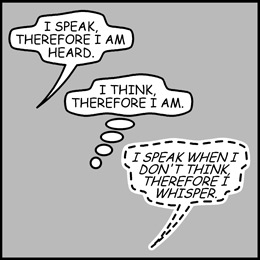
This posting complements my discussion of the same topic, which watched how thought balloons developed alongside whisper balloons since early on characters often seemed to be voicing asides to the audience.

Rosa writes:
I realized that one of the reasons why thought balloons were seldom used in those years was because the characters were constantly speaking to themselves out loud, like in this panel from Action Comics #1. In many of these cases, thought balloons should have been used instead. Rather than speaking out loud, a thought balloon containing a line like, “The cops are coming; I better change to my civilian clothes!” would make more sense.
He also reprints a delightful Spirit panel which shows the hero trapped under water and saying out loud: “I...can’t... hold...my...breath... much...longer!”

Soon, however, the thought balloon became a standard part of American comics punctuation, avoiding such unrealistic moments. Because superhero comics had to be realistic.

TOMORROW: Who started the thought balloon’s hibernation over the last thirty years?

29 April 2011

Superman as “Meretricious Dreck”

From the Comics Journal’s appreciation of comic-strip collector and scholar Bill Blackbeard, who just died after a lifetime of preserving the nation’s daily verbal-visual entertainment:
“Far from being overwhelmed when Action came out with Superman,” he continued, “I thought it was meretricious dreck. I liked the art. I’d been following Slam Bradley [also by Jerry Siegel and Joe Shuster] in Detective Comics. And I liked the art and the storyline; I thought that was fine. But the Superman content did nothing for me because I immediately saw what many other people saw: there’s no story here. If he can do anything he wants to, who cares? Why bother? But the art did appeal, and I looked at it occasionally. It was nicely drawn.

“Then the whole superhero thing came in, and I recall thinking in the early forties that certain things—like Sub-Mariner and the Human Torch—I thought those were psychotic, the work of a lunatic. And of course Mickey Spillane was scripting, so I wasn’t that far off. I couldn’t understand how anyone would want to immerse themselves in such stuff.
Spillane did write some scripts and prose stories about the Torch and Sub-Mariner, but he didn’t create those characters. Ironically, Spillane’s biggest success came after he failed to sell a comic-book private eye of the Slam Bradley type. Unable to find a publisher for “Mike Danger,” he rewrote his script into a prose novel featuring Mike Hammer.

02 April 2010

Superman Battles the Challenge of Thought!

This panel is from Action Comics, #6, the sixth comic book to contain a Superman story. Lois Lane and Clark Kent are building that wonderful relationship which, a mere half-century later, convinced fans they were meant to be together forever.

In this panel, writer Jerry Siegel and artist Joe Shuster clue us in on Lois and Clark’s unexpressed thoughts. But to understand that, we have to know the code the creators used to set off characters’ thoughts from their spoken words in the same balloon: parentheses, dashes, and quotation marks.

I assume some American comic-strip creators tackled the challenge of showing thought before Siegel and Shuster, but I don’t know what they came up with. The early strips I could find are surreal tales like Winsor McCay’s Little Nemo in Slumberland and George Herriman’s Krazy Kat, and those characters rarely had unexpressed thoughts. (When Ignatz was puzzled in this strip, Herriman gave him a regular word balloon filled with a big question mark.)

That approach wouldn’t work in a more realistic scene. It’s notable that these examples show Clark Kent thinking secretly; Superman didn’t need to conceal his thoughts in these early stories.

In Action, #11, Clark expressed his thinking inside what later became codified as a “whisper balloon.” Indeed, it’s possible that Clark is whispering to himself here, the way a character in a radio or stage play can speak thoughts aloud while all the other actors pretend to ignore him. But that solution is obviously limited. A hero wouldn’t want to give away his game plan, even quietly, when he was around the Ultra-Humanite or some other villain.

In the early 1940s most American comic books adopted a standard form for showing thoughts: the thought balloon. These word balloons had a trail of ovals to the thinking character rather than a sharply pointing tail, and borders that differed from those of speech balloons, usually by being more cloudy.

Even so, the first of these panels from Action, #64, in 1943 show Siegel and Shuster’s successors pulling out the old technique of parentheses, hyphens, and quotation marks to squeeze a thought into a crowded panel. And they still use dashes and quotation marks inside Superman’s thought balloon to make its meaning doubly clear.

27 April 2009

The Lasting Impact of Joe Shuster's Secret Work

Last summer I first read about Secret Identity: The Fetish Art of Superman’s Co-creator Joe Shuster, in a Publishers Weekly article:

[The book reprints] an unusual collection of S&M comics secretly created by Superman’s co-creator Joe Shuster. Thought to have been destroyed, the comics were discovered in a shop in Britain by [Craig] Yoe, who has verified that Schuster [sic] was the creator. Called Nights of Horror, the comics are fetish fantasies with characters that look just like Clark Kent and Lois Lane. “They’re chained and being whipped and there’s women kissing women,” said Kochman, “It’s a great story and no one ever connected them to Schuster [sic].”
Yoe had previously assembled Clean Cartoonists’ Dirty Drawings; Shuster's work appears to be the rare example that gets beyond the mildness of a Playboy cartoon. I found more explicitly "dirty" cartoon sex in the Young Adult Graphic Novels section of my local library. Of course, that was From Hell, the Jack the Ripper book by Alan Moore and Eddie Campbell.

All Secret Identity seemed to show is that Shuster was desperate for work in the 1950s, and was used to drawing men who looked like Clark Kent and women who looked like Lois Lane. But Steve Bunch's more recent comments at Publishers Weekly mentioned those drawings' indirect effect on the industry:
With famed psychiatrist Dr. Frederick [sic] Wertham spearheading the anti-comics witch hunt over several years, the case against comic books was given more credence by an incident in 1954 that was committed by the Brooklyn Thrill Killers, a gang of four Jewish teens who idolized Adolf Hitler, flogged girls in Brooklyn parks with a bullwhip and murdered vagrants during evenings of “bum hunting.”

The shocking crimes of these disturbed youths lead to interviews with Dr. Wertham and the revelation that the leader of the Brooklyn Thrill Killers was inspired by horror and crime comics, including most damningly, the Nights of Horror series. [Wertham's encounter described here.]

By conveniently lumping the hard-to-obtain S&M porn material in with comic books, Wertham now had “proof” of the mind-warping contents found between the covers of comics and easily convinced high-ranking government officials that such publications were easily obtained by children. Thus it was that Joe Shuster, the co-creator of Superman, unwittingly helped bring about the Comics Code Authority of America
So Shuster's anonymous work turns out to have been significant after all.

13 August 2008

Single Bounds in Superman Research

At Newsarama, Jeff Trexler has just written about the early correspondence between DC Comics and Jerry Siegel and Joe Shuster, the creators of Superman. An ongoing lawsuit has produced a document dump that's "a gold mine for folks interested in comics history." It's too late for Marc Taylor Nobleman to include this information in Boys of Steel, but then it isn't really picture-book material, anyway.

The DC legal team is releasing these documents letters to show that Siegel and Shuster were taking direction as "work-for-hire" creators during the first decade of Superman comics. So they focus on details that DC wanted Shuster (and his staff) to change, showing who was making the creative decisions. A taste of Trexler's reporting:

Another alleged problem with [Joe] Shuster’s artwork is that it made Superman look gay — or in the period slang of [Whitney] Ellsworth’s January 22, 1940, letter, “lah-de-dah” with a “nice fat bottom.”

What’s worse, the pose in the second panel also reminded Ellsworth of “certain FLIT ads done by a cartoonist who signs himself ‘Dr. Seuss.’”
In other not-safe-for-picture-book Shuster news, Abrams's new ComicArts "sub-imprint" is preparing to publish Secret Identity: The Fetish Art of Superman’s Co-creator Joe Shuster as one its inaugural titles. In July, Publishers Weekly described these drawings:
an unusual collection of S&M comics secretly created by Superman’s co-creator Joe Shuster. Thought to have been destroyed, the comics were discovered in a shop in Britain by [Craig] Yoe, who has verified that Schuster was the creator. Called Nights of Horror, the comics are fetish fantasies with characters that look just like Clark Kent and Lois Lane. “They’re chained and being whipped and there’s women kissing women,” said Kochman, “It’s a great story and no one ever connected them to Schuster [sic].”
Of course, the people could look like Clark Kent and Lois Lane simply because that was how Shuster drew men and women.

Yoe previously assembled Clean Cartoonists’ Dirty Drawings, which also included some of Shuster's drawings. They were, reportedly, some of the few examples in that book that went beyond the raciness of a Playboy cartoon. Even Robert Crumb complained, and he wrote the book's introduction. Judging by the samples I found on the internet, there's more explicitly depicted sex in the Young Adult Graphic Novels section of my local library.

27 March 2008

The Emergence of the Comic-Book Supervillain

There were larger-than-life villains in popular literature before comic books: Prof. Moriarty, Dr. Fu Manchu, and, as far back as 1862, Jean Diable. But the character type really took off after American comics created a world of superpowers and colored costumes.

The first supervillain naturally faced off against the first superhero, created by Jerry Siegel and Joe Shuster. In the thirteenth issue of Action Comics, with a publication date of June 1939, Superman met:

the Ultra-Humanite!

Until then, Superman had been battling natural disasters, economic injustice, and human evildoers who couldn't possibly match his strength. His antagonists in his first year included a wife beater, kidnappers, warmongering munitions dealers and their lobbyists, the owner of an unsafe mine, a hit-and-run driver, gamblers trying to fix a college football game, crooked stock brokers, and a fraudulent licensor of the valuable Superman trademark.

The Ultra-Humanite looked like he could be a real threat. Like Superman, he represented a further stage in human development. But while Superman was physically superior, this villain was physically debilitated--confined to a wheelchair, his hair sparse and white. The Ultra-Humanite claimed intellectual superiority to the rest of humanity. And while Superman was waging a "one-man battle against the forces of evil and oppression," the Ultra-Humanite was out for power.

Yet I can't help but note that Superman tracked down the Ultra-Humanite through a racket called the "Cab Protection League." Was this ultra-genius really expecting to achieve "DOMINATION OF THE WORLD" by forcing one city's independent taxi owners into an association? I imagine him skulking in his lair, boasting to himself:
"Why, soon I'll be taking in $300 or even $400 a week! At that rate, how long could it be before I can finance my death-ray construction plans?

"Let's see...multiply by 52 weeks, carry the 2,...

"That can't be right. I'm an evil genius. Let me do this again...."