Showing posts with label MOVIE Oz the Great and Powerful. Show all posts

18 March 2014

Oz and the Riverside Orchestra

On 13 April, the University of California at Riverside Orchestra will offer a program titled “American Fairy Tales,” celebrating the life and work of L. Frank Baum.

The orchestra’s description says:
We celebrate The Wizard of Oz and its creator, L. Frank Baum: the world premiere of Tim Labor’s A Royal Pair, musically telling two tales by Baum, and concert suites from The Wizard of Oz and its two offspring Wicked and Oz the Great and Powerful. The brilliant Johanna McKay returns as narrator.
Ruth Charloff (shown here) will conduct.

On Facebook, Jane Albright reports that A Royal Pair is based on Baum’s “The Queen of Quok” from American Fairy Tales—and perhaps a second tale? Composer Tim Labor is on the UCR music faculty; on Facebook he mentioned only one tale, so perhaps plans changed.

I mention this not because I know any of the folks involved or expect to attend a concert on the other side of the country. Rather, it’s because I attended symphony concerts in Riverside while still in the womb, and my mother introduced me to the Oz books.

23 July 2013

That Part about Not Needing Money in Oz? That’s Off.

The Disney by Mark blog is reporting that the Disney corporation is preparing what a lot of us expected ever since O.Z. Diggs landed in Oz in the middle of a waterpark ride: a theme-park spin-off of Oz the Great and Powerful.

It will reportedly become part of Disneyland in California, replacing an attracton based on old western movies:
DbM has it from reliable sources that our friends at Imagineering are finishing up concept and show design for an Oz land (or area) and Oz attraction based on the movie Oz the Great and Powerful. It will be located where “Big Thunder Ranch” now stands. An alternate location was at the old Motor Boat Cruise next to it’s a small world, but fire-safety issues with the monorail precluded it.

It is anticipated that the area will have one E-ticket ride and two C-ticket attractions. A restaurant similar to the Magic Kingdom’s “Be Our Guest” but placed in the Emerald City, and a Munchkinland-themed retail store will also be included. Show elements will include a hot air balloon, tornado effects, giant bubbles, and Dark Queen Evanora’s army of Winkies and flying baboons. Word is that China Doll will be featured in the ride. The final attraction mix will be decided shortly, and DbM expects that the announcement about Oz land will be made at D23.
I don’t know the Disney jargon or how reliable this source is. Many of the blog’s commenters are skeptical or dismayed by the prospect. There’s plenty of time for plans to change or develop before the threatened sequel.

For now, the Hollywood studios’ biggest Oz attraction remains Sony Studios’ giant arching steel rainbow, shown above. Sony didn’t produce any beloved Oz movie, of course, but decades back it bought the M.G.M. studio lot, which includes some areas involved in producing the 1939 movie.

27 June 2013

Big-Budget Action Movies Losing Their Wit

Last night I saw Man of Steel. It reminded me of Oz the Great and Powerful in that both movies are carefully made to trigger our memories of modern American myths, and in doing so both put spectacle over coherence, character, or wit.

Man of Steel does a fine job of showing us exactly what, say, a punch-out between two superpowered humanoids on a satellite would look like. Likewise, Oz the Great and Powerful swoops all over its digital locations, making them more convincing than the plot twists.

But does either of those movies have more than three quotable lines? (Check out these attempts to muster a quota of quotes.)

There’s no wit in either movie’s screenplay. Almost all their dialogue sounds like it was the first choice of tired screenwriters at the end of a long day. Most characters speak in simple, unimaginative ways, stating their emotions or desires baldly. (All the better, perhaps, for easy translations for the international market?) And the actors usually deliver that dialogue slowly, either to fill time or to ensure that no one in the audience can fall behind.

Consider Oz’s arrival in the strange fairyland:
Oz: Where...Where am I exactly?
Theodora: Where do you think you are?
Oz: I have no idea. It’s...It’s like no place I've ever seen.
Theodora: You’re in Oz.
And compare that to the hero’s lines from the parallel scene in MGM’s 1939 film:
Dorothy: Toto, I’ve a feeling we’re not in Kansas any more. . . . We must be over the rainbow! [Glinda arrives in her bubble.] Now I...I know we’re not in Kansas!
Okay, Dorothy’s speech includes #4 on the American Film Institute’s list of all-time best movie quotes. But those words are powerful because they’re understated and fresh. They could therefore be delivered with emotion instead of stating emotion. And the next line is actually metaphorical.

Even throwaway lines in the 1939 movie are evocative: “Now you go feed those hogs before they worry themselves into anemia!” “Of course, some people do go both ways.” “And the last to go will see the first three go before her.” Yes, sometimes the vaudeville shtick underlying that script shows through, but the words are still entertaining. It’s not just that repeated viewings have made the movie memorable. Rather, lines with verve have made it possible to view the movie over and over.

Last year’s big-budget popcorn movies showed that they don’t have to lack wit: The Avengers and Skyfall are powerful action movies with good scripts. They offer a lot to look at, but also a lot to hear besides explosions. Oz the Great and Powerful and Man of Steel offer only half that package.

25 June 2013

Contradictions and Coincidences in Oz the Great and Powerful

During Sunday’s panel discussion on Oz the Great and Powerful, Caroline Spector pointed out that we don’t see Theodora the witch perform any witchcraft.

That made me think of the scene in which Oz saves Finley the winged monkey from being devoured by scaring a lion away with flash powder. Theodora is nearby, but apparently doesn’t think to throw fire the same way. Nor does she protect herself from the flying baboon with her magic in the preceding scene. How much of a witch is she, anyway?

Of course, when Theodora turns evil (as shown here), she starts tossing fireballs around like there was a fire sale. Does that imply she must become bad to deploy her powers?

Other questions that arose during discussions at the Winkie Convention:
  • If Oz is such a fan of Thomas Edison, why doesn’t he use any electrical effects or machines in his magic act? (One old-fashioned projection machine in his trailer doesn’t count.)
  • If China Doll needs to sleep (Oz tucks her in one night), why is she unaffected by the Poppy Field?
  • Why does Finley struggle to carry Oz’s bag along the Yellow Brick Road but have no trouble flying with it?
  • How can a small, jury-rigged hot-air balloon lift so much gold? Gold is heavy.
And then there are the plotting coincidences of the sort that Hollywood often asks us to accept. There’s no reason for Oz to keep his final plan secret except to increase suspense for us. And that plan depends on him correctly calculating exactly what the wicked witches will do, down to the split second. In addition, China Doll returns Glinda’s wand not a second too late or too soon.

Those are all internal incongruities of the script. Trying to reconcile Oz the Great and Powerful with other versions of the Oz mythos would of course produce even bigger questions.

What’s your favorite, or least favorite, inconsistency within Oz the Great and Powerful?

24 June 2013

Oz the Great and Powerful Impaneled

Yesterday I moderated a panel at the Winkies Convention on Oz the Great and Powerful and its place in the history of Oz movies. The distinguished panelists were:
I laid out the topic by noting that Oz the Great and Powerful is the first financially successful cinematic version of Oz since 1939 (and perhaps, depending on how much one interprets Hollywood accounting, ever). Journey Back to Oz, The Wiz, and Return to Oz were all box-office failures, though the last has since won a cult following. But Box Office Mojo says that as of last week Oz the Great and Powerful has taken in nearly $500 million worldwide.

At the same time, Rotten Tomatoes says that both critics and audiences are split on the movie’s merits, with rankings hovering around the 60% approval line that defines the difference between a ripe red tomatoes and a messy green splat.

The discussion was lively, with Caroline pointing out the problematic ways that Oz the Great and Powerful treated its female characters. While working hard not to work blue, she noted how Oz seduced women by giving them cheap music boxes. On the other hand, Caroline said that China Doll was the most appealing character in the film.

Freddy pondered whether Oz the Great and Powerful would eventually gather a following like Return to Oz from people who watch it in childhood and find it speaks to them. But is there enough in the movie about a twentysomething hound dog to appeal to kids? I asked Peter about the visual effects. This is the first Oz movie in the era of CGI—but did the filmmakers put that technology into creating a world as obviously artificial as MGM’s matte paintings?

The audience offered great comments and questions. A lady wearing Theodora’s ruby ring pointed out how the three witches’ powers were color-coordinated with their outfits. Sam Milazzo asked how Theodora’s name related to Dorothy’s, which leads to larger questions of whether the movie’s Emma Gale will become Aunt Em or the Wizard and Glinda will become parents of that Oz’s Ozma. We all pondered whether this movie is a dream that no one’s yet woken up from.

I delayed calling on Carrie Hedges, president of the International Wizard of Oz Club, to ensure that she would have the last word. She spoke about how the many versions of Oz each bring their own fans to the overall mythos. And if the Wizard offered her a music box, Carrie said, she could gladly take it. That brought down the house and closed the convention in a lively way.

03 April 2013

More Revisionist Ozian History from L. Frank Baum

L. Frank Baum revised the character of the Wizard of Oz back to a capable and even lovable showman in his fourth novel in the series, Dorothy and the Wizard in Oz. After all, it wouldn’t do for Dorothy’s protector on that book’s journey to fairyland to be a child-stealing fraud, which is how the Wizard had last appeared in The Marvelous Land of Oz.

In the latter part of Dorothy and the Wizard, Oz gets to explain himself to Princess Ozma, the very child he had stolen (though no one has the effrontery to bring that up here):
“One day my balloon ran away with me and brought me across the deserts to this beautiful country. When the people saw me come from the sky they naturally thought me some superior creature, and bowed down before me. I told them I was a Wizard, and showed them some easy tricks that amazed them; and when they saw the initials [O.Z.] painted on the balloon they called me Oz.”

“Now I begin to understand,” said the Princess, smiling.

“At that time,” continued the Wizard, busily eating his soup while talking, “there were four separate countries in this Land, each one of the four being ruled by a Witch. But the people thought my power was greater than that of the Witches; and perhaps the Witches thought so too, for they never dared oppose me. I ordered the Emerald City to be built just where the four countries cornered together, and when it was completed I announced myself the Ruler of the Land of Oz, which included all the four countries of the Munchkins, the Gillikins, the Winkies and the Quadlings. Over this Land I ruled in peace for many years, until I grew old and longed to see my native city once again. So when Dorothy was first blown to this place by a cyclone I arranged to go away with her in a balloon; but the balloon escaped too soon and carried me back alone. . . .”

“That is quite a history,” said Ozma; “but there is a little more history about the Land of Oz that you do not seem to understand—perhaps for the reason that no one ever told it you. Many years before you came here this Land was united under one Ruler, as it is now, and the Ruler’s name was always ‘Oz,’ which means in our language ‘Great and Good’; or, if the Ruler happened to be a woman, her name was always ‘Ozma.’ But once upon a time four Witches leagued together to depose the king and rule the four parts of the kingdom themselves; so when the Ruler, my grandfather, was hunting one day, one Wicked Witch named Mombi stole him and carried him away, keeping him a close prisoner. Then the Witches divided up the kingdom, and ruled the four parts of it until you came here. That was why the people were so glad to see you, and why they thought from your initials that you were their rightful ruler.”

“But, at that time,” said the Wizard, thoughtfully, “there were two Good Witches and two Wicked Witches ruling in the land.”

“Yes,” replied Ozma, “because a good Witch had conquered Mombi in the North and Glinda the Good had conquered the evil Witch in the South. But Mombi was still my grandfather’s jailor, and afterward my father’s jailor. When I was born she transformed me into a boy, hoping that no one would ever recognize me and know that I was the rightful Princess of the Land of Oz. But I escaped from her and am now the Ruler of my people.”

“I am very glad of that,” said the Wizard, “and hope you will consider me one of your most faithful and devoted subjects.”

“We owe a great deal to the Wonderful Wizard,” continued the Princess, “for it was you who built this splendid Emerald City.”

“Your people built it,” he answered. “I only bossed the job, as we say in Omaha.”
Some of this history is reflected in the new movie, Oz the Great and Powerful:

  • the Wizard’s full name, with its embarrassing later initials spelling out “PINHEAD.”
  • the assumption that the Wizard must be the land’s savior if he comes from the sky in a balloon bearing the letters OZ.
  • the notion that the Wizard landed in the midst of a fight among the land’s witches.

However, in the new movie the Emerald City is already built, and green instead of made so by green glasses—all the better to bring up memories of the city in the 1939 MGM movie.

27 March 2013

Oh, Little China Girl

One of the new characters in Oz the Great and Powerful is the China Girl, an inhabitant of a village of china people who appear to have been genocidally destroyed by the Wicked Witch’s Flying Baboons. (She’s also the fairyland avatar of a disabled girl whom the carnival wizard can’t help back in Kansas.)

The china village is obviously inspired by a chapter L. Frank Baum interpolated into The Wonderful Wizard of Oz, in which Dorothy and her companions visit a China Country on their way south to Glinda’s palace. In that chapter, Dorothy wants to take a China Princess home to her aunt but is dissuaded. In the movie, China Girl demands that Oz take her along on his adventure.

There are various ways to read the character’s behavior in that scene. On the one hand, China Girl is insistent on her right to go on an adventure. On the other hand, she casts herself as a fragile little creature who shouldn’t be left on the Yellow Brick Road alone. Of course, she is a fragile little creature; we just saw her legs broken, and she’s less than a foot tall. China Girl clings weepily to Oz’s leg, but as soon as he agrees to take her she trots off happily. I think it’s clear that China Girl’s behavior is a ploy to manipulate Oz, the master manipulator. But in that effort she invokes gender stereotypes.

During the movie’s climax, China Girl plays an important role, bravely bringing Glinda her wand. (The fact that China Girl doesn’t use the wand herself implies the magic of this Oz differs from that in Baum’s Oz, where most magical tools can be wielded by anyone who holds them.) She’s also one of the two characters who asks anything specific of Oz beyond regime change, and ends the movie as his informally adopted daughter.

Illustrator Ben Wood noted a resemblance between the design of China Girl and how John R. Neill drew Dorothy in later Oz books, as he showed in the image above. He wrote, “It was a smart way to add her in without really adding her.” I’m not sure that’s what the moviemakers had in mind, but China Girl does provide more interest and, ironically, someone to identify with.

26 March 2013

Gender Politics in the Latest Oz

I’ve noted a couple of feminist critiques of Oz the Great and Powerful, one from Aisha Harris based on early previews and another from Elisabeth Rappe based on seeing the whole movie. I thought those critics made good points about the irony of taking L. Frank Baum’s fairyland, where little girls overthrow humbug rulers and the most powerful person is a sorceress, and pulling out a story all about a man.

But I wasn’t convinced that the main female characters in the new movie—the three witches Theodora, Evanora, and Glinda—really went gaga over the humbug Oz. And did even Glinda lack all “agency,” or independent thought and action? Having now seen Oz the Great and Powerful, I think those critiques were a little overblown. But in the main they’re sound analyses of how the Hollywood moviemakers adapted Baum’s mythos to mainstream storytelling expectations.

From the start, much of this project’s attraction for producer Joe Roth was the man at its center, as he told Jim Hill: “During the years that I spent running Walt Disney Studios, I learned about how hard it was to find a fairy tale with a good strong male protagonist. You’ve got your Sleeping Beauties, your Cinderellas and your Alices. But a fairy tale with a male protagonist is very hard to come by.”

In fact, as the recent Jack and the Beanstalk movie shows, there are many fairy tales about young men, and adapting those for the big screen is no guarantee of box-office success. Still, Hollywood producers believe, and with some reason, that the key to an international blockbuster that can pay for a production budget of well over $100 million is to bring in lots of male moviegoers, and for that it helps to have a male protagonist.

Once the moviemakers put the man called Oz at the center of their tale, his desires and character development defined their plot, according to the tight storytelling approach that Hollywood usually uses. Other characters, male and female, work around him, talk about him, and react to his actions and desires. In that respect Oz the Great and Powerful is no different from Lincoln.

Within the fiction of Oz the Great and Powerful, the inhabitants of Oz are in the grips of a religious belief. Their king with magical powers has been killed, and they eagerly await his return or the arrival of his successor, also with magical powers, to put everything right. Folks who grew up in western civilization shouldn’t have a hard time recognizing the durability of this way of thinking. That milieu explains why, as Rappe says, “the witches Glinda, Theodora, and Evanora now clasp their hands at [Oz’s] arrival, thrilled the prophesied hero has arrived.”

But of the three witches, only Theodora turns out to really believe in Oz’s magic and his amorous hints. Evanora pretends to share her sister’s faith, but views it and Oz as threats to her own power. Glinda is also happy to harness the popular belief in Oz to her own, more beneficent ends. So it’s inaccurate to say that all three witches, or even most of them, fall for Oz’s appeal. Two of the three quickly recognize him as a humbug.

I wasn’t surprised to find that Glinda sees through Oz but recognizes his potential to benefit the oppressed people. I was surprised, however, by the very late scene in the movie of Oz and Glinda sharing an amorous kiss. There’s no precedent for that in Baum’s novels or in the new movie’s real source material, the 1939 MGM film. It doesn’t seem to fit Glinda’s character even in this movie up until that point.

But evidently the moviemakers felt that a romantic pairing was necessary for a happy ending. Perhaps that’s because Oz’s seductions were an important element of the preceding plot, so that thread needed to be knotted off. But was it thought impossible for Glinda to have led on the foolish man, turn him aside, and yet remain Good? I’d have preferred Oz to realize that  Glinda had pushed him into growing as a man but he still had a way to go before he could win her, if ever.

TOMORROW: A strong female character?

21 March 2013

The Real Sources of Oz the Great and Powerful

Yesterday I noted how Oz the Great and Powerful credits “the Works of L. Frank Baum” as its source but doesn’t actually draw much from that source—and what it does draw is almost entirely filtered through MGM’s Wizard of Oz from 1939.

That beloved movie is of course the main source for the new one. Oz the Great and Powerful is quite obviously an attempt to create a prequel. Yet the new movie’s makers didn’t have the rights to do so, so they played an odd game of tiptoeing to the edge of fair use and stopping just an inch away from infringement.

Thus, MGM’s Wicked Witch of the West is green with a black gown, hat, and broomstick. (W. W. Denslow’s Wicked Witch is tan with an eyepatch, jacket and patterned skirt, and umbrella.) Sam Raimi and his team couldn’t exactly copy the previous movie, so they made the witch a different shade of green.

The New York Times reported on how Disney’s lawyers advised the moviemakers to alter one Munchkin’s whiskers to be less like those in the 1939 movie. But they’re still the same singing, dancing, particolored little people of that movie, not the dignified farmers all in blue of Baum’s book.

Similarly, the end of the yellow brick road goes in circles, but not in a spiral. There are brightly colored horses grazing outside the Emerald City, but they’re several colors at once instead of in succession. Glinda’s bubbles work a little differently. The green Wicked Witch says “my pretty one” instead of “my pretty.” Oz produces the illusion of a giant heading speaking from a cloud of smoke, but it’s a different giant head. And there are no ruby slippers or silver shoes.

At times, finding a way to evoke the MGM movie without directly copying some detail still under copyright produced new creativity. The winged baboons are even more frightening than MGM’s flying monkeys. The Emerald City’s towers are reminiscent of those from the older movie, but more angled. The landscape of Oz has a verticality that was hard to portray on 1939 sound stages, much easier with CGI.

At other time, the strain of aping the MGM movie is too great. There’s a scene at the end of the Wizard conferring gifts on his companions, but his remarks aren’t nearly as interesting as the dialogue Yip Harburg wrote for Frank Morgan in the equivalent scene, and most of those characters never asked him for stuff, so the scene has no greater meaning than triggering audience nostalgia.

Plotwise, the result doesn’t hang together. Like the 1939 film, the new movie’s screenplay provides for people whom Oz knows in Kansas to reappear as other characters in Oz. Yet there’s no hint that Oz is dreaming, as Judy Garland’s character was. Nor does Oz recognize the resemblance between his Kansas girlfriend and his Oz girlfriend.

And that girlfriend points to the second big influence: Wicked. (The hit stage show, not Gregory Maguire’s novel.) Again, the moviemakers didn’t have the rights to make Wicked, and they had a very different conception of the Wizard. But the screenplay is designed to set off the same nostalgic neurons that produce applause during the stage play, whenever the story foretells some detail from the movie: a cowardly lion, a scarecrow, and so on. And of course the Wicked Witch of the West starts out as sympathetic.

One of the biggest changes in Wicked’s journey from book to stage was the inclusion of a happy ending for Elphaba, with a boyfriend. Oz the Great and Powerful likewise ends with Oz and Glinda paired off. There’s no hint of that in the MGM movie, even less than none in Baum’s books, but apparently Hollywood demands a romantic ending. (To be fair, Baum inserted such pairings in most of his stage and screen adaptations of his books, and imported them back into books he based on his scripts.)

A third, smaller influence is Disney’s theme park and merchandising divisions. When the Wizard arrives in Oz, his balloon lands in a raging river, and we’re then treated to a water slide in 3-D. The climax involves fireworks bursting over the turreted city. I was pleased that Mari Ness also noted the similarity between that action and Disney’s nightly fireworks display. And the corporation already has a ton of collectibles on sale.

Indeed, the main takeaway from Oz the Great and Powerful isn’t a great screenplay or powerful acting (hard to do without a great screenplay), but spectacle and nostalgia. On that level it succeeds—quite well enough to make hundreds of millions of dollars. But I doubt it will have the real emotional impact as any of its predecessors and influences.

20 March 2013

What Oz the Great and Powerful Draws from Baum’s Works

The credits for Oz the Great and Powerful say the movie is “Based on the Works of L. Frank Baum.” Those works are in the public domain, meaning the moviemakers could use as many details from Baum’s Oz books as they wanted for free.

In fact, the moviemakers used very few details from those books, aside from The Wonderful Wizard of Oz itself, filtered through other versions (more on that tomorrow). Fans of the series have been tallying the items they recognize from the later books, and the list is short:
  • The Wizard’s full name is as stated in Dorothy and the Wizard in Oz (1908). That book also adds a few details to what the Wizard told Dorothy earlier about his arrival in Oz and finding himself caught between the witches.
  • When a map of Oz appears, it includes the name “Wogglebug.” Baum introduced that character in The Marvelous Land of Oz (1904), and the maps credited to his highly educated self appeared in Tik-Tok of Oz (1915).
  • A group of mechanically inclined inventors is called the Tinkers, and Ozma of Oz (1907) includes a Mr. Tinker as co-inventor of the Tik-Tok the clockwork man.
  • As discussed yesterday, The Road to Oz (1909) introduced the notion of traveling inside a bubble. That main inspiration for that detail of the new movie nonetheless appears to be its reappearance in the 1939 movie.
  • Oz has to escape from aggressive plants in a forest, reminiscent of man-eating flowers in The Patchwork Girl of Oz (1913). However, since both the book and movie forms of The Wizard of Oz include aggressive plants, Patchwork Girl might not be the source.
  • The land of Oz’s recent history echoes the situation Glinda explains in The Marvelous Land of Oz: the last rightful king was deposed and destroyed, leaving a daughter out of power. In the books, that daughter is Ozma. In Oz the Great and Powerful, that daughter is Glinda herself.
That last tidbit demonstrates the new movie’s real relationship to Baum’s books. While crediting them as its basis, the new movie’s story is incompatible with them.

In The Wonderful Wizard of Oz, for example, the Wizard explains that he oversaw the building of the Emerald City and had his subjects wear green glasses, ostensibly to shield their eyes but really to make the city glow like emeralds. In the new movie Oz arrives at the Emerald City, its green towers already scraping the sky. That leaves less for him to do.

And there’s no way for this land of Oz to become the fairyland of The Marvelous Land of Oz and beyond because there’s no way to fit Ozma into that political history. The new movie’s Glinda is not only the Good Witch of the South as in the books and the obvious analogue of the Good Witch of the North in the 1939 movie, but also the rightful heir to the throne of the Emerald City.

There’s nothing wrong with offshoots of the original mythos. Indeed, Baum was so unconcerned with consistency that he created offshoots in his own books and plays. But this latest version of Oz isn’t on a trajectory to end up at the happy paradise under Princess Ozma where Baum ultimately left us.

19 March 2013

Inspiration Bubbling Up

Even with the relatively awkward special effects of 1939, Glinda’s pink bubble in The Wizard of Oz is an American icon. So much so that the Wicked stage show reproduced that entrance.
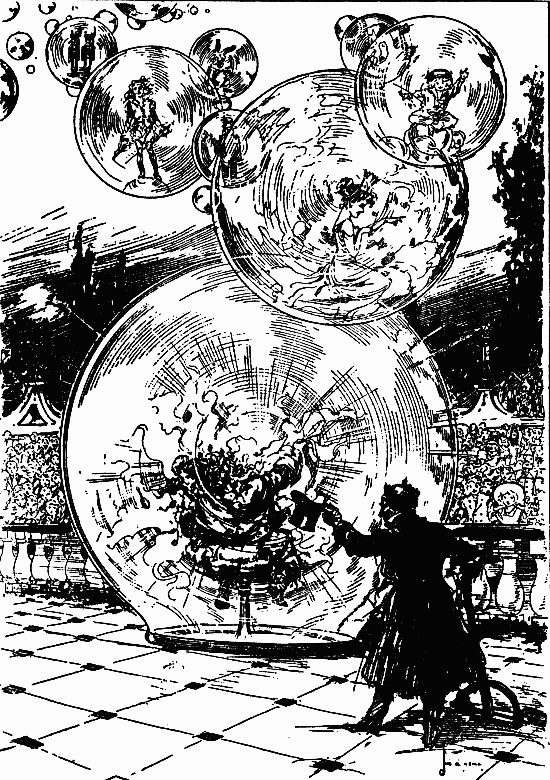
The new Oz the Great and Powerful movie is not supposed to infringe on the 1939 film’s copyright, however. Fortunately for its makers, L. Frank Baum and John R. Neill portrayed travel in giant bubbles at the end of The Road to Oz. (Curiously, it’s one of the few adventures Dorothy turns down.)
With that book in the public domain, Sam Raimi and company could show people in bubbles, and even make them Glinda’s thing, as long as they weren’t perfectly round and pink. In fact, with CGI animation they could show the Wizard’s weight bending his bubble out of its spherical shape. But there’s really no doubt those bubbles are supposed to evoke the 1939 movie, not Baum’s lesser-known 1909 sequel.
For the next couple of days I’ll discuss the sources of Oz the Great and Powerful—the official sources and the real ones.

07 March 2013

Of Witches and Women

At Film.com, Elisabeth Rappe offers an essay titled “Why ‘Oz the Great and Powerful’ Is a Major Step Back for Witches and Women.” It builds on the questions that Aisha Harris raised in Slate last fall, but Rappe has the advantage of having actually seen the movie.

Rappe makes some mistakes in describing L. Frank Baum’s work. She says, “He wrote 17 Oz books,” though the usual enumeration is fourteen Oz novels. We can get to seventeen by adding the Little Wizard Stories of Oz collection and the allied books Sea Fairies and Sky Island, but should we then also add Baum’s other non-Oz fantasies tied into the same magical region?

More problematic, the essay later lists Trot among the series’ male heroes, and says she, Cap’n Bill, and Ojo are “one-offs, never to return.” It would strengthen the essay’s argument about the importance of Baum’s female characters to note that Trot is a little girl, and she plays a major role in four of the seventeen books listed above as well as going along on two more adventures.

Later Rappe says Susan B. Anthony was a “frequent visitor” at Baum’s house. Anthony definitely visited his mother-in-law Matilda Joslyn Gage’s house in Fayetteville, New York, but I’m not sure she dropped in on the next generation. Again, Rappe’s underlying statement that Baum wrote from within the first wave of American feminism is accurate, but unreliable details undercut the essay’s authority.

The essay states:
Baum…made a decided choice to make women front and center of the series. They’re princesses, ordinary farmgirls, witches (both good and bad), rag dolls, generals, pastry chefs, and problem-solving faeries. They have adventures, lead search parties, rescue one another, solve difficulties, and challenge the Nome King in combat. Perhaps most significantly, none of the characters—not Ozma, Glinda, Betsy or Dorothy—ever engage in romantic relationships. Baum made a point of avoiding such trappings as love interests, because he believed children would find passionate romance boring, and an emotional element which they wouldn’t truly understand.
All true, except that Baum included romantic subplots in Tik-Tok of Oz and The Scarecrow of Oz. He maintained Dorothy, Ozma, and his other main heroines as preadolescent, not ready for romance. In Baum’s books, only Glinda is eligible for a love interest, and she’s not interested in men.

Which brings us to Rappe’s critique of the new movie’s storyline:
In a bitter reversal of Baum’s stories, “Great and Powerful” casts the women as the sidekicks, standing by to aid the Wizard should he need it. No longer instigators of action, the witches Glinda, Theodora, and Evanora now clasp their hands at arrival, thrilled the prophesied hero has arrived (“Aren’t you the great man we’ve been waiting for?” asks Theodora, voice trembling. Actually, all the female dialogue seems to be on the wobbly verge of tears). Whereas Baum’s charlatan Wizard accidentally became ruler of Oz, making a mess of things in the process, now we have one who has a place carved out for him, and is hailed as the man “who can set things right” . . .

Yes, Michelle Williams’ Glinda is smart enough to see through our hero’s lies and bluster, but otherwise she’s completely stripped of any real agency. “Great and Powerful” corrects Baum’s grievous abstinence, and reminds us all women must fall for a handsome traveler. The modern day Wizard now wins at least 2/3 of the onscreen hearts instead of being shamed as a liar.
Again, this overstates the case a bit. Baum’s books didn’t say the Wizard “accidentally became ruler of Oz, making a mess of things in the process.” He carved out a witch-free zone in the center of the country, built the land’s major metropolis, and maintained a peaceful prosperity for his subjects for many years. Of course, it took Dorothy and Glinda to restore the proper Ozian order, but the humbug Wizard was actually a moderate success.

That sort of slant makes me wonder if Oz the Great and Powerful really shows its Wizard succeeding so easily, or whether most of the movie is his struggle to fill the role the witches expect of him when he arrives, reforming himself in the process? Is Glinda truly “stripped of any real agency,” or is she happy to let this new arrival bumble along as she protects her own realm and bides her time? I suspect Rappe is on target about the movie, but the essay’s little errors make room for doubt.

Gili Bar-Hillel, a scholar of fantasy literature who’s seen the movie already, responded to the critiques from Rappe and others by noting that Oz the Great and Powerful doesn’t pass the Bechdel Test: “(1) It has to have at least two women in it, (2) who talk to each other, (3) about something besides a man.” As a Hollywood picture made by men and titled for a male character, that’s not surprising. But considering the feminist source material, it’s a missed opportunity.

05 March 2013

Yes, I’ve Heard About the New Movie

Soon after I first joined the International Wizard of Oz Club in late 1976, its journal, The Baum Bugle, was full of articles about the making of the The Wiz. How many stars the movie would have! How many costumes had been sewn! How many square miles of yellow linoleum had been laid in New York City to simulate the Yellow Brick Road!

Then the movie came out, a critical and financial disappointment. Bad casting and overproduction not only sank the film but in some ways ended the “blaxploitation” business for years.

A few years later, the journal reported the imminent arrival of Return to Oz, Disney’s first big-budget attempt to use its movie rights to L. Frank Baum’s later Oz books. Again, the technical aspects of the production caught the attention of the press, particularly the appearances of many Baum characters and such feats as filming in a hall of mirrors.

Then the movie came out. As Buzzfeed’s article “The 11 Most Traumatizing Moments from Return to Oz catalogues, it was a dreary, anxiety-ridden mashup of two of Baum’s most popular novels. The movie has many moments straight from my childhood favorites, all in a tone that made me wonder why they had ever appealed to me so strongly.

That track record is why I haven’t been writing enthusiastically, or even mildly optimistically, about Oz the Great and Powerful, due out this weekend. I’m curious about this new movie, but I’ve been disappointed before.

Newspapers and magazines, needing content to separate one movie studio’s ads from another, have offered many articles this month on the production and the Oz mythos. The New York Times’s contribution on Sunday started out by spelling the name of the Good Witch of the South as “Glenda.” The Boston Globe’s design-driven discussion of Oz’s influence on American culture didn’t even mention Dunkin’ Donuts Munchkins. So I’m not becoming any more optimistic.

27 November 2012

Oz, the Small and Meek

At Slate, Aisha Harris raised some serious questions about Sam Raimi’s upcoming movie Oz, the Great and Powerful, based on the most recent online trailer:
“You are here at last, and the prophecy shall be fulfilled,” says one witch. “I’ve waited for you to come and set things right,” says another. Is Oz slipping into an old-fashioned story about women needing a great male savior? Why are all these women with their own supernatural powers waiting around for an ordinary guy to come along and save them all?

L. Frank Baum’s original Oz books were published during the peak of the suffragette movement, and they were quite progressive in their depictions of a young female hero. Dorothy Gale, who ultimately reveals the man behind the curtain as the fraud that he is, was inspired by pioneer women and has been championed by some as the “first feminist role model.”
All that’s true. Not only was Dorothy the main protagonist of the Oz series, but the most powerful rulers in Oz were Ozma and Glinda.

I think Harris overstated her case, however, when she went on to say: “The 1939 film The Wizard of Oz stayed impressively true to this vision, giving us Judy Garland as an independent, curious young woman who aids a group of hapless men on their quest to see the wizard.” No, Judy Garland plays a breathy, largely reactive adolescent who decides she should never leave her own backyard to find her heart’s desire. The movie turned Dorothy’s happenstance visit to Oz from an adventure to a lesson about the dangers of running away, and thus into a punishment. In contrast, we next see Baum’s Dorothy on a voyage to Australia. Now that’s independent and curious.

But back to the Wizard. The whole point of The Wonderful Wizard of Oz is that “Oz, the great and terrible” (the book’s words) is a humbug. And that’s clearly part of Raimi’s story as well. When a movie sets up a character as “Great and Powerful” in the title, we know that has to be ironic or a challenge. Otherwise, there’d be no place for the story to go, nothing to reveal.

Back in July, the director laid out the main character arc:
As for the plot itself, everything is centered around [James] Franco’s Wizard, who is kind of a dick. “It’s the story of a selfish man, who’s a little bit of a lothario, a little bit of a cad.” Oz is “a land of second chances” for the Wizard, who’s also redeemed by the love of Glinda, the Good Witch. “It’s how he became ensconced in the Emerald City,” said Raimi. “By the time this picture ends, the audience has one interpretation of how it all came to be [...] how he became the protector of that great city.”
The phrase “love of Glinda” gives me pause because the Good Sorceress has no—needs no—love interest in the books. But will this movie’s Glinda offer Oz romantic love, or does he merely assume so? Does he set out to show himself protecting Oz just to impress Glinda and become a bigger, better man along the way? We’ll see next year.

31 July 2012

The Legacy of Oz in Culver City

Yesterday I went on the Sony Pictures Studios tour, which shows people working sets and backstage departments instead of giving them a theme-park ride.

The guide told us that an area where the ground had been painted yellow was connected to Sam Raimi’s upcoming Disney movie Oz, the Great and Powerful, about young Oscar Z. Diggs’s arrival in Oz. This seemed resonant since Sony Pictures Studios is the remaining part of the old MGM lot, including buildings where Judy Garland went to school and where the studio recorded its music while making its 1939 Wizard of Oz.

Through a complex series of corporate setbacks and real-estate transactions, the regal MGM lot now celebrates the legacy of once-low-rent Columbia Pictures. (In the same way, the MGM Wizard of Oz is now Warner Bros. intellectual property.)

Right now the Sony studio is undergoing a major construction project: a 90-foot-tall rainbow that will arc from a spot in front of the executive offices, over some other buildings, to another spot. That of course commemorates The Wizard of Oz, even though no rainbow appears in the film. If we hadn’t already been on the border of tourism and movies, it would all have been very ironic.