Showing posts with label TV or not TV. Show all posts

10 July 2026

“Possibly the most pathetic group of Hollywood ‘has-beens’”

Yesterday I quoted the February 1959 story from the the Associated Press’s Hollywood columnist Bob Thomas that began:
The recent deaths of two former members of “Our Gang”—one shot in an argument over $50—adds to the legend that the famed little rascals have been ill-fated in later life.
That article ran nationwide under headlines like “Was ‘Our Gang’ Jinxed?” (Illinois State Register, 17 February) and “‘Our Gang’ Ill-Fated in Later Life” (Sarasota Journal, 20 February).

As I wrote yesterday, that’s the first example I’ve found of the American media portraying veterans of the Our Gang comedies as prone to suffering sad adult lives.

A couple months later, Rick Du Brow of United Press International filed a longer story expanding on the same topic. When it appeared in the San Francisco News on 9 May, the headline was “Tragedy Stalks ‘Our Gang’.” Du Brow began:
Possibly the most pathetic group of Hollywood “has-beens” are the many former Our Gang child stars who flickered briefly to fame and prosperity only to come to grief as adults.

Five members of the “Gang” have died in the last seven years—some violently. . . .

Some “Our Gang” graduates, of course, have achieved success. These include Jackie Cooper, Eddie Bracken, Nanette Fabray and Johnny Downs. But they represent just a fraction of the more than 200 youngsters who made up of the most famous “gang” of all time in the last 38 years.
Having interviewed George “Spanky” McFarland back in February, as mentioned yesterday, Du Brow ran those quotes again to indicate McFarland was “having trouble.”

Darla Hood (shown above in a shot for TV Guide in 1955) was noted for her appearances in night clubs, on radio, and in TV shows, but she wasn’t included in that initial list of successful performers.

Du Brow spoke to Fern Carter, the kids’ regular teacher at the Hal Roach and MGM studios. She kept in touch with as many of her former pupils as she could. I doubt she liked how this article portrayed them as adults with troubled marriages and worse.

The article listed these five recent deaths:
  • Carl “Alfalfa” Switzer, shot the preceding January.
  • “Helen Parrish, 35-year-old TV actress, died last February of cancer.”
  • “Don Law, who played ‘Fats,’ died of an intestinal disorder at the age of 38 in Meadsville, Pa.”
  • “Froggy McLaughlin…killed in a motor scooter accident several years ago near Huntington Beach, Cal.”
  • “Clifton Young…died in a 1951 Los Angeles hotel fire.”
Du Brow also noted Scotty Beckett’s well publicized troubles with the law, Shirley Jean Rickert’s appearances in burlesque, and Mickey Daniels having “fled to Africa in search of a new life” (he worked in construction and mining).

One paragraph stated:
Tough guy Mickey McGuire became the Rev. Ben Griffith, a Los Angeles evangelist. And Lea Artye Folz, 38, was placed on probation three years ago after being charged with embezzling $5000 from a bank.
Did being a minister cancel out being charged with theft? Or were both activities signs of a troubled adulthood?

As mixed up as that portrayal of the Our Gang cast was, articles like Thomas’s and Du Brow’s appear to have established the idea in American culture that those kids were unusually liable to have sad adult lives and early deaths. Even today, websites address the question of an “Our Gang curse.”

But both those nationwide wire service dispatches were full of bad reporting, spun out of sensationalism, shoddy math, and lies.

TOMORROW: The facts behind the headlines.

03 July 2026

Credit Where It’s Due

I view the public discussion over fair credit for Rachel Hope Cleves’s Charity and Sylvia in Tillie Walden’s Charity and Sylvia from a particular perspective.

I’ve scripted indie comics, the field where Walden has made her name. I’ve written scholarly books and articles like Cleves. I’ve also worked in book publishing, so I know the considerations involved in adding more pages to a printed book or writing promotional copy about how ground-breaking a new title is.

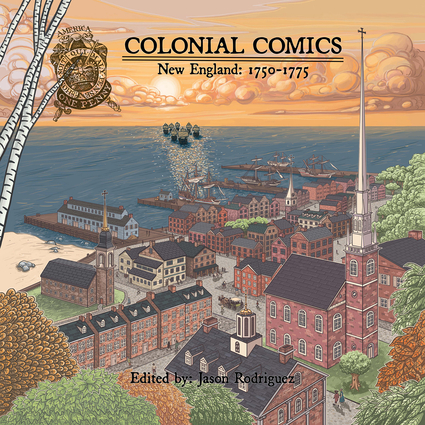
I’ve worked on both sides of the nonfiction-into-comic process. For Colonial Comics: New England, I adapted historical sources into stories about Samuel Maverick, Benjamin Franklin, and Crispus Attucks. I also supplied my nonfiction writing and research for other scripters to adapt into their own stories. I’ve seen artists add immeasurably to a tale in ways that go beyond what historical research could provide.

I also know what it’s like to have the work of historical research be rendered close to invisible. Years back, I worked with producers of the History Detectives television show to figure out the mysteries behind a couple of artifacts. I was never going to be paid, but for one of those two shows there were plans to interview me on camera. In the end, my name appeared as one short line in small type as the closing credits scroll by.

On my history blog I’ve published a series of posts about James McHenry and Elizabeth Willing Powell, drawing on new archival research and analysis. In 2019, the Washington Post published Zara Anishanslin’s article about Powell. She acknowledged relying on my work for one point, apologizing that the newspaper wouldn’t allow credit by name, only by a link. And then when a Post staffer wrote another article citing Anishanslin’s, that link didn’t survive. That’s a common problem in the major news media.

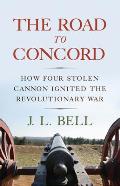
A few months back, I discovered my book The Road to Concord: How Four Stolen Cannon Ignited the Revolutionary War had been turned into a novel. A novel! The author never contacted me about obtaining derivative rights. The book contains one line of acknowledgement, grateful in tone but small in type. Since this novel was self-published, I decided simply to keep quiet about it.

At the same time, I think The Road to Concord could be adapted into a nifty movie. I’ve even taken a meeting with an aspiring producer about that prospect. If that ever happens, I darn well want credit and compensation, even though the whole point of the book and its many citations was to lay out the historical facts and sources for anyone to follow.

30 October 2025

At Last an Our Gang/Wizard of Oz Crossover

In 1962, as described yesterday, Starlight Musical Theatre of San Diego held tryouts for a production of The Wizard of Oz, using music from the MGM movie.

To play the Tin Woodman the company chose a local television personality: Johnny Downs!

Downs brought decades of experience as performer, starting with acting in Our Gang comedies in the mid-1920s. In fact, he had sung and danced alongside MGM’s Tin Man, Jack Haley, in such movies as Coronado and Pigskin Parade, which also featured fourteen-year-old Judy Garland.

Downs appears in this photograph scanned from the 3 June San Diego Union with Cammy Wesson as Dorothy, Ray Wilde as the Cowardly Lion, and John Bryce as the Scarecrow.

The director was Charlie Cannon, a co-founder of Starlight Musical Theatre (San Diego Civic Light Opera Company) years before. In 1978 the San Diego Evening Tribune reported:
Cannon is most proud of his “Wizard of Oz” production in 1962 featuring Johnny Downs, a TV personality, as the tin man. “We put close to 5,000 in the bowl for that one,” he said. “We even had people sitting in the aisles, and Downs would stay after the show for an hour signing autographs.”
That number may be an exaggeration since on 10 Aug 1964 the San Diego Union reported that 3,800 people was “a record crowd” at the Starlight Bowl. However, that record was set by the 1964 production of The Wizard of Oz—the show was so popular that the company brought it back after only two years.

In the revival Johnny Downs once again played the Tin Woodman, and was often listed first in newspaper notices. Cammy Wesson, now a college student, returned as Dorothy. Ole Kittleon played the Scarecrow and Forest Gantz the Cowardly Lion.

A new director reblocked the action for that run. In an interview with a high-school classmate for the 12 Aug 1964 Coronado Eagle and Journal, Wesson described having trouble at first knowing which way to turn. She added: “Johnny Downs, who plays the Tin Woodsman [sic], has adapted very well, but he’s a professional.”

Cammy Wesson went on to careers as an elementary school teacher, realtor, and financial advisor. As a sexagenarian back in Coronado, she took up marathon running.

28 October 2025

How Johnny Downs Grew Up

I mentioned Our Gang cast member Johnny Downs in this posting on Elmer “Scooter” Lowry going into vaudeville.

Johnny Downs was born in 1913, son of a naval officer, and spent his first years in San Diego. After he showed interest in performing, his mother gave him a Jackie Coogan haircut and brought him to Hollywood.

In 1924 Johnny acted in a couple of the kid-gang series launched after Our Gang’s success: the Reg’lar Kids movie “An Afternoon Tee” and the Juvenile Comedy “Wildcat Willie.” Late in that year the Hal Roach Studio hired him as a day player.

At first Johnny appeared in Our Gang films as a antagonist, but with a long-term contract at $50/week (and a new haircut) he became one of the gang.

When the studio announced Johnny Downs had joined the regular cast, it said he was nine years old. (He was eleven.) He made more than twenty Our Gang movies, remaining a regular until he was thirteen.

Johnny Downs was a handsome kid with a winning smile. He was rarely at the heart of the story, but sometimes his part stood out, as when he played a rich kid wanting friends in “Buried Treasure.” In “Telling Whoppers” he was cast as the neighborhood bully tormenting all the other boys; though he threw himself into the role, Johnny was just too naturally sunny to make it work.

In late 1926 the Hal Roach contract ended. Johnny spent twelve weeks in vaudeville before returning to Hollywood. Over the next few months he portrayed the young version of the hero in a few features: the young Tom Mix in Outlaws Of Red River, the young Fred Thomson in Jesse James, the young James Murray in King Vidor’s The Crowd. He made a brief return to the Our Gang unit to play an adolescent magician sporting a fake beard in “Chicken Feed.”

In 1928 Johnny went out on a vaudeville tour with fellow Hal Roach alumni Mary Kornman and “Scooter” Lowry, as discussed here. He sang a little, danced a little, told stories, showed audiences that sunny smile. Newspapers described his persona as “The All-American Boy.” That tour lasted through August 1929.

During the early 1930s Johnny Downs worked in musical revues, including shows on Broadway. Late in 1934, now an adult, he came back to Hal Roach again for the role of Little Boy Blue in the Laurel and Hardy musical Babes in Toyland.

In 1935 Downs signed with Paramount. Over the next few years he worked steadily as a juvenile lead, headlining small pictures (The First Baby, Blonde Trouble, Bad Boy) and playing small parts in vehicles for bigger stars (Algiers, Pigskin Parade, The Kid from Brooklyn). The lead role in the drag musical comedy All-American Co-Ed brought him back to the Hal Roach Studio again. He starred in a series of shorts for Columbia and a serial for Universal.

Of course, it’s harder to be a juvenile lead when you’ve hit thirty. After World War 2, Downs went back to Broadway. Then he tried television, hosting some shows and acting in others. In 1953, turning forty, Downs settled in Coronado, the region where he’d grown up. For well over a decade he was announcer and afternoon host for a San Diego television station, and also worked in real estate.

Johnny Downs never became a big star, but he was undoubtedly a small one, and he worked in show business for almost fifty years. Of all the regular members of Hal Roach’s Rascals in the silent era, Downs enjoyed the biggest and longest adult acting career.

10 September 2025

Are You Gonna?

“Are You Gonna Be My Girl?” performed by WJM (William Lipton, Jeremy Yun, and Max Simas, with guest bassist Collin Simas, uploaded to YouTube on 9 May 2013)

“Are You Gonna Be My Girl?” performed by The Runarounds (William Lipton, Axel Ellis, Jeremy Yun, Jesse Golliher, and Zendé Murdock, uploaded to YouTube on 10 Feb 2023)

The Runarounds was formed in 2000 for a television show that finally went out on Amazon Prime this month. The five musicians cast as slightly younger musicians for the series have been playing and writing songs together in the meantime, and they’re now touring the east coast.

In the series premiere, the characters bond over the song “Are You Gonna Be My Girl?”, originally by Jet. As the cast notes in interviews, and as this pair of videos shows, most of them have had fun playing that song since they were kids.

22 September 2020

Stillwater Runs 3-D

I actually made a little noise in my throat when I saw how animators are interpreting Jon J. Muth’s Zen Shorts watercolor art for a television cartoon.

This is of course the default computer-aided animation style of children’s entertainment today. Years back, I thought it was rather exciting. Now it seems to be what audiences expect and studios can easily produce.

But with all the images that computers can help artists create, that’s as close as they could get to the original?

07 April 2020

Reading the Monkey

In this time of pandemic throughout the Great Outside World, Prof. Dina Massachi and the International Wizard of Oz Club have organized a video reading of L. Frank Baum’s The Wonderful Wizard of Oz.

All the videos are on the Oz Club’s YouTube channel, as well as various Facebook, Instagram, and Twitter feeds. Yesterday there was even a report on the project in Philadelphia keyed to local reader Ryan Bunch.

Other readers have included Baum’s granddaughter Gita Morena, novelist Gregory Maguire, biographer Michael Patrick Hearn, historian of feminism Sally Roesch Wagner, and many friends I’ve made through the Oz conventions.

Dina asked me to tackle Chapter 14, “The Winged Monkeys.” In this chapter Dorothy learns the secret of the Golden Cap she took from the Wicked Witch of the West—that it can summon the Winged Monkeys to fulfill her wish. She then hears the story of how those Winged Monkeys became enslaved to the cap.

A large part of the chapter consists of the King of the Winged Monkeys’ story from his grandfather’s day. There are other long flashbacks in the book, such as when the Tin Woodman and the Wizard explain how they ended up in the fixes where Dorothy found them. This flashback is unusual in going so far back to tell a story about characters we never see elsewhere in the book—or elsewhere in Baum’s other books, either.

All the characters in the chapter are matter-of-fact about the Monkeys being compelled to obey the owner of the Golden Cap. The present King of the Winged Monkeys expresses no resentment about the sorceress who enslaved them, or his grandfather who angered her, or the Wicked Witch for ordering them around. Dorothy never considers freeing the monkeys from slavery as she’s inadvertently freed the Munchkins and the Winkies.

Glinda the Good does free the Winged Monkeys at the end of the book, but then in the sequel, The Marvelous Land of Oz, Baum describes them still as enslaved to the cap, so evidently that moment in his story hadn’t meant much to him. I doubt an author today could write so casually about slavery.

Reading Chapter 14 therefore presented a challenge. How to voice the King of the Winged Monkeys in a way that made him more than a docile servant by preserving the sense of mischief he acknowledges. Plus, that story of people we’d never meet again had to be interesting. In my telling, the king’s voice came out like a Bowery Boy.

Here’s the result for Chapter 14. Or you can start from the beginning in the great Kansas prairies.

07 November 2019

The Real Legacy of He Walked by Night

He Walked by Night didn’t influence The Third Man, but it definitely did influence American popular entertainment.

To start with, it appears to be the first movie that includes a scene of self-surgery. The bad guy stitches himself up after being shot, using a mirror and a lot of grit. I’ve seen variations of that scene in The Terminator, Ronin, and Master and Commander, but this might be the original.

Even more clearly, He Walked by Night gave birth to the most visible and long-lasting form of the dramatized police procedural. It even starts with an announcement that the story was based on real crimes, and that “names have been changed to protect the innocent.”

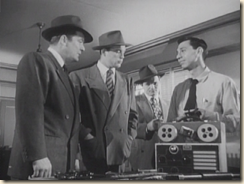
One of the supporting characters in the movie is a police lab technician played by Jack Webb. He’s young and almost winsome in the role.

At the time, Webb’s most prominent parts were as the star of the radio dramas Pat Novak, for Hire, about an unlicensed investigator who works at a pier, and Johnny Madero, Pier 23, about a pier manager who undertakes investigations. As was standard in hard-boiled mysteries, the cops in those stories were at best a rival for the hero, at worst a hindrance.

While working on He Walked by Night, Webb met the movie’s technical advisor, Detective Sergeant Marty Wynn of the Los Angeles Police Department. Their conversations and the movie’s format gave Webb the idea of creating a radio drama about a police detective, inspired by real crimes and portraying realistic law-enforcement techniques.

The LAPD also loved that idea and got behind it. Dragnet premiered in June 1949 with Webb in the starring role of Sgt. Joe Friday. It ran for more than eight years on radio. For most of those years, a version also ran on television for nine years, and there was a movie adaptation as well. Then the TV show was revived in 1966 with a TV movie and more than four more years of episodes. Webb expanded the procedural franchise in the 1970s by producing Adam-12 and Emergency!

Dragnet made Webb’s Joe Friday character a national icon, cementing his image as an actor and even his politics. That means it’s very striking to see him play a different personality in He Walked by Night, or to hear him as a cornet player during Prohibition in the fine radio drama Pete Kelly’s Blues.

20 August 2019

Television the Great and Terrible

The MGM Wizard of Oz has gone through three stages defined by how we the public got to watch it.

First was the reception that the filmmakers envisioned: exhibition in 1939 as a “prestige picture” in movie palaces, mostly owned by Loew’s Theatres. The movie was then moved to smaller venues and eventually taken out of circulation. MGM re-released the film in the same way in 1949 as the Hollywood studio system was under legal and financial siege.

That cinematic run was successful, if not immediately profitable. Even with reduced admission prices for children, The Wizard of Oz earned $3 million in its first release, enough to make it the second highest-grossing movie of 1939. It gained five nominations for Academy Awards, winning two. It established Judy Garland as a box-office star and enabled associate producer Arthur Freed to oversee many more movie musicals over the next two decades. Though most of the songs were novelty numbers, “Over the Rainbow” became a standard.

The next stage of the movie’s history started when MGM licensed the television rights to CBS in 1956. News reports about that deal marveled at how young Garland, Ray Bolger, and Bert Lahr had been when they made the picture—they were all major stars almost two decades later. In 1959 CBS took a further step and launched an annual showing, which the network touted as a major event for families to share.

The medium of television didn’t serve The Wizard of Oz well artistically. With more than 90% of American households in 1966 still watching TV in black and white, the movie’s shift to color as Dorothy arrives in Oz was invisible to most of the audience. Likewise, the nostalgic sepia tone of the Kansas scenes was printed in standard grays, and a bit of the opening was trimmed to free more time for commercials.

Culturally, however, television did wonders for The Wizard of Oz. Watching it once a year became almost required for American children, a common national experience. “Munchkin” entered the language, denoting small children and donut holes. Dorothy’s Ruby Slippers not only supplanted the book’s Silver Shoes in the public imagination but were enshrined in the Smithsonian’s National Museum of American History. In Marvel’s The Avengers, the Flying Monkeys are the one pop-culture reference that WW2 veteran Steve Rogers shares with his Gen-X colleagues and the audience. To be sure, there were American children who grew up without seeing The Wizard of Oz, or who didn’t like it enough to watch year after year, but most of them still knew its main points.

The third and current stage of the MGM movie’s life started with its release on VHS tape in 1980. It sped up as VCRs became standard household equipment and continues into today’s world of DVDs and streaming video. Now anyone ready to make an initial investment can watch The Wizard of Oz anytime they want to. No more waiting years for MGM to re-release the fabled movie into theaters, no more waiting months for the annual television airing.

Artistically, today’s media serve the movie much better than the last stage. Though we’re not watching the picture on giant movie screens as in 1939, the film has been restored to its pristine appearance and full length. What’s more, we can study scenes and frames and edited footage, and multiple behind-the-scenes books tell us about what went into this piece of popular art.

On the other hand, the MGM Wizard of Oz is no longer the cultural colossus it once was. The audience for popular entertainment has splintered, so families rarely gather around one screen to watch one channel. When one can watch the movie anytime, it no longer feels as urgent to watch it tonight. While the live-action recreations of the movie on stage and ice can provide families with a special shared experience as the movie itself once did, those productions are pale projections of the celluloid.

As a result, the fan base of the MGM movie appears to be shrinking and aging. The highest-profile works it inspired in the last three decades—Gregory Maguire’s novel Wicked, the subsequent Broadway musical, and and the movie Oz the Great and Terrible—were created for adult audiences, with sexual content and hardly any child characters. We once thought of The Wizard of Oz as a near-universal part of growing up in America. Now we see that only a couple of cohorts of Americans shared that experience.

Fortunately, the same abundance of entertainment media that swamps the annual airing of The Wizard of Oz offers many other ways to enjoy the Oz mythos. The original books, new books and comics inspired by them, virtually all the Oz movies and TV cartoons ever made—they’re all available for children to try. There are more doorways into Oz fandom now, not one big door that nearly all American children were funneled through to see if they liked it. But will more variety make up for smaller numbers?

[This essay was written at the behest of Michael Booth, to be published on his Facebook page in celebration of the 80th anniversary of the release of The Wizard of Oz on 25 August.

The picture above is PhotoShop art by LunaC, hosted on FreakingNews.com. The challenge was to slip a cathode ray TV into an old painting. LunaC chose Joseph Wright of Derby’s depictions of science in the eighteenth century.]

15 December 2015

Marvelous Land in Minneapolis

Back in 1981, the Children’s Theatre Company and School of Minneapolis staged a production of L. Frank Baum’s The Marvelous Land of Oz. On its blog the company has posted some photographs and videos of the show, along with these production notes:
Originally, the production was to be mounted by a guest writer/director but, ultimately, his concepts were felt not to be a good aesthetic match with the Company and so, fairly last-minute, the production team changed. Artistic Director John Clark Donahue assumed the role of stage director and Thomas W. Olson, resident playwright who previously that season had created the scripts for "The Story of Babar, the Little Elephant" and "The Clown of God," quickly began working on a new adaptation, while Gary Briggle was engaged to write lyrics with Richard A. Dworsky's music. . . .

At the time, ticket prices were $6.95 for adults and $4.95 for children, general seating. . . .

With "The Marvelous Land of OZ," the Company embarked on a three-year relationship with professional video producers The Television Theatre Company, shutting down the theatre for two weeks at the end of the season and transforming the auditorium into a video soundstage. The following winter, "The Marvelous Land of OZ" was distributed by MCA/Universal for cablecast on Showtime/HBO (winning a cable ACE award for outstanding family entertainment) and was also made available for home purchase on videocassette.
I saw the show when it was on cable TV and was impressed by how closely it followed the book. It was obviously a filmed stage production, not a movie, but it was a good one.

At the bottom of this posting about the CTC’s 1980-81 season are more photos from The Marvelous Land of Oz, what looks like a complete scan of the program, and the Minneapolis Tribune review. Plus some shots of Edward Albee looking grumpy and (connected to a previous show) Tomie De Paola looking svelte.

09 December 2015

The Feelings We Once Had

Of all the famous dramatic adaptations of L. Frank Baum’s The Wonderful Wizard of Oz, The Wiz in its original form is the most faithful. But of course the 1939 MGM movie is now more famous than either version.

As I observed yesterday, that movie clearly dominated Harvey Fierstein’s thinking about how to adapt the book of The Wiz for Broadway and TV today.

I spotted some other debts/homages to the MGM film that don’t come from the original Wiz:
  • Dorothy wears shiny red sneakers at the start, though public-domain silver shoes later.
  • Aunt Em’s farm employs three farmhands played by the men who (lots of makeup later) play the Scarecrow, Tinman, and Lion.
  • Dorothy is magically faced with the image of a maternal figure (Aunt Em/her late mother) calling for her.
  • We get a view of the distant green spires of the Emerald City across a red-poppy landscape.
  • The Wiz has a “Pay no attention to the man behind the curtain!” moment.
  • Glinda comes to the Emerald City for the penultimate scene instead of Dorothy and her friends going to Quadlingland.
Other elements of Baum’s original story that made it into The Wiz were dropped from this live-broadcast version, such as the Kalidahs as tiger-bear hybrids, the Lion falling asleep among the Poppies instead of outwitting them, and the need to wear green glasses in the Emerald City.

I saw the original Broadway production decades ago, and some elements of its stagecraft have stuck with me. Most memorable was the tornado depicted by a dancer with fabric billowing from her head, an image that inspired the play’s trademark art. The TV production simulated the tornado instead with projected images and wire-flying—much less magical.

The TV version of the Yellow Brick Road consisted of illuminated parts of the stage, like Michael Jackson’s “Billie Jean” video. The stage original was four men in yellow costumes with poles—another image that stuck with me strongly since I first saw it, probably because it was such a bold staging choice for my young mind.

Curiously, Baum’s Winged Monkeys, which became Flying Monkeys in the 1939 movie and Funky Monkeys in The Wiz, were referred to only as “Winged Warriors” here.

12 November 2015

Kryptonian Babysitting Service

There’s a lot to like in the new Supergirl television series, but there’s one detail in the introductory voiceover that I don’t like at all.

That line repeats a detail from the pilot, which shows Kara’s family sending her from Krypton to Earth. Her mother is a judge, showing how Kryptonian women could exercise authority.

In those scenes, Kara is about thirteen years old. Her cousin Kal-El is still a little baby. And their parents know that when the kids arrive on Earth they’ll have extraordinary powers—the yellow sun, you know.

But the women don’t tell Kara that she’ll have to be careful not to hurt the natives, or that she can be a hero. They say her job is “to look after your baby cousin, Kal-El.”

Kara replies, “I won’t fail Kal-El, or you.”

The grown-ups don’t tell Kara that she should do this “because you’re older, and he’s just a baby.” They don’t say she should do this “until he can look after himself.” They present this as her one and only mission in life.

The credits go on to explain that Kara’s spaceship was knocked off course, causing her not to arrive on Earth until her cousin has already grown up and become Superman. But she’s still in her teens. The series picks up a few years later when she’s in her early twenties. (Most comic-book versions of Supergirl are in their teens, but there is some precedent for a twentysomething.)

At first Kara says, “I didn’t have a mission anymore. But even though I had all the same powers he did, I decided the best thing I could do was fit in. After all, Earth didn’t need another hero.” Over the first couple of episodes, she decides to discard that attitude and be a superhero as good as her cousin.

Comics writers have gotten a lot of stories out of Supergirl’s wish to match her older, established cousin’s heroism. I have no problem with that being a big theme in this series. But here that theme is tied onto the notion that her job was to look after the family’s sole surviving male.

04 November 2015

A Golden Time for a New Golden Compass?

The news that there’s a deal for a television adaptation of Philip Pullman’s His Dark Materials series is very intriguing for us fans. It also shows how the economics of special-effects adventure dramas have changed in recent years.

In 2007, New Line’s adaptation of The Golden Compass cost an estimated $180 million to make. But that movie just didn’t capture the books’ magic, earning only $70 million in the US. That was so little that New Line’s parent corporation restructured the division the next year, bringing it under the control of Warner Bros. (The film made more overseas, but most of that money went to distributors, not the studio.)

Now television shows like Supergirl can afford digital visual effects on the same level, despite having a lower budget. And miniseries have become quite lucrative. So it’s possible to conceive of a His Dark Materials adaptation that’s not only visually stunning but tells the complete story of the three books.

Philip Pullman is part of this new deal. So is New Line, perhaps because it still holds the dramatic rights, and Scholastic. The production company, Bad Wolf, is new, without any completed projects, but its founders have brought on the BBC, their former employer. They also have ties to HBO, which would be a prime customer for the series in the US. All that makes me feel a little more hope than usual that this announced deal will lead to an actual show.

20 November 2014

Publishers as Venture Capitalists?

Another of Paul Levitz’s observations about the publishing industry last week was that book publishers have usually operated like bankers. They extend interest-free loans to authors in the form of advances, to be paid back (they hope) in royalties over succeeding years.

And like bankers, those companies are quicker to loan money to people who don’t need it: authors who are already earning a fine living off past books or in other fields. New or unknown authors, especially in fiction, have to do most of their work before they see any money, and then they don’t see much.

(That of course reflects that publishing advances aren’t exactly like loans. They’re also bids on properties, and in any business what looks more like a sure thing commands a higher price than an unproven quantity.)

Levitz suggested that publishers will have to become more like venture-capital firms, investing earlier in authors’ careers and projects. And, presumably, offering more guidance and control over their creations, as venture capitalists watch over the start-ups they invest in. Hollywood studios work closer to that model, paying earlier in the process to develop projects with a larger payoff.

I see a couple of problems for authors with that model. First, Hollywood studios are notorious for the number of projects they abandon: scripts in turnaround, TV pilots shot and never aired, and so on. Likewise, venture capitalists know that many of their investments won’t pay off, and they pull the plug a lot. Right now authors who get as far as a publishing contract are usually sure that their books will eventually see print, even if they’re marketed even more weakly than usual.

Hollywood studios are also notorious for getting involved in the creative process with script notes, personnel ultimatums, recutting, and so on. All to make the final stories more entertaining, of course. But does that work?

The screenwriter and novelist William Goldman famously wrote in Adventures in the Screen Trade:
Nobody knows anything. . . . Not one person in the entire motion picture field knows for a certainty what’s going to work. Every time out it’s a guess and, if you’re lucky, an educated one.
What’s more, writing a book is a far less collaborative process than making a movie, or creating a tech company. How much solid advice can publishers offer to authors early in the creative processs? How many experts can they bring on board, or how many systems can they put in place, when the whole enterprise consists of one person and one keyboard?

19 November 2014

A Paradox of Geek Fandom

Last week I sat in on a discussion with Paul Levitz, former President at DC Comics, at MIT’s Media Lab. (The door to the building said I had to have an MIT identification to enter, but I rode up the elevator with Levitz and helped him find the auditorium, so I figured I deserved to stay.)

Levitz started at DC Comics as a sixteen-year-old freelance writer and editor, and is still scripting comics. From 1976 to 2009 he took on increasing internal responsibilities, spending the last seven years as President. Having long functioned as a big part of the corporate memory, he recently wrote a gigantic history of the company.

Among other observations at MIT, Levitz said that “geek culture” has overtaken “pop culture.” That reflects the popularity of videogames and of superhero and science-fiction movies and TV shows, of course, but it also speaks to a certain style of consuming entertainment.

I asked Levitz for his thoughts about one paradoxical aspect of “geek culture.” On the one hand, that form of fandom is very interested in seeing the process of storytelling:
  • comics collections often include early sketches, scripts, and creators’ discussions of roads not taken. We rarely see that in novels.
  • DVDs feature deleted scenes, commentary tracks, outtakes, and other peeks into the creation of the movies or TV shows they document.
  • TV “show runners” are becoming celebrities with their own following.
  • the moviegoing/viewing/reading/gaming public follows the creation of a new piece of entertainment earlier than ever; news that used to be restricted to the industry is now spread everywhere.
In sum, it’s more obvious than ever that those stories we like are artificial creations designed to entertain us and earn our dollars. And we enjoy the reminders of that.

And yet “geek culture” is also marked by a fervid, sometimes rabid, protectiveness about those stories and the characters in them, as if they were real or deserved to be. Fans want to guard their favorites from the very companies and people who have the assignment of keeping them alive.

Levitz could only reply that part of his job as a DC executive was to warn people adapting the company’s properties to other media when they were straying too far from the characters’ “core.” He found that he couldn’t define in advance what would raise most fans’ protective responses, but he knew it when he saw it. And that emotional attachment remains, still hard to map but perilous to cross.

09 November 2014

“No other comic-book character has lasted as long”

In articles derived from her new book, The Secret History of Wonder Woman, Jill Lepore has been talking up that comic-book heroine’s place in superhero history.

In Smithsonian:
Wonder Woman is the most popular female comic-book superhero of all time. Aside from Superman and Batman, no other comic-book character has lasted as long.
In The New Yorker:
Superman débuted in 1938, Batman in 1939, Wonder Woman in 1941.
Who’s missing from this discussion? “The Sensational Character Find of 1940,” of course.

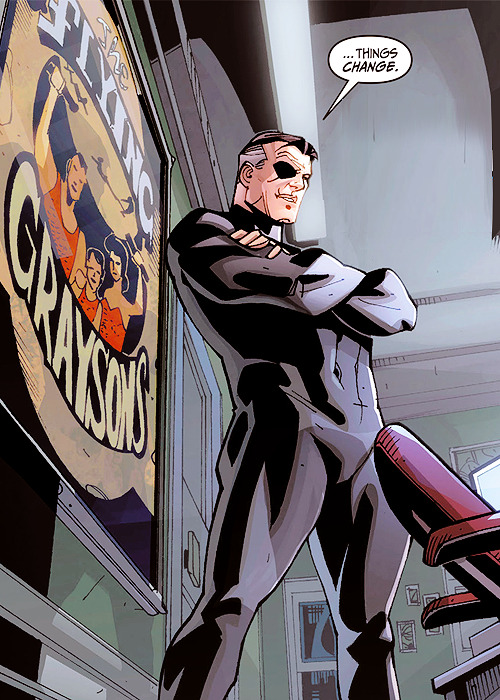
Dick Grayson has appeared in stories for nearly three-quarters of a century, about a year and a half longer than Wonder Woman. He’s been a major character in two movie serials, a television series, and two feature films. Plus, half a dozen television cartoons have featured some version of Robin.

I suspect Robin is a pop-culture reference as recognizable as Wonder Woman. In fact, the name “Dick Grayson” might be better known than Wonder Woman’s occasional alias, “Diana Prince.”

Of course, Robin has always been a sidekick to Batman, and thus a supporting character or one in an ensemble instead of a lead. Though he appeared on more comic-book covers in the 1940s than Batman, not until the 1990s was there a comic book with the Robin name in its official title. In contrast, there’s been a Wonder Woman magazine since 1942 (with a yearlong break in 1986-87), and she’s usually worked on her own as well as with the Justice Society and Justice League.

So I’m not arguing that Wonder Woman is less prominent than Robin, just that he qualifies as a famous, long-lasting comic-book crime-fighter on the same level.

(And I won’t even mention that Archie Andrews made his debut in comic books in the same month as Wonder Woman, so those two comic-book characters have lasted the same time.)

08 November 2014

Where Serials End Up

Someone else considering the workings of serial fiction this week was Linda Holmes, writing for NPR on the public-radio-related podcast Serial, reinvestigating a murder.

Holmes notes how many listeners are trying to view the podcast through the lens of the recent limited television series True Detective, Fargo, and Lost. In other words, they’re asking for a clear conclusion even if (as in two of those examples) it ends up disappointing a lot of the audience.

Holmes writes:

What’s good about this wrinkle, and what seems healthy about it, is that it raises the question of what stories are for. Must there be a lesson or a moral? Must we sense a particular idea about life at the end, and can it be futility? If you raise a question, do you have to answer it? In real life, of course, Chekhov’s gun need not come to anything in the third act just because it was shown in the first. If this makes a good true story but would not make a good piece of dramatic fiction, why is that?

Assuming people do find the [Serial] ending satisfying despite what almost must be its messiness, is it possible that a piece of serial crime reporting with no conclusion will point to the idea that we've perhaps become overly obsessed in judging an entire piece of storytelling on whether we get the perfectly symmetrical, flawless, balanced, wry, doubt-drowning ending we deserve?
I find it telling that Holmes’s essay doesn’t mention what until recently was the necessary name-drop in any article on quality television: The Sopranos. That show famously ended without resolution, just a sudden black screen. And people were pissed. So it fits right into Holmes’s thesis.

23 October 2014

No Justifiable Homicides for Superheroes

Recapping network television episodes seems to be big business for entertainment websites these days. I did it myself for Den of Geek and the first season of Turn.

For the new Flash series, Playboy evidently has the money to go straight to the top because the magazine’s recapper is Mark Waid, who wrote scores of highly regarded issues of that comic book and its spin-offs in the 1990s.

In his discussion of episode 3, Waid starts by analyzing a superhero trope that goes all the way back to when the genre was codified in the 1940s. He recaps his argument with an iconoclastic comic-book publisher about the rule against superheroes solving problems by killing bad guys:
Yes, there is absolutely such a thing as justifiable homicide, but it’s a last resort, not a method of operation. The concept that life in all forms is sacred isn’t just a throwback to fairy tales or simpler times, I argued; it’s a philosophy as old as realized religion.

Okay, yeah. Cops have to shoot robbers sometimes. Soldiers have to kill. Homicide detectives and private investigators, real or fictional, sometimes kill. They’re people just like you and me, with limited abilities and limited tools.

But super-heroes were created specifically, from the imaginations of the young and the young at heart, to do the impossible — to defy gravity or bounce missiles off their chest or outrun speeding bullets. It’s baked into their DNA. To find a perpetual audience, super-heroes must seem relevant and relatable and admirable, but they are still creations of fantasy.

We read their comics and watch their TV shows and movies to see them do the things we can’t, to triumph heroically against odds that would flatten you and me...not to suffer with them as they’re forced into the trauma of making the same real-world choices that you and I, mere humans, would have to make if we [were] caught helpless with our only available weapon one that was designed explicitly to kill.
To be sure, some costumed heroes, like Marvel’s Punisher and DC’s Vigilante, are specifically designed to go against the no-killing rule. But it’s notable that neither of those characters has fantastic powers. And the companies’ biggest brands avoid killing even if (as in the case of Wolverine) they talk about being willing to do it.

Waid’s faith in that dictum is what got him in trouble in viewing Man of Steel a couple of years back, as he so memorably described:
Superman wins by killing Zod. By snapping his neck. And as this moment was building, as Zod was out of control and Superman was (for the first time since the fishing boat 90 minutes ago) struggling to actually save innocent victims instead of casually catching them in mid-plummet, some crazy guy in front of us was muttering “Don’t do it…don’t do it…DON’T DO IT…” and then Superman snapped Zod’s neck and that guy stood up and said in a very loud voice, “THAT’S IT, YOU LOST ME, I’M OUT,” and his girlfriend had to literally pull him back into his seat and keep him from walking out and that crazy guy was me.

That crazy guy was me, and I barely even remember doing that, I had to be told afterward that I’d done that, that’s how caught up in betrayal I felt. And after the neck-snapping, even though I stuck it out, I didn’t give a damn about the rest of the movie.
And in that Waid was exactly right. Flash is not exhibiting the same problem.

28 September 2014

Beyond Batman Beyond

It’s interesting to watch what DC Comics has done with its Batman Beyond storyline this year, reflecting changes in its target audience.

Batman Beyond was a spin-off of the very successful 1990s Batman TV cartoons of the 1990s. Les Daniels’s Batman history states, “a new show was requested that might skew toward younger viewers.” The resulting cartoon was set in the future when the world has more advanced technology and Bruce Wayne is a goddamn octagenarian. The new Batman was a hot-tempered teenager named Terry McGinnnis.

This show was an extension of the DC Animated Universe, thus not tied to the publisher’s main comic-book continuity. There was an accompanying comic book in 1999-2001, but readers were supposed to keep it separate in their minds from the main Batman titles of the time.

In this version of the future, Barbara Gordon has long ago retired as Batgirl and now holds her father’s old job as police commissioner. She was romantically involved with Dick Grayson when they were college-age, then later with Bruce Wayne for some unspecified period, and is now married to someone else. Dick himself, having established himself in the DCAU as Nightwing, has left Bruce’s team and is nowhere to be seen.

Batman Beyond lasted for 52 episodes plus a TV movie—a respectable but not sterling run. Nevertheless, it made a strong impression on a lot of viewers, including Kyle Higgins. He told Comics Alliance:
I was such a huge fan of the show. The DC Animated continuity was my introduction to DC Comics growing up. So I know that stuff inside and out, and I actually know it better than the books.
Higgins’s fondness for the cartoon is also evident in how he spoke about it on Kevin Smith’s podcast and in other interviews.

In 2010, DC launched a series of new Batman Beyond runs scripted by Adam Beechen. One of his mandates was to tie the world of the TV cartoon more closely to the DC comics (though those were about to go through some sudden changes themselves). Beechen brought back Dick Grayson, revealing that he’d stepped away from crime-fighting and from Bruce Wayne after losing one of his eyes in a fight.

That was the history Higgins inherited when he took over DC’s digital-first Batman Beyond series in 2013. His series was subtitled “2.0” because it showed Terry McGinnis breaking away from Bruce as mentor and working instead with Dick. Higgins was thus writing two different versions of Dick Grayson as he finished his Nightwing run and started this series.

In a story titled “Mark of the Phantasm” (digital issues #25-31), Higgins and co-writer Alec Siegel dug deeper into the relationships among Barbara, Bruce, and Dick. Craig Rousseau provided the art for the scenes set in the future, adhering to the standard Batman Beyond style. Phil Hester penciled scenes set in the past, following the style of the earlier Batman: The Animated Series cartoon and its spin-off comics.

Issue #28 shows Barbara and Dick telling Terry how they broke with Bruce. In their early twenties they had started to rekindle their relationship and Dick was ready to propose, only for Barbara to discover she’d become pregnant by Bruce—only for Barbara to miscarry after intervening in a mugging.

Remember, this story appeared in a continuity created to “skew toward younger viewers.” But that was back in 1999. Those same viewers have aged fifteen years and are ready for plot twists based on sexual relationships and spontaneous abortion. They got that more adult story even within the nostalgic visual style that Hester provided.

In another sign of the DCAU’s hold on today’s comics readers, the main DC Comics continuity is being disrupted by a crossover story called “Future’s End,” and Terry McGinnis as a next-generation Batman is in the middle of it all. While he still represents only one possible future for the company’s main continuity, he’s also what the company thinks its present-day readers want to see.

26 September 2014

Gingrich’s Leap of Language

On Tuesday morning, President Barack Obama spoke about the expansion of the US war in Afghanistan and Iraq into ISIL-occupied Syria. The White House transcript of that statement is here, pegged to the time of 10:14 AM.

Former Speaker of the House and presidential candidate Newt Gingrich responded with a series of tweets.

On the other hand, Gingrich did not have the courtesy to listen to the speech himself, check the official White House text, or wait less than twenty minutes for C-Span to review its real-time transcription.

As the New York Times patiently explained:
…as any regular C-Span viewer can tell you, the network’s real-time captioning produces some far from accurate phrasing. In fact, later in the day, C-Span had Mr. Obama “partnering with African on Jupiter” on clean energy projects. What the president said was “partnering with African entrepreneurs.”
When faced with what he recognized as a “weird” text, Gingrich couldn’t simply consider that there might be an error and hold off commenting until he found more information. Instead, he fit that into his false image of President Obama’s foreign policy and leapt to criticize it. That’s another sign of Gingrich’s ongoing OIP Derangement Syndrome.