Showing posts with label movies. Show all posts

25 September 2026

A False Lead on Mrs. F. E. Woodbury

While researching the story of Hal Roach’s first marriage, I encountered a story that appeared in many American newspapers in late 1915.

The earliest example in my databases was in the 1 October Reno Gazette, shown here. Its headline then was: “She Gets Rich by Swapping / Now She Has Bank Account”.

That article showed a photograph of Helen G. Woodbury taken in Calumet, Michigan, probably in the 1890s. That picture was labeled “Mrs. F. E. Woodbury.”

The story, datelined Los Angeles, started: “‘David Harum’ has been outdone by a woman.” David Harum was a bestselling novel by Edward Noyes Westcott published in 1898, largely a character study of a sharp deal-maker. A movie adaptation had been released earlier in 1915.

According to the article, “Mrs. F. E. Woodbury” had “started to barter ‘for the fun of it,’” trading her imported gowns for a piano, a dentist’s kit, bird specimens, paintings, and eventually real estate—$22,000 worth of new property in all.

The story ended:
She is at present in charge of a hotel here, but intends soon to raise hogs and alfalfa on a southern California ranch.
Appearing in the season when Helen G. Woodbury Roach filed for divorce, the story didn’t seem out of character for a person of whims. She wasn’t “at present in charge of a hotel,” to be sure, but she was found the following year to have invested a lot of money into a restaurant and hotel. So I put this article into my research file on Hal Roach’s first wife.

To be safe, I went looking for the original Los Angeles story. And I found it—sort of.

Almost exactly the same text had appeared on the front page of the Los Angeles Daily Herald on 20 September. The two big differences were:
  • The earlier story described the trading of “Mrs. E. F. Woodbury” instead of “Mrs. F. E. Woodbury.”
  • The Herald ran a different photograph of a different woman.
A little more digging, and I learned that Mrs. E. F. Woodbury was the former Joan Meta Hadenfeldt (1873–1969), second wife of Elmer Franklin Woodbury. She had sung in vaudeville, married in 1904, and was the second or third queen of the Rose Parade in Pasadena.

These Woodburys were in the hotel business. Elmer started by owning a restaurant in his home state of Maine. In 1908 “Mr. Woodbury and his charming wife” were managing the Hotel Pepper in Los Angeles, according to the Hotel Bulletin. That article said of Elmer, “As a hotel manager he is one of the greatest publicity getters whom I have ever seen.”

The 25 Feb 1909 San Francisco Call stated Woodbury had just bought the St. Mark Hotel in Oakland, adding:
For many years the new manager was connected with the Cadillac hotel of New York and the Brighton Beach hotel. He came to California three years ago and has been in charge of the Maryland and Casa Grande hotels in Pasadena.
In September 1911, the New York Times reported that Woodbury had overextended himself in buying “the Hotel Belleclaire, at Broadway and Seventy-seventh Street,” assuming its debts. He declared bankruptcy in New York but bounced back on the west coast.

On 11 Sept 1915, less than a week before Joan Woodbury appeared on the front page of the Los Angeles Herald, a big advertisement in the paper’s evening edition announced that she and Elmer were opening a new “Apartment Hotel” called the Stratford. They continued to advertise in that newspaper for weeks.

Thus, it appears that a Los Angeles news story about Mrs. E. F. (Joan) Woodbury trading goods, played up to publicize her husband’s new venture, was distorted outside the city into a story about Mrs. F. E. (Helen) Woodbury. Somehow Helen’s old photo got attached. And since those latter articles appeared far from Los Angeles, neither Mrs. Woodbury saw them and asked for a correction.

Contrary to that news item, Joan Woodbury didn’t leave the hotel business to run a ranch. In fact, in 1920 Elmer purchased a twenty-year lease on the Hotel Richelieu in San Francisco. That year’s US Census listed Joan as his assistant manager.

The same census also found the household included four-year-old Joan Elmer Woodbury and her eighteen-year-old governess, Marie Sandow. Five years later, Elmer and Joan Woodbury divorced. Five years after that, Elmer married Marie as his third wife.

As for little Joan Woodbury, she started performing in motion pictures as early as The Half Breed, produced in 1922 by Oscar Morosco (formerly producer of L. Frank Baum’s stage musical The Tik Tok Man of Oz). She returned to the screen in the late 1930s and performed in many B westerns over the next decade.

24 September 2026

Separate Ways

We know what happened to movie producer Hal Roach and movie star Harold Lloyd after 1916, but what about the other people who appeared in this saga of Roach’s first marriage?

Helen G. Roach’s first husband, Frederick E. Woodbury, was initially interred in Milwaukee, but in 1916 his body was reburied in Nashua, New Hampshire, according to the 16 August New Hampshire Farmer and Weekly Union. His mother had died there when he was five, and her grave became the anchor of a family plot.

Craig Calman collected information about Daniel Linthicum, the other founding partner of the Rolin Picture Company, in 100 Years of Brodies with Hal Roach. Having worked in banking, he was president of the Linthicum Chemical Company in 1913. Five years later, he was a tractor distributor. In 1920, Linthicum returned to his home state of Arkansas, but by 1930 he was back in Long Beach, California, where he headed the Red Anchor Dock and Steamship Company until his death at age 73.

Dwight A. Whiting, the investor who got Rolin its crucial distribution deal, was the company’s operations manager, treasurer, board secretary, and financial backstop until April 1918. Then he sold his stock to Roach and moved on. Richard Lewis Ward’s History of the Hal Roach Studios stated that Roach later claimed “Pathé management had insisted on the change” but noted that no documentation supports this.

Whiting might have made his own choice to step away from the studio. He had married Rosalind Morris, and their first child was on the way in the spring of 1918. (That daughter, Nathalie, died in 2020 at the age of 102.) The Whitings might have decided he should devote his time to more solid enterprises than the movie business, and let Roach dig himself out of any further financial jams. 

Whiting listed himself as a “Rancher” in his Stanford alumni update in 1921. But the next year, the multimillion-dollar Union Oil Associates was incorporated as a holding company to keep the venerable Union Oil Company of California away from Shell Oil. Its headquarters, shown here, is now a museum of the early petroleum industry. Whiting was vice president of the holding company and remained on its board for decades.

As of 1925 Whiting was also chairman of the Bank of America, LA; president of Indemnity Mortgage Insurance; and on the board of several other corporations.

Whiting and Roach remained friendly. Calman reported that Whiting helped to sell Roach’s yacht in 1925, and the two men were in the group that established the racetrack at Santa Anita Park in 1934. Whiting and his first wife divorced in 1929; he remarried in 1931 and then again in 1960 after his second wife died.

Whiting’s assistant, Warren Doane, succeeded him as Hal Roach’s top manager from 1920 to 1931. At that point the studio’s main creditor, the Bank of America, insisted that Roach replace Doane with Henry Ginsberg, bringing a mandate to keep costs down. Doane then became a competing producer at Universal—but that’s another story.

I don’t have enough information to track Helen G. Woodbury’s chauffeur, F. J. Mulligan, or the movie actor named Hill she accused of stealing her jewelry.

After leaving the Lodge Café in Seal Beach, Jimmie Blyler continued to play piano at clubs around Los Angeles. In 1917 he had an act at the Jewel City Café with a singer named Vernon Dent (1895–1963). Soon both men were working in the movies. Dent spent the 1920s with Mack Sennett, then worked from 1935 to 1953 at Columbia, becoming a familiar face to generations of Three Stooges fans. As of 4 Apr 1918, the Venice Evening Vanguard identified Blyler as a “comedy pianist from the Triangle studio.” That year he appeared in seven Harold Lloyd shorts, so he must have been on fine terms with Hal Roach.

In his profile of Jane Blyler, Dave Lord Heath shares more information about Jimmie Blyler. In early 1916, even as the Lodge Café was opening with Helen G. Roach’s money, Jimmie was in a relationship with the dancer Jane Ott. Their child, James Blyler, Jr., was born in October. Though Heath found no record of their marriage, Jane began using Jimmie’s surname, and she too appeared in Harold Lloyd films in 1918. By the end of that year, however, Jimmie Blyler was partnered with the singer Jane Green and Jane Ott married a businessman named Robert Johnston, Jr.

Jimmie Blyler toured the country with Jane Green, marrying her in 1920. (Their publicity photo appears here.) He died while on the road in Chicago in April 1924, and his remains were buried in his home town of Des Moines.

Blyler’s partner in launching the Lodge Café at Seal Beach, Dave Combs, dropped out of the Los Angeles newspapers after being arrested for allegedly embezzling from the Roach estate. The 21 Nov 1921 Albuquerque Evening Herald reported the city’s Elks Lodge had learned that Combs died that day in Santa Barbara of typhoid fever.

Seal Beach hit hard times during the World War when shortages of gasoline and tires made it difficult for people to travel to resorts. Then came Prohibition, erasing the city’s advantage over nearby Long Beach. After a few years Seal Beach’s nightlife moved off shore—that city was where you caught the launches to ride out to gambling ships anchored in the Pacific.

Marguerite Roach, Hal Roach’s second wife, appears to have stopped acting in motion pictures after her marriage. She had two children: Hal, Jr., in 1918 and Margaret in 1921. The Roaches’ marriage went through rough patches. In January 1928 the New York Times reported the couple had separated at the end of the previous year, but a week later they set out on a round-the-world tour to patch things up.

An October 1940 New York Times article stated that “Mrs. Margaret Roach,” as she now spelled her name, had filed suit for “separate maintenance,” charging Hal with “cruel and inhuman treatment.” Four months after that, the press reported that the Roaches had reached a financial settlement with Margaret receiving “$1250 a month, one-half of her husband’s interest in the Hal Roach Studios and their mansion in Beverly Hills,” according to Craig Calman. She didn’t want a divorce “because of her religion.”

Less than a month later, however, Margaret Roach died of pneumonia after a week of illness. The press spun that as a reconciliation story, saying, “Her husband knelt at her bedside. His hand held hers.”

On 31 Aug 1942, Hal Roach married his third wife, Lucille Prin (1913–1981), a secretary for ASCAP who was twenty years younger. They would have four daughters and remain together until her death.

TOMORROW: A false lead.

23 September 2026

Interpreting the Story of Helen and Hal Roach’s Marriage

What sort of story does the marriage of Helen and Hal Roach produce?

As I traced Helen Grant Duncan Woodbury Roach’s life in Los Angeles, I kept thinking of a couple of early Laurel and Hardy movies that featured James Finalyson as an irrepressible Lothario.

In “Love ’Em and Weep” and “Sugar Daddies,” Finlayson played wealthy skirt-chasers. (He’d portrayed similar characters in earlier shorts, such as “Chasing the Chaser” and “Dizzy Daddies.”)

Stan Laurel and Oliver Hardy, not yet a solid pair but part of a trio, had to help the man out of the predicaments his libido had gotten him into.

Imagine a gender-swapped version of that, with Helen G. Woodbury as a rich woman who’s left her husband for the sunny clime of California and can’t stop chasing young men, many of whom turn out to be after her money.

The live-in chauffeur who developed a foul mouth when he drank. The movie cowboy who dreamed of making his own films. The “awfully handsome” actor with an eye for jewelry. The pianist ready to open a big night club. And what other men did she fancy who never made the newspapers?

Helen Roach’s sudden death in 1916 raises the prospect of a different, darker scenario: a murder mystery. Which of her entanglements might have wanted her dead? And who benefited from that death?

Of course, Helen Roach’s doctor certified she suffered from bronchial pneumonia for several weeks before dying. That detail would have to change to make a whodunnit.

I’m not suggesting that the Hal Roach Studio really grew out of murder. The true origin story wasn’t that sordid, just a little seedy.

Hal Roach happened to be Helen Woodbury’s favorite in the year her husband died, leaving her free to marry—or to demand her boyfriend marry her. That was just a matter of luck, but was it good luck or bad?

Since Hal Roach never talked about this marriage publicly, we can’t say what he thought in those years. It seems pretty clear that he received the money to start Rolin in the spring of 1914 from Woodbury. But they didn’t marry until the fall. Did they both want a more committed relationship then? Was Hal hoping for more funds? It doesn’t look like he got any.

The Roaches’ marriage soured, and she filed for divorce in late 1915. She found other men to invest her time and money in. He may have found other women. And then she fell ill.

Because Helen died before that divorce became final, Hal inherited her considerable estate—a good fortune for him and his moviemaking enterprise. He didn’t start the Rolin Film Company with an inheritance, but he undoubtedly enlarged the studio with one. 

TOMORROW: Whatever happened to all the other players?

18 September 2026

“We better stick at comedies and make good ones”

The Pathé company, founded in 1896 as Société Pathé Frères, was a giant in early cinema. In the first decade of the twentieth century, it was the largest producer of film equipment and films in the world.

Pathé established the system of renting prints to exhibitors instead of selling them. It invented the newsreel, distributed on its own non-flammable film stock for faster shipping through regular mail. It owned a large chain of cinemas in Europe.

In 1914 Pathé wanted a bigger presence in the US market. Its executives were already frustrated with its main American distributor, and then the World War stifled production, distribution, and attendance in Europe.

Pathé opened new studios in New Jersey. It produced the hit Perils of Pauline serial. And it invited small producers to submit their short films for distribution by its new subsidiary, Pathé Exchange.

In early 1915, Dwight Whiting traveled to the East Coast to present Pathé managers with a dozen films that the new Rolin Picture Company had made the previous year. Rolin had already seen two prospective new distributors fail before any of its movies got to theaters. The corporation was nearly dormant. Founder Hal Roach had taken a directing job at Essanay, and the acting company had dispersed.

The Pathé screening committee watched Rolin’s films and didn’t like them. According to Richard Lewis Ward’s History of the Hal Roach Studios, the company’s gatekeepers “completely dismissed the three dramas and complained that the nine comedies were crude and vulgar, full of censorable material,” “imitations and not very good ones,” poorly photographed and directed.

Whiting nonetheless convinced Pathé to accept one one-reel short for distribution: “Just Nuts.” In 1916 Roach described this movie as a “last attempt” made “With capital down to the zero point.” It featured Harold Lloyd as “Willie Work,” a blatant imitation of Charlie Chaplin, harassing people in a park. Roach admitted, “There was no story and no rhyme or reason to it.” Here’s a sample.

As quoted by Craig Calman in 100 Years of Brodies with Hal Roach, Whiting wrote to Roach from New York in March 1915 with what he’d learned from Pathé: “They seem to like the wrong party getting hit, so stick in a lot of it. [They] Say you work up to climax then fall down. Take more time and figure it out better at first and we will show them.” A few days later Whiting passed on more feedback from Pathé: “your work amateurish in all ways but we better stick at comedies and make good ones.”

Whiting then added, “I have faith in your ability. Go to it.” Whiting would have the title of production manager under Roach as studio president, but those aren’t the words of an employee to his boss. They’re the words of an investor, or a patron. Whiting was giving Roach the go-ahead to spend more money—his money.

In March 1915 Hal Roach went back to running Rolin. There was still no solid distribution—he would make more movies on spec for Pathé to evaluate in hopes that it would offer a contract. But with Whiting’s support he had the resources to resume filming.

Roach leased studio space in Edendale from the Norbig company. Pathé thought three Rolin actors had shown potential, but Roach could hire back only one: Harold Lloyd. With his father’s help, Lloyd designed a less obvious Chaplin imitation eventually dubbed “Lonesome Luke.”

In October 1915, Pathé Exchange looked at the first Lonesome Luke one-reelers and offered Rolin a distribution deal—though it would still reject any movies not up to its standards.

At last Rolin had audiences for its productions and money coming in. Whiting could offer the older films to minor distributors on fire-sale terms (and even then most of them didn’t sell).

Meanwhile, Hal Roach’s marriage to Helen G. Woodbury was on the rocks.

TOMORROW: Can this marriage be saved?

(Lonesome Luke’s Lively Life by Steve Massa, published in 2025, is the first study and probably the last word on the comedy series that established Harold Lloyd and Hal Roach in the movie business.)

17 September 2026

The Fortunes of Dwight Whiting

Helen G. Woodbury’s financial support helped Hal Roach to set up the Rolin Film Company, but it didn’t keep the new enterprise going.

In 1915 Rolin was rescued by the work and the money of board member and production manager Dwight A. Whiting (1891–1974).

For background on Whiting, I’m indebted to the articles of Janet Whitcomb, chronicler of Lake Forest, California.

Dwight A. Whiting grew up in a wealthy Los Angeles family. His father, also named Dwight, had come out from Massachusetts and founded the town of Del Toro, which became Lake Forest. The patriarch was known for planting eucalyptus trees. He met his wife Emily at the Hotel del Coronado, where L. Frank Baum later spent some winters during his period of celebrity and wealth.

In the spring of 1907, when Dwight was fifteen years old, his father died suddenly. In this article Whitcomb quotes from a death notice in the 1 May 1907 Los Angeles Times:
Death resulted from injuries received on a Santa Fe train while Mr. and Mrs. Whiting were returning from Los Angeles from the El Toro ranch with a party of friends. Mr. Whiting was walking down the aisle of the car when the train gave a lurch and he was thrown against the corner of one of the seats, the impact causing internal hemorrhages. The accident at first was not considered a serious one, and a day or so after it occurred the injured man was able to make a trip to Santa Barbara, but while there he became much worse and returned to his home, where he soon died.
The same news story said the older man had left instructions about his son’s future: the boy “is to receive an education in this country especially fitting him as a specialist in forestry, and then is to receive a special course in the University of Leipzig, Germany.” In fact, the son attended Stanford University from 1910 to 1912.

Dwight Whiting came of age in 1912 and probably gained control of his inheritance then. There’s no sign that he went into forestry. Instead, two years later he was running an automobile dealership. In later life he was involved in ranching, banking, insurance, and oil. But in 1914 and 1915 Whiting was interested in the Rolin Film Company.

In this article, Whitcomb quotes from a 1989 newspaper clipping (which I can’t find elsewhere) based on an interview with Hal Roach—who wasn’t always exact when telling stories about events over half a century earlier. Roach said that as a trucker he was once “unloading logs at a ranch owned by Dwight Whiting” and thought it was “an ideal shooting area for cowboy films.” He said of Whiting:
He loaned me the $200 to produce my first film, a 30-minute western, and let me shoot it all on his property.
As Whitcomb notes, Roach didn’t recall accurate information about Whiting and Del Toro. This “cowboy film” can’t be identified. Was it indeed Roach’s first film? Was the $200 a loan or an investment, and was it actually $200? Details aside, Roach’s basic memory was that Dwight Whiting was an early backer of his moviemaking enterprise.

Whiting’s mother had remarried in 1911, and he and his brother worked to keep her hefty inheritance out of the hands of her new husband by setting up trusts and corporations. An IRS ruling about those entities contains the information that in 1917 Dwight Whiting was worth about $176,000. That was the equivalent of more than $4 million today. Whiting didn’t need his job at the Rolin Film Company. The company needed him.

Indeed, Richard Lewis Ward’s History of the Hal Roach Studios says that in its first few years “the company was chronically short of general operating funds, necessitating frequent requests for advances from Pathé and occasional excursions into Dwight Whiting’s personal resources.”

The same study quotes Whiting’s assistant manager Warren Doane writing to H. M. “Beanie” Walker (then a freelancer) about late payment in early 1918, “Should worst come to worst, Mr. Whiting will come to bat again and liquidate all that is against the Company”—i.e., pay off the bills from his personal funds.

But first, Whiting needed to find Rolin a distributor, any distributor.

TOMORROW: A pathetic situation.

(In the absence of any photograph of Dwight Whiting, I’m illustrating this post with a photo of 542 Lorraine Boulevard in LA. As explained here, this house was commissioned by Dwight’s younger brother George in 1920. After George’s marriage broke up, he sold it to Dwight in 1925. Then Dwight’s first marriage broke up, and he sold it in 1931.)

16 September 2026

The Rolin Film Company Seed Money and When It Ran Out

On 21 Oct 1914 the Los Angeles Times, Los Angeles Morning Tribune, and Los Angeles Evening Express all reported that a marriage license had just been issued to Harry E. Roach and Helen G. Woodbury.

City records say the marriage took place on 19 October.

The marriage certificate and newspapers described Roach as aged 22 and working in motion pictures.

The documents also said Woodbury was 37. Helen was in fact 47 years old.

The couple were reported to be living in Helen’s home on Van Ness Avenue.

We thus have this timeline:
  • 14 Jan 1914: Frederick Woodbury died suddenly in a mine accident.
  • 26 May: Frederick’s widow Helen Woodbury, having received $10,000 in life insurance money, was suing for more.
  • 23 July: Hal Roach co-founded the Rolin Film Company, stunning his friend Harold Lloyd by having about $2,000 to invest.
  • 21 October: Helen Woodbury and Hal Roach married.
Also in that period, on 24 September a “wealthy society woman…walked into the side” of Helen Woodbury’s automobile outside the Mason Opera House (shown above). The Oakland Tribune reported that the woman had suffered “a severe concussion” but was expected to recover. So it was a busy time for Helen.

By the first half of 1915, however, Rolin was coming apart. The company had made several short films, mostly comedies, but couldn’t sell them to any distributor. Its most promising leads, Sawyer and United Film Service, both went out of business that year.

Harold Lloyd got sick of the low wages and went to act for Mack Sennett instead, starting in April. Rolin’s other lead performers also signed elsewhere.

One of the company co-founders, Daniel Linthicum, backed away without investing the additional money he had promised.

The company’s lease on space in the Bradbury Mansion lapsed.

Even Hal Roach himself put Rolin on the back burner, joining the Essanay company as a director. He spent his lunch hours talking about how to make movies with that studio’s star, Charlie Chaplin. As of 21 May 1915, the Los Angeles Record was quoting praise for its “Movie Edition” from “Harry Roach, Director, Essanay Film Mfg. Co.”

TOMORROW: The turnaround.

15 September 2026

“We have already paid $10,000 on a policy”

On 26 May 1914, the Milwaukee newspapers reported a new development in the story of Frederick E. Woodbury, the mining executive killed in January.

The most detailed article was in the Milwaukee Journal:
ASSIGNMENTS HALT THE PAYMENT OF INSURANCE.

Helen G. Woodbury, administratrix of the estate of Frederick Woodbury, sues the New England Mutual Life Insurance Co. to collect seven life insurance policies aggregating $40,000. She avers that Frederick Woodbury died Jan. 21, 1914, and the company refused to pay.

“The fact of the matter is that we have the money here now, ready to settle the claims, providing the question of the legality of certain assignments made by Mr. Woodbury is definitely cleared up,” says A. L. Saltzstein. “We have no record of these assignments. The original sum was $50,000, and we have already paid $10,000 on a policy that was entirely clear.”
I haven’t found anything further in the newspapers. It’s possible that court filings could offer more information about that dispute and how it was resolved.

Likewise, the county probate court might have more information on Frederick Woodbury’s estate and heirs. The fact that his widow was appointed administratrix instead of executrix indicates there was no will. That further suggests all or most of the estate would have gone to her as his legal wife.

That news story tells us that by May 1914 Helen G. Woodbury had received at least $10,000 after the sudden death of her husband, with the prospect of considerably more.

Some of that money, it appears, went into the founding of the Rolin Picture Company in Los Angeles.

We can make that link because, on 19 October, Helen Woodbury married Hal Roach.

TOMORROW: A marriage in movieland.

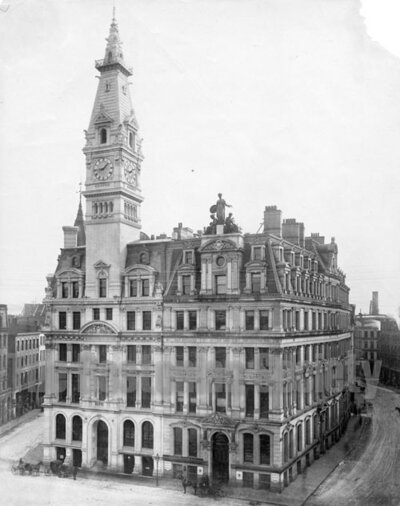
(The photo above, courtesy of the Tufts Digital Library, shows the Boston headquarters of the New England Mutual Life Insurance Company at the start of the 20th century. It’s been replaced by another building that opened in 1941.)

14 September 2026

“Comedies Filmed by Rolin Players”

There’s a fair amount of contradiction around the founding of the Rolin Film Company, the corporation that became the Hal Roach Studio, in 1914.

Some claims arose at the time, when Rolin needed to look more stable and well financed than it really was. Others came later as Roach burnished his legend with rags-to-riches details.

Richard Lewis Ward examined the legal papers for his History of the Hal Roach Studio. Those records show that Hal Roach, Dan Linthicum (1878–1952), and I. H. Nance incorporated the Rolin Film Company on 23 July 1914. Each man bought one share for $100 and had a seat on the board.

In August, at the first board meeting, Roach said he had the cash to pay for nineteen more shares, which would be a total of $2,000. Linthicum said he would buy more later. Nance resigned; he appears to have been involved only because the law required three incorporators. An automobile dealer named Dwight Whiting (1891–1974) enthusiastically took his place.

From the auto dealership Whiting brought along his assistant, Warren Doane (1890–1964), who was also put on the board, though he was still a junior manager at most and didn’t own stock.

Roach’s friend and fellow actor Harold Lloyd recalled in his 1928 autobiography:
Roach had an idea that there would be novelty and money in kid pictures—a conviction which he vindicated eventually with the Our Gang comedies. He hired two boys and built his first picture, a one-reel comedy, around their boisterous day at the beach. I was the adult lead—the chauffeur who chaperoned them and bore the brunt of their boyish mischief, the little dears.
If that was indeed the first Rolin movie, it has entirely vanished. As have several more movies the company made in its first year.

But the company was definitely filming. On 28 September, the Morning Tribune of Los Angeles carried an article headlined: “Comedies Filmed by Rolin Players / H. E. Roach Is Directing Work of Latest Company Entering Silent Drama.”

That article stated that the Rolin Film Company had “incorporated under the laws of California, with a capital of $10,000, all of which has been paid in.” It had “rented offices at the Los Angeles Film Corporation studio, 406 Court Street,” better known as the Bradbury Mansion.

The article went on to say that Rolin had a distribution deal with the Sawyer outfit in New York, that in the previous week Roach had directed a one-reeler called “A Barber for a Day,” and that the acting company included Harold Lloyd. The last statement was reliable.

Sawyer was in business only from May 1914 to January 1915, never getting around to issuing a Rolin film. The movie about “a correspondence school woman barber” has disappeared.

As for the money behind the company, it wasn’t close to $10,000, even if the Moving Picture World repeated that figure in June 1915. Working from company files, Craig Calman has written: “Frick, Martin & Co., an Investment Securities firm, affirmed in an October 1, 1928 document that Rolin ‘was started with a paid up capital of $7,500’,” but that number seems inflated as well. The August 1914 board meeting discussed only $6,000 of shares, and not all of those were sold.

Other sources understate the working capital, going as low as $200 or $300. The 10 Jan 1937 Los Angeles Times reported that Roach had started production with $850 in January 1914, which was months before incorporation and less than he proffered at the time. That story appears to have been shaped with hindsight to make the company’s rise look even more remarkable. 

Whatever the exact figures, by the summer of 1914 the Rolin Picture Company was renting space, buying film, and paying wages. Hal Roach, previously a movie player and occasional assistant director hustling to earn $5 per day, suddenly had a couple thousand dollars to fund his own production company.

TOMORROW: Where did that money come from?

13 September 2026

“I suspected for a while that he had robbed a bank or something”

In 1914, Hal Roach decided to go behind the camera and make his own movies.

Roach’s fellow bit player Harold Lloyd described that transition in an article published by the Los Angeles Record in 1925, one of a series headlined “Harold Lloyd’s Autobiography.” Eric Shanower kindly alerted me to this source.

This is how the 9 September installment begins:
Finally Hal Roach and I caught on with the “Wizard of Oz” Company. I played in animal comedies, all right. I was the animals. I played things nobody ever heard of—Gillikens and Mauchkins [sic] and Kalidahs.

One day Hal and I were sitting on a little bench in the sun, made up as Hottentots [sic]. All we had on was a lot of terrible colored grease paint and some grass skirts. And he said to me, “Some day I’m going to make a picture myself. I’m going to make a comedy. People like to laugh and there’s always room for real comedy.”

I was terribly impressed, though I couldn’t show it through my makeup. “And when I do, Harold,” he said, “you’ll be in it.”

I was. A couple weeks later he called me up and said that some distant relative of his had died and left him some money. I suspected for a while that he had robbed a bank or something, but I found out eventually that it was on the level. It was only a few hundred dollars, but it was the beginning of things for us.

That first picture cost $200 and it was exclusively exteriors.

We didn’t have any studio. Sunshine was free and plentiful, and Westlake park was big and roomy. Finally, we found a vacant house and we worked in it for a week before the owner caught us and threw us out. At last we found another old house, unfurnished, where some other little companies had offices. The only place we could afford was the main hall where everybody had to pass back and forth, but we thought it was pretty swell.
Westlake Park is now MacArthur Park, of melting-in-the-rain fame.

When Lloyd published his autobiography in book form as An American Comedy in 1928, he recounted those events more briskly:
Roach surprised me—though “surprise” is a faint word for it—one day by announcing that he had got hold of several thousand dollars with which he intended making pictures on his own. He would be the director and I could be the first brick in his company at the usual three dollars a day. A few days later he rented a corner in the Bradbury mansion as an office, with the use of a stage in the back yard, and Hal Roach was a producer.
Both versions came more than ten years after the event, and Lloyd was probably more interested in telling an entertaining story than in getting all the details and timing exact. Had Roach come into “a few hundred dollars” from “a distant relative” or “several thousand dollars” from an unstated source? The most reliable fact seems to be that Lloyd was very surprised that Roach suddenly had just enough money to set up a production company.

Legal filings and newspaper clippings from 1914 help us nail down some details.

TOMORROW: The Rolin Film Company starts rolling.

12 September 2026

When Harold Met Hal

Harold Eugene “Hal (or sometimes Harry)” Roach was born in Elmira, New York, in 1892.

As a boy, Hal admired the local celebrity Mark Twain, and at the age of seventeen he lit out for the territories.

After prospecting in Alaska, Roach moved south. In 1912 he was working as a trucking supervisor in Los Angeles when he saw an advertisement for cowboys to appear in a motion picture.

Roach had the clothes, the riding skills, and, it turned out, more knowledge of how a roulette wheel worked than the Bison Studio’s director. A role as a croupier and the prospect of daily pay turned him into a movie actor.

Hustling for bit parts, Roach crossed paths with Harold Lloyd (1893–1971). This young actor had found work with the stock company of Oliver Morosco, producer of L. Frank Baum’s Tik-Tok Man of Oz—but he kept away from that musical play, not wanting to become a “chorus man.” Needing more work to keep himself fed, Lloyd tried motion pictures.

Soon Roach was in the orbit of the action star J. Warren Kerrigan. Lloyd was doing a lot of work for the director J. Farrell MacDonald. When MacDonald directed Kerrigan in Samson (released in spring 1914), Roach and Lloyd both appeared in the movie under Biblical beards.

The new Oz Film Manufacturing Company hired MacDonald to direct The Patchwork Girl of Oz and other adaptations of Baum’s fairy tales. In his 1928 autobiography, An American Comedy, Lloyd wrote: “I found Roach working here and he and I clowned as Hottentots and similar savages in breechclouts and bolomania, a heavy but easily removed body paint.”

Baum actually called his characters Tottenhots, basing them on the hoary European idea of the Hottentot but also giving them their own voice and moving slightly past that stereotype. As I pointed out in my article “The Troublesome Tottenhots,” published in the spring 2013 Baum Bugle, the Oz Film Manufacturing Company showed a Tottenhot serving on a jury in the Emerald City at a time when African-Americans were excluded from juries in a large part of their country.

Reference books from the 1970s onward say “Al Roach” performed the role of the Cowardly Lion in some of those early Oz films. That rendering of Hal Roach’s name appears in Einar Lauritzen and Gunnar Lundquist’s American Film-Index 1908–1915, a seminal reference book published in 1976, but I don’t see signs of a lion there. The costume’s mask makes it impossible to confirm who’s inside. Any early-20th-century source for this credit is welcome.

TOMORROW: The big idea.

07 September 2026

The Real Story of How the Hal Roach Studio Began

The standard story of the founding of the Hal Roach Studio appears in Roach’s obituaries, in Richard Lewis Ward’s History of the Hal Roach Studios, and in Craig Calman’s 100 Years of Brodies with Hal Roach, among other sources.

That tale starts in 1914 when the struggling young movie actor Harold Eugene “Hal” Roach (1892–1992) came into money through an inheritance, often stated as $3,000.

Roach used that windfall to form a film production company with the businessman Dan Linthicum (1878–1952), combining the first letters of their last names to create the trademark “Rolin.”

Linthicum soon left the business, and a few years later Roach renamed the company after himself. His friend Harold Lloyd had become the studio’s star, first as Lonesome Luke and then in eyeglasses. Then came the Our Gang series, Charley Chase, and finally Laurel and Hardy. The independent Roach studio became Hollywood’s most successful and classiest supplier of comedy shorts.

That version of Roach’s story also says that in 1916 he married the actress Marguerite Nichols (1896–1941), and they had two children together. The year after Marguerite died, Hal married Lucille Prin (1913–1981), and they had four more daughters. Hal Roach’s obituaries referred to Marguerite as his “first wife.”

In fact, Marguerite was Hal’s second wife, and Hal didn’t receive an inheritance in 1914.

I started looking into this story in the spring after hearing Steve Massa speak about how Rolin got started on the “Becoming Harold Lloyd” episode of the Man in the Glasses podcast. Dave Lord Heath’s delight-filled website offers more details, as does Find a Grave, and I dug into newspapers for additional stories.

Like the great Hollywood story Citizen Kane, this tale begins with a mine.

TOMORROW: The fatal shaft.

11 July 2026

The Facts Behind the First News Stories about an “Our Gang Curse”

My last two postings have posited that the long-lived public discussion of an “Our Gang curse” started with a couple of wire-service articles in early 1959, spurred by the deaths of Carl “Alfalfa” Switzer and Don “Fats” Law.

Carl Switzer had indeed been a star of many Our Gang shorts. He had a bad death, shot in the groin in a fight over $50 for training a hunting dog. He was only thirty-one. Yes, that can sound cursed.

But Don Law, who “died of an intestinal disorder” a couple of weeks later, was never in the Our Gang movies, much less in twenty of them as his obituary claimed. That series never had a character named “Fats.” Law’s death got nationwide attention because it came so soon after Switzer’s, and that concatenation launched the “Our Gang curse.” Yet that coverage was based on a lie.

The long May 1959 article by Rick Du Brow about the Our Gang alumni as a “pathetic group of Hollywood ‘has-beens’” rested on similar misinformation. It offered a list of five Our Gang alumni who had “died in the past seven years” alone. Two were Switzer and Law, so right away the pattern was weaker than presented.

That list of recent deaths included the actress Helen Parrish, but she was never in the Our Gang series. Parrish had been a child actress in the 1920s, appearing in one Smitty short with Donald Haines, who was later part of the gang, but that’s as close as she got.

Clifton “Bobby” Young did appear in a bunch of Our Gang shorts in the late 1920s and early 1930s before his adult acting career. He died in a fire in 1951, and thus not in “the past seven years.”

Billy “Froggy” Laughlin (not McLaughlin, as Du Brow had it) was a regular in the late Our Gang shorts from MGM. He died at age sixteen after a motor scooter crash in 1948. Again, that wasn’t in the preceding seven years. Du Brow obviously stretched for examples to produce the illusion of a trend.

Du Brow also mistakenly listed Eddie Bracken and Nanette Fabray as Our Gang alumni. He wrote that embezzler Lea Artye Folz had been in the gang; she had small roles in three shorts but more appearances in rival series and features.

Du Brow said the Rev. Ben Griffith had played Mickey McGuire in Our Gang; that was the title character in a rival series, played by Mickey Rooney and Marvin Stephens. Griffith did claim to have played that part in Our Gang as early as 1950 and as late as his 1988 autobiography, but I don’t see confirmation anywhere.

I also mentioned a Miami News article from early 1959 listing four locals as Our Gang regulars. Only one was: Shirley Jean Rickert, who made six appearances in 1931 followed by an equal number of Mickey McGuire shorts in 1933–34. Geraldine Fay and Sy Rich had no discernible link to Hollywood. Jack Ray made a fleeting appearance in one Our Gang movie in 1926, but he never played “Freckles” in the series as the Miami story said. (Ray did, however, spend most of his childhood appearing in theaters across the US, Canada, and western Europe claiming to have played “Freckles” in Our Gang. I’m still collecting information on him.)

Thus, in 1959 a lot of people were telling false stories about being in Our Gang as children, possibly because of work on other series, possibly out of wishfulness. Yet Du Brow was actually in touch with Fern Carter, who knew exactly which kids she had taught. And he still got a lot of names wrong.

Bob Thomas’s earlier Associated Press article started with “the legend that the famed little rascals have been ill-fated,” but it was actually an interview with producer Hal Roach. He knocked down the idea of a jinx, saying that “176 kids” had appeared in his series, and many had “turned into happy respected citizens, including doctors and lawyers here in Los Angeles.” (Early Our Gang player Jack Davis was indeed a doctor. I can’t think of an alumnus who became a lawyer, though.)

Some newspapers therefore gave Thomas’s AP dispatch headlines like “‘Our Gang’ Normal Group of Kids—Roach” (Morris Herald-News, 17 February) and “Roach Denies Ill Fate Plagues ‘Our Gang’” (Duluth News-Tribune, 18 February). But that fact-based argument didn’t have the appeal of the “Our Gang curse.”

In his UPI story, Du Brow cited an even higher number of kids in the series—“more than 300 youngsters.” But then he ignored the consequences of that math. He wrote that four highly successful performers were “just a fraction” of the total while five deaths (which included two people with no part in the series) were representative of the larger group.

Clearly those reporters sensed that the public would lap up the idea of an “Our Gang curse.” And the longevity of that idea—bolstered, to be sure, by some sensational deaths after 1959—shows that their sense was right.

[The photo above shows Fern Carter teaching arithmetic to Pete the Pup, Allen “Farina” Hoskins, and Jean Darling during a publicity tour in 1928.]

10 July 2026

“Possibly the most pathetic group of Hollywood ‘has-beens’”

Yesterday I quoted the February 1959 story from the the Associated Press’s Hollywood columnist Bob Thomas that began:
The recent deaths of two former members of “Our Gang”—one shot in an argument over $50—adds to the legend that the famed little rascals have been ill-fated in later life.
That article ran nationwide under headlines like “Was ‘Our Gang’ Jinxed?” (Illinois State Register, 17 February) and “‘Our Gang’ Ill-Fated in Later Life” (Sarasota Journal, 20 February).

As I wrote yesterday, that’s the first example I’ve found of the American media portraying veterans of the Our Gang comedies as prone to suffering sad adult lives.

A couple months later, Rick Du Brow of United Press International filed a longer story expanding on the same topic. When it appeared in the San Francisco News on 9 May, the headline was “Tragedy Stalks ‘Our Gang’.” Du Brow began:
Possibly the most pathetic group of Hollywood “has-beens” are the many former Our Gang child stars who flickered briefly to fame and prosperity only to come to grief as adults.

Five members of the “Gang” have died in the last seven years—some violently. . . .

Some “Our Gang” graduates, of course, have achieved success. These include Jackie Cooper, Eddie Bracken, Nanette Fabray and Johnny Downs. But they represent just a fraction of the more than 200 youngsters who made up of the most famous “gang” of all time in the last 38 years.
Having interviewed George “Spanky” McFarland back in February, as mentioned yesterday, Du Brow ran those quotes again to indicate McFarland was “having trouble.”

Darla Hood (shown above in a shot for TV Guide in 1955) was noted for her appearances in night clubs, on radio, and in TV shows, but she wasn’t included in that initial list of successful performers.

Du Brow spoke to Fern Carter, the kids’ regular teacher at the Hal Roach and MGM studios. She kept in touch with as many of her former pupils as she could. I doubt she liked how this article portrayed them as adults with troubled marriages and worse.

The article listed these five recent deaths:
  • Carl “Alfalfa” Switzer, shot the preceding January.
  • “Helen Parrish, 35-year-old TV actress, died last February of cancer.”
  • “Don Law, who played ‘Fats,’ died of an intestinal disorder at the age of 38 in Meadsville, Pa.”
  • “Froggy McLaughlin…killed in a motor scooter accident several years ago near Huntington Beach, Cal.”
  • “Clifton Young…died in a 1951 Los Angeles hotel fire.”
Du Brow also noted Scotty Beckett’s well publicized troubles with the law, Shirley Jean Rickert’s appearances in burlesque, and Mickey Daniels having “fled to Africa in search of a new life” (he worked in construction and mining).

One paragraph stated:
Tough guy Mickey McGuire became the Rev. Ben Griffith, a Los Angeles evangelist. And Lea Artye Folz, 38, was placed on probation three years ago after being charged with embezzling $5000 from a bank.
Did being a minister cancel out being charged with theft? Or were both activities signs of a troubled adulthood?

As mixed up as that portrayal of the Our Gang cast was, articles like Thomas’s and Du Brow’s appear to have established the idea in American culture that those kids were unusually liable to have sad adult lives and early deaths. Even today, websites address the question of an “Our Gang curse.”

But both those nationwide wire service dispatches were full of bad reporting, spun out of sensationalism, shoddy math, and lies.

TOMORROW: The facts behind the headlines.

09 July 2026

“Death has taken a second former member of the ‘Our Gang’ movie comedy cast”

Carl “Alfalfa” Switzer died of a gunshot wound during a fight on 21 Jan 1959.

Switzer had been a big star in the Our Gang film series from 1935 to 1940, and those shorts were finding a new audience on television.

Switzer had also been fairly successful at maintaining a career as a character actor with bit parts in movies and larger parts on TV.

And of course his violent death at age thirty-one was sensational.

As a result, Switzer’s death was widely reported in American newspapers.

A couple of weeks later, on 6 February, an Associated Press dispatch out of Meadville, Pennsylvania, began:
Death has taken a second former member of the “Our Gang” movie comedy cast within the past three weeks.

Don Law, 38, who played “Fats” in some 20 of the old-time child comedy films, died here following a brief illness.
Newspapers headlined that story with variations on “2d Our Gang Star Dead” (Boston American).

That concatenation produced follow-up stories. On 8 February, the Miami News ran “‘Our Gang’ Deaths Hit Home in Miami” by Denis Sneigr. With the news of Switzer and Law as a hook, that article collected the movie-making memories of four locals: Geraldine “Sissy” Fay; Jack “Freckles” Ray; Gilda Edwards, formerly known as Shirley Jean Rickert; and Sy Rich.

George “Spanky” McFarland called up Rick Du Brow of United Press International, “spurred to comment by the death last month of his co-star” and his own wish to restart his Hollywood career. In the 15 February Memphis Commercial-Appeal, that story was headlined, “Spanky Knows Why Many Child Stars Go Bad.”

That same week, the Associated Press’s Hollywood columnist Bob Thomas filed a story that began:
The recent deaths of two former members of “Our Gang”—one shot in an argument over $50—adds to the legend that the famed little rascals have been ill-fated in later life.
As far as I can tell, this was the first public discussion of a “jinx” or “curse” on the Our Gang cast.

There was earlier reporting on child stars in general feeling “jinxed” when they tried to continue their acting careers as adults; an article in the 19 Aug 1954 Long Beach Independent actually held up Carl Switzer as a counterexample. But that’s a long way from suggesting that Our Gang veterans in particular were cursed.

Though Thomas’s article mentioned only two “ill-fated” Our Gang actors, not even by name, the idea of a jinx had legs. Soon another reporter picked up the theme.

TOMORROW: The story takes hold.

03 July 2026

Credit Where It’s Due

I view the public discussion over fair credit for Rachel Hope Cleves’s Charity and Sylvia in Tillie Walden’s Charity and Sylvia from a particular perspective.

I’ve scripted indie comics, the field where Walden has made her name. I’ve written scholarly books and articles like Cleves. I’ve also worked in book publishing, so I know the considerations involved in adding more pages to a printed book or writing promotional copy about how ground-breaking a new title is.

I’ve worked on both sides of the nonfiction-into-comic process. For Colonial Comics: New England, I adapted historical sources into stories about Samuel Maverick, Benjamin Franklin, and Crispus Attucks. I also supplied my nonfiction writing and research for other scripters to adapt into their own stories. I’ve seen artists add immeasurably to a tale in ways that go beyond what historical research could provide.

I also know what it’s like to have the work of historical research be rendered close to invisible. Years back, I worked with producers of the History Detectives television show to figure out the mysteries behind a couple of artifacts. I was never going to be paid, but for one of those two shows there were plans to interview me on camera. In the end, my name appeared as one short line in small type as the closing credits scroll by.

On my history blog I’ve published a series of posts about James McHenry and Elizabeth Willing Powell, drawing on new archival research and analysis. In 2019, the Washington Post published Zara Anishanslin’s article about Powell. She acknowledged relying on my work for one point, apologizing that the newspaper wouldn’t allow credit by name, only by a link. And then when a Post staffer wrote another article citing Anishanslin’s, that link didn’t survive. That’s a common problem in the major news media.

A few months back, I discovered my book The Road to Concord: How Four Stolen Cannon Ignited the Revolutionary War had been turned into a novel. A novel! The author never contacted me about obtaining derivative rights. The book contains one line of acknowledgement, grateful in tone but small in type. Since this novel was self-published, I decided simply to keep quiet about it.

At the same time, I think The Road to Concord could be adapted into a nifty movie. I’ve even taken a meeting with an aspiring producer about that prospect. If that ever happens, I darn well want credit and compensation, even though the whole point of the book and its many citations was to lay out the historical facts and sources for anyone to follow.

11 May 2026

“The following routine hardly constitutes a ‘vacation’”

In March 1924, for the first time in more than six years, eleven-year-old Ernie Morrison didn’t have a movie to make.

He had no call time the Hal Roach Studio. He wouldn’t spend hours with the other kids he’d worked and played with for the past two years. (Ernie had his own tutor, so at least he wasn’t also cut off from Fern Carter’s studio classroom.)

The end of Ernie’s $250 per working week salary would no doubt affect the Morrison family finances, but not immediately. His father, Joseph, who had run a market before entering show business, evidently invested some of those earnings in what the 17 September New York Evening Journal called “a string of ice cream parlors and frocery [sic] stores in Los Angeles.” In addition, the 18 December Savannah Tribune indicated he owned the Four Brown Candy Factory. The African-American press treated Joseph Morrison as a admirable entrepreneur.

It’s notable that the Morrison family and the Hal Roach Studio didn’t cut ties. Joseph continued to play black men in the movies, performing opposite Gene “Pineapple” Jackson and Allen “Farina” Hoskins in “Circus Fever.” Ernie’s little sister Dorothy Morrison appeared as Farina’s girlfriend in “The Love Bug,” with Joseph along as her father. In 1925 she would make “Isn’t Life Terrible?” with Charley Chase.

In late June, Ernie himself returned to Our Gang unit for a week (at his previous salary) to finish shooting “Fast Company,” a short begun over a year before. (Harold Lloyd’s young brother-in-law, Jack Davis, returned from military school for the same shoot.) That movie proved to be the coda to Ernie’s long Rolin/Hal Roach Studio career, but decades later he still had good things to say about Roach.

An item in the 24 May Colton Daily Courier revealed how Ernie was spending most of his days:
Sunshine Sammy, world famous little comedian and formerly featured player in Hal E. Roach’s “Our Gang” comedies, has a complaint to enter. . . . his father, Joseph Morrison, well known candy manufacturer, promised Sammy a good long vacation. Sammy, in his aforesaid complaint, says the following routine hardly constitutes a ‘vacation’—“Three to four hours a day study under his special teacher, Miss Zenovia [sic] Frierson. One hour violin lesson each day from James B. Warren. Miscellaneous and incidental other hours spent in perfecting himself in fencing, boxing, wrestling and in his ‘spare’ moments he composed a wonderful waltz, “Sunshine Sammy is a Good Old Scout.”
The same newspaper had reported on that waltz back on 3 May, saying “hundred of congratulatory messages” had come for Ernie. That article added:
The fact that he has become a composer of the first rank is only incidental with Sammy’s plans and he will soon spring a surprise on his friends, that will prove momentous in amusement circles.
COMING UP: Big plans.

10 May 2026

“They are trying to get along without Ernest Morrison”

As I wrote back here, almost all the other kid-gang comedy movies produced in the wake of Our Gang’s success included at least one African-American kid in the cast.

People viewed Ernie “Sunshine Sammy” Morrison and Allen “Farina” Hoskins as vital to the series’ success.

On 4 July 1924 the California Eagle, published for Los Angeles’s African-American community, reported:
The kid situation seems to be worrying that powers that be at the Hal Roach Studio. They are trying to get along without Ernest Morrison (Sunshine Sammy) but the big question is will the exhibitors accept “Our Gang” comedies without Sammy or a Race star other than Farina.

It is rumored that two of the “Our Gang” Series that were made without Ernest were returned from the Eastern exchange marked N.G.
“N.G.” was the standard Hollywood label for bad shots to be discarded.

In fact, Hal Roach had quickly sought out a replacement for Ernie Morrison. In April 1924 the studio brought on Flemon Miller, a black boy about the same age, to appear in “The Sun Down Limited” and “Every Man for Himself.” The Pathé Exchange would distribute those pictures in the fall, but Flemon wouldn’t make much impression on the screen.

The California Eagle went on to drop some inside information:
The Dramatic League booking office received a hurry up call for Eugene Jackson and Eugene has gone to work there and his director is McGowan who directs the “Our Gang” series.
Eugene Jackson (1916–2001) had already acted in a few films, including the feature Penrod and Sam and “An Afternoon Tee” in the rival Reg’lar Kids series (a short which was Johnny Downs’s break into the movies).

The newspaper’s next item noted that another black child actor, James “Bubbles” Berry (1915–1969, shown above), was available after making eight pictures for the Century studio. Those movies, such as “Speed Boys,” were also imitations of Our Gang. But “Bubbles” was made up with white lipstick for a minstrel-show effect, something the Roach studio never did to Ernie Morrison.

The Eagle’s deduction about Gene Jackson was correct: he joined the Our Gang unit at the end of June and made six movies through early 1925. In his 1999 autobiography, Jackson described his beginning this way:
I met with Mr. Roach, and he liked my natural acting ability. I did some impromptu acting, and he said I had an open freshness with a million dollar smile. He conversed with me for a short while, and I signed immediately for a three-year contract. He coined the name “Pineapple” for me in the series, which has been a permanent part of my show business name.
As for Ernie Morrison, Jackson remembered living around the corner from him. Ernie was four years older and busier, so Gene admired him from a distance:
Sammy was such a big star. He was an established star. When he arrived home, the entire neighborhood would could out to see him. He had a great big limousine a mile long.
But now that Ernie had left the Hal Roach Studio, what would he do?

TOMORROW: Training in ’24.

08 May 2026

“‘Our Gang’ comedies will be as a ship without a rudder without Sammy”

In the early 1920s, Ernie Morrison was almost certainly the most prominent African-American actor in Hollywood, the only one to appear regularly in movies marketed to mainstream audiences.

What’s more, whether as sidekick to Hal Roach’s adult male comedians or as a leading member of Our Gang, Ernie didn’t really fit inside the dominant culture’s racial stereotypes (despite the studio and the press’s best efforts).

While he often played scamps, Ernie the real-life hard-working actor was also a role model. His June 1922 trading card assured children, “In between his motion-picture work he studies hard at his lessons, and a very great future is predicted for this clever youngster.”

Naturally, Ernie Morrison held special significance for African-Americans. W. E. B. Du Bois’s short-lived magazine for black children, The Brownies’ Book, featured the boy twice while he was still working with Snub Pollard. In 1923 Du Bois visited the Hal Roach Studio with other members of the NAACP. The June issue of that organization’s magazine, The Crisis, included the photo above.

Ernie, clowning with a broken bass fiddle, was surrounded by:
  • Dr. Vada Somerville (1885–1972), co-founder of the NAACP’s Los Angeles chapter, first black woman to be licensed as a dentist in California.
  • Dr. W. E. B. Du Bois (1868–1963).
  • Anita Thompson (1901–1980), star of By Right of Birth from the Lincoln Motion Picture Company and actress in other films.
  • Beatrice Thompson (1874–1938), executive secretary of the LA chapter and the actress’s mother.
  • Pearl W. Hinds Roberts (1892–1984), pipe organist with a degree from the Oberlin Conservatory, wife of a California assemblyman.
On 28 Feb 1924, around the time Joseph Morrison and Hal Roach broke off negotiations over a contract renewal, the Omaha World-Herald reported that the local NAACP chapter had sponsored a free showing of “one of ‘Sunshine’ Sammy’s photoplays” for more than 200 black children to raise funds to support an anti-lynching bill.

Given Ernie’s profile, the end of his contract with Roach was a big deal for African-American moviegoers. The most detailed reports about that change appeared in the black press. The New York Age article cited here was the first to report salary numbers. On 18 July 1924, the Afro-American of Baltimore ran this item:
SUNSHINE SAMMY LEAVES HAL ROACH

The Hal Roach Studio seems hard put to it these days. Ernest Morrison, nationally known as “Sunshine Sammy” has left the lot.

Mr. Morrison, Sammy’s father, refuses to give any information other than to say that Ernest will be featured in his own company. The “Our Gang” comedies will be as a ship without a rudder without Sammy.
The Morrisons’ contract had ended four months before, but the studio was about to run out of the Our Gang movies Ernie had made early in the year. And audiences viewed black kids as an essential part of the gang.

COMING UP: Keeping busy in 1924.

06 May 2026

“Ended an eight-year engagement with Hal Roach”

Ernie Morrison starred in the Our Gang films regularly for more than two years, from January 1922 to March 1924.

The only other movies he made during that time were cameo appearances with the gang in other Hal Roach Studio comedies. He was too valuable to be an adult comic’s sidekick anymore.

Ernie had started at the studio at $100 per week, plus $30 for his father, Joseph Morrison, who played occasional roles for black men. (In the Our Gang series Joseph often played Ernie’s father, though in “Lodge Night” and “Circus Fever” he appeared prominently in other roles.)

By 1924 Ernie was making $250 per week, plus $50 for his father, according to Rob Demoss’s Lucky Corner website. That was the studio’s most expensive contract for an Our Gang member; freckle-faced Mickey Daniels also earned $250 per week, but with no added payment to a parent.

In early 2024, Joseph Morrison asked Hal Roach to increase his son’s pay. According to an article in the 31 Jan 1925 New York Age (published for the city’s African-American community), Joseph asked for Ernie to earn $300 a week.

That article also said that would have been a $75 raise for Ernie, which doesn’t add up. But perhaps Joseph also asked for his own weekly rate to rise by $25, which would be $75 more overall. In any event, it wasn’t an outlandish request.

Hal Roach said no. Roach’s employees liked the collaborative culture and working conditions he established, but he could be ruthless in negotiating salaries, even with his biggest stars.

“Quits Roach,” headlined the 1 Mar 1924 Los Angeles Evening Citizen News over a photo of Ernie smiling; “the child will not sign for another engagement because of financial differences.”

The 16 March Detroit News told readers: “‘Sunshine Sammy’…has ended an eight-year engagement with Hal Roach.” He’d been at the studio for less than five years, but Roach sometimes wrote his contracts to include options into the future.

The 23 March Omaha Morning Bee said: “the cute negro boy screener, has quite [sic] Hal Roach, due to a difference in salary demand on a new contract and may essay a trip into vaudeville.”

Those items appeared in long columns of other news from Hollywood, but other journalists had more to say.

COMING UP: Sunshine Sammy and the black press.

04 May 2026

Ernie Morrison before Our Gang

Ernie Morrison was born in late 1912 in New Orleans. About six months later his father, Joseph, moved the family to Los Angeles, where he ran a grocery store.

In 1916, Joseph Morrison later told the New York Age, he “overheard some directors inquiring as to where they could find a clever little youngster.” Another source says the moviemakers were looking for a “little colored boy.” Ernie fit both descriptions. Joseph took his son to the studio.

By age four, Ernie was a regular in the Baby Marie Osborne comedies. The studio behind those films, Diando, even tried to create a new series around Ernie in 1918, using his father’s nickname “Sunshine Sammy.” But the Pathé Exchange didn’t pick up those short movies for distribution.

In August 1919, Harold Lloyd, the only consistently successful comedy star at the Rolin Studio, was badly injured by a prop bomb during a photo shoot. Rolin’s head, Hal Roach, scrambled both to help his friend recover and to find new material to release.

Lloyd’s usual sidekick, the Australian comedian Snub Pollard, was promoted to a lead. In the short “Call for Mr. Caveman,” filmed in September 1919, his supporting cast included a little black boy played by Ernie Morrison.

Roach saw how well Ernie performed. Indeed, his lively personality still comes through on the screen. Envisioning a new series (which, Robert Demoss reports at the Lucky Corner, he unfortunately referred to as “‘coon’ pictures”), Roach signed Ernie to a two-year contract, as shown above. That made the six-year-old the first African-American actor with a long-term movie deal.

However, Pathé still wasn’t interested in a “Sunshine Sammy” series—“not on the basis of racism,” writes Richard Lewis Ward in A History of the Hal Roach Studios, but because the company head felt “‘kid pictures’ were box office poison.”

Instead, Ernie performed as Snub Pollard’s regular sidekick from 1919 to 1921. After Lloyd recovered, Ernie appeared in a few of his films, too, most delightfully in “Get Out and Get Under.” During that time, Rolin was renamed as the Hal Roach Studio.

Roach saw that Ernie Morrison was gaining a fan base. He renewed the contract and assigned the boy to boost the studio’s lesser comedians, such as Eddie Boland and Paul Parrott (brother of Charley Chase and later director for Laurel and Hardy). Ernie was also loaned out for the Neilan adaptation of Booth Tarkington’s Penrod with Wesley Barry.

In mid-1921, Hal Roach once again put “Sunshine Sammy” at the center of a picture. In an advertisement to cinema owners (shown here), the studio declared:
Millions have laughed at him, exhibitors have commented upon his popularity with their audiences,…full of pep, a “pip” of a “feeder” to the comedy stars he supported

Now he is starred in one two-reel comedy, made the way Hal Roach knows how to make ’em

Hot Dog! This one isn’t a gamble, it’s just sure to please!
The rest of that ad copy uses broad dialect and racial slurs. The movie itself was titled “The Pickaninny,” though Ernie never fit into that stereotype of a black child. Roach thus offered the Morrisons more opportunity than they would find elsewhere but still played into the racism of the time.

Pathé released that “Sunshine Sammy” comedy in December 1921. It didn’t do well enough to launch a new series. Ernie continued to appear in supporting roles. But he was popular enough to be featured on a Boys’ Cinema trading card in June 1922, posing in top hat and tails with a short biography on the back; most of the other “Famous Heroes” in this series were grown men, all of them white.

Meanwhile, in January 1922 Ernie had started performing in a new series of shorts at the Roach studio—not in support of an adult male comedian, but alongside other child actors and animals. Those “kid pictures” would make him an even bigger star.

COMING UP: After the gang.