Showing posts with label ARTIST Norman Rockwell. Show all posts

12 January 2014

Another Look at Leaving the Manor

This is from Comics Should Be Good!’s series “The Line It Is Drawn,” this week a challenge to draw well-known comics characters in an homage to a well-known painting.

This is, of course, a reworking of the opening pages of “One Bullet Too Many” from 1969 as Norman Rockwell’s “Breaking Home Ties.” The subject was suggested by Keith Alan Morgan.

The artist who drew this, Bill Walko, created the webcomic The Hero Business and is a mainstay at Titans Tower.

03 August 2010

Tom Sawyer’s Window

One of the oldest and most resonant images in American children’s literature is Tom Sawyer sneaking out his bedroom window, here portrayed by Norman Rockwell.

I think this moment from Mark Twain’s novel is so well known that it’s become an archetype of how kids slip away from home, even though most American houses have at least two doors that are easier to exit.

About a decade and a half ago, I visited Mark Twain’s childhood home in Hannibal, Missouri, and came away with a new understanding of this scene. In that house, the stairway comes up from the ground floor into the parents’ bedroom. So the window was definitely young Sam Clemens’s best hope of getting out undetected.

To be sure, a character in Louisa May Alcott’s Eight Cousins, published a year before Twain’s novel, describes climbing in and out of windows as a boy. But Tom Sawyer made that relatively rare activity part of the mythical all-American childhood.

25 December 2009

Denslow’s Santa Claus in Green and Brown

At right is the cover of The Night Before Christmas as illustrated by W. W. Denslow in 1902. This Santa is wearing a red hat, but no red suit. As in the interior illustrations, Denlow’s Santa dresses primarily in green and brown.

It took a while for Santa’s red suit to become an immutable part of his image. Thomas Nast’s drawings of Santa for Harper’s Weekly from 1863 on popularized the character. In these engravings Santa always wore a fur suit, usually with a wide belt, short fur boots, and a fur hat trimmed with holly.

In 1886 the publishing firm McLaughlin Bros., who pioneered the use of color printing in children’s books, hired Nast to adapt his Santa art for a new book, Santa Claus and His Works. In The Santa Claus Book, E. Willis Jones writes:

This posed a problem for the artist, because he had always thought of the Santas he drew in black ink as wearing a tannish fur suit, which certainly would not contribute to colorful illustrations. The simple solution was to make Santa’s suit in a bright red, and to add a little contrast he trimmed it with white ermine fur.
Nast’s first red-suited Santa was still a way from our modern image. The character is short, and wears fur, not woven cloth; his garment’s cut is like a set of pajamas with feet, and the ermine trim is slight, running around his waist in place of a belt.

In 1890 the McLaughlins published Nast’s Christmas Drawings for the Human Race, which put Santa in buckled shoes and a wide belt. But his ermine piping went down the front of his fur coat only. And the firm issued some copies of The Night Before Christmas showing Santa’s suit as green.

Maxfield Parrish’s 1896 portrait of Santa shows two rows of big buttons on his chest. Mary Cowles Clark’s illustrations for L. Frank Baum’s Life and Adventures of Santa Claus (1902) dress Claus alternately in green and red.

Thus, when Denslow drew this Santa, the character hadn’t become completely standardized. In December 1904 his Scarecrow and the Tinman comics page showed the Tinman dressing up as Santa in a red coat—with bristly brown trim.

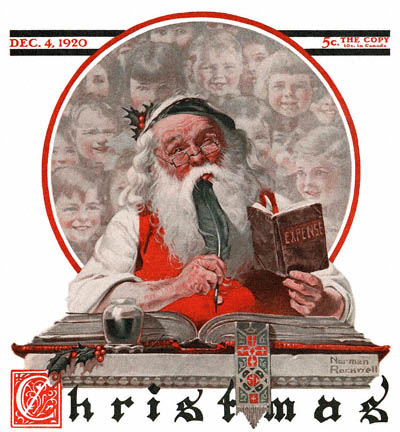
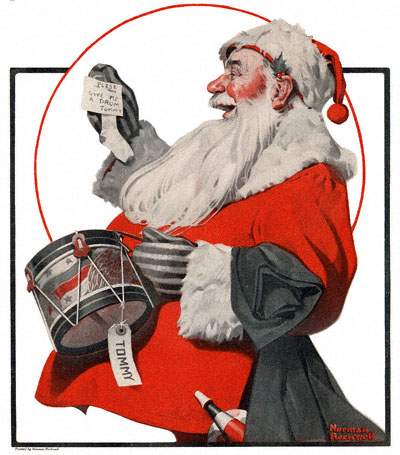
After World War 1, the standard image of Santa settled down, with magazine cover artists showing him in a red coat with lots of white fur trim—a choice largely determined by how those magazines were printed in black and red on white paper. The Saturday Evening Post and Country Gentlemen commissioned holiday images from Norman Rockwell (in 1920 and 1921, for example) and N. C. Wyeth (“Old Kris” in 1925) under those technical restrictions. And thus we stopped seeing Santa in green.

30 November 2009

Norman Rockwell and History Painting

NPR and Time have both run stories about a new exhibit/book from the Norman Rockwell Museum in Stockbridge that discusses the painter’s use of photographs in detail. Not that Rockwell hid the fact that he used photos as well as live models and his imagination.

NPR interviewed a photographer who occasionally worked with Rockwell but looked down on his method and results—specifically disliking “the tracing techniques and saccharine subject matter.” (And yet he kept working with the man.)

It’s clear from looking at the photos alongside Rockwell’s finished art that he didn’t just trace what he’d had photographed. He tweaked poses, fabrics, settings, poses, and facial features and expressions to produce the image he wanted—usually a much more dramatic one than what the cameras had recorded. He may have traced details, but he chose which details to trace.

As for subjects, Rockwell worked for money and mass reproduction. He worried about being thought a mere “illustrator” instead of an artist. Of course, when he made paintings for Tom Sawyer, he was working as an illustrator. As was Leonardo da Vinci when he created his Last Supper or Henry Fuseli when he painted Titania Awakening, now at the Tate Gallery. They were all illustrating well known texts.

Rockwell’s best known paintings weren’t inspired by written stories, however. Rather, he used his composition and details, his titles, and his viewers’ knowledge to tell new stories in graphic form. And indeed he often aimed for emotional effects, even easy laughs and sugary uplift. But that’s what made Rockwell both popular and a chronicler of his nation’s values.

I think that part of Rockwell’s work has to be judged according to a standard the art world discarded in the late 1800s after it had had a long run at the very top of the heap—the history painting or genre painting.