Showing posts with label radio drama without pictures. Show all posts

08 February 2025

“I just didn't know how to steer it”

By the spring of 1932, two years after Buddy McDonald first acted in an Our Gang movie, there had been some big changes at the Hal Roach Studio.

The Great Depression had caught up with the movie business. At the end of 1931, Bank of America set a new condition for renewing Roach’s credit: he had to hire Henry Ginsberg to supervise production and keep down costs.

Within the Our Gang unit, long-time players Allen “Farina” Hoskins, Mary Ann Jackson, and Norman “Chubby” Chaney all aged out in mid-1931. The next March, Bobby “Wheezer” Hutchins went off to make movies elsewhere for a while. The only cast members left from Buddy’s first three films were Dorothy DeBorba and Matthew “Stymie” Beard.

There were also two important additions to the gang. In spring 1932 the studio hired Dickie Moore, already established as a child actor, to play lead in the next several films. And from Texas the irrepressible George “Spanky” McFarland had stepped into Wheezer’s baby shoes as cute little brother and absolute chaos agent.

As a younger man producer-director Bob McGowan had been a firefighter, and he’d already applied that experience to two Our Gang movies: “Fire Fighters” (1922), the second to be filmed and released, and “The Fourth Alarm!” (1926).

To start a new slate of movies for fall 1932, McGowan remade “The Fourth Alarm!” with sound as “Hook and Ladder” (YouTube; IMDB; Lucky Corner). Dickie is the fire chief. Stymie is his right-hand man. Spanky is the wise-ass baby brother who can’t be left behind because he has to take his medicine every half-hour.

In “The Fourth Alarm!” there were a dozen gang members in the fire company. “Hook and Ladder” had eight—perhaps a sign of cost-cutting. And one of those kids was Buddy McDonald.
At this point, nine-year-old Buddy was the tallest in the gang (though not the oldest). He didn’t have any significant lines or close-ups. But he was tasked with driving a makeshift fire engine through the streets of Palms, California. Indeed, that job might have been why McGowan cast him again: the movie needed a kid big enough to handle a horse.

That didn’t go great. McDonald told Our Gang historian Richard D. Bann:
I was on the back of the hook and ladder trying to drive the thing and they had to pull me off of there. Don Sandstrom had to take over. I was supposed to steer from back there [behind the camera], but it was difficult for me and also a little dangerous. Scary, too. I allowed the contraption to get away from me, and it scared us all, so the assistant director took over. I just didn't know how to steer it. The thing wasn’t meant to swing side to side; I couldn’t keep it running straight. It must have looked funny because even after Don Sandstrom took over steering, it continued swaying back and forth. This time on purpose. I was lucky I didn’t kill somebody on the city streets!
At least Buddy didn’t have to work with goats again.

That was Buddy McDonald’s last film, from Hal Roach or any other studio. He stayed in show biz, singing on the Juvenile Revue radio show, which started in 1933. His photo appeared in the 30 Aug 1933 Los Angeles Herald-Examiner as a member of the cast of the radio soap opera Molly Malone’s Family, produced by star Edith Greaves. McDonald recalled doing that job “every afternoon when I wasn’t at Hal Roach Studios.”

But late in 1933 Buddy’s parents blew up his career:
Then my parents separated and my mom grabbed we three kids—my older brother, my younger brother, and myself—and we went to Oregon. She had an aunt up there she thought would take us in. All the aunt did was point to the berry field. “Go help yourself,” was her advice. We lived in a tent, slept on the ground, picking and eating berries and fruit to live. We were fruit tramps. In time we scraped together enough money to get back to Southern California and return to our same house.
That was “About a year later.”
With the money I’d earned in pictures and radio, my parents had been able to pay off the house. In those days a nice, four bedroom house in the town of Bell was something you could have bought for around $800 to $1,200. While we had been tramping up in Oregon, my dad told us—before he left—that Hal Roach Studios called six to eight times looking for me to do more picture work. Then that finally stopped. . . .

During the Prohibition era in this country, my dad had a cafe on Florence Avenue, and he was bootlegging out the back door. When Prohibition was repealed [December 1933] he turned the place into a bar and then he got a liquor license for a second operation in Bell. Trouble was, he and my mother were their own best customers.
The McDonalds divorced. Buddy started drinking himself, then committing petty crimes. He went to a high school for “incorrigible boys,” served in the US Marines in the war, and did a stint in jail for armed robbery.

In 1953, Bud McDonald joined Alcoholics Anonymous and started living sober. He helped to raise a family and to run a trucking business. He founded programs to help addicts.

After his talk to Bann in 2001, McDonald was invited to some Los Angeles gatherings of the Sons of the Desert, the society founded to celebrate Laurel and Hardy, which had also adopted Our Gang and other Hal Roach series. Thomas “Bud” McDonald died in 2008, a couple of weeks short of turning eighty-six and more than three-quarters of a century after his last ride with Our Gang.

(This is the end of an analysis of Bann’s interview with McDonald, considered through other sources about the Our Gang movies, that started with these posts:

21 January 2020

The First Whiff of Gunsmoke

In the late 1940s the head of CBS, William Paley, asked his staff to develop a radio drama based on the concept of “Philip Marlowe in the early West.”

At the time, most western shows on the radio were aimed for kids, in the mold of The Lone Ranger. In contrast, this show was supposed to air in the evening and appeal to adult listeners.

CBS executive Harry Ackerman, who produced the Philip Marlowe radio show, had writers Mort Fine and David Friedkin take one of their scripts from Mike Shayne, another hard-boiled detective show, to create a pilot called “Mark Dillon Goes to Gouge Eye.”

The influence of Raymond Chandler on that script is obvious. Dillon serves as narrator as well as protagonist, his voiceover is full of elaborate metaphors. The plot checks off several requirements of the hard-boiled genre, such as the detective being knocked out for a while.

In the summer of 1949 Ackerman recorded two versions of the pilot with different actors playing Mark Dillon. But then the project stalled over contract issues.

A short time later, Philip Marlowe producer Norman Macdonnell and writer John Meston also started to develop an adult western radio drama. They produced an episode of their series Romance called “Pagosa” featuring a lawman named Jeff Spain. Macdonnell and Meston proposed a “Jeff Spain” show.

Ackerman told Macdonnell and Meston that CBS was ready to air their adult western, but it had to grow out of the network’s existing pilot. And it had to be called Gunsmoke.

With a hole opening in the network’s schedule in early 1952, Macdonnell and Meston had only a couple of weeks before going on the air. They changed the lawman’s name to Matt Dillon, cast busy radio actor William Conrad in that role, and recorded the first episode in time to air in April.

Gunsmoke had little to no narration after the first episodes, but the voice of the protagonist introduces each show in full Chandleresque mode:
I’m that man, Matt Dillon, United States Marshal–the first man they look for and the last they want to meet. It’s a chancy job, and it makes a man watchful…and a little lonely.
The first episode starts with the murder of a man who has just robbed a bank out of desperation and gets darker from there, with Dillon shooting the dead man’s brother when he comes leading a lynch mob. The marshal snaps at friends and locks up an innocent man on little evidence. The town doctor is gleeful over the number of corpses to autopsy.

Yet the most direct signal to listeners that this was not your kid’s western might come in the character of a young runaway whom Marshall Dillon tries to take under his wing. Billy was played by Dick Beals, an actor who had a glandular condition that meant his voice never deepened, so he played a lot of child roles on radio and in cartoons.

As the shows ends, Dillon realizes that young Billy knifed that bank robber to steal his gun. But by then the boy has grabbed a horse and ridden off to a life of crime under the name of, as the episode title says, “Billy the Kid.” So not only was this not a kids’ western, but the cute little kid was the most hard-boiled of them all.

(All episodes mentioned here available through the podcast OTR Westerns.)

07 November 2019

The Real Legacy of He Walked by Night

He Walked by Night didn’t influence The Third Man, but it definitely did influence American popular entertainment.

To start with, it appears to be the first movie that includes a scene of self-surgery. The bad guy stitches himself up after being shot, using a mirror and a lot of grit. I’ve seen variations of that scene in The Terminator, Ronin, and Master and Commander, but this might be the original.

Even more clearly, He Walked by Night gave birth to the most visible and long-lasting form of the dramatized police procedural. It even starts with an announcement that the story was based on real crimes, and that “names have been changed to protect the innocent.”

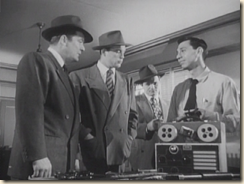
One of the supporting characters in the movie is a police lab technician played by Jack Webb. He’s young and almost winsome in the role.

At the time, Webb’s most prominent parts were as the star of the radio dramas Pat Novak, for Hire, about an unlicensed investigator who works at a pier, and Johnny Madero, Pier 23, about a pier manager who undertakes investigations. As was standard in hard-boiled mysteries, the cops in those stories were at best a rival for the hero, at worst a hindrance.

While working on He Walked by Night, Webb met the movie’s technical advisor, Detective Sergeant Marty Wynn of the Los Angeles Police Department. Their conversations and the movie’s format gave Webb the idea of creating a radio drama about a police detective, inspired by real crimes and portraying realistic law-enforcement techniques.

The LAPD also loved that idea and got behind it. Dragnet premiered in June 1949 with Webb in the starring role of Sgt. Joe Friday. It ran for more than eight years on radio. For most of those years, a version also ran on television for nine years, and there was a movie adaptation as well. Then the TV show was revived in 1966 with a TV movie and more than four more years of episodes. Webb expanded the procedural franchise in the 1970s by producing Adam-12 and Emergency!

Dragnet made Webb’s Joe Friday character a national icon, cementing his image as an actor and even his politics. That means it’s very striking to see him play a different personality in He Walked by Night, or to hear him as a cornet player during Prohibition in the fine radio drama Pete Kelly’s Blues.