Last fall I met Evan I. Schwartz, whose book Finding Oz: How L. Frank Baum Discovered the Great American Story has just been published. Schwartz had been researching the historical context which inspired Baum. He's shared some of that on his website for the book.
The New York Post just ran a review of Finding Oz, focused on the book's suggestions of what inspired various details in The Wonderful Wizard of Oz and/or what those details might represent:
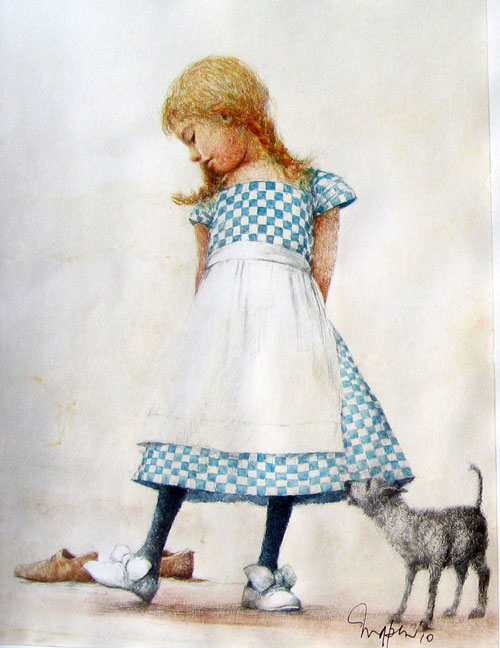
Toto, Dorothy's dog, likely symbolizes the Eastern philosophy of Totality, a component of Theosophy. Schwartz suggests that the name Toto connotes Totality.
The connection between Toto and Totality is highly plausible. But here lies a quandary: What if Baum intended the name Toto to symbolize the concept of a totem, or animal protector?
Or what if the name comes from the concept of a tote, or small object that can be carried around?
For that matter, what if Baum had all of these ideas in mind, or something else entirely?
For that matter, what if Toto was a very common name for a dog a hundred years ago, on the level of Rover, Spot, or Fido?
Context is crucial in understanding the roots of a work of fiction. It’s relatively easy to skim through period literature, looking to familiar terms. But we can’t really posit that there’s a connection between those terms and the book we’re studying unless we gauge where else those same terms appear. Are those actual connections or mere coincidences?
It was once incredibly time-consuming to research such questions as whether it was common for dogs to be named Toto. That's why we invented graduate fellowships. But now Google Books can reduce that searching to seconds. Looking in that database for “Toto” and “dog” produces many examples.
“Canine Curiosities,” an article in
Every Saturday: A Journal of Choice Reading, 19 Oct 1867:
There are dogs who are almost public characters. Toto, for instance, a white poodle of the purest breed, belonged to a Parisian cafe-keeper. As neat in person as lively in temper, he was the favorite not only of his master and his men but of all the customers who frequented the establishment. But besides his mere external graces the poodle rendered important service by performing errands intrusted to him.
Home Life on an Ostrich Farm, by Annie Martin (1890):
We found a comfortable little furnished house at Walmer, in which we spent the first five months after our arrival. It was just a convenient size for our small party, consisting, besides my husband and myself, of our two English servants, and Toto, a beautiful collie.
The Adventures of François, by Silas Weir Mitchell (1898):
The dog leaped on to his lap, and the boy, as he lay in the sun, began to think of a name for this new friend. He tried merrily all the dog-names he could think of; but when at last he called, “Toto!” the poodle barked so cordially that François sagaciously inclined to the belief that he must have hit upon the poodle's name. “Toto it shall be,” he cried.
So in 1898 readers were supposed to expect a French boy to have "Toto" among "all the dog-names he could think of."
“Toto,” a story in
La Strega, and Other Stories, by Ouida (1899):
They had good health, good appetites, good tempers, good neighbors; and if many would have thought it a hard life to serve in a little dark shop all day, and spend the evenings counting up sous and centimes, they did not think so. They were used to it, and they gained enough by it to keep themselves and to afford one luxury, Toto--Toto, who ate as much as two dragoons, and for whom they were obliged to pay the tax regularly to have civic permission for him to live.
This passage is particularly notable because, while it becomes clear later in the story that Toto is a large dog, Ouida obviously didn’t think it necessary to spell that out in introducing the character.
The Fortunes of Fifi, by Molly Elliot Seawell (1903):
an Italian...was exhibiting the most entirely fascinating little black dog that Fifi had ever seen. He was about as big as a good-sized rabbit, and was trimmed like a lion. Around his neck was tied a card on which was written:
Toto is my name, and I am a dog of the most aristocratic lineage in France, and I can be bought for twenty francs. See me dance and you will believe that I would be cheap at a hundred francs.
“As Told by Mrs. Williams,” a story by Emily Wakeman in
Cosmopolitan Magazine, 1907:
She's a beautiful, well-bred dog. Why, she and Toto had the same grandfather.
And there’s even a Spanish-English Grammar from 1901 which
translates “Toto” directly as “dog’s name.”
Surely not all of these authors were independently naming dogs to symbolize “the Eastern philosophy of Totality.” Toto was simply a common “dog-name” at the last turn of the century. People appear to have thought it particularly appropriate for French dogs, and perhaps for small fancy ones.
So the real question of why L. Frank Baum named Dorothy’s little dog Toto isn’t whether the dog was meant to symbolize something Theosophical, but why a poor Kansas farmgirl has a little dog with a fancy French name?




 The issue of Oziana cover-dated 2009 is at last on its way to subscribers, and will be available for ordering from the