Showing posts with label Newbery Medal. Show all posts

10 July 2020

How a Real Story Became Incident at Hawk’s Hill
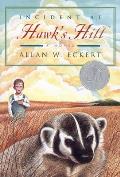
In 1873, a young boy went missing from his family’s farm in Manitoba. After more than a week, a man of Native and European ancestry found him hiding in a badger hole. That much we can read in nineteenth-century sources from Winnipeg.

In the early 1900s the nature writer Ernest Thompson Seton picked up that story from some Manitobans. He published a version that went into much more detail about how the little boy had actually shared that hole for days with a mother badger that had recently lost its young. Seton or his informants turned the mysterious event into a morality tale, which he published in at least three books.

This 1960 article from the Manitoba Historical Society’s Manitoba Pageant magazine mentions some other local recountings: by Archbishop Samuel Matheson in 1936, in Country Guide in 1951 by Margaret Arnett MacLeod, by the Manitoba Free Press in 1953. I haven’t seen those versions, so I don’t know what new details they provide and what evidence they were based on.

At some point the American writer Allan W. Eckert (1931-2011) came across Seton’s version of the story. Eckert had made himself a specialist in ecological writing, penning most of the scripts for Mutual of Omaha’s Wild Kingdom. He also found a niche writing on Native Americans, including outdoor dramas about Tecumseh and Blue Jacket. (That pairing of nature and Native Americans probably reflects a bias within our culture.)

Eckert’s nonfiction tended toward the imaginative. One of his early magazine sales was an article for the American Legion magazine in 1962 about the disappearance of the US Navy air training mission Flight 19 off the coast of Florida. Eckert appears to have added details not in the documentary record, and that event later became a keystone of the “Bermuda Triangle” legend.

Likewise, Kirkus said of Eckert’s 1992 biography of Tecumseh, A Sorrow in Our Heart, “in its interpretative zeal it strays from, or at least embellishes, the historical record to the point of being suspect.” Even Kirkus’s good review of That Dark and Bloody River noted Eckert’s method of “'reconstituting' credible dialogue among people in briefly reported events.”

On the other hand, Eckert’s fiction was often based closely on historical fact. His first novel was about the extinction of the great auk. Another was based on an event in the life of Daniel Boone. In the late 1960s Eckert started a series of historical sagas about the “Winning of America.”

Eckert saw the skeleton of a novel in Seton’s tale of the lost boy and the badger. The tale offered a chance to write about both the frontier past and the natural world. And it came with the gloss of nonfiction. When Eckert published his novel Incident at Hawk’s Hill in 1971, he stated up front in a short author’s note, “The story which follows is a slightly fictionalized version of an incident which actually occurred at the time and place noted.” Toward the end of the book, Eckert introduced characters who shared the names of two of Seton’s informants.

Eckert changed some details of the story, starting with calling the little boy not Harry (or Willie) Service but Benjy MacDonald. Seton had written that the event took place near “Bird’s Hill,” and Eckert turned that into “Hawk’s Hill,” named after a hawk the MacDonalds see. (The original Manitoba landmark was named after a settler named Bird, not an actual bird.)

Many other details and the plot of Eckert’s story came directly from Seton’s narrative. From the outset, the little boy shows more affinity for animals than for people. Seton’s villain—a nasty neighbor named Grogan—appears under the name of George Burton. He’s not a “half-breed,” however; in fact, he’s cruel to Natives as well as animals. As in Seton’s story, Benjy wanders away after a prairie chicken and needs to take shelter from a storm. A mother badger has been injured in the villain’s trap and lost her babies, leaving her with unfulfilled maternal instincts.

The real boy was lost for about ten days, but Incident at Hawk’s Hill draws that time out to two months. Eventually, Benjy is rescued by a relative rather than (as with the real boy) a stranger; where Seton wrote that that relative was a cousin, Eckert found more drama in making the rescuer a brother.

When Benjy returns, he initially behaves like a badger, but eventually returns to human behavior, stronger for his experience in the wild. Finally, just as in Seton’s telling, the villain shoots the badger, not realizing it has become a family companion, and the family unites to drive him away. The experience brings the MacDonalds closer, particularly father and son. But the family has also decided, with a visiting archbishop’s help, to keep the full story secret so as not to make Benjy appear stranger than people already think of him.

Eckert didn’t write Incident at Hawk’s Hill for children. The point of view skips around among many characters—adults, children, badger, and omniscient narrator. Though six-year-old Benjy is a central character, for many pages Eckert describes him entirely from the outside, and not in appealing terms—he’s small for his age, developmentally odd. It takes several chapters before readers are privy to Benjy’s thoughts, and then only when he’s the only human in the scene. Much of the book follows the drama of the MacDonald family searching for him or reacting to his return.

The early reviews treated Incident at Hawk’s Hill as an adult novel. Critics focused on Eckert’s reputation as a nature writer, with the New York Times calling the book a “folk fable” written “without recourse to undue anthropomorphism.” Kirkus’s reviewer, who could barely stand the story, concluded, “Were it not for Mr. Eckert’s natural history credentials one might think he had been sniffing too much meadow grass.”

Soon, however, people began to view Incident at Hawk’s Hill as a book for children. It was, after all, about a young boy and an animal making friends. It was on the short side, well under 200 pages. And it had pictures. Little, Brown commissioned scratchboard art from John Schoenherr, who had illustrated Sterling North’s Rascal (1963) and Walt Morey’s Gentle Ben (1965)—two novels about boys and animals written for children. (Schoenherr had an earlier career as a science-fiction illustrator. He would go on to win the Caldecott Medal for Owl Moon.)

The Bulletin of the Center for Children’s Books deemed Incident at Hawk’s Hill “An adult novel that should appeal to many young readers.” And in 1972 the novel was named a Newbery Honor Book. That year the judging committee appears to have been unusually generous, naming five Honor Books, more than in any other year in the 1960s and 1970s. From then on, Eckert’s novel was treated as a children’s book.

Disney adapted Incident at Hawk’s Hill into a 1975 television movie called The Boy Who Talked to Badgers. This treatment made Benjy, played by ten-year-old Christian Juttner, more of a likable hero. It switched some episodes around, but the basics of Seton’s and Eckert’s story remained. One notable addition was Denver Pyle as narrator, revealed at the end to be Benjy grown up.

Almost two decades later, in 1998, Eckert published Return to Hawk’s Hill, starting at the end of the first novel and then going over much the same ground. Benjy, a little older, wanders off again. Even the villain returns, despite having been run off before. But the new story had one major difference. This time, instead of a badger Benjy falls in with a community of mixed Cree and French descent who look after him, and his father learns to apologize for his prejudice against these Métis.

Return to Hawk’s Hill thus restored the helpful role of Métis in the real story of the lost boy in Manitoba. As specified in the nineteenth-century sources, a man of Cree and European ancestry rescued the boy from the badger hole. Seton’s early-1900s version had not only erased that rescuer from the story but made the villain a “half-breed.”

I have no idea whether Eckert had learned of those original sources by the time he wrote Return to Hawk’s Hill and set out to fill a deficit in his earlier novel. He may simply have wanted to create a sequel to one of his most successful books and looked to his interest in indigenous North Americans for inspiration. Either way, he added yet more significance in the mysterious story of a lost boy in the badger hole.

TOMORROW: Further meaning for 21st-century readers.

02 December 2015

William Pène du Bois’s Work Before It’s Gone

One of the children’s-book author-illustrators I really liked when I was young was William Pène du Bois. I got deep into his catalogue. The Three Policeman. Those koalas. Emil Bandicoot. Peter Graves before he became a square-jawed movie actor.

I see that this month the Eric Carle Museum is opening an exhibition of his work, titled “A Taste for Adventure”:
This exhibition marks the centenary of William Pène du Bois’s birth (1916-1993). Featured are illustrations from his 1947 Newbery Award-winning book, The Twenty-One Balloons, the fantastic story of Professor William Waterman Sherman’s around-the-world balloon voyage of 1883. Also on view are illustrations of Giant Otto, a large yellow hound who uses his size and strength to perform good deeds. Other endearing Pène du Bois characters come to life in Elizabeth the Cow Ghost, The Horse in the Camel Suit, and Porko von Popbutton. Pène du Bois’s illustrations animate text by such legendary authors as Isaac Bashevis Singer and local professor and two-time Pulitzer Prize winner Richard Wilbur.
I’ll have to get out to Amherst before May Day, when the exhibit closes. I also see that most of Pène du Bois’s books, aside from the Newbery winner (which is unusual, both in his oeuvre and among novels for young readers), are out of print.

09 October 2013

Parity in Publishing?

On Wednesday, 16 October, the University of Connecticut in Storrs will host a panel on “Gendered Publishing: The State of the Profession for Women Writers and Illustrators of Children’s Literature.” The discussion starts at 6:30 in the Class of 1947 Room of the Homer Babbidge Library. Participants are:

  • Barbara McClintock, author/illustrator
  • Gene Kannenberg, Jr., director of ComicsResearch.org
  • Lisa Rowe Fraustino, professor and department chair of English at Eastern Connecticut State University (ECSU)
  • Susannah Richards, associate professor of Education at ECSU and member of the 2013 Newbery Award Committee
On that recurring topic, last month The Horn Book published Martha Parravano’s essay “It’s Always Men’s Night at the Caldecott.” Since we live in the Most Overstated Era EVUH!, we can accept that Parravano’s “Always” actually referred to men winning the Caldecott Medal 63% of the time over seventy-five years. Over the last twenty years, male artists have been even more commonly rewarded: sixteen men and four women have won the Medal.

However, a commenter signing on as “Scope Notes” noted:
Total side note here, but an interesting thing I’ve found is that the Newbery has nearly identical numbers, but in reverse – 66% female to 34% male.
Over the past twenty years, fourteen women and six men have won the Newbery Medal—again, a growing disparity.

Of course, we should include a much harder factor to measure: how many men and women are writing or illustrating children’s books? Which gets us to another question: how many women and men are trying?

I started attending SCBWI conferences about twenty years ago, and immediately saw how women outnumbered men in the audience. In organizing those conferences, we always ask the host hotel to turn a men’s bathroom into a ladies’ room for the day. Yet the gender ratio of people on the podium—i.e., the authors and artists who have achieved recognition in the field—is usually closer to parity.

Adding to the complexity of the issue is how most parts of the children’s-literature chain—literary agencies, publishing departments, review journals, library staffs—are more female than male, though not as often at the top. And then there’s the question of who’s reading the most books.

12 September 2009

Boston 1775 Considers Johnny Tremain

Yesterday and today at Boston 1775, I’ve written about the Newbery Medal winner for 1944: Esther Forbes’s Johnny Tremain.

How does the novel reflect its time and the time in which it’s set? How did Forbes deal with her editors? And what scene did she delete from her manuscript at the final stage?

26 January 2009

Fantastic Newberys

It was a good year for fantasy novels at the Newbery awards. The gold medal went to The Graveyard Book, written by Neil Gaiman.

In addition, Newbery Honors went to The Underneath by Kathi Appelt, and Savvy by Ingrid Law. (As well as to two historical novels with political overtones: The Surrender Tree: Poems of Cuba's Struggle for Freedom by Margarita Engle, and After Tupac & D Foster by Jacqueline Woodson.)

Two of those three fantasy novels were illustrated: The Graveyard Book by Dave McKean, decades after he started collaborating with Gaiman on the Sandman comics, and The Underneath by David Small. One of the happy results of the stunning success of the Harry Potter novels, I think, is the return of illustration to children's novels, particularly fantasies.

23 January 2009

Newbery Numbers and Nonsense

As the children's-lit world gears up for the announcement of this year's Newbery Medals on Monday morning, there was news coverage earlier in the month about graduate student Anthony Nisse's study "Do You See What I See?: Portrayals of Diversity in Newbery-Medal-Winning Children’s Literature."

A piece from Bloomberg News produced a short squib in the New York Times, but all the attention seems to have stemmed from this opinion piece on the Latina Lista website.

The question of how well a culture's literature reflects its people and how they live is profound and important, with implications for that culture's values. However, if we raise that question on the basis of unreliable data or flawed analysis, then that not only doesn't promote the discussion, but it reflects poorly on efforts to do so.

Kathleen Odean, writing on Child_Lit, noted a lot of quirks and glitches in the reporting on Nisse's study, and dug further. Liz B at A Chair, a Fireplace & a Tea Cozy looked at the books in question and found that she can't make the numbers add up. They're both still working on their findings, and I look forward to their final reports. Meanwhile, Eric Carpenter appears to have not only been the first to track down the study, but also started a Google Worksheet for fuller analysis.

Nisse studied the protagonists and major supporting characters in Newbery Medal-winning books, with a particular emphasis on four qualities:

  • gender
  • ethnicity
  • family structure
  • socioeconomic class
The last variable garnered the least analysis from Nisse, and no attention at all from Bloomberg News.

My first thought is that it's always better to study as large a sample as possible, so I think the study would have benefited from including the Newbery Honor books as well. Eric Carpenter's spreadsheet is set up to do so. It would also be valuable to look at whether the establishment of the Coretta Scott King and Pura Belpré awards affected the pool of Newbery honorees.

Nisse structured some of his questions to reflect the complex contingencies of fiction, and life. For instance, he has a separate category for books in which a child has a single adult caregiver, but not a parent. That still leaves the question of change over the course of a story. How should one classify books in which one of two parents dies, such as Out of the Dust, or a single parent marries, such as Sarah Plain and Tall--are those single-parent books or two-parent books?

What about books with multiple protagonists, such as The Westing Game? Does the protagonist of The Secret of the Bull, set in Spain, count as Latino? Do readers respond the same way to Asian protagonists as to Asian-American?

And a challenge rarely seen in adult literature: a non-human protagonist. What ethnic group is Despereaux the mouse in The Tale of Despereaux? (And does it matter that in the recent movie he looks considerably whiter than in Tim Ering's artwork?)

On top of all that, both Odean and Liz B raised questions about how accurately the study had classified some titles. And they reported that the news coverage added errors. Nisse's data showed that male protagonists are less common in the last 28 years than the 29 before, but the news reports had that the other way around. Surely this discussion can benefit from a more solid beginning.

06 October 2008

Newbery Negativity

Last week the School Library Journal published an article asking "Has the Newbery Lost Its Way?" The top award in American children's fiction can still sell lots of books. But the essayist wrote that for some titles that sales bump wasn't lasting. And why?

She reported:

First, a librarian at my local public library confessed that she had no interest in learning “what unreadable Newbery the committee was going to foist on us this year.” Then, a few weeks later at an education conference, I was startled to hear several teachers and media specialists admit they hadn’t bought a copy of the Newbery winner for the last few years. Why? “They don’t appeal to our children,” they explained patiently.
These complaints aren't new, but what makes them notable now is that Anita Silvey--former editor of The Horn Book, former editor-in-chief at Houghton Mifflin, author of guides to children's literature--is voicing them.

Among recent Newbery winners, Silvey counts these as successful with young readers, teachers, and "small-town public librarians":
  • Holes (1998)
  • Bud, Not Buddy (1999)
  • A Single Shard (2001)
  • The Tale of Despereaux (2003)
(The parenthetical dates are when the books were published; they won their medals in the following year.)

The medal-winners from the same stretch which Silvey describes as not becoming popular successes are:
  • A Year Down Yonder (2000)
  • Crispin: The Cross of Lead (2002)
  • Kira-Kira (2004)
  • Criss Cross (2005)
  • The Higher Power of Lucky (2006)
  • Good Masters! Sweet Ladies! (2007)
Interestingly, with the exception of Crispin, that's also a sort of recent Newbery winners that have male protagonists from those that don't. Hmmmm.

14 January 2008

Today's Newbery and Caldecott Mélange

This morning the American Library Association and its various unfathomable caucuses and divisions announced its awards, the most influential honors in US children's publishing.

The Newbery Medal, which usually goes to a middle-grade novel, was awarded to a picture book, albeit an unusually long one: Good Masters! Sweet Ladies!: Voices from a Medieval Village, written mostly in verse by Laura Amy Schlitz and illustrated by Robert Byrd.

The Caldecott Medal, which usually goes to a picture book, was awarded to a middle-grade novel: The Invention of Hugo Cabret, written and illustrated by Brian Selznick.

Not only were the medalists untraditional choices, but both those books expanded the bounds of their genres. Good Masters! Sweet Ladies! takes some elements of the recent flowering of nonfiction for young readers and adds fictional characters to produce an even more lively mix. Hugo Cabret broke new ground in its use of visuals within a novel (more so than in its writing and story, so Oz and Ends is happy that it popped up in the Caldecott category).

Among the lesser-known but eminent awards, the Robert F. Sibert Award for "the most distinguished informational book" went to Peter Sis's The Wall: Growing Up Behind the Iron Curtain. What makes this choice interesting is that Sis was a runner-up for the Caldecott, and Good Masters! Sweet Ladies! has more than a bit of "informational" in it, so it could have traded places with either medal-winner.

Orson Scott Card won the Margaret A. Edwards Award for "lifetime contribution in writing for young adults."

10 April 2007

The Ear, the Eye, and the Arc

For years now, my writing-group friend Mordena has been urging us all to read Nancy Farmer’s The Ear, the Eye, and the Arm. And now I’ve actually done so. (Special points for me! And probably a big surprise for Mordena.)

And I liked the book. Of course, it was a Newbery Honor Book in the fantasy/science-fiction genre, so I should like it or there’s something seriously wrong with the system.

I think what makes The Ear, the Eye, and the Arm so refreshingly original is its setting: Zimbabwe in the year 2194, precisely two centuries after the book was first published. Farmer thus combines three ways of taking Americans to an unfamiliar place: a foreign country, a technologically advanced future, and a world with fantastic elements (in this case, ancestral spirits). Her novel stands alongside the previous American children’s books set in a futuristic sub-Saharan Africa, which were... Well, you get the picture.

The book has two separate trios of protagonists:

  • siblings Tendai (aged 13), Rita (11), and Kuda (4). Chafing against the boundaries set by their powerful, protective father, they set off on what they expect will be a one-day scout trip--and end up being kidnapped.
  • detectives named the Ear, the Eye, and the Arm. Mutants born after plutonium contamination, they respectively have enhanced hearing, sight, and sensitivity (both of touch and of emotion). But their powers also make them vulnerable misfits.
Tendai, Rita, and Kuda’s parents hire the Ear, the Eye, and the Arm to find their children.

The plot humps along, which produces a lot of action but not necessarily a lot of progress. The children are held captive by strict but not totally evil people who show us something about Zimbabwean society in the future (and today). After weeks or months of captivity, the kids realize that they’re in even greater danger than they thought and manage a breathless escape. Meanwhile, the detectives have had a few lucky breaks and figured out where the kids are, arriving only hours or minutes after those kids have moved on. Whereupon the children are kidnapped again.

And this happens not just once but three times.

Among the siblings, eldest brother Tendai does the most growing up. That makes sense since he starts on the verge of adolescence. Farmer narrates many scenes from his point of view. The two younger siblings are what E. M. Forster called “flat” characters--interesting in their quirks but essentially unchanging.

I expected more equalized attention for the detectives since they’re introduced as a trio. However, it quickly becomes clear that the Arm is the leader of the group. He has the most interesting capacities, and he undergoes the most change over the course of the book. The Ear contributes to the hunt but remains much the same, and the Eye does rather little, actually. Thus, of the detectives, only the Arm has his own arc.

17 March 2007

Postdating Awards - Best since 1983?

Rounding out this week of Cybils nominees, I quote an anonymous commenter over at Read Roger who said of such awards:

It can't be easy to choose one book as the best contribution to literature for children in a given year. I am sure it is easier with hindsight. Could we have a prize, maybe called The Postdated Newbery, for the best book published five years earlier?
I suggested something similar in history back when Michael Bellesiles’s Arming America was finally accepted as fraudulent. The book had received the Bancroft Prize, among the top honors for an American historian. Bellesiles had also received the Binkley-Stephenson Award award from the Organization of American Historians for the best historical paper of 1996--a paper that became the seed of his book, and which was also based on spurious evidence.

During the controversy, with gun-rights advocates calling for Bellesiles’s head, many academics defended a deliberate evaluation as necessary for scholarship. It may take months or years to judge a complex historical work, they said: checking citations, considering what other sources might have to say on the topic, testing the analysis, etc. But of course the OAH, the Bancroft committee, the Pulitzer committee, and other organizations give awards for the best of the past year.

Eventually Columbia University rescinded its Bancroft Prize for Arming America. People asked whether the OAH would rescind its award for his paper as well. Executive Director Lee Formwalt explained the answer:
After lengthy discussion, the board decided not to rescind the prize noting that the decisions of the organization to award a prize or publish an article are based on the best information available at that time. The post-publication vetting, through the process of scholarly give and take, ultimately determines the viability of any historical interpretation.
In short, the process of granting formal awards for best history article or book is often too short to really determine the best history article or book.

Novels eligible for the Newbery don’t have citations to consider, but hindsight can still be useful. Among middle-grade novels published in 1964, Harriet the Spy has clearly proved more influential and beloved than Shadow of a Bull or that year’s Honor Book, Across Five Aprils. Of the 1966 honorees, Honor Book The Black Cauldron has kept more fans than medalist I, Juan de Pareja. But then there are years with more than one landmark title on the short list, and time hasn’t produced a clearcut choice among them.

Furthermore, there are advantages to giving book awards fairly soon after publication. Bancroft and Newbery recognition can help a first-time author or first-time nominee become established. With the store shelf life of books shrinking, a bright gold sticker five years later might have to go on remainder copies.

In 1993, the Booker organization in the UK designated a special award for the best Booker Prize-winner of the previous twenty-five years. That went to Salman Rushdie’s Midnight’s Children, winner in 1981. Though Rushdie no doubt benefited from sympathy in 1993 (he was still in hiding), his novel truly is a magnificent achievement and a landmark in how British fiction expanded in that period.

Would the same process work for Newberys? Of all the Medalists (and Honor Books, if one chooses) from 1983 through this year, which shows the most quality, influence, and staying-power? If you had to choose one title as the Newbery of Newberys in this period, could you do it?

11 March 2007

Cybils Sales Effect

Awards matter most when someone besides the awarders and the awardees care--which usually means there’s money at stake. Alfred Nobel and Joseph Pulitzer knew that when they put some of their fortunes into prizes. So did the founders of the MacArthur Foundation: before 1981 no one knew what the organization was. Now “MacArthur genius” can serve as a synonym for “rocket scientist.”

Among American book prizes, the Newbery and Caldecott Medals are prominent not because they offer a lot of prize money but because they always increase a book’s sales significantly. The Pulitzer and Oprah’s Book Club are basically the only other American book awards that have the same consistent and lasting effect.

Now the organizers of the Cybils Awards have documented a pattern of four award-winning books, including our Fantasy/Science Fiction pick Ptolemy’s Gate, suddenly climbing up Amazon’s sales rankings as word of the Cybils spread. Will that effect last for future years? Will it catch publishing marketers’ eyes so that they start to claim and proclaim their “Cybils-winning” titles?

While waiting breathlessly for the answer, this week I’ll post remarks on the rest of the Fantasy/Science Fiction nominees for 2006.

18 February 2007

Are You Feeling Lucky?

The children's book world is buzzing over some librarians’ complaints about this year’s Newbery Medal winner, The Higher Power of Lucky, by Susan Patron, and its use of the word “scrotum” in chapter 1. As Monica Edinger wrote at Educating Alice, “How very, very sad that it wasn’t winning the Newbery that propelled Susan Patron to the front page of the New York Times, but a bunch of jittery librarians.” For exasperated grumbling rather than regret, see AS IF.

My own personal take: Lucky, this book’s heroine, learns the word “scrotum” at the age of ten, from hearing about an unlucky dog’s rattlesnake bite. Despite actually having the body part in question, I don’t recall hearing that word until I was a few years older.

Of course, I knew multiple words for its contents--an anatomical word for polite conversation, an everyday word, and a somewhat impolite slang term--so I got along just fine. As Lucky says, the word “scrotum,” with the grinding consonants at its start and its neuter ending, sounds like it should refer to something else. So the book might end up having educational value.

Incidentally, according to Colonial Williamsburg, when John Newbery himself sold copies of his Little Pretty Pocket-Book, boys could ask for their copies to come with balls.

31 January 2007

Definitely a Dead Mother Book

Publishers Weekly offers some interesting remarks from Susan Patron about how she came to write her Newbery-winning novel for the middle grades, The Higher Power of Lucky:

The genesis for Lucky goes back a number of years. Patron recalls a dinner at an ALA midwinter conference given by Dick Jackson, who had edited her earlier books. "Amy Kellman [one of the librarians at the dinner] asked me, "What are you working on?' I thought, 'Here's my chance to pitch this book.' I told them about it and they laughed at all the right places, and Dick said, in so many words, 'Send me some chapters and I'll send you a contract.'"

Pretty speedy path to publication, right? Well, not exactly. Patron says she ended up working on the book for 10 years. "Dick was very patient. Each time I'd send him a draft, he'd say, 'Not ready, not yet.' So I'd take another stab." Patron found a new direction for Lucky after her mother passed away. "I had this sense of being unmoored--it was a very surprising feeling. That gave the book its heart."
The Washington Post also reports on Patron's creative path: "For a long time she had the characters in her head but didn't know what they would go on to do. After her mother died a few years ago, she realized that her title character 'was really dealing with losing her mom.' The writing started to go faster at that point."

23 January 2007

Time for Some Serious Awards

Here's the American Library Association's complete list of winners of its 2007 Newbery, Caldecott, Printz, Sibert, King, etc. awards, announced yesterday.

Yesterday I posted about the Newbery shortlist's Seriousness, but I don't actually disagree with the judges' choices. All the winning and honored books of this year that I've read are indeed excellent (with one exception, and that doesn't reflect on the area of the honor). I suspect the list above offers a good guide to fine children's literature of 2006.

But it also offers more evidence of this rule in life:

Big Awards Make People Very Serious.
Readers and critics who love humor, parody, alternate worlds, and reading simply for pleasure become much more Serious when it comes time to give the biggest and most prestigious awards in their fields.

For the Newbery Medal for children's literature, that means contemporary and historical fiction about Overcoming Hardships, societal or familial, almost always prevail over humor, adventure, and fantasy or science fiction. Stories that bring us into Other Cultures also have an edge, as long as those cultures are real. Of course, there are exceptions, like 2004's Tale of Desperaux, but the pattern holds up generally over several decades of winners. It's just the way our culture tends to think.

This isn't confined to the Newberys, of course. It's probably even more pronounced in the awards for other artistic fields, such as the Oscars (nominations announced today). How many people still think that The English Patient was a better movie in 1996 than Fargo or Jerry Maguire, two other nominees that year? Heck, for effective filmmaking it's hard to top that year's box-office champ, Independence Day; any movie that can make you accept alien invaders and Bill Pullman as President has succeeded in suspending your disbelief.

But The English Patient was Serious historical fiction, based on a literary novel and performed by British and French actors. How much more classy can ya get? The others movies I mentioned were--how shall I say this?--enjoyable. It took an three-year worldwide box-office rampage for the fantasy saga The Lord of the Rings to win a Best Picture Oscar--and then only when it was clear the quality wouldn't sag.

The same attitudes also affect acting awards. The best acting performance(s) of 1996 came from Eddie Murphy in The Nutty Professor, and he wasn't even nominated for an Oscar then. He was a comic actor in a broadly comic movie, but what made that story work was the humanity Murphy gave to its central character, Sherman, even through all the makeup.

This year Murphy appears to have a good shot to win a Best Supporting Actor award because he's given a Serious performance in Dreamgirls. As with Red Buttons and Robin Williams, Academy voters might honor a respected comic in the supporting category rather than as a lead.

22 January 2007

The Diversity of the 2007 Newbery Honorees

This year's Newbery Medal recipient and Honor Books were announced this morning. And as usual (though not always), they're very serious books.

The Higher Power of Lucky, by Susan Patron: dead mother.

Penny from Heaven, by Jennifer Holm: dead father.

Hattie Big Sky, by Kirby Larson: dead mother and father.

Rules, by Cynthia Lord: autistic brother.

This year, the honored books are also all about girls. And I'm betting that each and every one ends up offering a “sense of hope.”

12 December 2006

More Wrinkles about A Wrinkle in Time

Back in September I wrote about the legend of how A Wrinkle in Time came to be published, and how much publishing has changed since then. Here are some more thoughts about that book's initial reception.

Powell's shares the "Special Message" from Madeleine L'Engle printed in the book's recent paperback editions, and in it she discusses what she perceived as a difficult path to publication. She wrote:

A Wrinkle in Time was almost never published. You can’t name a major publisher who didn’t reject it. And there were many reasons.

One was that it was supposedly too hard for children. Well, my children were 7, 10, and 12 while I was writing it. I’d read to them at night what I’d written during the day, and they’d say, “Ooh, mother, go back to the typewriter!”

A Wrinkle in Time had a female protagonist in a science fiction book, and that wasn’t done. And it dealt with evil and things that you don’t find, or didn’t at that time, in children’s books.
Now anyone who's been in publishing for a while knows that the fact that an author's own children or other relatives like a book carries no weight with editors. L'Engle, a published novelist, would have known that as well as anyone. (Surely someone had told her something like, "My children love our old family stories. Won't you recommend them to your agent?")

A book one's children love could be a good book, or they could be good children, eager to support their beloved parent. The book could speak to all children of those ages, or it could speak a special family language. That doesn't mean there aren't relatives ready to rip a story apart because of different tastes or honest criticism or some Freudian resentments. It simply means that editors can't know whose kids fall into what category, so "My kids like it a lot" is meaningless to them. (The same rules apply to parents.)

As for L'Engle's next two reasons, they really boil down to the fact that A Wrinkle in Time was a revolutionary book. It broke the widespread assumptions and expectations of its era. It came out in 1963, basically the last year of the 1950s--before the feminist movement, before the youth culture, before the counterculture, before widespread interest in non-western beliefs and innovative spiritual seeking. It's very hard for a book to be both truly revolutionary and a good commercial bet.

I find it significant that the 1963 Newbery committee balanced out L'Engle's rules-breaking science-fiction fantasy with not one but two undeniably serious and traditional Honor Books:
  • Thistle and Thyme: Tales and Legends from Scotland, by Sorche Nic Leodhas (pseudonym of Leclaire Alger)
  • Men of Athens, by Olivia Coolidge
Both those titles are out of print now. The first made The Brookeshelf's "Forgotten Books" list last month. The latter has earned one comment at Amazon. They basically reflect a world of traditionalist children's literature that A Wrinkle in Time helped wipe away.

14 November 2006

Better Than The Westing Game

When it comes to Ellen Raskin mystery novels involving word games, multimillion-dollar inheritances derived from household products, inappropriate engagements, assumed identities, sudden deaths, an epilogue stretching years into the future, and children and adults detecting together, I'm fondest of The Mysterious Disappearance of Leon (I Mean Noel). Yes, I like it better than The Westing Game.

I'm not claiming that The Mysterious Disappearance of Leon (I Mean Noel) is clearly better than Raskin's Newbery-winner. The Westing Game is more sophisticated. Its cast is bigger, rounder, and more diverse, with tougher issues to deal with alongside the mystery. There are more layers to its narrative and its mystery (in large part because it's a puzzle deliberately crated to deceive rather than a set of mysterious circumstances). The Westing Games can also boast a swell online archive of Raskin's notes and manuscript, which the University of Wisconsin set up a few years ago.

Nevertheless, I have strong nostalgic feelings about The Mysterious Disappearance of Leon (I Mean Noel). As I commented on The Magic of Books months back, I think the many devoted fans of The Westing Game could do a lot worse than to check out her first novel. What precisely makes me prefer the earlier book?

1) THE TIMING. My paperback copy of The Mysterious Disappearance of Leon (I Mean Noel) was printed in 1973, the year I became a "middle reader." The Westing Game was published in 1978, the year I became a teenager. So the first book became available just when I was ready for it, and the latter as I was growing out of kids' mysteries. I liked it, but it didn't grab me and hold on.

Furthermore, The Mysterious Disappearance of Leon (I Mean Noel) is very much of its time--of my childhood's time. It takes place in a New York City when a bunch of shaggy-haired, jeans-wearing hippies are ready to protest at the drop of a hat. Not that I've ever lived in New York or ran with such a crowd, but I liked the idea that they'd be available if ever I needed someone sprung from a pesthole of a jail.

2) THE GRAPHICS. Until this book, Raskin had been creating delightful picture books in her unique graphic style: Spectacles, And It Rained, Nothing Ever Happens on My Block. As part of her transition to novelist, she created drawings to start each chapter of The Mysterious Disappearance of Leon (I Mean Noel).

Furthermore, those drawings incorporate typographical elements, which have long fascinated me. The characters' bodies are made up of words and phrases important in the following chapter. The central character's flowered dress and upholstery are rendered in asterisks.

3) THE FOOTNOTES. Reading the book last week, I realized that they're a forebear of Lemony Snicket's authorial interjections.

4) THE FARCE. The plot of The Mysterious Disappearance of Leon (I Mean Noel) is undoubtedly silly, the central character undoubtedly flat (in E. M. Forster's sense) and immature. In real life, she'd never get to adopt twins; she'd be referred to therapy instead. But now that we're all adults, do the characters in The Westing Game behave any more realistically, especially Mr. Westing himself? At least The Mysterious Disappearance of Leon (I Mean Noel) doesn't take itself so seriously.

01 October 2006

Motherless Bybanks

Rachael Vilmar's last posting on Your Fairy Bookmother weeks ago caught my eye because she listed four similar examples of "A Children's Book I Did Not Like," and I'd already chosen to stop reading two of them: Because of Winn-Dixie, by Kate DiCamillo, and Everything on a Waffle, by Polly Horvath. Furthermore, number 3 on Vilmar's list was a volume in my reading queue: Walk Two Moons, by Sharon Creech.

Vilmar wrote of Creech's 1995 Newbery-winner:

it just came off as yet another “My Mother Is Dead Or In Trouble But It’s A Good Thing I Have Such Wise People In My Community/Family To Teach Me What Life Is All About So I Can Approach Things From A Philosophical But Whimsical Point Of View” book. Yes, it made me cry, but they felt like cheap tears. I felt manipulated.
Not really what the business calls a selling review.

But I decided to tough it out. There's no question that Walk Two Moons is a "My Mother Is Dead or in Trouble" book. The narrator's mother is gone, and not just to make it easier for the kids can have an adventure--a common authorial challenge. Missing Mom is the central theme of the book. By my count there are, in no particular closeness to the narrator:
  • a dead mother
  • two mothers who suddenly leave their families
  • a mother who gave up her child for adoption
  • a blinded mother
  • an insane mother
  • a mother who suffers a miscarriage
  • a mother who dies in the course of the novel
In fact, I can recall only one example of a fully-intact mother in Walk Two Moons, and she's a minor character.

I was able to make it all the way through Walk Two Moons because the young protagonist's response to this plight is not syrupy cheeriness, as I found in Winn-Dixie and Waffle.

Walk Two Moons also displayed a most interesting use of what I called "perspective" in an SCBWI New England conference workshop earlier this year. I'm promoting this as a new idea in writing, so bear with me. By "perspective" I don't mean just another word for "point of view." I mean a measurement in time between when events happen and when the narrator relates them. A novel in diary form has a different perspective from a novel that masquerades as a memoir. The narrator has had time to learn more, grow, and reflect when the perspective is more distant.

In Walk Two Moons Creech actually juggles four different perspectives. As Sal tells her story, she braids together incidents from four different times:
  • memories of her mother in Bybanks, Kentucky
  • memories of life without her mother
  • experiences in a new home with new friends, particularly Phoebe
  • her trip to Idaho with her grandparents, telling them about Phoebe
Sal has a different perspective on each of these periods, and in the final chapter, adventure over, she describes her current situation in an immediate perspective.

I've seen Walk Two Moons described as "intricately plotted," but that just seems like a synonym for "lots of things to keep track of." I found some of the plotting to be a bit forced. There are coincidences, information withheld from Sal for no apparent reason, information withheld by Sal from us for a most apparent reason, etc. But I would certainly agree that the book is intricately narrated.

23 August 2006

Watered-down Farce in Flush

Of all the successful adult novelists who've taken up writing children's books in recent years, Carl Hiaasen has had the most additional success: bestsellers plus a Newbery Honor for Hoot. I thought that the elements which made his adult comic thrillers work--off-kilter characters, humor, farcical plots--would translate well for kids, and indeed gain more respect than they command in the world of adult literature.

But I found Hoot to be a bit disappointing. Its plotting didn't differ much from what other children's writers have been offering for a long time. As for Hiaasen's latest kids' novel, Flush, it's more realistic, more emotionally grounded--and even a little bit less enjoyable for me. In shifting to a first-person point of view (instead of one that jumps among characters as needed, section to section), Hiaasen seems to have given up even more of the potential for farce.

Hoot takes Hiaasen's usual colorful Florida characters and setting, adds young protagonists, hides the sex and the worst of the violence, and lets us all learn a valuable lesson about protecting the natural environment. Flush does much the same--plus we learn a valuable lesson about sticking together as a family.

I like the natural environment. I like my family. But the earnestness with which Flush assured me those were good things got a little wearisome. These books are well-written, to be sure, but they didn't surprise or excite me or make me think in new directions.

Come on, Carl--how about the story of one of those stupid bullies instead of one with stupid bullies pestering the admirable young protagonist? How about a protagonist who realizes that preserving part of the natural world means sacrificing something he (or she) wants, instead of something the cigar-smoking adult villain wants?

22 August 2006

If It Weren't for the Honor of It...

My weekend posting about Charlotte's Web and interesting discussion about it with Monica Edinger made me look closer at the seal on that book cover. No, not the "MAJOR MOTION PICTURE" circle that gets top position these days. The silver seal at the bottom right.

In 1953, Charlotte's Web was a Newbery Honor book. Everyone now agrees it's a classic. It came from an established writer, meaning the common wariness about a first book didn't apply. So what title did the Newbery Medal committee think was more deserving that year? I just had to look that up.

Answer: Secret of the Andes, by Ann Nolan Clark.
Highlight the line above or click on the link.

Fairly or unfairly, seeing that Newbery Medal winner took me a back a few summers to when I vacationed with my dad's family. My younger sister, Allison, had a summer reading assignment, with a long list of middle-grade novels to choose from. She'd spent an hour or so in a bookstore comparing all those books--to find the shortest. And what did she end up with?

Shadow of a Bull, by Maia Wojciechowska, weighing in at 176 pages! What is the story in this Newbery Medal winner for 1965? (It's not a good sign when even the publisher's page has nothing to say about it.) Shadow of a Bull follows a Spanish boy conflicted over whether to train as a bullfighter. (Wikipedia offers a slightly longer summary.) It would be hard to find a topic less intriguing to my sister, and I recall that she had a lousy time getting through the book.

Allison would probably have enjoyed reading Louise Fitzhugh's Harriet the Spy more. It was eligible for the 1965 Newbery, but not honored. (Back in 2001 E. J. Graff complained at length in a Salon essay.) But for Allison's purposes, Harriet is nearly 300 pages.

Now I get rather bored with any complaints that contemporary prejudices about what's worthy influence which books (or movies, or cheeses, or anything) win awards, rather than (a) what people most enjoy, or (b) what people turn out to most enjoy twenty years later. That's like complaining about the second law of thermodynamics. It's just how the world works.

Nevertheless, it's interesting to consider why Newbery committees thought Secret of the Andes was more worthy than Charlotte's Web, and Shadow of the Bull clearly superior to Harriet the Spy. Both Newbery winners are about boys, for one thing. Did that matter in pre-feminist days? Or do books about contemporary girls get more fondly remembered because there are more women in children's literature?

Actually, I think the significant factor in those two Newbery winners is that they're realistic stories about different cultures. They were multicultural literature before the term was coined. The librarians on those Newbery committees--and many others in mid-century, if we look at the list of honorees--seem to have striven to bring the world to young Americans through books. And what have young Americans ended up preferring instead? Mostly stories about other young Americans.
