Showing posts with label book extract. Show all posts

11 November 2014

“Perhaps the women are made of cast-iron”

In The Marvelous Land of Oz, L. Frank Baum introduces the character of General Jinjur, leader of an army of girls. She aims to depose the Scarecrow as ruler of the central part of Oz. Why? “Because the Emerald City has been ruled by men long enough, for one reason,” she says.

Jinjur is thus a comedic version of turn-of-the-century suffragists. And soon she succeeds in conquering the Emerald City. When the Scarecrow returns with his friend the Tin Woodman and others, they find domestic society turned upside-down:
As they passed the rows of houses they saw through the open doors that men were sweeping and dusting and washing dishes, while the women sat around in groups, gossiping and laughing.

“What has happened?” the Scarecrow asked a sad-looking man with a bushy beard, who wore an apron and was wheeling a baby-carriage along the sidewalk.

“Why, we’ve had a revolution, your Majesty as you ought to know very well,” replied the man; “and since you went away the women have been running things to suit themselves. I’m glad you have decided to come back and restore order, for doing housework and minding the children is wearing out the strength of every man in the Emerald City.”

“Hm!” said the Scarecrow, thoughtfully. “If it is such hard work as you say, how did the women manage it so easily?”

“I really do not know” replied the man, with a deep sigh. “Perhaps the women are made of cast-iron.”
At the end of the book, Glinda conquers Jinjur and crowns the young princess Ozma. As for the conflict between the genders, Baum writes:
At once the men of the Emerald City cast off their aprons. And it is said that the women were so tired eating of their husbands’ cooking that they all hailed the conquest of Jinjur with Joy. Certain it is that, rushing one and all to the kitchens of their houses, the good wives prepared so delicious a feast for the weary men that harmony was immediately restored in every family.
Baum was on record as a supporter of woman suffrage, and had even written about a female US President by the 1990s. His mother-in-law, Matilda Gage, was one of America’s most radical feminist authors. Without that history, however, I don’t know if people would be so quick to read this part of the book as a gentle parody of feminism rather than a dismissal of it.

24 December 2013

Santa Claus and the Modern World of Central Heating

One of the hallmarks of L. Frank Baum’s fantasy writing was the crossover—and often conflict or rivalry—of fairy-tale traditions with modern technology. Here’s a passage from the final chapters of The Life and Adventures of Santa Claus, published in 1902.
By and by people made ships from the tree-trunks and crossed over oceans and built cities in far lands; but the oceans made little difference to the journeys of Santa Claus. His reindeer sped over the waters as swiftly as over land, and his sledge headed from east to west and followed in the wake of the sun. So that as the earth rolled slowly over Santa Claus had all of twenty-four hours to encircle it each Christmas Eve, and the speedy reindeer enjoyed these wonderful journeys more and more. . . .

However, there was one evil following in the path of civilization that caused Santa Claus a vast amount of trouble before he discovered a way to overcome it. But, fortunately, it was the last trial he was forced to undergo.

One Christmas Eve, when his reindeer had leaped to the top of a new building, Santa Claus was surprised to find that the chimney had been built much smaller than usual. But he had no time to think about it just then, so he drew in his breath and made himself as small as possible and slid down the chimney.

”I ought to be at the bottom by this time,” he thought, as he continued to slip downward; but no fireplace of any sort met his view, and by and by he reached the very end of the chimney, which was in the cellar.

”This is odd!” he reflected, much puzzled by this experience. “If there is no fireplace, what on earth is the chimney good for?”

Then he began to climb out again, and found it hard work—the space being so small. And on his way up he noticed a thin, round pipe sticking through the side of the chimney, but could not guess what it was for.

Finally he reached the roof and said to the reindeer:

“There was no need of my going down that chimney, for I could find no fireplace through which to enter the house. I fear the children who live there must go without playthings this Christmas.”

Then he drove on, but soon came to another new house with a small chimney. This caused Santa Claus to shake his head doubtfully, but he tried the chimney, nevertheless, and found it exactly like the other. Moreover, he nearly stuck fast in the narrow flue and tore his jacket trying to get out again; so, although he came to several such chimneys that night, he did not venture to descend any more of them.

“What in the world are people thinking of, to build such useless chimneys?” he exclaimed. “In all the years I have traveled with my reindeer I have never seen the like before.”

True enough; but Santa Claus had not then discovered that stoves had been invented and were fast coming into use. When he did find it out he wondered how the builders of those houses could have so little consideration for him, when they knew very well it was his custom to climb down chimneys and enter houses by way of the fireplaces. Perhaps the men who built those houses had outgrown their own love for toys, and were indifferent whether Santa Claus called on their children or not.
Fortunately, the modern world also afforded Santa a solution for this problem.
“I will make all loving parents my deputies!” cried the jolly old fellow, “and they shall help me do my work. For in this way I shall save many precious minutes and few children need be neglected for lack of time to visit them.”

Besides carrying around the big packs in his swift-flying sledge old Santa began to send great heaps of toys to the toy-shops, so that if parents wanted larger supplies for their children they could easily get them; and if any children were, by chance, missed by Santa Claus on his yearly rounds, they could go to the toy-shops and get enough to make them happy and contented. For the loving friend of the little ones decided that no child, if he could help it, should long for toys in vain. And the toy-shops also proved convenient whenever a child fell ill, and needed a new toy to amuse it; and sometimes, on birthdays, the fathers and mothers go to the toy-shops and get pretty gifts for their children in honor of the happy event.
After all, Baum had been editor of The Show Window, a trade magazine for retailers, just two years before writing this book. He had abiding faith in the power of American shopkeepers.

27 August 2013

Ruffles and the Invaders

Here’s a magical moment from L. Frank Baum’s Queen Zixi of Ix, first published in St. Nicholas magazine under the title (for reasons that become obvious) “The Magic Cloak”:
Today, as they came slowly down the garden walk, Tallydab noticed a splendid cloak lying upon the path. “How very beautiful!” he exclaimed as he stooped to pick it up. “I have never seen anything like this since the Princess Fluff first rode into Nole beside her brother the king. Isn’t it a lovely cloak, Ruffles?”

The dog gave a subdued yelp and wagged his stubby tail. “How do I look in it, Ruffles?” continued the lord high steward, wrapping the folds of the magic cloak about him. “How do I look in such gorgeous apparel?”

The dog stopped wagging its tail and looked up at its master earnestly. “How do I look?” again said Tallydab. “I declare, I wish you could talk!”

“You look perfectly ridiculous,” replied the dog in a rather harsh voice.

The lord high steward jumped nearly three feet in the air, so startled was he at Ruffles’ reply. Then he bent down, a hand on each knee, and regarded the dog curiously. “I thought at first you had spoken!” said he.

“What caused you to change your mind?” asked Ruffles peevishly. “I did speak, I am speaking. Can’t you believe it?”

The lord high steward drew a deep sigh of conviction. “I believe it!” he made answer. “I have always declared you were a wonderful dog, and now you prove I am right. Why, you are the only dog I ever heard of who could talk.”

“Except in fairy tales,” said Ruffles calmly. “Don’t forget the fairy tales.”

“I don’t forget,” replied Tallydab. “But this isn’t a fairy tale, Ruffles. It’s real life in the kingdom of Noland.”
Noland suffers a couple of invasions in the course of this book, and both times Ruffles proves his loyalty by helping out his master and the regime. The second and more dangerous set of invaders are the Roly-Rogues, shown above. Earlier the encroachment came from Ix:
When the army of Ix had climbed the mountain and was marching down again toward Nole, the lord high steward [of Noland] sent his dog Ruffles to them to make more mischief. Ruffles trotted soberly among the soldiers of Ix, and once in a while he would pause and say in a loud voice, “The army of Noland will conquer you.”

Then all the soldiers would look around to see who had spoken these fearful words, but could see nothing but a little dog, and Ruffles would pretend to be scratching his nose with his left hind foot and would look so innocent that they never for a moment suspected he could speak.

“We are surrounded by invisible foes!” cried the soldiers, and they would have fled even then had not Queen Zixi called them cowards and stubbornly declared they only fancied they had heard the voices speak. Some of them believed her, and some did not, but they decided to remain and fight since they had come so far to do so.
Psychological warfare is so much easier if you have a talking dog.

03 April 2013

More Revisionist Ozian History from L. Frank Baum

L. Frank Baum revised the character of the Wizard of Oz back to a capable and even lovable showman in his fourth novel in the series, Dorothy and the Wizard in Oz. After all, it wouldn’t do for Dorothy’s protector on that book’s journey to fairyland to be a child-stealing fraud, which is how the Wizard had last appeared in The Marvelous Land of Oz.

In the latter part of Dorothy and the Wizard, Oz gets to explain himself to Princess Ozma, the very child he had stolen (though no one has the effrontery to bring that up here):
“One day my balloon ran away with me and brought me across the deserts to this beautiful country. When the people saw me come from the sky they naturally thought me some superior creature, and bowed down before me. I told them I was a Wizard, and showed them some easy tricks that amazed them; and when they saw the initials [O.Z.] painted on the balloon they called me Oz.”

“Now I begin to understand,” said the Princess, smiling.

“At that time,” continued the Wizard, busily eating his soup while talking, “there were four separate countries in this Land, each one of the four being ruled by a Witch. But the people thought my power was greater than that of the Witches; and perhaps the Witches thought so too, for they never dared oppose me. I ordered the Emerald City to be built just where the four countries cornered together, and when it was completed I announced myself the Ruler of the Land of Oz, which included all the four countries of the Munchkins, the Gillikins, the Winkies and the Quadlings. Over this Land I ruled in peace for many years, until I grew old and longed to see my native city once again. So when Dorothy was first blown to this place by a cyclone I arranged to go away with her in a balloon; but the balloon escaped too soon and carried me back alone. . . .”

“That is quite a history,” said Ozma; “but there is a little more history about the Land of Oz that you do not seem to understand—perhaps for the reason that no one ever told it you. Many years before you came here this Land was united under one Ruler, as it is now, and the Ruler’s name was always ‘Oz,’ which means in our language ‘Great and Good’; or, if the Ruler happened to be a woman, her name was always ‘Ozma.’ But once upon a time four Witches leagued together to depose the king and rule the four parts of the kingdom themselves; so when the Ruler, my grandfather, was hunting one day, one Wicked Witch named Mombi stole him and carried him away, keeping him a close prisoner. Then the Witches divided up the kingdom, and ruled the four parts of it until you came here. That was why the people were so glad to see you, and why they thought from your initials that you were their rightful ruler.”

“But, at that time,” said the Wizard, thoughtfully, “there were two Good Witches and two Wicked Witches ruling in the land.”

“Yes,” replied Ozma, “because a good Witch had conquered Mombi in the North and Glinda the Good had conquered the evil Witch in the South. But Mombi was still my grandfather’s jailor, and afterward my father’s jailor. When I was born she transformed me into a boy, hoping that no one would ever recognize me and know that I was the rightful Princess of the Land of Oz. But I escaped from her and am now the Ruler of my people.”

“I am very glad of that,” said the Wizard, “and hope you will consider me one of your most faithful and devoted subjects.”

“We owe a great deal to the Wonderful Wizard,” continued the Princess, “for it was you who built this splendid Emerald City.”

“Your people built it,” he answered. “I only bossed the job, as we say in Omaha.”
Some of this history is reflected in the new movie, Oz the Great and Powerful:

  • the Wizard’s full name, with its embarrassing later initials spelling out “PINHEAD.”
  • the assumption that the Wizard must be the land’s savior if he comes from the sky in a balloon bearing the letters OZ.
  • the notion that the Wizard landed in the midst of a fight among the land’s witches.

However, in the new movie the Emerald City is already built, and green instead of made so by green glasses—all the better to bring up memories of the city in the 1939 MGM movie.

02 April 2013

“He wasn’t so much of a Wizard as he might have been.”

This is how Tip, the young hero of L. Frank Baum’s second Oz book, explains the first to his creation Jack Pumpkinhead:

“Where are we going?” asked Jack, when they had resumed their journey.

“I’m not exactly sure,” said the boy; “but I believe we are headed South, and that will bring us, sooner or later, to the Emerald City.”

“What city is that?” enquired the Pumpkinhead.

“Why, it’s the center of the Land of Oz, and the biggest town in all the country. I’ve never been there, myself, but I’ve heard all about its history. It was built by a mighty and wonderful Wizard named Oz, and everything there is of a green color. . . And in the Country of the Munchkins, over at the East, everything is blue; and in the South country of the Quadlings everything is red; and in the West country of the Winkies, where the Tin Woodman rules, everything is yellow.”

“Oh!” said Jack. Then, after a pause, he asked: “Did you say a Tin Woodman rules the Winkies?”

“Yes; he was one of those who helped Dorothy to destroy the Wicked Witch of the West, and the Winkies were so grateful that they invited him to become their ruler,—just as the people of the Emerald City invited the Scarecrow to rule them.”

“Dear me!” said Jack. “I’m getting confused with all this history. Who is the Scarecrow?”

“Another friend of Dorothy’s,” replied Tip.

“And who is Dorothy?”

“She was a girl that came here from Kansas, a place in the big, outside World. She got blown to the Land of Oz by a cyclone, and while she was here the Scarecrow and the Tin Woodman accompanied her on her travels.”

“And where is she now?” inquired the Pumpkinhead.

Glinda the Good, who rules the Quadlings, sent her home again,” said the boy.

“Oh. And what became of the Scarecrow?”

“I told you. He rules the Emerald City,” answered Tip.

“I thought you said it was ruled by a wonderful Wizard,” objected Jack, seeming more and more confused.

“Well, so I did. Now, pay attention, and I’ll explain it,” said Tip, speaking slowly and looking the smiling Pumpkinhead squarely in the eye. “Dorothy went to the Emerald City to ask the Wizard to send her back to Kansas; and the Scarecrow and the Tin Woodman went with her. But the Wizard couldn’t send her back, because he wasn’t so much of a Wizard as he might have been. And then they got angry at the Wizard, and threatened to expose him; so the Wizard made a big balloon and escaped in it, and no one has ever seen him since.”

“Now, that is very interesting history,” said Jack, well pleased; “and I understand it perfectly all but the explanation.”
A number of touches show the influence of the Wizard of Oz stage extravaganza that debuted to great crowds in 1902:

  • the vaudeville crosstalk of the conversation itself. Baum’s first Oz book has relatively little dialogue, and much of it is straightforward and declaratory. With this sequel he began writing patter. That offered more chance to distinguish his characters, but also more chance to stretch for cheap laughs.
  • the omission of the Cowardly Lion as one of Dorothy’s companions, just as Baum omitted him from this book. The big stars of the stage show were the Scarecrow and the Tin Woodman, and this sequel was designed to give the public more of them. 
  • the portrayal of the Wizard as a villainous fraud, as he appeared in the stage show, rather than a good-hearted humbug. In The Wonderful Wizard of Oz, the Wizard builds a balloon in a sincere attempt to take Dorothy home to Kansas, but he can’t stop it once it’s launched. As Tip retells the story, the Wizard built the balloon simply to escape before Dorothy and her companions could reveal his secrets.

Or is that actually how the people of Oz came to look upon the Emerald City’s former ruler?

25 December 2012

Who Brings Dad His Neckties and Stockings?

The last act of The Road to Oz is basically cross-marketing, with L. Frank Baum bringing in characters from most of the other fantasies he’d published in recent years as guests at Ozma’s birthday party.

Among those titles was The Life and Adventures of Santa Claus, whose title character makes a grand entrance, as I’ve quoted before:
“The most Mighty and Loyal Friend of Children, His Supreme Highness—Santa Claus!” said the Chamberlain, in an awed voice.

“Well, well, well! Glad to see you—glad to meet you all!” cried Santa Claus, briskly, as he trotted up the long room.

He was round as an apple, with a fresh rosy face, laughing eyes, and a bushy beard as white as snow. A red cloak trimmed with beautiful ermine hung from his shoulders and upon his back was a basket filled with pretty presents for the Princess Ozma.

“Hello, Dorothy; still having adventures?” he asked in his jolly way, as he took the girl’s hand in both his own.

“How did you know my name, Santa?” she replied, feeling more shy in the presence of this immortal saint than she ever had before in her young life.

“Why, don’t I see you every Christmas Eve, when you’re asleep?” he rejoined, pinching her blushing cheek.

“Oh, do you?”

“And here’s Button-Bright, I declare!” cried Santa Claus, holding up the boy to kiss him. “What a long way from home you are; dear me!”

“Do you know Button-Bright, too?” questioned Dorothy, eagerly.

“Indeed I do. I’ve visited his home several Christmas Eves.”

“And do you know his father?” asked the girl.

“Certainly, my dear. Who else do you suppose brings him his Christmas neckties and stockings?” with a sly wink at the Wizard.

“Then where does he live? We’re just crazy to know, ’cause Button-Bright’s lost,” she said.

Santa laughed and laid his finger aside of his nose as if thinking what to reply. He leaned over and whispered something in the Wizard’s ear, at which the Wizard smiled and nodded as if he understood.
Santa displays his magical power in two ways:

  • by awing not only Ozma’s chamberlain but Dorothy Gale herself. She hasn’t acted “shy” or “meek” since her first meeting with the Wizard.
  • by knowing where Button-Bright lives—something I’m not sure even Baum had settled on by that time.

On the other hand, even Santa’s power has limits: he can’t think of any better presents for Button-Bright’s dad than neckties and stockings. Dads can be like that.

18 December 2012

The Little Man with a Little Gun

L. Frank Baum’s first book for children was Mother Goose in Prose, a collection of stories inspired by nursery rhymes. One of the rhymes has fallen in popularity. It starts, “There was a little man, and he had a little gun…”

The little man, named Jimson, suffers from feelings of inadequacy: “This little man was very sorry he was not bigger, and if you wanted to make him angry you had but to call attention to his size.” So he gets a gun and goes off duck-hunting.

When Jimson shoots only one duck, however, his wife Joan pooh-poohs the feat and the evening newspaper prints a verse poking fun at him. Jimson consoles himself that “Mr. Brayer, the editor, is probably jealous because he himself cannot shoot a gun.” And eventually:
After a time the little man woke up, and in looking around for the drake he saw Johnny’s red wig sticking out of the top of the bushes.

“That is surely the drake,” he thought, “for I can see a curl and something red;” and the next minute “bang!” went the gun, and Johnny Sprigg gave a great yell and jumped out of the bushes. As for his beautiful wig, it was shot right off his head, and fell into the water of the brook a good ten yards away!

“What are you trying to do?” he cried, shaking his fist at the little man.

“Why, I was only shooting at the drake,” replied Jimson; “and I hit it, too, for there it is in the water.

“That’s my wig, sir!” said Johnny Sprigg, “and you shall pay for it, or I’ll have the law on you. Are you the man who shot the duck here yesterday morning?”

“I am, sir,” answered the little man, proud that he had shot something besides a wig.

“Well, you shall pay for that also,” said Mr. Sprigg; “for it belonged to me, and I’ll have the money or I’ll put you in jail!”

The little man did not want to go to jail, so with a heavy heart he paid for the wig and the duck, and then took his way sorrowfully homeward.

He did not tell Joan of his meeting with Mr. Sprigg; he only said he could not find a drake. But she knew all about it when the paper came out, for this is what it said on the front page:
There was a little man and he had a little gun,
And the bullets were made of lead, lead, lead.
He shot Johnny Sprigg through the middle of his wig,
And knocked it right off from his head, head, head.
The little man was so angry at this, and at the laughter of all the men he met, that he traded his gun off for a lawn-mower, and resolved never to go hunting again.
Maxfield Parrish illustrated Mother Goose in Prose, and his portrait of the little man appears above.

30 October 2012

“A terrible storm”

The opening paragraphs of Ozma of Oz, by L. Frank Baum:
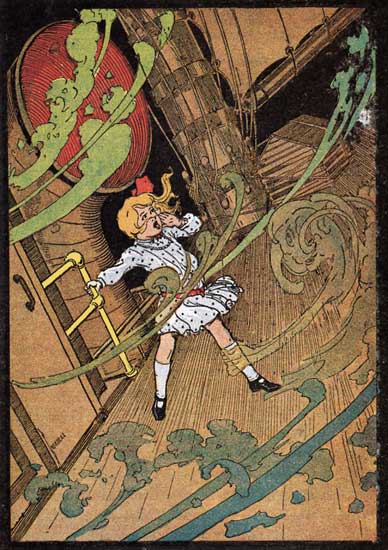
The wind blew hard and joggled the water of the ocean, sending ripples across its surface. Then the wind pushed the edges of the ripples until they became waves, and shoved the waves around until they became billows. The billows rolled dreadfully high: higher even than the tops of houses. Some of them, indeed, rolled as high as the tops of tall trees, and seemed like mountains; and the gulfs between the great billows were like deep valleys.

All this mad dashing and splashing of the waters of the big ocean, which the mischievous wind caused without any good reason whatever, resulted in a terrible storm, and a storm on the ocean is liable to cut many queer pranks and do a lot of damage.
Having sent Dorothy Gale to fairyland by cyclone (tornado), for her second trip Baum turned to this storm at sea. Next, in Dorothy and the Wizard in Oz, he used an earthquake. And then, since he’d exhausted the range of natural disasters, her next two trips were caused by magic from the Emerald City.

In The Scarecrow of Oz Baum had Trot and Cap’n Bill start their journey via a whirlpool—another type of nautical disaster. As with the earthquake suddenly opening a huge crack in the ground in Dorothy and the Wizard, people in the 1910s believed that such whirlpools existed in nature, but they don’t really. Does that mean magic must have been at work in those journeys too?

24 September 2012

“She couldn’t climb down, Jim”


L. Frank Baum’s Dorothy and the Wizard in Oz contains this dialogue between Dorothy Gale and the old horse Jim about Dorothy’s pet kitten:
“Why, where’s Eureka?” cried Dorothy, suddenly.

They all looked around, but the kitten was no place to be seen.

“She’s gone out for a walk,” said Jim, gruffly.

“Where? On the roof?” asked the girl.

“No; she just dug her claws into the wood and climbed down the sides of this house to the ground.”

“She couldn’t climb down, Jim,” said Dorothy. “To climb means to go up.”

“Who said so?” demanded the horse.

“My school-teacher said so; and she knows a lot, Jim.”

“To ‘climb down’ is sometimes used as a figure of speech,” remarked the Wizard.

“Well, this was a figure of a cat,” said Jim, “and she went down, anyhow, whether she climbed or crept.”
I used the Google Ngram Viewer to test how often people writing in English used “climb/climbed/climbing down” over time.

The results show uses of “climb down” in various forms were relatively rare when Baum went to school. There was a marked ascent in the 1880s and ’90s, followed by a temporary turndown halfway through the next decade—precisely when Dorothy and the Wizard in Oz was published.

As a control, use of the verb “climb” in the same three forms rose steadily over most of the same period, with a much less pronounced dip (mostly for the “climbed” form) in the first decade of the 1900s.

That pattern seems consistent with “climb down” becoming popular in Baum’s adulthood, and thus coming to people’s attention as a “modern” usage even though there had been examples for decades earlier.

TOMORROW: And then there was a pushback.

21 August 2012

Ozma, the Birthday Girl

Though L. Frank Baum probably never intended to convey this information, today is the birthday of Ozma, fairy queen of Oz. Some passages in The Road to Oz mention that her birthday is on the 21st of the month. Another passage says that the month is August. So there we go.

One of Baum’s longest descriptions of Ozma comes in The Magic of Oz, his penultimate novel:
Ozma, the beautiful girl Ruler of the Fairyland of Oz, was a real fairy, and so sweet and gentle in caring for her people that she was greatly beloved by them all. She lived in the most magnificent palace in the most magnificent city in the world, but that did not prevent her from being the friend of the most humble person in her dominions. She would mount her Wooden Sawhorse, and ride out to a farm house and sit in the kitchen to talk with the good wife of the farmer while she did her family baking; or she would play with the children and give them rides on her famous wooden steed; or she would stop in a forest to speak to a charcoal burner and ask if he was happy or desired anything to make him more content; or she would teach young girls how to sew and plan pretty dresses, or enter the shops where the jewelers and craftsmen were busy and watch them at their work, giving to each and all a cheering word or sunny smile.

And then Ozma would sit in her jeweled throne, with her chosen courtiers all about her, and listen patiently to any complaint brought to her by her subjects, striving to accord equal justice to all. Knowing she was fair in her decisions, the Oz people never murmured at her judgments, but agreed, if Ozma decided against them, she was right and they wrong.

When Dorothy and Trot and Betsy Bobbin and Ozma were together, one would think they were all about of an age, and the fairy Ruler no older and no more “grown up” than the other three. She would laugh and romp with them in regular girlish fashion, yet there was an air of quiet dignity about Ozma, even in her merriest moods, that, in a manner, distinguished her from the others. The three girls loved her devotedly, but they were never able to quite forget that Ozma was the Royal Ruler of the wonderful Fairyland of Oz, and by birth belonged to a powerful race.
Ozma is clearly devoted first to her ideals and second to the protection and rule of her country. I think those priorities present a challenge for people who want to write adventures for her. Ozma leaves her capital for extended periods in order to carry out what she sees as important duties (e.g., Glinda of Oz, The Magical Mimics of Oz), she can be kidnapped (e.g., The Lost Princess of Oz, Grampa in Oz, Kabumpo in Oz, The Hungry Tiger of Oz), and she can even suffer amnesia about her duties (e.g., The Forbidden Fountain of Oz). But I don’t see it as in her character to “go off on an adventure” the way Dorothy does. She’s got things to do.

24 July 2012

“I’ve the right to make new laws, haven’t I?”

For the last two Tuesdays I’ve been following L. Frank Baum’s discussion of governance in the Pink Country in Sky Island. What Polychrome called “the customs of the country, absurd though they may be,” require that:

Because of the first rule, the book’s heroine, Trot, is made Queen of the Pinks, and because of the second she has to wear a plain pink dress with no flounces and live in a rough hut.
Trot and Button-Bright, with Cap’n Bill and Rosalie the Witch, went to the humble palace, where they had a simple supper of coarse food and slept upon hard beds. In the houses of the City, however, there was much feasting and merrymaking, and it seemed to Trot that the laws of the country which forbade the Queen from enjoying all the good things the people did were decidedly wrong and needed changing.

The next morning Rosalie said to the little girl, “Will you make Tourmaline the Queen again when you go away?”

“I’ll send for her and see about it,” replied Trot. But when Tourmaline arrived at the palace, dressed all in lovely, fluffy robes and with a dainty pink plume in her pink hair, she begged most earnestly not to be made the Queen again.

“I’m having a good time just now after years of worry and uncomfortable living in this uncomfortable old hut of a palace,” said the poor girl, “so it would be cruel for you to make me the servant of the people again and condemn me to want and misery.”

“That seems reason’ble,” replied Trot thoughtfully.

“Rosalie’s skin is just as light a pink as my own,” continued Tourmaline. “Why don’t you make her the Queen?”

“I hadn’t thought of that,” said Trot. Then she turned to Rosalie and asked, “How would you like to rule the Pinkies?”

“I wouldn’t like it,” replied the Witch with a smile. “The Queen is the poorest and most miserable creature in all the kingdom, and I’m sure I don’t deserve such a fate. I’ve always tried to be a good witch and to do my duty.”

Trot thought this over quite seriously for a time. Then one of her quaint ideas came to her—so quaint that it was entirely sensible. “I’m the Queen of the Pinkies just now, am I not?” she asked.

“Of course,” answered Rosalie. “None can dispute that.”

“Then I’ve the right to make new laws, haven’t I?”

“I believe so.”

“In that case,” said the girl, “I’m goin’ to make a law that the Queen shall have the same food an’ the same dresses an’ the same good times that her people have; and she shall live in a house jus’ as good as the houses of any of her people, an’ have as much money to spend as anybody. But no more. The Queen can have her share of ever’thing ’cordin’ to the new law, but if she tries to get more than her share, I’ll have the law say she shall be taken to the edge an’ pushed off. What do you think of that law, Rosalie?”

“It’s a good law and a just one,” replied the Witch approvingly. So Trot sent for the Royal Scribbler, who was a very fat Pinky with large, pink eyes and curly pink hair, and had him carefully write the new law into the Great Book of Laws. The Royal Scribbler wrote it very nicely in pink ink, with a big capital letter at the beginning and a fine flourish at the end.
Trot then makes Rosalie her successor as queen because, she explains, “you’ve got more sense than Tourmaline has and your powers as a witch will help you protect the people.” That perpetuates the benevolent dictatorship usually found in children’s fairylands.

Baum thus had Trot institute equality between the governor and the governed, but not interfere with a law that conferred elite status on the color of a person’s skin. Did that reflect the dominant values among American progressives in 1912, when Sky Island was published?

Baum’s Sky Island is one of the books highlighted in the program at the Winkie Convention, which starts this Friday in Asilomar, California. I’ll moderate a panel on Oz blogs on Sunday morning.

17 July 2012

Queen by the Color of Her Skin

A week ago, I quoted the passage from Sky Island in which L. Frank Baum revealed how the Queen of the Pink Country must live in poverty in exchange for her authority. But how does one become queen?

A later chapter explores that aspect of the country’s governance. As the Pinkies plan to toss our heroes off the island because “They do not harmonize with our color scheme,” Polychrome the Rainbow’s Daughter (introduced in The Road to Oz) arrives and starts to research their laws:

Polychrome began turning over the leaves, while the others all watched her anxiously and in silence. “Here,” she said presently, “is a Law which reads as follows: ‘Everyone in the Pink Country is entitled to the protection of the Ruler and to a house and a good living, except only the Blueskins. If any of the natives of the Blue Country should ever break through the Fog Bank, they must be driven back with sharp sticks.’ Have you read this Law, Tourmaline?”

“Yes,” said the Queen, “but how does that apply to these strangers?”

“Why, being in the Pink Country, as they surely are, and not being Blueskins, they are by this Law entitled to protection, to a home and good living. The Law does not say ‘Pinkies,’ it says any who are in the Pink Country.” . . .

“I am indeed relieved to have you interpret the Law in this way,” declared Tourmaline. “I knew it was cruel to throw these poor people over the edge, but that seemed to us the only thing to be done.”

“It was cruel and unjust,” answered Polychrome as sternly as her sweet voice could speak. “But here,” she added, for she had still continued to turn the leaves of the Great Book, “is another Law which you have also overlooked. It says, ‘The person, whether man or woman, boy or girl, living in the Pink Country who has the lightest skin shall be the Ruler—King or Queen—as long as he or she lives, unless someone of a lighter skin is found, and this Ruler’s commands all the people must obey.’ Do you know this Law?”

“Oh yes,” replied Tourmaline. “That is why I am the Queen. You will notice my complexion is of a lighter pink than that of any other of my people.”

“Yes,” remarked Polychrome, looking at her critically, “when you were made Queen without doubt you had the lightest-colored skin in all the Pink Country. But now you are no longer Queen of the Pinkies, Tourmaline.”

Those assembled were so startled by this statement that they gazed at the Rainbow’s Daughter in astonishment for a time. Then Tourmaline asked, “Why not, your Highness?”

“Because here is one lighter in color than yourself,” pointing to Trot. “This girl is, by the Law of the Great Book, the rightful Queen of the Pinkies, and as loyal citizens you are all obliged to obey her commands. Give me that circlet from your brow, Tourmaline.” Without hesitation Tourmaline removed the rose-gold circlet with its glittering jewel and handed it to Polychrome, who turned and placed it upon Trot's brow. Then she called in a loud, imperative voice, “Greet your new Queen, Pinkies!”
Trot Griffith thus follows Dorothy Gale in overturning the governments of about half the countries she visits. And she becomes queen herself, not simply putting one of her companions on the throne.

But, as last week’s extract showed, it’s a hard life being Queen of the Pinkies.

COMING UP: Queen Trot’s reforms.

(Incidentally, Baum’s incomplete sentence in the last paragraph above was itself mistranscribed in the electronic text of Sky Island that circulated since at least 2003 and is the basis of some reprints. The line is corrected in the latest Project Gutenberg text released on 15 Mar 2012.)

10 July 2012

What We Can Learn from Tourmaline the Poverty Queen

L. Frank Baum’s 1912 fantasy novel Sky Island is one of the themes of the Winkie Convention taking place in California later this month. In that book, Baum continued his pattern of cheekily examining how nations organize themselves politically. As usual, he presented the governors of those nations as monarchs, simplifying the world to match how most children experience it. But he discarded the west’s traditional hereditary way of choosing rulers.

On the blue side of the island, the Boolooroo is supposed to rule for only 300 years, and is further be term-limited by the 600-year ceiling on his life. And on the pink side of the island:

The Queen gazed upon our friends with evident interest. She smiled—a little sadly—at Trot, seemed to approve Button-Bright’s open, frank face, and was quite surprised because Cap’n Bill was so much bigger than her own people. “Are you a giant?” she asked the sailor in a soft, sweet voice.

“No, your Majesty,” he replied, “I’m only—“

“Majesty!” she exclaimed, flushing a deeper pink. “Are you addressing that word to me?”

“O’ course, ma’am,” answered Cap’n Bill. “I’m told that’s the proper way to speak to a Queen.”

“Perhaps you are trying to ridicule me,” she continued, regarding the sailor’s face closely. “There is nothing majestic about me, as you know very well. Coralie, do you consider ‘majesty’ a proper word to use when addressing a Queen?” she added, appealing to the Pinky woman.

“By no means,” was the prompt reply.

“What shall I call her, then?” inquired Cap’n Bill.

“Just Tourmaline. That is her name, and it is sufficient,” said the woman.

“The Ruler of a country ought to be treated with great respec’,” declared Trot a little indignantly, for she thought the pretty little queen was not being properly deferred to.

“Why?” asked Tourmaline curiously.

“Because the Ruler is the mos’ ’risticratic person in any land,” explained the little girl. “Even in America ever’body bows low to our President, an’ the Blueskins are so ’fraid o’ their Boolooroo that they tremble whenever they go near him.”

“But surely that is all wrong,” said Tourmaline gravely. “The Ruler is appointed to protect and serve the people, and here in the Pink Country I have the full power to carry out the laws. I even decree death when such a punishment is merited. Therefore I am a mere agent to direct the laws, which are the Will of the People, and am only a public servant obliged constantly to guard the welfare of my subjects.”

“In that case,” said Button-Bright, “you’re entitled to the best there is to pay for your trouble. A powerful ruler ought to be rich and to live in a splendid palace. Your folks ought to treat you with great respect, as Trot says.”

“Oh no,” responded Tourmaline quickly. “That would indeed be very wrong. Too much should never be given to anyone. If, with my great power, conferred upon me by the people, I also possessed great wealth, I might be tempted to be cruel and overbearing. In that case my subjects would justly grow envious of my superior station. If I lived as luxuriously as my people do and had servants and costly gowns, the good Pinkies would say that their Queen had more than they themselves, and it would be true. No, our way is best. The Ruler, be it king or queen, has absolute power to rule, but no riches, no high station, no false adulation. The people have the wealth and honor, for it is their due. The Queen has nothing but the power to execute the laws, to adjust grievances and to compel order.”

“What pays you, then, for all your bother?” asked Trot.

“I have one great privilege. After my death a pink marble statue of me will be set up in the Grand Court, with the statues of the other Kings and Queens who have ruled this land, and all the Pinkies in ages to come will then honor me as having been a just and upright queen. That is my reward.”

“I’m sorry for you, ma’am,“ said Cap’n Bill. “Your pay for bein’ a queen is sort o’ like a life-insurance. If don't come due till after you’re dead, an’ then you can’t get much fun out o’ it."
Ironically, the Americans—particularly the little girl Trot—want to treat Queen Tourmaline with more deference than her own society accords her.

American society in Baum’s lifetime had struggled with the Pinkies’ problem of how to motivate government employees to work for the good of the people, resisting the temptation to work for themselves. The solution—the federal civil service system—was instituted in 1871. It promised protection from political shifts in exchange for salaries less volatile than in the private sector, pensions to reduce the motivation to amass money, and respect.

Currently a lot of American governments are cutting back on compensation and breaking contracts to public workers. I fear we’ve forgotten the original reasoning behind that social compact. Civil service systems aren’t perfect and can be exploited, but they’re one of those flawed arrangements that’s nonetheless better than anything else we’ve come up with. As Baum went on to explore, the Pinkies’ solution of an impoverished ruler with no respect until death had its own problems.

COMING UP: Choosing the Queen of the Pink Country.

30 May 2012

Reconciling with the Wizard of Oz

Yesterday I described a review of a latter-day Oz book by Hugh Pendexter III. Among Oz fans he’s best known for his short book Oz and the Three Witches, published in 1977. It was inspired by two contradictory passages that L. Frank Baum left us about the Wizard of Oz, the evil witch Mombi, and the baby princess Ozma.

First, near the end of The Marvelous Land of Oz (1904), Baum narrated Glinda the Good’s interrogation of Mombi this way:
“I will ask my first question: Why did the Wizard pay you three visits?”

“Because I would not come to him,” answered Mombi.

“That is no answer,” said Glinda, sternly. “Tell me the truth.” . . .

Mombi now saw how useless it was to try to deceive the Sorceress; so she said, meanwhile scowling at her defeat:

“The Wizard brought to me the girl Ozma, who was then no more than a baby, and begged me to conceal the child.”

“That is what I thought,” declared Glinda, calmly. ”What did he give you for thus serving him?”

“He taught me all the magical tricks he knew. Some were good tricks, and some were only frauds; but I have remained faithful to my promise [to hide] the Princess Ozma—the child brought to me by the Wizard who stole her father’s throne.“
Baum wrote that book because of the popularity of the 1902 stage extravaganza adapted from The Wonderful Wizard of Oz. That show used the Wizard as an antagonist, a charlatan and mountebank who had stolen the rightful king’s throne, and the book reflected that characterization.

But in Dorothy and the Wizard in Oz (1908), Baum brought the Wizard back as a capable and reliable protector for Dorothy. What happened when they reached the Emerald City and the Wizard met up with its new ruler, Princess Ozma? She asks him about his first arrival in Oz.
“At that time,” continued the Wizard, busily eating his soup while talking, “there were four separate countries in this Land, each one of the four being ruled by a Witch. But the people thought my power was greater than that of the Witches; and perhaps the Witches thought so too, for they never dared oppose me. I ordered the Emerald City to be built just where the four countries cornered together, and when it was completed I announced myself the Ruler of the Land of Oz. . . .”

“That is quite a history,” said Ozma; “but there is a little more history about the Land of Oz that you do not seem to understand—”
Aha—the J’accuse moment when Ozma confronts the Wizard with his misdeeds: “Do you remember the child you handed over to an evil crone? I, sir, was that little baby you sold into slavery!”

But no. She continues:
“Many years before you came here this Land was united under one Ruler, as it is now, and the Ruler’s name was always ‘Oz,’ which means in our language ‘Great and Good’; or, if the Ruler happened to be a woman, her name was always ‘Ozma.’ But once upon a time four Witches leagued together to depose the king and rule the four parts of the kingdom themselves; so when the Ruler, my grandfather, was hunting one day, one Wicked Witch named Mombi stole him and carried him away, keeping him a close prisoner. Then the Witches divided up the kingdom, and ruled the four parts of it until you came here. That was why the people were so glad to see you, and why they thought from your initials that you were their rightful ruler.”

“But, at that time,” said the Wizard, thoughtfully, “there were two Good Witches and two Wicked Witches ruling in the land.”

“Yes,” replied Ozma, “because a good Witch had conquered Mombi in the North and Glinda the Good had conquered the evil Witch in the South. But Mombi was still my grandfather’s jailor, and afterward my father’s jailor. When I was born she transformed me into a boy, hoping that no one would ever recognize me and know that I was the rightful Princess of the Land of Oz. But I escaped from her and am now the Ruler of my people.”

“I am very glad of that,” said the Wizard, “and hope you will consider me one of your most faithful and devoted subjects.”
And nothing more is said of kidnapping and baby-selling and other disagreeable subjects.

Ruth Plumly Thompson explored the history of Ozma’s father and Mombi in The Lost King of Oz (1925), but many gaps and inconsistencies remained. (Indeed, we haven’t even touched Baum’s later statement that Ozma was really a fairy left by a fairy queen in the far distant past.)

Pendexter’s Oz and the Three Witches picks up after the second conversation above as Glinda comes to the Emerald City to quiz the Wizard about the whole Ozma matter. The result is a lively little tale of the Wizard trying to fend off the Wicked Witches of East and West through his humbug illusions while navigating the tricky politics of pre-Dorothean Oz. He doesn’t realize who Mombi is, and he’s very, very sorry. All in all, it’s about as good a reconciliation of Baum’s contradictory statements as possible.

First published in 1977, Oz and the Three Witches was reprinted in its entirety with Patricia Ambrose’s quite competent illustrations in Oz-Story, #6.

15 May 2012

“We ought to be friends.”

From the first chapter of L. Frank Baum’s Sky Island:
The boy sat down beside her on the flat rock.

“Do you like girls?” asked Trot, making room for him.

“Not very well,” the boy replied. “Some of ’em are pretty good fellows, but not many. The girls with brothers are bossy, an’ the girls without brothers haven’t any ‘go’ to ’em. But the world’s full o’ both kinds, and so I try to take ’em as they come. They can’t help being girls, of course. Do you like boys?”

“When they don’t put on airs or get roughhouse,” replied Trot. “My ’sperience with boys is that they don’t know much, but think they do.”

“That’s true,” he answered. “I don’t like boys much better than I do girls, but some are all right, and—you seem to be one of ’em.”

“Much obliged,” laughed Trot. “You aren’t so bad, either, an’ if we don’t both turn out worse than we seem, we ought to be friends.”
Sky Island is one of Baum’s best novels, and one of the books that will be commemorated at this summer’s Winkie Convention at the Asilomar Conference Center in Pacific Grove, California. I plan to be there, moderating a panel on Oz blogs and judging a writing contest or two. I’ve also submitted an unconventional piece for the convention booklet.

26 January 2012

The Real Glinda

From the penultimate chapter of L. Frank Baum’s The Emerald City of Oz, as Ozma, Dorothy, and her family go south to visit their friend:
With hearts light and free from care they traveled merrily along through the lovely and fascinating Land of Oz, and in good season reached the stately castle in which resided the Sorceress.

Glinda knew that they were coming.

"I have been reading about you in my Magic Book," she said, as she greeted them in her gracious way.

"What is your Magic Book like?" inquired Aunt Em, curiously.

"It is a record of everything that happens," replied the Sorceress. "As soon as an event takes place, anywhere in the world, it is immediately found printed in my Magic Book. So when I read its pages I am well informed." . . .

"Then," said Ozma, "I suppose you know what is in my mind, and that I am seeking a way to prevent any one in the future from discovering the Land of Oz."

"Yes; I know that. And while you were on your journey I have thought of a way to accomplish your desire. For it seems to me unwise to allow too many outside people to come here. Dorothy, with her uncle and aunt, has now returned to Oz to live always, and there is no reason why we should leave any way open for others to travel uninvited to our fairyland. Let us make it impossible for any one ever to communicate with us in any way, after this. Then we may live peacefully and contentedly."

"Your advice is wise," returned Ozma. "I thank you, Glinda, for your promise to assist me."

"But how can you do it?" asked Dorothy. "How can you keep every one from ever finding Oz?"

"By making our country invisible to all eyes but our own," replied the Sorceress, smiling. "I have a magic charm powerful enough to accomplish that wonderful feat, and now that we have been warned of our danger by the Nome King's invasion, I believe we must not hesitate to separate ourselves forever from all the rest of the world."

"I agree with you," said the Ruler of Oz.

"Won't it make any difference to us?" asked Dorothy, doubtfully.

"No, my dear," Glinda answered, assuringly. "We shall still be able to see each other and everything in the Land of Oz. It won't affect us at all; but those who fly through the air over our country will look down and see nothing at all. Those who come to the edge of the desert, or try to cross it, will catch no glimpse of Oz, or know in what direction it lies. No one will try to tunnel to us again because we cannot be seen and therefore cannot be found. In other words, the Land of Oz will entirely disappear from the knowledge of the rest of the world."

"That's all right," said Dorothy, cheerfully. "You may make Oz invis'ble as soon as you please, for all I care."

"It is already invisible," Glinda stated. "I knew Ozma's wishes, and performed the Magic Spell before you arrived."
She doesn’t say, “I did it thirty-five minutes ago,” like Ozymandias in Watchmen, but she’s still mighty high-handed.

And from the third chapter of Tik-Tok of Oz, after Queen Ann Soforth has set out to conquer all of Oz from her little corner:
Princess Ozma was all unaware that the Army of Oogaboo, led by their ambitious Queen, was determined to conquer her Kingdom. The beautiful girl Ruler of Oz was busy with the welfare of her subjects and had no time to think of Ann Soforth and her disloyal plans. But there was one who constantly guarded the peace and happiness of the Land of Oz and this was the Official Sorceress of the Kingdom, Glinda the Good.

In her magnificent castle, which stands far north of the Emerald City where Ozma holds her court, Glinda owns a wonderful magic Record Book, in which is printed every event that takes place anywhere, just as soon as it happens.

The smallest things and the biggest things are all recorded in this book. If a child stamps its foot in anger, Glinda reads about it; if a city burns down, Glinda finds the fact noted in her book.

The Sorceress always reads her Record Book every day, and so it was she knew that Ann Soforth, Queen of Oogaboo, had foolishly assembled an army of sixteen officers and one private soldier, with which she intended to invade and conquer the Land of Oz.

There was no danger but that Ozma, supported by the magic arts of Glinda the Good and the powerful Wizard of Oz—both her firm friends—could easily defeat a far more imposing army than Ann's; but it would be a shame to have the peace of Oz interrupted by any sort of quarreling or fighting. So Glinda did not even mention the matter to Ozma, or to anyone else. She merely went into a great chamber of her castle, known as the Magic Room, where she performed a magical ceremony which caused the mountain pass that led from Oogaboo to make several turns and twists. The result was that when Ann and her army came to the end of the pass they were not in the Land of Oz at all, but in an adjoining territory that was quite distinct from Ozma's domain and separated from Oz by an invisible barrier.
In Baum’s books, Ozma has a tendency to want to talk nicely to people threatening Oz so as to convince them of the error of their ways. Glinda doesn’t play by those rules. You threaten Oz—she will take you down. And she may not even bother to tell anyone about it.

20 December 2011

One-Page Wizard of Oz

This is an unabridged publication of L. Frank Baum’s Wonderful Wizard of Oz in poster form, available from Spineless Classics in the UK.

The same outfit has versions of Peter Pan, Treasure Island, and other classics, all in appropriate silhouettes.

But for £40?!

(I understand that expressing the price with the singular form of the currency—“Forty pound?!”—conveys indignation in British speech. But I could be wrong.)

06 December 2011

Our First Glimpse of Evardo XV

The picture above, by John R. Neill, comes from the end of Ozma of Oz. It shows the dowager queen of Ev and her eldest son, the new King Evardo XV.

L. Frank Baum earlier described Evardo this way: “He was a grave and quiet youth, and would doubtless rule his people wisely and with justice.” He narrates this scene thusly:
Then the Queen took her eldest son out upon a balcony that overlooked the crowd of subjects gathered below, and said to them:

“Here is your future ruler, King Evardo Fifteenth. He is fifteen years of age, has fifteen silver buckles on his jacket and is the fifteenth Evardo to rule the land of Ev.”

The people shouted their approval fifteen times, and even the Wheelers, some of whom were present, loudly promised to obey the new King.

So the Queen placed a big crown of gold, set with rubies, upon Evardo’s head, and threw an ermine robe over his shoulders, and proclaimed him King; and he bowed gratefully to all his subjects and then went away to see if he could find any cake in the royal pantry.
He is fifteen, after all.

Baum has even less to say about most of the queen’s other children, aside from the youngest: Prince Evring, whom Dorothy rescues. The rest of the siblings are simply names: “The Princesses were named, Evanna, Evrose, Evella, Evirene and Evedna, while the Princes were Evrob, Evington, Evardo and Evroland.”

Baum derived the names of Evrob and Evedna from those of one son and his fiancée. Robert Baum was also inspiration for the young hero of Baum’s science-fiction novel The Master Key, and Edna Drucker was a family neighbor. They were in their early twenties when Ozma of Oz appeared, clearly older than the queen’s children.

As to other details of the Ev princes and princesses, especially as individuals, Baum’s book is basically silent.

TOMORROW: Filling in the gaps, one way or another.

29 November 2011

Kaliko Vision

In L. Frank Baum’s Ozma of Oz, Roquat the Nome King is served by a Nome introduced this way:
Meantime the King ordered refreshments to be served to those waiting, and at his command a rudely shaped Nome entered, bearing a tray. This Nome was not unlike the others that Dorothy had seen, but he wore a heavy gold chain around his neck to show that he was the Chief Steward of the Nome King, and he assumed an air of much importance, and even told his majesty not to eat too much cake late at night, or he would be ill.
Later, thinking himself out of the hearing of the guests, the Chief Steward tells the king, “You are a fool to waste so much time upon these people” from Oz.

Baum next visited the Nomes in The Emerald City of Oz, and in that book stated that the king’s steward was named Kaliko. He’s “frightened” by his master, “trembling and white with fear.” Baum offers this exchange:
“Fetch my pipe!” yelled the King.

“Your pipe is already here, your Majesty,” replied Kaliko.

“Then get my tobacco!” roared the King.

“The tobacco is in your pipe, your Majesty,” returned the Steward.

“Then bring a live coal from the furnace!” commanded the King.

“The tobacco is lighted, and your Majesty is already smoking your pipe,” answered the Steward.

“Why, so I am!” said the King, who had forgotten this fact; “but you are very rude to remind me of it.”

“I am a lowborn, miserable villain,” declared the Chief Steward, humbly.
Obviously that exchange shows a interpersonal dynamic very different from the earlier one.

In Who’s Who in Oz, Jack Snow stated that Kaliko first appeared in Ozma—in other words, that he was the Chief Steward in that book as well as the later one. As a young reader, I adopted that interpretation without question. It suggests that the Nome King’s anger over losing his Magic Belt in the earlier book makes it much more dangerous to talk back to him in the later.

More recently, however, such Oz scholars as David Hulan convinced me that might be too much of an assumption. What if the Nome King got rid of the first Chief Steward between the two books? In that case, Kaliko didn’t change his behavior drastically; rather, he could be obsequious enough to manage the angry monarch. What happened to the earlier Chief Steward? Based on what the Nome King orders for some Nome army officers in Emerald City, it would be nothing good.

The Marvel Comics adaptation of Ozma of Oz comes down firmly on the first interpretation, with the Chief Steward being named “Kaliko.” Scripter Eric Shanower’s choice makes for a smaller, more unified cast of characters for the series, and there’s certainly tradition behind it.

Artist Skottie Young also makes an interesting choice in how he designed the Nomes. His Nome King looks much like John R. Neill’s, with a human face, hair, and beard; five-fingered hands; and a caricatured but recognizably humanoid body. In contrast, Young draws the rest of the Nomes as little imps, basically isosceles triangles with tiny limbs and snappish personalities. And Kaliko is among them, as the picture below shows.
Looking ahead, will we see this little Kaliko assuming the Nome Kingdom’s throne?

18 October 2011

Uncle Henry’s Mortgage Crisis

The second chapter of The Emerald City of Oz, L. Frank Baum’s fifth and, he thought, final Oz novel, starts with an echo of the first:
Dorothy Gale lived on a farm in Kansas, with her Aunt Em and her Uncle Henry. It was not a big farm, nor a very good one, because sometimes the rain did not come when the crops needed it, and then everything withered and dried up. Once a cyclone had carried away Uncle Henry’s house, so that he was obliged to build another; and as he was a poor man he had to mortgage his farm to get the money to pay for the new house. Then his health became bad and he was too feeble to work. The doctor ordered him to take a sea voyage and he went to Australia and took Dorothy with him. That cost a lot of money, too.

Uncle Henry grew poorer every year, and the crops raised on the farm only bought food for the family. Therefore the mortgage could not be paid. At last the banker who had loaned him the money said that if he did not pay on a certain day, his farm would be taken away from him.
This was, of course, before American society decided that it was both heartless and wasteful to let medical costs force people into bankruptcy. Now, of course, we’ve progressed to... Never mind.

In this book, published in 1910, Dorothy comes up with a solution to the family’s financial straits: occupy the Emerald City! Or at least move there. Baum explains that Oz under Princess Ozma has a very different economic system, as I quoted back here, which means there are no poor people.