11 April 2013

We Welcome You

This is a detail from one of the photographs in NPR’s “Witches and Wizards” scrapbook collecting listeners’ memories of Oz.

These young ladies are docents at Dorothy’s House and Land of Oz in Liberal, Kansas. It’s gratifying to see how any girl can represent Dorothy.

The webpage has many more stories, photographs, photographs accompanied by stories, especially of kids in costume. A lot of those stories involve mothers insistent on making a kickass Wizard of Oz outfit and making their progeny wear it.

Me? One year I dressed myself as L. Frank Baum.

10 April 2013

A Mystery with Not-So-Secret Identities

A while back, I had the idea for a mystery story set in the world of mid-1900s American comics publishing. I’m still working on that, but in the meantime I sampled Max Allan Collins’s A Killing in Comics, the first in a series of mystery novels set, well, in the world of mid-1900s American comics publishing.

I should have expected Collins to have worked out this idea already. He’s written many comics himself, including the Dick Tracy newspaper strip for many years, the Ms. Tree private-eye stories, and The Road to Perdition. Collins was the Batman scripter who gave the second Jason Todd his past as a runaway with criminal parents.

Collins is also a prolific writer of prose mysteries, including his award-winning Nathan Heller books, another series built around major modern disasters, and numerous novelizations. So basically he’s already worked out every idea for a mystery story.

A Killing in Comics is clearly inspired by Gerard Jones’s Men of Tomorrow, which has become the authoritative history of the start of the American comic-book industry. It’s a roman à clef about the first generation of DC Comics, or more particularly about the men who worked on its most famous creations, Superman and Batman. But in this book those trademarks are cleverly disguised as Wonder Guy and Batwing.

Thus, instead of Jerry Siegel and Joe Shuster, the book gives us Harry Spiegel and Moe Shulman—but they’re almost exactly as Jones characterized the Superman creators. On the Batman side, Bob Kane becomes Rod Krane, Bill Finger becomes Will Hander, and Jerry Robinson becomes…nothing, because unlike the other creators there’s no clear moral conflict in his career. Editor Mort Weisinger is on the scene at Sy Mortimer but as of 1948 hasn’t reached his full potential as a villain.

The detective, Jack Starr, is the troubleshooting vice president of a newspaper syndication service. Though he refers to his father as “the major,” reminiscent of Maj. Malcolm Wheeler-Nicholson, this business is actually successful. It’s also run by a version of Gypsy Rose Lee, a retired stripper of an intellectual kind. That’s the most fictional part of the book.

As with Oz the Great and Powerful, the story is a little less interesting than watching it play out just on the edge of its source material without stepping over the line onto that territory. In this case, the mystery depends on all those comics pros being capable of killing the equivalent of the president of DC Comics. So of course “any resemblance to actual persons…is entirely coincidental,” as the copyright page says.

Further volumes in Collins’s Jack Starr series appear to be inspired by the Li’l Abner Broadway show of 1956 and its roots in newspaper comics, and by Dr. Fredric Wertham’s anti-comics crusade.

09 April 2013

Yes, I Know She’s Supposed to Be Inside the House

Prints of “Dorothy’s World” by John Coulter are available through Gallery Nucleus in Alhambra.

His work is part of the exhibition “Not in Kansas Anymore: A Tribute to The Wizard of Oz.”

I’m unduly fond of “Nikko and Toto” by an artist called Cuddly Rigor Mortis, but that might be because I played the Winged Monkey Who Grabs Toto in my second-grade production of The Wizard of Oz.

08 April 2013

Maps of the Homeland

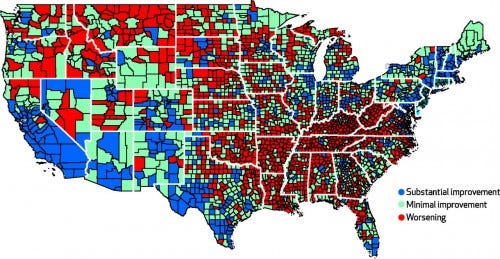
In this map of the continental United States, the red areas represent where women’s mortality statistics grew worse between the early 1990s and the mid-2000s, as Grace Wyler at Business Insider reports. The blue areas saw substantial improvement in that measure, green small improvement.

In this map, from Mark Newman at the University of Michigan, the redder the area, the more strongly that county voted for Mitt Romney in 2012.


07 April 2013

Photos from Gotham Rooftops

Generally the Oz and Ends editorial team looks on superhero cosplay as an exercise in futility, like wishing the comic books were as good as when you were twelve.

Superheroes aren’t drawn realistically. Their faces, musculature, clothing, and hair are beyond ideal. We see them in the middle of astonishing and yet good-looking moves, depicted with foreshortening and all the other tricks artists have devised. It’s impossible to reproduce that look consistently with actual human bodies, real fabrics, and convention-center settings.

But when cosplayers and photographers get close to the images on the comics page, we have to acknowledge their achievement.

Photographer Mike Halloran caught this image at a 2011 Comic-Con.
ComicChic19 made this outfit for her son.

05 April 2013

Jetmore, Kansas, and Its Lee Harvey Oswald Fan Club

The Boston Globe’s Matt Viser visited a part of rural Kansas to learn about the district of two-term Republican Representative Tim Huelskamp, known for alienating his own party leaders in the House with his refusal to compromise.

Among the residents is Norman Bamberger, a cattle rancher who wants to cut the federal budget—except all the parts he depends on for his business:

Bamberger has 900 cattle, and he’s going on his second bad year in a row. Meat prices are high, good for reaping a profit, but a drought has caused increases in prices of grain he needs to buy to feed his cattle. He supports the automatic budget cuts of earlier this year, except for the one that threatens to reduce the number of federal meat inspectors—which could affect his own business.

“It’s just stupid,” he said. Then, in a jarring attempt at dark humor that most would find offensive, he added: “Where’s Lee Harvey when you need him?”

Concerned about seeming harsh with his reference to the man who assassinated President John F. Kennedy, he quickly added, “That wasn’t very nice.”
Of course, the automatic budget cuts were forced by Republicans, like his own Representative. And I’m sure there are other benefits and subsidies for farmers that Bamberger would to see preserved as well.

Bamberger wasn’t the only person in Jetmore talking about political murder. At a gathering of leading citizens—“The group included the mayor, a retired farmer, and the editor of the ­local newspaper, the Jetmore Republican”—Viser heard the owner of an appliance repair shop (shown above) complain the same way:
“Hell, we ought to impeach the little bastard,” [Charles] Leet said. “Asleep at the switch. I keep ­donating to the Bring Back Lee Harvey Committee. It hasn’t worked yet.”

The group chuckled.

“We aren’t rabble-rousers. We don’t want to cause ­trouble,” [newspaper editor Mike] Thornburg said a few minutes later.
In that case, the men of Jetmore might want to make fewer jokes about Presidential assassinations. That habit makes them look like they have OIP Derangement Syndrome.

04 April 2013

Local Heroes

I won’t be attending MoCCA this year, but I’ll be represented at that independent comics festival by a couple of titles from Dan Mazur’s Ninth Art Press. One is The Greatest Comics Anthology of All Time, introduced back here.

And Geoff Halvorsen and I have a story in the inaugural issue of In a Single Bound, a magazine of eight short superhero comics set in Boston and hot off the press.

This tale is really Geoff’s baby. We were talking at a Boston Comics Roundtable meeting about his frustration with finding a structure for his visual ideas, so I listened and thought and came back with a story set at MIT. Dan, the magazine editor, provided great suggestions to make the result more “superheroey.” Geoff handled all the layout, art, and lettering. The result is the Tesla Club’s first tale, “The Infinite Corridor.”

Part of the point of In a Single Bound is that it’s not so “superheroey.” These are stories set in Boston, after all, not braggadocious New York or its other-universe avatars (Gotham, Metropolis). They tend toward the smart, skewed, and parodic. The parody might be directed at the superhero genre or the Hub itself. We’ll see how the collection fares in Manhattan this weekend before it flies back to home base for the Boston Comic-Con.

03 April 2013

More Revisionist Ozian History from L. Frank Baum

L. Frank Baum revised the character of the Wizard of Oz back to a capable and even lovable showman in his fourth novel in the series, Dorothy and the Wizard in Oz. After all, it wouldn’t do for Dorothy’s protector on that book’s journey to fairyland to be a child-stealing fraud, which is how the Wizard had last appeared in The Marvelous Land of Oz.

In the latter part of Dorothy and the Wizard, Oz gets to explain himself to Princess Ozma, the very child he had stolen (though no one has the effrontery to bring that up here):
“One day my balloon ran away with me and brought me across the deserts to this beautiful country. When the people saw me come from the sky they naturally thought me some superior creature, and bowed down before me. I told them I was a Wizard, and showed them some easy tricks that amazed them; and when they saw the initials [O.Z.] painted on the balloon they called me Oz.”

“Now I begin to understand,” said the Princess, smiling.

“At that time,” continued the Wizard, busily eating his soup while talking, “there were four separate countries in this Land, each one of the four being ruled by a Witch. But the people thought my power was greater than that of the Witches; and perhaps the Witches thought so too, for they never dared oppose me. I ordered the Emerald City to be built just where the four countries cornered together, and when it was completed I announced myself the Ruler of the Land of Oz, which included all the four countries of the Munchkins, the Gillikins, the Winkies and the Quadlings. Over this Land I ruled in peace for many years, until I grew old and longed to see my native city once again. So when Dorothy was first blown to this place by a cyclone I arranged to go away with her in a balloon; but the balloon escaped too soon and carried me back alone. . . .”

“That is quite a history,” said Ozma; “but there is a little more history about the Land of Oz that you do not seem to understand—perhaps for the reason that no one ever told it you. Many years before you came here this Land was united under one Ruler, as it is now, and the Ruler’s name was always ‘Oz,’ which means in our language ‘Great and Good’; or, if the Ruler happened to be a woman, her name was always ‘Ozma.’ But once upon a time four Witches leagued together to depose the king and rule the four parts of the kingdom themselves; so when the Ruler, my grandfather, was hunting one day, one Wicked Witch named Mombi stole him and carried him away, keeping him a close prisoner. Then the Witches divided up the kingdom, and ruled the four parts of it until you came here. That was why the people were so glad to see you, and why they thought from your initials that you were their rightful ruler.”

“But, at that time,” said the Wizard, thoughtfully, “there were two Good Witches and two Wicked Witches ruling in the land.”

“Yes,” replied Ozma, “because a good Witch had conquered Mombi in the North and Glinda the Good had conquered the evil Witch in the South. But Mombi was still my grandfather’s jailor, and afterward my father’s jailor. When I was born she transformed me into a boy, hoping that no one would ever recognize me and know that I was the rightful Princess of the Land of Oz. But I escaped from her and am now the Ruler of my people.”

“I am very glad of that,” said the Wizard, “and hope you will consider me one of your most faithful and devoted subjects.”

“We owe a great deal to the Wonderful Wizard,” continued the Princess, “for it was you who built this splendid Emerald City.”

“Your people built it,” he answered. “I only bossed the job, as we say in Omaha.”
Some of this history is reflected in the new movie, Oz the Great and Powerful:

  • the Wizard’s full name, with its embarrassing later initials spelling out “PINHEAD.”
  • the assumption that the Wizard must be the land’s savior if he comes from the sky in a balloon bearing the letters OZ.
  • the notion that the Wizard landed in the midst of a fight among the land’s witches.

However, in the new movie the Emerald City is already built, and green instead of made so by green glasses—all the better to bring up memories of the city in the 1939 MGM movie.

02 April 2013

“He wasn’t so much of a Wizard as he might have been.”

This is how Tip, the young hero of L. Frank Baum’s second Oz book, explains the first to his creation Jack Pumpkinhead:

“Where are we going?” asked Jack, when they had resumed their journey.

“I’m not exactly sure,” said the boy; “but I believe we are headed South, and that will bring us, sooner or later, to the Emerald City.”

“What city is that?” enquired the Pumpkinhead.

“Why, it’s the center of the Land of Oz, and the biggest town in all the country. I’ve never been there, myself, but I’ve heard all about its history. It was built by a mighty and wonderful Wizard named Oz, and everything there is of a green color. . . And in the Country of the Munchkins, over at the East, everything is blue; and in the South country of the Quadlings everything is red; and in the West country of the Winkies, where the Tin Woodman rules, everything is yellow.”

“Oh!” said Jack. Then, after a pause, he asked: “Did you say a Tin Woodman rules the Winkies?”

“Yes; he was one of those who helped Dorothy to destroy the Wicked Witch of the West, and the Winkies were so grateful that they invited him to become their ruler,—just as the people of the Emerald City invited the Scarecrow to rule them.”

“Dear me!” said Jack. “I’m getting confused with all this history. Who is the Scarecrow?”

“Another friend of Dorothy’s,” replied Tip.

“And who is Dorothy?”

“She was a girl that came here from Kansas, a place in the big, outside World. She got blown to the Land of Oz by a cyclone, and while she was here the Scarecrow and the Tin Woodman accompanied her on her travels.”

“And where is she now?” inquired the Pumpkinhead.

“Glinda the Good, who rules the Quadlings, sent her home again,” said the boy.

“Oh. And what became of the Scarecrow?”

“I told you. He rules the Emerald City,” answered Tip.

“I thought you said it was ruled by a wonderful Wizard,” objected Jack, seeming more and more confused.

“Well, so I did. Now, pay attention, and I’ll explain it,” said Tip, speaking slowly and looking the smiling Pumpkinhead squarely in the eye. “Dorothy went to the Emerald City to ask the Wizard to send her back to Kansas; and the Scarecrow and the Tin Woodman went with her. But the Wizard couldn’t send her back, because he wasn’t so much of a Wizard as he might have been. And then they got angry at the Wizard, and threatened to expose him; so the Wizard made a big balloon and escaped in it, and no one has ever seen him since.”

“Now, that is very interesting history,” said Jack, well pleased; “and I understand it perfectly all but the explanation.”
A number of touches show the influence of the Wizard of Oz stage extravaganza that debuted to great crowds in 1902:

  • the vaudeville crosstalk of the conversation itself. Baum’s first Oz book has relatively little dialogue, and much of it is straightforward and declaratory. With this sequel he began writing patter. That offered more chance to distinguish his characters, but also more chance to stretch for cheap laughs.
  • the omission of the Cowardly Lion as one of Dorothy’s companions, just as Baum omitted him from this book. The big stars of the stage show were the Scarecrow and the Tin Woodman, and this sequel was designed to give the public more of them. 
  • the portrayal of the Wizard as a villainous fraud, as he appeared in the stage show, rather than a good-hearted humbug. In The Wonderful Wizard of Oz, the Wizard builds a balloon in a sincere attempt to take Dorothy home to Kansas, but he can’t stop it once it’s launched. As Tip retells the story, the Wizard built the balloon simply to escape before Dorothy and her companions could reveal his secrets.

Or is that actually how the people of Oz came to look upon the Emerald City’s former ruler?

01 April 2013

Fooling Ourselves: Are We Hard-Wired for Optimism?

A while back I read about a couple of studies in medical decision-making by Lucas S. Zier, Douglas B. White, and colleagues. In particular, they looked at how medical surrogates responded to doctors saying that there was very little that they could do for a dying patient.

In 2009 the team reported in the journal Chest:

Sixty-four percent of surrogates expressed a reluctance or unwillingness to believe physicians’ futility predictions. They provided the following four main explanations for this belief: a skepticism about physicians’ ability to achieve complete prognostic certainty, a need to see for themselves that a patient was incapable of recovery, a need to triangulate multiple information sources before believing physicians, and a belief that God could intervene to change the course of an illness. . . .

Surrogates who doubted physician’s futility predictions clustered into the following two general groups: those whose doubt was based on religious beliefs (n = 18); and those whose doubt was based on secular considerations (n = 15), such as past experiences with inaccurate prognostication, a secular belief that future-telling is inherently inaccurate, and a need to triangulate physicians prognostications with other sources before accepting the prognosis as true. Surrogates who doubted physicians’ futility predictions on religious grounds were more likely to request continued life support in the face of a very poor prognosis…, whereas those whose doubt was based on secular concerns were not…
Three years later the researchers published further findings in the Annals of Internal Medicine, also looking at how medical surrogates responded to doctors’ good predictions:
Participants’ interpretations of prognostic statements expressing a low risk for death were relatively accurate, but interpretations of statements conveying a high risk for death were more optimistic than the actual meaning. . . . Interpretations of the statement “90% chance of surviving” did not differ from the actual meaning, but interpretations of “5% chance of surviving” were more optimistic and showed substantial variability.
If I interpret the abstract right, people hearing “90% chance of surviving” generally interpreted that as 90%, with only a slight spread to 95%. People hearing “5% chance of surviving” spread that out into 15%, with the center of the bell curve going as high as 40%.

In interviews, the researchers found two reasons for the distortion of bad news: “surrogates’ need to register optimism in the face of a poor prognosis and surrogates’ belief that patient attributes unknown to the physician would lead to better-than-predicted outcomes.”

In other words, our brains may not process bad medical news rationally or accurately.