31 December 2011

The End of Lord Peter Wimsey

I read the Lord Peter Wimsey novels as a boy, spurred by my mother’s fondness for them and by Ian Carmichael’s portrayal of the character on Masterpiece Theater. Like any good fuddy-duddy, I was therefore a little wary of Jill Paton Walsh’s sequels to Dorothy L. Sayers’s originals.

The first, titled Thrones, Dominations, grew out of notes that Sayers left behind, and her name appears on the cover before Walsh’s. For the second, A Presumption of Death, Walsh had only some fictional letters that Sayers had published as propaganda during the Battle of Britain, showing how her characters were coping with the Blitz. On that book, Walsh’s name came first.

For the third, The Attenbury Emeralds, Walsh had no unpublished Sayers material to draw from, simply allusions and remarks. She is sole author.

The Attenbury Emeralds tries to bookend Lord Peter’s career. The first half recounts a couple of his earliest cases as a detective, with Lord Peter and Bunter recounting the events at great length to Harriet. The narrative thus takes the form of a three-way conversation, interrupted by family business and daily life. It’s an awkward read, though more believable than those Conrad novels in which a narrator supposedly speaks for hours on end.

Naturally, this early case comes back in the book’s second half. That mystery involves a murderer who’s mad (mad, I say!), so I found that plot less than fully satisfying. On the other hand, the mystery of Thrones, Dominations depended on details of the proper dress for royal mourning after the death of George V, so it wasn’t good for the fashion-blind.

I found A Presumption of Death to be the most satisfying of this trilogy, with its interesting wartime setting and good roles for children. It has much the same feel as Sayers’s short story “Talboys,” her only glimpse of Peter and Harriet as parents. There are priceless moments with Harriet and Bunter.

What was truly satisfying, however, was how Walsh drew the whole Lord Peter saga to a close. Sayers left his nephew the Viscount St. George in the RAF during the Battle of Britain, and acknowledged that the young man probably didn’t survive the war.

I remember reading that factoid in a book about the series back around 1980, and realizing that would make Lord Peter heir apparent to his older brother, the Duke of Denver. The duchess was clearly past the age to have another child, even if she and her husband still got along, so the only way that succession would change is if she died, Denver remarried, and the new wife quickly had a male child. Which was, I suppose, what Peter would hope for.

The Attenbury Emeralds explores that situation. It’s set in 1951 as new tax rates and social rules are spreading peers’ inheritances and privileges more widely around the English nation. Peter and Harriet’s boys are at Eton and other public schools, as is Bunter’s son, clearly on the rise. And by the end of the book, Lord Peter is no more.

Which is not to say he’s dead. If in future he does any more mystery-solving, perhaps under another author’s pen, he’ll do it under a different name.

29 December 2011

Piling on The Seeker

Salon asked some children’s writers about movie adaptations, and a couple had interesting things to say about an uninteresting film, The Seeker: The Dark Is Rising. I read that piece just a couple of hours after watching the movie for the first time (I had a bunch of envelopes to stuff, all right?). M. T. Anderson is right on the mark about it:
The original novel, published in the ’70s, established a lot of the common tropes of kids’ fantasy novels – for example, the odd penchant of Forces of Light in general for engaging underage teens to save the world. (Really? Is that a wise choice? Are those the only resumes they receive?)

The qualities of the original that make it a classic of the genre also make it a tough thing to adapt into a movie. It’s richly atmospheric and moody, even dreamy, evoking a Celtic Christmas that is ancient and half-pagan – but the confrontations between Light and Dark are subtle. The action is almost ritualistic.

For the movie, they threw the whole Celtic thing out the window and focused on action. By sapping the story of everything that made it particular (its mood and its focus on a seductive blend of British mythologies) they left behind only the elements that have been imitated so many times in the 30 years since the book’s publication that they’ve become cliché. So the filmmakers managed to create something that fans of the book hated – because it gutted the original material – while at the same time boring the hell out of everyone who didn’t know the book, because all that was left was insipidly generic.
Charitably, Anderson says, “Some of the bustling family scenes, scripted by the talented John Hodge (‘Trainspotting’) have verve.” Family was also a major theme in Susan Cooper’s novel as well, starting from the first line, but used in a completely different way. Though one Stanton brother is exasperated by the number of siblings (which the movie doesn’t try to replicate fully), for Will his family is safe and sturdy. In contrast, the movie family is full of nasty teasing, sexual rivalry, and hidden shame.

I was struck by how desperate the moviemakers were to establish that The Seeker was set in the present, not the (gasp!) 1970s. Our first sight of Will is him putting in earbuds. Shortly afterward comes a shot of a line of teens all flicking open their cell phones. (Remember when phones flicked open?) Will’s brothers have a huge screen for their videogames, an older brother Skypes in from Hawaii for Christmas, and Will researches the ancient battle of light and dark through Google.

That technology theme fades away, however, and cell phones and computers aren’t allowed to affect the plot any more than in the Harry Potter stories. The conflict plays out in a series of very familiar special-effects shots. Giant snakes! Water bursting through archways! Glass breaking! Smoke billowing!

Diane Duane concurred on how much was lost:
…probably the adaptation I’ve seen that stands out as most completely screwed-up would be “The Seeker: The Dark Is Rising.” The basic concept was eviscerated and left staggering around like a zombie-ized shell of itself, and all the good character business was either dumbed down, ripped out or rendered meaningless. It infuriated me, because that book was the anchor of one of the great mid-’70s YA fantasy series, a nuanced piece of work.
I know mood is hard to translate from page to screen. But The Dark Is Rising offers one of the finest lines in children’s literature—“Tonight will be bad, and tomorrow will be beyond all imagining”—and The Seeker managed to screw up even that.

I have no compunction about spoiling what’s supposed to be one of the movie’s big reveals: that Will’s twin brother was kidnapped in infancy, and—despite his growing up in a family with two guilt-stricken parents and five older brothers who love to torment him—no one ever told him. This allows for a sight of the lead actor in an awful wig alongside his regular self in trick shots at the end of the film. Hell, I’ll even give away the ending! The brother returns to the family after fourteen years of captivity in a snow globe as if nothing has happened.

28 December 2011

Wisest Thing I’ve Read Today

Here’s a taste of economist and New York Times columnist Tyler Cowen’s remarks about storytelling at something called TEDxMidAtlantic (evidently the future is moving too fast for the spacebar to keep up).

I was told to come here and tell you all stories, but what I'd like to do is instead tell you why I'm suspicious of stories, why stories make me nervous. In fact, the more inspired a story makes me feel, very often the more nervous I get. So the best stories are often the trickiest ones.

The good and bad things about stories is they're a kind of filter. They take a lot of information, and they leave some of it out, and they keep some of it in. But the thing about this filter, it always leaves the same things in. You're always left with the same few stories. . . . There's monster, rags to riches, quest, voyage and return, comedy, tragedy, rebirth. You don't have to agree with that list exactly, but the point is this: if you think in terms of stories, you're telling yourself the same things over and over again.

There was a study done, we asked some people to describe their lives. And when asked to describe their lives, what's interesting is how few people said, "mess". It's probably the best answer; I don't mean that in a bad way. "Mess" can be liberating, "mess" can be empowering, "mess" can be a way of drawing upon multiple strengths.

But what people wanted to say was, "My life is a journey." 51% wanted to turn his or her life into a story. 11% said, "My life is a battle." Again, that's a kind of story. 8% said, "My life is a novel," 5% "My life is a play." I don't think anyone said, "My life is a reality TV show." Again, we're imposing order on the mess we observe, and it's taking the same patterns, and when something is in the form of a story, often we remember it when we shouldn't.

So how many of you know the story about George Washington and the cherry tree? It's not obvious that's exactly what happened. The story of Paul Revere, it's not obvious that that's exactly the way it happened. So again, we should be suspicious of stories. We're biologically programmed to respond to them. They contain a lot of information. They have social power. They connect us to other people. So they're like a kind of candy that we're fed when we consume political information, when we read novels. When we read nonfiction books, we're really being fed stories. Nonfiction is, in a sense, the new fiction. The book may happen to say true things, but everything's taking the same form of these stories.

So what are the problems of relying too heavily on stories? You view your life like "this" instead of the mess that it is or it ought to be. But more specifically, I think of a few major problems when we think too much in terms of narrative. First, narratives tend to be too simple. The point of a narrative is to strip it way, not just into 18 minutes, but most narratives you could present in a sentence or two. So when you strip away detail, you tend to tell stories in terms of good vs. evil, whether it's a story about your own life or a story about politics.
Even if we avoid the pitfall of assigning good and evil, we still face the other fallacies of seeking a well-constructed narrative: that things don’t just happen randomly, but for a reason already established in the story; that we as characters affect the outcome of events through our efforts (or fail because of lack of effort); that there’s a lesson or insight to be learned. In writing fiction, I’m eager to create good narratives. In studying history, I’m suspicious of them, yet it’s the natural way I lay out information.

Cowen’s whole talk can also be viewed as a video.

27 December 2011

Oz on the iPad

One of my gifts this holiday/birthday season was an iPad, and one of my first apps purchased for that iPad was Oz, created by Boluga.

The text is an abridgment of L. Frank Baum’s Wonderful Wizard of Oz, and the aesthetic is derived from W. W. Denslow’s illustrations. Not as they originally appeared, though, since the “pages” have also been digitally aged and dusted with grime for a “classic” look. In addition, key phrases are enlarged and laid diagonally on many screens, especially those with no art. As I noted before, Denslow’s thick-line cartooning adapts well to this format.

Kirkus found that shortening the text removed a lot of Baum’s charm. Knowing the story already, I didn’t pay much attention to that, but I agree that a lot of Baum’s strength as a storyteller—his ability to create a verisimilitudinous fairyland through respect for individual characters and quotidian detail—appears in passages unnecessary for the plot and therefore likely to be the first to go.

Some of the screens have interactive elements, but I found them inconsistent. From one page to the next, the art can:
  • do nothing but look pretty. It’s possible to spot these by the lack of a circular icon in the upper right corner. 
  • come with animation, music, or other sounds, but (aside from rerunning the screen by hitting that icon) there’s nothing for readers to do. This is how the Wicked Witches die, for example.
  • let readers play with visual elements, though to no clear purpose. I don’t know why one is supposed to knock down the Soldier with the Green Whiskers’s gun. One can fill the poppy field with poppies drifting snowglobe-style from the sky, which is kind of pretty, but it doesn’t seem to grow from the story. 
  • allow readers to be part of the story by, say, taking the Scarecrow off his pole or putting the heart in the Tin Woodman. These screens are, of course, the most fun. But Kirkus complains that such games and puzzles require too much fine-motor control for the app’s intended audience. I must admit I still haven’t got the Guardian of the Gates’s key into the lock—I’d actually decided it didn’t belong there.
Not being able to distinguish one type of interaction from another was also a little frustrating. For example, after Mr. Joker, the clown in the China Country, shatters into dozens of pieces, I kept trying to reassemble him. But I think he’s a lost cause.

Perhaps a version 2.0 will fix those frustrations. But honestly, for 99¢, Oz was a fine way to learn some of the tricks of my iPad while revisiting some familiar faces and places. I was more than satisfied.

Incidentally, I noticed only one sign of the MGM movie’s influence on this version: when the Tin Woodman’s heart goes into his chest, it starts to tick. All the other details are from the book.

26 December 2011

Cry Freedom

Over at Boston 1775, I’ve run an interview with Seamus Heffernan, the creator of a new independent comic called Freedom, set in an alternative 1779 when the American Patriots have lost their war for independence from Britain. We cover his inspiration, research, working methods, and plans for upcoming installments.

The first issue of Freedom is available now. It starts the adventures of Adam Farr, a fourteen-year-old Massachusetts farmboy going into redcoat-occupied Boston to work for a merchant who supports the Crown. Its website offers a preview, a scene in which Adam and his brother encounter trouble at an army checkpoint.

Freedom won a Xeric Foundation grant earlier this year, helping Heffernan to publish in an oversized 8" x 12" format that really shows off his art. This first issue raises a lot of questions, and the saga will probably take years to complete, but it’s off to a very intriguing start.

25 December 2011

Weekly Robin Holiday Greetings

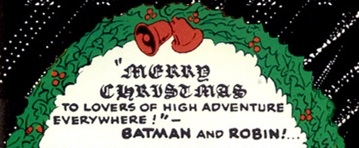
This weekly Robin shares a few highlights from the holiday story in Batman, #15, dated February-March 1943 but on sale the previous December. That was even before Alfred Beagle arrived at stately Wayne Manor.

The tale, scripted by Don Cameron and drawn by Bob Kane and Jerry Robinson, begins with Bruce Wayne and Dick Grayson out holiday shopping. (As usual in winter scenes of this era, Dick wears earmuffs.) They see a poor newsboy and give him presents, but the image of his poverty lingers in their minds that night.
Bruce and Dick decide to bring gifts to the three loneliest men in Gotham. But of course they can’t do that simply as a wealthy philanthropist and his ward. No, they’ve got to show off the bat-tech!

One of the men they’ve targeted is a doorman at an “ultra-exclusive” nightclub.
Batman brings the doorman inside and asks the revelers for a show of appreciation for the doorman. The 1% obligingly rattle their jewelry. But because this is Gotham City, any upper-class entertainment is due to be disrupted by crooks. Sure enough, thugs arrive, walk through the now-unguarded door, and hold everyone at gunpoint.

Fortunately, the Boy Wonder has a brainstorm about one of the presents the Dynamic Duo has brought for the doorman.
Also fortunately, these are the two dumbest crooks in the world. (Full story here.)

23 December 2011

Bartimaeus Flattened on the Page

Andrew Donkin shares credit for the script of the Amulet of Samarkand graphic novel with Jonathan Stroud, just as he shared credit for the Artemis Fowle adaptation with Eoin Colfer.

I thought the Artemis Fowle comic was very good, equal or perhaps even better than the novel. However, I thought the comics adaptation of the first Bartimaeus novel was merely a flattened version of the original.

The Samarkand art, by draftsman Lee Sullivan and colorist Nicolas Chapuis, is just fine. Their pictures of a magical London are terrific; I especially like the way their London Eye has the five-pointed pentagram inside it. I found it somewhat difficult to follow how old Nathaniel was in different scenes as the narrative flashed back and forth, but that really points to the larger problem in this adaptation.

Colfer’s Artemis Fowle was practically made for the comics form. The narrative voice is an omniscient, detail-oriented third person. The conflict is built on opposing teams with clear goals. The narrative is built up from plot twists in the physical world rather than realizations in the mental one. The characters cover a broad range of physical types, with corresponding personalities.

In contrast, Stroud’s Bartimaeus books are a triumph of narration. There’s Bartimaeus’s own voice, with its boasts and footnotes, which brief comics captions can barely replicate. That voice helps us follow the djinn through his shapeshifting and world-jumping while in the graphic format we have to see Bartimaeus from the outside.

The novel’s other, third-person narrative voice shows us Nathaniel growing up and working his schemes. It provides the sense of distance useful for an anti-hero while letting us into his head as he thinks and rethinks.

The narration also keeps the timing of different scenes distinct. In the comics version, there’s a short sepia-toned flashback to when Nathaniel was very little, but all the other scenes unfold before us looking like the present, differentiated only by captions saying NOW and BEFORE.

Indeed, I wonder if this form would have worked better if it started at Chapter 11, “The Day Everything Changed”; using Nathaniel’s confrontation with Simon Lovelace to fill us in on the boy’s background and world; and then proceeding chronologically. That approach would have kept Bartimaeus off the stage for longer. However, if we can’t hear his voice in all its glory, it’s unfortunately not such a loss.

22 December 2011

“The lessons they want to hand down”

The Horn Book just sent me editor Roger Sutton’s interview with Daniel Handler on the textual side of Why We Broke Up. I don’t think it’s yet on the web, so this might be a reminder to sign up for the Horn Book’s electronic newsletter.

In any event, at one point Handler (né for book-buying audiences Lemony Snicket) says:
I don’t quite understand what YA literature is. To me it’s the genre where the authors publicly talk the most about the lessons they want to hand down to the reader, even more so than in picture books, I’d say. It seems like everybody who's writing a book for a fifteen-year-old is trying to save a particular kind of fifteen-year-old from a particular kind of thing.
That’s just not true. There’s a whole ’nother kind of YA lit whose valuable lesson about life is reassuring a fifteen-year-old that others are going through a particular kind of thing just like them, so they don’t need saving.

(Unless, of course, the “particular kind of thing” is the adolescent belief that nobody is suffering just like them, that everyone else in high school is having more fun than they are.)

But does Why We Broke Up at the end offer a sense of hope?

21 December 2011

Are Today’s Picture Books Too Short?

Last month, the reviewer, author, and former editor Anita Silvey delivered some sharp talk about picture books in School Library Journal, starting with the teapotted tempest about a New York Times article reporting that booksellers saw some parents hurrying their children through picture books to early novels:

I must admit, I’ve grown quite weary over the last few years of the all-too-predictable response from adults who champion children’s and teen books: attack anyone who makes critical comments about them. . . . The basic premise of the New York Times article—that new picture books are increasingly ignored in today’s marketplace—seems completely sound to me. During the 1990s and into the 21st century, picture books brought in about 33 to 35 percent of the revenue of any major publishing house’s list. As Houghton Mifflin’s publisher in the late ’90s, I observed years when picture books made up more than 40 percent of sales. But today that number has slipped to a mere 10 to 11 percent for most publishers. . . .

So outside of obvious demographics (the big teen bubble and adults who now read YA books), why has this magnificent genre [of picture books] fallen on hard times? It’s certainly not because children don’t need or want picture books. In fact, kids today appear happiest when the combination of art and text extends into chapter books like Jeff Kinney’s “Diary of a Wimpy Kid” series and even novels like Brian Selznick’s The Invention of Hugo Cabret.
Silvey thinks the crucial data is that new picture books aren’t selling, but older ones are, and concludes that the older titles offer features the newer ones lack.

One of those features, however, might just be being older. If parents are buying fewer picture books overall, the books they’re most likely to pick up might be those they recognize from their own childhoods.

The article doesn’t offer data for Silvey’s next conclusion: that older picture books are appealing because they’re longer and fuller. It notes the short word counts of two older books, but not the longer word counts of several others, and it’s not clear whether any of those are on the bestseller lists cited earlier.

Nevertheless, I suspect Silvey is right in her diagnosis. As she notes, there’s tremendous pressure on picture-book writers, especially new ones, to write very short, spare manuscripts:
During the last few years, publishers began to maintain that adults wanted shorter texts to read to children—because of the demands on their time and young readers’ shorter attention spans. In the 1990s, publishers believed that kids didn’t want novels longer than 200 pages—until J. K. Rowling set everyone straight.
While demanding that picture books not be “slight,” editors might be hemming authors in so much on word count that it’s extraordinarily difficult not to be. Is there actually a market space for new “picture storybooks,” or is that still simply a label hopeful authors cling to when they don’t want to edit down their wordy picture-book manuscripts? Are there enough readers of picture-book age to generate sufficient demand for a longer form?

20 December 2011

One-Page Wizard of Oz

This is an unabridged publication of L. Frank Baum’s Wonderful Wizard of Oz in poster form, available from Spineless Classics in the UK.

The same outfit has versions of Peter Pan, Treasure Island, and other classics, all in appropriate silhouettes.

But for £40?!

(I understand that expressing the price with the singular form of the currency—“Forty pound?!”—conveys indignation in British speech. But I could be wrong.)