02 April 2010

Superman Battles the Challenge of Thought!

This panel is from Action Comics, #6, the sixth comic book to contain a Superman story. Lois Lane and Clark Kent are building that wonderful relationship which, a mere half-century later, convinced fans they were meant to be together forever.

In this panel, writer Jerry Siegel and artist Joe Shuster clue us in on Lois and Clark’s unexpressed thoughts. But to understand that, we have to know the code the creators used to set off characters’ thoughts from their spoken words in the same balloon: parentheses, dashes, and quotation marks.

I assume some American comic-strip creators tackled the challenge of showing thought before Siegel and Shuster, but I don’t know what they came up with. The early strips I could find are surreal tales like Winsor McCay’s Little Nemo in Slumberland and George Herriman’s Krazy Kat, and those characters rarely had unexpressed thoughts. (When Ignatz was puzzled in this strip, Herriman gave him a regular word balloon filled with a big question mark.)

That approach wouldn’t work in a more realistic scene. It’s notable that these examples show Clark Kent thinking secretly; Superman didn’t need to conceal his thoughts in these early stories.

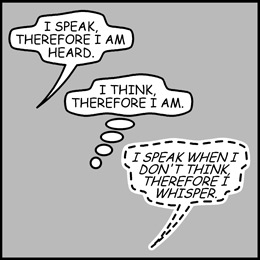
In Action, #11, Clark expressed his thinking inside what later became codified as a “whisper balloon.” Indeed, it’s possible that Clark is whispering to himself here, the way a character in a radio or stage play can speak thoughts aloud while all the other actors pretend to ignore him. But that solution is obviously limited. A hero wouldn’t want to give away his game plan, even quietly, when he was around the Ultra-Humanite or some other villain.

In the early 1940s most American comic books adopted a standard form for showing thoughts: the thought balloon. These word balloons had a trail of ovals to the thinking character rather than a sharply pointing tail, and borders that differed from those of speech balloons, usually by being more cloudy.

Even so, the first of these panels from Action, #64, in 1943 show Siegel and Shuster’s successors pulling out the old technique of parentheses, hyphens, and quotation marks to squeeze a thought into a crowded panel. And they still use dashes and quotation marks inside Superman’s thought balloon to make its meaning doubly clear.

01 April 2010

“Whoever lettered this thing…”

Back in January, I wrote about “The Twilight Lettering Disaster,” based on a magazine preview of the first volume of the Twilight comics adaptation.

Chris Sims of the Invincible Super-Blog offers more details and examples of what he calls “the worst lettering I have ever seen” at Comics Alliance:

To start with, the balloons themselves, which are clearly the product of the Ellipse tool in Photoshop, and which manage to be both gigantic and poorly placed. So gigantic and poorly placed, in fact, that they not only complicate simple art problems of speaking order…, they’re also occasionally reduced to transparencies to avoid obscuring the art any more than they already do. . . .

Whoever lettered this thing put a stupidly gigantic word balloon on top of a character’s face, despite the fact that there’s a huge open spot just slightly to the left of where it sits now. . . . the problem was solved with a transparency, which…makes it look like we're reading his dialogue through a glass of water.
Sims also notes that the book contains no credit for the letterer.

And thus “Adventures in Lettering” Week begins…

31 March 2010

Derivative Works—Revisited

Back in December, I wrote about our artistic culture’s valuing of originality:

our literary and artistic culture has, probably since the Romantic period in literature and for over a century in the visual arts, valued originality more than highly competent reworkings. If we look back on the art and literature of previous centuries, we see artists and writers unabashedly exploring the same topics and tales. The competition among artists over the same ground fueled both technique and creativity.
I used the example of the Trojan War as a subject that storytellers and artists reworked for centuries until the modern age, and asked:
So how are storytellers exploring the Trojan War legend today? Not in “literary fiction”; most novels about it are published as genre fiction.
Just in time for the publication of three books that Eric Mendelsohn reviews in this week’s New Yorker:
  • John Banville’s The Infinities, “a more or less contemporary tale over which the Greek gods Zeus and Hermes rather startlingly preside.”
  • David Malouf’s Ransom, “a riff on the twenty-fourth (and final) book of the Iliad” in the form of a serious novel that happens to be about Priam.
  • Zachary Mason’s The Lost Books of the Odyssey, which seems to be a more typically postmodernist arch manipulation of older texts.
So I guess there’s some literary life in that old war story after all.

30 March 2010

Adventures in Oz Fandom

Last month Alameda librarian Eva Volin wrote about

books I know I purchased, but I never see on the shelf; the books are checked out, they come back three weeks later, and go out again the same day.

For example, we’ve owned Eric Shanower’s Adventures in Oz for only two and a half years and it has already circulated 45 times.
That’s 45 check-outs in approximately 130 weeks, or once every 2.9 weeks. That book really is spending no time on the library shelf.

Fortunately, a delightfully inexpensive spin-off has appeared in comics stores: Little Adventures in Oz, volume 1. I’ve joked about how that title suggests all-chibi versions of Shanower’s 1980 Oz comics. In fact, this volume—the first of a possible pair—reprints two of those tales in a smaller trim size with all the draftsmanship, color, and storytelling that appear in the big omnibus. It also contains a few of the extras that appear in Adventures in Oz, and that, I realized, represents a collision of two forms of fandom.

One common aspect of Oz fandom is treating the books and all the other Oz stories one likes as a fairly accurate history of that fairyland. Such fans try to line up the stories in a single chronology, and reconcile the books’ contradictory statements. (I understand that Sherlockians do the same.)

In contrast, a common aspect of comics fandom is to celebrate the process of creating the stories, including preliminary material and creative dead ends. Many collected comics volumes offer such extras as artists’ sketches (especially early character designs), writers’ scripts, variant covers, other artists’ versions of the same characters, and so on. That would be the equivalent of publishing a novel with some pages from the author’s early drafts—we just don’t do that.

Little Adventures in Oz includes such sketchbook material—in particular, penciled pages of Shanower’s first crack at The Enchanted Apples of Oz. In this “draft,” young Trot, Cap’n Bill, and the Glass Cat do what in the finished version is done by Dorothy, the Scarecrow, and Billina the Yellow Hen. From the perspective of comics fandom, this is good stuff: we get to see behind the scenes, that art doesn’t go to waste, we learn a valuable lesson about copyrights in the 1980s.

From the perspective of Oz fandom, however, it’s potentially disturbing. For readers who believe that Enchanted Apples presents an actual adventure that Dorothy and her friends had in 1904, those extra pages pull back the curtain on an entirely different reality—a parallel universe in which Trot has almost the same adventure. Spooky!

29 March 2010

Conflicting Recollections of Prof. Tolkien

In his book The Wand and the Word: Conversations with Writers of Fantasy, literary scholar Leonard S. Marcus asked a number of established fantasy writers about their influences, particularly J. R. R. Tolkien.

Diana Wynne Jones (born in 1934) and Susan Cooper (born in 1935) attended Oxford University at about the same time, and they gave Marcus completely different memories of Tolkien.

Cooper said:

I never met him, but I went to his lectures on Anglo-Saxon literature, along with hundreds of other students. He was a wonderful lecturer. Like C. S. Lewis, whose lectures I also attended, he was a tweedy, pipe-smoking, middle-aged man. We were all waiting for the third volume of The Lord of the Rings to come out.
But Jones told Marcus:
I went to his public lectures. They were absolutely appalling. In those days a lecturer could be paid for his entire course even if he lost his audience, provided he turned up for the first lecture. I think that Tolkien made quite a cynical effort to get rid of us so he could go home and finish writing The Lord of the Rings.

He gave his lectures in a very, very small room and didn’t address us, his audience, at all. In fact he looked the other way, with his face almost squashed up against the blackboard. He spoke in a mutter. His mind was on finishing The Lord of the Rings, and he was really musing to himself about the nature of narrative.

But I found this so fascinating that I came back week after week, as did one other person. I’ve always wondered what became of him, because he was obviously equally fascinated. And because we stuck there, Tolkien couldn’t go away and write Lord of the Rings!

He would say the most marvelous things about the way you take a very basic plot and twitch it here and twitch it there—and it becomes a completely different plot.
Perhaps these writers are remembering different series of lectures, and Tolkien was more engaged in the topic of Anglo-Saxon than in his “public lectures.” Perhaps Cooper’s memory of Tolkien is mixed with her memory of Lewis, whom Jones recalls as a polished, popular speaker in a large, packed auditorium.

28 March 2010

Batman Shows Robin the Door

Today’s weekly Robin resumes exploring how the fact that “Robin isn’t evil” developed in the 1980s. At first, the Boy Wonder was as heroic as any other comic-book hero: “regular,” patriotic, a little square. But as superhero comics grew darker, Robin began to shine in a new way.

The process started in 1980, after DC Comics recruited a handful of highly successful writers from Marvel, including Marv Wolfman, Len Wein, Gerry Conway, and Roy Thomas. Each had been Marvel Editor-in-Chief for a while—in Thomas’s case for years, in others only a few months. DC publisher Jenette Kahn and newly rehired managing editor Dick Giordano invited those writers to come over to the competition and reshape the DC Universe.

Wein as editor and Wolfman as writer teamed up with artist George Pérez and launched the New Teen Titans. At first, Wolfman was also writing Batman, which allowed him to portray the decades-old character of Robin in two situations: as leader of the young superheroes, and as a frustrated sidekick to Batman. For the first time, the Boy Wonder began to separate from the Dark Knight.

Of course, DC had published stories of Robin on his own before: in Star Spangled Comics starting in the late 1940s, and in the back of Detective, Batman Family, and other magazines in the 1970s. But those adventures didn’t draw a clear distinction between Batman and Robin. The characters still stood for the same things, just in big and little sizes.

In contrast, Wolfman developed friction within the Dynamic Duo. Dick Grayson drops out of Hudson University and worries about how to break this news to his guardian. Yet when Dick comes back to Gotham, he discovers that Bruce Wayne has entered a partnership, perhaps even a romantic relationship, with Talia, daughter of his nemesis Ra’s al Ghul.

“That woman’s destroying you!” Robin tells Batman on the cover of Batman, #330. “Either she goes, or I do!”

“The door is that way, chum,” Batman replies.

Of course, the conversation inside the magazine isn’t so dire. The conflict continues over the next five issues. And, not to spoil this thirty-year-old story, eventually it turns out that Batman was onto Talia’s scheme all along.

Nevertheless, the scenes between Batman and Robin in these issues highlight the difficult aspects of Bruce Wayne’s personality. Too often he’s emotionally distant, overbearing, and secretive.

The Dynamic Duo argue about intimidating a young delinquent. Driven by vengeance, Bruce is out to scare people; that is, after all, why he dresses as a giant bat (rather than a stoplight). It also becomes clear that Batman is drawn to the dark side—he’s truly attracted to Talia, and in issue #332 the only other woman Robin can find who might tempt him away is another villain, the Catwoman.

At the end of Wolfman’s extended story, Bruce and Dick are reconciled, Batman and Robin still on the same team. But the two characters no longer symbolized the same values and ideas about heroism. They were now in a dialogue. COMING UP: And that gap widened over the 1980s.

27 March 2010

Feeling Grateful for Sid Fleischman

As a lad, I read a novel about a family of traveling magicians in the Old West. It wasn’t one of my favorite books, but it was entertaining, and parts of it stuck with me. Just not the name of the author.

Until I heard Sid Fleischman speak at an SCBWI New England conference, and he mentioned that his first novel for kids was about a family of traveling magicians in the Old West. The book’s title is Mr. Mysterious & Company.

Sid, who died this month at the age of ninety, went on to write many books that have gained bigger audiences or more awards, such as The Whipping Boy (Newbery Medal), Humbug Mountain (Boston Globe-Horn Book Award), and Escape!: The Story of the Great Houdini (Boston Globe-Horn Book Honor). He even has an award named after him, given by SCBWI for the best humorous book for kids.

At that same writing conference, I heard Sid say what he finds necessary to start a story. He’s stated this advice elsewhere, including his memoir The Abracadabra Kid. This formulation is from Tracy Barrett’s website:

The author Sid Fleischman says that one idea is like a stick: you can’t do much with it. But two ideas are like two sticks: you can rub them together, and if you’re lucky, you’ll get a fire.
For example, Mr. Mysterious & Company might have been the cross-pollination of Sid’s memories of working as a young magician, his experience as a young father, and the milieu of the classic American western. The Ghost in the Noonday Sun plays off our understandings of both pirates and ghosts. The mix makes resonant but familiar (i.e., potentially cliché) ideas fresh.

I’ve found that advice to be very helpful in developing story ideas. Rather than try to squeeze more out of a single idea, I try laying it alongside another and see if they mix well. Living in a magical world with no magical powers? Kids’ caper with Wodehousean plot twists? Washing out of espionage training? Satire of common classroom projects? Knight who wants to be an inventor? Tale of dual narrators, both with secret identities? The right combination, however arbitrarily generated, sparks off more ideas.

At one SCBWI conference, Sid sat down with a pile of his books to autograph for volunteers. He started to sign The Whipping Boy for me and then got pulled away, so the book came back with half a signature. That evening, Sid heard what had happened and promised me he’d finish signing the book if I’d send it to him. I never got around to doing so because I rather liked the distinction of having a half-autographed book. After all, Sid must have autographed a lot of books in his long career, but I bet he only half-autographed a few.

In a decade or so I may even improve my story and hint that this was the last book that Sid ever started signing. “A writer to the end,” I can murmur, and let people draw their own conclusions about my copy. Somehow I think Sid would get a kick out of that.

26 March 2010

Shelving and Marketing in the Dark

Alaya Dawn Johnson recently wrote on Justine Larbalestier’s blog about the experience of finding her debut fantasy novel Racing the Dark shelved—or actually reshelved in its paperback edition—outside of Borders’s Fantasy section:

Cut to this past Christmas, when my Dad, my sister, my brother and I were all last-minute shopping at the local mall. Like we do every Christmas, we all tromped through the local Borders, looking for presents. This time I was especially excited, because the store claimed to have a copy of my book.

My dad and I searched all through the fantasy section, just so I could experience hasn’t-gotten-old-yet zing of seeing my own work in a bookstore. But Racing the Dark wasn’t there. Finally, we went back to the computers to look for it again.

And we saw what we had missed the first time: though Racing the Dark is clearly labeled “fantasy” on its spine, the powers that be at Borders, in their infinite wisdom, had decided to shelve me in the “African American” section.
Borders indeed recategorized Racing the Dark: the chain’s website lists the hardcover edition under “Popular Fiction - Science Fiction & Fantasy - Science Fiction/Fantasy,” and the paperback edition under “Literature/Fiction - African American - African American Fiction.”

Johnson perceives this as Borders’s choice, but it looks to me like the decision started with her publisher, Agate Publishing. It issued Racing the Dark through Bolden Books, “Agate’s imprint dedicated to publishing both fiction and nonfiction dealing with the African-American experience.” Though it’s unclear whether the “islander” heroine of the book has any connection to “the African-American experience” except as a reflection of one African-American author’s imagination.

Of course, the hardcover was a Bolden book as well. But Agate is now emphasizing Johnson’s ethnic identity more than before. Racing the Dark has the tagline “A brilliant debut fantasy novel with a powerful female sensibility by a youthful writer to watch.” The second title in the trilogy, The Burning City, is “by a brilliant young African-American fantasy novelist with a powerful female sensibility.”

Compared to the figure on the Racing the Dark hardcover (shown here), the model on the paperback is easier to identify as a person of color—though not necessarily one with recent African roots. She’s also wearing less clothing, which might grab customers’ eyes faster.

Unlike Borders, Barnes & Noble doesn’t display categories in its online listings. Then again, Barnes & Noble stores don’t appear to be carrying Racing the Dark as part of their regular inventory. The chain’s buyers apparently passed on the book, deciding it wouldn’t sell enough. If B&N had tried that hardcover, then it based its decision on that edition’s sales.

In contrast, someone at Borders still sees enough potential in Racing the Dark to stock it. But who? The Fantasy and African-American shelves are managed by two different buyers at the chain’s headquarters. (At least “Genre Fiction” and “African-American Fiction/Studies” had different buyers as of a couple of years ago.)

Did the two buyers and Agate’s sales rep discuss the book and decide where it had the best chance of selling? Did the new cover come before or after that discussion? Did the Fantasy buyer pass on Racing the Dark, but the African-American section buyer thought it still deserved a slot in Borders stores? In that case, Agate’s choice would have been not “African-American” or “Fantasy,” but “African-American” or not being stocked at all.

Johnson describes how her family moved the paperback from the “African-American” shelves to “Fantasy” (and gave it a face-out display—as authors and their families often do). However, if that copy sells as a result, the credit will still go to the “African-American” section.

Whatever happened, I’m sure that the people involved—Borders buyers, sales reps, Agate marketers—have every incentive to make Racing the Dark sell as profitably as possible. That’s how corporations are set up. But none has complete freedom of action. Among the limitations, the big chains aren’t set up to try shelving the same edition in multiple sections and see where it sells more. And a small press with a relatively new author doesn’t have the clout to drive them change.

I see an interesting contrast with Racing the Dark in Johnson’s new supernatural thriller, Moonshine, from the much bigger publisher Thomas Dunne, which is part of St. Martin’s, which is part of Macmillan. That book’s bio for “Alaya Johnson” says nothing about the author’s ethnicity, and the cover shows a woman of no color at all. (Of course, she may be a vampire.)

Reflecting my own interests, I also note that Alaya Dawn Johnson scripted The Goblin King in Graphic Universe’s “Twisted Journeys” series, which combines the comics form, prose, and choose-your-own-path storytelling. So I think she is an author to watch.

24 March 2010

Back from Centre County

As far as ice cream in State College, Pennsylvania, I found that the Meyer Dairy Store north of the town center outshone the Berkey Creamery on the Penn State campus.

Plus, the friendly folks at Meyer’s offered directions to this life-size folk-art sculpture of the Tin Woodman, less than three miles further on after a series of county highway forks. The tin man stands, holding oil can and pitchfork, beside a little Tik-Tok and what looks like a metallic representation of Toto.

Photographer Carmen Frost has made greeting cards featuring this assemblage to benefit the Centre County Farmland Trust, and of course I bought a couple. The roadside snapshot above comes from Anne Oeldorfhirsch via Flickr.

22 March 2010

A Tall Order

Back in 2006, I wrote how Carl Hiaasen’s Hoot and Flush relied on flat portrayals of environmental conflicts featuring stereotypical bad guys. (The good guys are fresher and more rounded.)

Specifically, I wrote:

Come on, Carl—how about the story of one of those stupid bullies instead of one with stupid bullies pestering the admirable young protagonist? How about a protagonist who realizes that preserving part of the natural world means sacrificing something he (or she) wants, instead of something the cigar-smoking adult villain wants?
Both those books provide a black-and-white choice with little hint of the sacrifice of short-term convenience for long-term benefits that environmental preservation often requires.

I thought Operation Redwood, by S. Terrell French, might be the sort of book I was looking for. A précis told me that the young hero, Julian, discovers that his uncle is the focus of protests aimed at preserving a stand of redwood trees. Are family loyalty and lifestyle at odds with environmental preservation?

But it turns out that Julian’s Uncle Sibley is a thoroughly dislikable person, an obvious antagonist from chapter 1. In fact, the book establishes him as nasty even before redwoods come into the story. It ends up portraying environmental preservation as a handy way of getting back at your relative for saying bad things about you.

Still looking for a middle-grade caper that dares to acknowledge the trade-offs of environmental preservation, and make them part of a young protagonist’s character growth.