10 June 2012

Stephanie Brown: The Final Fight

The last weekly Robin closed with a hint that it was actually good that the Robin storyline titled The Final Fight, scripted by Chuck Dixon, was never produced.

That’s not because Fabian Nicieza’s Search for a Hero was stellar. (I thought Nicieza was kept from exercising his fine understanding of the character of Tim Drake because of difficult scheduling.) And it’s certainly not because that canceled volume would have impeded Tony Daniel’s Battle for the Cowl.

Rather, the key to that sentiment rests in how DC Comics’s description of that volume concluded: “Robin also has his hands full with a not-so-happy family reunion between his lady love [Spoiler] and her father, Cluemaster!”

Dixon created Stephanie Brown, the Spoiler, as an antagonist for the Cluemaster, a second-rate Riddler introduced in 1966. When fans wanted to see more of her, Dixon wrote stories of Stephanie as Tim’s other woman, then his main girlfriend. But since Tim was the protagonist of those stories, Stephanie mainly posed problems for him: a crush on her when he was seeing someone else, her pregnancy, her father moving back in, her replacing him as Robin, her temporary death, and so on. Stephanie was, as TV Tropes said, a walking Afterschool Special of teen woes.

The Final Fight description promises further adventures in that mode. It describes Robin with “his hands full” once again because of Spoiler and Cluemaster. And as the protagonist in his own magazine, Tim Drake would have once again helped to fix Stephanie’s troubles for her.

But being the child of a minor supervillain was Stephanie’s problem, not Tim’s. So the cancellation of this Robin storyline meant that problem was available to Bryan Q. Miller to address in his Batgirl series, collected in three volumes: Batgirl Rising, The Flood, and The Lesson.

And those volumes are really good. Miller wrote funny dialogue. He created a solid supporting character in a young homicide detective who becomes Stephanie’s special contact on the police force (every hero seems to need her own) and possible love interest (ditto). He had the advantage of a clear narrative arc as Stephanie took over the role of Batgirl with the help of predecessor Barbara Gordon.

As Miller was telling his stories, Christopher Yost and Nicieza were showing Tim Drake fighting crime overseas and in cyberspace. That left Stephanie with the challenges that Dixon used to give Tim in Robin: trying to keep up the life of a normal Gotham City student while also fighting powerful criminals. So Stephanie has to deal with midterms, campus crime, a teenage witch-boy, and a suspicious mom.

It’s clear that Miller had to shape his storytelling around some editorial mandates. Barbara Gordon gets yanked out of the action when DC needed her to appear in another series. Another supporting character, Wendy from Teen Titans, is just settling in when she suddenly disappears. One issue in the last volume was written to set up an issue of Batman Incorporated that wasn’t even published until months later. But the series’ overall narrative arc stands up to all that.

Like Nicieza in his second opportunity with Tim Drake, Miller had to finish his run much faster than he planned to make room for DC’s reboot. I thought Nicieza’s climactic storyline suffered from being crammed into one issue, but Miller was able to overcome that problem. In a terrific last issue, he simultaneously showed Stephanie confronting her oldest problem—her dad, of course—and looking ahead to possible glorious futures. And she achieves those triumphs for herself.

It would still have been possible for Tim and Stephanie to confront the Cluemaster in Dixon’s Final Fight and for her later to confront him again in her own magazine. Parental issues never go away, after all. But for Stephanie Brown to come of age, she had to be more than support for another title character. Tim makes some appearances in Batgirl, but the much more significant crossovers of this period are when Stephanie appears in Red Robin, showing him how she can stand on her own.

In DC’s rebooted universe, Stephanie Brown’s role—and even existence—is uncertain. She was never a Robin, even briefly. It’s unclear whether she was ever Batgirl. Her larger story for all practical purposes appears to be over.

COMING UP: But that may not be a bad thing.

09 June 2012

“The general confusion of office-work”

In late 1951 or early 1952, EC Comics writer-editor Al Feldstein combined two science-fiction stories he’d read into a single tale, adapted it into the comics form, and assigned it to artist Wally Wood. Apparently Feldstein was working on the belief that stealing from two stories at once wasn’t plagiarism but research.

He also apparently didn’t anticipate that anyone would notice. But on 19 Apr 1952 the author of those stories sent this letter to the company:
Just a note to remind you of an oversight. You have not as of yet sent on the check for $50.00 to cover the use of secondary rights on my two stories THE ROCKET MAN and KALEIDOSCOPE which appeared in your WEIRD-FANTASY May-June '52, #13, with the cover-all title of HOME TO STAY. I feel this was probably overlooked in the general confusion of office-work, and look forward to your payment in the near future. My very best wishes to you.

Yours cordially,
Ray Bradbury
In a postscript, Bradbury recommended that the editor check out his books for more stories, and even offered to send copies. No doubt pleased not to be facing a lawsuit for copyright infringement (Weird Fantasy, #12, had also contained a story inspired by one of Bradbury’s), EC paid the suggested fee and did indeed license several further stories in advance, thus time trumpeting Bradbury’s name on its covers.

That letter is reproduced in Grant Geissman’s Foul Play!: The Art and Artists of the Notorious 1950s E.C. Comics. Check out Histories of Things to Come for a peek at those stories.

08 June 2012

Romney’s Selective Keynesianism

In May, Time published Mark Helperin’s interview with Mitt Romney, which included this exchange:

Time: Why not in the first year, if you’re elected — why not in 2013, go all the way and propose the kind of budget with spending restraints, that you’d like to see after four years in office? Why not do it more quickly?

Romney: Well because, if you take a trillion dollars for instance, out of the first year of the federal budget, that would shrink GDP over 5%. That is by definition throwing us into recession or depression. So I’m not going to do that, of course.
That’s standard economic thinking: cutting government spending during economic bad times not only hurts the most vulnerable but can causes a vulnerable national economy to stall. John Maynard Keynes realized that years ago, advising governments to spend more to grow out of recession, even if that requires more borrowing in the short term. Romney evidently accepts that reality.

Except when the President is Barack Obama. At the same time Romney was excusing himself from making deep cuts in his first term, he was criticizing President Obama for not doing so:
What’s happened here isn’t complicated. Washington has been spending too much money and our new President made things much worse. His policies have taken us backwards. . . . The consequence is that we are enduring the most tepid recovery in modern history.
This was the same speech in which Romney lied in saying Obama “added almost as much debt as all the prior presidents combined,” as detailed back here.

In fact, as Rex Nutting wrote in the Wall Street Journal’s Marketwatch blog, President Obama’s budgets have increased spending less than his predecessors’. Which to any Keynesian explains why the economic recovery has been “tepid.”

Even Romney recognizes that drastic spending cuts would hurt a fragile economy, “by definition throwing us into recession or depression”—as long as he’s in charge. But according to him and people suffering from OIP Derangement Syndrome, the laws of economics work differently under President Obama.

COMING UP: Romney keeps trying to move the economic goal posts.

07 June 2012

“You are approaching the periphery shield of Vortex Four”

So I was thinking, “Where on Earth could we find the right sets for an affordable remake of Zardoz?” And then I realized that the former Yugoslavia is available.


These are all monuments to World War 2 erected under the Tito regime, photographed by Jan Kempenaers of Belgium and published in his book Spomenik. (Hat tip to the Crack Two blog.)

06 June 2012

Boston Drivers

The Boston Public Library is the repository of the work of Boston Herald-Traveler cameraman Leslie Jones (1886-1967). It’s created a webpage for this collection, which contains 34,000 negatives, and shared a significant selection on Flickr.

One category getting a lot of attention lately is Jones’s photographs of early auto accidents. The outcome of a slide on an icy road above, for example, comes from the Norumbega section of my home town.
This one is labeled “Fire truck goes into Charles River near Cottage Farm Bridge.” Which leaves some unanswered questions, like “Why"?”

It’s startling how flimsy these old cars seem—and this was decades before seat belts became common, much less mandatory.


05 June 2012

Oz Museum and Opera in the Works

This Boston Globe interview with illustrator Bob Staake alerted me to work on an opera based on L. Frank Baum’s The Road to Oz. Googling brought me to the website for the National Oz Museum, a project of Oz collector supreme Willard Carroll.

About the opera, the website says:

Together with the prestigious performing-arts organization Bay Chamber Concerts, the Museum is developing a live multi-media musical based on Baum’s book “The Road to Oz.” The production is being written and will be directed by Willard Carroll, with sets and costumes designed by acclaimed author and illustrator Bob Staake. The concept is to create a one-hour, one-act musical work based on L. Frank Baum’s fifth Oz book.

The approach to the music is not envisioned in a conventional operatic or musical-theater/show-tune way, but to find a unique slant from which to tell the story through character and music. Baum’s characters in this book – Shaggy Man, Polychrome, Button Bright the Rainbow’s Daughter [whoops—Button-Bright seems to have gone missing from his proper place in that sentence], etc. – each offer up imaginative starting points for songs to tie together the story; a story about loss, love, reconnection, hope - and joy deferred and joy attained.
Those are indeed some of the themes of The Road to Oz. The book’s main weakness is its story, both thin and cut short. Yet it’s also immensely pleasing, and that simplicity might benefit adaptations into elevated media. A few years back, for instance, I saw Eric Shanower’s adaptation of the basic tale as an amateur ballet, cut down to focus on the Shaggy Man’s transformation, and it worked.

As for the museum, Carroll’s collection seems still to be mostly in boxes after his move across the country, but this spring students at the Rhode Island School of Design worked on designs for the institution.

04 June 2012

The Game of Life, the Universe, and Everything

This weekend the Boston Globe reviewed Jill Lepore’s The Mansion of Happiness, an examination of American life and values through board games—particularly the game Life itself.

Reviewer Buzzy Jackson wrote:
Lepore, a staff writer at The New Yorker and a professor of American history at Harvard who has written about the intellectual and political history of Colonial and 19th-century America, isn’t really interested in board games. Instead, she wants to know what [Milton] Bradley’s game can tell us about American values and aspirations. As in the game of Life, each chapter takes the reader a little further along the path of human development. . . .

The marriage chapter examines the life and work of Paul Popenoe, famous for posing the eternal question, “Can this marriage be saved?” The oddly contentious story behind E.B. White’s story, “Stuart Little,” makes up the chapter on childhood, and Lepore dismantles the myth of Taylorized efficiency in “Happiness Minutes,” the chapter on working.
Now did Lepore actually start her investigations and ruminations with board games, or did she realize that Bradley’s Life provided a structure to unite essays on several disparate concerns?

Lepore will speak about this book and the history of American board games, with pictures, at the American Antiquarian Society in Worcester on 5 June at 7:30. This illustrated lecture is free and open to the public.

03 June 2012

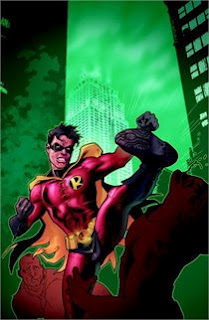
The Lost Robin Storyline of 2008-09

Collected Editions alerted me to this curiosity from 2008: the announcement of a collection of Robin issues to be scripted by Chuck Dixon and drawn (at least initially) by Chris Batista, the team behind most of the Violent Tendencies volume. In June 2008, Dixon and DC Comics parted ways, and that book was canceled before its scheduled publication in early 2009.

DC Comics’s description of the forecast Robin: The Final Fight, still visible at Powell’s and elsewhere, said:
All of Robin’s training and crime-fighting by Batman’s side comes to a head in this spectacular volume as Batman goes missing and the Boy Wonder becomes the new Dark Knight.

Tying into the events of “Batman R.I.P.” continues here as Robin and the Bat family search for their leader while engaging in all-out battle with Gotham City's underworld. And with his once-dead girlfriend Spoiler now back among the living, Robin also has his hands full with a not-so-happy family reunion between his lady love and her father, Cluemaster!
This copy makes clear that Dixon didn’t break with DC because he disagreed with that “Batman RIP” storyline, as some observers posited at the time. As I wrote back here, Dixon’s a pro who knows how the business works. Rather, the difficulty was that it wasn’t working that way. His comments at the time showed that he disliked how the company changed its plans.

Clearly the storyline described above had DC’s approval—otherwise, the company wouldn’t have announced this volume. It was a direct continuation of the events Dixon had scripted in Violent Tendencies, which in turn grew from some of his earliest work with the Tim Drake character.

Then the top editors suddenly decided to go in a different direction, one which ultimately led to Tony Daniel’s Battle for the Cowl. We know that was a late decision, after Judd Winick had scripted some of the same transition for Dick Grayson. We know that the timing of that shift caused plotting trouble for Fabian Nicieza when he suddenly took over Robin after Dixon and for Peter J. Tomasi when he scripted Nightwing.

Dixon has a reputation in the industry for working well ahead of deadline, and interview with the Examiner in March 2009, shortly before this volume was to appear:
I [had] written about eight more scripts. There was a storyline with Steph’s dad and the return of some Robin villains in a new way and the introduction of several new bad guys. Much of this is hazy in my mind already. Lots of changes were made as I was writing and the direction of the book was being altered even as I was in the middle of a story arc.
Some covers were already prepared and released when Nicieza took over from Dixon. Others were altered. The Final Fight cover shows Robin kicking someone in the face; was that character deliberately obscured to hide his identity?

Despite the breathless marketing copy quoted above, I doubt Tim Drake was to become “the new Dark Knight” permanently. I noted back here that Grant Morrison had pitched the idea of Dick Grayson taking over as Batman back in 2005 when he first talked with Tomasi, then an editor, about the assignment. I suspect Dixon wrote Tim trying to be Batman in a pinch, as in Battle for the Cowl, and deciding (once again) that’s not what he wants to do.

COMING UP: Why it was good this Robin storyline was canceled.

02 June 2012

Old Impulse Visits New Young Justice

“Look, pal! A superhero team needs only one comic-relief guy, and this season it’s me!

01 June 2012

Man Claiming to Be Arizona Official Struggles through OIP Derangement Syndrome

Last month Ken Bennett, who publicly states that he is the Arizona secretary of state, struggled through a bout of OIP Derangement Syndrome. It started when he told a right-wing radio host:
I’m not a birther. I believe the president was born in Hawaii—or at least I hope he was. But my responsibility as secretary of state is to make sure the ballots in Arizona are correct and that those people whose names are on the ballot have met the qualifications for the office they are seeking.
Bennett said that over a thousand people had sent him messages demanding he investigate Obama’s birth, and that he was expressing doubt about that well documented historical event only to satisfy their curiosity. Not, of course, because he was a co-chair of the Mitt Romney campaign in Arizona.

To that end, Bennett asked the government of Hawaii to send him “a verification in lieu of a certified copy of a birth certificate.” And to its credit, the Hawaiian government demanded that he prove that he’s really the Arizona secretary of state and responsible for presidential ballots.

When asked if he might exclude the elected President of the United States from the Arizona ballot if he wasn’t satisfied with another state’s standard legal document, Bennett said he might do that, “Or the other option would be I would ask all of candidates, including the president, maybe to submit a certified copy of their birth certificate. But I don’t want to do that.”

However, even days after Bennett went public with this policy, his office still hadn’t asked Michigan for its record of Mitt Romney’s birth, or any other state about other candidates. When Bennett first publicized that he was investigating the President, he stated flat out that he didn’t want to ask the same questions of all the candidates.

Since Bennett claimed to be taking this action only because of public questions, the Left Action group mounted an online petition to demand that he investigate the proposition “Mitt Romney is a Unicorn." As of 22 May, that petition had more than ten times the number of signers as had demanded that Bennett investigate and disqualify President Obama.

And on that date Bennett apologized to his state and said of the President, “He’ll be on the ballot as long as he fills out the same paperwork and does the same things that everybody else has.” Has Bennett come out the other side of OIP Derangement Syndrome? Has he stopped insisting that this President go to ridiculous lengths without making the same demands of other politicians? We’ll see.

Meanwhile, Bennett is collecting signatures to run for governor of Arizona. The state represented in the Senate by John McCain. Who, according to a 2008 analysis of pertinent law by Prof. Gabriel J. Chin, was not technically eligible for the Presidency. But of course officials like Bennett don’t try to apply such technicalities to a candidate like McCain.