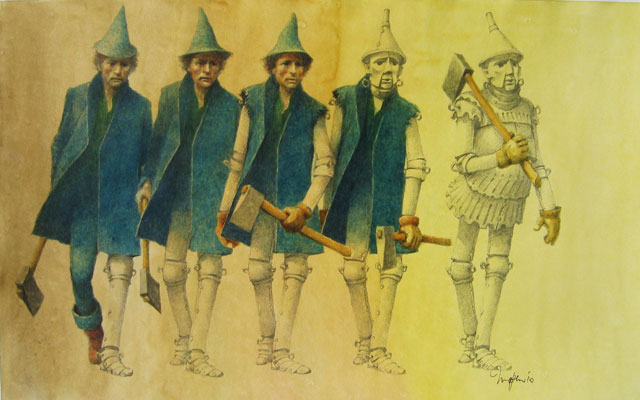
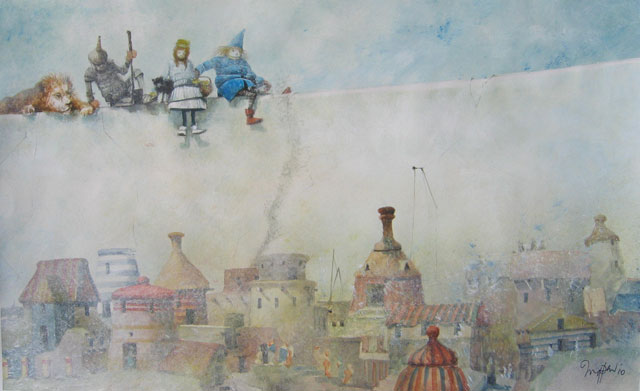
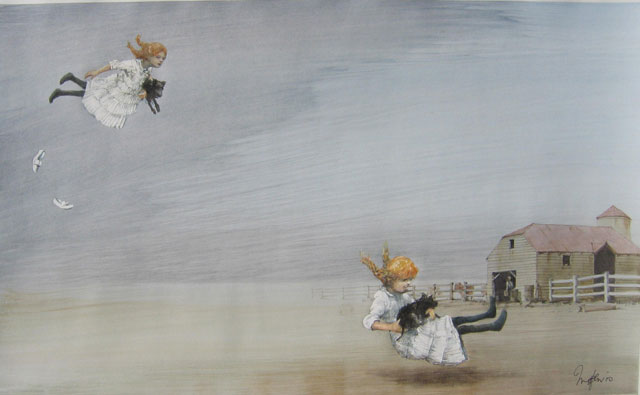
A View of Oz from Oz
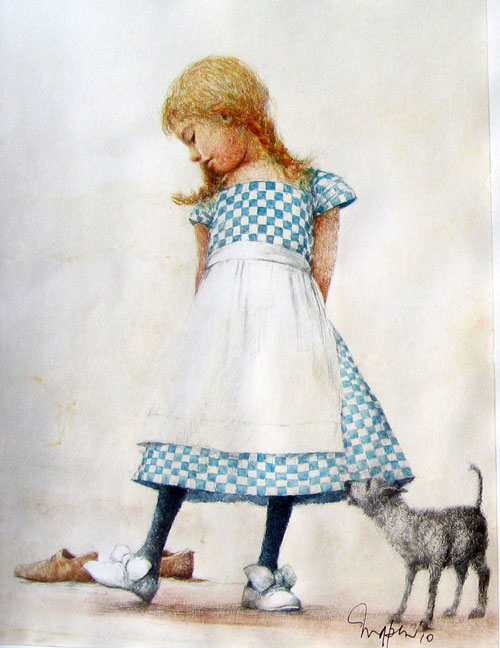
Melaleuca Galleries of Australia offers a page of Ingpen’s artwork for this book, including:
The image above comes via Melaleuca.


When President Obama addressed the nation after the killing of Osama bin Laden in May, some conservative reactions to his rhetoric were all too predictable. On National Review Online, Victor Davis Hanson highlighted the 15 times that Obama used “I,” “me” or “my” in the 1,400-word speech, and asserted that “these first-person pronouns . . . reflect a now well-known Obama trait of personalizing the presidency.” A few weeks later, when Obama gave a speech at the C.I.A.’s headquarters in Langley, Va., the Drudge Report offered the headline, “I ME MINE: Obama praises C.I.A. for bin Laden raid — while saying ‘I’ 35 times.”Especially if one’s standards for what seems arrogant in a black man’s speech are different from what seems arrogant in a white man’s speech.
This “well-known Obama trait” has come up again and again in criticisms from the right — George Will has said that Obama is “inordinately fond of the first-person singular pronoun,” while Charles Krauthammer has written of the president’s “spectacularly promiscuous use of the word ‘I.’ ”
Regrettably, none of these pundits have bothered to look into how Obama might compare with his predecessors. . . . Pennebaker crunches the numbers on presidential press conferences since Truman and finds that “Obama has distinguished himself as the lowest I-word user of any of the modern presidents.” If anything, Obama has shown a disdain for the first-person singular during his administration.
“Why,” Pennebaker wonders, “do very smart people think just the opposite?” He chalks it up the selective way we process information: “If we think that someone is arrogant, our brains will be searching for evidence to confirm our beliefs.” If we’re predisposed to look for clues that Obama is all about “me me me,” then every “me” he utters takes on outsize importance in our impressionistic view of his speechifying.

I love the Bed of Ware. The museum, through no action on its own, cleaned up the act of the bed — because it’s in the museum, it must be a noble bed. It’s this giant carved, circa 1590 to 1600 Elizabethan bed.Among the literary allusions to this monument are:
But the truth of the bed is that it was commissioned by an inn in the town of Ware, in Hertfordshire, as an Elizabethan publicity stunt to advertise, I’m sure, something along the lines of “Have the best sex of your life in the biggest bed in England.” They spoke about it at the time. Writers wrote about it and said it could sleep 20 couples. Shakespeare included it in a very bawdy way in “Twelfth Night.” I thought, why don’t I put the sex back into the Bed of Ware, because that’s something I can do.
How do you do that?
You put 14 pairs of what look like Elizabethan prostitute shoes around the bed, to suggest that 14 occupants, plus a 15th — whoever rented the bed for the night — is sleeping in it.
At the end of today’s New York Times article about newly released recordings of air traffic control transmissions on 11 Sept 2001 (which are innocuous and add little to the historic record) are these paragraphs:
The account published this week is missing two essential pieces that remain restricted or classified, according to Mr. [Miles] Kara. One is about 30 minutes of the cockpit recording of United Airlines Flight 93, which crashed into the ground after passengers tried to storm the cockpit as hijackers flew across Pennsylvania toward Washington, D.C. Families of some of those onboard have objected to the release of that recording, Mr. Kara said.The issue of how “to continue government operations” is very sensitive, of course, both militarily and politically (as Alexander Haig discovered). But that may be secondary to the issue of who was really in charge that day.
The other still-secret recording is of a high-level conference call that began at 9:28 and grew, over the course of the morning, to include senior figures like Mr. [Dick] Cheney, Defense Secretary Donald H. Rumsfeld and the vice chairman of the Joint Chiefs of Staff, Gen. Richard B. Myers.
The recording was turned over to the National Security Council. The 9/11 Commission was not permitted to keep a copy of it or of the transcript, Mr. Kara said, and investigators were closely monitored when they listened to it. Mr. Kara said he believed that the only truly sensitive material on the recordings were small portions that concerned the provisions being made to continue government operations if the attacks took out some national leadership or facilities.
“There was a staffer who was designated to sit with us, who would stop and start the tape, in my estimation to mask continuity of operations,” Mr. Kara said.
Nevertheless, he noted, the commission ended up with hours and hours of recordings that it initially did not have access to or had been told did not exist, a point Mr. Farmer echoed in the preface to the Rutgers Law Review article.
When the commission began taking testimony, military and civil aviation officials said “that no tapes were made, and we were told at one point that a technical malfunction would prevent us from hearing them,” Mr. Farmer wrote. “If we had not pushed as hard as we did — ultimately persuading the commission to use its subpoena power to obtain the records — many of the critical conversations from that morning may have been lost to history.”


Anna May Wong...discovered during her heyday in the 1930’s that part of being American means coming to terms with your “inner Dorothy.” So we could say, and should say, that Dorothy was also Chinese American.The quotation marks might tempt one to think that Blythe is quoting Wong. But his essay offers no evidence that Wong ever read Baum’s book, much less saw herself in Dorothy.

When Baum writes: “The Wicked Witch was angry to find them in her country,” the illustration shows her dressed in Manchu pigtails, her imperial regalia and her Golden Cap—the Empress Dowager in all her glory.Yet that quoted passage says nothing about the supposedly obvious resemblance between the Wicked Witch and the Dowager Empress, even as it proposed links between other characters and European figures.
Many people spotted this when the book came out. The Boston Beacon wrote, in September 1900, that “the Scarecrow wears a Russian blouse, the fierce Tin Woodman bears a striking resemblance to Emperor Wilhelm of Germany, the Cowardly Lion with its scarlet beard and tail tip at once suggest Great Britain, and the Flying Monkeys wear a military cap in Spanish colors.”


This is something that has been bugging me for some time. The latest news to come down is that First Second Books, the publisher of my last three books, are now under the umbrella of Macmillan's Children's Group. I'm not surprised, because the book world, by which I mean the mainstream book publishers as well as the libraries and the Library Association, has been viewing "the graphic novel" as a young reader's genre for quite some time.Campbell then added a quote from “a relevant blog post” by, um, me.
In part I think it's because the part of a publishing house that is likely to be interested in bright illustrated narratives is the children's books department, and in part also because those publishers, and America's libraries, see the "graphic novel" as a way of grabbing a part of the literate populace that has hitherto proved elusive.
Now, I have no objection to young folks having their own literature specially designed for them, though when I was a young 'un myself I would have been highly suspicious of anything that the adult world thought I should read because it was supposed to be good for me. Let's not forget that this is one of the things that drew us to comics in the first place, the very fact that they were not approved by our adults; they were our visual rock'n'roll, the things we knew that they didn't. However, let's not get bogged down on that point.
The problem with this development is that comics were supposed to have grown up and become the "graphic novel," but now we are apt to find articles telling us that the "graphic novel has grown up." In other words we're back where we started.
I read about this forensic case in Chemistry and Engineering News, but found the abstract for the case study among the papers at the European Geosciences Union General Assembly 2011: “Stable Isotope Profiles from a Lock of Hair Provide Information of Illegal People Trafficking Route used by a Vietnamese Organised Crime Group” (PDF).
The study was conducted by Wolfram Meier-Augenstein and Helen F. Kemp of the Stable Isotope Unit of the Scottish Crop Research Institute in Dundee, and by Ian Brewster and Geoff Ronayne of the Gwent Police, “Croesyceiliog, Cwmbran.” (I’m assuming that’s Welsh, but I’m not familiar with the language of those ancestors.)
A young man with Asian features was left in the A&E department of a hospital in Gwent, South Wales (UK) by persons unknown and died shortly thereafter. A hit in the Interpol fingerprint database provided some information regarding the victim’s nationality but there was no record of this individual ever having entered the UK, at least not legally.Isotopes are atoms or ions of the same element with different atomic weights (i.e., numbers of neutrons). Different parts of the world have different concentrations of oxygen isotopes, which people and animals in those places take into their bodies.
On behalf of Gwent Police, stable isotope analysis was carried out on a lock of scalp hair to generate chronological profiles for diet or nutritional changes as well as a recent geographic life trajectory.
Moving from the oldest part of the hair (the tip) to the most recently formed part (near the scalp) the longitudinal 2H isotope profiles suggested the following. At 15 months prior to death, the victim spent approx. 2.5-3 months spent in Eastern Europe (most likely the Ukraine) followed by a direct move to Central Europe (e.g. Germany).According to the C&E News story, a rival gang stole a big crop from this man, and his enslavers killed him as punishment. Those details would, of course, not be available through isotope analysis, so it’s quite possible the whole story could have come out through traditional police inquiries. But the match between those investigative findings and the isotopic readings confirms the value of both methods.
Subsequent to this move from the Ukraine to Germany, the victim lived in Germany for about 6-7 months from where he moved to the UK eventually to arrive at his final location of residency on or near the UK’s West Coast (South Wales). In contrast to the move from Eastern Europe to Central Europe, this move was not a direct transition from one location to another. This move either happened in stages over a period of 1.5 to 2 months interrupted by brief stays (< 0.5 month) at different locations, or the period between leaving Central Europe and arriving at the final location was characterized by frequent travel and change of location not necessarily related to or influenced by the final area of residency.
The information provided by stable isotope analysis in conjunction with enquiries carried out under Operation C#$#$## showed that the victim (a Vietnamese man) was indeed smuggled into the UK illegally and the trafficking route did run through the Ukraine via Germany into the UK. Once in the UK the victim was moved between Dover, London and Birmingham before eventually being settled down in South Wales, where he lived and was forced to work as Cannabis farmer for an organised Vietnamese crime group during the final 2.5 months of his life.