10 February 2011

Comics and Children’s Publishing—When Worlds Collide

As traditional children’s publishers issue material in comics form, their editors are being challenged to develop new skills and working methods. A couple of web interviews this month gave hints at managing the creative process.

First, at the Brown Bookshelf, Randy DuBurke describes his work on Yummy: The Last Days of a Southside Shorty, scripted by G. Neri. With experience drawing mainstream comics that goes back to DC in the late 1980s (I think I have some of the issues of Action Comics that he contributed to), DuBurke was the veteran on this project:

Jennifer Fox at Lee and Low Books…contacted me partly because this was their first foray into graphic novels and since I had experience in doing comics they thought it would be a good idea if I worked on the project. . . .

Before I started, I told my editor I would need to make changes along the way, which is not unusual when doing stories for comics. Comic book stories are collaborations between the artist and writer. I did change some scenes to strengthen the visual impact. Once the page art was completed, Greg and our editor would do a rewrite to accommodate the changes if necessary.
Meanwhile, over at Cynsations, artist Neil Numberman writes about creating the art for the Joey Fly, Private Eye comics, scripted by Aaron Reynolds. One of his responsibilities is “to thumbnail the entire book”:
There’s a good reason they call these sketches "thumbnails," but even though they’re super tiny, they do give me a number of things I need to know before starting the real sketches. They help me pace out the entire book, to make sure scenes and act breaks end at the end of a page or spread. I also need to roughly figure out where everyone in the scene will be and their word balloons, in each panel. . . .

Our editor, Reka Simonsen, always requests to see these little thumbnails. I love that she wants to be so involved in the process, and she claims she loves looking at my thumbnails, but I have no idea how she gets anything from these sloppy little drawings.
That step was especially important in this project because Reynolds did not specify page turns, as his sample script shows. That’s how picture books are created; it’s up to the artist to decide what goes on which page. In contrast, comics scripts usually state where the page breaks fall, and often other details about page layout.

It struck me that neither DuBurke nor Numberman mentions interacting directly with their scripters. For example, Numberman describes a later stage like this:
So, after the sketch stage, I hand ’em over to Reka, and she hangs onto them for a month or two, making notes and passing them around to other folks at the publisher, so when I get it back, I have a giant printout of the entire book, with little stickie notes on them.
The editors of these two books appear to be working as children’s-book editors have usually done, standing between author and artist. In contrast, writers in mainstream comics—at least the more successful ones who get asked to write introductions to their collections—often describe direct interaction with their artists. They sometimes approach publishers as a team, and comics scripts can contain notes directly to the artist, though the editor is always in the loop.

There’s no evidence to suggest that one method is preferable to the other, or usually produces better results. Rather, these two parts of the publishing industry have different cultures, but now they’re starting to overlap.

09 February 2011

His Father Must Be So Proud

I know there are more young authors (i.e., younger than me) every year, but Max Brallier is the first I met when he was really young—going into middle school or so. I used to work with his dad.

The New York Daily News just interviewed Max about his opus Can You Survive the Zombie Apocalypse? It traces possible responses to a zombie assault on New York City, using branching paths. Max described the creative process this way:

"As I was writing, I kept thinking, man, I want to do this in the story, too. I wanted to do a dirt bike scene. I wanted to do an underwater scene. I also wanted to have zombies on fire and zombies at Yankees Stadium, but how do I get all of this into one narrative?" he says.

"I used to love these Choose Your Own Adventure books as a kid, so I thought, why not get in as an adult, and put every stupid zombie thing that ever happened into one book?"
Max survived being on a TV series in his early teens, so I figure he can easily survive the rough life of an author. He might even survive the zombie apocalypse.

08 February 2011

That’s a Lot of Creamed Corn

Today’s edible Oz image comes from a charity event where “teams of Kansas City architects, engineers and contractors showed off their ‘can do’ spirit by creating structures using cans of food.” The photo above appeared on the Kansas City Community News site; Oz fans Ruth Berman and Alan Wise dug up the story and the link.

This is the Society of Design Administration’s tenth annual CANstruction, which “challenges teams to design and build large sculptures made only of canned food and other non-perishable food items.” The canned food used then goes to the Harvesters Community Food Network.

07 February 2011

Brian Jacques and Death

This morning I read of Brian Jacques’s death at age seventy-one. I didn’t grow up with his animal-adventure novels, and they proved to be hit-or-miss for me. I enjoyed his audio production of Redwall, with Jacques himself among the heavily-accented performers, but couldn’t finish his Castaways of the Flying Dutchman.

One lesson has stuck with me, however. Chapter 2 of Redwall introduces the story’s villain, a rat named Cluny. (As in other modern British fantasies, the villain is from the Continent, with a particularly Gallic tinge.) The chapter tells us—Jacques was a great one for telling—that Cluny killed the pike who injured his eye. Cluny killed the ferret whose skull tops his standard. Within a few more chapters, Cluny’s cart rolls over two of his own followers.

Jacques thus sets out the stakes for Redwall. This book about little talking animals isn’t cute. It isn’t afraid to draw blood. The battle for Redwall Abbey will be a battle for life and death.

06 February 2011

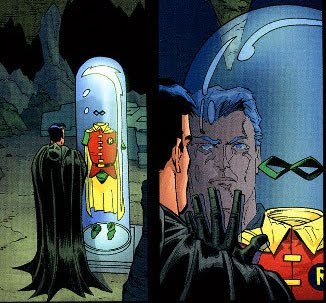
Jason Todd’s Memorial Trophy Case

There was a time when the Batcave contained no trophy cases devoted to the memory of the late Jason Todd.

Last year the weekly Robin reviewed the history of Jason, by my reckoning the second and third Robins in the Batman mythos, until his death at the hands of the Joker. The Batman comics then had to shift away briefly as DC’s editors and writers worked out the ramifications of fate their readers had chosen for Jason. In early 1989, the team dove into stories about reactions to Jason’s death.

The panel above, from Batman, #436, shows Dick Grayson’s first return to the Batcave after learning of that event. For decades that cave was graphically defined by the Dynamic Duo’s trophies, particularly a robot dinosaur (species variable, but eventually a T. rex), giant penny, and giant joker playing card. As technology burgeoned, the team installed a giant computer as well. There were also many smaller trophies in glass cases, wall-mounted batarangs, and other memorabilia. But, as Dick noticed, Bruce Wayne refused to memorialize any of his work with Jason.

Eventually, Dick, Alfred, and a potential new Robin named Tim Drake helped Bruce through the mourning process. Denial gave way to a new trophy case displaying Jason’s Robin costume, floating in space, mask and all. That costume looked exactly like Dick’s, but its emptiness symbolized loss.

Like so many other parts of the modern Batman mythos, the glass case with the costume actually appeared first in Frank Miller’s The Dark Knight Returns. That story, set in one potential future, also suggested Jason’s death, and introduced the phrase that sometimes appears on the case’s label: “A Good Soldier.”

As I’ve written before, when Jason died, he finally acquired the symbolic definition that the living character had lacked. Indeed, we might say that Jason became that costume in the trophy case, haunting the Batcave. He and it were together a symbol of youth cut short, of Batman’s greatest failure, of the dangers of masked vigilantism.
In the following years, Bruce would brood in front of the case. Tim would gaze up at the costume, seeing both the allure and the danger of being Robin. The trophy case was how Tim’s friends on the Young Justice team learned about his late predecessor. If villains invaded the Batcave, their desecration of that ground became undeniably clear when the fight that followed always smashed Jason’s case.

Eventually that glass case with the costume floating inside supplanted the Batcave’s older landmarks as a visual shorthand for that setting. Its design varied from one artist to another, but it was always immediately recognizable. (Perhaps Bruce had it rebuilt in different styles every time it got smashed.) Comics fans embraced the importance of the case. Matt Cauley at Iron-Cow Productions hand-crafted his own action-figure version. When Stephanie Brown died after being Robin, fans at Project Girl Wonder demanded to know why Batman hadn’t created a trophy case for her costume as well. (She got better.)

Remarkably, the symbolic significance of the trophy case endures when even Jason is not dead. In the DC Animated Universe of the 1990s Batman cartoons, which never had a Jason Todd, Tim Drake gazes at a costume in a glass case, a costume that those cartoons never show Dick Grayson wearing. A sense of promise and danger hovers overhead, even though there’s no explanation for it.

In the comics Jason Todd has returned from the grave (a story for another week), but his costume is still on display, and the trophy case is still sacred ground. In Batman and Son Damian Wayne goes down to the Batcave, breaks into the case, and puts on parts of Jason’s costume; that seems like such defilement that it’s hard to recognize how Damian is seeking acceptance into the Batman family.

That parti-colored costume behind glass thus now carries a symbolic weight separate from the actual loss of a young man. Indeed, in recent years Batman comics have shown future or imagined Batcaves with multiple trophy cases holding multiple Robin costumes, some not previously seen in that DC Universe. The sight of a Robin costume behind glass now has a visual resonance and significance of its own.

05 February 2011

MLA CFP—OMG!

The Modern Language Association threatens to tackle one of Oz and Ends’ favorite topics: how does the picture book form differ from the comics form?

Of course, the MLA is ready to deploy…jargon! Here’s the call for papers for a possible panel at the January 2012 MLA meeting in Seattle:

This panel will explore the possible relationships between comics and picture books, two imagetext genres implicated in children’s literacy learning which, despite overlapping formally and aesthetically, nonetheless stand apart socially and culturally. The potential application of picture book theory to comics, and, conversely, comics theory to picture books, promises to challenge this apartness—that is, to call into question the generic distinctiveness of the two forms. In that spirit, this panel invites participation from multiple perspectives, including but not limited to genre theory, education, history, formalism, aesthetics, semiotics, and ideological criticism.
Yadda yadda, Nodelman, McCloud, usual suspects among critics.
This panel will seek to enliven that dialogue by posing questions such as:
  • What formal resources and aesthetic strategies do comics and picture books share? Do they tend to deploy those resources and use those strategies differently?
  • What similar or different demands do the two genres make of readers?
  • How does the typical experience—if indeed we may posit a typical experience—of reading one genre differ from that of reading the other? For instance, how conducive are comics to what Ellen Spitz calls conversational reading, that is, reading shared by adult and child?
  • How do both comics and picture books participate in discourses and projects related to literacy learning and cultural literacy? For example, the possible role of comics in reading instruction has garnered much interest in recent studies…—how might this development be regarded culturally and critically? How might comics differ from or resemble picture books in their classroom use?
Yadda yadda, Spiegelman, Davis, Sendak, Tan, Selznick, usual suspects among practitioners.

Several factors make this an opportune and even urgent topic for MLA 2012, including the many artists who have worked in both genres; the genres’ shared aesthetic and narrative resources, and the relevance of image/text theories to both; the new prominence of comics in both children’s book publishing and reading instruction; and the current struggle of the picture book market to respond to social, educational, economic, and technological change.

Prospectuses due 5 March, response by 1 April, allowing chosen panelists to join the MLA by 7 April.

04 February 2011

Edible Oz

Oz and Ends reader Judy Cataldo kindly sent me this photo of a gingerbread and candy landscape displayed at the Strawbery Banke Museum in December.

Titled “Trail of Oz,” it was created by Zachary, Alexia, Nicholas, and Mimi.

Fans of the Oz books will be pleased to see how more than one Yellow Brick Road converges at the Emerald City. Of course, this sticky terrain is more like what we’d expect to find in Mo.

03 February 2011

Banville, Black, and Beam

In my SCBWI New England workshop on writing within and without genre last year, I used the example of John Banville, the Irish novelist. Under his own name, he writes Man Booker Prize-winning literary fiction, such as The Sea. Under the name Benjamin Black, he writes murder mysteries—a popular genre.

The pseudonym isn’t even an open secret anymore, an the Boston Globe columnist Alex Beam makes clear in a new interview:

Q. How do Black and Banville divide their time?

A. I’ve got a schedule now. I do a Benjamin Black in the spring and early summer. I hate summer, so this is a wonderful excuse to sit in my room and pound away at a crime book. I write those quickly on the computer, in three to four months.

What I want from Benjamin Black is spontaneity; John Banville writes in longhand with a fountain pen. I can’t do them both at the same time. Banville was never much interested in character, dialogue, and plot, and Black is entirely character and dialogue and plot.
Which is indeed a common distinction between literary and genre fiction. Whether future generations will consider that distinction worthwhile is another matter.

02 February 2011

Stumbling Through Scott Pilgrim?

Back in July, Bryan Lee O’Malley posted one page from the third volume of his Scott Pilgrim epic on his website under the label “what not to do.” Specifically, what not to do in laying out panels and word balloons on a comics page.

As this counterexample from his fifth volume shows, a page can have a complex design but still provide the readers with a clear path from one panel and balloon to the next.

I think O’Malley was being too hard on himself in suggesting that the bottom of the earlier page doesn’t work. The balloon placement and characters’ eyelines strike me as setting out the proper visual path. Maybe the balloon over Wallace’s head could be a little lower so the reader’s eye doesn’t trip over it while moving down from the middle tier, but that’s it.

But the top half—what to do with the top? How to keep readers along the intended path (marked in red) and not following momentum and the direction of Wallace’s look to the big panel on the right, which should actually come last? This must be why most comics manuals recommend against trying to stack panels in a left-hand column alongside a tall panel on the right—though one can find plenty of successful examples of just that. Perhaps even some in Scott Pilgrim.

01 February 2011

They May Not Spell Precisely, But…

A new blog on my reading list is E Is for Book, started by a group of authors and illustrators for children who are exploring the possibilities of electronic publishing. Many of them have had books published or republished in digital formats, such as Emilie Boon’s Peterkin Meets a Star, as I mentioned back here.

Just last week Publishers Weekly reported on a Digital Book World panel about children’s packagers turning into app-makers by saying:

They are also focused on a category—kids' multimedia entertainment—so new and fast-changing that standards for quality barely exist and an underlying technology that seems to change on a weekly basis. Indeed, moderator Charlie Schroder was quick to ask the panel “how do you stay perpetually innovative?” in a field that seems to change by the minute.
The challenges for authors and illustrators used to working on their own are even more daunting. But some want to try themselves, both to explore the creative freedom and to keep a larger slice of the smaller pie. Loren Leedy just wrote at E Is for Book about book-app-making software in development. (I guess those would be apps for making apps.)