27 December 2019

The Oxford and Cambridge Schools of British Fantasy

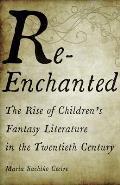
From Slate’s interview with Maria Sachiko Cecire, professor at Bard and author of Re-Enchanted: The Rise of Children’s Fantasy Literature in the Twentieth Century:
J.R.R. Tolkien and C.S. Lewis, of course, as many people know, were friends and colleagues, but they were actually working to reform the English curriculum at Oxford, in addition to writing their own fantasy.

They were the architects of this curriculum, which went into effect in 1931. And they really had an enormous role to play in the kinds of questions that were set in examinations, the texts that were required for undergrads to read; then this had this kind of huge knock-on effect in terms of what people were studying for the next nearly 40 years at Oxford. There’s still some vestiges of that curriculum in the Oxford education today. Then the younger authors I was looking at were Susan Cooper, Kevin Crossley-Holland, Diana Wynne Jones, and Philip Pullman. They all studied this curriculum and got their degrees between 1956 and 1968.

This curriculum at Oxford was really heavy on medieval literature, just at the moment when most other universities were going in the direction of modernism and the kinds of writing that we now associate with literary fiction in the 20th and 21st centuries. At Oxford they were doubling down on medieval literature and also looking at it not just as examples for linguistic analysis—which was how it had been primarily studied in the 19th century under philology—but really looking at it as literature. Really seriously asking students to meditate on both the English medieval past and also this idea of magic and enchantment. . . .

And for comparison’s sake, I also went to the archive at a few other universities, including Cambridge, which went in a really different direction from Oxford in the ’20s and ’30s—much more intentionally towards modernism, towards more contemporary texts, and cutting out medieval requirements for their undergraduate English degree.

And interestingly, Cambridge didn’t really have the same legacy of children’s fantasy writers. T.H. White was at Cambridge at a really interesting time, when there was still a medieval requirement, but right as they were ending it. If you compare his The Once and Future King to, say, The Lord of the Rings, they’re so different in the way they talk about the Middle Ages, with a different level of reverence. There’s anachronism in White’s writing, and pretty profound critiques of the warlike nature of the Middle Ages and of a lot of the nostalgia for that period. Whereas Tolkien and his students tend to be a lot more reverent of that material.
See previous discussions of Tolkien as a teacher of future fantasy writers in 2010 and 2011.

24 December 2019

Life Lessons from the MGM Movie

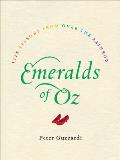
Emeralds of Oz: Life Lessons from Over the Rainbow is a short but not insubstantial riff on the MGM Wizard of Oz. The author, Peter Guzzardi, is a veteran book editor, but this is the first book published under his own name, several years in the making.

Emeralds of Oz is not based on the Oz mythos as a whole—just the famous movie. Guzzardi writes nostalgically about watching that film on television with his family but shares no fond memories of reading the Oz books as a child. He read a lot, but his taste leaned toward boys’ adventures. It takes over a dozen pages before Guzzardi even mentions L. Frank Baum, and there are only a couple of times when the book invokes parts of Baum’s story that didn’t make it into the movie.

Guzzardi isn’t just playing to the MGM movie’s larger contemporary fan base. That movie really defines his idea of Oz. At one point he recalls a difficult journey, noting he was about the same age as when Dorothy went to Oz. Context makes clear that he’s picturing the young adolescent Dorothy portrayed by Judy Garland, not the little girl drawn by W. W. Denslow.

The bulk of the book consists of lessons drawn from rewatching the MGM movie, rather like a sincere Mystery Science Theater 3000 viewing. A fair number of these homilies actually grow out of the vaudeville-style jokes mixed into the screenplay. There are longer meditations on the movie’s more explicit lessons, and of course a struggle at the end because of the screenplay’s ethical knots.

The “Emeralds of Wisdom” found in the movie tend toward pleasant reminders to keep doing what we normally do or know we should do, not deeper digs into the philosophical and ethical questions that the movie could raise. (Can one be a very good man while pretending to be a wizard?) The working title was All I Need to Know I Learned from the Wizard of Oz, with the implication that we knew it all from when we were young. Guzzardi drops mentions of the Kabbalah, mantras, Maslow’s hierarchy of needs, and other mainstays of modern self-help books. The more interesting commentary grows from his own life, however.

As an editor, Guzzardi’s specialty was crowd-pleasers, sometimes with fantastic results—Stephen Hawking’s A Brief History of Time, most notably. Emeralds of Oz grew out of that same commercial impulse. It’s designed as a gift, with glittery emerald endpapers, deckle edges, eye-catching interior design, and other hallmarks of the book as object. For people who like the movie and this sort of advice, it’s a fine package. But its strength comes from Guzzardi’s sincerity as he seeks guidance in the question, “What Would Dorothy Do?”

18 December 2019

See What See You Yesterday Did There

Stories of time travel with branching possibilities emphasize the results of characters’ choices even more than other types of stories.

Furthermore, the way those stories end is inherently optimistic or pessimistic. They show that people can change their worlds, futures, or selves—or they show those people can’t.

[Since it’s impossible to discuss how stories end without SPOILERS, the remainder of this posting will not only not be SPOILER-free, it will be packed with extra SPOILERS.]

Back to the Future presents such an optimistic portrait of the universe that not only does Marty restore his family but without even trying he actually makes their life much better. In the sequels he also manages to repair the future and distant past.

Men in Black 3 doesn’t fix the losses of the past, but more knowledge of the past gives Agent J a happier present.

In contrast, Twelve Monkeys shows the hero unable to prevent the global catastrophe that leads to a dystopic future. From the same director, Terry Gilliam, Time Bandits ends on a sour note with its young hero orphaned and evil once again loose in the world. Something about free will, the Supreme Being doesn’t really explain.

See You Yesterday, a movie directed by Stefon Bristol and co-written by him and Frederica Bailey, is a time-travel story set in 2019 Brooklyn. Two high-school juniors, C.J. and Sebastian, have built a temporal displacement device as a science project. They have high hopes for college scholarships. The future looks bright.

Unfortunately, C.J. and Sebastian are also in the world where it’s necessary to say Black Lives Matter. Both crime and overpolicing constrict those African-American teens’ lives. Their experiments with traveling through time in their neighborhood end in the death of one character close to them, then another. No matter how many times they go back to the crucial day, someone ends up dead.

Finally, C.J. goes back on her own. And the movie ends with her running along a now-familiar alley. We don’t know if she succeeds is changing events. We don’t know if she can. By American entertainment standards, that’s a pessimistic ending. And a well considered one.

In an interview at the Decider, director Bristol said:
Often times when you have a tragic movie with a happy ending, people are like, “Well, all’s well that ends well.” I don’t want that. I want the audience to be uncomfortable. I want the audience to have their own interpretation of what’s happening with our country.
In other words, if we want this story to work out well for C.J., her family, her friends, and people like them, we have to fix this timeline ourselves.

27 November 2019

The Busytown Neighborhood in New-York

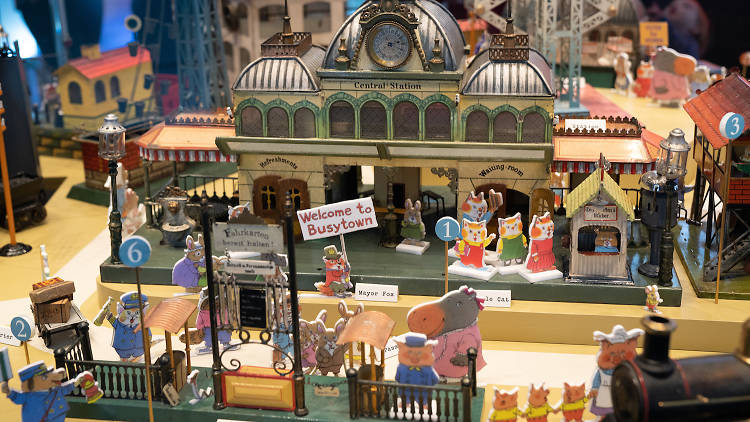
Every December the New-York Historical Society lays out a big model train set to visit, and this year’s design celebrates the centenary of Richard Scarry’s birth by sending the trains through Busytown.

The museum’s webpage doesn’t have any images from the display, but Time Out offered the photo above, showing that Scarry’s characters appear as little flat cutouts direct from his illustrations. (Rather than, say, three-dimensionally modeled adaptations.)

There are also “custom-made Busytown vehicle-themed benches” and larger “Busytown characters” for selfies. Busytown is of course a going commercial concern, licensed from Random House. Given how hard most of its inhabitants work at their jobs, such marketing doesn’t violate the Busytown spirit in the least.

Weekend storytimes will feature Scarry’s books, including The Night Before the Night Before Christmas, and on 14-15 December Scarry’s son and collaborator, Huck Scarry, will get busy sketching characters and talking to visitors.

24 November 2019

Tom Lyle and the Robin Miniseries

In 1986 Tom Lyle, an aspiring comic-book artist in his thirties, went to a comics convention in Philadelphia. There he met Chuck Dixon, a young writer who was scripting Air Boy for Eclipse. Based on Lyle’s samples, Dixon got him the job of penciler on a related title, Sky Wolf. In a chat with Comics Interview magazine, Lyle credited that as “the event that triggered my career” in comics.

Lyle was recruited by DC Comics to draw Starman in 1988. After a couple of years, as he was wrapping up that assignment, Lyle asked Batman group editor Dennis O’Neil if he had any openings. O’Neil was planning a miniseries focusing the newly created Robin, Tim Drake.

“I’ve never been real thrilled with the Robins,” Lyle told his interviewer. “Dick Grayson, the original Robin, I couldn’t have given a flip about when I was a kid; it was like, ‘Get out of the way, kid, I want to see Batman.” But a job was a job.

O’Neil’s team wanted to make Robin into a martial-arts expert, so they needed a writer who understood the martial arts. Lyle suggested Dixon. He got the assignment and went on to be DC’s most productive writer of the decade. (On the occasion of his 40,000th comics page in 2017, Bleeding Cool noted Dixon wrote 106 issues of Robin, 89 issues of Detective Comics, 77 issues of Nightwing, 46 issues of Birds Of Prey, and 22 issues of Catwoman, to name a few.)

Dixon and Lyle’s first issue of the first Robin series carried a cover date of January 1991. The character of Tim Drake had been created by Marv Wolfman in issues drawn by George Pérez, Jim Aparo, and Norm Breyfogle, and his costume was designed by Neal Adams. But Dixon and Lyle’s portrayal fleshed him out by showing him on his own. Lyle was especially good at portraying Tim as a thirteen-year-old, lithe but not a powerhouse, the littlest guy in the fight who needed to think harder than anyone else to stay alive.

In the gritty, pouched, and overpumped 1990s, Robin was the equivalent of counterprogramming on broadcast television—standing out by doing something different. And it worked. According to Lyle, DC expected to sell about 200,000 copies of the first issue of the Robin miniseries. Instead, it sold three times that number.

DC asked the Dixon-Lyle team for a second miniseries about Tim Drake going up against the Joker, issued at the end of 1991. Then came a third, featuring the character the Huntress for an interesting contrast. That was the height of the speculative boom, and those magazines are festooned with holograms and other gimmicks.

Dixon and Lyle also collaborated on issues of Batman and Detective Comics showing Batman and Robin together. One of those magazines introduced Stephanie Brown as the Spoiler, who went on to become Tim Drake’s love interest, a fan favorite, and eventually Robin and Batgirl herself for limited periods. Lyle was also the artist for the first Robin Annual and the 1992 public service ad in which Tim decides to learn the facts about AIDS.

During that time, Lyle also plotted and penciled the early issues of The Comet for DC’s Impact imprint. In 1993 he started working for Marvel Comics on Spider-Man stories. That same year, DC launched the Robin monthly series with Dixon as regular scripter.

After another ten years or so, Lyle left monthly comics to become an art teacher at the Savannah College of Art and Design. Earlier this year he suffered an aneurysm, and last week he died, aged 66. Friends and fans have set up a Go Fund Me page for his family.
15 November 2019

Breakdown

Let’s imagine that Donald Trump paid millions of dollars—assuming he actually has that much money to spend—to officials of a foreign government to announce a criminal investigation into his leading political opponent.

The officials didn’t even have to conduct the investigation. After all, Trump doesn’t criticize notoriously corrupt regimes, has cut the budgets of international anti-corruption programs, and is ignoring multiple laws and norms in the US. But for these millions of dollars Trump clearly wanted a big public announcement of that criminal probe that would damage his opponent.

Obviously, that would be a crime: bribing a foreign government for political purposes.

Now let’s imagine that Donald Trump took $391 million that the US Congress had allocated for a particular program and diverted it for his own political benefit. Again, that would obviously be a crime: a form of embezzlement and abuse of power.

Donald Trump did both those things at the same time.

07 November 2019

The Real Legacy of He Walked by Night

He Walked by Night didn’t influence The Third Man, but it definitely did influence American popular entertainment.

To start with, it appears to be the first movie that includes a scene of self-surgery. The bad guy stitches himself up after being shot, using a mirror and a lot of grit. I’ve seen variations of that scene in The Terminator, Ronin, and Master and Commander, but this might be the original.

Even more clearly, He Walked by Night gave birth to the most visible and long-lasting form of the dramatized police procedural. It even starts with an announcement that the story was based on real crimes, and that “names have been changed to protect the innocent.”

One of the supporting characters in the movie is a police lab technician played by Jack Webb. He’s young and almost winsome in the role.

At the time, Webb’s most prominent parts were as the star of the radio dramas Pat Novak, for Hire, about an unlicensed investigator who works at a pier, and Johnny Madero, Pier 23, about a pier manager who undertakes investigations. As was standard in hard-boiled mysteries, the cops in those stories were at best a rival for the hero, at worst a hindrance.

While working on He Walked by Night, Webb met the movie’s technical advisor, Detective Sergeant Marty Wynn of the Los Angeles Police Department. Their conversations and the movie’s format gave Webb the idea of creating a radio drama about a police detective, inspired by real crimes and portraying realistic law-enforcement techniques.

The LAPD also loved that idea and got behind it. Dragnet premiered in June 1949 with Webb in the starring role of Sgt. Joe Friday. It ran for more than eight years on radio. For most of those years, a version also ran on television for nine years, and there was a movie adaptation as well. Then the TV show was revived in 1966 with a TV movie and more than four more years of episodes. Webb expanded the procedural franchise in the 1970s by producing Adam-12 and Emergency!

Dragnet made Webb’s Joe Friday character a national icon, cementing his image as an actor and even his politics. That means it’s very striking to see him play a different personality in He Walked by Night, or to hear him as a cornet player during Prohibition in the fine radio drama Pete Kelly’s Blues.

06 November 2019

Going Deep for a Climactic Chase

He Walked by Night is a 1948 police procedural that gets better as it goes along, largely because the original director, journeyman Alfred L. Werker, left the project and the up-and-coming Anthony Mann took over.

The cinematographer, John Alton, stayed the same, so the whole movie has the same look. It’s a noir docudrama. Many of the opening scenes have no more zip than an educational film. But scenes with the bad guy, played by Richard Basehart, are strong, and the climax is terrific. The police chase the killer through the Los Angeles sewer drain system. Mann and Alton used light and dark, angles and shapes, tracking shots, and sound with no music to build up tension.

The sewer chase immediately brings up a comparison with The Third Man, directed by Carol Reed and released the following year. Did a B movie produced by a British-American distribution company that had just got into production influence that prestige project filmed in Europe with an international cast of stars? The similarity is striking, but it’s just a coincidence.

Producer Alexander Korda recruited Graham Greene to write a new screenplay for Reed after they had worked together well on The Fallen Idol. Korda had the idea of setting a story in Vienna, its policing divided among the Allied powers. Greene had one sentence in an old notebook about someone spotting an old friend a week after attending his funeral.

In early 1948, Greene traveled to Vienna to research and come up with more. Discussions with various people gave him two ideas: black-market penicillin and patrols of the city’s old sewer system. Greene went to Rome and drafted a novella incorporating all those elements, then adapted his prose into a screenplay. Filming on The Third Man began in October.

Meanwhile, Eagle-Lion Films was making He Walked by Night, inspired by the case of murderer Erwin Walker. In April 1946, after a shootout with police, Walker had escaped through Los Angeles’s storm drains. He did the same thing the following month. Walker was finally arrested in December 1946 in his apartment, the police having received a tip-off.

According to The Crime Films of Anthony Mann, the original scenario for He Walked by Night didn’t include scenes of the killer in the sewer. Instead, the climax was a chase at the Los Angeles Coliseum, which Werker probably filmed in the spring of 1948. When Mann took over, he reworked the screenplay. He and his chosen writer, John C. Higgins, changed the climax to be an extended capture in the storm drains. Those scenes were a technical challenge, but Alton and Mann captured that footage in reshoots in July 1948.

In November, Eagle-Lion released He Walked by Night in Los Angeles. That same month, Orson Welles arrived in Vienna and performed in a few shots of The Third Man. One of those involved going down into the sewer. But Welles famously balked at filming underground surrounded by actual drain water. The company had to build sewer sets in London and film the movie’s climax months later. Still, that timing shows how the sewer scenes of The Third Man were already mapped out by the time He Walked by Night was released.

Thus, the two movies’ chase scenes through drainage systems developed independently, each based on real events. Both scenes take advantage of the darkness and watery reflections of underground drainage tunnels. But they end up offering a strong visual contrast that reflects the two cities above. LA’s drains are all modern concrete, with smooth surfaces and sharp angles and arcs. Vienna’s Old World tunnels (or the studio reproduction of them) are bumpy brick and stone, filmed at vertiginous tilted angles. And both scenes are excellent.

03 November 2019

Restorative Young Justice

I was intrigued by the news that Brian Michael Bendis was reviving DC Comics’s original Young Justice team, featured from 1998 to 2003. I didn’t pick up the comic books, however, because I was already confused enough by the publisher’s continuity changes in recent years. The alternate universes that got us to this reboot seemed even more tortuous.

I’ve now read the first collected volume of that series, Young Justice: Gemworld, and I’m just as confused as I anticipated.

Bendis has indeed restored the core of the original team: Tim Drake as Robin, Conner Kent as Superboy, Bart Allen as Impulse, and Cassie Sandsmark as Wonder Girl. In addition, he’s added three more girls, versions of established heroes/trademarks: Jinny Hex, Amethyst, and Teen Lantern (leaving out the original Young Justice’s Secret, Artemis Arrowette, and later members). Bendis has also established that the team has always been part of this DC universe’s history but wiped from memory by a bunch of hand-waving—the same hand-waving that brought those characters back together. But as for the story itself, it felt thin.

Of course, the original Young Justice series was far from deep. Launched by Todd Dezago and then taken over and scripted almost entirely by Peter David, it was a sitcom. It had catch phrases, laugh lines, villains and supporting characters whose names were based on puns. Sure, there were many moments of teen angst and very special episodes and all that. But fundamentally that series didn’t take itself too seriously. This team formed because a bunch of young superheroes liked hanging out, not because they had a crucial mission or psychological need. That’s why the unorthodox artwork of Todd Nauck worked.

Bendis has restored the group, but he hasn’t restored that tone. To be sure, these first issues are devoted to reintroducing and introducing the team through one breathless flashback after another. But I recall only two jokes fondly, one of them repeated and the other almost lost in small panels.

The new series doesn’t need to follow the same path, of course. So far, however, there just isn’t enough adolescent drama (as in Teen Titans at its best) or threats to this world (as in the intermediate, TV-spin-off Young Justice magazine) to make up for the loss.

31 October 2019

The Deep Roots of Willow Cove

Next summer will bring The Witches of Willow Cove, a new novel for tweens by Josh Roberts, one of my writing group colleagues.

Here are some extracts from Josh's interview at Writers' Rumpus:

Growing up, I lived in a three-story Victorian funeral home, complete with creaky floors, drafty windows, and a secret room sealed off from the rest of the house, so I spent a lot of my childhood making up stories to spook myself and my friends. . . . When I was younger, some of my friends were afraid to sleep over because the house was so spooky. But I have a lot of great memories from living there, too. And obviously it provided some fuel for my imagination.

I’ve always believed that the best spooky stories are the ones that feel like they could be happening to real people in real places. I knew from the beginning that THE WITCHES OF WILLOW COVE would be set in a small New England town like the one I grew up in. I knew I wanted it to be upper-middle grade, too, with characters right on the cusp of their teenage years, caught in that moment of their lives when they’re not quite grown up yet, but also not quite kids anymore. And I knew that my take on it would be: What happens when you find out you’re one of the spooky things that everyone’s afraid of? . . .

I think there’s a sort of comforting thrill that comes along with reading a spooky story—the promise that eventually the scary part will be over and things will generally sort themselves out. That release of tension is just as important as the frightening part. Maybe more so.
The Witches of Willow Cove will come from the appropriately named Owl Hollow Press, and the sequel, I happen to know, is already in the works.