29 June 2011

“An osmosis between the oral and the visual”

Today’s New York Times quotes Tomi Ungerer as saying:

Look, it’s a fact that the children’s books that withstand the grinding of time all come from authors who did both [writing and illustrating]. Because the author has a vision, and there’s an osmosis between the oral and the visual, which come together and mix.
Is that true? Context suggests Ungerer was talking about picture books rather than illustrated novels like Carroll and Tenniel’s Alice in Wonderland, Baum and Denslow’s Wonderful Wizard of Oz, or Milne and Shepard’s Winnie the Pooh. But even in the picture book genre, is it too reductive?

I bopped over to Betsy Bird’s Top 100 Picture Books poll from 2009. Second on the list is Margaret Wise Brown and Clement Hurd’s Goodnight Moon (and #74 is their Runaway Bunny, which I prefer). Other titles from author-illustrator teams in the top forty that have lasted over a generation include:
  • Ferdinand the Bull, by Munro Leaf and Robert Lawson.
  • The Monster at the End of this Book, by Jon Stone and Mike Smollin (and, of course, all the uncredited collaborators who helped to create your lovable furry pal Grover).
  • Bread and Jam for Frances, by Russell Hoban and Lillian Hoban.
  • Alexander and the Terrible, Horrible, No Good, Very Bad Day, by Judith Viorst and Ray Cruz.
  • Brown, Bear, Brown Bear, What Do You See?, by Bill Martin Jr. and Eric Carle.
  • Tikki Tikki Tembo, by Arlene Mosel and Blair Lent.
  • Eloise, by Kay Thompson and Hilary Knight.
  • Harry the Dirty Dog, by Gene Zion and Margaret Bloy Graham.
In some of those cases, we know the author and illustrator worked together closely. In others, I suspect, picture-book publishing traditions kept them apart, so that only the text, the editor, and a few notes guided their collaboration. Yet they still produced “books that withstand the grinding of time.”

Then again, that list may not be Ungerer’s list. (None of his work appears on it.)

28 June 2011

Beyond the Butter Cow

Norma “Duffy” Lyon, the Iowa State Fair’s butter cow sculptor from 1960 to 2005, has just passed away. Lyon had some art training in college, but her strongest qualification might have been being an Iowa dairy farmer who knew cows.

A predecessor had established a tradition of sculpting something new alongside each year’s cow. Among Lyon’s choices were Grant Wood’s American Gothic, a Last Supper, the Peanuts gang, and Tiger Woods with a tiger.

There’s a book about Lyon, and a website created by her younger brother.

27 June 2011

“A seemingly endless series of rich and unexpected interpretations”

More from Steven Knapp’s remarks on “The Enduring Dilemma of the Humanities”:
Defenders of scholarship in the humanities sometimes think the way to give it a social standing and public support equivalent to that of the sciences is to defend either the rigor and objectivity of its research or the social relevance and utility of its implications.

In fact, however, what the public values in the humanities is their relation to the particular power, prestige, and interest of the objects of humanities inquiry — not, I regret to say, the more general benefits allegedly derived from such inquiry itself. What matters to the public is Shakespeare, not the logic of theatrical representation. What matters is the story of America, not the ideological structure of American exceptionalism. . . .

Because, in my view, the humanities cannot escape this problem, the best approach is, and has always been, to embrace it and make the best of it. But how?

Well, decades ago, that kind of modus vivendi could be achieved by strongly connecting the professional academic pursuit of advanced humanities scholarship to the teaching of undergraduates; the unspoken assumption was that parents wanted their children to have contact with the prestigious histories imbedded both in classic works of literature and other arts and in the emergence of the modern world.

Perhaps the most brilliant example of that strategy, at least in the Anglo-American context, was the invention of the so-called New Criticism. For those who were never exposed to it or have since forgotten it, this was a set of techniques for generating close readings of just about any kind of text, although the objects to which it was mainly applied were shorter works — mostly poems — from the canon of English literature. By looking for certain kinds of paradoxes in a poem’s rhetorical structure, one could generate a seemingly endless series of rich and unexpected interpretations.

Because they were unexpected and in that sense apparently original, these readings were eminently publishable, so they helped fuel an explosion of academic publishing and formed the basis of countless academic careers. And because the technique itself was so eminently teachable, it enabled countless students with little or no background in literary history to produce extraordinarily sophisticated critical papers that made them seem astonishingly learned and cultured, to themselves and others. (I mean that statement less ironically than it may sound.)
Knapp is president of George Washington University. His books include Literary Interest: The Limits of Anti-Formalism, and an article he wrote in 1982 with Walter Benn Michaels titled “Against Theory” was an early sign of the crumbling appeal of New Criticism and the deconstructionism that followed.

26 June 2011

Ruining the Gauntlet

Among the casualties of DC Comics’s September reboot are Nightwing’s distinctive two-color gloves.

From the mid-1990s to his inheritance of the Batman cape, Dick Grayson wore one of the sparest of superhero outfits. Almost the only decoration was a light blue stripe from the middle fingertips of one hand across the chest to the fingertips of the other—all the better to show off the acrobatic body underneath, of course.

The Nightwing gloves—usually called gauntlets, though that term has another meaning in the Batman mythos—are supposed to be functional. Dick carries a radio and an impossibly large bunch of tools and weapons in the bands around his forearms, and in the cuffs of his boots. Since he used to carry an impossibly large bunch of things in a thin little belt, readers accept that. But really the gloves are all about the aesthetics.

To symbolize its new beginning, DC has redesigned all its heroes’ costumes. The new Nightwing outfit has a red stripe at the chest and fins sticking out of monochromatic black gloves.

Such a mistake. For decades DC Comics has earned most of its money from licenses of its characters and trademarks, rather from the magazines that tell new stories about them. The company should license two-tone Nightwing gloves—the two-color pattern, a subtle logo at the wrists, for adults.

There are similar gloves in many styles, but none exactly right. Clearly the technology is available. I tell you, the company’s leaving money on the table.

24 June 2011

Sally Rand as an Opening Act

From the back pages of Harvard Magazine, a word-picture from F. Harvey Popell of the historic Freshman Smoker of 1951:
The Smoker started off in Memorial Hall with good fellowship (i.e., a lot of beer-drinking), after which we trooped across to Sanders for the show, which featured fan dancer Sally Rand—not to perform (imagine the headlines!), but to do stand-up comedy. Rand had a different idea.

The Korean War had broken out three months before our class entered Harvard, so after a few ribald jokes she pulled a sheaf of papers from her low-cut gown and started reading the anti-Communist speech. We thought it was the build-up to another joke, but the punch line never came and the unruly crowd grew restless.

Then a guy threw a penny, and Rand shot back one of the best retorts I ever heard. “Boys,” she said (itself a putdown), “there’s only one animal I know who throws a cent.” That drew a rousing ovation—and a lot more metal hurled her way. She gamely finished her speech, and the poor woman left the stage in tears.

Sensing a riot in the offing, the quick-thinking emcee hurriedly had a piano rolled out, and a bespectacled young math instructor sat down and started playing and singing his own catchy, satirical compositions. He was so good that soon everyone had forgotten Sally Rand. Tom Lehrer always acknowledged that this Freshman Smoker was his “first big gig.”
I of course am part of the generation of Americans who first heard Lehrer through “Silent E” (“Who can turn a can…into a cane?”) and “L-Y” (“Immediately, immediately, Immediate L.Y.”).

23 June 2011

“Just an amazingly good looking guy.”

Folks in the Boston Comics Roundtable alerted me to a new blog by Jim Shooter, editor-in-chief at Marvel Comics during the late 1970s and 1980s, when the company overtook DC not only in innovation but in sales. He began work in the industry at thirteen, scripting stories for DC’s Legion of Super Heroes.

After work at other companies, DC hired Shooter to script some new Legion stories in the past decade. Among the assignments was to take a stab at creating a new Superboy since the courts might assign the copyright of that character to the heirs of co-creator Jerry Siegel. (Long story.) Shooter shared his response in a posting titled “Super Lad.”

I’m among the many people who can’t keep the Legion straight, and I don’t care about the original Superboy. What interested me about Shooter’s posting is what he, as an industry vet, saw as the necessary essence of Superman. In other words, what DC had to retain for a “Super” character if they couldn’t use any of the character history that would become the intellectual property of the Siegel family:
If a Super were anything but a noble being with an iron will and tremendous self control, impervious to the failings bad writers nonetheless foisted upon him or her, the Super would have been a villain. Period. And all the rest of the heroes, all the world for that matter, would have had nothing on their minds, and nothing else worthy of devoting their efforts to than destroying the Super. Period. 
. . .

I see him as a genuine good guy. Someone who does the right thing, who has tremendous willpower and courage, who is smart and reasonable. Smart about using his powers, as he learns how. The nicest, best guy you ever met. NOBLE, in the best senses of the word. Not that he can't make mistakes, not that he doesn't have humanity--but he's the best of humankind, one of the few survivors of his particular kind, determined, therefore, to give a good account of himself. 


Elliot S! Maggin once wrote an imaginary story in which Kal-el did not become Superman. Since that didn't occur, he was chosen as the Green Lantern of his sector because he among all beings there had the greatest courage, greatest will and noblest spirit. Right on. That was ES!M's finest hour.

Fair enough. But comics are a visual as well as verbal medium. How would that character be embodied in art? Shooter wrote:
- A strong, young man's physique. NOT overbuilt, NOT Hercules. Strong-looking but slim. Like Ditko's early Spider-man. An ATTAINABLE build. He's Kryptonian. He doesn't have to be absurdly musclebound.


- Handsome. A really, really good looking guy. No lantern jaw, no jock sensibility. Just an amazingly good looking guy. 


- Haircut: timeless. A haircut that wouldn't look out of place in almost any era. I wouldn't mind something pretty close to Superman's. Nothing dated or trendy. No mullet, no crew cut, no high-and-tight, no long hair, no Pet Detective, no spike-y do, no dreads, no curls, no mop. Timeless.
In sum, a good superhero has to look good. Really good. Even if he’s not musclebound or lantern-jawed, he has to be “amazingly good looking.” Or, as critic Douglas Wolk put it in Reading Comics:
The default style of the superhero mainstream [is] designed to read clearly and to provoke the strongest possible somatic response. You’re supposed to react to it with your body before you think about it. Most of its characters, especially the heroic ones, are drawn to look as “sexy” as possible…
The result is that the most underrepresented group among superheroes isn’t women, or non-white ethnic groups, or sexual minorities—not that those people aren’t underrepresented relative to their proportion of the general public. It’s people who are plain or unattractive.

Male or female, young or old, whatever color or orientation, superheroes are almost all drawn as physically attractive people. The main alternative is physically attractive people who turn into wildly exaggerated monsters.

Comics readers have long pointed out how artists routinely draw female heroes with big busts and little costumes, but are there any female heroes who aren’t conventionally attractive to begin with? As for men:
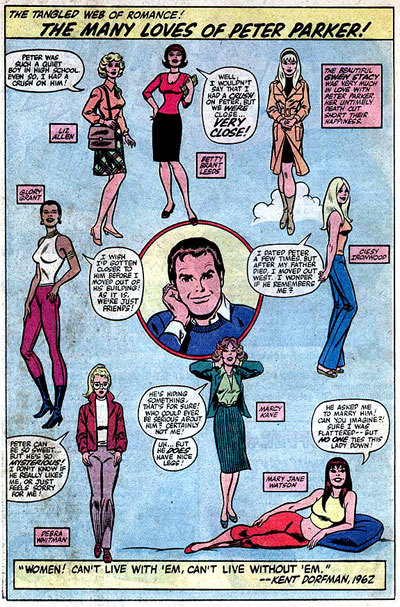
This is, after all, a genre in which Peter Parker was created to represent nerdy guys.

20 June 2011

“The origin of an object makes a profound difference”

From Steven Knapp’s remarks on “The Enduring Dilemma of the Humanities” at a symposium in March:
Why, [Paul] Bloom asks [in How Pleasure Works], should we care so much about the origin of a forged work of art if the aesthetic features of that forgery are, as far as we can tell, just as good as those of an unforged original?

It turns out that the origin of an object makes a profound difference to human beings, and according to Bloom, that difference is built into the way we relate to the objects around us. Bloom regards this human disposition as a kind of innate essentialism in the human psyche: We automatically and involuntarily see objects as connected with their histories in ways that transcend their physical and aesthetic properties.

That’s why it matters to us whether an image was created on purpose or by accident, and that’s why we care more about what a picture was intended to represent than we care about what it actually looks like. Hence Bloom reports on “a series of studies that found that even three-year-olds would name their pictures based on what they were intending when they created it.” One investigator found that “even 24-month-olds are sensitive to a drawing’s history when deciding what to call it.”

What these studies point to, it seems to me, is the inseparability of our notion of particularity from our notion of history. What differentiates one object from another, from the point of view of human interest and value, is not what it looks like but where it came from, how it came to be, what it was intended to do or mean.
I think the same factor is at work in how we read fiction differently from nonfiction. A story that seemed moving when people thought it was nonfiction—James Frey’s A Million Little Pieces—turned out to be shallow and thoroughly unbelievable when revealed as fiction. And so for the many other recent examples of fake memoirs, and even fake autobiographical fiction.

In February 2010 I wrote about author Ben Mezrich’s statement that “The idea that the story is true is more important than being able to prove that it’s true.” That’s because the idea of truth affects how we take in the story more than any proof we haven’t assessed.

On being similarly questioned about details in The Accidental Billionaires, Mezrich told Reuters: “It’s a nonfiction book. It’s a true story. I am a narrative nonfiction writer in a way that other people don’t write. I’m trying to create my own genre of nonfiction.” That book is the basis for the movie The Social Network, which many people have the idea is true.

19 June 2011

Glimpses of the Original Conception of Tim Drake

When DC Comics introduced Tim Drake in late 1989, the character was still solidifying. A couple of unclipped loose ends slipped through in that early material to show how he might have been a little different.

The first panel here comes from the collection of world-class Robins fan and occasional Oz and Ends commenter Icon-UK, shared on the Comic Art Fan website. It’s from the pencil of George Pérez and the pen of inker Bob McLeod. Our helpful pal Ike reveals:
Tim’s hair has been altered after the inking stage with an overlay, to what would become his trademark appearance; originally he seemed destined to have the same side-curls as Dick and Jason had had at the start of their Robin careers, but clearly they wanted to give him his own look both in costume and civilian looks.
It’s interesting how in the same stretch of issues show Timmy as a younger boy appears with a side part. As a teenager, did he start trying to imitate how his idol wore his hair the same age?

Those double forehead curls appear in a classic Dick Grayson image to the right. They stopped being standard for Robin with the “New Look” of 1964. For the next quarter-century, various artists instead depicted Dick with his hair combed straight back or a side part. (And then came the dreaded mullet years.)

After the first and then the second Jason Todd came into the picture, that character inherited the classic Robin hairstyle. Until recently he retained those forehead curls in most artists’ depictions, along with a streak of white through his black hair. In Jason’s most recent appearance he has long red hair. And who knows what will be under the red hood after the upcoming reboot?

The panel to the left comes from another issue of the story that introduced Tim Drake, Batman, #441, drawn by Jim Aparo. In this image, Dick addresses Tim as “Jeff.”

Originally DC planned for Batman’s new sidekick to be named Jeff, but plans changed toward the last minute, probably because editors wanted to put more distance between this character and his predecessor Jason, often addressed as “Jay.” The revision process caught most of the old name’s appearances in Marv Wolfman’s script, but not this one. (Many years later Robin, #167, told us that Tim’s middle name is Jackson.)

The first three male Robin names aren’t really that far apart. Despite the characters’ different backgrounds, they’re all WASPy names of the sort American pop literature has given young heroes since the dime-novel days. They all built around percussive consonants (D in particular) and that strong long A. And so far each male Robin has a given name sharing a rhyme or first letter with his predecessor’s last name.

The girls, Carrie Kelley and Stephanie Brown, are of course left out of these patterns.

16 June 2011

Video Killed the Comic-Book Star

From Jean-Paul Gabillet, Of Comics and Men: A Cultural History of American Comic Books, translated by Bart Beaty and Nick Nguyen:
In 1960, 41 percent of boys in the fourth grade in San Francisco read at least nine comics a month; by comparison, ten years earlier, a study based on a sampling of over fourteen hundred young students in Des Moines, Iowa, showed that 75 percent of children of the same age read similar quantities.

A 1961 study had also examined the differences between two Canadian cities, one with television, one without, respectively referred to as Teletown and Radiotown (at the start of the 1960s it was no longer possible to find an American city without television): a third of the sixth-grade students read more than ten comics a month in Teletown as opposed to 87 percent in Radiotown; for high school students, the gap was 6 percent at Teletown versus 49 percent in Radiotown.

Clearly, television consumption among children seemed to be inversely proportional to comic book reading.
I was happy to see studies to support one of my hunches. In particular, the fall of romance comics from market-driving leaders in the late 1940s to a small slice of a shrinking market a decade later strikes me as due to how readers found similar storytelling at greater value on television soap operas. Superhero and science-fiction comics offered stories and visuals that television production couldn’t match, so they kept their audiences relatively well. Now, of course, they’re losing out, too.

All of Gabillet’s citations for this passage go through one essay also cited in many other studies of comic books: Patrick Parsons’s “Batman and His Audience: The Dialectic of Culture,” published in The Many Lives of the Batman. I’ve looked for that book for a while. It came out from a British academic press in 1991, before the study of comics was wide or respected in American culture, and there’s no copy in my local library network. I must make a note to visit a local university.

The Gabillet book is more comprehensible than Thierry von Groensteen’s The System of Comics, translated by the same team for the same university press. Still, there are some maddening passages, such as:
Nineteen fifty-two was the year where the combined printings of comic books reached their historical maximum but there is no data at our disposal that allow us to quantitatively determine this.
If there’s no data to “quantitatively determine” how many comic books were printed in a year, how can we identify a “historical maximum”? Apparently that statement is (a) a relative measurement, based on (b) qualitative impressions by individuals at the time. But one cited witness’s estimate of production in 1952 is twice as much as another’s.

13 June 2011

Be Careful Whom You Have Coffee With

From Leon Neyfakh’s profile of documentary filmmaker and blogger Errol Morris in the Boston Globe:

Morris fought with the head of his [graduate school] program, Thomas Kuhn, a decorated philosopher specializing in the history of science at Princeton. Kuhn believed it was fundamentally impossible for someone in the present to understand the past — that what was considered “true” in one era might be thought false in another, and therefore “objective reality” as such could not be said to exist.

Young Errol Morris was horrified by this view, and was not particularly shy about making Kuhn aware of it. Things came to a breaking point in 1972 when, during a particularly heated conversation, Kuhn threw a heavy glass ashtray at Morris’s head. He missed, but drove his point home by having Morris ejected from the program.

“I felt that he had destroyed my life,” said Morris. It left him reeling for years to come: He still remembers sitting in a coffee shop at Berkeley with Daniel Friedan, a fellow Princeton exile and the son of feminist icon Betty, and commiserating over the frustrating time they’d had out East.

“I’m talking about all these problems that I had with Kuhn, which was a constant refrain, and he’s telling me about all the problems he’d had in the physics department,” Morris recalls. “He said, you know, ‘They just could not appreciate me. I had discovered a new kind of physics!’ And I thought, ‘Oh, no. This looks bad. This looks very, very, very bad. This is not going to turn out well. We’re both going to the nuthouse.’”

Of course, they didn’t. Friedan would go on to win a Macarthur Fellowship, and be recognized for his pioneering work on string theory. Morris, meanwhile, left academia behind once and for all to make a movie about a pet cemetery. . .