11 November 2012

The Exaggerations of Dick Grayson’s Love Life

A couple of weeks ago, the weekly Robin discussed how in 1984 Dick Grayson was the first hero DC Comics clearly showed having a sex life—and outside of marriage yet! However, his relationship with fellow Titan Koriand’r was always presented as a long-term commitment.

Indeed, for the rest of the 1980s that relationship was one of the tent poles of the Titans franchise—which meant Marv Wolfman and his artists were constantly shaking it to make readers worry. Kory contracted a political marriage for the sake of her home planet, and Dick couldn’t handle it. Teammate Raven had sexual fantasies about Dick, and Kory could handle it. A freedom fighter from an alternate future disguised herself as Kory to have sex with Dick.

The relationship endured until New Titans, #100, when Dick and Kory tried to get married and everything went horribly, horribly wrong. Dick and Kory broke up, and that Titans team itself went separate ways—which just shows how much of a tent pole it was.

That left Dick Grayson unattached for the first time in years. He kept busy being Batman for a while, but then DC’s writers happily seized the chance to use “Dick has a new girlfriend” as the starting-point for stories.

Meanwhile, the internet enabled fanfiction to spread, and that area of writing has never been bound by what official continuities say about heroes’ love lives. As a result, Dick Grayson became a “fandom bicycle” on which everyone got a ride. TV Tropes lists him as DC’s top “Launcher of a Thousand ’Ships,” saying: “It's a running gag in the DC Universe that virtually every female that comes in contact with Nightwing falls in love with him.” In fanfiction, that group expands to include every male.

Despite Dick being a symbol of sexual appeal, however, his romantic/sexual activity within the comics was exaggerated. Here’s a conversation on the topic between Dick and Tim Drake, his successor as Robin, in Nightwing, #25 (dated October 1998, script by Chuck Dixon, art by Scott McDaniel). The boys are, naturally, standing on the back of a freight train while blindfolded—Dick’s told Tim this is good training. Tim manages to say the only thing that can throw Dick off balance.
Dick asks Tim if perhaps he could choose a girlfriend who’s not an “Afterschool Special,” knowing that won’t happen. Tim responds by showing off how much of a Dick Grayson fan he is.
Tim lists six women whom Dick has had a relationship with since Crisis on Infinite Earths. But in fact that list is exaggerated, even more than Dick’s response in the following panel lets on.

His relationship with Koriand’r was more than “a need…for affection”—it was a multi-year, live-in relationship that came close to marriage. It was precisely the opposite of casual.

As Dick reminds Tim, he and Donna Troy never “really dated.” They never dated at all. Wolfman did propose to “have very slowly had Dick and Donna get together,” “if only for them to see that they were too similar to be together.” But that never happened.

Miggie Webster appeared in the Nightwing miniseries by Dennis O’Neil and Greg Land. Dick was apparently depressed at the time—or maybe just weighed down by his hair. In any event, he became briefly infatuated with Miggie because he thought she represented a normal, happy family life—only to see her kill her abusive father. And as far as I can tell, they never even went on a date.

Emily Washburn married Dick in Nightwing Annual, #1 (cover shown above). That was part of a 1997 DC tribute to pulp fiction, and the story was a James M. Cain-style take on a murderous marriage. Dick married Emily as part of his investigation. After he identified the killer, he offered to remain her husband and help raise her son—again with the monogamous values!—but she declined. It’s unclear whether the marriage was consummated, but given scripter Devin Grayson’s take on Dick as a very physical and open person, it probably was.

Meanwhile, in 1996 DC launched the Nightwing series written by Dixon. Among its subplots was Dick’s friendship—or would it be something more?—with the superintendent of his apartment building in Blüdhaven, Bridget Clancy. Dixon was a master at playing out conflicts over many issues, but this relationship never reached the level of dating.

Instead, at the time of this train-top conversation, Dixon was gradually moving Dick toward a second serious, multi-year relationship: with Barbara Gordon, daughter of the Gotham police commissioner, former Batgirl, and at that time Oracle. Dick had shown interest in her in the 1970s, but fans then pointed out that she was several years older than he. At the time of this issue, Nightwing, #25, it was still unclear whether they would become an item.

Thus, of the six women Tim reeled off, Dick had actually had serious and/or sexual relationships with only two, and in one of those (Emily Washburn) he was working on a case. That exchange thus leaves a misleading impression.
Of course, I have to acknowledge a seventh relationship that Tim, despite his snooping, doesn’t know about until Dick reveals it. Dick is just coming off the 1998 Nightwing/Huntress miniseries, once again scripted by Devin Grayson and drawn by Land. That shows his brief affair with Helena Bertinelli, the Huntress. It’s clearly sexual. (“Tunnel”!)

But in that miniseries Dick is looking for something long-lasting. (He’s evidently drawn to strong women who need rescuing.) The story ends with Helena seeing the chemistry between him and Barbara and chuckling that they don’t notice it themselves. In other words, even this example of Dick having a sexual fling points to him as a man seeking a committed love.

From the No Man’s Land crossover (1999) through Infinite Crisis (2006), Dick and Barbara were usually a couple. Since then, each new regular Nightwing scripter came up with a new love interest: a fashion designer, a criminal who lured a teen-aged Dick away from Wayne Manor, a librarian. Judd Winick has put him back in bed with Kory a couple of times. But only the unfortunate Nightwing Annual, #2, portrayed him as anything other than a one-woman man.

10 November 2012

Ahoy! A Little More Teen Boat!

This week I ran up against a short Teen Boat! story that didn’t make it into the collection.

Okay, it’s a promotion for the last Toronto Comic Arts Festival. But it’s got some nice gags and cameos.

09 November 2012

Facing the Truth of OIP Derangement Syndrome

On Tuesday evening, many Republicans discovered that they had been suffering from a form of OIP Derangement Syndrome—or at least discovered the consequences of it.

People close to the Romney-Ryan campaign, journalists carrying water for it, and many supporters had convinced themselves that there was something seriously wrong with American political polling. It simply couldn’t be true that more Americans supported President Obama, especially in swing states that offered the balance of victory in the Electoral College. No, something must be skewed with those surveys, many Republicans insisted.

The surveys were, in aggregate, correct. President Obama won reelection solidly, by a margin bigger than his predecessor’s. Furthermore, Democrats picked up seats in the Senate and outpolled Republicans in the House, though still not gaining control in the that chamber. The world got to see a full-blown case of OIP Derangement Syndrome as right-wing money manager and FOX commentator Karl Rove denigrated his colleagues on live television while real numbers continued to pile up against him.

Another symptom of the derangement was fixation on voter fraud, a concern that was really a thinly disguised way to suppress votes for President Obama. But people with OIP Derangement Syndrom convinced themselves this was a widespread problem, and, unable to find any actual examples, manufactured their own. A voting official in Oregon filled in blank lines on absentee ballots with Republican candidates. A New Mexico poll watcher was arrested for trying to obtain a second ballot.

Unfortunately, the election doesn’t appear to be have cured OIP Derangement Syndrome. Sufferers continued to:
Will the fever break soon? Will we be able to discuss political differences from a basis of shared facts and logic? Or are we doomed to another four years of right-wing lies, hypocrisy, and contempt?

08 November 2012

Books for Middle-Grade Boys Who Might Be Gay

Dee Michel, a friend and colleague in Oz scholarship, is giving a talk at the Forbes Library in Northampton, Massachusetts, next 14 November:
My son is 9 (or 5 or 7 or 11) years old, and I think he’s gay. Can you recommend any children’s books for him?

If you thought you had a gay son, what kinds of stories would you want to read to him or have him read for himself? For a few decades now GLBT young adults have been able to see images of themselves in young adult novels from Annie on My Mind (1982) to Parrotfish (2007). But are there any books for kids younger than adolescents that have representations of gay adults or gay kids in them? Let’s talk about the barriers to getting books with gay children as characters published, and imagine what a book with gay kids as characters would look like!

Equally important are stories that don’t have explicit gay images, but have themes that would resonate with a gay child who feels different, or doesn’t fit the typical gender mold. These might be less threatening and more accessible for kids, parents, librarians, and teachers. After corresponding with dozens of experts in children’s literature, and interviewing over 100 gay male adults, I’ve come up with a list of children’s stories with “subterranean gay content,” as well as those that have gay adults in them.
Dee has a Ph.D. in library and information science and has been researching the varied appeal of The Wizard of Oz for gay men and boys. His talk starts at 7:00 P.M.

06 November 2012

Shanower on the State of Kids’ Comics, In and Out of Oz

Back in September, Newsarama interviewed comics creator Eric Shanower about the embarkation of the Marvel comics adaptation of The Road to Oz, which he scripted and Skottie Young drew.

Eric had this to say about the field of comics for younger readers:
There are great children’s comics out there. But there are a ton more that just aren’t in print and I’m sure there would be more reprints and more new stuff if the market were different. But there aren’t many places that children generally see comic books and graphic novels, so those things aren’t on most children’s radar. Children don’t have the spending power of adults, so why should any publisher market to children, why should any distributor figure out how to get product to children? This situation is exemplified by the fact that Disney comics haven’t sold in any major numbers since the 1970s. How crazy is that? Disney comics, simply through name recognition, ought to be top sellers. . . . But I don’t think most kids go into comics stores or even care about comics.

It’s merely anecdotal evidence, but time and time again adult readers of the Marvel Oz comics tell me that their kids love them. But the kids know about them because a parent discovered them first. I can only remember meeting one child who found the Marvel Oz comics on his own — and that was because he was an Oz fan first. As I said, anecdotal evidence, and centered on one project, but I think it’s a valid representation of the broader comics culture.
In this conversation Eric seems to be speaking of magazines and books from comics publishers, as opposed to extremely similar books in graphic form sold by mainstream book publishers. The latter seem to be reaching kids better than ever through bookstores and libraries.

Around the time I read this interview, Prof. Jay Hosler told me that he and his sons are enjoying the Oz comics a lot. But of course he’s the creator of the wonderful Clan Apis graphic novel about honeybees, so he was already visiting the comics stores.

Elsewhere in the interview Eric mentioned that the Road to Oz adaptation will be shorter than its predecessors: “Marvel has started cutting our page count and issue count, so it’s becoming a challenge to fit everything in.” That book doesn’t have much of a plot, but it has a lot of incident. The next volume in the series, The Emerald City of Oz, is quite episodic and therefore possibly flexible.

But I really hope sales for those volumes stay high because L. Frank Baum’s next Oz book, The Patchwork Girl of Oz, was his longest, one of his most full, and one of his best. It would be much harder to boil that one down, and the results would be disappointing.

05 November 2012

With YA Power Comes YA Responsibility?

At the CBC Diversity blog, author and digi-editor Daniel Nayeri shared an essay on an apparent double standard in discussions of Young Adult books:

These days every book festival has a YA panel, and every panel has a moment when a well-meaning attendee will stand up and ask: Are YA novels becoming more perverse? . . .

several times I’ve heard authors say, “Well, we can’t take responsibility for what a reader will take from a book. It could be anything.”

Dylan Klebold and Eric Harris could have been reading Judy Moody just as easily as The Catcher in the Rye.

It’s a tempting idea for anyone who has ever written anything. You write what you write. Readers take whatever they want from it. . . .

ten minutes later—still at this hypothetical YA panel—a different panelist will mention all the good that their book might have done. A young fan wrote in with news of recovery, and the author glows with pride. . . .

We believe in the power of writing, and we accept the good it can cause in the lives of young readers, but we reject even the notion that it can also do harm.
In fact, the CBC Diversity blog itself is based in part on the idea that books can harm young readers by not portraying a diverse set of people or by portraying certain people in insulting or stereotypical ways. That acknowledges the power of writing. 

04 November 2012

Remaking Batgirl in Li’l Gotham

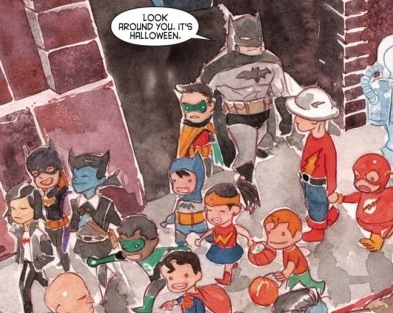
This week DC published a digital comic called Batman: Li’l Gotham, by Dustin Nguyen and co-writer Derek Fridolfs. It’s a Halloween tale about Batman introducing Damian Wayne as Robin to the custom of trick-or-treating.

This Dynamic Duo is never out of costume, so the pages don’t clarify whether Batman is Bruce Wayne in DC Comics’s current continuity or Dick Grayson during the last year of the last one. I felt the story really belonged in that earlier universe. Damian seems like a very new arrival to America. This Batman’s appreciation of holidays seems more like Dick. Of course, the Li’l Gotham universe doesn’t have to exactly match the standard continuity. (Would any other version of Damian be so excited about candy?)

I suspect that Nguyen created this story in early 2011 or before. He’d been experimenting with this watercolor chibi style for a few years, and DC published a couple of stories written with Fridolfs in 2009. Some of the art promoting the series still shows Nightwing in blue, Cassandra Cain, and other sights not included in DC’s new continuity.

As more evidence of the story’s age, look at the three figures in the left of the detail above. Batman fans would quickly recognize trick-or-treaters dressed as Cass Cain after she stopped being Batgirl, a Batgirl, and Klarion the Witch Boy in blue. Which Batgirl? The big smile and purple stripe down her leg suggest Stephanie Brown, and indeed Nguyen painted Stephanie meeting Klarion in Batgirl, #18, published for Halloween 2010. Contrarily, the red hair suggests Barbara Gordon, once and present Batgirl, who had appeared in Nguyen’s original Li’l Gotham poster. But it’s easy to change a spot of yellow into a spot of orange with Photoshop.

In fact, the Bleeding Cool comics gossip website showed just how easy. The image above comes from DC’s preview of the story, issued early on 31 October. Later that day Bleeding Cool labeled that Batgirl as Stephanie.

The image at left comes from the version I downloaded late on the afternoon of 31 October from ComiXology. Note how its Batgirl has dark hair and a purple stripe.

On 1 November Bleeding Cool shared another image, on the right, showing a further change: even the purple stripe is gone. Someone at DC had digitally recolored Nguyen’s watercolors to remove all visual allusions to Stephanie Brown.

Some observers interpreted these late changes as an attempt to catch up on an editorial mandate to wipe out all traces of that character. I suspect the motivation was to make that Batgirl look more like Barbara Gordon and thus match the current continuity.

But was that at all necessary? Once superhero fans might have been bothered by discrepancies, but today’s fandom seems to accept different versions of the same mythos. Just this week, for instance, DC Collectors highlighted paper dolls from Funko that include a definitely un-round Robin with a look not seen in DC’s main comics since Ronald Reagan’s first term and wiped out of existence in the current continuity. McDonald’s is offering Young Justice toys based on a TV cartoon set in a world all to itself. DC’s parent company is preparing to release a movie based on Lego Batman. It just made a bundle on Christopher Nolan’s “realistic” take on the mythos. Why put so much effort into making the Li’l Gotham world reflect the late-2011 continuity instead of the early-2011 one?

02 November 2012

The End of OIP Derangement Syndrome?

If your arguments and positions are solid, it shouldn’t be necessary to develop or fake the symptoms of OIP Derangement Syndrome to run against President Barack Obama.

It should be possible, for example, for a candidate who favors lower taxes to argue for them without claiming, as Mitt Romney has, “Instead of raising taxes, I will cut them.” In fact, federal taxes have gone down for the great majority of Americans under President Obama.

It should be possible for a candidate who thinks the federal government should be smaller and less active to make that argument based on facts. It’s not necessary to claim, as Romney did, “Instead of expanding the government, I will shrink it. . . . Instead of adding more regulations, I will reduce them…”

Again, those statements are false. The Federal Reserve of St. Louis shows federal employment shrinking. Overall government employment has shrunk severely because of the Bush-Cheney recession. Bloomberg News reported in October 2011 that “Obama’s White House has approved fewer regulations than his predecessor George W. Bush at this same point in their tenures, and the estimated costs of those rules haven’t reached the annual peak set in fiscal 1992 under Bush’s father.”

It’s possible for a candidate to argue that the Obama administration’s 2009 stimulus bill was unaffordably large or that it took the wrong approach to fighting unemployment. But it’s simply false to say, as Romney has, that the President ignored unemployment. That stimulus bill was aimed at unemployment. (And most American economists say it worked. Once again, it’s possible to argue we won’t be able to afford it in the long run, but Romney wasn’t satisfied with that.)

Of course, Romney isn’t the only example of OIP Derangement Syndrome in his party. Republicans have spread false information about Obama’s policies since 2008. The Bush-Cheney administration became notorious for disdaining “the reality-based community.” Romney simply proved himself most comfortable fitting around the false beliefs of his electoral base. He’s been seeking my vote for various offices since 1994, and after his one term as governor I’m not at all surprised by his political shape-shifting.

Romney’s latest examples of shifty mendacity—his new debate positions, his pilloried ad about Chrysler, and his Potemkin food drive after Hurricane Sandy (shown above)—damaged his standing with potential endorsers and perhaps in the polls. If he loses the vote on Tuesday, it would be nice to think that we the people realized that willingness to lie on important matters is a Bad Thing in an elected official.

Already the Romney campaign’s brazen lies have led journalists such as Kevin Drum, Jonathan Chait, James Fallows, and James Bennett to question what they say about our political system. Can we address problems, much less solve them, if a candidate is happy to ignore facts? Even Newt Gingrich, back when he was losing to Romney, complained, “You cannot debate somebody who is dishonest. You just can’t.” Not just for their own mental health but for the sake of the country, people with OIP Derangement Syndrome should try to recover their sense of truth and base their political arguments on facts.


Unfortunately, if we reelect Obama as President, those people are more likely to clutch onto even more outlandish explanations and false beliefs. And some of those people are already in elected office.

01 November 2012

When Authors Set Their Own Prices

For decades now, books have been one of the few American products that come with their price tags not just attached but integrally incorporated into them. That’s limited the flexibility of retailers. One of the changes wrought by digital publishing is that retailers can change the price of a product (or, to be precise about the big companies’ legalities, license) instantly.

The big bookselling sites offer that flexibility to self-publishers, and a couple of colleagues are taking advantage of it today.

Jason Rodriguez writes:

I just published my new sci-fi short, “The End of Stars,” to Amazon. It will be free on Monday but right now it is priced at 99-cents.

“The End of Stars” is a climate change fairy tale about a young girl who discovers that the sky is falling and tries to warn her neighbors before the village is destroyed. Due to the message in the story, I decided to donate all residuals made off of the book (I get 35-cents per download) through Sunday (and then it becomes free) to the Red Cross relief efforts centered on rescue and recovery following the destruction caused by Hurricane Sandy.

And, to sweeten the pot, I will also donate all of the residuals made off of my other sci-fi shorts over the next four days to the Red Cross, as well. For more info, please feel free to go to this link.
In addition, Chris Eboch has extended her Halloween special for the ebook edition of her novel The Ghost Miner’s Treasure through today. She writes:
This is book 4 of my Haunted series originally published by Aladdin/Simon & Schuster. My editor got fired and the publisher dropped the series, so I finally decided to self-publish the fourth book, which was already written. Book 4 can be read on its own. It’s spooky but not gory, much more a comedy/mystery than a horror novel, suitable for ages 8+.
The Haunted series features two siblings working with a “ghost hunter TV show” that (unlike most of them) finds actual ghosts.

The Color of Drama

Color is an element of comics I have very little handle on. I can spot broad patterns, like the contrasting worlds of brownish-red and blue-green in the Artemis Fowle adaptations. But more subtle color schemes need to be spelled out for me. (Spider-Man’s early villains were often green and purple because those contrast with his own red and blue—ohhh!)

I therefore latched onto this passage from Graphic Novel Reporter’s interview with Raina Telgemeier about Drama:
You worked with design studio Gurihiru to create a color scheme for this book that perfectly complements the tone of the story. Tell us a little bit about how you went about that.

Gurihiru (a two-women team, Kawano and Sasaki) is responsible for some of my favorite art and comics of the past half-decade or so. They illustrated the rebooted Marvel Power Pack series, and they’re working on the Avatar: The Last Airbender: The Lost Adventures with Gene Yang right now. They have a really soft, pleasing color palette, so I looked to them to help create the jewel-toned world of Callie’s universe, which I love.

In some cases, I had really clear ideas—the story is set in a specific part of California, where the weather and atmosphere are very distinctive. And because Gurihiru are Japanese and work through a translator, there were a few instances where they needed solid American references. Soda cans, the bookstore scene, things like that.
In the New York Times Book Review, Ada Calhoun praised that element of the art: “Telgemeier’s use of color, created with the design team Gurihiru, is eloquent; Callie’s amethyst-colored hair complements her suburb’s sky-blue skies and pistachio-green grass.”

Frankly I don’t see coloring the skies “sky-blue” to be that much of a stretch. But once the interview called it to my attention I could see how Telgemeier and Gurihiru had found a rich, luminous palette even as they stayed away from the stark primaries.