22 December 2011

“The lessons they want to hand down”

The Horn Book just sent me editor Roger Sutton’s interview with Daniel Handler on the textual side of Why We Broke Up. I don’t think it’s yet on the web, so this might be a reminder to sign up for the Horn Book’s electronic newsletter.

In any event, at one point Handler (né for book-buying audiences Lemony Snicket) says:
I don’t quite understand what YA literature is. To me it’s the genre where the authors publicly talk the most about the lessons they want to hand down to the reader, even more so than in picture books, I’d say. It seems like everybody who's writing a book for a fifteen-year-old is trying to save a particular kind of fifteen-year-old from a particular kind of thing.
That’s just not true. There’s a whole ’nother kind of YA lit whose valuable lesson about life is reassuring a fifteen-year-old that others are going through a particular kind of thing just like them, so they don’t need saving.

(Unless, of course, the “particular kind of thing” is the adolescent belief that nobody is suffering just like them, that everyone else in high school is having more fun than they are.)

But does Why We Broke Up at the end offer a sense of hope?

21 December 2011

Are Today’s Picture Books Too Short?

Last month, the reviewer, author, and former editor Anita Silvey delivered some sharp talk about picture books in School Library Journal, starting with the teapotted tempest about a New York Times article reporting that booksellers saw some parents hurrying their children through picture books to early novels:

I must admit, I’ve grown quite weary over the last few years of the all-too-predictable response from adults who champion children’s and teen books: attack anyone who makes critical comments about them. . . . The basic premise of the New York Times article—that new picture books are increasingly ignored in today’s marketplace—seems completely sound to me. During the 1990s and into the 21st century, picture books brought in about 33 to 35 percent of the revenue of any major publishing house’s list. As Houghton Mifflin’s publisher in the late ’90s, I observed years when picture books made up more than 40 percent of sales. But today that number has slipped to a mere 10 to 11 percent for most publishers. . . .

So outside of obvious demographics (the big teen bubble and adults who now read YA books), why has this magnificent genre [of picture books] fallen on hard times? It’s certainly not because children don’t need or want picture books. In fact, kids today appear happiest when the combination of art and text extends into chapter books like Jeff Kinney’s “Diary of a Wimpy Kid” series and even novels like Brian Selznick’s The Invention of Hugo Cabret.
Silvey thinks the crucial data is that new picture books aren’t selling, but older ones are, and concludes that the older titles offer features the newer ones lack.

One of those features, however, might just be being older. If parents are buying fewer picture books overall, the books they’re most likely to pick up might be those they recognize from their own childhoods.

The article doesn’t offer data for Silvey’s next conclusion: that older picture books are appealing because they’re longer and fuller. It notes the short word counts of two older books, but not the longer word counts of several others, and it’s not clear whether any of those are on the bestseller lists cited earlier.

Nevertheless, I suspect Silvey is right in her diagnosis. As she notes, there’s tremendous pressure on picture-book writers, especially new ones, to write very short, spare manuscripts:
During the last few years, publishers began to maintain that adults wanted shorter texts to read to children—because of the demands on their time and young readers’ shorter attention spans. In the 1990s, publishers believed that kids didn’t want novels longer than 200 pages—until J. K. Rowling set everyone straight.
While demanding that picture books not be “slight,” editors might be hemming authors in so much on word count that it’s extraordinarily difficult not to be. Is there actually a market space for new “picture storybooks,” or is that still simply a label hopeful authors cling to when they don’t want to edit down their wordy picture-book manuscripts? Are there enough readers of picture-book age to generate sufficient demand for a longer form?

20 December 2011

One-Page Wizard of Oz

This is an unabridged publication of L. Frank Baum’s Wonderful Wizard of Oz in poster form, available from Spineless Classics in the UK.

The same outfit has versions of Peter Pan, Treasure Island, and other classics, all in appropriate silhouettes.

But for £40?!

(I understand that expressing the price with the singular form of the currency—“Forty pound?!”—conveys indignation in British speech. But I could be wrong.)

18 December 2011

Not in the Mood

Of course, Robin still manages to get the pun out even as he insists he’s above such things now.

17 December 2011

Something That Makes Letterman Happy

A well-known critical voice on the opening of the CelebriGum photography exhibit at the Ameringer McEnery Yohe gallery in New York:
“At the very core of it, it’s stupid. And so if you take something stupid and magnify it to this extreme, then it’s really stupid. And I couldn’t be happier.”
That quote comes from the New York Times Arts Beat blog. The CelebriGum site itself says that the critic was actually instrumental in effecting the show.

16 December 2011

Dragons as an Evolutionarily Adaptive Construct

At Salon, Paul A. Trout summarizes the hypothesis of anthropologist David E. Jones’s An Instinct for Dragons:
Jones argues that the image of the dragon is composed of the salient body parts of three predator species that hunted and killed our tree-dwelling African primate ancestors for about sixty million years. The three predators are the leopard, the python, and the eagle.

According to Jones (what follows is a condensed summary of a complex argument), ancient primates evolved alarm calls to identify each of the three predators, with each call triggering the defensive response appropriate to the nature of the attack mode of the specific predator. Jones calls this predator-recognition template the “snake/raptor/cat complex.” This complex is the source of what Jones refers to as the “brain dragon.”

The brain dragon emerged when our apelike ancestors left the trees to walk on the ground. rather suddenly, the relatively small brain of Australopithecus had to process a lot of information about many new forms of predators and develop new alarms calls and strategic responses to them. Faced with information overload, the brain of Australopithecus resorted to lumping information into manageable and memorable chunks.

As a result, the cat, the snake, and the raptor were merged into a hybrid creature that had the salient predatory features of each: the face of a feline, the body of a snake, and the talons of a raptor. This is the hybrid “monster” that came to be known as the “dragon.”
But aren’t European dragons usually reptilian in their facial features? And what about the wings—or is that another carryover from the raptors?

15 December 2011

The Whole Tooth and Nothing But

In last Sunday’s New York Times a frustrated parent (who on second look I find is my college classmate Bruce Feiler) laid into the tooth fairy tradition:
Over the centuries, many cultures developed rituals to mark children’s loss of their deciduous teeth, which usually begins around 5 or 6. In some societies, witches were believed to covet discarded teeth for spells, so proper disposal was paramount. Children have variously tossed their teeth onto the roof (Vietnam, Haiti), buried them with ancestors (New Guinea), fed them to mice (Mexico, Afghanistan) or even burned them.

Americans were the first to popularize the idea of a tooth fairy early in the 20th century, though the custom did not become widespread until the 1950s, according to research by Rosemary Wells, a dental lecturer who lived in Chicago. American parents introduced two wrinkles to the age-old ritual, neither one for the better.

First, in the prosperity-obsessed climate of the 1950s, the tooth fairy began compensating children with cash for the alleged trauma of losing a tooth. Leave it to Americans to debase a perfectly good 3,000-year-old tradition by making it all about money.

Second, and even worse, while nearly all cultures mark the falling out of the first tooth, Americans extended the ritual to cover every tooth, a number that usually reaches 20. These days, losing a tooth is not a quaint right of passage, it’s the Ironman triathlon of parental obligation.
I can’t imagine that inflation has made this ritual any easier for parents. This year’s Visa survey of how much money the tooth fairy leaves per tooth found that the national average is $2.60. (In trying to calculate the median, I discovered that the proffered numbers on how many children receive what amount add up to only 82%, so who knows?)

I don’t think my brother and I ever saw more than small change from the tooth fairy back in the 1970s. Nowadays the idea of putting a dime or quarter in a child’s bed probably seems ridiculous. And what if she swallows it in her sleep and chokes?!

14 December 2011

The Crossover We’ll Never See

Russell Hoban died last night, the Guardian reports.

I remember being struck back in high school by the stark contrast between his delightful early readers and his post-apocalyptic novel. Could there be two authors named Russell Hoban? But no.

13 December 2011

“The First Teenage Print Culture” at the AAS, 20 Dec.

The American Antiquarian Society in Worcester, Massachusetts, has just announced this upcoming seminar:
On Tuesday, December 20, at 4:30 PM, Lara Langer Cohen--an assistant professor of English at Wayne State University, and a current American Antiquarian Society-National Endowment for the Humanities Long-term Fellow—will be presenting a regional academic seminar, titled:

Inventing Teenage Print Culture: The Postbellum Amateur Press


In the late 1860s, hobby printing presses for home use appeared on the market, leading to an explosion of amateur newspapers-nearly all written, edited, and printed by teenagers. Although amateur journalists were spread throughout the country, they were enmeshed in a tight-knit virtual community forged through exchanges; local, state, and national associations; and a determinedly insular focus; indeed, many amateur papers consisted of little more than columns of news about other amateur papers. This presentation will explore how the first teenage print culture helped shaped emerging ideas about adolescence, particularly the combination of rebelliousness and conformity we continue to associate with it today.
This seminar will take place in the the Society’s Goddard-Daniels House at 190 Salisbury Street, with refreshments and a dutch-treat dinner to follow. Contact Ann-Cathrine Rapp at AAS by Friday in order to attend.

Why do I post this on Tuesday, which I’ve reserved for stuff about Oz?

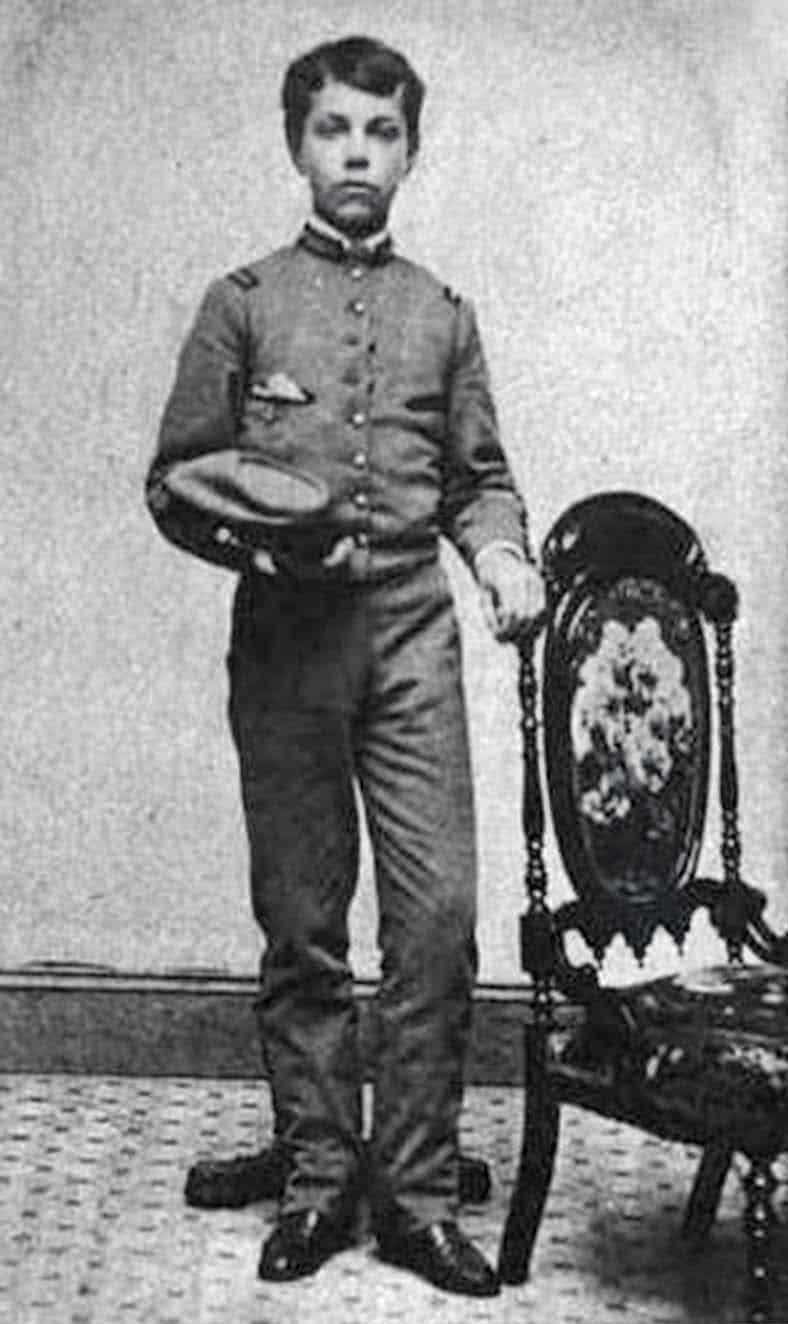
Because L. Frank Baum, born in 1856, and his brother Harry were participants in that “first teenage print culture.” In 1871 they wrote and printed a family newspaper called the Rose Lawn Home Journal, named after the family estate in upstate New York. It contained riddles, stories, poems, neighborhood news, and some advertisements for the family firm. (The photo above shows Frank in 1868 during his short career at a military academy.)

Frank went on to publish booklets about stamp-collecting and chicken-raising. Later in life, he used his printing skills to publish the weekly Aberdeen Saturday Pioneer newspaper and a book of his poetry called By the Candelabra’s Glare. For the latter, Baum asked W. W. Denslow to draw some decorative art, and their collaboration led in two years to The Wonderful Wizard of Oz.

What are the equivalent youth cultures today? One is, I suspect, the young folks who post videos on YouTube, commenting and favoriting back and forth. Networking is so much easier now.

12 December 2011

Wisest Thing I’ve Read Today

I much enjoyed editor Andrew Karre’s essay “#yamatters” at Hunger Mountain:

I’ve made the joke several times that there are two sure-fire ways to drive traffic to a blog or newspaper website. Barely informed speculation about a new Apple product is the first. Second is a half-baked analysis of the state of YA literature (“Think of the children!”). Sometimes this joke gets laughs. . . .

More than any other tech company, Apple thrives on disruptive technology. Remember the music industry before the iPod and iTunes? Remember what your cell phone looked like and what you expected it to do in 2006? Remember netbooks? And the list goes on. In short, a disruptive technology is some device or system that, when it enters an established market, changes everything. . . .

I believe modern novels for young readers—particularly YA novels—are a disruption in children’s books and maybe in books in general.
And just imagine what sort of disruption there will be when those crazy kids can read their books on their iPhones!

What? . . . Really?! . . . Oh, my god, the disruption!
Novels for teens and younger readers are substantially less intermediated and substantially more anticipated in real time. For affluent audiences of avid young adult readers, teachers and librarians no longer act as gatekeepers. They are still there, but now they’re just one of dozens of avenues for discovery. Fifteen years ago, authors were abstractions; today, they’re friends on Facebook, and we stay up until midnight to buy their new books at the moment of release.

Additional evidence of this disruption is abundant: Look at children’s and teen sections in stores and libraries now and fifteen years ago. Look at the sizes of book advances and print runs. Bestselling adult authors are writing YA novels (or feeling the need to deny that they’d ever do so—it’s the same thing really). Etc, etc. YA has disrupted children’s books.
Of course, this disruption follows the disruption of the Harry Potter series, with each volume rewriting the rules of publishing. Remember when it took months for books to be published on both sides of the Atlantic, when there was no New York Times best-seller list for children’s books, when everyone knew that eight-year-olds couldn’t possibly read more than 160 pages? And the scary part is that it’s the same readers!