10 October 2007

Thanks to the People of Seven Up

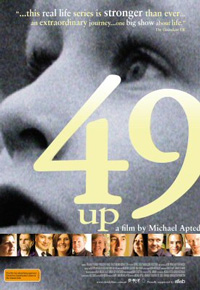
Last night I watched Michael Apted's 49 Up, the latest installment in the long-running Up Series of documentaries. Starting with Seven Up in 1964, these films check in on several British citizens every seven years. (There's a more general review of this movie and the series at documentaryfilms.net.) I think I came across these movies when its subjects were twenty-one or twenty-eight years old, which means I've been checking in on them for half their lives.

A recurring theme in the recent documentaries, including the latest, is how much of an imposition it's been to participate in the series. The interviewees were chosen over four decades ago by their headmasters because, I suspect, they were a little more open and articulate than the average seven-year-old. And now they've been asked to examine their lives before the English-speaking world every seven years. Some people have dropped out of the filming, temporarily or permanently, while others shield parts of their lives from the cameras.

So I feel I should express my gratitude to those brave people. I've enjoyed watching them because their lives and interviews have offered such insight into what it's like being human. Since I'm a few years younger, I've been able to watch them age and foresee my own changes. It's reassuring to see these strangers build families and find fulfillment, sad to hear about their losses, worrisome to see them taking risks. Naturally, a two-hour documentary every seven years can show only slices of their lives, but these slices are also a slice of humanity as a whole.

As to this installment, among its major themes seems to be real estate. A number of the interviewees have invested more of themselves in their homes (or second homes). It was also interesting to hear the dissatisfaction with Tony Blair's government at the time the film was shot, coming from both the left and the right. What will life bring at fifty-six?

09 October 2007

Library of Congress Uses Oz to Promote Literacy

The Library of Congress has launched a simple online game called "Storybook Adventures" that draws heavily on knowledge of The Wonderful Wizard of Oz for its first round.

And by that I don't mean the more basic story of The Wizard of Oz as it's been popularized by the MGM movie. The game's questions, like those on "The Little Mermaid" and "Aladdin" in the following rounds, are obviously designed to test people's knowledge of the written versions of those stories rather than the most popular movie versions. They ask about details not in the films.

The game isn't immediately easy to find. You can start here, wait for the animation, and then click on the box marked "Play!" Or you can go straight to the game, watching the countdown to start. At the end there's an e-card reward or something.

And of course every book today, even one published 107 years ago, needs a book trailer.

08 October 2007

Ministers Redefining the Meaning of Halo

Only two days after inkygirl revealed an anti-unhappy endings group featured in a British tabloid to be a marketing hoax, the New York Times published a front-page dispatch by Matt Richtel that seems equally ridiculous--and yet I have no doubt it's true:

Across the country, hundreds of ministers and pastors desperate to reach young congregants have drawn concern and criticism through their use of an unusual recruiting tool: the immersive and violent video game Halo. . . .

Those buying it must be 17 years old, given it is rated M for mature audiences. But that has not prevented leaders at churches and youth centers across Protestant denominations, including evangelical churches that have cautioned against violent entertainment, from holding heavily attended Halo nights and stocking their centers with multiple game consoles so dozens of teenagers can flock around big-screen televisions and shoot it out. . . .

Complicating the debate over the appropriateness of the game as a church recruiting tool are the plot’s apocalyptic and religious overtones. The hero’s chief antagonists belong to the Covenant, a fervent religious group that welcomes the destruction of Earth as the path to their ascension.
So some ministers are trying to turn underage teens into apocalyptic zealots by offering them the chance to pretend to kill apocalyptic zealots--all in the name of a religion that counsels peace and love. Yeah, that "complicates" things, all right.

07 October 2007

A Girl's Guide to the Superhero Life

NON-COMICS WEEK (and a day) at Oz and Ends comes to a close with a look at a superhero genre novel aimed at girls. Zoe Quinn's Caped 6th Grader series starts with Happy Birthday, Hero! I've already discussed two types of anachronisms in this book, but today I'm comparing this book's approach to the superhero life with that in similar novels about boys, such as William Boniface's The Hero Revealed.

Both books take place in a world of full of superheroes, with families passing down extraordinary powers. Kids collect comic books and other artifacts about grown-up heroes. (The Hero Revealed explores the marketing of such artifacts while Happy Birthday, Hero! has more fun at the mall: among the earring stores its protagonist visits are the Piercing Post, Hoop De-Doo's, Pierce-sonal Preference, The Stud Farm, and Lobe-and-Be-Holed.)

Both books have big, energetic illustrations, and Happy Birthday, Hero! also uses big type for sound effects, as in comics. I can't tell whether readers are meant to see a reference to straightening the Tower of Pisa as an allusion to Superman III, but clearly its readers are supposed to know the traditions of superhero comics.

When it comes to superheroing, Happy Birthday, Hero! puts a lot more emphasis on secrecy than The Hero Revealed. After Zoe hears that she's developing superpowers, she doesn't immediately try them out. (Think of "Will" in the critically lambasted Dark Is Rising movie, asking "Merriman" if he'll now be able to fly; a lot of fans of the book have criticized that moment in previews, but it's exactly what an American boy would do.)

Instead, Zoe wonders, "Is everything going to have to change?" The big drama for her is the secrecy of swearing to follow the superhero code, particularly keeping the secret from her mother. Overall, her view of superheroing emphasizes the emotional side:

But as far as I was concerned, the thing that made her [Lightning Girl] truly heroic was the fact that she never pretended she wasn't scared.
I don't think that concern shows up in any of the boy-superhero books.

In fact, while I criticized The Hero Revealed for putting only one token female on its superhero teams, I found Happy Birthday, Hero! to be even more colored by gender stereotypes. And by "colored," let me start by pointing out this is the pinkest book I've read in a long time. Beyond that:
  • Zoe's first sign of trouble from her encroaching powers is when she can't get her ears pierced.
  • On page 64, she uses her new powers to choose an outfit for school.
  • Page 97 brings Zoe her first crime to thwart: a robbery in a jewelry store.
And here's the moment that shows how superpowers can be so embarrassing:
Feeling brave, I decided to try one of the cute gestures Emily's magazines were always recommending: I tilted my chin and gave my hair a little toss.

Unfortunately, it turned out to be a superpowered turbo hair toss, and the sweeping motion of my flowing locks created a gust of wind that toppled the prop table.
By the end of the book, Zoe hasn't gone far in her superhero career; this is just the first in a series, and it's slim. But she has discovered that other girls made unauthorized alterations to a costume for a school play. Oh, the villainy!

Maybe those details sprang out at me more forcefully because I'm a former boy rather than a former girl, or because they stand out in the superhero genre, which has traditionally been dominated by a masculine sensibility. But I think this is probably an example of mass-market fiction playing off society's dominant attitudes rather than daring to challenge them.

06 October 2007

Looking for the Great American Superhero Novel

A few days ago, toward the start of NON-COMICS WEEK, I posited that the increasing respect for comics in our culture has opened the door for "literary" novels about comics creators, both children and adults. Another, less high-falutin' result of the same trend is more prose novels about superheroes. Not just characters with special powers, like Harry Potter, but characters whose fantastic powers and worlds are based on American superhero traditions.

In American literary publishing for adults, we have Jonathan Lethem’s The Fortress of Solitude (2003) as the most prominent example. For kids, the trend seems to be largely confined to mass-market series, such as Dan Greenburg's Maximum Boy and Greg Trine's Melvin Beederman, Superhero.

Which brings me to William Boniface's Extraordinary Adventures of Ordinary Boy series, starting with The Hero Revealed. Boniface is actually Jon Anderson, who worked at Penguin and now heads Running Press. He comes by his superhero knowledge honestly: he was once buyer of graphic novels for Barnes & Noble.

For more background, see this video interview at First Book. And according to an interview with Anderson's hometown paper, the Argus Leader:

"Ordinary Boy" was written during a four-month period when Anderson devoted himself to his story full time. He sold the manuscript to the first publishing house he approached. But the whole process screeched to a halt with the arrival of a movie about another superhero family. "'The Incredibles' has been haunting me," Anderson says.

In spite of being written nearly two years before "The Incredibles" took center stage, HarperCollins decided to delay the release of "Ordinary Boy" so as not to appear to be riding the coattails of the hit animated movie. Even now, as Ordinary Boy takes his turn in the spotlight, "Incredibles" comparisons persist.
(That article is no longer on the Argus Leader website; I pulled it from a Google cache.)

That worry about "riding the coattails" seems to be missing the point of all of today's superhero books, movies (e.g., Sky High), and TV shows (e.g., Heroes), not to mention the current state of superhero comics publishing. It's all self-referential. Everyone is chasing each other's coattails. Readers are expected to spot cross-references and allusions. So let's hear no more about the genre being derivative; that's the point.

The Hero Revealed exemplifies a number of trends in recent superhero novels for kids. It takes place in a world with a plethora, a veritable surfeit, of superpowered criminals and crime-stoppers; these books tend to be inspired by the DC and Marvel "universes" rather than individual hero legends. The protagonist is a growing member of that society; in The Hero Revealed, Ordinary Boy is special because he doesn't appear to have any powers.

The genre emphasizes comedy, finding it in the awkward disadvantages of superpowers. These books usually have a lot of illustrations in an energetic, humorous style. The Ordinary Boy series is part of the subcategory--maybe half of the genre--that plays off the marketing of superheroes to kids.

The Hero Revealed is on the long side--almost 300 pages. But it's not terribly tight. On pages 132-3, for instance, OB spends five paragraphs reviewing the mystery and his feelings about it for us readers. And then he tells his parents exactly the same things in one big paragraph on page 134.

The book starts slowly, with 30 pages before "an enormous muffled explosion" inaugurates something like a plot. Up to then, Boniface has simply filled us in on Superopolis society with a maps, trading card-like character profiles, and backstory. It's possible to be too self-referential.

One big, old-fashioned flaw in this book, not shared by all others in the genre: as in the earliest versions of Superfriends, each group has a token female. The main crime-fighting organization, the League of Ultimate Goodness, includes one woman, and her sole job is to make the leader feel good about himself. (I'm not making that up.) Does Ordinary Boy's club do any better? No, they, too, have only one female member.

TOMORROW: A superhero novel from a female point of view.

(Publishers who are looking to get into the superhero novel genre should ask Greg Fishbone for a look at his How to Be a Superhero manuscript.)
05 October 2007

The Weight of Hugo Cabret

Yesterday I discussed how I think the illustrations and text of The Invention of Hugo Cabret work together cinematically, unlike pictures and words in picture books, traditionally illustrated novels, or comics. Today I'll discuss how well the book worked for me.

The story surely qualifies as a novel, but it's no more complex than a lot of other middle-grade fiction. As a story it's fine but not great. The prose is often prosaic, and not just because I see my least favorite word, “excitedly,” on page 115. The point of view can suddenly shift (“Isabelle's foot felt like it was broken,” page 298), and a French boy comes out with, “OK.”

I will here acknowledge the obvious, that the prose in Selznick's first novel is much better than my drawings will ever be. And those drawings do make The Invention of Hugo Cabret a more interesting project to study, both as a reader and as someone who works on books. As an object, the book is undeniably impressive.

In the end, however, I kept wondering whether this novel was worth its extra weight in paper. It's 300+ pages longer than a typical middle-grade, but the story didn't seem more full. Furthermore, that paper is extra-thick and extra-white to preserve the rich blacks of Selznick's art. The binding, Selznick said at this winter's SCBWI conference in New York, is an innovative type that lets the book lie flat, with nothing swallowed into the gutter (more like a movie screen).

All that paper produces a thick brick of a book. Both Hugo Cabret and Harry Potter and the Order of the Phoenix are 2.1 inches thick, according to Scholastic’s web catalog, and about the same weight. But HP5 is 870 pages, and Hugo Cabret 544. (The official page count is 533, but the real count must be divisible by 16.) That means the same shelf space contains two-thirds the number of pages for storytelling.

Furthermore, many of those pages are, as I discussed yesterday, pictures meant to be looked at for just a second. Some might say that each picture is worth a thousand words, but in this case a lot of the pictures repeat information because they're inspired by a cinematic model: one image zipping by after another. At the end, for example, there are fourteen pages of the Moon fading; those spreads produce an impression, to be sure, but they're not the informational equivalent of 7,000 words, or even fourteen book pages. All-black pages punctuate scenes
, like a movie fading to black. Again, that storytelling technique works by evoking cinema, but it also adds to the book's heft without adding much to the content.

As a result, for me Hugo Cabret seemed a little inflated. I won't be surprised if Hugo Cabret becomes a landmark in book design and graphic storytelling, but I kept wondering if it will turn out to be a children's favorite.

(Despite its size, Hugo Cabret is not burdened with a high price. Its $22.99 is about two-thirds of the jacket price of Harry Potter and the Deathly Hallows for about two-thirds the pages. Looked at in another way, it's about the normal cost of an adult novel that's half as long. How is it economically possible for Scholastic to produce this book at that price? Hugo Cabret was printed in Singapore.)

04 October 2007

A Real Graphic Novel: Hugo Cabret

The Invention of Hugo Cabret, by Brian Selznick, is a graphic novel. Unfortunately, in a bid for literary respectability a couple of decades ago, comics genius Will Eisner coined the term "graphic novel" for what was in fact a collection of his comics. Thus, when we now hear "graphic novel," we think "comics over 48 pages long that take themselves seriously."

But Hugo Cabret actually has the length, plot, and undeniable weight of a novel. Its graphic elements are a crucial part of the storytelling, both in content and theme. It's therefore a graphic novel. But it's not comics.

The pictures in Hugo Cabret don't work like the pictures in comics. They're sequential, to be sure, but only one image is visible on each page spread. We move from one to the next through by turning pages, so we can never take in two images at once.

Furthermore, those pictures don't combine words and images the way most comics do. In fact, the pictures are almost empty of words. One shows a sign over an old man's toy stand which says, "JOUETS"; most American readers won't be able to read that. Another picture shows an automaton signing the old man's name. In all the rest, including scenes in the train station and in a bookstore, there are no signs or titles to read. On page 143 Hugo reads a note, but we readers never see an image of that note, even one created typographically.

Hugo Cabret actually tells us what storytelling model it's based on. On page ix the yet-unnamed narrator asks us to imagine that we're in a cinema, with the curtain opening on a screen. To reinforce that point, the book contains several stills from movies, such as Safety Last and A Trip to the Moon.

After the young characters sneak into René Clair's The Million, the text tells us that Hugo “thought every good story should end with a big, exciting chase.” And sure enough, two hundred pages later there's a big chase through the tunnels of the railroad station with the background blurring to convey the speed. (This is a technique from Japanese comics as well as cinema.) At the end of that chase Hugo gets caught and locked up, but no matter; on page 458 he escapes again, so that pursuit seems to be in the book just for the excitement.

Selznick's pictures work like movie shots, not like comics panels or picture-book spreads. Sequences of drawings narrow in on details, track moving characters, cut and dissolve from one image to another.

Furthermore, we're really supposed to look at each image only once before moving on to the next. The pictures don't reward close examination or reexamination. In a scene of Hugo making his way across the crowded train station, for example, his face is the only one that's clearly rendered, focusing our attention on him just as good Hollywood lighting and cinematography would. There are no important details to collect after your first impression. These images are like frames of a film, each a burst of visual information rather than a landscape to visit at your leisure.

TOMORROW: So what does that all add up to?

03 October 2007

A Lunch Money Date

Yesterday I wrote about how Andrew Clements's Lunch Money uses comic books to explore the issue of commercialism in kids' lives; I posited that comic books' place in American culture makes them uniquely appropriate for that theme. Choosing comics as the field on which his characters maneuver lets Clements explore another theme as well.

Traditionally, American comics have been a gendered medium, with some titles published for girls and others--the greater part--for "fanboys." Now female readers drive the sale of "manga," but that simply reinforces the same divide. We even have imprints like Minx targeting just one sex.

Some categories of books display a similar gender divide, but that's a matter of content (sports, romance, trucks) or style (pink, which characters are on the cover) rather than format. (I'm not saying these divisions are firm, strictly enforced, or a good idea. But they exist.)

Lunch Money divides characters along that traditional gender line in portraying how they think about comics as they enter the story. The fans include:

  • Greg's father, a comic-book collector
  • Greg himself, who occasionally buys comics as investments and draws his own, also to make money
  • Ted and Roy, Greg's customers in the sixth grade
  • Mr. Z, the math teacher
The characters who start out cool or hostile to comics are:
  • Maura, Greg's across-the-street neighbor and rival since kindergarten. After she's drawn a picture book, Maura tells Greg, "I know you said mine isn't a comic book, but I don't really get what that means. Prob'ly because I haven't looked at comics books much. Tommy has some, but I never got into reading them."
  • Principal Davenport, who tells Greg: "This is a comic book, and in my view, comic books are practically toys, and bad toys at that. This is hardly what I would call a book."
The gender divide is mighty clear, isn't it?

Lunch Money can thus be not just a story about money, but also a story of crossing that gender gap, with comics as the bridge. Maura reads McCloud's Understanding Comics, and starts drawing her own comic books. They're still about unicorns and princesses, but they use the hitherto male language of panels, speech balloons, and sound effects. And eventually the school principal admits she's "read comic books for the first time in my life."

We also see another bridge between the sexes getting built. ***SPOILER*** Near the end of the book Clements drops the news that Greg and Maura have made "one awkward attempt at holding hands." And all because of comic books.

02 October 2007

Where the Lunch Money Goes

Lunch Money is one of Andrew Clements's best "school stories." This one mainly follows Greg, a sixth-grader who's a little too interested in money. The book starts in a rare fashion, flashing back to Greg as a preschooler to show that this interest is long-standing. That's well below the age of the book's target audience, and well before its plot starts; Clements has the track record to get away with that, but it's not advisable for new authors.

I suspect Lunch Money was inspired, at least in part, by the increasing commercialization of American public schools, along with other public institutions: museums, public broadcasting, tax collection, national defense, and so on. Chapter 17 says:

On the first day of school Mrs. Sanborn had required that all the kids tape covers onto their new books. And the glossy book covers Mrs. Sanborn had handed out were loaded with pictures of high-school athletes wearing Nike shoes and Nike shirts and Nike shorts and hats and warm-ups. And Maura realized that every social studies book in the classroom was trying to sell her something.
This realization comes right after the school principal, citing school committee policy, has forbidden any students to sell comics books in school.

Given those themes, it makes sense for Lunch Money to use comic books as its main props. Greg creates tiny, hand-drawn comics about cavemen and superheroes to sell at his school. Maura, his long-time rival, starts to make little picture books about princesses and unicorns, but then a one-night reading of Scott McCloud's Understanding Comics reveals her to be a natural at sequential-art storytelling. (Kids, don't try this at home; McCloud's books require much more time to digest. Besides, Making Comics is now a more practical guide.)

The school principal tries to halt the sale of "small comic books" specifically. Bottom line: Lunch Money is about the debate over what's permissible in school and what's impermissibly "commercial," about the line between healthy commerce and money-grubbing.

Our culture has traditionally treated mass-market adventure comics as more money-grubbing than almost any other form of printed stories published for kids. This despite the fact that they're usually less expensive, at least in the periodical form, than "real books." Of course, comic books do contain ads, they're designed to make you buy the next issue, and without plastic bags and care they don't last as long as hardcover picture books. But still.

I think the main reason comic books are seen as perilously "commercial" is that they've been marketed and priced for kids themselves. In contrast, adults tend to pay for picture books and middle-grade novels like Clements's, and thus control the purchase. Comic books are one of the few things that Greg buys with his own money, when he's willing to part with it.

When our culture looks down on comic books as commercial, it may not be the actual expense that scares us but the financial autonomy of young consumers.

01 October 2007

The Back of The Man in the Ceiling

NON-COMICS WEEK at Oz and Ends continues with thoughts on novels about creating comics--more specifically, creating adventure comics of the sort that dominate the field in America.

As comics have achieved more literary respect, so respectable fiction has opened up to stories about the crafting those comics. The leading example in literary fiction is Michael Chabon's The Amazing Adventures of Kavalier & Clay, which won the Pulitzer Prize in 2001, the year after it was published. Can you imagine an American novel published in the 1950s through the 1980s that treated the creation of a superhero comic called The Escapist as a serious enterprise? Showing an author or artist toiling in that field would more likely have signaled creative frustration or a fall.

I think the real start of this trend was Jules Feiffer's The Man in the Ceiling, published for young readers in 1993 and put on some of that year's "best" lists. It's about a boy named Jimmy trying to create comics for popularity and self-respect, against a backdrop of his uncle's efforts to write a Broadway musical and ordinary family life.

Feiffer had already written about the comics he drew as a boy in The Great Comic Book Heroes. I think there's a fair amount of autobiography in this first novel. As I wrote earlier, The Man in the Ceiling doesn't have the period detail to set it in the 1930s and ’40s, when Feiffer grew up, but neither does it quite feel like it's taking place in the 1990s. One of the giveaways is the type of comic book Jimmy creates; his stories seem to reflect the anything-goes period when superheroes were still new rather than the continuity-, celebrity-, and event-driven business of the last two decades.

In addition to treating comics as a respectable hobby for a young fellow, The Man in the Ceiling also took a step forward in integrating text and illustration in a middle-grade novel. Now we see a lot more of that: Ruth McNally Barshaw's Ellie McDoodle, Jeff Kinney's Diary of a Wimpy Kid, and Greg Fishbone's Penguins of Doom are all very recent examples.

How tightly are words and pictures integrated in The Man in the Ceiling? Here are the novel's last words:

Jimmy dug his head deep into Uncle Lester's shoulder, forcing him to bring his right arm up to get a better hold. His right hand grasped a sheet of paper that Mother had not noticed before. Uncle Lester gripped it tight, as if it meant the world to him. Mother tried to see what was on it, but couldn't, so she moved quietly and swiftly down the steps to get a better look.

See for yourself, it's the last page of this book.
You then turn the page and see--well, I'm not going to spoil it. But I will say that this ending doesn't translate well to an audiobook. I had to go back to the library for a print edition in order to understand what was going on.
