22 August 2023

Baum’s Contradictory Characters

In my Characters of Oz essay “A Good Man but a Bad Wizard?: The Shifting Moral Character of the Wizard of Oz,” I took the opportunity to talk about L. Frank Baum’s successful characterizations in general:
Baum built most of his best characters around contradictions. Ozma looks and plays like a young girl, but she is a dedicated monarch and, later books say, a powerful fairy. The Scarecrow and the Patchwork Girls are literally dummies made of cloth, straw, and cotton, yet they are among the most intelligent people in Oz. The Tin Woodman is metallic but warm-hearted. The Shaggy Man is a hobo proud of his ragged appearance. Jack Pumpkinhead is a tall man with the mind of a child. Tik-Tok the robot is utterly reliable and liable to run down at any moment. Even Dorothy is a paradox, a simple little girl who spends most of the first books in the series deposing one ruler after another like Napoleon sweeping through Europe.

Resolving those paradoxes, Baum came to understand, rendered the characters far less interesting. The Wonderful Wizard of Oz settled the contradiction inherent in the personality of the Cowardly Lion by dosing him with courage, leaving him as a stereotypically brave lion ruling the forest. That character was no longer as compelling, and he had no role in the next book. When Baum brought the Lion back in Ozma of Oz, the first thing the character says is to assure Dorothy and readers that he’s “As cowardly as ever.”
(That’s my original text. The printed page says, “Tik-Tok the robot is utterly unreliable,” shifting the contradictory fulcrum within the sentence by a couple of words. I’d never want to call Tik-Tok that when he could hear me—i.e., when he’s wound up. It’s not his fault that other people neglect to wind him.)

Of course, in the essay I then had to tackle why Baum resolved the interesting contradiction he originally built into the character of the humbug wizard by making him a real wizard. And does that make the Wizard uninteresting?

15 August 2023

“Dorothy the Conqueror” Now Online

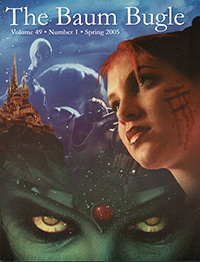
Back in 2005, the International Wizard of Oz Club’s journal, The Baum Bugle, published my article “Dorothy the Conqueror.”

It discussed the character of Dorothy Gale as L. Frank Baum developed her, from a little girl who called herself “small and meek” into a bold adventurer. That boldness had always been part of her character, but after her first trip to Oz she knew it. By the end of Baum’s series, she was happy to set out for unknown parts of Oz because “all excitement is fun.”

The article also points out ways that the MGM movie’s treatment of Dorothy doesn’t reflect that character, especially in her baffling speeches at the end.

The Oz Club has now made the text of “Dorothy the Conqueror” available for anyone to read through this webpage. It even comes with citations in both Chicago and MLA style.

18 July 2023

Call for Presentations at the CharlOz Festival

On September 27-29, 2024, the city of Charlotte, North Carolina; the University of North Carolina at Charlotte; and other organizations, local and national, will host CharlOz, a three-day festival exploring The Wonderful World of Oz and its cultural legacy.

The event is now open to proposals for presentations on almost any aspect of Oz, particularly:
  • History and Culture: Oz’s reflection of American history and/or culture
  • Social and Economic: Aspects of Oz relating to race, class, disability, or childhood
  • Visual and Performing Arts: Analysis of the visual or performing arts as they relate to Oz
  • Literary Arts: Authors and/or illustrators who have adapted Oz, and how those adaptations fit into the larger framework Oz provides
  • Gender Studies: Oz themes that examine gender roles/norms/traditions and sexualities, including LGBTQIA+ Oz portrayals of education, love, herosim, self-reliance, and teamwork
  • Technology: Application of non-traditional technologies that include podcasts, games, making, or other examinations of how varied technology transforms Oz themes
  • Mass-Marketing: Presentations of how a creator’s mass-marketed Oz work fits within the larger Oz world
Presentations can take the form of individual talks, group talks, workshops, roundtables, or panels.

The guidelines for submitting a 250-word proposal are on this page. The submission deadline is November 17, 2023. The organizing committee will respond to submitters by the end of January.

11 July 2023

Contents of The Characters of Oz

Last week I introduced The Characters of Oz, a collection of essays that I contributed to, edited by Dina Schiff Massachi.

Since I don’t yet see this information on the web in a form easy to search out, I’m sharing the contents of this book.
  • Introduction — Dina Schiff Massachi
  • Dorothy and the Heroine’s Quest — Mark I. West
  • But First, There Was a Scarecrow... — Katharine Kittredge
  • Heart Over Head: Evolving Views on Male Emotional Intelligence and the Tin Woodman — Dina Schiff Massachi
  • The Proto-Sissy, the Sissy, and Macho Men: The Cowardly Lion in The Wonderful Wizard of Oz, the MGM The Wizard of Oz, and Dark Oz Stories — Dee Michel and James Satter
  • A Good Man but a Bad Wizard? The Shifting Moral Character of the Wizard of Oz — J. L. Bell
  • Witches, Wicked and Otherwise — Robert B. Luehrs
  • Witch's Familiars or Winged Warriors? Liberating the Winged Monkeys — Dina Schiff Massachi
  • Glinda and Gender Performativity — Walter Squire
  • Ozma, Sorceresses, and Suffrage: Women, Power, and Politics in L. Frank Baum's Land of Oz — Mary Lenard
  • A Living Thing: The Very American Invention of Jack Pumpkinhead — Paige Gray
  • Trading Knitting Needles for Pistols: The Feminist, Violent, and Sexual Evolution of General Jinjur — Shannon Murphy
  • The Nome King — Angelica Shirley Carpenter
  • Piecing Together the Patchwork Girl of Oz — Gita Dorothy Morena
  • Afterword: Frank and His Imagination — Robert Baum
  • Bibliography: Further Oz Readings, Fiction and Nonfiction — Dina Schiff Massachi
In other (surprising) news about this book, it’s been printed, and McFarland is taking orders.

04 July 2023

The Characters of Oz and the Character of Oz the Wizard

Later this year McFarland will publish The Characters of Oz: Essays on Their Adaptation and Transformation, edited by Dina Schiff Massachi of the University of North Carolina at Charlotte.

The publisher says, “This collection of essays follows Baum’s archetypal characters as they’ve changed over time in order to examine what those changes mean in relation to Oz, American culture and basic human truths.”

Among those essays is my own “A Good Man But a Bad Wizard?: The Shifting Moral Character of the Wizard of Oz.”

One of the few lines that appeared in both L. Frank Baum’s original novel and the 1939 MGM movie was the Wizard’s insistence that he was “a good man, but a bad wizard.” Within that first novel the Wizard was a humbug whom people believed in, a tyrant who benefited his people, but ultimately someone Dorothy couldn’t rely on.

Just a few years later, however, the American public knew the Wizard of Oz unambiguously as a bad man in the Wizard of Oz stage extravaganza. And a few years after that, Baum brought the Wizard back as a stalwart friend for Dorothy and eventually a real magic-worker. This essay analyzes those changes in his persona across media and moral boundaries.

Other articles in this collection include Katharine Kittredge on Dorothy, Dee Michel and James Satter on the Cowardly Lion, Walter Squire on Glinda, Paige Gray on Jack Pumpkinhead, and Angelica Carpenter on the Nome King, among many other experts. Dina Massachi wrangled the contributors and provided her own exploration of the Winged Monkeys.

29 August 2022

The First Part of “The Donnington Affair”

In 1914, Max Pemberton published part of a murder mystery in a magazine called The Premier. It was titled “The Donnington Affair.”

Pemberton sent proofs of the story to G. K. Chesterton, inviting him to complete the mystery with a pleasing solution.

Chesterton obliged, bringing in his sleuth Father Brown. The result is an oddity in Chesterton’s oeuvre, not included in the first Father Brown omnibuses.

After Chesterton fans rediscovered the story, anthologists began to include “The Donnington Affair” in collections of the Father Brown stories—but usually only Chesterton’s part. The result is less than fully coherent. (A 2012 edition of The Complete Father Brown is indeed complete.)

Pemberton lived until 1950, so his work remained under copyright protection in the U.K. until 2020. That year, the Chesterton Review published the whole story, but that issue is behind a paywall.

Fortunately for people who like a complete narrative, Metropolitan Magazine bought the U.S. serial rights in the story, and Google has digitized the issue that includes Pemberton’s part. So you can start reading the tale here. There’s even a picture by Dalton Stevens.

The same volume of Metropolitan includes stories by Booth Tarkington, Mary Roberts Rinehart, Richard Harding Davis, Joseph Conrad, E. C. Bentley, and more; nonfiction by John Reed, Lincoln Steffens, Walter Lippmann, Francis Ouimet, and H. G. Wells; and humorous tales each with one illustration (not, unfortunately, comics) by Harry Grant Dart.

19 May 2022

Drama about a Dress

One of the blue gingham dresses worn by Judy Garland in the MGM Wizard of Oz is up for auction. Or maybe not.

WTOP reports that a court has ordered the auction house not to proceed until it works out whether the seller, Catholic University in Washington, DC, really owns the garment.

At issue:

The family of Gilbert Hartke, who was Catholic University’s longtime drama director, said the dress was given to him by actress Mercedes McCambridge as a personal gift after he helped her battle substance abuse.

The university said that the dress was presented to Hartke in his official capacity as a professor of drama at the university.
Catholic University provided evidence that Hartke wanted the dress to be displayed at the campus theater, named after him.

The garment went missing for decades and was found on campus last year. Some smart lawyers might argue that treatment negates Hartke’s gift to the school.

But of course Catholic University’s position is that the dress never belonged to Hartke individually anyway. He had, in fact, taken a vow of poverty.

All this matters because the collector’s price for the dress might be $1 million.

04 April 2022

The Opening of the Emerald City

My last posting explored the location of the original gateway into the Emerald City, the one Dorothy and her friends use in L. Frank Baum’s The Wonderful Wizard of Oz.

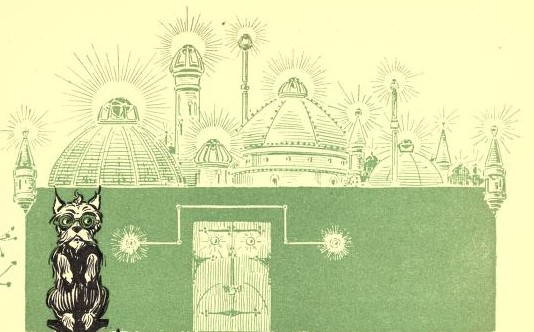
The travelers come to an emerald-studded gate at the end of the Yellow Brick Road. That outer gate leads to a room inside the thick wall with an inner gate on the other side. The little man inside is therefore called the “Guardian of the Gates” even though there is only one opening the in wall. (With his typical inconsistency, Baum also called this character the “Guardian of the Gate,” sometimes within the same chapter.) Thus, the many early references to the city “gates” don’t mean there’s more than one gateway through the wall.

When characters arrive at the city in The Marvelous Land of Oz, Baum describes their experiences in much the same way as in the first book. The Guardian of the Gates greets them and hands them off to the Soldier with the Green Whiskers. Characters speak of “the gate” of the city.

At the same time, it’s clear that there have been changes in the Emerald City. While before the gate was studded with emeralds, the jewels inside the city only appeared to be emeralds because people wore green spectacles. In Land the city contains some real jewels. General Jinjur and her soldiers don’t fear blindness without the spectacles.

More pertinent to this inquiry, in Wizard the Guardian tells Dorothy and her friends there’s no road to the west because no one ever travels that way for fear of the Wicked Witch. In Land the Sawhorse follows “the road to the West.” It’s not clear whether this path begins at the same gate where the Yellow Brick Road ends.

Finally, toward the end of Land Baum tells us that “Jinjur had closed and barred every gateway” into the city. While other passages in that book refer to “the gate” as if there’s still only one, the phrase “every gateway” definitely implies that by the time of Jinjur’s brief rule the city had more entrances.

Once again, this fits with what we know about overall politics in Oz. When the Scarecrow becomes ruler of the Emerald City at the end of Wizard, the Wicked Witches of the East and West have been eliminated. He’s on good terms with Glinda to the south. His friend the Tin Woodman will now govern the west. It would be safe to welcome visitors to his city.

I therefore surmise that between Wizard and Land the Scarecrow began the process of building more gates into the Emerald City walls. Perhaps not as large as the original gate, or perhaps (given the peacetime conditions) larger. Likewise, the Scarecrow and Tin Woodman probably promoted the new road from the city to the west.

Commerce and travel between the parts of Oz was probably still slow in this period. The Scarecrow met Gillikins so rarely that by the time of Land he hadn’t learned they speak his language. Yet General Jinjur could assemble an Army of Revolt of young women from all four outer realms of Oz. (Indeed, Jinjur’s uprising might have been the first pan-Oz movement, at least for several decades.)

Another sign of Oz opening up to travelers appears when we consider the “road to the South” to Glinda’s castle. At the time of Wizard, that route ran into the Fighting Trees, the walled China Country, a dark and boggy forest, and the Hammerheads, who refused to let anyone hike over their hill. None of those obstacles ever appear in the Oz books again, and characters make many easy land journeys from the Emerald City to Glinda’s home. 

What could produce that change? The most likely answer is Glinda the Good Sorceress. With the Wizard in power, she might well have appreciated having several difficult obstacles between his power base and her castle. But once the Emerald City was under a friendly straw-man regime, Glinda probably preferred easier travel.

In The Emerald City of Oz we learn that Glinda has established several protected little communities in Quadlingland and even manipulates the weather over one of them, Miss Cuttenclip’s village. At the end of that book she unilaterally cuts all of Oz off from our Great Outside World. Tik-Tok of Oz shows us Glinda’s moving a mountain pass to divert a hostile army outside of Oz—and so casually she doesn’t bother to remember that she’s done so.

Given that record, it’s easy to imagine Glinda magically shifting the road from the Emerald City to her castle to be straighter or safer, or shifting the Fighting Trees, Hammerheads, and other relentlessly hostile obstacles away from it.

The process of connecting the Emerald City to the rest of Oz no doubt accelerated after Princess Ozma took the throne at the end of Land. Unlike the Scarecrow, she claimed dominion over all of Oz. Her realm is largely peaceful and her rule increasingly secure. It’s no surprise, therefore, that years later The Patchwork Girl of Oz assures us there are four gateways into the city, one for each quadrant of Oz.

02 April 2022

Seeking the Original Gateway into the Emerald City

For fictive purposes, I’ve been trying to figure out the location of the original gate to the Emerald City and when more gates were added.

L. Frank Baum’s The Wonderful Wizard of Oz makes clear the city has only one gateway, which Dorothy and her companions use to enter and exit. That makes sense historically. Oz the Wizard built the Emerald City as a citadel against the witches, especially the Wicked Witches, so he wanted to minimize the entry points. He claimed no authority over the lands of the Munchkins, Winkies, Quadlings, and Gillikins and therefore didn’t need to welcome them.

Several adventures later, The Patchwork Girl of Oz states that by then there are four gates in the city walls, one pointing in each cardinal direction. Presumably one of the four gates of the later city was the Wizard’s original. That means the original gate faces north, south, east, or west—but which one?

We know that it doesn’t face to the west or south because when Dorothy and her friends leave the gate to head in those directions, Baum wrote that they “turned toward the West” and “turned their faces toward the Land of the South.” Turning would be unnecessary if they were already facing either of those directions as the gate opened.

Baum described the travelers’ first glimpse of the gate this way:
As they walked on, the green glow became brighter and brighter, and it seemed that at last they were nearing the end of their travels. Yet it was afternoon before they came to the great wall that surrounded the City. It was high and thick and of a bright green color.

In front of them, and at the end of the road of yellow brick, was a big gate, all studded with emeralds that glittered so in the sun that even the painted eyes of the Scarecrow were dazzled by their brilliancy.
Likewise, in The Marvelous Land of Oz travelers from the Gillikin Country to the north follow another Yellow Brick Road to what appears to be the same gate. And in The Patchwork Girl of Oz we learn there’s another Yellow Brick Road in Munchkinland.

We must presume that when there was only one gateway into the city, all those roads merged at some place in the green country surrounding the city. That leads to the possibility that one or more of the Yellow Brick Roads didn’t head straight to the city from east or north but first led to the merge point—perhaps why Dorothy’s approach seeemed to take so long.

In contrast, the Sawhorse and Jack Pumpkinhead’s arrival at the gate from the north in Land seems more direct. To me that gives a slight edge to the original gateway being at the Emerald City’s north.

Again, that seems to fit with what we know of the history of Oz’s reign. Wicked Witches ruled to the east and west, so the Wizard wouldn’t have built an entrance in either of those directions. The most powerful magician in Oz, Glinda, controlled the south; though she was not a hostile power, she was still a threat to the humbug ruler.

In contrast, the Good Witch of the North dominating the Gillikin Country was a lesser danger to the Wizard. And as for the wicked witch in that territory, Mombi, he actually had personal dealings with her. A gateway to the north would have made the most sense to the great Oz.

COMING UP: Adding more gateways.

15 January 2022

Stupendo, Secret Girl, and Boston Powers, #5

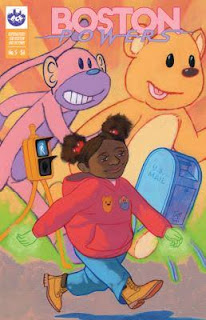
The Boston Comics Roundtable just published Boston Powers, #5, its latest superhero comic book for young readers. For now it’s available at local events, and there are, alas, few local events, but I hope to share order information soon.

This magazine includes the second tale of Stupendo and Secret Girl, story by me and art by Brendan Tobin. This episode starts almost immediately after the pair’s first published adventure in Boston Powers, #2.

As you recall, Stupendo is a very strange visitor from another planet, and Secret Girl is a youngster from suburban Boston who’s taken on the task of turning Stupendo into a successful superhero.

In this installment, Emma’s parents are worried about her going along on Stupendo’s missions while someone in greater Boston is making things like babies and puppy dogs into gallumphing giants. Is this the end of the team of Stupendo and Secret Girl?

(No, it isn’t. I’ve already written the third and culminating episode in this story arc. But that, too, ends with the question: Is this the end of the team of Stupendo and Secret Girl?)