03 June 2014

Google’s Scalawagons

Various forms of The Wizard of Oz are so famous that it’s common to see allusions to that story. But The Scalawagons of Oz, written and illustrated by John R. Neill in 1941, is another matter. It’s one of the rarest of the official Oz series and perhaps the worst.

Yet this article at Seeking Alpha not only alludes to Scalawagons but is built around that allusion. David Zanoni writes:
…Scalawagons were smart vehicles that would take passengers wherever they desired. Just sit down in the car, tell the Scalawagon where you want to go and the car transports you to your destination without the need for using pedals and steering wheels.

Google (GOOG) is essentially taking this concept and turning it into a reality with its self-driving car. Google's car actually resembles the shape and look of the Scalawagon.
As I wrote back here, one of the problems of Scalawagons in Oz is that they minimized the possibility of adventure. I suppose that’s one of the advantages of Google cars for us.

01 June 2014

A “Foolhardy Boy Companion” Named Robin

From Stuart Kelly’s review of Nick Harkaway’s “superhero novel” Tigerman in this weekend’s Guardian:
In the suspension of international law necessary to destroy [the island of] Mancreu, a ring of ships – "The Black Fleet" – has circled in the island's newly lawless waters. From extraordinary rendition to organised crime brothels, to surgery ships where, if they don't have a heart to transplant for you, one can be found (and the rest of the body kept for if you need it), it's a zone of licensed criminality. It's therefore no wonder when Shola, a local bar owner, is shot by three men, which accelerates the plot.

At the time, [protagonist] Lester is drinking tea with a strange boy he has befriended called Robin. Robin is saturated in pop culture from Green Lantern to Star Wars, but seems to have no family. It is Robin who, after Shola's funeral, when Lester has a drunken encounter with a tiger, suggests he become Tigerman, "unassuming sergeant for fallen empire by day ... Hero of Mancreu! Tigerman, full of win!" He also, in self-assumed role as "foolhardy boy companion", finds a clue: Shola worked for "Mancreu's resident fairy king", variously known as Bad Jack, Mauvais Jack, Jack Storm-Eye, Jack the Wrecker, Jack of the Nine.
Of course the foolhardy boy companion would be named Robin. But one question for me is whether he exists, or is simply the projection of Lester’s psyche.

Tigerman is scheduled for publication in the US this July.

31 May 2014

The Relationship of Andersen and Dickens

From Suzi Feay’s review of Hans Christian Andersen: European Witness in this weekend’s Guardian:
The relationship with Dickens was fraught; it began well, but after a lengthy visit, a note was placed on their mantelpiece: "Hans Andersen slept in this room for five weeks – which seemed to the family ages!" . . .

[Paul Binding] points out many links between Andersen's novel The Improvisatore and David Copperfield, explaining the weak, unconvincing endings of each book as being due to "the writer having no experience at all of sustained union with a woman (Andersen), or failing to feel for a wife (and even children) that committed devotion in which he professed to believe (Dickens)".
Of course, I’d find the Dickenses’ sign more amusing if I weren’t entering my second week as a house guest. (Heading home Monday.)

29 May 2014

From Spring Heel Jack to Batman

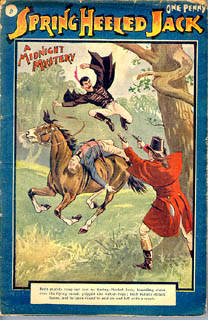
Among the ephemera on display in the “Comics Unmasked: Art and Anarchy in the UK” exhibit at the British Library is a penny-dreadful tale of Spring-Heeled Jack, which the curators suggest was an inspiration for Batman, pointing particularly to his horns.

I thought that was a stretch. Not that Bob Kane and Bill Finger were above borrowing plots, images, and details from other adventure stories of their time, acknowledged and unacknowledged. But how would two guys growing up in post-WW1 America have seen the Spring-Heeled Jack magazine serials from Victorian Britain? And wasn’t Spring-Heeled Jack a monster and/or troublemaker instead of a crimefighter?

At io9, commenter Michael Munro laid out a lineage of pulp fiction leading from London to California to Gotham:
Spring Heeled Jack…transitioned from London urban myth (1830s) to melodrama anti-hero (1870s) to prototype superhero (1880s-early 1900s). As written by "penny dreadful" author Alfred Burrage, SHJ was a wealthy aristocrat who assumed the disguise of a devilish, bat-winged avenger of the night, maintained a secret underground lair and used his athletic and technological skills to battle evil-doers - sounds familiar?
Expounding at more length, Munro wrote:
The several "penny dreadful" iterations of Spring Heeled Jack, many written by Alfred Burrage under the pseudonym "Charlton Lea", portrayed him as a nobleman who had been cheated out of his inheritance and who took up a devilish disguise to punish those responsible. Along the way, Spring Heeled Jack also rescued damsels in distress and generally stood up for the innocent and downtrodden. He wore a distinctive mask and costume and was capable of performing incredible leaps thanks to a special pair of boots, credited in one source to a secret mechanism invented by Indian street magicians.

Anticipating Zorro, Jack was fond of marking both enemies and territory by carving his initial with the point of his rapier. He also maintained a secret underground lair (in a converted crypt) and terrified his adversaries with his ringing laugh and catch-phrase, "The day is yours - leave the night to me!"
As Munro notes, the Batman team acknowledged Zorro, created by Johnston McCully in 1919, as an inspiration. Thus, Spring-Heeled Jack wasn’t a direct influence on Batman, and the horns/ears were a shared trope rather than deliberate borrowing.

25 May 2014

Back in Bellingham

This art is by Carororo. It’s part of a display of fan art at Friendly Neighborhood Comics in Bellingham, Massachusetts.

Though that store’s in my home state, and my home state isn’t that large, it’s still what I consider a long drive from my home. What’s more, I’m in London this weekend, so it’s even less likely that I’ll visit. So I was happy to learn about this event online.

22 May 2014

Black and Blue?

The May/June Yale magazine considers who the university’s first African-American graduate was. The usual names are Richard Henry Green, MD 1857; Courtlandt Van Rensselaer Creed, MD 1857; and Edward Bouchet, 1874, PhD 1876. They were recognized as having black ancestry and (at least at times) classified as black in the racial categories of their time.

But what, Mark Alden Branch asks, about Moses Simons, 1809, already identified as Yale’s first Jewish graduate?
…evidence uncovered recently by two scholars—Adam Wolkoff of Rutgers and Laura Copland of Eugene Lang College—suggests that Simons could have had an African American mother, and that he was viewed by others as “colored,” in the parlance of the time.

Simons came from South Carolina, apparently the son of one of five Jewish brothers who emigrated there from London. Records are not clear as to which of the brothers was his father, and no record of his mother has been found. At least one of the brothers is known to have fathered a mixed-race child.

Simons became a lawyer in New York City. The only hints that he had African American ancestry come from an account of a criminal trial in 1818 after Simons was charged with assault. As told by a lawyer and journalist named Daniel Rogers in a contemporary legal periodical, Simons and his brother were asked to leave a dance because other patrons were uncomfortable with the presence of the “two coloured men.”
And the story of Randall Lee Gibson, 1853, reminds us that the whole question of racial classification is based on a series of fictions.
Gibson…grew up on a sugar plantation in Louisiana, the descendant of a family of wealthy planters and slave owners. He was a colonel in the Confederate army, fought to defend slavery, and called black people “the most degraded of all the races of men.” He became a US senator from Louisiana after Reconstruction.

But as Vanderbilt law professor Daniel Sharfstein ’00JD details in his book The Invisible Line: Three American Families and the Secret Journey from Black to White, Gibson’s great-grandfather Gideon Gibson came to South Carolina in the 1730s as a “free man of color” with a white wife. By Randall Gibson’s time, the family explained any dark complexion in the family as due to Gypsy or Portuguese roots, Sharfstein says.
Both these Yale men had family roots in South Carolina, which had a fairly cosmopolitan port at Charleston, at times a legally “black” majority, and a racial code that differed from the Virginia laws that have been so studied.

21 May 2014

Tik-Tok and a Kalidah Walk into a Bar

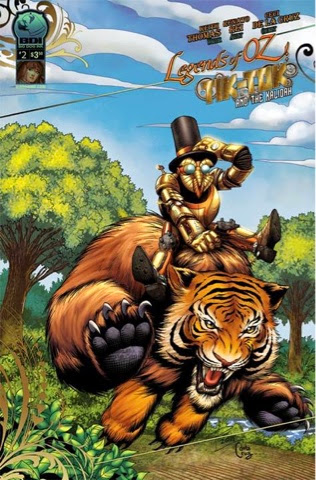
The comics universe of The Legend of Oz: The Wicked Witch and Legends of Oz: The Scarecrow will expand a little this summer as publisher Big Dog Ink releases a comics miniseries subtitled Tik-Tok and the Kalidah this summer.

As created by Tom Hutchinson, this comics continuity “mashes up the Land of Oz with a classic Western,” in the words of Rob Anderson. Anderson pitched the idea of Tik-Tok, the mechanical man, as a bounty hunter in that universe.

Tik-Tok’s partner is a kalidah, a creature L. Frank Baum invented in The Wonderful Wizard of Oz. Kalidahs are crosses between bears and tigers. They’re smart, they’re nasty, they’re carnivorous. They can swim like ducks. Their king knows a bit of magic. In sum, they’re extremely dangerous. And it’s hard to imagine a kalidah partnering up with anyone except another kalidah.

The miniseries is scripted by Anderson and Keith Thomas, with art by Renato Rei and Ceci de la Cruz. It looks like they’ve redesigned Tik-Tok significantly. It’s harder to tweak a kalidah.

20 May 2014

Behind the Legends of Oz

Legends of Oz is shaping up to be a legendary flop at the American box office, a computer-animated musical based on a well-known property that’s not only losing money (such movies are expensive) but hardly making any money.

After a week and a half of wide release (over 2,500 theaters), it’s made less than $7 million. Adjusted for the cost of tickers, that’s even worse than Hoot and The Seeker: The Dark Is Rising.

It turns out that financing has been an issue for Legends of Oz all along, as documented in a Metafilter post cleverly titled “Pay No Attention to the Man Behind the Curtain”:
Alpine Pictures, aka Summertime Entertainment, aka Box Office Productions, aka Dorothy of Oz LLC, began selling shares in the film in 2006, at a projected budget of $20m. By 2009, having sold close to $18m in shares, the offering was expanded to $24m. The offering would be expanded again later, with reference to future Oz sequels, merchandising, and an Oz-themed MMORPG. The film's release was repeatedly pushed back.

Complaints appeared online as early as 2008 about a Burbank, California-based telemarketing firm, First National Information Network, that appeared to exist only to aggressively solicit strangers for investments in Oz. Others report seeing the film promoted on the Global Information Network, a listing of spurious investment opportunities hawked by jailed con man Kevin Trudeau. Potential investors were told they could use retirement accounts if cash wasn't available.

Cease-and-desist orders have been issued against Alpine by the states of Delaware, Ohio, Indiana, Pennsylvania, Massachusetts, Texas, Alabama, Washington and California for alleged violations of SEC rules against general solicitation. Alpine allegedly targeted naive, unaccredited investors with cold calls; painted unrealistic pictures of the film's potential; and collected 40% "consulting fees" on the money raised.
(Hat tip to Laura Gjovaag.)

19 May 2014

Thunderstruck Strikes

My science-activity book Soap Science is out of print, but it’s received a dollop of literary immortality in Elizabeth McCracken’s new collection of short stories, Thunderstruck.

In the story “Juliet,” originally published in Esquire, some town librarians look up the record of a kid who’s suddenly in the news for all the wrong reasons. All they find is that two years before he’d borrowed Bell, Soap Science (1993), and never returned it.

I’m pleased to report that the story doesn’t suggest I was a bad influence. Instead, the appearance of Soap Science as what the kid probably borrowed for a school assignment reads as one of many innocuous details—so dutiful, so clean—that don’t add up to an explanation of what’s gone wrong. As in her best-known work, The Giant’s House, Elizabeth McCracken focuses on details of ordinary living in an extraordinary circumstance.

At the time she wrote that story, Elizabeth was working as a librarian outside Boston. We knew each other in high school and crossed paths in local book circles once or twice. Now she’s teaching at the University of Texas and tweeting up a storm.

Elizabeth McCracken is swinging through New England on her book tour this week, including appearances at Porter Square Books in Cambridge on Wednesday and Newtonville Books in Newton Centre on Thursday. Unfortunately, I can’t go to either event since I’m heading across the Atlantic this week. So I’m spreading the word about them instead. Check out Thunderstruck. Especially page 70.

18 May 2014

Adam Beechen on Taking on Tim Drake

Several weeks back, the Nerdist Writers podcast had a discussion about the challenge in comic-book scripting of taking over an ongoing magazine. One of the regulars, Adam Beechen, spoke about his two experiences with that challenge, which both happen to have involved Tim Drake as Robin.

One was Robin itself at the “One Year Later” break after DC’s Infinite Crisis, issues #148-166. As Beechen says, he wasn’t picking up right after the previous scripter; the company had established an excuse for changing things, dropping threads, reworking the situation.

The second magazine was Teen Titans a short time later, with a transitional period of co-scripting with that volume’s founding writer Geoff Johns, issues #44-49. (Beechen briefly mentions his work launching a Batman Beyond comic and doesn’t mention his Batgirl miniseries.)

Along the way, Beechen, who came from the field of television animation, made a few notable observations:
  • DC’s only editorial mandate for Robin was that the first villain had to be Cassandra Cain, then Batgirl. That remains a very unpopular decision with her fans, for which Beechen is sometimes blamed. (I discussed the possible thinking behind DC’s mandate here.)
  • Beechen studied his predecessor Bill Willingham’s issues of Robin and tried unsuccessfully to contact him, and he read Chuck Dixon’s earliest issues, available in paperback. But he apparently didn’t check the bulk of Dixon’s run (nor the intervening stretch by Pete Wood).
  • Beechen didn’t study Batgirl. His comments implicitly acknowledge one result, the fan criticism of how he handled the question of Cassandra Cain’s difficulties with language.
  • Beechen came away with the idea that no one had explored Tim’s life as a teenager. Actually, that was the focus of most of Dixon’s issues. One result, it seems to me, is that after the initial storyline Beechen’s issues don’t really stand out. The small moments that are memorable, however, involve Tim’s relationship with Bruce Wayne.
As for Teen Titans, Beechen voices the usual complaints of a comics writer without the clout of Johns or Grant Morrison: sudden editorial changes, company-wide crossovers, having to cut a plotline short.