30 March 2007

The British Empires' Rebellious Colonies

Earlier this week I wrote about the rebirth of the British Empire in Jonathan Stroud’s Bartimaeus series and Philip Reeve’s Larklight (which will officially become a series in October). I harped on how both authors seem to shy away from awkward elements of the real UK’s imperial history: oppression of peoples in south Asia and Africa, border-drawing in the Mideast, trade wars in China, etc.

But there’s one region of the old British Empire that Stroud and Reeve have no problem depicting under the control of their fantastic Londons. And what part would that be? America!

The mere mention of American colonies signals that each book occurs in a fantasy world, of course. Nevertheless, America remains a source of rebellion and trouble for Britain. In the Cybils-winning Ptolemy’s Gate, a North American war for independence is draining the resources of the magicians’ regime in London, just as the nascent USA’s revolution did for Lord George Germain’s government around 1780. It’s unclear at the end of the book whether a more democratic government in London would maintain that struggle, give it up, or reach some accommodation with the rebels.

In Larklight, young narrator Art Mumby writes of American colonies in the first pages, indicating that they’re still firmly part of Britain's Empire in this 1851. But later, when discussing who’s tried to steal away Sir Isaac Newton’s alchemical secrets, Art lists “Frenchmen and Russians and rebel Americans.” The first two were Britain’s rivals for influence in the early 1800s (before the emergence of a united Germany), but the last reflects a perception of the American character that extends even into this fantasy world.

I can’t help but see a bit of national wish-fulfillment in how these books show Britain still ruling America, especially in a decade when many people on both sides of the Atlantic have perceived the opposite. The American market has been very lucrative for British fantasy authors, but there’s bound to be a little ambivalence, isn’t there?

29 March 2007

Let's Get Messy

What's the deal with British book designers? With a few exceptions (Salman Rushdie's Satanic Verses), I much prefer American covers. But that's not just a mild liking. In many cases UK presses' choices just baffle me. I recall hearing a sales manager suggest that the same aesthetic behind British book jackets also infuses British fast-food breakfasts.

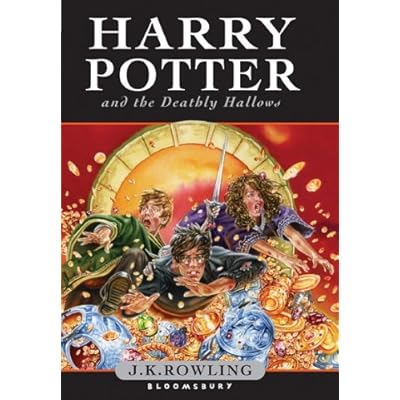
Here's the latest example, the UK children's edition of Harry Potter and the Deathly Hallows. This book is supposed to be the culminating battle of good versus evil, right? And the young protagonists' coming-of-age? Instead, it looks like Ron, Harry, and Hermione have just won big on Fun House. I expect to see a mulleted J. D. Roth clapping on the spine.

The American wraparound jacket produces a greater sense of foreboding and confrontation, though the caption that occurs to me is, "Stop Snitchin'!" Surely Harry and Voldemort won't resolve all their differences in a quidditch stadium, will they?

28 March 2007

More of the British Empire in Larklight

Like Jonathan Stroud's Bartimaeus trilogy, Philip Reeve's Larklight revisits the British Empire. Indeed, it revisits that empire during the Victorian period, as it approached its height, and then takes it even higher.

In this "steampunk for punks" science fiction, not only does the Sun never set on the British Empire, but that empire extends to both sides of the Sun, from Mercury to the moons of Jupiter.

Like Stroud, Reeve explores the tensions of empire by showing the British elite dealing with extraterrestrial beings, but shies away from portraying how the same empire might have worked on Earth. We never know quite how much terrestrial territory Reeve's Victoria rules. We meet Sir Richard Burton, but he's exploring the heavens, not the Earth. The perennial "servant problem" seems to have been solved with robots, thus requiring no vulnerable underclass.

Larklight offers one glimpse of Earthly racism, but only in the previous generation: an aristocratic young Englishman fell in love with a black Caribbean woman, and his family disinherited him. The couple then rocketed off to a remote space colony to raise their family.

One of their children, Jack Havock, has ended up confined at a scientific institute in London which also collects extraterrestrial beings. But I recall no hint that the imperial elite locked up Jack because of his parentage. Rather, those scientists did so because his parents had turned into trees. (It's a long story.)

For all its young narrators' pleasure in being British, Larklight ends up championing universal equality. Almost all the intelligent lifeforms we meet end up forming one happy band: humans of all backgrounds, Jack's fellow inmates, Shapers--everyone, it seems, but ten-legged white spiders. Jack and one of those upper-class English narrators fall in love, but her family make no complaints about the prospect of a "mixed marriage" (nor are they in any position to do so). Larklight readers thus get to cherry-pick Victorian values, believing in progress but not prejudices.

Of course, today's enlightened British authors can’t treat empire as a Good Thing, even if that empire has been sugar-coated. Reeve undercuts the pillars of Victorian Britain, starting with Victoria and Albert themselves, who end up hiding under a rowboat. The Duke of Wellington (who really should be the conqueror of Europe and autocratic Prime Minister in Stroud's series) makes a cameo appearance, grumpy and superannuated. The Crystal Palace of 1851, the height of Victorian science and industry, turns out to be a mere illusion of human progress.

Larklight's British Empire may be larger and stronger than what really existed on Earth in the 1800s, as well as more welcoming. But we still mustn't believe as whole-heartedly as the Victorians that it was a Good Thing.

27 March 2007

Bartimaeus and the British Empire

In the past year I’ve written about nationalist themes in an Irish fantasy series and an American fantasy series. But what of the British, who so dominate the genre? Does any nationalist self-fashioning poke through in their fantasy novels?

Jonathan Stroud has acknowledged one quality he finds characteristically British in his Bartimaeus trilogy. This is a bit from the terrific discussion at the State Library of Victoria that I pointed to earlier:

Michael Pryor: Now the Bartimaeus trilogy is interestingly a very political novel with the magicians, the non-magicians disenfranchised. So there is a class struggle going on here between the aristocratic magicians and the commoners. It’s British socialism? Is this a reaction to Thatcher’s ’80s? What’s going on here?

Stroud: Well, it--yes, it probably is, actually. Yes, I think that somebody did note that all British books, certainly all British children’s books, you can look at in terms of the class system and it’s definitely true.
In that exchange the two authors refer to the books’ struggle between magicians and commoners which culminates in a democratic rebellion against the magical oligarchy, and specifically to the rivalry between protagonists Nathaniel and Kitty.

But in fact the deepest conflict in the Bartimaeus books isn’t between magician and commoner but between magician and djinni. And I’d say that’s not so much a class system as a colonial one. The wizards exploit the resources and bodies of the djinn they can control. Those djinn are a different race of being from an Other Place, ancient and yet bound to serve their British masters.

It’s notable that Bartimaeus and his magical peers include no leprechauns, elves, ogres, or the other enchanting creatures from European fairy tales. He doesn’t tell many stories about Arthur, Archimedes, Daedalus, Roland, Siegfried, Heracles, or other European heroes of the distant past. Instead, Bartimaeus talks at length about Gilgamesh of Mesopotamia, Solomon of Israel, Ptolemy of Egypt. He speaks of tasks in Uruk (Sumer), Karnak (Egypt), and--when forced to--Jericho (Palestine). The amulet that provides the title for the first book comes from Uzbekistan.

The main “made in Europe” exceptions to that pattern are the mercenary’s seven-league boots and the golems of The Golem’s Eye--but the latter are a Jewish legend, outside the European mainstream. Bartimaeus gets busy in Europe only during the Renaissance: Faust, Tycho Brahe, Tower of Pisa, Prague as capital of the Holy Roman Empire. He also refers to work in eastern North America at unspecified times, but really his heart and history lie in what we used to call the Near East and now call the Mideast.

Those roots are apparent in the terms Bartimaeus and his peers use to describe themselves. The words djinni, afrit, and marid all come from pre-Islamic Arabic. They appear in the Koran, and “genie” came into western culture through literary translations, not folktales. (“Imp” is Germanic, on the other hand, but its magical meaning is a late arrival, less than half a millennium old.)

Despite his books’ picture of British governors exploiting Asian power, Stroud seems to steer away from addressing parallels to real history. In resurrecting the British Empire as a magical superpower, he emphasizes its power over continental Europe and North America only. The Golem’s Eye depicts a Czech immigrant underclass in London, but we never see the Asian, African, and Caribbean minorities of today’s Britain. The Amulet of Samarkand makes a brief mention of weavers in Basra toiling to create a magnificent carpet, but the books aren’t clear about whether their British Empire is contiguous with “all the pink bits” that used to appear on British school maps. Perhaps that past is too recent and too awkward.

A conflicted attitude toward the British Empire may help to explain the series’ emphasis on William E. Gladstone. In the trilogy, he’s the greatest of British magicians and Prime Ministers, the conqueror of the Continent, the man who imprisoned marids in his staff. In real life, Gladstone was a domestic reformer who also came to back home rule in Ireland; he opposed most of his rival Benjamin Disraeli’s imperialism toward India and the Near East.

In the end, of course, the Bartimaeus trilogy is not imperialistic. Stroud’s political sympathies clearly lie with the djinn and commoners, not the magicians who built and run the empire. The series ends hopefully with the prospect of political reform for the humans in Britain, which might also lead to less exploitation of the beings from the Other Place. And, as I wrote before, the voice that dominates the series is that of Bartimaeus, one of the exploited. Therefore, I believe Stroud’s trilogy can fairly be grouped with other British post-colonial fiction.

TOMORROW: The British Empire revived another way in Larklight.
26 March 2007

Would You Like Big Staring Eyes with That?

McDonald's® has started to sell Madame Alexander® Wizard of Oz® figurines, inspired by the MGM movie, as premiums in its Happy Meals®. These are apparently offered as alternatives to Teenage Mutant Ninja Turtle® dolls. Some websites indicate that girls receive a toy from one set, boys from another, but I doubt McDonald's® would officially court protest that way. Rather, I suspect they recognize some American parents still aren't ready to hop on the turtle bandwagon.

I saw larger versions of the Madame Alexander® dolls at last year's Munchkin Convention. It was interesting to hear about how the company operates (the young ladies from marketing always referred to “Madame”®), but frankly the product creeps me out.

25 March 2007

Pullman Panel Promotion

Following breadcrumbs laid through the woods at Educating Alice, I found Saestina's report on a panel in Oxford where Philip Pullman participated in promoting the upcoming film adaptation of his novel Northern Lights/The Golden Compass.

The most interesting tidbits, I thought, had to do with Pullman's creative process while writing the books, lo those few years ago. He's mentioned the inspiration for the trilogy title before:

His initial inspiration for the book was the landscape of hell that Milton describes in the first two books of Paradise Lost, which is also where the title His Dark Materials comes from. The original working title for the trilogy was The Golden Compasses, also from a quotation from Paradise Lost.
That would be from Book VII:
Then staid the fervid wheels, and in his hand
He took the golden compasses, prepared
In God's eternal store, to circumscribe
This universe, and all created things:
One foot he centered, and the other turned
Round through the vast profundity obscure;
And said, Thus far extend, thus far thy bounds,
This be thy just circumference, O World!
Saestina's description of Pullman's remarks continues:
When Northern Lights went to the US editor, he thought the [original series] title was a reference to the alethiometer, changed it to a singular compass and made it the title of the first book instead of the trilogy as a whole. This is, apparently, the same editor who changed the name of the first Harry Potter book from Philosopher's Stone to Sorceror's Stone, which Pullman said, "obviously makes no sense."
Not to quibble, but the US publishers of the Harry Potter series and Pullman's retitled (and soon to be renumbered) trilogy are different companies. In fact, to confuse matters beyond easy meaning, the UK publisher of Northern Lights is the same multinational firm as the US publisher of Harry Potter.

It may also be worth acknowledging that a stone which conveys magical immortality makes much more sense--in modern usage--as a "sorcerer's stone" than as a "philosopher's stone." Yes, I support educating fourth-graders in the history of Renaissance scientific nomenclature as much as the next guy, but let's face it--until that happens, there's a case for "sorcerer's stone."

And it definitely seems noteworthy that while J. K. Rowling's Philosopher's Stone title survives in the UK and around the world, for both book and movie, Pullman accepted the US title for his first volume even though that meant he had to find a new series title. Such is the power of US sales.

An item of more interest to story creators:
Pullman really struggled with the first chapter of Northern Lights. On his sixteenth draft (according to him, I think this may have been hyperbole) he was hit with the idea of daemons and it all came together.
What, at least from this hind perspective, seems like a fundamental element of the His Dark Materials universe, and even of some of the books' plotting, wasn't part of Pullman's original planning.

Fuse #8 provides a link to another Golden Compass movie promotion, an advance trailer spotlighting the half-finished special effects.

24 March 2007

Now We're Talking

Bookshelves of Doom’s T-shirt of the week:


Our first glimpse of Rupert Psmith in P. G. Wodehouse’s public-school novel Mike and Psmith:

A very long, thin youth, with a solemn face and immaculate clothes, was leaning against the mantelpiece. As Mike entered, he fumbled in his top left waistcoat pocket, produced an eyeglass attached to a cord, and fixed it in his right eye. With the help of this aid to vision he inspected Mike in silence for a while, then, having flicked an invisible speck of dust from the left sleeve of his coat, he spoke.

“Hello,” he said.

He spoke in a tired voice.

“Hello,” said Mike.

“Take a seat,” said the immaculate one. “If you don’t mind dirtying your bags, that‘s to say. Personally, I don't see any prospect of ever sitting down in this place. It looks to me as if they meant to use these chairs as mustard-and-cress beds. A Nursery Garden in the Home. That sort of idea. My name,” he added pensively, “is Smith. What’s yours?”

“Jackson,” said Mike.

“Are you the Bully, the Pride of the School, or the Boy who is Led Astray and takes to Drink in Chapter Sixteen?”

“The last, for choice,” said Mike, “but I’ve only just arrived, so I don’t know.”

“The boy--what will he become? Are you new here, too, then?”

“Yes! Why, are you new?”

“Do I look as if I belonged here? I’m the latest import. Sit down on yonder settee, and I will tell you the painful story of my life. By the way, before I start, there's just one thing. If you ever have occasion to write to me, would you mind sticking a P at the beginning of my name? P-s-m-i-t-h. See? There are too many Smiths, and I don’t care for Smythe. My father‘s content to worry along in the old-fashioned way, but I’ve decided to strike out a fresh line. I shall found a new dynasty. The resolve came to me unexpectedly this morning. I jotted it down on
the back of an envelope.”

23 March 2007

Red-Letter Day

Many happy returns of the day to Kit and Justin!

Poetry Friday: Love Sonnet of an Office Boy

I rarely remember Poetry Friday until it's well, Friday, so I put this one by last week. It is the first of Samuel Ellsworth Kiser’s Love Sonnets of an Office Boy, published in 1902.

Oh, if you only knowed how much I like
To stand here, when the “old man” ain’t around
And watch your soft, white fingers while you pound
Away at them there keys! Each time you strike
It almost seems to me as though you’d found
Some way, while writin’ letters, how to play
Sweet music on that thing, because the sound
Is something I could listen to all day.

You’re twenty-five or six and I’m fourteen,
And you don’t hardly ever notice me--
But when you do, you call me Willie! Gee,
I wisht I’d bundles of the old long green
And could be twenty-eight or nine or so,
And something happened to your other beau.
For the remaining twenty-seven sonnets in the cycle, visit the dedicated page at Sonnet.org.

The office boy seems to have totally vanished from our culture, not just our everyday lives but also from most historical fiction. We have new novels for kids about blacksmith’s apprentices, mill-girls, farmworkers, and other young laborers, but no office assistants, bell hops, or telegraph boys that I can think of.

Yet once that population young urban workers was large, literate, and lucrative enough to inspire products tailored to them. These satirical sonnets were obviously not meant to entertain young teens, but office boys had their own exciting fiction, comic strip, and even board game.

22 March 2007

Longfellow Bicentennial Concert, 25 March

On Sunday afternoon, 25 March, there will be a free concert at Harvard’s Sanders Theatre to celebrate the 200th anniversary of Henry Wadsworth Longfellow’s birth in 1807.

Longfellow was the most popular American writer in the world in the late 1800s. Because so many American schoolkids memorized and recited his poetry, and because he wrote rhyming, metrical, and often narrative verse that went out of fashion in the early 1900s, people started to associate his work with children. There have been some excellent picture-book editions of his poems while some of his longer and more mature work faded.

Long out of favor, Longfellow now seems to be gaining a bit more respect from the academic world, especially because his interests dovetail with two current broad concerns:

  • internationalism: Longfellow was a professor of languages, a translator, a traveler, and a correspondent and champion of poets around the globe.
  • multiculturalism: For his time Longfellow was unusually interested in minority cultures within the US, researching and writing poems about Acadians, Ojibway, Jews, and African-Americans. (Longfellow supported Abolutionism while his father-in-law, who paid for his mansion in Cambridge, was a major textile mill-owner, making family discussion of the issue somewhat awkward.)
This concert, in the same site as a centennial celebration of Longfellow one hundred years ago, will feature:
  • The Boston Landmarks Orchestra, under Charles Ansbacher, performing musical works Longfellow enjoyed and Julian Wachner’s musical setting of “The Midnight Ride of Paul Revere”
  • Christopher Lydon, host of the WGBH radio discussion show Open Source, as master of ceremonies
  • Matthew Pearl, author of the historical crime novel The Dante Club, featuring Longfellow, Dr. Oliver Wendell Holmes, James Lovell, and other Boston literary figures
  • David Connor in the role of Paul Revere
  • Baritone Brett Johnson performing “A Psalm of Life”
  • A local children’s chorus singing a setting of Longfellow’s poem “Snowflakes”
This free family concert starts at 2:00, with the theater open at 1:30. Seating is not reserved.