21 April 2020

The Strange Death of the Virus Vanguard!

On 20 April, the government of Singapore presented a new tool in the public-health armamentarium fighting the coronavirus epidemic: superheroes!

The Virus Vanguard team, created with the help of a large collective named Band of Doodlers, consisted of five heroes:
  • Dr Disinfector, who can spot, smell, and hear viruses and bacteria.
  • Fake News Buster, wielding his Mallet of Truth against false claims and fake news.
  • Circuit Breaker, a solar-powered robot mentally controlled by a young girl who volunteers at a nursing home.
  • Care-Leh Dee, pronounced “care lady,” who “uses empathy to absorb all negativity.”
  • MAWA Man, who Must Always Walk Alone, pushing people away with force beams.
A day later, the government took down the webpage and disavowed the team.

What happened? It looks like the saga began with a large collective named Band of Doodlers who do public art in a graffiti style.

On 7 April, on the Band of Doodlers’ Facebook page, an artist named Mas Shafreen presented the first proposal for the Covid Warriors, including Safe-Distancing Girl, Santizer Soze, Contact Tracer, Expressman, and the Nurse. They fought the evil King Corona. It looks like other artists and writers joined in the fun.

At some point, it appears, the government got involved. The heroes probably went through a committee process, emerging with a team that conformed to epidemiological priorities.

Once the Virus Vanguard was official, however, it became fair game for much more criticism than just a bunch of superheroes created by a friendly band of artists stuck at home with lots of time.

People complained that for the government to promote superheroes as thousands of people got sick and died was a waste of time and in poor taste.

Critics judged that not only were the characters derivative [duh!—they’re superheroes], but some of the artwork was clearly traced from others’ work.

But the most passionate criticism seems to have focused on MAWA Man. He’s of course supposed to embody the virtue of keeping two meters away from everyone. Mas Shafreen and his colleagues gave MAWA Man this tragic backstory: “a fanatical Manchester United fan who grew up in the 80s when Liverpool kept winning titles and he was constantly taunted by his two Liverpool fan brothers. This made him despise everything Liverpool including their motto You’ll Never Walk Alone (YNWA).”

Now that seems obviously satirical to me, but many football fans are passionate about their teams and their fight songs. Liverpool fans probably feel such slights even more keenly now that Man U has been on top for several years. Those fans, too, complained volubly about the Virus Vanguard and even started an online petition.

So the Singapore government took the webpage down, Mas Shafreen has apologized and even offered to leave the Band of Doodlers, and the world is bereft of the only Covid-19-fighting superheroes.

But wait! Now there’s a growing backlash against the backlash, supporting Band of Doodlers for its efforts.

07 April 2020

Reading the Monkey

In this time of pandemic throughout the Great Outside World, Prof. Dina Massachi and the International Wizard of Oz Club have organized a video reading of L. Frank Baum’s The Wonderful Wizard of Oz.

All the videos are on the Oz Club’s YouTube channel, as well as various Facebook, Instagram, and Twitter feeds. Yesterday there was even a report on the project in Philadelphia keyed to local reader Ryan Bunch.

Other readers have included Baum’s granddaughter Gita Morena, novelist Gregory Maguire, biographer Michael Patrick Hearn, historian of feminism Sally Roesch Wagner, and many friends I’ve made through the Oz conventions.

Dina asked me to tackle Chapter 14, “The Winged Monkeys.” In this chapter Dorothy learns the secret of the Golden Cap she took from the Wicked Witch of the West—that it can summon the Winged Monkeys to fulfill her wish. She then hears the story of how those Winged Monkeys became enslaved to the cap.

A large part of the chapter consists of the King of the Winged Monkeys’ story from his grandfather’s day. There are other long flashbacks in the book, such as when the Tin Woodman and the Wizard explain how they ended up in the fixes where Dorothy found them. This flashback is unusual in going so far back to tell a story about characters we never see elsewhere in the book—or elsewhere in Baum’s other books, either.

All the characters in the chapter are matter-of-fact about the Monkeys being compelled to obey the owner of the Golden Cap. The present King of the Winged Monkeys expresses no resentment about the sorceress who enslaved them, or his grandfather who angered her, or the Wicked Witch for ordering them around. Dorothy never considers freeing the monkeys from slavery as she’s inadvertently freed the Munchkins and the Winkies.

Glinda the Good does free the Winged Monkeys at the end of the book, but then in the sequel, The Marvelous Land of Oz, Baum describes them still as enslaved to the cap, so evidently that moment in his story hadn’t meant much to him. I doubt an author today could write so casually about slavery.

Reading Chapter 14 therefore presented a challenge. How to voice the King of the Winged Monkeys in a way that made him more than a docile servant by preserving the sense of mischief he acknowledges. Plus, that story of people we’d never meet again had to be interesting. In my telling, the king’s voice came out like a Bowery Boy.

Here’s the result for Chapter 14. Or you can start from the beginning in the great Kansas prairies.

06 April 2020

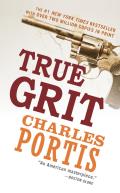
The Truth of True Grit

Charles Portis’s True Grit is a straightforward manhunt story elevated into a great American comic novel by the narrative voice.

The narrator is Mattie Ross, a fourteen-year-old determined to track down the man who killed her father and bring him to justice—at an affordable price. To do this she hires one-eyed deputy marshal Rooster Cogburn and forms an awkward alliance with Texas ranger LaBoeuf.

The very first paragraph ends with an accounting of the money Mattie’s father had on him when he was killed. Mattie knows that figure because she manages the business of the family farm. She speaks with the fiercest emotion when striking a financial bargain with horse traders, bounty hunters, and other men. At the end of the novel we learn that she’s grown up to run a private bank.

But Mattie Ross doesn’t want money for its sake, or for luxuries. She’s ready to endure privation and danger, defying the bounty hunters’ commands that she go home and leave the tracking to men. Money matters to Mattie because it’s how she measures fairness in the world, and fairness is her real concern.

Mattie is not out to make friends. She speaks bluntly and judgmentally to everyone she meets. She exasperates Cogburn and LaBoeuf until eventually they realize her integrity, and that they’re not getting rid of her. By the end of their trek, they risk their lives to save her. Then the three characters go their separate ways, never seeing each other again.

Others perceive the potential sexual tensions in a young girl traveling through unsettled territory with older men. LaBoeuf tells Mattie that he first thought she was pretty. But Mattie herself never shows any feel for sexual or romantic attractions. As an adult, she is a contented maiden lady.

I came to view the character of Mattie Ross through the lens of autism spectrum disorder, and I’m not the first to do so. Caroline Narby wrote such an interpretation for Bitchmedia. This Goodreads member named Stephanie did the same.

When Portis wrote True Grit in 1968, pretty much only psychiatrists knew about autism, and the syndrome was widely attributed to “refrigerator mothers” and other nonsense. The term “Asperger syndrome,” which seems to be the closest category to describe Mattie’s character, wasn’t coined until 1976. The recognition that some people with autism function well in certain fields, such as financial analysis, while having trouble with everyday social relations was well in the future.

But goldurnit if Mattie Ross doesn’t come off as one of the most incisive portraits of a character on the autism spectrum. While she looks for “true grit” in Cogburn, she demonstrates that integrity, drive, and unwillingness to compromise in herself.

There have been two movie versions of True Grit, the first made in 1969 when the book was still new. John Wayne played Rooster Cogburn as a semi-parodic version of his usual persona and won an Oscar for his troubles. However, writer Marguerite Roberts, director Henry Hathaway, and actress Kim Darby never seem to have a handle on Mattie Ross’s character, portraying her as a teenager with the stubbornness of a child.

In contrast, Joel and Ethan Coen’s 2010 version of True Grit is built around Mattie. The scene of the ferry crossing shows the difference: in the first movie, we arrive at the ferry with Cogburn and LaBoeuf and view Mattie’s crossing at a distance. In the second film, it’s the other way around.

Portis’s narrative voice and dialogue fit right into the Coens’ usual combination of high and low rhetoric. Hailee Steinfeld played Mattie with the right exasperating exactitude, her determination not childish but single-minded.

Parts of the first True Grit movie are entertaining, but the second is really good. And the novel is a masterpiece.

02 April 2020

A Picture Book for Patriots Day

A couple of years ago, I did a specialized editorial job for Disney’s publishing wing.

The company contacted me because of my research into the start of the Revolutionary War and asked me to fact-check a picture book on the topic.

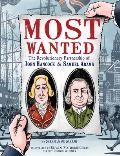
Most Wanted: The Revolutionary Partnership of John Hancock and Samuel Adams is written by Sarah Jane Marsh and illustrated by Edward Fotheringham. Earlier, they collaborated on Thomas Paine and the Dangerous Word, also from Disney.

On the day after OzCon 2018, a bunch of attendees made plans to go to Disneyland. I expected to go with them until I suddenly realized I’d had my fill of company and wanted to decompress in a library with a manuscript and my history sources. So instead of giving money to the Disney Corporation, I spent the day earning money from it with this job.

Most Wanted was published this week, just in time for the pandemic cancellation of the reenactment of the Battle of Lexington and Concord, which provides the book’s climax. That was bad luck for Marsh and Fotheringham, I thought. But as I was preparing this blog post, I realized the book had gone through another big change recently.

Powell’s was now listing Most Wanted as a Little, Brown title. Same with the Paine book. I had to reassure myself that my little story about Disney was accurate.

Then I remembered that in February the Disney Corporation sold a thousand children’s titles to Hachette, parent company of Little, Brown. Hachette was already distributing for Disney, so the supply chain is intact (except for the retail end, of course). There’s a lot of editorial and marketing shuffling going on, though.

I hope Most Wanted comes through the turmoil unscathed, the way Samuel Adams and John Hancock made it out of Lexington and to the Second Continental Congress.

28 March 2020

Greenmantle, White Men

John Buchan’s second spy novel featuring Richard Hannay was Greenmantle, published in 1916 even as the Great War was raging.

Like Buchan’s The Thirty-Nine Steps the previous year, the story is primarily a chase. Hannay and his fellow British secret agents make their way across Germany, Austria-Hungary, Serbia, Bulgaria, and Turkey to the Russian front in various guises.

There’s no doubt the book is well written and gripping. But ultimately it was unsatisfying. Though Hannay is our narrator and lead protagonist, by far the most important figure in the mission is his friend Sandy, who travels up through the Near East. Yet we hardly ever see what adventures Sandy has.

Another supporting character, Peter, becomes crucial at the end, but he gets a whole chapter to himself, reportedly told to Hannay later. For the rest of the book we’re traveling with Hannay, who’s resourceful and lucky in equal measures, but ultimately accomplishes little beyond staying alive and stumbling across a map.

In contrast, Sandy disguises himself as an Arab and undermines German efforts through the local society. He recruits a band of loyal aides, infiltrates the villainess’s household, and rescues Hannay on several occasions. Yet almost all that work and all those suspenseful moments are off stage.

Furthermore, that whole plotline just underscores shows how the racism of Greenmantle goes well beyond its rhetoric. And the rhetoric is unmistakably bad. Hannay says things like:
  • “Gaudian was clearly a good fellow, a white man and a gentleman. I could have worked with him for he belonged to my own totem.”
  • “‘Europe is a poor cold place,’ said Peter, ‘not worth fighting for. There is only one white man's land, and that is South Africa.’ At the time I heartily agreed with him.”
  • “Then we were always being stopped by sentries and having to show our passes. Still the ride did us good and shook up our livers, and by the time we turned for home I was feeling more like a white man.”
  • “Peter had a compass, but he didn't need to use it, for he had a kind of ‘feel’ for landscape, a special sense which is born in savages and can only be acquired after long experience by the white man.”
To be sure, the book also reflects Buchan’s time in how it describes different European nationalities and sexes. The character of Blenkiron is a provocative portrait of an American industrialist, but since he’s the only Yank, it’s hard to know how idiosyncratic he was supposed to be.

To get back to Sandy, he doesn’t spout the same nonsense about non-whites. He actually seems to respect the non-British culture he blends into. But his success in disguise gives rise to another racist trope: this Scotsman becomes a better Arab than any Arab we meet.

Sandy not only blends in completely, he’s not only the leader of his little cult, but he ends up becoming the “Greenmantle” himself—the reincarnation of a Muslim prophet whom a German agent was hoping to use to energize the Turks.

In that setup, Buchan was evidently inspired by the Islamic tradition of the Mahdi, a returning savior. This belief is especially strong in Shi’a Islam, but also has many adherents in Sunni Islam. However, to Buchan as a British colonist in Africa, “the Mahdi” meant a particular ruler of Sudan in the late 1800s who claimed that title. Thus, Buchan invented “Greenmantle” as a new term for that Islamic savior.

Buchan’s first novel, Prester John, also involved a messianic uprising of locals against the British Empire. Evidently it was a danger he felt keenly.

Such movements remained inscrutably foreign to Buchan, and thus to Hannay. I see that as tied into the author’s inability to tell Sandy’s story from within Islamic society, much less to tell the story of someone from that society instead of someone infiltrating it. Instead, the real action in Greenmantle remains off-stage, submerged, and unfathomable.

26 March 2020

“Literary texts might be doubly infectious”

I just learned about this book, but I had a tag all set up for it already.

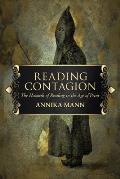
Reading Contagion: The Hazards of Reading in the Age of Print, by Annika Mann:
Eighteenth-century British culture was transfixed by the threat of contagion, believing that everyday elements of the surrounding world could transmit deadly maladies from one body to the next. Physicians and medical writers warned of noxious matter circulating through air, bodily fluids, paper, and other materials, while philosophers worried that agitating passions could spread via certain kinds of writing and expression. Eighteenth-century poets and novelists thus had to grapple with the disturbing idea that literary texts might be doubly infectious, communicating dangerous passions and matter both in and on their contaminated pages.

In Reading Contagion, Annika Mann argues that the fear of infected books energized aesthetic and political debates about the power of reading, which could alter individual and social bodies by connecting people of all sorts in dangerous ways through print. Daniel Defoe, Alexander Pope, Tobias Smollett, William Blake, and Mary Shelley ruminate on the potential of textual objects to absorb and transmit contagions with a combination of excitement and dread. This book vividly documents this cultural anxiety while explaining how writers at once reveled in the possibility that reading could transform the world while fearing its ability to infect and destroy.
This eighteenth-century worry seems to have resurfaced now that we’re are hunkering down with reading material and mail-order packages while word goes around that those same packages might carry the virus we’re hunkering down to avoid.

However, as science journalist Zeynep Tufekci tweeted: “Future generations will be driven batty by the amount of concern over contamination from cardboard boxes—a tail risk: porous surface, exponential decay—compared with protecting the pathways to OUR RESPIRATORY SYSTEM WITH MASKS FOR A RESPIRATORY ILLNESS WITH ASYMPTOMATIC SPREAD.”

14 March 2020

The Magic Wand of Tudor Jenks

I’ve been enjoying the Magic Wand book set by Tudor Jenks, published in 1905.

This collection of modern fairy tales first came to my attention because the volumes were illustrated by John R. Neill in between his work on L. Frank Baum’s Marvelous Land of Oz and John Dough and the Cherub. His style is immediately and delightfully recognizable.

Tudor Jenks was Baum’s near contemporary, born in 1857 and dying in 1922. He was a child of New York City rather than Syracuse, however, and he enjoyed the benefits of Yale College and Columbia Law School.

Jenks started a career in the law, interrupted that to spend fifteen years as an associate editor of St. Nicholas Magazine, and then went back to the law. But he continued to churn out books for young people, mostly nonfiction.

It was shortly after stepping away from the editorial desk that Jenks wrote the Magic Wand series for the Henry Altemus Company. The series consists of six short books about magic:
Each volume is a little over 100 pages long, printed in black and red, with many simple line drawings by Neill. None appears to have been in print for a very long time, but I’ve linked to scans of them all.

The stories are all independent. Some are set in what seems like modern America with a touch of magic. Others take place in countries with kings, queens, dragons, fairies, witches, and similar elements of European fairy tales—but also party line telephones, bicycles, and corporations that offer princess-rescuing services.

The tales show lots of fondness for traditional fairy stories but not too much reverence. They remind me of E. Nesbit’s “The Deliverers of Their Country,” George MacDonald’s The Light Princess, and some of Baum’s American Fairy Tales from the same years.

The plots can be perfunctory, possibly cut off once word or page counts had been achieved. Jenks had what feels to me like a lazy habit of naming his characters after roles from Shakespeare or everyday objects, as in Duchess Darningneedle or the pony Gallopoff. But his narrative voice is charming.

It’s also striking how often Jenks tells stories from an adult’s point of view, even though the protagonists are almost always children or teens. The result is a series of magical tales that kids of 1905 might well have enjoyed but that really reflect the sensibility of adults who would rather not be working office jobs.

12 March 2020

Stupendo Takes Off!

I’m pleased to report that the Kickstarter crowdfunding campaign for Boston Powers, the Boston Comics Roundtable’s collection of all-ages superhero comics, was successful.

And Brendan Tobin has done wonders with the art for our story. Here’s a slightly blurred preview as Stupendo and Secret Girl discuss the challenge of being a hero from another planet.

25 February 2020

Art for “The Axman’s Arm”

At Skookworks, David Lee Ingersoll has just shared his illustrations from the 2006 issue of Oziana magazine, which I edited and produced for the International Wizard of Oz Club.

David created the art for a story I wrote called “The Axman’s Arm,” a horror tale exploring what happened to the Tin Woodman’s left arm after it was chopped off in The Wonderful Wizard of Oz. That arm wasn’t around for the assembly of the character of Chopfyt, introduced in The Tin Woodman of Oz—so where did it go?

I rarely tell horror stories, but the Oz books’ premise that people and animals can survive being sliced up leads inevitably to that mode.

For that issue of Oziana, David also illustrated Adrian Korpel’s poem “Rivals” with pictures of the Scarecrow, Tin Woodman, and Cowardly Lion looking bitter and angry—and yet completely recognizable. I’d seen some of the pictures David drew for the Oz Squad project, so I knew he could do a great job with that challenge. I don’t view those poems as “canonical,” but they offered an interesting alternative view of favorite characters.

11 February 2020

Helping Stupendo Take Off

This picture shows Stupendo and Secret Girl, a superhero team I dreamed up a couple of years ago in a burst of short comics scripts for kids.

Stupendo is a very strange visitor from another planet. Secret Girl is a young suburbanite determined to help Stupendo to fit in and be all the hero he can be.

They’re being made flesh by Brendan Tobin, the artist behind Tolerable Tales of the Adequate and The Protagonist. Check out his blog.

Brendan and I are sharing “Hero Helper,” Stupendo and Secret Girl’s first published adventure, in Boston Powers, an all-ages comic book featuring original stories of superheroes from greater Boston. Conceived and edited by Dan Mazur, this project just launched its Kickstarter campaign, and it’s got a delightful video. Check it out!